Knill-Laflamme Conditions: Establishing Algebraic Criteria for Exact Quantum Error Correction and Subspace Preservation
Every digital transaction powering the modern global economy—from overnight interbank settlements across the SWIFT network to encrypted communications safeguarding national infrastructure—relies on mathematical puzzles that would demand millennia of computation from our most formidable supercomputers. A fully realised, fault-tolerant quantum computer could dissolve these cryptographic barriers in mere hours, while simultaneously unlocking atomic-scale simulations capable of revolutionising molecular medicine, nitrogen fixation for clean agriculture, and room-temperature energy transmission.
Yet between humanity and this technological epoch stands an uncompromising physical adversary: environmental noise. Quantum information is astonishingly fragile. The microscopic thermal vibrations of a silicon substrate, stray stray photons from ambient electromagnetic fields, or minute fluctuations in control lasers can instantly corrupt a quantum calculation through a process known as decoherence. In the classical computing realm, preserving data is straightforward: transistors hold trillions of redundant electrons, and a corrupted bit is easily detected and reset using simple majority-voting circuits.
In the quantum domain, this strategy fails catastrophically. The foundational laws of quantum mechanics forbid both the duplication of unknown quantum states—the celebrated No-Cloning Theorem—and their direct observation without irreversibly collapsing delicate superpositions into ordinary, classical certainty. Building a machine capable of calculating for hours without succumbing to ambient noise requires an extraordinary feat: detecting and rectifying errors without ever learning, measuring, or disturbing the information being protected. The mathematical blueprint that proved this seemingly impossible objective can be achieved is known as the Knill-Laflamme conditions.
The Idea in Plain English
To understand how quantum error correction operates, consider an analogy involving a delicate, masterfully blown glass sculpture sealed inside an opaque, vacuum-insulated crate. If the transit truck hits a pothole, the sculpture might fracture. In a classical setting, an inspector could open the lid, look directly at the glass, photograph the fracture, and piece the fragments back together.
If that sculpture is quantum, however, the very act of shining light into the box to inspect the glass instantly shatters it into dust. You cannot look at the state, nor can you make an identical backup sculpture beforehand to replace it if broken.
The resolution devised by quantum information theorists is to encode a single "logical" piece of quantum data across the collective, non-local correlations of several entangled physical qubits. Instead of carving the sculpture from a single block of glass, the information is distributed across a harmonious web of physical components such that no single qubit possesses any individual record of the logical secret.
When environmental noise strikes one of the physical qubits, it alters the local relationship between that qubit and its neighbours. By entangling the system with separate, sacrificial helper qubits—known in quantum computing as ancillae—and measuring only those helpers, researchers can extract an error fingerprint, or syndrome. This measurement reveals precisely which physical disruption occurred and where it happened, without leaking even a single bit of information about the logical computation itself.
Before 1997, it remained an open and fiercely debated question whether this mechanism could handle the infinite variety of continuous, analog errors that occur in physical hardware. In that landmark year, physicists Emanuel Knill and Raymond Laflamme formulated the rigorous algebraic criteria—the Knill-Laflamme conditions—that define the exact mathematical boundary between errors that can be completely erased and those that permanently destroy quantum information.
How It Actually Works — The Mechanics
To appreciate the mathematical elegance of the Knill-Laflamme framework, one must examine how general physical noise operates on open quantum systems. In the standard formalism of quantum mechanics, the most general physical evolution of a quantum state is represented by a completely positive trace-preserving (CPTP) quantum channel, formalised through the operator-sum representation, or Kraus decomposition.
1. Quantum Noise Channels and the Kraus Representation
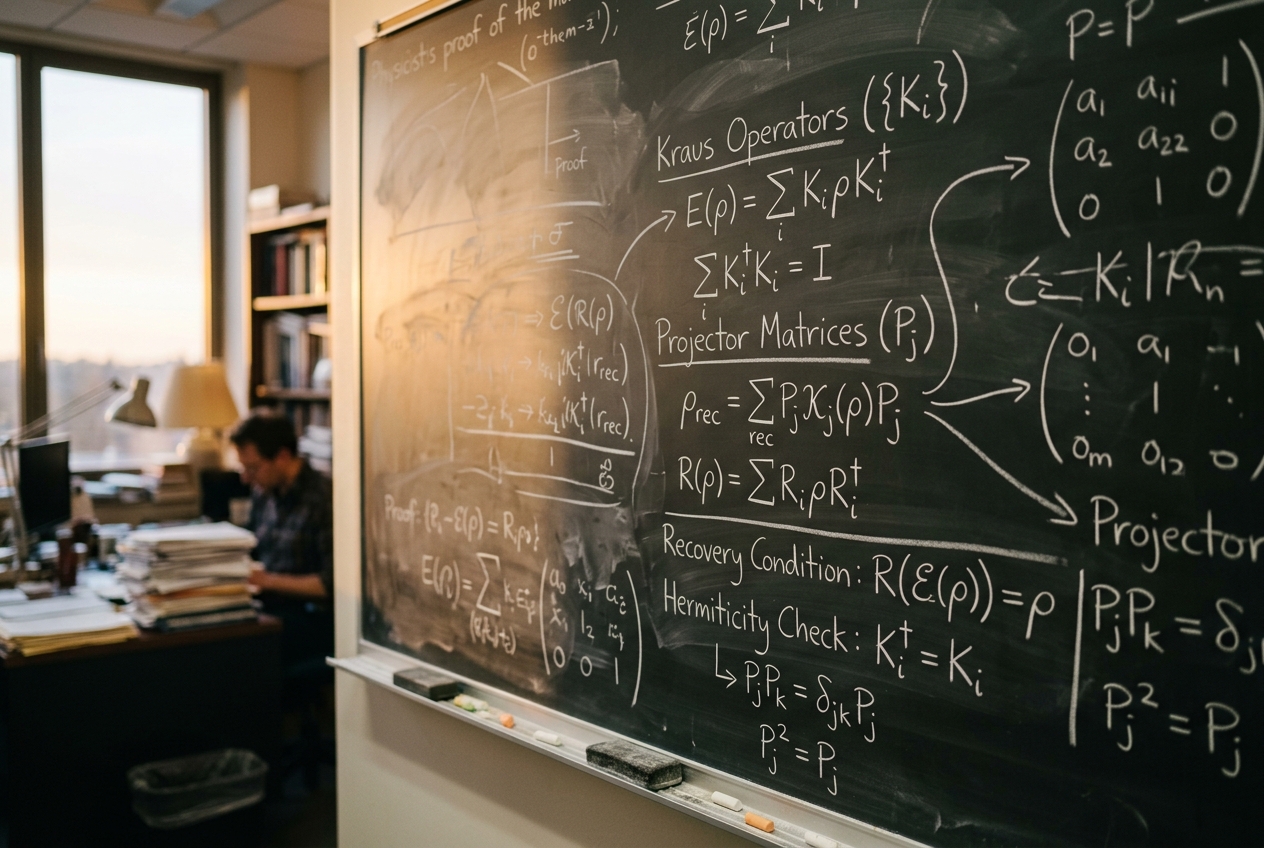
When a quantum system with density operator $\rho$ interacts with an uncontrollable external environment, the resulting noisy transformation $\mathcal{E}(\rho)$ can be decomposed into an ensemble of linear operators known as Kraus operators ${E_k}$:
$$\mathcal{E}(\rho) = \sum_{k} E_k \rho E_k^\dagger$$
Because the total probability of all physical outcomes must remain strictly equal to one, these error operators satisfy the completeness condition $\sum_k E_k^\dagger E_k = I$, where $I$ denotes the identity operator on the physical Hilbert space.
These Kraus operators encompass every conceivable physical degradation: continuous phase drift, bit flips, spontaneous thermal emission, leakage into unwanted atomic energy levels, and collective environmental dephasing. While these physical noise processes form a continuous, infinite continuum, quantum mechanics provides a remarkable simplification: because quantum measurement projects states into discrete outcomes, if a quantum code can correct a finite, discrete basis of errors (such as the Pauli operators $X$, $Y$, and $Z$), it automatically and perfectly corrects any arbitrary continuous linear combination of those errors.
2. The Algebraic Criterion: The Knill-Laflamme Equation
Let a quantum error-correcting code be defined by a logical code subspace $\mathcal{C}$ within a larger physical Hilbert space $\mathcal{H}$, characterised by an orthogonal projection operator $P$ that projects any state onto $\mathcal{C}$. Let $\mathcal{E}$ be a noise channel with a set of possible errors ${E_i}$.
The Knill-Laflamme Theorem establishes that the error set ${E_i}$ is perfectly correctable by the code $\mathcal{C}$ if and only if:
$$P E_i^\dagger E_j P = \alpha_{ij} P$$
where $\alpha$ is an arbitrary complex Hermitian matrix ($\alpha_{ij} = \alpha_{ji}^*$) that depends solely on the error operators and the code subspace, but is strictly independent of the specific quantum state stored within the code.
This compact algebraic relation embodies two vital physical principles:
- Uniform Noise Action (Non-Deformation): When $i = j$, the diagonal relation reads $P E_i^\dagger E_i P = \alpha_{ii} P$. This guarantees that the contraction or attenuation caused by the error $E_i$ affects all encoded logical basis states equally. If one logical state suffered greater attenuation than another, the relative amplitude between them would change, distorting the superposition and leaking logical information to the environment.
- Orthogonality of Error Subspaces (Distinguishability): When $i \neq j$ and $\alpha_{ij} = 0$, the condition demands that the damaged subspaces $E_i \mathcal{C}$ and $E_j \mathcal{C}$ are mutually orthogonal. Consequently, a projective measurement can unambiguously identify whether error $E_i$ or error $E_j$ occurred without disturbing the underlying logical state.
3. Non-Degenerate versus Degenerate Quantum Codes
A profound insight arising from the Knill-Laflamme framework lies in the structure of the Hermitian matrix $\alpha$:
- Non-Degenerate Codes: If the matrix $\alpha$ is strictly positive-definite and of full rank, distinct physical errors map the code space to entirely distinct, orthogonal subspaces. Every distinct physical error produces a distinct syndrome, requiring an individual recovery operation.
- Degenerate Codes: If the matrix $\alpha$ is positive semi-definite and possesses zero eigenvalues, distinct physical errors can map the code space to identical or overlapping subspaces without causing damage. In this scenario, multiple distinct physical error operators act identically on the code space (for instance, multiplying a logical codeword by an overall global phase).
Degeneracy is a uniquely quantum phenomenon with no classical counterpart. In classical coding, two distinct bit-flip errors cannot produce identical corrupted bit patterns. In quantum mechanics, however, because certain physical operators commute with all logical operators or act trivially on the logical subspace, the system can correct an immense variety of microscopic physical faults using only a small set of syndrome extraction circuits.
A classic illustration of degeneracy is Peter Shor's historic 9-qubit code. In Shor's code, a phase-flip error $Z$ occurring on the first physical qubit produces an identical change on the encoded logical state as a $Z$ error on the second or third physical qubit. Because the matrix element satisfies $\alpha_{12} \neq 0$, the syndrome extraction does not need to distinguish which of the three qubits experienced the phase shift; a single, unified correction pulse rectifies any of the three physical occurrences simultaneously.
4. Mathematical Construction of the Recovery Map
When the Knill-Laflamme conditions are satisfied, a physical recovery channel $\mathcal{R}$ can always be explicitly constructed. Because $\alpha$ is a Hermitian matrix, it can be diagonalised by a unitary transformation $U$:
$$D = U^\dagger \alpha U$$
where $D$ is a diagonal matrix with non-negative real eigenvalues $d_k \ge 0$. We can define a new, transformed basis of error operators:
$$F_k = \sum_m U_{mk} E_m$$
Under this transformed basis, the Knill-Laflamme equation simplifies to a strictly orthogonal relation:
$$P F_k^\dagger F_m P = d_k \delta_{km} P$$
For every non-zero eigenvalue $d_k > 0$, the polar decomposition allows us to decompose the restricted operator $F_k P$ into a unitary-like isometry $U_k$ multiplied by a scalar factor:
$$F_k P = \sqrt{d_k} U_k P$$
Here, $U_k$ is an operator that maps the code space $\mathcal{C}$ isometrically onto the corrupted subspace $\mathcal{C}_k = F_k \mathcal{C}$. Because the subspaces ${\mathcal{C}_k}$ are mutually orthogonal, we can define projector operators $P_k = U_k P U_k^\dagger$ that project onto each corrupted subspace.
The universal recovery channel $\mathcal{R}$ is then expressed in Kraus form as:
$$\mathcal{R}(\sigma) = \sum_{k: d_k > 0} R_k \sigma R_k^\dagger + R_0 \sigma R_0^\dagger$$
where $R_k = P U_k^\dagger = U_k^\dagger P_k$, and $R_0 = I - \sum_{k} P_k$ handles any residual Hilbert space components. When this recovery operation acts upon a damaged density matrix $\mathcal{E}(\rho)$ for any logical state $\rho = P \rho P$, the inversion is exact:
$$\mathcal{R}(\mathcal{E}(\rho)) \propto \sum_{k} R_k (F_k \rho F_k^\dagger) R_k^\dagger = \sum_{k} (P U_k^\dagger) (\sqrt{d_k} U_k \rho U_k^\dagger \sqrt{d_k}) (U_k P) = \left(\sum_k d_k\right) \rho$$
Normalising the trace restores the pristine logical state $\rho$ with absolute fidelity.
5. From Knill-Laflamme to Modern Topological and Bosonic Architectures
The Knill-Laflamme conditions provide the unifying theoretical bedrock for virtually every modern quantum error-correcting architecture:
- The Stabilizer Formalism: Developed by Daniel Gottesman, the stabilizer framework translates the Knill-Laflamme algebraic condition into group theory over the Pauli group. An abelian subgroup $\mathcal{S}$ of multi-qubit Pauli operators defines the code space as the joint $+1$ eigenspace of all stabilizer generators. The Knill-Laflamme condition is satisfied if and only if for every pair of correctable Pauli errors $E_i, E_j$, the product $E_i^\dagger E_j$ either falls within the stabilizer group $\mathcal{S}$ (degeneracy) or anticommutes with at least one generator in $\mathcal{S}$ (producing a non-zero syndrome).
- Calderbank-Shor-Steane (CSS) Codes: By separating the detection of bit flips ($X$) and phase flips ($Z$) into two orthogonal classical linear codes, CSS codes—the foundation of modern surface codes and 2D color codes—satisfy the Knill-Laflamme requirements using highly efficient, local parity-check circuits.
- Continuous-Variable (Bosonic) Codes: In optical cavities and superconducting microwave resonators, quantum information is stored in infinite-dimensional harmonic oscillators. The Gottesman-Kitaev-Preskill (GKP) and cat code families map the Knill-Laflamme conditions to phase-space grid displacements, enabling physical error correction within a single hardware microwave cavity.
Real-World Applications Today
The abstract mathematics of the Knill-Laflamme conditions has transitioned from blackboards to operational quantum processing units across international research laboratories.
1. Google Quantum AI: Threshold Scaling on Superconducting Grids
At its Santa Barbara laboratories, Google Quantum AI has focused on demonstrating that physical error rates can be driven below the fault-tolerant threshold. Using their superconducting architecture, the team validated a critical prediction of the Knill-Laflamme theorem: scaling a surface code from distance $d=3$ (using 17 physical qubits) to distance $d=5$ (using 49 physical qubits) exponentially suppressed logical error rates. By verifying that local physical noise behaves as independent, correctable Kraus operators satisfying Knill-Laflamme bounds, Google demonstrated that increasing physical hardware overhead genuinely yields more reliable logical computation.
2. Quantinuum and Microsoft: High-Fidelity Entangling Gates on Trapped Ions
Utilising shuttled trapped-ion hardware, Quantinuum, in collaboration with Microsoft, has created logical qubits with error rates orders of magnitude lower than their underlying physical components. Trapped ions provide near-perfect physical coherence and all-to-all connectivity, allowing researchers to implement complex degenerate color codes. By executing non-destructive syndrome extraction that directly measures error operators while preserving logical coherence, they have demonstrated repeated rounds of full Knill-Laflamme recovery alongside fault-tolerant two-qubit logic gates.
3. IBM Quantum: Heavy-Hex Lattices and Dynamic Circuit Decoding
IBM Quantum has engineered fixed-frequency superconducting transmon processors arranged in a "heavy-hex" lattice, optimised to minimise frequency crowding and stray crosstalk. IBM's open-source Qiskit compilation stack incorporates real-time classical decoding engines capable of processing syndrome data within microsecond coherence windows. By mapping physical noise into discrete stabilizer measurements, IBM's dynamic circuits actively apply corrective feedback pulses during active algorithmic execution.
4. QuEra Computing and Harvard University: Reconfigurable Neutral-Atom Arrays
A research consortium led by Harvard University, MIT, and QuEra Computing has demonstrated the execution of complex algorithms across dozens of logical qubits using neutral rubidium atoms suspended in dynamic laser optical tweezers. By physically shuttling entangled atomic clusters across a two-dimensional plane, their architecture realizes non-local CSS codes that satisfy Knill-Laflamme conditions with minimal physical qubit overhead, paving the path toward fault-tolerant quantum chemistry simulations.
What This Means for You
For anyone outside the cleanrooms of quantum physics, the Knill-Laflamme conditions represent the definitive bridge between an esoteric laboratory curiosity and a transformative technological reality.
Without quantum error correction, a quantum computer is essentially a hyper-sensitive analog instrument. Just as early 20th-century analog computers accumulated drift and noise with every operational step, uncorrected quantum circuits quickly decay into random statistical white noise within a few hundred operations. The Knill-Laflamme conditions proved that quantum computers are fundamentally digital: continuous noise can be digitized, isolated, and eradicated without altering the program state.
The realisation of fault-tolerant logical qubits directly determines the timeline for discoveries that will touch everyday life:
- Life-Saving Therapeutics: Simulating the enzyme nitrogenase or the quantum mechanics of protein folding requires millions of error-free quantum logic gates. Achieving this will enable the design of targeted cancer therapies and low-energy fertilizers entirely in silico.
- Energy Infrastructure: Accurate modeling of complex catalytic reactions on quantum hardware could lead to solid-state battery electrolytes with tenfold energy densities and high-efficiency carbon capture membranes.
- Data Security & Privacy: As fault-tolerant machines advance, global cybersecurity must transition to post-quantum cryptography standards (such as lattice-based algorithms) to ensure personal medical records, banking credentials, and governmental communications remain impervious to retrospective decryption.
Today's Takeaway
The Knill-Laflamme conditions establish the bedrock mathematical principle of quantum resilience: continuous, destructive physical noise can be digitized and completely eliminated from an entangled system, provided the noise never leaves an un-erasable imprint that distinguishes one logical state from another.
Further Reading & Authoritative References
- Knill, E., & Laflamme, R. (1997). Theory of quantum error-correcting codes. Physical Review A, 55(2), 900–911 (Preprint available at arXiv:quant-ph/9604034).
- Gottesman, D. (1997). Stabilizer Codes and Quantum Error Correction. Caltech Ph.D. Thesis / arXiv:quant-ph/9705052.
- Nielsen, M. A., & Chuang, I. L. (2010). Quantum Computation and Quantum Information. Cambridge University Press / MIT OpenCourseWare Quantum Information Science.
- Google Quantum AI (2023). Suppressing quantum errors by scaling a quantum error-correcting code. Nature, 614, 676–681.
- IBM Quantum Research. Fault-Tolerant Quantum Computing Documentation and Qiskit QEC Modules. IBM Quantum Platform.