Quantum LDPC Codes: Scaling Fault-Tolerant Architectures Through Constant-Rate Hypergraph Product Encodings
1. Opening Hook — Why You Should Care
The encryption safeguarding your digital life—from your private banking credentials and medical histories to the international communications of nation-states—relies on mathematical locks that would take the world’s most powerful supercomputers billions of years to crack. A fully realized, fault-tolerant quantum computer could dissolve those cryptographic defenses in a matter of hours. Beyond cybersecurity, such a machine would possess the unprecedented ability to simulate the molecular dynamics of chemical catalysts, unlocking room-temperature fertilizers, revolutionary battery chemistries, and targeted pharmaceuticals that remain computationally impossible today.
Yet, for the past two decades, an insurmountable engineering chasm has stood between theory and reality: quantum states are impossibly fragile. The slightest whisper of thermal vibration, stray magnetic field, or cosmic ray destroys their delicate computational states in microseconds. Under the orthodox blueprint of quantum error correction—the planar surface code—protecting a single usable "logical" quantum bit requires surrounding it with a defensive perimeter of thousands of imperfect "physical" qubits.
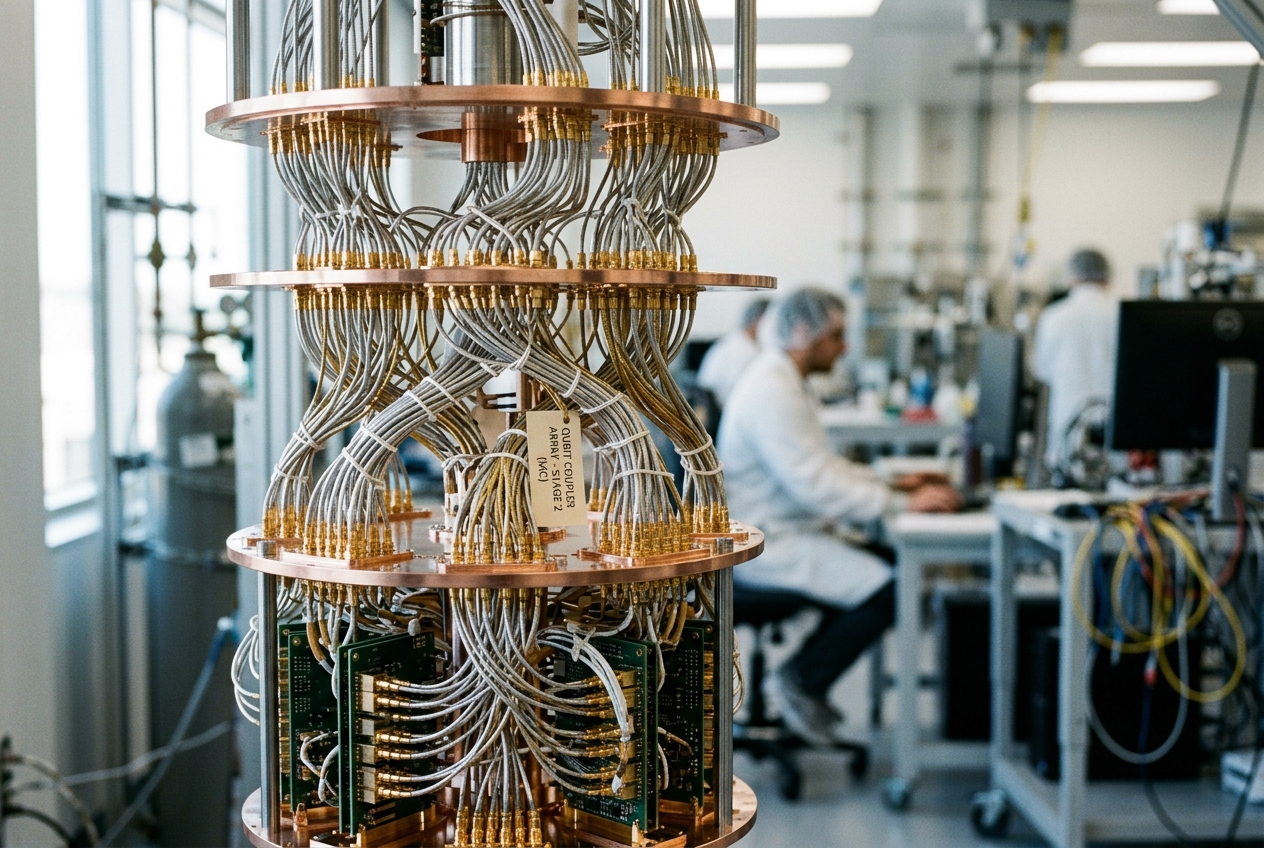
To run a world-changing quantum algorithm, engineers calculated they would need warehouse-sized cryogenic refrigerators housing upwards of 20 million physical qubits to yield a modest cluster of reliable logical processors. Building such an apparatus would be akin to assembling a jumbo jet using millions of vacuum tubes.
Now, a quiet mathematical revolution is rewriting that timeline. By reimagining the geometry of quantum information through the lens of Quantum Low-Density Parity-Check (qLDPC) codes, quantum physicists and mathematicians have shattered the 20-million-qubit bottleneck. By embedding hyper-dimensional graphs into quantum circuits, qLDPC architectures can compress the required physical hardware by a factor of fifty. The race toward the quantum era is no longer a brute-force manufacturing marathon; it has become an elegant triumph of coding theory.
2. The Idea in Plain English
To understand how qLDPC codes work, one must first confront the peculiar stubbornness of quantum information. In a conventional classical computer, data is stored in unambiguous bits: tiny transistors that are either charged (1) or uncharged (0). If an errant voltage spike flips a bit, correcting it is conceptually trivial. You can implement a classical repetition code: store three identical copies of the bit (111). If thermal noise corrupts one bit to 101, a simple majority-voting circuit recognizes that two 1s outvote a single 0, and flips the rogue digit back.
Quantum bits, or qubits, refuse to play by these rules due to two fundamental laws of quantum mechanics:
- The No-Cloning Theorem: It is physically impossible to create an identical, independent copy of an arbitrary, unknown quantum state. You cannot simply make three copies of a qubit and check them later.
- Wavefunction Collapse: The moment you directly observe or measure a qubit to see if an error has occurred, its delicate superposition—a simultaneous combination of 0 and 1—instantly collapses into a mundane classical value, destroying the quantum computation in progress.
How do you detect errors on data you cannot copy and dare not look at?
Imagine a classroom where four students hold coins. You need to know if any student accidentally flipped their coin, but you are strictly forbidden from looking at any individual coin. Instead, you instruct pairs of students to compare their coins in secret and report only whether their coins match (even parity) or differ (odd parity). If Student A and Student B match, but Student B and Student C differ, you know with mathematical certainty that Student C or Student B encountered an error, all without ever discovering whether the coins show heads or tails.
In quantum error correction, these indirect parity checks are performed using intermediary helper qubits, known as syndrome ancillas. By entangling these ancillas with clusters of data qubits and measuring only the ancillas, physicists extract an error "syndrome"—a diagnostic fingerprint of disturbances—while leaving the underlying quantum information untouched.
A Low-Density Parity-Check (LDPC) code is simply an error-correcting network designed around extreme efficiency and minimalism. In an LDPC architecture, each parity check inspects only a tiny, fixed number of data qubits (the "sparse" check), and each data qubit participates in only a handful of checks. Instead of a chaotic, congested network where every qubit is tethered to hundreds of neighbors, LDPC codes form an expansive, whisper-quiet web of sparse, localized interactions.
3. How It Actually Works — The Mechanics
The transition from classical to quantum LDPC codes represents one of the deepest intellectual journeys in information theory, bridging classical graph theory, algebraic topology, and quantum Hamiltonian dynamics.
       CLASSICAL LDPC (Gallager 1962)              QUANTUM LDPC (CSS Construction)

       Checks (c)       Bits (v)               X-Checks (c_x)    Qubits (q)    Z-Checks (c_z)
          (c1) -------- (v1)                      (X1) --------- (q1) --------- (Z1)
            \          /    \                       \          /    \          /
             \        /      \                       \        /      \        /
             (c2) --- (v2) -- (v3)                   (X2) --- (q2) -- (q3) --- (Z2)

       Sparse Bipartite Factor Graph             Dual-Orthogonal Symplectic Tanner Graph
          H * x = 0 (mod 2)                         H_X * H_Z^T = 0 (mod 2)
Classical Gallager Foundations and the Quantum CSS Commutativity Barrier
In 1962, Robert Gallager introduced classical Low-Density Parity-Check codes in his MIT doctoral dissertation. A classical LDPC code is defined by a sparse binary parity-check matrix $H$, where the number of non-zero entries in any row or column is bounded by a small constant. This sparsity allows the code to be visualized as a sparse bipartite "Tanner graph," with data bits on one side and parity checks on the other.
To construct a quantum analogue within the Calderbank-Shor-Steane (CSS) framework, one must account for the fact that qubits suffer from two distinct, continuous varieties of errors: bit-flips (represented mathematically by the Pauli $X$ operator) and phase-flips (represented by the Pauli $Z$ operator). A quantum CSS code requires two separate parity-check matrices: $H_X$ to diagnose phase-flips, and $H_Z$ to diagnose bit-flips.
However, quantum mechanics introduces a stringent mathematical constraint. Because measuring an $X$-type check must not disturb the outcome of a $Z$-type check, all parity-check operators in the code's stabilizer group must mutually commute. In the language of binary linear algebra, this imposes the fundamental CSS commutativity condition:
$$H_X H_Z^T \equiv 0 \pmod 2$$
This formula dictates that the matrix product of the bit-flip checks ($H_X$) and the transpose of the phase-flip checks ($H_Z$) must evaluate to zero over the binary field $\mathbb{F}_2$. In physical terms, every $X$-check and every $Z$-check must overlap on an even number of shared data qubits, guaranteeing that their quantum measurements commute and do not destroy one another's diagnostic information.
The Geometric Confinement of 2D Planar Surface Codes
For the past fifteen years, the leading paradigm in physical hardware has been the 2D planar surface code, pioneered by Alexei Kitaev and popularized by institutions like MIT OpenCourseWare Quantum Physics. In a surface code, physical qubits are laid out on a flat, two-dimensional square grid, interacting exclusively with their immediate nearest neighbors.
While physically convenient to fabricate on silicon chips, 2D local architectures are severely limited by geometric constraints. By the celebrated Bravyi-Kitaev-Terhal (BKT) theorem, any 2D local stabilizer code on $n$ physical qubits can encode at most $k = O(1)$ logical qubits—in practice, exactly $k = 1$ logical qubit per patch of hardware. Furthermore, its code distance $d$ (the minimum number of physical qubit errors required to cause an undetectable logical failure) scales at best as $d = O(\sqrt{n})$.
The Modern Breakthroughs: Hypergraph Products, Lifted Products, and Asymptotically Good Codes
To break free from the 2D locality trap, researchers realized that quantum parity-check matrices must describe graphs that exist in higher-dimensional, non-Euclidean topologies.
- Hypergraph Product (HGP) Codes (Tillich & Zémor, 2014): Jean-Pierre Tillich and Gilles Zémor demonstrated that one can take two classical Gallager LDPC codes, $C_1$ and $C_2$, and take their "Cartesian product" over chain complexes. This automatically satisfies $H_X H_Z^T = 0 \pmod 2$. HGP codes achieved a constant encoding rate ($k/n = \Theta(1)$), allowing a single interconnected patch of physical qubits to store dozens of logical qubits simultaneously. However, their code distance remained sub-linear ($d = O(\sqrt{n})$).
- Lifted Product Codes and Bivariate Bicycle Codes (Panteleev & Kalachev; Bravyi et al.): By incorporating group algebras and generalized algebraic symmetries, lifted product codes replace simple binary matrix entries with group ring polynomials over cyclic groups. This allows high-rate codes to be synthesized with compact, periodic wiring diagrams, such as the IBM Quantum bivariate bicycle codes that encode $k=12$ logical qubits into just $n=144$ physical qubits with distance $d=12$.
- Asymptotically Good Quantum Codes (Panteleev & Kalachev, 2021): In a monumental theoretical breakthrough, Pavel Panteleev and Gleb Kalachev solved the thirty-year-old "quantum LDPC conjecture." By taking fiber bundles of classical codes over high-dimensional Ramanujan expander graphs, they constructed quantum codes that simultaneously achieve a constant encoding rate and linear code distance:
$$\frac{k}{n} = \Theta(1) \quad \text{and} \quad d = \Theta(n)$$
This mathematical relationship establishes that as the total number of physical qubits $n$ grows, both the number of protected logical qubits $k$ and the resilience distance $d$ grow in direct linear proportion to $n$. A single chip with 10,000 physical qubits could protect hundreds of logical qubits with unprecedented error suppression.
+-----------------------------------------------------------------------------------------------+
| ARCHITECTURAL COMPARISON: 2D SURFACE CODES vs. ASYMPTOTICALLY GOOD qLDPC                      |
+------------------------------------+-----------------------------+----------------------------+
| Metric                             | 2D Planar Surface Code      | Modern qLDPC Code          |
+------------------------------------+-----------------------------+----------------------------+
| Logical Qubits per Patch ($k$)     | $k = 1$ (Fixed)             | $k = \Theta(n)$ (Linear)   |
| Code Distance ($d$)                | $d = O(\sqrt{n})$           | $d = \Theta(n)$ (Linear)   |
| Hardware Connectivity Topology     | Strictly 2D Nearest-Neighbor| Non-local / Multi-layer 3D |
| Physical Qubits per Logical Qubit  | $\sim 1,000 - 4,000$        | $\sim 15 - 50$             |
| Dominant Decoding Algorithm        | Minimum Weight Perfect Match| BP-OSD / Neural BP         |
+------------------------------------+-----------------------------+----------------------------+
The Syndrome Decoding Engine: Belief Propagation and Ordered Statistics Decoding (BP-OSD)
Once syndrome measurements are extracted, the classical control hardware must identify and neutralize the underlying physical errors in real time before the next clock cycle. The syndrome vector $s$ is related to the unknown error pattern $e$ by:
$$s \equiv H e^T \pmod 2$$
This syndrome equation states that multiplying the sparse parity-check matrix $H$ by the binary error vector $e$ yields the observed symptom vector $s$. The decoder's computational objective is to deduce the most probable error vector $e$ that satisfies this linear relation.
In classical telecommunications, LDPC decoding is solved via Belief Propagation (BP)—a message-passing algorithm where nodes on the Tanner graph iteratively exchange marginal probabilities along their edges. However, in quantum codes, two severe complications arise: * Quantum Degeneracy: Multiple distinct physical error configurations can produce identical physical effects if they differ only by a stabilizer operator. Standard decoders can become confused by these equivalent error loops. * Short Graph Cycles: The geometric constraints of the $H_X H_Z^T = 0$ condition inevitably create short 4-cycles in the Tanner graph, causing classical Belief Propagation to oscillate and fail to converge.
To overcome this, modern quantum decoders employ Belief Propagation combined with Ordered Statistics Decoding (BP-OSD), as detailed in recent computational frameworks published in Nature. When BP iterations stall due to topological cycles, the decoder freezes the most confident probabilistic soft decisions, ranks the most reliable qubit positions, and uses rapid linear algebra (Gaussian elimination on the most dependable columns of $H$) to deterministically reconstruct the most likely error pattern in sub-microsecond timeframes.
4. Real-World Applications Today
The transition of qLDPC codes from esoteric blackboard mathematics to physical hardware is taking place across the world's leading quantum laboratories between 2024 and 2026.
       NEUTRAL ATOM RECONFIGURABILITY             SUPERCONDUCTING MULTI-LAYER 3D

          [Atom 1] ~ ~ ~ (Laser Tweezer)                 [Qubit Layer] --- (Transmons)
             |                 |                               |
             v                 v                               v
         [Zone A] --------> [Zone B]                     [Routing Vias] --- (3D Coaxial Interconnects)
         (Entangle)         (Measure)                          |
                                                               v
                                                         [Control Plane] -- (Readout Lines)
1. Neutral-Atom Arrays and Optical Tweezer Shuttling (Harvard University & QuEra Computing)
- The Mission: Neutral-atom quantum computing uses focused laser beams ("optical tweezers") to trap individual rubidium or ytterbium atoms in high-vacuum chambers. Harvard University, in collaboration with QuEra Computing and MIT, has demonstrated large-scale programmable quantum processors utilizing reconfigurable atom arrays.
- The Quantum Advantage: Unlike superconducting chips whose physical wires are permanently lithographed onto silicon, neutral atoms can be physically picked up and shuttled across the processor at millimeter-per-second velocities without losing their quantum coherence. This dynamic reconfigurability allows researchers to execute the non-local, long-range entangling gates required by high-rate qLDPC codes without needing a spiderweb of fixed physical wires. In landmark 2024–2025 experiments, this architecture successfully encoded dozens of logical qubits with complex topological transversal operations.
2. Superconducting Processors and Bivariate Bicycle Architectures (IBM Quantum)
- The Mission: IBM Quantum has pivoted its long-term fault-tolerant roadmap toward qLDPC architectures, utilizing bivariate bicycle codes developed in collaboration with Sergei Bravyi.
- The Quantum Advantage: Conventional planar transmon chips are restricted to nearest-neighbor coupling on a heavy-hex lattice. To support the non-local checks of bivariate bicycle codes, IBM is pioneering multi-layer microfabricated chips that employ vertical coaxial interconnects ("through-silicon vias") to route long-range connections across the 3D chip stack. This approach allows an experimental device with 144 physical qubits to encode 12 fully protected logical qubits simultaneously—a task that would have required over 1,500 physical qubits under the old planar surface code paradigm. Researchers program and simulate these experimental lattices directly using open-source tools within the Qiskit Documentation ecosystem.
3. High-Connectivity Trapped-Ion Processors (Quantinuum)
- The Mission: Quantinuum operates trapped-ion systems based on the Quantum Charge-Coupled Device (QCCD) architecture, where individual barium or ytterbium ions are moved through microscopic electromagnetic channels.
- The Quantum Advantage: Trapped ions boast the highest gate fidelities in the industry and feature arbitrary all-to-all connectivity. Quantinuum has utilized this intrinsic long-range flexibility to implement color codes and generalized LDPC syndrome extraction networks across shuttling junctions. Because any ion can interact with any other ion, the complex multi-qubit parity checks of LDPC matrices can be measured with minimal circuit depth overhead, establishing world records for logical two-qubit gate fidelities.
4. Cat-Qubit and Bias-Preserving Architectures (AWS Center for Quantum Computing & Caltech)
- The Mission: Amazon Web Services (AWS), based at the Caltech campus, is engineering hybrid fault-tolerant systems that pair bosonic "cat qubits" with outer qLDPC codes.
- The Quantum Advantage: Cat qubits utilize continuous-variable microwave cavities to autonomously suppress bit-flip errors at the single-component hardware level, leaving only phase-flip errors to be handled by software. By designing asymmetric qLDPC codes tailored specifically to correct the remaining phase flips, AWS aims to achieve logical quantum memory with an order-of-magnitude fewer physical components than standard symmetric architectures.
5. What This Means for You
While the mathematical formalisms of symplectic geometry and Tanner graphs belong to academic treatises, the downstream societal consequences of the qLDPC breakthrough are profoundly tangible.
       HISTORICAL SCALING (2D Surface Code)       MODERN SCALING (qLDPC Codes)

       [ 20,000,000 Physical Qubits ]            [ 40,000 Physical Qubits ]
       Warehouse-Sized Cryo-Facility              Single Laboratory Cryostat
       Estimated Timeline: 2040+                  Estimated Timeline: 2028-2032
- Accelerated Timelines for Practical Chemistry and Medicine: Under the old 2D surface code paradigm, a fault-tolerant quantum computer capable of simulating the nitrogenase enzyme (the chemical mechanism behind industrial fertilizer production, which currently consumes 1–2% of the world’s entire energy supply) was estimated to be decades away. By slashing the physical qubit overhead by 95%, qLDPC codes compress that roadmap by an estimated ten to fifteen years. Useful quantum simulations of catalytic energy systems, carbon-capture materials, and neurodegenerative disease enzymes may arrive within the decade rather than mid-century.
- Urgency of the Post-Quantum Cryptographic Migration: If quantum computers require tens of millions of physical qubits, current public-key encryption (RSA and Elliptic Curve Cryptography) might have remained secure for another twenty years. The hardware compression afforded by qLDPC codes means that code-breaking quantum architectures could become viable with only tens of thousands of high-fidelity physical qubits. This dramatically accelerates the urgency for individuals, banks, and governments to migrate immediately to post-quantum cryptographic standards endorsed by NIST.
- A Shift in Global Hardware Economics: The computational race has shifted from brute manufacturing capacity to topological elegance. A startup or academic laboratory operating a high-connectivity 1,000-qubit neutral-atom array or ion trap can now theoretically achieve the logical compute power that previously belonged exclusively to industrial tech giants building million-qubit chip foundries.
6. Today's Takeaway
The realization of fault-tolerant quantum computing is not merely an engineering quest to manufacture millions of identical microscopic components; it is an architectural revolution in how quantum information is mathematically woven together. By escaping the flat confines of two-dimensional nearest-neighbor grids and embracing the hyper-dimensional connectivity of Quantum Low-Density Parity-Check codes, physicists have transformed an intractable warehouse-sized engineering nightmare into an elegant, highly compact reality that brings the quantum future decisively within our reach.
Key Theoretical References & Further Reading
- Gallager, R. G. (1962). Low-Density Parity-Check Codes. MIT Press.
- Panteleev, P., & Kalachev, G. (2021). Asymptotically good quantum LDPC codes. IEEE Transactions on Information Theory / arXiv:2111.03654.
- Bravyi, S., Cross, A. W., Gambetta, J. M., Maslov, D., Rall, P., & Yoder, T. J. (2024). High-threshold and low-overhead fault-tolerant quantum memory. Nature.
- Tillich, J.-P., & Zémor, G. (2014). Quantum LDPC codes with positive rate and minimum distance proportional to the square root of the blocklength. IEEE Transactions on Information Theory.
- Bluvstein, D., et al. (2024). A topological quantum processor with up to 48 logical qubits. Nature.