Zhen Jiu Wen Dui: Navigating Wang Ji's Dialectical Channel Inquiries, Point Selection Logic, and Precision Acupressure Protocols
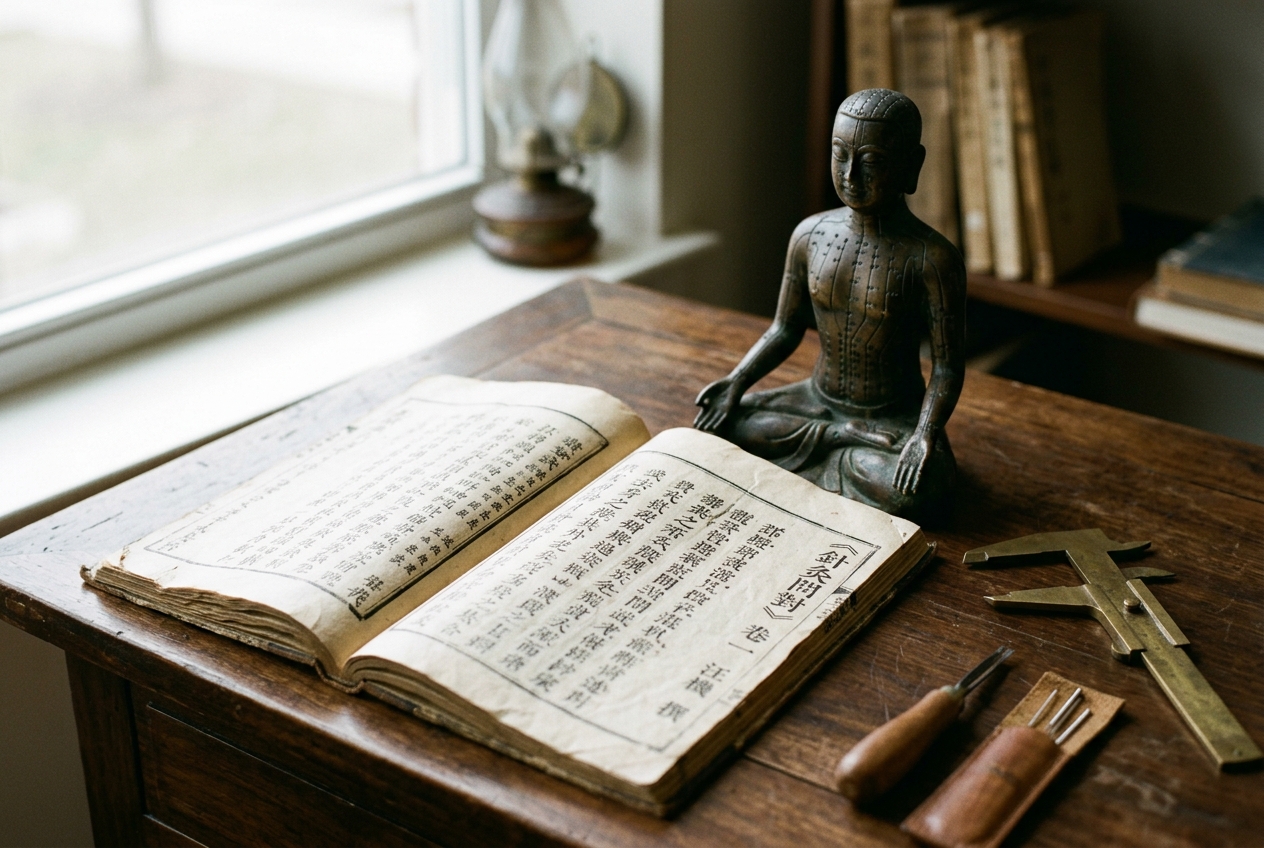
Traditional Chinese Medicine (TCM) provides a remarkably coherent, somatic map for interpreting these systemic patterns. Far from being an esoteric abstraction, the meridian network represents a contiguous, bio-responsive architecture. By intersecting the dialectical inquiries of classical scholarship with 21st-century neurofascial science, we uncover a practical, non-invasive therapeutic framework that allows any individual to systematically reset autonomic tone, restore visceral motility, and dissolve musculoskeletal tension using nothing more than their own fingertips.
Key Historical & Biomechanical Insights
- The Classical Text: Wang Ji’s 1530 masterwork, Zhen Jiu Wen Dui (針灸問對, Questions and Answers on Acupuncture and Moxibustion), utilized a dialectical catechism to adjudicate historic controversies between the Huangdi Neijing and the Nan Jing, establishing strict criteria for point selection, needle depth, and channel energetics.
- The Neurofascial Reality: Modern research reveals that classical meridians correlate strongly with intermuscular connective tissue planes, interstitial fluid channels, and neurovascular tracts characterized by high electrical conductivity and rich mechanoreceptor density.
- The Core Benchmark Points: ST36 (Zusanli), LV3 (Taichong), LI4 (Hegu), SP6 (Sanyinjiao), and PC6 (Neiguan) serve as primary bio-electrical switches governing systemic homeostasis, neuroendocrine regulation, and autonomic balance.
1. The Classical Dialectic: Wang Ji's 1530 Adjudication of Channel Controversies
To fully grasp the therapeutic power of meridian points, one must understand how their theoretical foundations were forged. In the early 16th century, Chinese medicine was fractured by competing theoretical factions. Practitioners regularly disputed whether point selection should be governed by the elemental transformations of the Five Transport Points (Wushuxue) or the structural relationships of the Source-Connecting (Yuan-Luo) pairings. They argued over whether needles should be retained for hours or manipulated instantaneously, and whether tonification (bu) and sedation (xie) were distinct physical mechanics or merely metaphors for physiological intent.
In 1530, Wang Ji published his landmark clinical treatise, Zhen Jiu Wen Dui. Formatted as an incisive series of questions and answers between a seeking disciple and an experienced master, the text systematically deconstructed centuries of conflicting dogmas. Wang Ji insisted that clinical efficacy required a rigorous, reproducible understanding of channel dynamics.
Tonification (Bu) versus Sedation (Xie)
Wang Ji clarified that tonification and sedation are not merely passive states of mind, but precise biomechanical interventions defined by vector alignment, respiration, and rotational dynamics: * Tonification (Bu): Defined as reinforcing the physiological baseline. Wang Ji mandated that the stimulation vector follow the natural flow of the channel (Shun Jing), applied gently during the patient's exhalation and withdrawn during inhalation, thereby closing the aperture to preserve metabolic qi. * Sedation (Xie): Defined as dispelling pathogenic excess or clearing stagnation. Wang Ji mandated directing the physical vector counter to the channel’s directional flow (Ni Jing), applying dynamic force upon the patient's inhalation, and withdrawing during exhalation while leaving the pathway open to discharge trapped heat or tension.
Five Shu Points versus Yuan-Luo Host-Guest Strategies
One of Wang Ji's greatest contributions was establishing a clear rubric for choosing between Five Shu transport points and Source-Connecting (Yuan-Luo) pairings: * Five Shu Transport Points (Jing-Well, Ying-Spring, Shu-Stream, Jing-River, He-Sea): Wang Ji categorized these as dynamic, environmentally responsive points situated below the elbows and knees. Drawing upon Chapter 69 of the Nan Jing (Classic of Difficult Issues), he asserted that Five Shu points should be mobilized when pathology manifests as a seasonal or elemental disequilibrium—utilizing the "mother-tonification and child-sedation" rule (Xu ze bu qi mu, Shi ze xie qi zi). * Yuan-Source and Luo-Connecting Combinations (Zhu-Ke / Host-Guest): In contrast, Wang Ji reserved Yuan-Luo combinations for deep, structural, and interior-exterior dual-channel syndromes. The primary afflicted meridian is treated via its Yuan-Source point (the "Host"), anchoring the organ's essential energy, while the coupled interior-exterior meridian is stimulated via its Luo-Connecting point (the "Guest"), opening collateral micro-channels to vent excess pathology across systemic fascial planes.
Classical vs. Modern Meridian Paradigms
| Diagnostic Dimension | Wang Ji's Classical Rationales (Zhen Jiu Wen Dui, 1530) | Contemporary Neurofascial & Bio-mechanistic Frameworks |
|---|---|---|
| Point Localization | Specific energetic conduits (Xue) situated in topographical depressions where defensive (Wei) and nutritive (Ying) qi converge. | Connective tissue cleavage planes, perineural sheaths, and neurovascular bundles rich in free nerve endings and mechanoreceptors. |
| The De Qi Sensation | Arrival of the vital breath (Qi Zhi); described as a fish taking a hook or a deep, spreading soreness (Suan), numbness (Ma), and fullness (Zhang). | Mechanical needle-grasp/fascial winding via collagen fiber engagement; selective recruitment of unmyelinated C-fibers and thinly myelinated A-delta afferents. |
| Tonification Mechanism | Consolidating channel emptiness; directional manipulation with channel flow, synchronized with respiratory exhalation. | Low-frequency, rhythmic mechanostimulation promoting local parasympathetic dominance, tissue hydration, and fibroblast relaxation. |
| Sedation Mechanism | Venting stagnant heat and pathogenic excess; directional opposition to channel flow, clearing turbulent collateral resistance. | High-intensity sustained mechanotransduction triggering endogenous opioid release, descending noxious inhibitory control (DNIC), and substance P clearance. |
| Yuan-Luo Coordination | Harmonizing the primary zang-fu organ root while clearing the coupled collateral branch via the host-guest dynamic. | Cross-segmental spinal reflex modulation and bidirectional autonomic balancing between visceral organs and somatic body walls. |
2. The Meridian Path: A Journey Through the Living Body
To understand how stimulating a point on the ankle or hand can ease a headache or calm an upset stomach, we must abandon the outdated notion that meridians are magical lines drawn on skin. Modern biological research, led by figures such as Dr. Helene Langevin and documented in extensive connective tissue and fascial research on PubMed, reveals that acupuncture and acupressure pathways correspond directly to the continuous webs of the extracellular matrix, deep intermuscular fascia, and underlying neurovascular networks.
When you press an acupressure point, you are physically deforming collagen fibers, opening stretch-activated ion channels, stimulating piezocurrents, and sending electrical and biochemical signals through connective tissue planes directly to the central nervous system and internal organs.
Let us trace these primary continuous pathways using palpable, everyday physical landmarks:
The Stomach Channel (Foot Yangming): The Frontline of Digestion and Posture
The Stomach pathway begins just below the bony orbit of your eye, wraps around the jaw, and descends through the throat, traversing down the front of the ribcage and abdomen along the lateral border of the rectus abdominis. It crosses the groin into the front of the thigh, traveling down the fleshy outer ridge of your shinbone—the exact muscular groove that aches after a day of marching across town—before coursing across the top of the foot to terminate at the corner of the second toe. This pathway is the body’s structural shock-absorber and the primary metabolic conduit governing food intake, gastric motility, and physical endurance.
The Spleen Channel (Foot Taiyin): The Inner Moisture and Fluid Highway
Originating at the medial corner of the big toe nail, the Spleen pathway runs along the soft boundary where the pale skin of your sole meets the darker skin of the foot’s top. It ascends behind the inner ankle bone, climbs directly along the inner border of your shinbone, passes the inside of the knee, and ascends through the inner thigh into the lower abdomen. It is the primary regulator of interstitial fluid balance, lymphatic clearance, and the transformation of nutrients into cellular energy.
The Liver Channel (Foot Jueyin): The Spring-Loaded Tension Axis
Beginning at the outer edge of the big toe nail, this pathway courses across the top of the foot through the soft valley between your first two metatarsal bones. It climbs up the inner leg, passing in front of the Spleen pathway, travels across the groin, and culminates deep in the flank below the ribcage. The Liver channel regulates physical and emotional tone, governing smooth muscle elasticity, bile excretion, and the systemic distribution of blood during physical exertion or acute psychological stress.
The Large Intestine Channel (Hand Yangming): The Outer Arm Release Route
Starting at the tip of the index finger, this channel travels across the muscular web between your thumb and forefinger, runs along the outer edge of the forearm, crosses the top of the shoulder joint, climbs the neck, and wraps across the upper lip to terminate beside the opposite nostril. It is the body's premier elimination and craniofacial regulatory conduit, directly modulating mucosal immunity, cervical tension, and bowel elimination.
The Pericardium Channel (Hand Jueyin): The Central Axis of Heart and Breath
Originating in the chest near the heart, this channel emerges into the armpit, courses straight down the middle of the inner bicep, and travels down the center of the inner forearm directly between two thick, palpable flexor tendons. It crosses the center of the palm and ends at the tip of the middle finger. This pathway is the master regulator of the vagus nerve, thoracic relaxation, cardiac rhythm, and emotional tranquility.
For official definitions and global standards on these classical pathways, consult the World Health Organization Western Pacific Region Traditional Medicine guidelines.
3. Five Benchmark Acupressure Points: Somatic Anatomy and Exact Mechanics
Acupressure is not mere massage; it is an applied mechanobiological intervention. When performing the following protocols, precision in anatomical localization, vector angle, and pressure dynamics is essential to elicit the classical de qi sensation (characterized neurophysiologically by deep tissue heaviness, tingling, or a spreading, warm ache).
1. Stomach 36 (Zusanli – "Leg Three Miles")
- Everyday Landmark: Sit with your knee bent at a right angle. Place your four fingers horizontally across your shin, directly beneath the bottom edge of your kneecap. ST36 is located four finger-widths down, in the soft muscular groove approximately one thumb-width lateral to the sharp ridge of your shinbone (the tibialis anterior muscle belly).
- The De Qi Sensation: A pronounced, dull muscular ache that radiates distally down the outer shin and into the top of the foot.
- Biomechanical Action: Triggers the vagal-adrenal anti-inflammatory axis, stimulates gastric slow-wave rhythmicity, and induces cellular nitric oxide release.
- Stimulation Dynamics: Apply firm, perpendicular thumb pressure with slow, micro-circular frictions. Press firmly enough that the tissue resists slightly, sustaining for 2 to 3 minutes while maintaining slow diaphragmatic breathing.
2. Liver 3 (Taichong – "Great Surge")
- Everyday Landmark: Trace your finger upward from the web space between your big toe and second toe along the top of your foot. Your finger will glide through a soft groove between the two long bones (the first and second metatarsals) until it settles naturally into the V-shaped junction where the bones meet.
- The De Qi Sensation: A distinct, slightly sharp or electric tenderness that rapidly gives way to a spreading sensation of muscular decompression and warmth throughout the foot.
- Biomechanical Action: Downregulates sympathetic nervous system outflow, eases hyperactive smooth muscle contractions, and modulates cortical pain matrices via descending monoaminergic systems.
- Stimulation Dynamics: Direct your thumb pressure at a 45-degree angle pointing proximally toward the ankle joint. Maintain sustained, static pressure for 90 seconds per foot, focusing on slow, full exhalations to facilitate release.
3. Large Intestine 4 (Hegu – "Joining Valley")
- Everyday Landmark: Bring your thumb and index finger flat against each other. A fleshy mound of muscle will rise on the back of your hand. LI4 is located at the highest point of that mound (within the first dorsal interosseous muscle), nestled against the midpoint of the second metacarpal bone.
- The De Qi Sensation: An intense, deeply grounded ache, often felt as a heavy, spreading pressure that resonates through the palm and wrist.
- Biomechanical Action: Stimulates primary sensory afferents that project to the thalamus and somatosensory cortex, promoting powerful central endorphin and enkephalin release to inhibit craniofacial and spinal pain circuits.
- Stimulation Dynamics: Use a pincer grip with your opposite thumb on top of the point and your index finger supporting the palm underneath. Direct pressure inward and slightly angled toward the bone of your index finger. Apply intermittent pulsing pressure (3 seconds firm, 1 second release) for 2 minutes on each hand.
4. Spleen 6 (Sanyinjiao – "Three Yin Intersection")
- Everyday Landmark: Place the pinky finger of your four-finger flat hand directly on the prominent peak of your inner ankle bone. Spleen 6 is located four finger-widths straight up your inner leg, in the soft tender depression immediately behind the posterior border of the shinbone (tibia).
- The De Qi Sensation: A tender, warm, and deeply relaxing dull sensation that may travel upward along the inner calf or down into the sole of the foot.
- Biomechanical Action: As the anatomical convergence point of the Spleen, Liver, and Kidney channels, SP6 modulates pelvic parasympathetic splanchnic nerves, regulates microcirculation in the lower abdomen, and reduces hypothalamic-pituitary-ovarian axis tension.
- Stimulation Dynamics: Press with the flat pad of your thumb directly against the back edge of the shinbone, applying a gentle posterior-to-anterior perpendicular compression. Hold continuously for 2 minutes per leg, pairing each hold with relaxed abdominal expansion.
5. Pericardium 6 (Neiguan – "Inner Frontier Gate")
- Everyday Landmark: Turn your hand palm-up. Place your three middle fingers across your wrist crease. PC6 is located exactly three finger-widths above the wrist crease, dead-center in the midline of your forearm, resting between the two prominent, rope-like tendons (the flexor carpi radialis and palmaris longus).
- The De Qi Sensation: A subtle, electric, or buzzing tingling that diffuses down into the center of the palm and middle finger, accompanied by a sensation of chest expansion.
- Biomechanical Action: Transmits signals via the median nerve directly to the nucleus tractus solitarii (NTS) in the brainstem, attenuating vestibular emetic signals, suppressing gastric tachyarrhythmia, and enhancing cardiac vagal tone.
- Stimulation Dynamics: Press your thumb perpendicularly down between the two tendons. If the tendons are tight, gently flex your wrist back and forth to help the thumb sink deeper into the intertendinous space. Maintain steady, rhythmic pressure for 2 to 3 minutes while actively lengthening your exhalations.
For comprehensive details on point categorization and anatomical mapping, explore the scientific entries on Wikipedia's Acupuncture Point Index and Meridian Systems.
Comparative Benchmark Point Matrix
| Point Name & Code | Classical Classification & Element | Primary Somatic Structure | Modern Physiological Biomarker / Action | Optimal Vector & Duration |
|---|---|---|---|---|
| ST36 (Zusanli) | He-Sea Point; Earth Element; Foot Yangming | Tibialis anterior muscle; deep peroneal nerve; anterior tibial artery. | Modulates vagal efferents; upregulates gastric peristalsis; suppresses systemic TNF-α and IL-6. | Perpendicular circular compression; 2–3 min. |
| LV3 (Taichong) | Shu-Stream & Yuan-Source Point; Earth/Wood; Foot Jueyin | 1st dorsal interosseous muscle; deep peroneal nerve; dorsalis pedis artery. | Decreases sympathetic tone; reduces blood pressure volatility; attenuates cerebral vascular spasm. | 45° proximal-angled static hold; 90 sec. |
| LI4 (Hegu) | Yuan-Source Point; Metal Element; Hand Yangming | 1st dorsal interosseous; first web space; superficial radial nerve branch. | Triggers central μ-opioid receptor binding; reduces trigeminal neuralgia; relieves tension headaches. | Angled toward 2nd metacarpal bone; pulsing 2 min. |
| SP6 (Sanyinjiao) | Three Yin Crossing (Taiyin, Jueyin, Shaoyin); Foot Spleen | Flexor digitorum longus; posterior tibial nerve; posterior tibial artery. | Normalizes pelvic visceral blood flow; balances ovarian endocrine output; relieves pelvic floor spasm. | Perpendicular flat thumb hold against tibia; 2 min. |
| PC6 (Neiguan) | Luo-Connecting Point; Confluent of Yinwei; Hand Jueyin | Intertendinous septum; median nerve trunk; anterior interosseous vessels. | Activates vagal dorsal motor nucleus; aborts nausea and motion sickness; restores Heart Rate Variability (HRV). | Direct perpendicular inter-tendinous press; 2–3 min. |
4. Clinical Protocol: The Evening "Desk-Bound Autonomic Reset"
For the modern professional experiencing end-of-day cognitive overload, shoulder stiffness, shallow breathing, and epigastric heaviness, apply this complete 8-minute sequential acupressure protocol.
Execution Steps
- Preparation: Sit comfortably in a supportive chair with feet flat on the floor or cross-legged on a cushion. Unbutton tight waistbands. Take three deep breaths, extending your exhalation to twice the length of your inhalation (e.g., inhale for 4 seconds, exhale for 8 seconds).
- Step 1 — Venting the Stress Axis (LV3): Begin on your left foot. Locate LV3 in the valley between the big toe and second toe bones. Sink your thumb in at a 45-degree angle pointing back toward your ankle. Hold with steady, deep pressure for 90 seconds. Feel the localized tension release. Repeat on the right foot.
- Step 2 — Decompressing Craniofacial and Trapezius Spasm (LI4): Grasp your left hand with your right. Place your right thumb on LI4 and index finger under the palm. Squeeze firmly toward the index finger bone until a strong, heavy ache develops. Maintain steady pressure for 90 seconds while gently rolling your head in slow, relaxed half-circles. Switch and repeat on the right hand.
- Step 3 — Unlocking the Diaphragm and Vagal Rhythm (PC6): Place your left forearm resting palm-up on your thigh. Place your right thumb into the center of the wrist, three finger-widths down between the two tendons. Press down firmly. As you hold this for 2 minutes, breathe deeply into the lower belly, feeling your chest and throat soften. Repeat on the opposite arm.
- Step 4 — Grounding Energy and Restoring Digestive Flow (ST36): Place both thumbs into ST36 on your outer shins simultaneously. Lean forward slightly to use your upper body weight to apply deep, circular, clockwise friction. Continue for 2 full minutes. You may feel your stomach gurgle or a warm sensation travel down into your feet—classic markers of parasympathetic gastrointestinal reactivation.
5. Safety, Sense, and Clinical Boundaries
While manual acupressure is an extraordinarily safe and non-invasive modality, rigorous adherence to physiological contraindications and clinical boundaries is imperative.
- Pregnancy Precautions: Points LI4 (Hegu) and SP6 (Sanyinjiao)—along with Gallbladder 21 (Jianjing) and Bladder 60 (Kunlun)—are strictly contraindicated throughout pregnancy (unless administered by a licensed professional during active labor). Mechanistically, strong stimulation of these points promotes descending motor discharge and pelvic parasympathetic activation, which can induce uterine contractions.
- Understanding Pressure Thresholds: Effective acupressure should feel like a deep, satisfying ache—often described as "good pain" (rated 4 to 6 on a 10-point discomfort scale). If you experience sharp, lancinating pain, numbness resembling an electric shock across a nerve trunk, or tissue bruising, you are applying excessive force. Excessive force induces sympathetic fight-or-flight muscle guarding, directly counteracting the therapeutic goal.
- When to Seek Professional Medical Care: Acupressure is an exceptional tool for functional and chronic lifestyle complaints, but it is not a substitute for emergency medicine. If you experience crushing chest pain, unexplained shortness of breath, acute high fever, rigid abdominal tenderness, sudden neurological deficits, or persistent unyielding pain, bypass self-treatment and seek immediate evaluation from a licensed physician or emergency medical service. For complex chronic conditions, consult a licensed acupuncturist (L.Ac. or equivalent credentialed practitioner).
6. Today's Takeaway: The Two-Minute Vagal Reset
You do not need an entire afternoon or specialized equipment to change your physiological state. Before you close this article, take exactly two minutes to experience the power of non-invasive channel mechanotransduction.
The 2-Minute Exercise
- Target Point: Pericardium 6 (Neiguan) on your non-dominant wrist.
- Action: Place three fingers of your opposite hand across your inner wrist crease. Right where your third finger rests, between the two thick central tendons, firmly plant the tip of your thumb. Place your index finger on the back of your wrist to create a steady pincer clamp.
- Execution: Press straight down until you feel a distinct, heavy ache spreading into the center of your palm.
- Breath Integration: Close your eyes. Inhale slowly through your nose for 4 seconds, feeling your lower belly expand. Exhale slowly through your mouth for 8 seconds. Complete six full breath cycles (exactly 72 seconds).
- The Shift: Release the point. Notice the immediate drop in your resting heart rate, the softening of your throat and diaphragm, and the sudden spaciousness in your chest.
You have just engaged the exact biological reflex arc that Wang Ji dissected nearly five centuries ago—bridging ancient empirical wisdom with the modern living architecture of the human body.
Authoritative Medical & Academic Resources
- Explore traditional medicine global initiatives and technical reports at the World Health Organization.
- Search peer-reviewed clinical trials and neuroimaging studies on acupoint stimulation via NCBI PubMed Central.
- Review historical translations and channel mappings on the Wikipedia Overview of Meridian Systems and Acupuncture Point Database.
- Read landmark research on connective tissue mechanics and acupuncture point physiology in PMC2835594.