Wegener Arcs & Anthelic Halo Dynamics: How Horizontally Oriented Columnar Crystals and End-Face Internal Reflections Forge Soaring Sky Loops
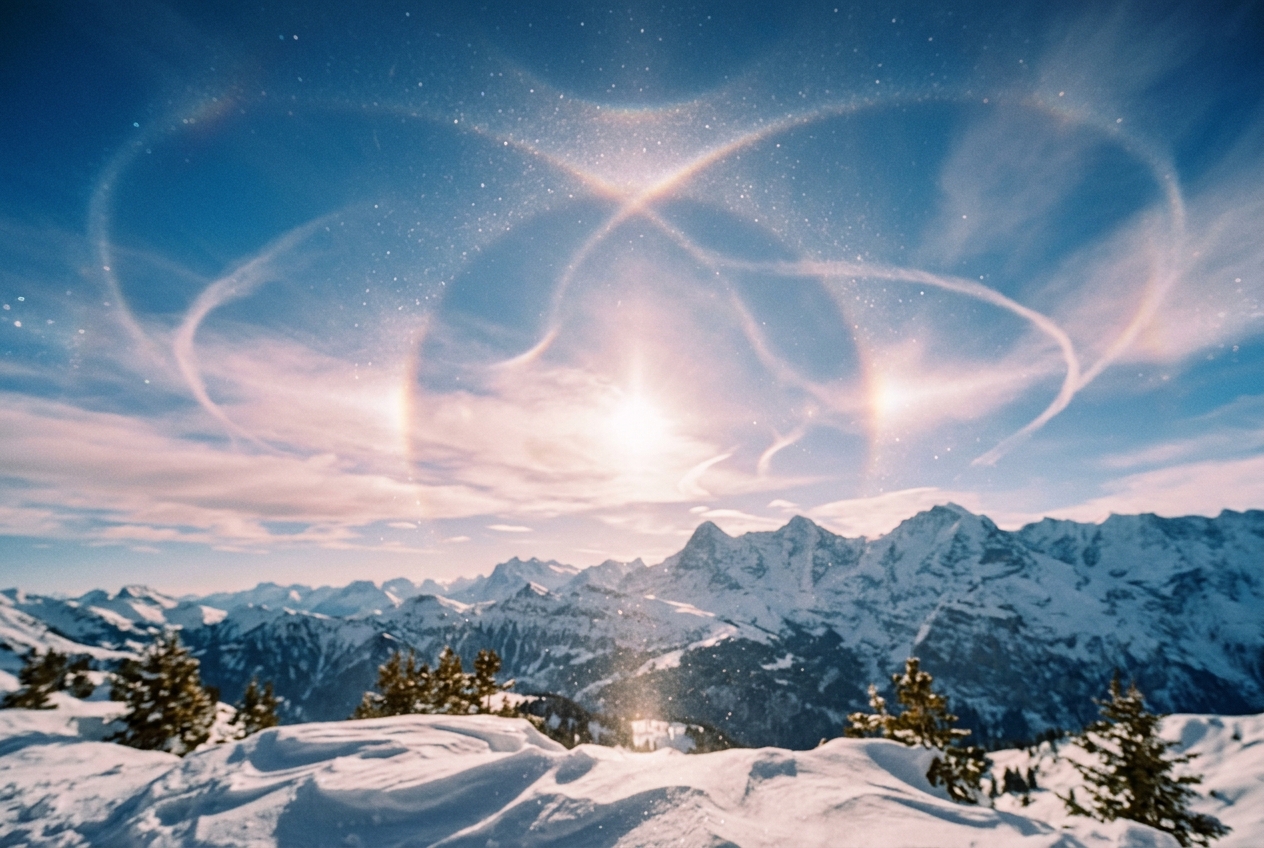
1. Opening Scene: The Diamond Dust Awakening
Step outside onto an Antarctic plateau or a high alpine pass at dawn when the mercury has plunged past $-30^\circ\text{C}$. The world is hushed into an immaculate, crystalline silence. The air is so dry and biting that each inhalation stings the bronchial pathways, yet there is not a breath of wind to stir the snowpack. A profound thermal inversion grips the valley: cold, dense air sits pooled on the ground beneath a warmer, stagnant atmospheric lid. In this frozen stillness, the air itself appears to have solidified into light.
Suspended throughout the shallow boundary layer is a glittering mist of what polar meteorologists call diamond dust—microscopic, pristine hexagonal ice columns that drift downward so slowly they seem to float. As the low Arctic sun clears the jagged rim of the horizon, you instinctively raise a hand to shield your eyes from the blinding glare. The immediate solar sky erupts into the familiar rings and pillars: a sharp $22^\circ$ ring, parhelia burning at the flanks, and an upper tangent arc unfurling like a celestial bird in flight.
       [Zenith]
          /\
         /  \  <-- Wegener Arcs Crossing Overhead
        /    \
       /      \
[Solar Sky]    [Anthelic Sky (180° Opposite)]
   Sun               Anthelion
    *                   (X)
   / \                  / \
  /   \ < Upper Tangent/   \ < Tricker / Hastings Arcs
Now, turn your back completely to the Sun.
Facing directly opposite the solar disk into the anthelic sky, where ordinary atmospheric intuition expects only empty blue or pale shadow, an extraordinary architecture of light reveals itself. Floating at the exact altitude of the Sun, but $180^\circ$ away in azimuth, glows the anthelion—a soft, luminous white knot on the horizon. Arising from the flanks of the sky, two immense, ghost-white curves sweep upward in broad hyperbolic arcs. They soar high overhead, cross one another near the zenith, and dive down to converge squarely through that opposite anthelic point. These are Wegener arcs, discovered mathematically and observed in the field by the pioneering geophysicist Alfred Wegener.
Unlike the vivid spectral rainbows formed by spherical raindrops, these anthelic ribbons are pure, pearlescent white, shimmering against the deep polar indigo. They look less like fleeting optical tricks and more like rigid vaulted arches built from cold glass, drawn across the sky by an unseen cosmic geometer.
2. What's Actually Happening — Plain English First
To understand why light ends up behind you when you are looking away from the Sun, we must look closely at the miniature architecture of falling ice.
           Basal Face (Entry)
              +-------+
             /         \
            /  Prism    \
           |   Faces     |  <--- c-axis (Horizontal)
            \  (TIR)    /
             \         /
              +-------+
           Basal Face (Exit)
Think of each ice crystal as a tiny, perfectly cut hexagonal pencil made of transparent glass. It has two flat hexagonal end-caps (called basal faces) and six rectangular sides that wrap around its body (called prism faces). The long line running down the centre of the pencil from end to end is known as the c-axis.
When these crystals form slowly inside supercooled air, gravity pulls them down while air resistance pushes back against their descent. If you drop a sheet of paper or a flat stick, it does not slice through the air edge-first like an arrow; instead, fluid drag forces it to fall flat, presenting its largest surface area to the air below. In the very same way, these microscopic ice pencils settle so that their long c-axis lies completely flat and parallel to the Earth's surface.
However, while the pencil is locked horizontally, it remains completely free to roll around its own long axis like a rolling pin gliding over a baker's table. Atmospheric scientists call this singly oriented column alignment (or the Parry/horizontal column class). In a cloud of diamond dust, millions of these tiny crystals are all lying horizontally, but rolling at every possible angle around their spines.
When sunlight hits one of these rolling horizontal cylinders, it performs a clever optical gymnastics routine: 1. Entry: A beam of sunlight enters through one of the flat hexagonal end-caps (the basal face). As it passes from air into solid ice, the light ray refracts (bends) downward. 2. Internal Bouncing: The beam travels down the interior shaft of the crystal and strikes one of the six inner side walls. Because of the steep angle of impact, the glass-like boundary acts as a flawless mirror through a process called total internal reflection. The ray bounces off this interior prism face—and often off a second prism face across the tube—without losing any energy to the outside. 3. Exit: Finally, the ray reaches the far end of the crystal and emerges through the opposite flat hexagonal end-cap, bending once more as it exits back into the cold air.
Because the crystals are lying horizontal while rolling through all $360^\circ$ of rotation, the exit rays do not scatter into random noise. Instead, they are channeled into precise mathematical angles. As millions of drifting crystals contribute their exit rays simultaneously, they trace out continuous, sweeping luminous loops that arc high across the sky and tie themselves into a knot at the anthelic point.
3. The Science: Aerodynamics, Bravais Optics, and Ray Trajectories
For those who wish to step into the deeper mechanics of halo formation, the phenomenon bridges fluid mechanics and three-dimensional vector optics.
Aerodynamic Stabilization in Laminar Shear
The alignment of columnar ice crystals is governed by low-to-moderate Reynolds number ($0.1 \le Re \le 50$) fluid dynamics within the viscous atmospheric boundary layer:
$$Re = \frac{\rho_{\text{air}} \, v_{\text{term}} \, d}{\mu_{\text{air}}}$$
where $\rho_{\text{air}}$ is air density, $v_{\text{term}}$ is the terminal fall velocity of the crystal (typically $0.1$ to $0.5\text{ m s}^{-1}$ for diamond dust columns of diameter $d \approx 20\text{--}50\,\mu\text{m}$ and length $L \approx 100\text{--}200\,\mu\text{m}$), and $\mu_{\text{air}}$ is the dynamic viscosity of air.
Because the crystal's aspect ratio $L/d > 1$, the non-spherical body experiences an aerodynamic pitching torque when tilted relative to the relative wind. The hydrodynamic pressure distribution generates a restoring torque $T_a \propto \sin(2\phi)$, where $\phi$ is the tilt angle between the long c-axis and the horizontal plane. This torque quickly dampens any pitch oscillations, locking the principal optical axis $\mathbf{c}$ into the horizontal plane:
$$\mathbf{c} \cdot \hat{\mathbf{z}} = 0$$
where $\hat{\mathbf{z}}$ is the local zenith unit vector. The azimuthal orientation $\psi$ of the c-axis is uniformly distributed across $[0, 2\pi)$, and the crystal is aerodynamically symmetric with respect to rotation about $\mathbf{c}$, creating an unconstrained roll angle $\theta \in [0, 2\pi)$.
Bravais' Law and the Effective Refractive Index
When light strikes a crystal whose refracting surfaces are inclined relative to the plane of incidence, ordinary two-dimensional Snell's law cannot be applied directly. In 1845, the French physicist Auguste Bravais demonstrated a profound simplification: the refraction of skew rays through an oriented cylinder or prism can be resolved into two orthogonal planes—one parallel to the crystal axis and one perpendicular to it.
Equation 1: Bravais Effective Index
In plain English: As sunlight strikes an ice crystal at a steeper angle relative to its axis, the ice behaves optically as if it were a much denser material, bending the cross-sectional light path more sharply.
Mathematically, if $\Delta$ represents the inclination angle of the incident ray to the normal of the crystal axis (which is equal to the solar elevation angle $e$ for a horizontal column when the sun lies perpendicular to the axis), the effective refractive index $n'$ is:
$$n' = \sqrt{\frac{n^2 - \sin^2 \Delta}{\cos^2 \Delta}} = \frac{1}{\cos \Delta}\sqrt{n^2 - \sin^2 \Delta}$$
where $n \approx 1.309$ is the mean refractive index of ice ($I_h$) at visible wavelengths ($\lambda \approx 589\text{ nm}$).
Worked Numerical Example: Calculating $n'$ for Mid-Elevation Sun
Let us trace a concrete scenario where an alpine observer witnesses Wegener arcs under a solar elevation angle of $e = 20^\circ$.
-
Identify the Given Parameters: - Refractive index of solid hexagonal water ice: $n = 1.3090$ - Incident inclination angle: $\Delta = 20.0^\circ$ - Compute trigonometric components: $$\sin(20^\circ) \approx 0.34202, \quad \sin^2(20^\circ) \approx 0.11698$$ $$\cos(20^\circ) \approx 0.93969, \quad \cos^2(20^\circ) \approx 0.88302$$
-
Evaluate the Numerator inside the Radical: $$n^2 - \sin^2 \Delta = (1.3090)^2 - 0.11698 = 1.71348 - 0.11698 = 1.59650$$
-
Calculate the Radical: $$\sqrt{1.59650} \approx 1.26353$$
-
Compute the Effective Index $n'$: $$n' = \frac{1.26353}{0.93969} \approx 1.34462$$
The Complete 3D Optical Ray Path for Wegener Arcs
The specific ray path notation for halo features classifies the hexagonal faces as follows: - Face 1: Top basal face (hexagonal end-cap) - Face 2: Bottom basal face (opposite hexagonal end-cap) - Faces 3, 4, 5, 6, 7, 8: The six rectangular prism side faces arranged sequentially in $60^\circ$ increments around the c-axis.
       Basal Face 1 (Entry)
          +-------------+
         /               \
Face 3  |                 | Face 6
Face 4  |     Ice (n)     | Face 7
Face 5  |                 | Face 8
         \               /
          +-------------+
       Basal Face 2 (Exit)
The canonical ray path generating the Wegener arc is the sequence:
$$\text{Ray Path: } \mathbf{1} \longrightarrow \mathbf{3} \longrightarrow \mathbf{2} \quad (\text{or } \mathbf{1} \longrightarrow \mathbf{3} \longrightarrow \mathbf{5} \longrightarrow \mathbf{2})$$
That is: 1. Refraction at Entry: Sunlight enters through basal face 1. The incident unit wavevector $\mathbf{S}0$ is refracted into the internal unit wavevector $\mathbf{S}{\text{int},1}$ via the 3D vector form of Snell's Law: $$\mathbf{S}{\text{int},1} = \frac{1}{n} \mathbf{S}_0 + \left( \frac{1}{n} \cos \alpha_i - \sqrt{1 - \frac{1}{n^2}(1 - \cos^2 \alpha_i)} \right) \hat{\mathbf{N}}_1$$ where $\hat{\mathbf{N}}_1 = \mathbf{c}$ is the outward surface normal of basal face 1, and $\alpha_i$ is the incident angle between $-\mathbf{S}_0$ and $\hat{\mathbf{N}}_1$. 2. Total Internal Reflection: The internal wavevector travels along the crystal length and strikes an internal prism side face (e.g., face 3) with surface normal $\hat{\mathbf{N}}_3 \perp \mathbf{c}$. Because the internal ray is skimming the long axis, the angle of incidence $\theta{\text{prism}}$ readily exceeds the critical angle for the ice-air interface: $$\theta_{\text{crit}} = \arcsin\left(\frac{1}{n}\right) = \arcsin\left(\frac{1}{1.309}\right) \approx 49.8^\circ$$ The ray undergoes $100\%$ lossless specular reflection: $$\mathbf{S}{\text{int},2} = \mathbf{S}{\text{int},1} - 2\left(\mathbf{S}{\text{int},1} \cdot \hat{\mathbf{N}}_3\right)\hat{\mathbf{N}}_3$$ 3. Refraction at Exit: The reflected ray reaches the opposite basal face 2 ($\hat{\mathbf{N}}_2 = -\mathbf{c}$) and refracts back into the air, yielding the final exit wavevector $\mathbf{S}{\text{out}}$.
Derivation of Celestial Trajectories
Because the crystal's entry and exit basal faces are parallel ($\hat{\mathbf{N}}_1 = -\hat{\mathbf{N}}_2$), the net along-axis component of the ray vector is strictly preserved throughout the journey. All directional modification occurs in the transverse plane perpendicular to $\mathbf{c}$ due to the internal reflections off the prism facets.
Equation 2: Exit Ray Unit Vector Transformation
In plain English: The direction of light emerging from a spinning crystal is determined by rotating the sun's incoming beam around the crystal's horizontal axis by twice the angle of the internal mirror face.
Mathematically, for a crystal oriented along horizontal azimuthal angle $\psi$ and rolled at facet angle $\theta$, the exit vector $\mathbf{S}_{\text{out}}$ is given by:
$$\mathbf{S}{\text{out}}(\psi, \theta) = \mathbf{R}{\mathbf{c}(\psi)}(2\theta + \delta_0) \, \mathbf{S}_0^*$$
where $\mathbf{R}_{\mathbf{c}(\psi)}(\phi)$ is the 3D rotation matrix by angle $\phi$ about the horizontal vector $\mathbf{c}(\psi) = (\cos\psi, \sin\psi, 0)^T$, $\mathbf{S}_0^*$ is the parity-inverted solar vector, and $\delta_0$ represents the intrinsic angular shift dictated by the prism face geometry.
When we integrate across all azimuthal angles $\psi \in [0, 2\pi)$ for every possible rolling state $\theta$, the family of vectors $\mathbf{S}_{\text{out}}$ forms closed geometric loci on the celestial sphere.
At the point where the crystal's c-axis lies precisely in the solar vertical plane ($\psi = \psi_{\odot}$), the exit ray is redirected straight through the anthelion ($\text{azimuth} = \psi_{\odot} + 180^\circ$, $\text{elevation} = e$). As the azimuthal angle $\psi$ swings away from the solar meridian, the resulting exit vectors lift above the horizon, curve past the zenith, and form the majestic sweeping wings of the Wegener arc.
The Anthelic Family: A Structural Comparison
Wegener arcs do not exist in isolation; they are the most prominent member of a broader family of anthelic optical phenomena produced by horizontally oriented columnar crystals. Variations in the specific sequence of internal reflections create distinct geometric signatures:
| Halo Phenomenon | Ray Path Sequence | Geometric Trajectory on Sky | Primary Symmetry / Characteristic |
|---|---|---|---|
| Wegener Arc | Entry Face 1 $\to$ TIR on 1 or 2 Prism Faces $\to$ Exit Face 2 | Sweeps from anthelion upward to cross the zenith and upper tangent arc | Inverts vertical deviation; passes precisely through the anthelion |
| Tricker Arc | Entry Face 1 $\to$ Multiple TIR on alternating Prism Faces $\to$ Exit Face 2 | Forms sharp, intersecting loops centered around the anthelic point | High-order internal reflections; crosses itself at the anthelion |
| Hastings Arc | Entry Face 1 $\to$ Mixed Basal/Prism TIR $\to$ Exit Prism Face | Faint arcs flanking the anthelion, joining the parhelic circle | Asymmetric internal reflections off both basal and lateral facets |
| Subhelic Arc | Entry Prism Face $\to$ Internal TIR on Basal Face $\to$ Exit Prism Face | Arcs sweeping below the horizon (or visible from aircraft/mountaintops) | Intersects the subsolar point and anthelic horizon |
| Anthelion | Focal intersection of Wegener, Tricker, and diffuse anthelic reflections | A brilliant, achromatic white spot at $180^\circ$ solar azimuth, elevation $+e$ | Pure constructive focal intersection of multiple anthelic ray paths |
4. Practical Outdoor Guidance: Chasing the Phantom Arcs
Observing Wegener arcs and anthelic phenomena requires specific atmospheric conditions, deliberate visual techniques, and appropriate meteorological timing.
       +-------------------------------------------------------------+
       |                  FIELD IDENTIFICATION CHECKLIST             |
       +-------------------------------------------------------------+
       | [ ] Surface Temperature: Below -15°C (Ideal: -25°C to -35°C)|
       | [ ] Wind Speed: Calm (< 3 knots / 1.5 m/s)                  |
       | [ ] Inversion Layer: Strong ground-based thermal inversion  |
       | [ ] Crystal Habit: Diamond dust columns visible in sunlight |
       | [ ] Solar Elevation: Between 5° and 25° above horizon        |
       +-------------------------------------------------------------+
What to Look For in the Sky
- Locate the Anthelic Point: Turn $180^\circ$ away from the Sun. Note your own shadow's head on the horizon—this marks the anti-solar point (elevation $-e$). Look directly above your shadow's head by an angle equal to the Sun's current height in the sky. This is the anthelic point.
- Scan the Overhead Sky: Wegener arcs are often easiest to spot overhead near the zenith rather than near the horizon. Look for two smooth, non-iridescent white bands that cross each other at an angle like giant celestial calipers.
- Follow the Traces Downward: Trace those overhead ribbons back toward the anthelic horizon. If the diamond dust cloud is dense and uniform, you will see them plunge straight into the white knot of the anthelion.
Key Instrument Readings to Monitor
To predict an anthelic display, monitor these key parameters via your local weather station, radiosonde soundings (NOAA Atmospheric Soundings), or handheld instruments:
- Thermometer: Ground temperatures should be below $-15^\circ\text{C}$ ($+5^\circ\text{F}$), with optimal crystal growth occurring between $-25^\circ\text{C}$ and $-35^\circ\text{C}$. At these temperatures, water vapor deposits directly into solid hexagonal columns rather than complex dendrites or plates.
- Anemometer: Near-zero wind shear is vital. Surface winds must be under $3\text{ knots}$ ($< 1.5\text{ m s}^{-1}$). Any turbulent gusts disrupt the delicate laminar boundary layer, tumbling the crystals randomly and washing out the arcs into diffuse background haze.
- Barometer & Soundings: Look for a high-pressure anticyclone accompanied by strong radiative cooling overnight. A steep surface temperature inversion—where the temperature rises by $5^\circ\text{C}$ to $10^\circ\text{C}$ within the first 100 meters of the atmosphere—acts as an aerodynamic settling chamber for pristine crystal growth.
Field Observation and Photography Techniques
Because Wegener arcs are uncolored (pure white due to the parallel nature of the entry and exit basal faces eliminating chromatic dispersion) and often faint, standard viewing techniques can miss them entirely:
- Solar Occlusion: Always shield the direct Sun behind a solid obstruction—a building edge, mountain ridge, or thick pine trunk. Blocking the solar glare allows your pupils to dilate sufficiently to detect the faint, low-contrast anthelic ribbons.
- Polarizing Filters: Wegener arcs exhibit strong linear polarization due to the internal reflections within the ice columns. Rotating a linear polarizing filter in front of your eye or camera lens will darken the background blue sky and make the arcs stand out with dramatic clarity.
- All-Sky HDR Photography: Use a wide-angle or full-frame fisheye lens pointed directly at the zenith. Bracket exposures from $-2\text{ EV}$ to $+2\text{ EV}$ and merge them into a high-dynamic-range image, followed by a local contrast enhancement (such as unsharp masking) to reveal the complete geometric loop from the Sun to the Anthelion.
Historical Polar Records
The discovery and mathematical explanation of these anthelic ribbons are deeply intertwined with heroic-era polar exploration.
In 1906–1908, during the Danish Danmark Expedition to northeast Greenland, the German meteorologist and geophysicist Alfred Wegener spent long hours recording atmospheric optical displays at $-35^\circ\text{C}$. Wegener recognized that the sweeping white arcs he observed crossing overhead could not be explained by simple prism refraction. Using hand-drawn vector sketches on grid paper, he deduced the exact basal-entry, prism-reflection, basal-exit ray trajectory that now bears his name.
Earlier, during the 1897–1899 voyage of the RV Belgica—the first expedition to winter in the Antarctic pack ice—the Polish geophysicist Antoni Bolesław Dobrowolski painstakingly sketched complex anthelic halo systems. Dobrowolski caught falling diamond dust on velvet boards, examining the pristine column crystals under a field microscope to correlate crystal habit with the appearance of Tricker, Hastings, and Wegener arcs.
Modern high-resolution halo displays recorded at the South Pole Station have verified the extraordinary precision of Wegener's hand derivations: when smooth hexagonal columns fall through calm air, the laws of classical ray optics transform the polar sky into a living computer, projecting the internal symmetries of water ice across the dome of the heavens.
5. Today's Meteorological Rule of Thumb
Further Reading and Authoritative Resources
- World Meteorological Organization (WMO) International Cloud Atlas: Optical Phenomena
- Atmospheric Optics: Wegener Arcs and Ray Paths (Les Cowley)
- Met Office (UK): Atmospheric Optical Effects and Haloes
- National Oceanic and Atmospheric Administration (NOAA) Weather Observation Systems
- Auguste Bravais: Mémoire sur les halos et les phénomènes optiques qui les accompagnent