Terrestrial Gamma-Ray Flashes (TGFs) & Relativistic Runaway Electron Avalanches: How Severe Thunderstorm Electric Fields and Bremsstrahlung Deceleration Forge Sub-Millisecond High-Energy Radiation Bursts
1. Opening Scene: The Gathering Tempest
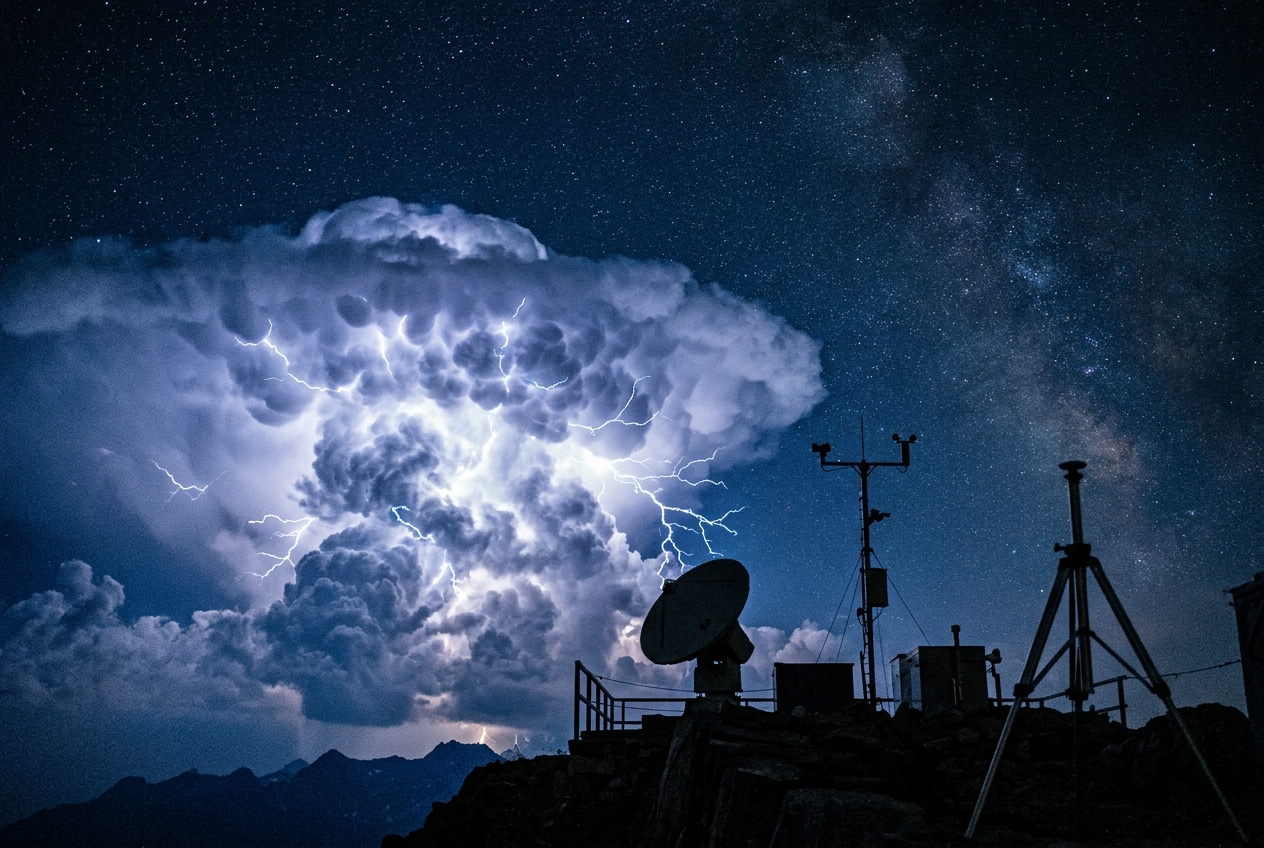
The late-afternoon air hangs thick, heavy, and motionless over the parched landscape. For hours, the summer sun has baked the topsoil, but now the horizon is overtaken by a colossal wall of shadow. A towering cumulonimbus cloud marches across the plains, its anvil head flattening against the tropopause ten miles above the earth, expanding like an icy shield across the stratosphere.
At ground level, the atmosphere shifts with visceral immediacy. The temperature plummets ten degrees in a matter of seconds as a ferocious cold downdraft tears through the canopy. The sweet, sharp fragrance of petrichor—rain-saturated soil and crushed plant oils—mingles with the distinct, metallic tang of ozone. The ambient light drains into an eerie, bruised indigo. The pressure drops noticeably; you can feel the faint popping sensation in your eardrums as the storm's convective updraft drinks millions of tons of warm, buoyant air per second.
Then, the hair on your forearms begins to lift.
An invisible, electrostatic tension has locked onto the terrain. Trees, fence posts, and blades of grass begin to whisper with faint, unseen electrical coronas. High above, within the dark, churning core of the cloud where supercooled water droplets and hail collide in violent updrafts, billions of volts of potential difference are being forged.
Suddenly, a blinding pulse of sheet lightning fractures the cloud from within. To the human eye, it is a magnificent, familiar display of raw meteorological power. But if your eyes could register high-energy radiation, you would have witnessed something far more astounding: a blinding, sub-millisecond flash of pure gamma radiation—a terrestrial gamma-ray flash (TGF)—beaming upward toward the blackness of space with an energy comparable to the emissions from the edge of a black hole.
2. What's Actually Happening — Plain English First
Until the mid-1990s, conventional astrophysics held that high-energy gamma-ray bursts were the exclusive domain of extreme cosmic phenomena: exploding supernovas, neutron star mergers, and active galactic nuclei located millions of light-years away. That paradigm was shattered when space telescopes designed to study deep-space astrophysics turned their sensors back toward Earth and discovered intense, sub-millisecond bursts of hard gamma rays emanating directly from our own atmosphere. These phenomena are known as Terrestrial Gamma-Ray Flashes (TGFs).
To understand how a rain cloud transforms into a particle accelerator, think of the atmosphere as a giant, crowded pinball machine. Under normal conditions, if you shoot a marble (an electron) through the machine, it immediately bumps into bumpers and pins (nitrogen and oxygen molecules). Every collision robs the marble of its speed, causing it to slow down and wander aimlessly. In ordinary household circuits or benign static shocks, electrons cannot gain much kinetic energy because the atmospheric "drag" perpetually resets their speed.
However, an electron traveling through matter experiences a peculiar physical property: the faster it moves, the less friction it experiences once it crosses a certain speed threshold.
If a severe thunderstorm generates a powerful enough macroscopic electric field across a span of several kilometers, the electrical force pulling the electron forward overcomes the atmospheric drag. The electron escapes the drag trap—it becomes a "runaway" particle.
As this single runaway electron accelerates to near-light speed, it violently smashes into an atmospheric atom, knocking out a secondary energetic electron. Because the storm's electric field is still active, both electrons now accelerate and knock free two more. Two become four, four become eight, and within microseconds, a microscopic cascade explodes into an avalanche of billions of relativistic electrons. This cascading phenomenon is called a Relativistic Runaway Electron Avalanche (RREA).
When this roaring river of relativistic electrons plows through air molecules, the intense electric fields of nitrogen and oxygen nuclei violently deflect the electrons. In physics, whenever a charged particle decelerates or changes direction, it must radiate away its lost energy as light. Because these electrons are moving at nearly the speed of light, that radiated light is emitted not as visible glow or heat, but as ultra-hard gamma rays—a process known as Bremsstrahlung (German for "braking radiation").
3. The Science (for those who want to go deeper)
To formalize the microphysics of Terrestrial Gamma-Ray Flashes, we must turn to the foundational mechanics of relativistic electrodynamics and atomic collisions, first formulated by Soviet physicist Aleksandr Gurevich in 1992 and subsequently expanded through the relativistic feedback models of Joseph Dwyer.
The Bethe-Bloch Friction Minimum and the Runaway Threshold
An electron traversing air loses kinetic energy primarily through inelastic Coulomb collisions with atomic orbital electrons (ionization friction). The mean energy loss per unit path length is described by the relativistic Bethe-Bloch formula:
$$-\left\langle \frac{d\mathcal{E}}{dz} \right\rangle = 2\pi r_e^2 m_e c^2 n_e \frac{1}{\beta^2} \left[ \ln\left(\frac{\mathcal{E}^2 (\mathcal{E} + 2m_e c^2)}{2 I^2 m_e c^2}\right) + (1-\beta^2) - (2\sqrt{1-\beta^2} - 1 + \beta^2)\ln 2 + \frac{1}{8}(1-\sqrt{1-\beta^2})^2 - \delta \right]$$
Where: - $r_e$ is the classical electron radius ($2.818 \times 10^{-15}\text{ m}$), - $m_e$ is the electron rest mass ($9.109 \times 10^{-31}\text{ kg}$), - $c$ is the speed of light ($2.998 \times 10^8\text{ m/s}$), - $n_e$ is the ambient electron number density of air, - $\beta = v/c$ is the relativistic velocity factor, - $\mathcal{E}$ is the kinetic energy, - $I$ is the mean excitation potential of air ($\approx 85.7\text{ eV}$), - $\delta$ is the density-effect correction.
When plotted against kinetic energy, the ionization friction curve exhibits a distinct minimum at approximately $\mathcal{E}{\text{kin}} \approx 1.2\text{ to }1.5\text{ MeV}$. Below this kinetic energy, thermal electrons experience massive friction ($\sim 10^7\text{ eV/m}$ at sea level). However, at the minimum, the stopping power drops to approximately $F{\text{min}} \approx 280\text{ keV/m}$ at standard temperature and pressure (STP).
For an ambient electric field $E$ to accelerate an electron continuously, the electrostatic force $q_e E$ must exceed this minimum friction force $F_{\text{min}}$.
Equation 1: The Critical Runaway Threshold Field
The critical runaway electric field threshold $E_{\text{th}}$ required to initiate relativistic runaway is directly proportional to the ambient air density $\rho$:
$$E_{\text{th}} \approx E_0 \cdot \left(\frac{\rho}{\rho_0}\right)$$
Where: - $E_0 \approx 2.8 \times 10^5\text{ V/m} = 280\text{ kV/m}$ represents the critical threshold field at standard temperature and pressure ($T_0 = 273.15\text{ K}$, $P_0 = 1013.25\text{ hPa}$), - $\rho$ is the local mass density of air at the thundercloud altitude, - $\rho_0$ is the standard atmospheric density at sea level ($\approx 1.225\text{ kg/m}^3$).
Worked Numerical Example: The Threshold at Cloud Altitudes
Consider a deep convective thunderstorm over the tropics, where intra-cloud lightning leaders and main charge centers reside at an altitude of $z = 12\text{ km}$ ($12,000\text{ meters}$).
-
Calculate the atmospheric density ratio: Using the barometric formula with an atmospheric scale height of $H \approx 7.4\text{ km}$: $$\frac{\rho}{\rho_0} = \exp\left(-\frac{z}{H}\right) = \exp\left(-\frac{12.0}{7.4}\right) \approx \exp(-1.6216) \approx 0.1976$$ The air density at $12\text{ km}$ is roughly $20\%$ of its sea-level value.
-
Compute the required runaway threshold field: $$E_{\text{th}} \approx (2.8 \times 10^5\text{ V/m}) \times 0.1976 \approx 5.53 \times 10^4\text{ V/m} = 55.3\text{ kV/m}$$
Physical Interpretation: While creating an avalanche at sea level requires an enormous field of $280\text{ kV/m}$, at the cruising altitude of commercial jetliners ($12\text{ km}$), an electric field of only $\approx 55\text{ kV/m}$ is sufficient to trigger relativistic electron runaway. Because thunderclouds routinely produce localized field enhancements between $80\text{ kV/m}$ and $150\text{ kV/m}$, the conditions for runaway acceleration are easily satisfied in the upper troposphere.
Seed Particles and the Avalanche Multiplication
Where do the initial energetic electrons come from? Thunderstorms do not need to generate them from scratch; nature provides a continuous ambient shower of secondary cosmic rays. High-energy protons from deep space constantly strike the upper atmosphere, producing a background flux of relativistic electrons and muons ($\approx 1\text{ per }\text{cm}^2\text{ per minute}$). When one of these cosmic-ray secondaries drifts into a region where $E > E_{\text{th}}$, it acts as the "seed" that ignites the avalanche.
Equation 2: Exponential Avalanche Growth
As seed electrons accelerate through an over-critical field region of length $\Delta z$, the population of relativistic electrons $N(z)$ grows exponentially according to the avalanche multiplication scale:
$$N(z) = N_0 \cdot \exp\left(\frac{\Delta z}{\lambda_{\text{av}}}\right)$$
Where: - $N_0$ is the initial number of seed electrons, - $\Delta z$ is the spatial extent of the high-field region along the electric field vector, - $\lambda_{\text{av}}$ is the characteristic avalanche length scale (the mean distance required for the electron population to increase by a factor of $e$).
The avalanche length scale $\lambda_{\text{av}}$ is parameterized semi-empirically by Dwyer and Gurevich as:
$$\lambda_{\text{av}} \approx \frac{\mathcal{E}{\text{av}}}{e \left( E - E{\text{th}} \right)}$$
Where $\mathcal{E}_{\text{av}} \approx 7.3\text{ MeV} \times (\rho / \rho_0)$ is the characteristic energy gain constant, and $e$ is the elementary charge ($1.602 \times 10^{-19}\text{ C}$).
Worked Numerical Example: The Avalanche Multiplier
Suppose an upward-propagating positive lightning leader tip creates an intense electric field region where $E = 120\text{ kV/m}$ across a vertical column of $\Delta z = 800\text{ m}$ at an altitude of $12\text{ km}$ (where $E_{\text{th}} \approx 55.3\text{ kV/m}$ and $\rho/\rho_0 \approx 0.198$).
-
Calculate the characteristic energy $\mathcal{E}_{\text{av}}$: $$\mathcal{E}_{\text{av}} = 7.3\text{ MeV} \times 0.1976 \approx 1.442\text{ MeV} = 1.442 \times 10^6\text{ eV}$$
-
Compute the excess electric field: $$E - E_{\text{th}} = 120\text{ kV/m} - 55.3\text{ kV/m} = 64.7\text{ kV/m} = 6.47 \times 10^4\text{ V/m}$$
-
Calculate the avalanche length $\lambda_{\text{av}}$: $$\lambda_{\text{av}} \approx \frac{1.442 \times 10^6\text{ eV}}{e \cdot (6.47 \times 10^4\text{ V/m})} = \frac{1.442 \times 10^6}{6.47 \times 10^4}\text{ m} \approx 22.3\text{ meters}$$
-
Calculate the total multiplication factor: The number of avalanche e-folding lengths along the $800\text{ m}$ column is: $$\frac{\Delta z}{\lambda_{\text{av}}} = \frac{800\text{ m}}{22.3\text{ m}} \approx 35.87$$ The electron multiplication factor is: $$\frac{N}{N_0} = \exp(35.87) \approx 3.79 \times 10^{15}$$
Physical Interpretation: A modest initial injection of just 100 cosmic-ray seed electrons ($N_0 = 100$) will multiply into an astronomical swarm of over $3.7 \times 10^{17}$ relativistic electrons in less than three microseconds!
Bremsstrahlung, Pair Production, and Dwyer's Relativistic Feedback
As this torrent of $10^{17}$ relativistic electrons tears through the air, they undergo catastrophic inelastic scattering against the Coulomb fields of nitrogen ($Z=7$) and oxygen ($Z=8$) nuclei. The electrons decelerate violently, converting their kinetic energy into high-energy photons via Bremsstrahlung:
$$e^- + Z \xrightarrow{\text{Coulomb}} e^- + Z + \gamma_{\text{hard}}$$
These gamma photons attain energies reaching tens of mega-electronvolts ($\text{MeV}$)—far exceeding the energy of medical X-rays ($\sim 0.05\text{ MeV}$) and rivaling cosmic gamma rays.
When these high-energy photons travel through the cloud, two critical secondary processes occur: 1. Compton Scattering: Gamma photons collide with ambient atomic electrons, knocking them forward at relativistic speeds to create new runaway seeds. 2. Pair Production: Photons with energies exceeding $2 m_e c^2 \approx 1.022\text{ MeV}$ interact with atomic nuclei to spontaneously generate electron-positron pairs: $$\gamma + Z \to e^- + e^+ + Z$$
This brings us to Dwyer's Relativistic Feedback Mechanism. Positrons ($e^+$) carry a positive charge, meaning the thundercloud's electric field accelerates them in the opposite direction (downward). As these positrons travel backward toward the origin of the avalanche, they collide with air molecules, undergoing ionization collisions and generating new forward-directed runaway electrons. When they slow down, they annihilate with ambient electrons ($e^+ + e^- \to 2\gamma$), producing additional energetic gamma rays that Compton-scatter into even more forward seed electrons.
This creates an internal, self-sustaining relativistic feedback loop. If the electric field is large enough, the feedback factor exceeds unity ($k_{\text{feedback}} \ge 1$), and the thunderstorm discharges its electrical energy in an explosive, self-amplifying burst of $10^{17}\text{ to }10^{18}$ gamma-ray photons within a time window of less than $100\text{ microseconds}$ ($0.1\text{ ms}$).
Orbital and Ground-Based Observational Evidence
The theoretical framework of RREA and relativistic feedback has been verified through a global network of spaceborne observatories and ground arrays:
-
Spaceborne Telescopes: - The Fermi Gamma-ray Space Telescope (via its Gamma-ray Burst Monitor, GBM) has recorded thousands of TGFs, detecting individual photon energies exceeding $40\text{ MeV}$. In several instances, Fermi flew through the magnetic field lines connected to a thunderstorm and detected clouds of terrestrial positrons beamed directly into space. - The Atmosphere-Space Interactions Monitor (ASIM), mounted on the exterior of the International Space Station, provides simultaneous, high-speed photometer and gamma-detector recordings. ASIM demonstrated that TGFs occur simultaneously with intense optical and ultraviolet emissions at the exact moment an initial lightning leader leaps upward within the cloud. - Earlier instruments, such as NASA's RHESSI solar satellite and the Compton Gamma-Ray Observatory (BATSE), laid the initial foundation proving that TGF spectra match Bremsstrahlung radiation from electrons accelerated up to tens of MeV.
-
Ground-Based Energetic Radiation & Radio Sferics: - Ground arrays, such as the Telescope Array in Utah and the European LOFAR radio telescope, have detected downward-directed relativistic electron bursts and gamma-ray showers hitting the ground during cloud-to-ground strikes. - These energetic radiation bursts are precisely correlated with Low Frequency (LF) and Very Low Frequency (VLF) radio signatures—known as lightning sferics or Energetic In-cloud Pulses (EIPs)—confirming that the lightning leader's rapid electric potential jump acts as the primary trigger.
4. Practical Outdoor Guidance: Reading the Electrified Atmosphere
While human beings cannot directly perceive gamma rays, the atmospheric conditions that give birth to runaway electron avalanches produce unmistakable visual, barometric, and electrical clues that anyone outdoors can observe and interpret.
1. Visual Signatures in the Sky
- The Anvil and the Overshooting Top: Keep a close watch on the anvil of a cumulonimbus cloud. If you observe a distinct dome or "knob" protruding violently through the flat anvil into the clear stratosphere above (an overshooting top), this indicates an updraft exceeding $40\text{ to }50\text{ meters per second}$. These colossal updrafts generate the rapid charge separation required for relativistic runaway fields.
- Shelf Clouds and Wall Clouds: A low, menacing, wedge-shaped shelf cloud rolling along the leading edge of a storm indicates an intense cold outflow boundary. If you see rapid rotation or ragged upward-scudding clouds along the base, the local convective electric fields are surging.
- Mammatus Formations: Smooth, pouch-like clouds hanging beneath the anvil indicate severe turbulence and strong microphysical mixing between ice crystals and graupel.
2. Instrument Readings to Monitor
- The Barometer: Watch for the classic "thunderstorm barograph trace." As the storm approaches, atmospheric pressure drops steadily due to the broad low-pressure convergence zone. However, as the storm's downdraft core and rain hit, the barometer will suddenly spike upward by $2\text{ to }4\text{ hPa}$ in minutes—a phenomenon known as the thunderstorm wake high or cold pool pressure dome.
- The Thermometer: A sudden, sharp drop in surface temperature ($5^\circ\text{C to }10^\circ\text{C}$ in under three minutes) marks the arrival of the cold downdraft (gust front). This is your final warning that severe lightning discharges are imminent.
- The AM Radio Detector: If you are outdoors or in a vehicle without digital radar access, switch a battery-powered radio to an unused AM frequency (e.g., $530\text{ kHz}$). Lightning discharges and energetic in-cloud pulses emit broad-spectrum electromagnetic sferics that manifest as sharp, loud pops and crackles over the speaker long before the thunder becomes audible.
3. Practical Safety Protocol for Outdoors Enthusiasts
- The 30/30 Rule: Endorsed by the National Oceanic and Atmospheric Administration (NOAA) and the Met Office: when you see a lightning flash, count the seconds until you hear thunder. If that time is 30 seconds or less, the storm is within $10\text{ km}$ ($6\text{ miles}$)—well within striking distance of both direct lightning and high-altitude electrostatic leaders. Seek substantial shelter immediately. Remain indoors for at least 30 minutes after hearing the last clap of thunder.
- Electrostatic Warning Sign: If you feel your hair stand on end, hear buzzing or humming from metal gear (trekking poles, fishing rods, wire fences), or observe faint blue St. Elmo's fire, you are standing directly in an active electrostatic leader channel. Drop metallic objects, crouch low on the balls of your feet with your heels touching (to minimize ground contact and step voltage), and tuck your head down. Do not lie flat on the ground.
5. Today's Meteorological Rule of Thumb
Authoritative References and Further Reading
- World Meteorological Organization (WMO) Severe Weather Guide
- National Oceanic and Atmospheric Administration (NOAA) Lightning Safety
- Met Office UK: Understanding Thunderstorms and Lightning
- NASA Fermi Gamma-Ray Space Telescope: Terrestrial Gamma-Ray Flashes
- European Space Agency (ESA) ASIM Mission on the International Space Station
- Dwyer, J. R., et al. (2012): High-energy atmospheric physics, Space Sci. Rev. / Wikipedia Resource