Subsun & Subparhelia Dynamics: How Aerodynamically Leveled Plate Crystals and Subhorizon Refraction Forge Below-Horizon Solar Doubles
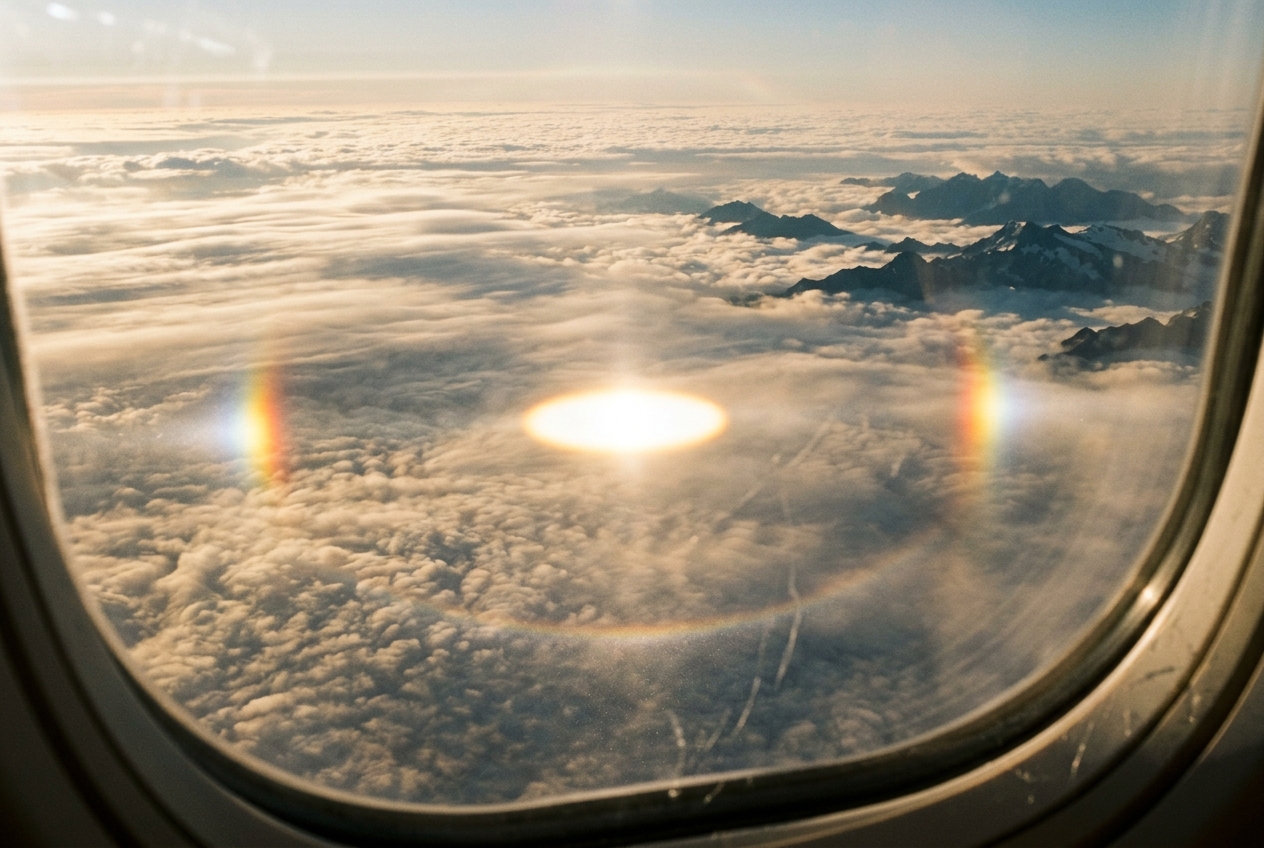
When sub-zero stillness transforms the lower atmosphere into a suspended hall of mirrors, airborne observers can look down to witness phantom suns and iridescent arcs burning within the cloud deck beneath them.
1. Opening Scene: The Mirage in the Abyss
Cruising at thirty-six thousand feet above the frost-locked expanse of the subarctic, the world outside the double-paned aircraft cabin window appears cleaved in two. Above the wing stretches the deep, cobalt vault of the lower stratosphere, barren of weather and lit by a piercing, unblinking morning sun. Below lies an unbroken floor of cirrostratus cloud—a blinding desert of frozen mist stretching toward the curved rim of the Earth.
The air outside is brutally cold, hovering near fifty degrees below zero Celsius, and entirely devoid of convective turbulence. Inside the cabin, passengers adjust their sunshades against the glare, yet looking downward reveals an extraordinary sight. Suspended not in the heavens, but deep within the rolling white plateau of the cloud below the horizon, is a second sun.
       Sun (Elevation +h)
           \
            \
--- Horizon - \ --------------------------------------------- (0° Eye Level)
               \
                \
                 [ Subsun ] (Elevation -h)
            /                 \
[ Left Subparhelion ]    [ Right Subparhelion ]
This is no diffuse glare or oily rainbow smear on the acrylic pane. It is a brilliant, blindingly coherent orb of white light—a "subsun"—anchored precisely as far below the true astronomical horizon as the celestial Sun sits above it. Flanking this phantom orb to the left and right, spaced along an invisible subterranean arc, burn two intense, jewel-like patches of spectral color: the subparhelia, or subhorizon sun dogs. Their inner edges glow a sharp ruby red, bleeding outward into emerald green and electric sapphire before fading into the brilliant white cloud deck.
To the untrained eye, it appears as though the aircraft is floating above an impossible ocean of polished glass reflecting the sky. In reality, the observer is peering into a colossal optical engine comprised of billions of microscopic, aerodynamically leveled ice crystals, each behaving as a floating prism and mirror.
2. What’s Actually Happening — Plain English First
To understand why a sun can appear beneath the earth, think of the atmosphere not as an empty void, but as a layered ballroom. In turbulent weather, the air is an energetic dance floor where updrafts and downdrafts tumble snowflakes and water droplets in complete chaos. But when high-pressure weather systems stall over frozen landscapes, or when thin cirrus clouds drift through a stable upper troposphere, the atmosphere becomes intensely quiet.
In this calm, moisture freezes directly from vapor into minute, microscopic hexagonal plates—flat, six-sided wafers of pure ice no thicker than a fraction of a sheet of paper. As these crystals fall under gravity, they do not tumble wildly like crumpled paper. Instead, think of dropping a flat plastic coaster or a leaf into a swimming pool: the resistance of the water pushes flat against the broad face, forcing it to settle horizontally as it glides downward.
The atmosphere behaves precisely the same way. As billions of microscopic hexagonal ice crystals drift slowly toward the ground through quiet air, aerodynamic drag cushions their broad bottom faces, forcing them to lie flat, parallel to the surface of the Earth.
           INCOMING SUNLIGHT
               \       /
                \     /  (Specular Reflection)
                 v   ^
          +-----------------+  <-- Basal Face (0001)
          |   HEXAGONAL     |
          |   ICE PLATE     |
          +-----------------+  <-- Basal Face (0001)
                 |   |
                 v   v
           Aerodynamic Drag
Each horizontal crystal face acts as an optical mirror. When sunlight strikes the upper horizontal surface of these descending crystals, the light bounces upward, toward an observer looking down from a mountain peak or an airplane window. Because every crystal is aligned horizontally within fractions of a degree, their individual microscopic reflections combine into a single, blinding specular image of the Sun: the subsun.
When sunlight enters through the flat top face or side walls of these crystals, it undergoes refraction—bending through the crystal’s 60-degree internal prism angles before bouncing internally off a mirror-flat face and exiting toward the observer below. This compound bending separates white sunlight into its constituent spectral wavelengths, creating the iridescent subparhelia (sub-sun dogs) mirrored beneath the horizon.
3. The Science: Microphysics, Fluid Dynamics, and Raypath Optics
For those who wish to step deeper into the physics, the creation of subhorizon halos is a masterpiece of fluid mechanics and geometric optics governed by the laws of crystal habit, boundary layer aerodynamics, and the classic refractive indices of hexagonal ice.
3.1 Aerodynamic Levelling and Low Reynolds Number Sedimentation
Atmospheric ice crystallizes primarily in the hexagonal $I_h$ phase. When temperatures in the cloud layer range between $-10^\circ\text{C}$ and $-25^\circ\text{C}$ under conditions of low supersaturation, ice grows preferentially along its secondary prism axes ${10\bar{1}0}$, forming thin hexagonal plates whose basal faces $(0001)$ are dramatically larger than their side prism faces. The ratio of crystal thickness $c$ to diameter $a$ often falls below $c/a < 0.1$.
As these plates sediment under the pull of gravity, they experience aerodynamic drag from the surrounding air. The nature of this flow is characterized by the Reynolds number ($Re$), a dimensionless parameter describing the ratio of inertial forces to viscous forces within the fluid medium:
$$Re = \frac{\rho_a \, v_t \, d}{\mu}$$
where: - $\rho_a$ is the ambient air density ($\approx 0.45\text{ kg/m}^3$ at flight cruising altitudes of $10\text{ km}$), - $v_t$ is the terminal settling velocity of the ice crystal ($\approx 0.1\text{ to }0.5\text{ m/s}$), - $d$ is the crystal’s maximum horizontal diameter ($100\text{ to }500\text{ }\mu\text{m}$), - $\mu$ is the dynamic viscosity of air ($\approx 1.45 \times 10^{-5}\text{ Pa}\cdot\text{s}$ at $-40^\circ\text{C}$).
+-----------------------------------------------------------------------------+
| CALLOUT: THE STABILITY CRITERION                                            |
| For ice plates with diameters between 50 and 300 micrometers falling in the |
| upper troposphere, Re falls strictly within the range of 10 to 100.         |
| In this flow regime, a stable toroidal vortex ring forms behind the falling |
| plate. Any momentary angular tilt (pitch or roll) generates an asymmetric   |
| pressure gradient—a restoring aerodynamic torque—that damps out rotational |
| libration, locking the basal (0001) faces into a strictly horizontal plane. |
+-----------------------------------------------------------------------------+
If the crystal diameter is too small ($d < 20\text{ }\mu\text{m}$, $Re \ll 1$), Brownian motion and thermal molecular collisions randomly tumble the crystal, washing out coherent optical features into diffuse pillars or fog bows. If the crystal is too large ($d > 1\text{ mm}$, $Re > 300$), non-linear vortex shedding causes the crystal to tumble or flutter chaotically, as detailed in the American Meteorological Society Glossary. Hence, subhorizon halos demand a distinct aerodynamic sweet spot ($Re \sim 10\text{--}100$).
3.2 Raypath Optics of the Subsun and Bottlinger’s Rings
The subsun is generated by the simplest possible raypath: external specular reflection from the horizontally leveled top basal face $(0001)$ of the ice plate (optical Raypath 1).
          True Sun
              \  +h
               \
================\================= Earth Horizon (0°)
                 \
                  \  -h
              Observer Eye
                   ^
                  /
                 /
          [Crystal Plane] (0001)
By the law of reflection, the angle of reflection equals the angle of incidence relative to the surface normal $\mathbf{\hat{n}} = (0, 0, 1)$. Consequently, if the celestial Sun is at an elevation angle of $+h$ and solar azimuth $\phi_0$, the reflected rays appear to originate from an apparent elevation of:
$$\theta_{\text{subsun}} = -h, \quad \phi_{\text{subsun}} = \phi_0$$
When the air is exceptionally calm, crystal tilt angles deviate from the horizontal by less than $\sigma_\alpha \approx 0.2^\circ$, producing a subsun that is an exact, pinpoint virtual image of the solar disk.
However, slight aerodynamic perturbations or micro-scale shear induce a narrow Gaussian distribution of crystal tilts with standard deviation $\sigma_\alpha$. Because of the geometry of oblique reflection, an angular tilt $\alpha$ in the vertical plane (tilt toward or away from the observer) alters the reflected elevation by $2\alpha$, whereas an equal tilt in the horizontal plane (tilt sideways) alters the azimuth by only $2\alpha \sin h$.
This geometric asymmetry stretches the point-like reflection into a vertical elliptical pattern known as Bottlinger’s Rings:
+-----------------------------------------------------------------------------+
| EQUATION 1: BOTTLINGER'S ELLIPTICITY RATIO                                  |
|                                                                             |
| The ratio of the horizontal angular spread (Δθ_h) to the vertical angular   |
| spread (Δθ_v) of the reflected sunlight from a population of librating      |
| plates tilted by maximum angle α is given by:                              |
|                                                                             |
|                    e = (Δθ_h) / (Δθ_v) = sin(h)                             |
|                                                                             |
| where h is the solar elevation angle.                                       |
+-----------------------------------------------------------------------------+
Worked Example: Calculating the Distortion of Bottlinger's Rings
Consider an observer aboard an aircraft flying over an ice cloud when the Sun is at an elevation of $h = 30^\circ$. The falling ice plates experience minor aerodynamic flutter with a maximum tilt angle of $\alpha = 1.5^\circ$.
- Vertical Angular Width ($\Delta\theta_v$): $$\Delta\theta_v = 2\alpha = 2 \times 1.5^\circ = 3.0^\circ$$
- Horizontal Angular Width ($\Delta\theta_h$): $$\Delta\theta_h = 2\alpha \sin(h) = 2 \times 1.5^\circ \times \sin(30^\circ) = 3.0^\circ \times 0.5 = 1.5^\circ$$
- Aspect Ratio ($e$): $$e = \frac{1.5^\circ}{3.0^\circ} = 0.50$$
The subsun is transformed from a circular disk into an elongated ellipse whose vertical axis is twice as long as its horizontal axis. When multiple reflections occur between adjacent tilted crystal facets, this distortion organizes into nested, concentric interference rings first documented by the German meteorologist Carl Bottlinger in 1910.
3.3 Subparhelia Refraction Dynamics and Bravais Optics
While the subsun is purely reflective, its vibrant companions—the subparhelia—require compound transmission and internal reflection through the hexagonal prism lattice.
A standard upper-air parhelion (sun dog) occurs when light enters a vertical prism side face ${10\bar{1}0}$, refracts through the crystal's interior at a $60^\circ$ wedge angle, and exits through an alternate vertical side face. For subparhelia, light follows one of two compound raypaths:
- Raypath 1-3-2: Sunlight enters the flat, horizontal upper basal face $(0001)$, undergoes total internal reflection from an inclined side prism face, and exits through an opposing lower prism face.
- Raypath 3-1-4: Sunlight enters a vertical prism side face ${10\bar{1}0}$, undergoes total internal reflection off the internal bottom basal face $(0001)$, and refracts out through an adjacent vertical side face.
       Ray Entry (Side Face)
           \
            +---------\---------+  <-- Top Basal Face (0001)
            |          \        |
            |           \       |  Internal Prism Angle = 60°
            |            v      |
            +-------------\-----+  <-- Bottom Basal Face (Internal Reflection)
                           \   /
                            \ /
                             v
                    Ray Exit (Adjacent Side Face)
Because the internal reflection occurs off a basal face that is mathematically horizontal, the vertical component of the raypath is inverted: the ray exits downward at an elevation angle of exactly $-h$. Crucially, the horizontal component of the refraction is governed strictly by the $60^\circ$ prism angle between the vertical faces.
According to Bravais' Law of Refraction for Inclined Rays, when parallel light strikes a prism tilted at an angle $h$ relative to the ray’s plane of incidence, the crystal behaves as if it possesses an effective refractive index $n'$:
$$n' = \sqrt{\frac{n^2 - \sin^2 h}{\cos^2 h}}$$
The azimuthal angular separation $\Delta\phi$ of the subparhelion from the solar vertical is governed by the minimum deviation condition through the $60^\circ$ internal prism angle ($A = 60^\circ$):
+-----------------------------------------------------------------------------+
| EQUATION 2: BRAVAIS AZIMUTHAL SEPARATION FOR SUBPARHELIA                    |
|                                                                             |
| The angular distance Δϕ between the solar azimuth and the subparhelion at   |
| solar elevation h is given by:                                              |
|                                                                             |
|        Δϕ = 2 * arcsin[ (sqrt(n² - sin²h) / cos(h)) * sin(A/2) ] - A        |
|                                                                             |
| where n ≈ 1.309 (refractive index of ice for red light, λ = 656 nm) and    |
| A = 60° (the internal angle between alternating prism facets).              |
+-----------------------------------------------------------------------------+
Worked Example: Calculating Subparhelion Azimuthal Position
Let an observer at an alpine observatory measure a solar elevation of $h = 20^\circ$ over a valley filled with supercooled ice fog. We calculate the precise azimuthal position $\Delta\phi$ of the red inner edge of the subparhelion ($n = 1.309$).
-
Calculate the numerator terms: $$\sin(20^\circ) = 0.3420 \implies \sin^2(20^\circ) = 0.1170$$ $$n^2 = (1.309)^2 = 1.7135$$ $$\sqrt{n^2 - \sin^2 h} = \sqrt{1.7135 - 0.1170} = \sqrt{1.5965} = 1.2635$$
-
Calculate the denominator terms: $$\cos(20^\circ) = 0.9397$$
-
Compute the effective refractive ratio: $$\frac{\sqrt{n^2 - \sin^2 h}}{\cos h} = \frac{1.2635}{0.9397} = 1.3446$$
-
Apply the prism half-angle ($A/2 = 30^\circ$, $\sin 30^\circ = 0.5000$): $$\text{Argument} = 1.3446 \times 0.5000 = 0.6723$$ $$\arcsin(0.6723) = 42.24^\circ$$
-
Determine the total azimuthal separation ($\Delta\phi$): $$\Delta\phi = 2(42.24^\circ) - 60.00^\circ = 84.48^\circ - 60.00^\circ = 24.48^\circ$$
+-----------------------------------------------------------------------------+
| OPTICAL PREDICTION RESULT                                                   |
| At a solar elevation of +20°, the subparhelia will appear at an elevation of|
| -20° (below the horizon), displaced horizontally by 24.48° to the left and  |
| right of the solar meridian.                                                |
+-----------------------------------------------------------------------------+
Because the refractive index of ice varies with wavelength ($n_{\text{red}} = 1.307$ vs. $n_{\text{violet}} = 1.317$), blue and violet light experience a larger effective index, placing the blue outer tail of the subparhelion at an azimuth of $\Delta\phi \approx 25.8^\circ$. This dispersion produces the distinctive, razor-sharp color separation characteristic of pure prismatic refraction.
3.4 Rare Companion Subhorizon Phenomena
When crystal quality is pristine and optical paths multiply, subparhelia do not stand alone. They form part of an extensive family of subhorizon optical phenomena documented by the World Meteorological Organization (WMO):
+-----------------------------------------------------------------------------+
| SUBHORIZON PHENOMENON  | RAYPATH MECHANISM             | APPARENT POSITION  |
+------------------------+-------------------------------+--------------------+
| Subsun                 | Specular reflection off basal | Azimuth: φ₀        |
|                        | (0001) faces                  | Elevation: -h      |
+------------------------+-------------------------------+--------------------+
| Subparhelia            | Refraction through 60° prism  | Azimuth: φ₀ ± Δϕ   |
| (Sub-sun dogs)         | + basal internal reflection   | Elevation: -h      |
+------------------------+-------------------------------+--------------------+
| Subparhelic Circle     | Multiple external/internal    | Azimuth: 0° to 360°|
|                        | reflections off vertical walls| Elevation: -h      |
+------------------------+-------------------------------+--------------------+
| Subanthelion           | Internal retroreflection      | Azimuth: φ₀ + 180° |
| (Sub-counter sun)      | through orthogonal facets     | Elevation: -h      |
+------------------------+-------------------------------+--------------------+
- The Subparhelic Circle: A luminous, colorless white horizontal band encircling the sky at a uniform elevation of $-h$. It is created by simple external and internal reflections from the vertical prism faces of the same aerodynamically aligned plate crystals.
- The Subanthelion: A bright white diffuse spot located directly opposite the subsun along the subparhelic circle (azimuth $\phi_0 + 180^\circ$, elevation $-h$). Rays enter a basal face, reflect internally off two perpendicular prism faces in a corner-cube configuration, and exit parallel to the incident direction.
4. Practical Outdoor Guidance: The Observer’s Protocol
While subhorizon halos are mathematically complex, observing them in the field requires simple situational awareness and a clear understanding of atmospheric stratification.
                  +-----------------------------------+
                  |   COLD, DRY STRATIFIED AIR MASS   |
                  |     (Stable Anticyclonic Ridge)    |
                  +-----------------------------------+
                                    |
                                    v
     +-------------------------------------------------------------+
     | Low-level Temperature Inversion (T_valley < T_ridge)        |
     | Calm Surface Winds (< 2 m/s) + High Pressure (> 1020 hPa)   |
     | Diamond Dust Formation (-10°C to -25°C in Saturated Fog)    |
     +-------------------------------------------------------------+
                                    |
                                    v
     +-------------------------------------------------------------+
     | ELEVATED OBSERVATION PLATFORM (Aircraft / Alpine Peak)      |
     | Look DOWN at -h elevation toward the sunward cloud deck!    |
     +-------------------------------------------------------------+
Where and How to Look
- Aviation Transects: Book a window seat on the sunward side of the aircraft during morning or late afternoon flights. When passing over high cirrostratus or winter stratus sheets, look downward at an angle matching the Sun's height in the sky. If the Sun is $20^\circ$ high, the subsun and subparhelia will burn $20^\circ$ below the aircraft's artificial horizon line.
- Mountaintop Ridges and Ski Resorts: High-elevation alpine ridges (such as those monitored by the UK Met Office and alpine research stations) frequently rise above winter temperature inversions. If supercooled fog or "diamond dust" fills the valley below under clear skies, stand at the crest and look down into the cloud layer toward the azimuth of the Sun.
Meteorological Indicators to Monitor
- Barometer: Look for strong, slow-moving anticyclones (barometric pressure $> 1020\text{ hPa}$). High-pressure subsidence creates the laminar, non-turbulent conditions essential for aerodynamic crystal leveling.
- Thermometer & Soundings: Check regional radiosonde skew-$T$ log-$P$ diagrams from the National Oceanic and Atmospheric Administration (NOAA). Seek a strong elevated temperature inversion layer where wind shear is minimal ($\Delta v / \Delta z < 2\text{ m/s per km}$) and ambient temperatures within the cloud deck sit between $-10^\circ\text{C}$ and $-25^\circ\text{C}$.
- Anemometer: Surface and ridge-line winds must be light ($< 3\text{ m/s}$). Turbulent mechanical mixing destroys the horizontal alignment of the plates, instantly degrading subparhelia into a featureless glare.
Field Equipment and Photographic Technique
- Linear Polarizers: Rotate a polarizing filter while observing the subparhelia. Because internal crystal reflections occur near Brewster’s angle, the scattered background cloud light is strongly polarized, allowing a polarizing filter to dramatically increase the color saturation and contrast of the subparhelia.
- Exposure Compensation: The brilliant white cloud deck will deceive camera light meters into underexposing the scene. Dial in manual exposure, shading the direct Sun above the frame with an opaque card to prevent internal lens flare from washing out faint features like the subparhelic circle.
5. Today’s Meteorological Rule of Thumb
When standing above cold, calm clouds under a clear sun, never look solely to the sky for optical marvels. If the air is frozen and the winds are still, the true celestial architecture is reflected beneath your feet—where every falling ice plate acts as a mirror, casting the sun into the cloud below.
Authoritative References & Further Reading
- Atmospheric Optics: Subsun & Lower Hemisphere Halos
- World Meteorological Organization: International Cloud Atlas — Halo Phenomena
- National Oceanic and Atmospheric Administration: Atmospheric Thermodynamics and Optics
- American Meteorological Society: Glossary of Meteorology (Bravais Optics & Ice Crystals)
- Met Office UK: Cloud Microphysics and Optical Effects