Schumann Resonances & Earth-Ionosphere Cavity Dynamics: How Global Lightning Discharges and Spherical Waveguides Resonate at 7.83 Hz
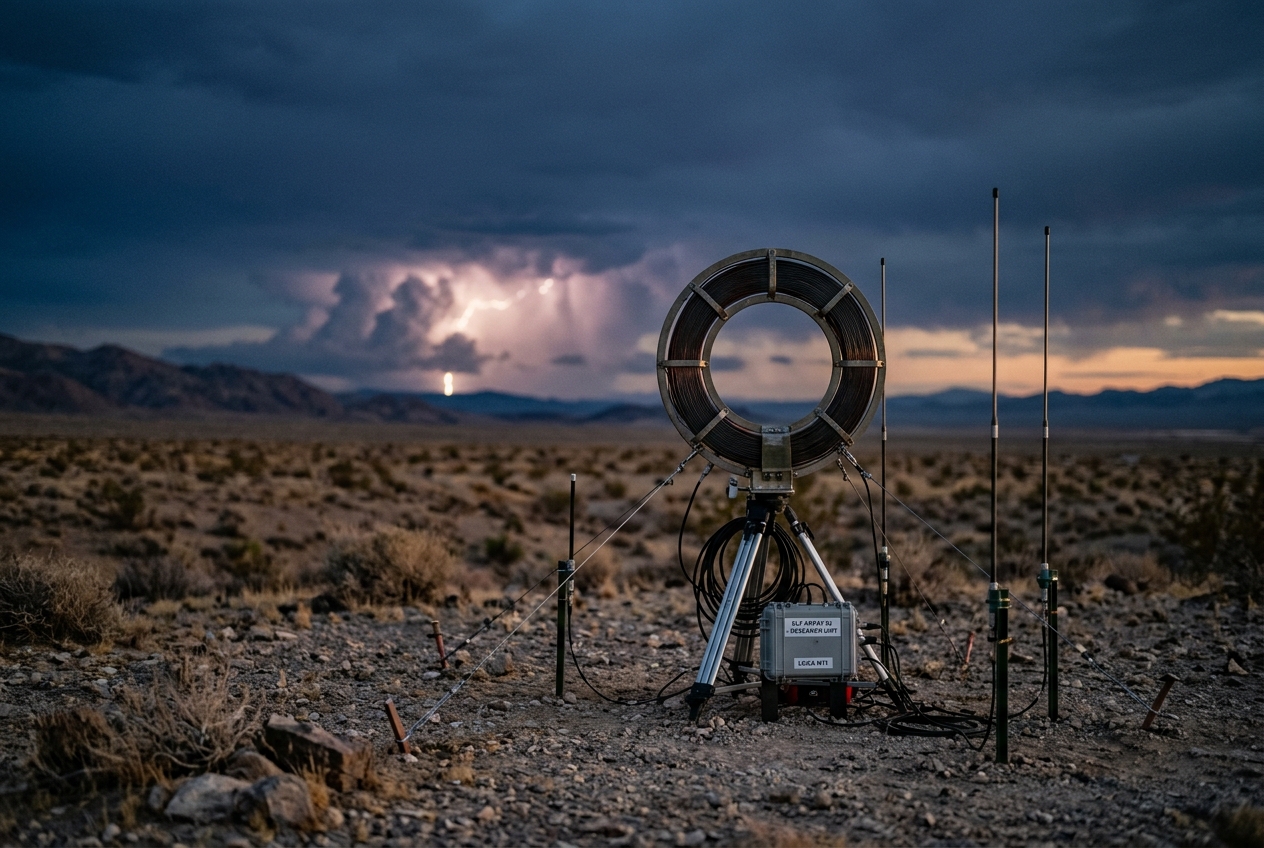
GEOPHYSICS / THE PLANETARY CAVITY
Far below the limits of human hearing, a global chorus of tropical thunderstorms drives a standing electromagnetic wave around our world. Tracking its subtle pulse reveals the thermodynamic health of our warming biosphere.
1. Opening Scene
Stand on the open expanse of an open moorland or high prairie in late August, and the sky ceases to be a passive backdrop; it becomes an encroaching, physical presence. The afternoon air, thick with moisture and suspended heat, grows unnaturally still. Across the southern horizon, towering cumulus towers—having simmered under solar irradiance since dawn—have coalesced into an ominous cumulonimbus incus. Its anvil top spreads across the upper troposphere like a frozen, fibrous canopy, bruising the sky into shades of charcoal and bruised plum.
You feel the change before you hear it. A sudden drop in ambient air temperature cascades downward in a biting gust front, carrying the unmistakable scent of petrichor—that geosmin-rich perfume thrown into the air as the first heavy raindrops fracture against baked soil. The hairs on your forearms stir, lifted by the steepening electrostatic gradient between the charged cloud base and the earth beneath your boots. Then comes the stroke: a blinding channel of plasma tears through the sky, heating the surrounding air column to nearly thirty thousand kelvins in microseconds. The explosive expansion produces a concussive shockwave that rattles your ribcage as a rolling, guttural thunder.
Yet the sensation that reaches your physical senses is merely the local, acoustic exhaust of an event whose true reach is planetary. At the instant of that flash, a colossal pulse of electromagnetic energy detached itself from the lightning channel. While the thunder dies away over several miles, the invisible electromagnetic burst shoots outward at the speed of light. It climbs toward the upper fringes of the sky, bounces beneath the edge of space, and wraps entirely around the globe in a fraction of a second. As you stand in the sudden mountain downpour, you are standing inside a vast, ringing electromagnetic instrument.
2. What’s Actually Happening — Plain English First
To understand this phenomenon, one must look at our planet not as an open ball drifting in empty vacuum, but as a self-contained, concentric architectural structure.
Think of the atmosphere as a layered cake, bounded at the bottom by a solid, highly conductive floor and at the top by an electrically reflective ceiling. The floor is the terrestrial surface of the Earth—a mix of salty oceans and moist ground that readily conducts electric charge. The ceiling sits between 60 and 90 kilometres above our heads: the lower boundary of the ionosphere, known to geophysicists as the D-region. Here, solar ultraviolet and X-ray radiation constantly strip electrons from atmospheric gas molecules, creating a rarefied sea of free electrons and ions that behaves like a mirror for low-frequency radio waves.
Between this conductive ground and the ionosphere lies the troposphere and stratosphere—vast regions of neutral, electrically insulating air. This concentric gap forms what physicists term a spherical cavity resonator.
  ======================================================  <- Ionospheric D-Region (~60–90 km)
  |                  ELECTRODYNAMIC                      |     (Conductive "Ceiling")
  |                     WAVEGUIDE                        |
  |                                                      |  <- Insulating Air (Troposphere/Stratosphere)
  |    ⚡ Lightning Stroke (~50/sec) -> [ E-M Wave ]     |
  |                                                      |
  ======================================================  <- Terrestrial Ground & Oceans
                                                               (Conductive "Floor")
If you blow across the narrow mouth of an empty glass bottle, the turbulent rush of your breath excites the column of air inside, producing a clear, steady musical tone. The pitch of that note is determined strictly by the geometry of the bottle: the sound waves reflect back and forth between the glass walls, constructively reinforcing only those wavelengths that fit perfectly within the enclosure while cancelling out all others.
On a planetary scale, lightning acts as the breath across the bottle. At any given moment, the global atmosphere crackles with roughly forty to fifty lightning discharges every second, sustained by thousands of individual convective storms raging over the tropics. Each individual stroke acts like a gigantic vertical broadcast antenna, pumping a broadband burst of extremely low-frequency (ELF) electromagnetic radiation into the insulating air gap.
Most of these radio waves quickly attenuate, but those whose physical wavelengths are comparable to the circumference of the Earth do not vanish. Instead, they travel entirely around the globe, overlap with themselves, and set up a perpetual set of standing electromagnetic waves. This unceasing, planet-wide resonance is known as the Schumann resonance, named after the German physicist Winfried Otto Schumann who predicted its existence mathematically in 1952.
3. The Science (for those who want to go deeper)
To formalise this planetary hum, we treat the shell of air between the Earth and the ionosphere as an electromagnetic waveguide operating in the transverse magnetic ($TM$) mode. Because the radial height of the cavity ($h \approx 60\text{--}90\text{ km}$) is minuscule compared to the radius of the Earth ($R_E \approx 6,371\text{ km}$), the electric field vector is predominantly vertical (radial), while the magnetic field vector is horizontal and oriented tangentially to the wavefront.
In an idealised scenario—assuming both the terrestrial surface and the ionosphere are lossless, infinitely conductive boundaries—the propagation of the electromagnetic field is governed by the scalar Helmholtz equation formulated in spherical polar coordinates $(r, \theta, \phi)$. Solutions across the sphere require the wavefunctions to be single-valued and continuous, forcing the spatial field distribution to be described by Legendre polynomials $P_n(\cos \theta)$, where $n = 1, 2, 3, \dots$ represents the discrete angular mode number.
The Ideal Resonant Mode Equation
In plain terms, this mathematical formulation predicts that a closed spherical resonator will only support standing waves whose wave numbers satisfy an eigenvalue condition linked to the discrete curvature of the sphere.
$$\boxed{f_n = \frac{c}{2\pi R_E} \sqrt{n(n + 1)}}$$
Where: * $f_n$ is the resonant frequency of the $n$-th harmonic mode (in Hertz, $\text{Hz}$), * $c$ is the speed of light in free space ($\approx 2.998 \times 10^8\text{ m/s}$), * $R_E$ is the mean radius of the Earth ($\approx 6.371 \times 10^6\text{ m}$), * $n$ is the integer mode index ($n = 1, 2, 3, \dots$).
Let us walk through a worked example for the fundamental mode ($n = 1$):
- First, calculate the fundamental transit time factor: the speed of light divided by the circumference of the Earth ($2\pi R_E \approx 40,030\text{ km}$): $$\frac{c}{2\pi R_E} = \frac{2.9979 \times 10^8\text{ m/s}}{2 \times \pi \times 6.371 \times 10^6\text{ m}} \approx 7.493\text{ Hz}$$
- Next, calculate the spatial geometric term for the first mode ($n = 1$): $$\sqrt{n(n + 1)} = \sqrt{1(1 + 1)} = \sqrt{2} \approx 1.4142$$
- Multiply the two terms together to yield the theoretical lossless frequency: $$f_1 = 7.493\text{ Hz} \times 1.4142 \approx 10.60\text{ Hz}$$
If we repeat this calculation for higher modes, the ideal lossless equation predicts a discrete harmonic ladder: * Mode 1 ($n=1$): $10.6\text{ Hz}$ * Mode 2 ($n=2$): $7.493 \times \sqrt{6} \approx 18.35\text{ Hz}$ * Mode 3 ($n=3$): $7.493 \times \sqrt{12} \approx 25.96\text{ Hz}$ * Mode 4 ($n=4$): $7.493 \times \sqrt{20} \approx 33.51\text{ Hz}$
  Ideal vs. Real Observed Schumann Resonances:
  Mode Index (n) | Theoretical Lossless | Real Observed Peak | Downward Shift (Δf)
  ---------------+----------------------+--------------------+---------------------
  n = 1          | 10.60 Hz             |  7.83 Hz           | -2.77 Hz
  n = 2          | 18.35 Hz             | 14.30 Hz           | -4.05 Hz
  n = 3          | 25.96 Hz             | 20.80 Hz           | -5.16 Hz
  n = 4          | 33.51 Hz             | 27.30 Hz           | -6.21 Hz
  n = 5          | 41.04 Hz             | 33.80 Hz           | -7.24 Hz
Why Reality Deviates: Real-World Damping and Dielectric Losses
When geophysicists first measured these signals empirically in the early 1960s (led by Martin Balser and Charles Wagner), they discovered that the fundamental resonance does not occur at $10.6\text{ Hz}$. Instead, it sits at $7.83\text{ Hz}$, accompanied by subsequent harmonic overtones at approximately $14.3\text{ Hz}$, $20.8\text{ Hz}$, $27.3\text{ Hz}$, and $33.8\text{ Hz}$.
This downward shift of nearly $26\%$ in the fundamental frequency stems directly from the fact that the Earth-ionosphere cavity is not an ideal, mirror-like resonator:
- Finite Ionospheric Conductivity: The lower D-region is not a sharp, metallic wall. It is a diffuse, exponentially grading plasma where electron density increases smoothly with altitude ($N_e(z)$). The electrical conductivity ($\sigma$) ranges between $10^{-7}\text{ S/m}$ and $10^{-4}\text{ S/m}$. Electromagnetic waves penetrate into this resistive plasma layer, dissipating energy via collisional damping between electrons and neutral molecules ($N_2, O_2$).
- Phase Velocity Retardation: Because the boundaries absorb and leak electromagnetic energy, the effective phase velocity of the wave ($v_{ph}$) inside the terrestrial waveguide drops significantly below the speed of light in a vacuum ($v_{ph} \approx 0.74c\text{ to } 0.80c$). Substituting this reduced phase velocity into our wave equation directly produces the observed fundamental resonance of $7.83\text{ Hz}$.
- Cavity Asymmetry and the Day-Night Terminator: The dayside ionosphere is compressed and heavily ionised by solar radiation (D-layer altitude $\approx 60\text{ km}$), while the nightside ionosphere relaxes and rises (effective boundary shifts up to the E-region at $\approx 90\text{ km}$). This creates an eccentric, continuously shifting waveguide geometry across the planet.
                    SUNLIT HEMISPHERE                     NIGHT HEMISPHERE
             (Intense Solar Ionisation)              (Recombination & Uplift)

             D-Region Ceiling: ~60 km                E-Region Ceiling: ~90 km
             ------------------------                ------------------------
             \                      /                \                      /
              \   Compressed Gap   /                  \    Expanded Gap    /
               \                  /                    \                  /
            ~~~~~~~~~~~~~~~~~~~~~~~~~ Earth's Core ~~~~~~~~~~~~~~~~~~~~~~~~~
The Three Global Chimneys and Diurnal Variations
Because the Schumann resonances are excited by lightning, their spectral power fluctuates in direct synchrony with the diurnal convective cycle of the Earth. Tropical meteorologists recognize three dominant continental thunderstorm centres, known colloquially as the planetary tropical chimneys: 1. The Maritime Continent (Southeast Asia, Indonesia, and Northern Australia) 2. The Congo Basin (Equatorial Africa) 3. The Amazon Basin (South America)
Convective storm activity over land peaks strongly in the mid-to-late afternoon (around 15:00 to 17:00 local solar time), driven by peak surface insolation. As the Earth rotates beneath the sun, each of these three chimneys fires up in sequence, driving a characteristic triple-peaked diurnal variation in the global Schumann amplitude when recorded in Universal Time (UTC):
  Schumann Amplitude (pT)
    ^
    |          Congo Peak
    |          (~14:00 UTC)
    |             /\
    |  Asia Peak /  \           Amazon Peak
    | (~08:00 UTC)   \          (~20:00 UTC)
    |     /\          \             /\
    |    /  \          \           /  \
    |   /    \          \_________/    \
    +----------------------------------------> Universal Time (UTC)
       04:00    08:00      14:00     20:00
- 08:00 UTC: The Maritime Continent reaches maximum convective vigor.
- 14:00 UTC: The Congo Basin—the most electrically active continental chimney on Earth—reaches its afternoon peak, producing the strongest global Schumann resonance amplitude of the 24-hour cycle.
- 20:00 UTC: The Amazon Basin achieves peak convective intensity.
Observational Instrumentation and Noise Mitigation
Measuring an electromagnetic field with a frequency below $40\text{ Hz}$ and an amplitude measured in picoteslas ($\text{pT}$, $10^{-12}\text{ Tesla}$) or microvolts per metre ($\mu\text{V/m}$) requires specialized, ultra-sensitive instrumentation installed in radio-quiet environments:
- Orthogonal Magnetic Search Coils: To capture the horizontal magnetic components ($H_{NS}$ and $H_{EW}$), researchers employ induction coil magnetometers. These consist of high-permeability ferromagnetic cores (such as mu-metal or permalloy) wound with tens of thousands of turns of ultra-fine copper wire. They are buried in subterranean, temperature-stabilised trenches to eliminate microphonic vibrations caused by wind rustling nearby vegetation.
- Vertical Capacitive Ball Antennas: The vertical electric field component ($E_r$) is measured using a spherical metallic terminal elevated several metres above a grounded plane, coupled to an ultra-high input impedance electrometer amplifier.
- Filtering Man-Made Contamination: The greatest challenge in ELF research is the crushing electromagnetic pollution generated by commercial electrical power grids (operating at $50\text{ Hz}$ in Europe and Asia, and $60\text{ Hz}$ in the Americas). Because the fifth Schumann mode ($33.8\text{ Hz}$) sits uncomfortably close to power line fundamental frequencies and their sub-harmonics, field stations utilize analog pre-amplification notch filters combined with digital signal processing (such as adaptive line enhancement and notch filtering) to suppress mains hum without distorting the underlying geophysical spectrum.
Diagnostic Applications: Climate and Space Weather
Tracking the exact frequencies, amplitudes, and quality factors ($Q$-factors) of the Schumann spectrum has evolved into an indispensable remote sensing tool:
- Global Thermometry: In a seminal paper, atmospheric scientist Earle Williams demonstrated that tropical lightning flash rates scale non-linearly with surface air temperature (varying approximately with the fifth or sixth power of temperature, $I \propto T^5\text{--}T^6$). Consequently, minute variations in tropical surface temperatures produce amplified swings in global Schumann resonance power, making the resonances a sensitive, integrated "global thermometer."
- Space Weather Perturbations: During major solar flare events, high-energy solar X-rays and energetic protons flood the sunlit upper atmosphere. This sudden ionisation dramatically lowers the effective altitude of the D-region ceiling (a phenomenon known as a Sudden Ionospheric Disturbance, or SID). This geometrical compression alters the cavity dimensions, inducing measurable, instantaneous frequency shifts and surge damping across all Schumann harmonics.
4. Practical Outdoor Guidance
While you cannot perceive extremely low-frequency radio waves directly with the human eye or ear, you can read the atmospheric indicators of the very engine that excites them. When you are out in the field, you can observe the atmospheric thermodynamic conditions that sustain the Earth's electrical resonator.
                  ANATOMY OF A PLANETARY TRANSMITTER

   Altitude
     (km)
     12 +                       /-----------\  <- Anvil Cirrus (Charge Separation)
        |                      /             \
      9 |                     |   UPDRAUGHTS  |
        |                     |   (Ice/Graupel|
      6 |                     |    Collisions)|
        |                     |               |
      3 |   Shelf Cloud       |  DOWNDRAUGHT  |
        |   =============\    |   (Rain-cooled|
      0 +-----------------\---|---------------/---  <- Ground Surface
                           \
                            \-> Flash -> ELF Pulse propagates around Earth
What to Look for in the Sky
- The Glaciating Anvil: Watch the evolution of high cumulus clouds. When their crisp, cauliflower-like tops soften, turn fibrous, and shear horizontally into a flat anvil, supercooled water droplets have frozen into ice crystals. This transition marks the onset of vigorous charge separation: collisions between rising ice crystals and descending graupel (soft hail) strip electrons, building the multi-megavolt potential required to trigger lightning.
- Shelf Clouds and Inflow Bands: A smooth, low-slung, wedge-shaped shelf cloud appearing along the leading edge of a dark rain curtain marks the boundary of the cold downdraught (gust front). Low-level ragged clouds rapidly scudding into the storm indicate an active convective updraught feeding warm, buoyant air into the storm core.
What Instrument Readings to Watch
- Digital Barometer: Watch for the thunderstorm barometric nose. As a convective storm approaches, ambient pressure typically declines steadily due to the broad thermal low. However, right as the gust front arrives, your barometer will show a sharp, sudden jump of $1.5\text{ to }3.5\text{ hPa}$. This spike is caused by the mechanical weight of the dense, rain-cooled downdraught slamming into the ground.
- Thermometer and Hygrometer: A sudden plunge in temperature ($4^\circ\text{C to }10^\circ\text{C}$ within ten minutes) coupled with humidity spiking toward saturation ($>90\%$) confirms that the storm's precipitation shaft has penetrated the boundary layer.
- Wind Vane / Anemometer: A sudden $180^\circ$ reversal in wind direction—shifting from a warm, gentle breeze blowing toward the storm to a cold, violent wind blowing directly out of the rain core—indicates that the convective system is mature and actively generating cloud-to-ground electrical strikes.
A Rule of Thumb for Hikers, Gardeners, and Sailors
To evaluate whether a local storm is contributing to the planetary electromagnetic circuit near you, apply the modern 30/30 Safety Rule:
The 30/30 Rule: Count the seconds between seeing a lightning flash and hearing the thunder. If that interval is 30 seconds or less, the lightning stroke is within approximately 10 kilometres (6 miles), meaning you are within strike range of the parent storm cloud. Seek substantial indoor or enclosed metal vehicle shelter immediately. Remain in shelter until at least 30 minutes have elapsed after the last audible rumble of thunder.
5. Today's Meteorological Rule of Thumb
"When the afternoon thunder rolls across your valley, its sound will fade in miles, but its electromagnetic signature will circle the globe eight times in a single second—ringing the planet's ionospheric bell at eight beats per second until the dusk falls."
Further Reading & Authoritative Data Sources
- Track global space weather and ionospheric disturbances at the NOAA Space Weather Prediction Center.
- Monitor global convective storm dynamics via the World Meteorological Organization.
- Explore atmospheric electricity and storm research with the UK Met Office.
- Learn about Earth's upper atmosphere and radiation belts through the NASA Earth Observatory.
- Review historical and technical foundations of the Schumann Resonances on Wikipedia.