Stable Auroral Red (SAR) Arcs & Plasmapause Thermal Dynamics: How Ring Current Energy Dissipation and Downward Electron Conduction Excite Monochromatic 630.0 Nm Oxygen Glows
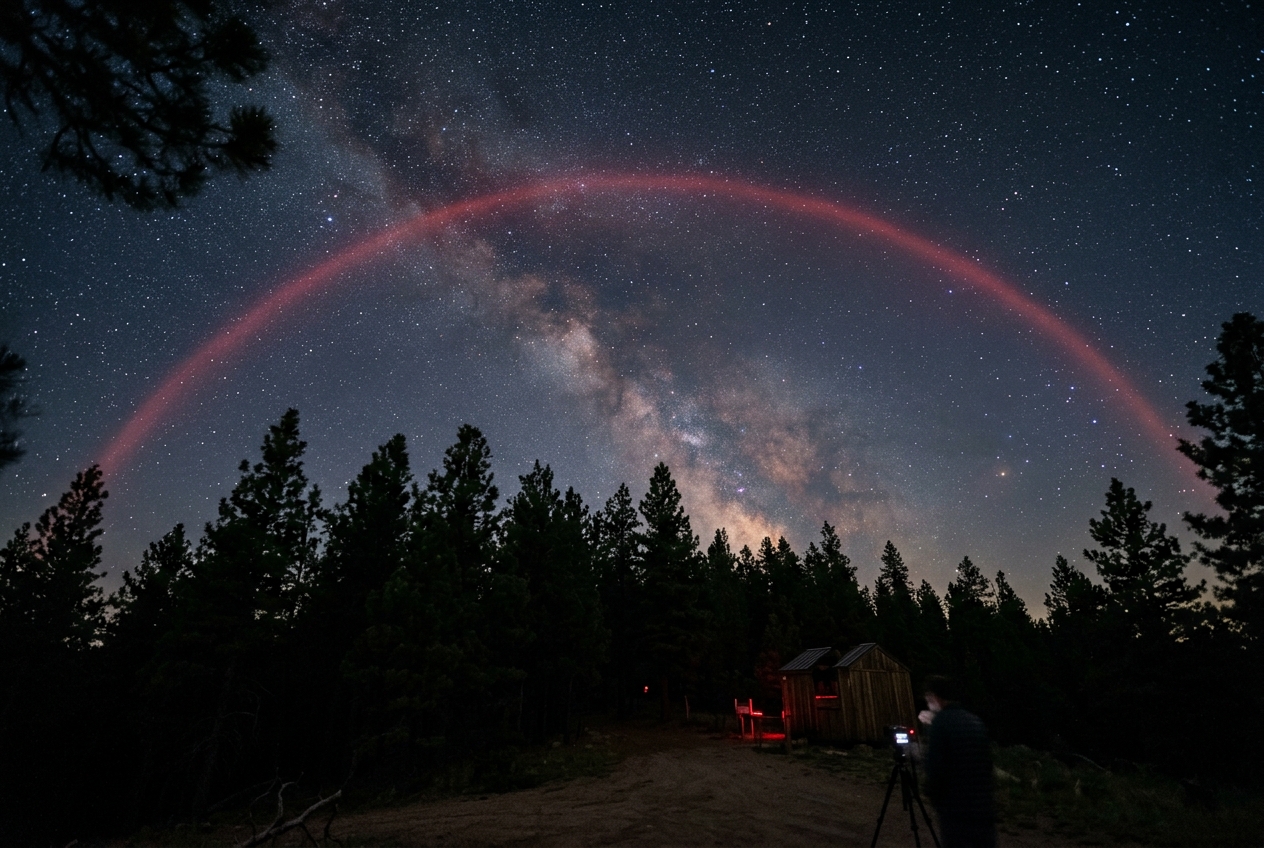
Standing on an exposed granite ridge at 44 degrees north latitude at two o'clock in the morning, the terrestrial atmosphere feels deceptively inert. The ambient temperature has plunged to minus four degrees Celsius, coating the desiccated autumn needles of the surrounding pines in a brittle, crystalline frost. The valley floor below lies swathed in a stagnant thermal inversion, deadening all sound save for the intermittent sigh of a nocturnal katabatic breeze slipping down the granite face. Overhead, the sky is exceptionally transparent; the barometric pressure has settled into a broad, post-frontal high, banishing convective clouds and leaving the stellar field pin-sharp against an ink-black void.
  Zenith (Subauroral Mid-Latitude Sky)
  =============================================================
  [   Faint, Monochromatic Ruby Ribbon (~630.0 nm)   ]  <-- SAR Arc (400 km)
  =============================================================

  [ Dark Sky Gap / Subauroral Ion Drift Channel      ]

  .............................................................
  [ Dynamic Green Curtains / Auroral Oval (~110 km)  ]  <-- Poleward Horizon
  -------------------------------------------------------------
Yet, if you look directly toward the celestial zenith—far south of the dynamic, dancing green curtains that flicker above the northern horizon—the sky is quietly burning. It is not the flickering, violent luminescence associated with polar auroral displays, nor does it possess the sweeping, curtain-like folds of field-aligned ray structures. Instead, stretching from the eastern horizon straight through the meridian to the western edge of the sky, lies a broad, motionless bridge of deep crimson light. It appears almost ghostly to the dark-adapted human eye: a diffuse, monochromatic ribbon of pure ruby, dozens of kilometers wide and suspended hundreds of kilometers above the sleeping continents.
There is no motion. For hours, as the stars drift slowly through its ethereal bounds, the red arc remains locked in geographic orientation, hovering silently in the upper thermosphere. To the uninitiated, it might be mistaken for the distant diffuse light pollution of an unseen metropolis or a high-altitude vapor trail catching lingering sunlight. But to the space physicist and the attuned night-sky observer, this silent crimson arch is the visible footprint of a colossal magnetospheric heat engine—the thermal dissipation of a violent solar storm playing out across the invisible frontiers of near-Earth space.
2. What's Actually Happening — Plain English First
To understand why this quiet red bridge forms, it helps to first contrast it with the two other prominent luminous spectacles of the night sky: classical auroral curtains and the recently popularized phenomenon known as STEVE (Strong Thermal Emission Velocity Enhancement).
Classical polar auroras are driven by energetic particle precipitation. Imagine a high-energy particle accelerator in space firing torrents of fast electrons down Earth's magnetic field lines directly into the dense upper atmosphere at altitudes between 100 and 150 kilometers. These incoming fast particles strike neutral oxygen and nitrogen atoms with brute force, knocking their internal electrons into higher energy states. When these atoms relax, they emit light almost instantaneously, creating the vibrant, dancing green (557.7 nm) and magenta sheets familiar from high-latitude expeditions.
STEVE, by contrast, is a narrow, mauve-colored ribbon driven by extreme kinetic friction. In the subauroral ionosphere, a supersonic river of hot plasma—a subauroral ion drift—rushes westward at velocities exceeding five kilometers per second. This supersonic flow shears against the neutral atmosphere, generating extreme frictional heating that produces a narrow, brief, purplish glow alongside green, picket-fence structures.
A Stable Auroral Red (SAR) arc is fundamentally different from both. Despite its historical name, a SAR arc is not actually an aurora in the traditional sense; there is no direct rain of energetic particles smashing into the upper air, nor is there supersonic kinetic shear. Instead, a SAR arc is pure, conductive thermal glow.
+------------------+-----------------------+------------------------+
| Phenomenon       | Primary Driver        | Altitude & Emission    |
+------------------+-----------------------+------------------------+
| Classical Aurora | Energetic Electron    | 100–150 km; Green      |
|                  | Precipitation         | (557.7 nm), Multi-line |
+------------------+-----------------------+------------------------+
| STEVE            | Supersonic Ion Drift  | 150–300 km; Mauve      |
|                  | & Frictional Heating  | Continuum + Green Rays |
+------------------+-----------------------+------------------------+
| SAR Arc          | Thermal Electron Heat | 350–500 km; Pure       |
|                  | Conduction from Ring  | Monochromatic Red      |
|                  | Current Overlap Zone  | (630.0 nm)             |
+------------------+-----------------------+------------------------+
Think of the Earth's space environment as a vast, nested set of magnetic shells. Close to Earth sits the plasmasphere, a donut-shaped reservoir of relatively cold, dense ionized gas (plasma) that rotates along with the planet. Farther out, orbiting in the opposite direction during geomagnetic disturbances, is the ring current—a massive belt of high-energy ions carrying millions of amperes of electric current.
During a severe geomagnetic storm, the ring current swells and pushes inward, penetrating the outer boundary of the cold plasmasphere (a dynamic boundary region known as the plasmapause). When these energetic ions slam into the cold, dense plasma, they do not create an explosion; rather, they act like a massive immersion heater dropped into a cold pool. The energy transfers from the energetic ions into the cold plasmaspheric electrons.
Because electrons move with exceptional ease along magnetic field lines, this trapped thermal energy has only one viable escape route: it flows downward along the magnetic field lines like heat travelling down an iron poker stuck into a hearth fire. This downward heat flux channels directly into the high-altitude subauroral F-region ionosphere, heating the local thermal electrons to several thousand degrees. These hot, energized ambient electrons gently nudge atomic oxygen into an excited electronic state, which slowly radiates a pure, monochromatic crimson photon at 630.0 nanometers.
3. The Science (for those who want to go deeper)
To formalize the physics of the SAR arc, we must trace the entire chain of energy transport: from the storm-time decay of the magnetospheric ring current, down through the magnetic flux tubes via field-aligned electron thermal conduction, and into the quantum collisional kinetics and radiative de-excitation of atomic oxygen in the presence of atmospheric quenching.
3.1. Magnetospheric Energy Transfer and the Plasmapause
During major geomagnetic disturbances characterized by a storm-time disturbance index $Dst < -100\text{ nT}$ (as tracked by the NOAA Space Weather Prediction Center), intense solar wind-magnetosphere reconnection injects tens of kiloelectronvolt ($\text{keV}$) ring current ions (predominantly $\text{H}^+$ and $\text{O}^+$) into the inner magnetosphere. At equatorial radial distances between $L = 2$ and $L = 4$ Earth radii ($R_E$), this energetic ring current overlaps the high-density cold plasma of the outer plasmasphere.
Energy transfer in this overlap zone proceeds through two dominant channels: 1. Direct Coulomb Collisions: Ring current ions undergo small-angle Coulomb scattering against cold thermal electrons ($T_e \sim 1\text{--}2\text{ eV}$), transferring thermal kinetic energy directly to the electron population. 2. Resonant Wave-Particle Interactions: The anisotropic distribution of energetic ring current ions drives the growth of Electromagnetic Ion Cyclotron (EMIC) waves. These waves undergo Landau damping on the cold thermal electron distribution, strongly accelerating energy transfer into the electron population.
3.2. Downward Heat Conduction: The Spitzer Thermal Conduction Equation
The heated equatorial electron population establishes a steep temperature gradient along the magnetic field lines directed toward the cooler, denser ionosphere below. Because the mean free path of electrons along the magnetic field lines in the collisionless topside ionosphere is governed by Coulomb collisions, the field-aligned downward heat transport is described by classical Spitzer-Härm thermal electron conduction.
The equation predicts the conductive heat flux ($q_e$, in units of $\text{W m}^{-2}$ or $\text{eV cm}^{-2}\text{ s}^{-1}$) traveling downward along the field-aligned coordinate $z$ as a function of local electron temperature $T_e$ and temperature gradient:
$$q_e = -\kappa_0 T_e^{5/2} \frac{dT_e}{dz}$$
Where: - $\kappa_0 \approx 7.7 \times 10^5\text{ eV}^{-5/2}\text{cm}^{-1}\text{s}^{-1}\text{K}^{-1}$ (or $\approx 1.84 \times 10^{-5}\text{ erg cm}^{-1}\text{s}^{-1}\text{K}^{-7/2}$ in CGS units) represents the classical Spitzer thermal conductivity coefficient for a fully ionized hydrogen-electron plasma. - $T_e$ is the thermal electron temperature (expressed in Kelvin). - $\frac{dT_e}{dz}$ is the field-aligned temperature gradient ($\text{K cm}^{-1}$).
As this conductive flux $q_e$ cascades down into the subauroral F-region ionosphere ($h \approx 350\text{--}500\text{ km}$), it encounters increasing densities of neutral atomic oxygen and ambient ionospheric electrons ($n_e \sim 10^5\text{--}10^6\text{ cm}^{-3}$). The convergence of this heat flux elevates the ambient electron temperature from its background daytime/nighttime baseline of $1,000\text{--}1,500\text{ K}$ up to intense localized peaks of $T_e \approx 3,000\text{--}5,000\text{ K}$ ($k_B T_e \approx 0.25\text{--}0.43\text{ eV}$).
3.3. Quantum Kinetics and the $630.0\text{ nm}$ Transition
In this superheated thermal electron pool, the electrons do not possess the tens of thousands of electronvolts typical of auroral precipitation. However, the high-energy Maxwellian tail of the electron distribution contains a substantial fraction of electrons exceeding the $1.96\text{ eV}$ threshold required to excite ground-state neutral atomic oxygen from the $^3\text{P}$ triplet ground state to the metastable $^1\text{D}$ singlet state:
$$e^-{\text{thermal}} (E \ge 1.96\text{ eV}) + \text{O}(^3\text{P}) \longrightarrow e^-{\text{scattered}} + \text{O}(^1\text{D})$$
The excited $\text{O}(^1\text{D})$ state is a metastable quantum state with an exceptionally low Einstein transition probability for spontaneous radiative decay:
$$\text{O}(^1\text{D}) \longrightarrow \text{O}(^3\text{P}) + h\nu\ (\lambda = 630.0\text{ nm},\ 636.4\text{ nm})$$
The Einstein coefficient for the primary $630.0\text{ nm}$ transition is $A_{6300} \approx 0.0069\text{ s}^{-1}$, while the total radiative de-excitation rate across all branching paths is:
$$A_D = A_{6300} + A_{6364} + A_{6392} \approx 0.0091\text{ s}^{-1}$$
This corresponds to an unusually long radiative lifetime:
$$\tau_{\text{rad}} = \frac{1}{A_D} \approx 110\text{ seconds}$$
Because the atom remains in the excited $\text{O}(^1\text{D})$ state for nearly two minutes before shedding its energy as a photon, it is acutely vulnerable to non-radiative deactivation via physical collisions with surrounding molecular species.
3.4. Collisional Quenching and Altitude Filtration
If an excited $\text{O}(^1\text{D})$ atom collides with a neutral diatomic nitrogen ($\text{N}_2$) or oxygen ($\text{O}_2$) molecule before it can radiatively decay, its excitation energy is transferred into molecular vibration and kinetic heat without emitting light. This process is called collisional quenching:
$$\text{O}(^1\text{D}) + \text{N}2 \xrightarrow{\ k{\text{N}2}\ } \text{O}(^3\text{P}) + \text{N}_2(v)$$ $$\text{O}(^1\text{D}) + \text{O}_2 \xrightarrow{\ k{\text{O}_2}\ } \text{O}(^3\text{P}) + \text{O}_2(b^1\Sigma_g^+)$$
The rate coefficients at upper thermospheric temperatures are well established: $k_{\text{N}2} \approx 2.0 \times 10^{-11}\text{ cm}^3\text{ s}^{-1}$ and $k{\text{O}_2} \approx 3.2 \times 10^{-11}\text{ cm}^3\text{ s}^{-1}$.
The quantum yield $\eta_{6300}(z)$—the probability that an excited $\text{O}(^1\text{D})$ atom at altitude $z$ will successfully emit a $630.0\text{ nm}$ photon rather than suffer collisional quenching—is expressed by the quenching equation:
$$\eta_{6300}(z) = \frac{A_{6300}}{A_D + k_{\text{N}2} n{\text{N}2}(z) + k{\text{O}2} n{\text{O}_2}(z)}$$
Where $n_{\text{N}2}(z)$ and $n{\text{O}_2}(z)$ are the neutral number densities of molecular nitrogen and oxygen at altitude $z$.
Below $300\text{ km}$, the neutral atmospheric density is high ($n_{\text{N}2} > 10^9\text{ cm}^{-3}$), making the collision frequency $\nu{\text{quench}} \approx k_{\text{N}2} n{\text{N}2} \gg A_D$. Consequently, $\eta{6300} \to 0$, completely extinguishing the emission. Above $350\text{--}450\text{ km}$, the molecular atmosphere thins out exponentially ($n_{\text{N}2} < 10^7\text{ cm}^{-3}$), allowing $A_D \gg \nu{\text{quench}}$ and causing $\eta_{6300} \to \frac{A_{6300}}{A_D} \approx 0.76$.
This quenching threshold acts as an altitude filter: SAR arcs cannot exist in the lower thermosphere. Their physical manifestation is strictly confined to the tenuous reaches of the upper F-region between $350\text{ km}$ and $500\text{ km}$.
3.5. Mathematical Worked Example: Heat Flux to Rayleigh Emission
Let us now calculate the column-integrated optical emission rate produced by a storm-time downward electron heat flux, proving why a flux of $q_e \sim 10^{10}\text{ eV cm}^{-2}\text{ s}^{-1}$ generates a visible SAR arc of several kilorayleighs ($\text{kR}$).
Step 1: Input Parameters for a Moderate-to-Strong SAR Arc
- Downward Conductive Heat Flux: $q_e = 1.0 \times 10^{10}\text{ eV cm}^{-2}\text{ s}^{-1}$ ($= 1.602 \times 10^{-2}\text{ erg cm}^{-2}\text{ s}^{-1} = 1.602 \times 10^{-3}\text{ W m}^{-2}$).
- Peak Emission Layer Altitude: $z_0 = 420\text{ km}$ with an effective emission column thickness $\Delta z = 100\text{ km} = 1.0 \times 10^7\text{ cm}$.
- Ambient Electron Temperature in the Arc: $T_e = 4,000\text{ K}$ ($k_B T_e \approx 0.345\text{ eV}$).
- F-Region Electron Density: $n_e = 3.0 \times 10^5\text{ cm}^{-3}$.
- Neutral Atomic Oxygen Density: $n_{\text{O}} = 1.5 \times 10^8\text{ cm}^{-3}$.
- Neutral Molecular Nitrogen Density: $n_{\text{N}_2} = 5.0 \times 10^6\text{ cm}^{-3}$.
Step 2: Calculate the Quantum Yield $\eta_{6300}$ at $420\text{ km}$
Using our quenching formula:
$$\nu_{\text{quench}} = k_{\text{N}2} n{\text{N}_2} = (2.0 \times 10^{-11}\text{ cm}^3\text{ s}^{-1}) \times (5.0 \times 10^6\text{ cm}^{-3}) = 1.0 \times 10^{-4}\text{ s}^{-1}$$
Comparing this to $A_D \approx 0.0091\text{ s}^{-1}$:
$$\eta_{6300} = \frac{0.0069}{0.0091 + 0.0001} = \frac{0.0069}{0.0092} \approx 0.75$$
At this high altitude, fully $75\%$ of all excited $\text{O}(^1\text{D})$ atoms successfully escape quenching and emit a $630.0\text{ nm}$ photon.
Step 3: Collisional Excitation Rate Coefficient
For a Maxwellian thermal electron gas at $T_e = 4,000\text{ K}$, the velocity-averaged excitation rate coefficient $k_{ex}(T_e)$ for the $^3\text{P} \to\ ^1\text{D}$ transition is given by integrating the collision cross-section:
$$k_{ex}(T_e) \approx 8.63 \times 10^{-6}\ \frac{\bar{\Omega}(^3\text{P}, ^1\text{D})}{\omega(^3\text{P})\, \sqrt{T_e}}\ \exp\left(-\frac{\Delta E}{k_B T_e}\right)\quad [\text{cm}^3\text{ s}^{-1}]$$
For atomic oxygen with ground state degeneracy $\omega(^3\text{P}) = 9$, effective collision strength $\bar{\Omega} \approx 0.4$, excitation energy $\Delta E = 1.96\text{ eV}$, and $T_e = 4,000\text{ K}$ ($\frac{\Delta E}{k_B T_e} = \frac{1.96}{0.345} \approx 5.68$):
$$k_{ex}(4000\text{ K}) \approx 8.63 \times 10^{-6} \times \frac{0.4}{9 \times \sqrt{4000}} \times \exp(-5.68)$$ $$k_{ex}(4000\text{ K}) \approx 8.63 \times 10^{-6} \times \frac{0.4}{569.2} \times 0.00341 \approx 2.07 \times 10^{-11}\text{ cm}^3\text{ s}^{-1}$$
Step 4: Compute the Volume Emission Rate $\epsilon_{6300}$
The local volumetric photon production rate ($\text{photons cm}^{-3}\text{ s}^{-1}$) is:
$$\epsilon_{6300} = \eta_{6300} \cdot k_{ex}(T_e) \cdot n_e \cdot n_{\text{O}}$$ $$\epsilon_{6300} = 0.75 \times (2.07 \times 10^{-11}\text{ cm}^3\text{ s}^{-1}) \times (3.0 \times 10^5\text{ cm}^{-3}) \times (1.5 \times 10^8\text{ cm}^{-3})$$ $$\epsilon_{6300} \approx 0.699\text{ photons cm}^{-3}\text{ s}^{-1}$$
Step 5: Column Integration into Rayleighs
Column emission brightness $I$ in Rayleighs ($\text{R}$), where $1\text{ R} \equiv 10^6\text{ photons cm}^{-2}\text{ s}^{-1}\text{ (column)}$, is calculated by integrating across the emission slab thickness $\Delta z = 1.0 \times 10^7\text{ cm}$:
$$I_{6300} = \frac{1}{10^6} \int \epsilon_{6300}(z)\, dz \approx \frac{\epsilon_{6300} \cdot \Delta z}{10^6}$$ $$I_{6300} \approx \frac{0.699 \times 1.0 \times 10^7}{10^6} = 6.99\text{ kR} \approx 7.0\text{ kR}$$
4. Practical Outdoor Guidance
Observing a Stable Auroral Red arc requires moving beyond standard auroral forecasts, as SAR arcs obey geomagnetic and spatial rules distinct from the typical oval aurora.
4.1. What to Look for in the Sky
- Geographic Position: Look directly overhead (at zenith) or slightly poleward/equatorward across mid-latitudes ($40^\circ\text{--}55^\circ$ geomagnetic latitude). While standard auroras dance along the northern horizon for mid-latitude observers, a SAR arc will cut directly across the sky from east to west at a much higher elevation angle.
- Visual Characteristics: Expect a broad, diffuse band spanning $1^\circ\text{ to }5^\circ$ in width (roughly 2 to 10 full moon diameters across). Unlike dynamic auroral ribbons, a SAR arc does not ripple, flicker, pulsate, or develop vertical rayed structures. It appears as an entirely static, motionless swath of crimson that can persist in the exact same coordinates for four to eight hours.
- Optical Perception vs. Sensor Capture: Because human scotopic (rod-dominated) vision is notoriously insensitive to deep red wavelengths ($\lambda = 630.0\text{ nm}$ sits near the outer limit of dark-adapted human retinal response), an arc of $1\text{--}3\text{ kR}$ may appear visually as an indistinct, milky-white or pale-grey haze. A digital camera sensor equipped with a fast lens ($f/1.4\text{ to }f/2.8$) set to ISO 3200 and a 15-second exposure will immediately reveal its true, intensely saturated monochromatic blood-red hue.
       Visual Spectrum Identification:
       ========================================================
       557.7 nm (Atomic Green)  --> ABSENT in SAR Arcs
       427.8 nm (N2+ Blue/Violet) --> ABSENT in SAR Arcs
       630.0 nm (Atomic Red)    --> 100% of Optical Signature
       ========================================================
4.2. Instrument and Space Weather Metrics to Monitor
To know when to step outside with a spectrometer or camera, monitor real-time data from space weather monitoring agencies such as the Met Office Space Weather Operations Centre and the World Meteorological Organization Space Weather Portal:
- The $Dst$ / $Sym\text{-}H$ Index: The primary predictive metric. A SAR arc requires significant ring current energization. Look for $Dst \le -100\text{ nT}$ (a major geomagnetic storm). During extreme storms where $Dst < -200\text{ nT}$, SAR arcs expand rapidly equatorward, becoming visible across lower mid-latitudes (down to $30^\circ\text{--}35^\circ$ latitude).
- Planetary $K$-Index ($Kp$): A $Kp$ value of 6 or greater is typically required, indicating planetary geomagnetic disturbance sufficient to drive the plasmapause inward toward $L \sim 2\text{--}3$. Real-time indices can be checked via NASA Goddard Space Physics Data Facility.
- Interplanetary Magnetic Field (IMF) $Bz$: Sustained, strong southward IMF ($Bz < -10\text{ nT}$) for multiple hours is the fundamental catalyst that injects solar wind energy into the ring current, priming the plasmapause thermal engine.
4.3. The Field Observer's Rule of Thumb
For field researchers, astrophotographers, and night-sky observers:
The Subauroral Zenith Rule: When space weather monitors register a major storm ($Kp \ge 7$, $Dst < -100\text{ nT}$) and local magnetometers indicate severe ring current compression, do not restrict your observation to the northern horizon. Direct your optics straight toward the zenith along the geomagnetic east-west axis. If your wide-field long exposures capture a broad, perfectly uniform crimson ribbon devoid of green emissions or dynamic motion, you are observing the thermal footprint of the outer plasmapause.
5. Today's Meteorological Rule of Thumb
The SAR Arc Axiom: Whenever a violent solar storm drives the planetary $Dst$ index below $-100\text{ nT}$, the Earth's upper atmosphere ceases to be merely a passive shield and becomes a giant conductive resistor—channelling downward heat fluxes of billions of electronvolts per square centimeter to paint a silent, motionless, 400-kilometer-high ruby arch across the mid-latitude sky.