Pyramidal Halos & Odd-Radius Halo Dynamics: How Bipyramidal Ice Crystal Facets and Complex Inter-Prism Refraction Forge Rare Concentric Sky Rings
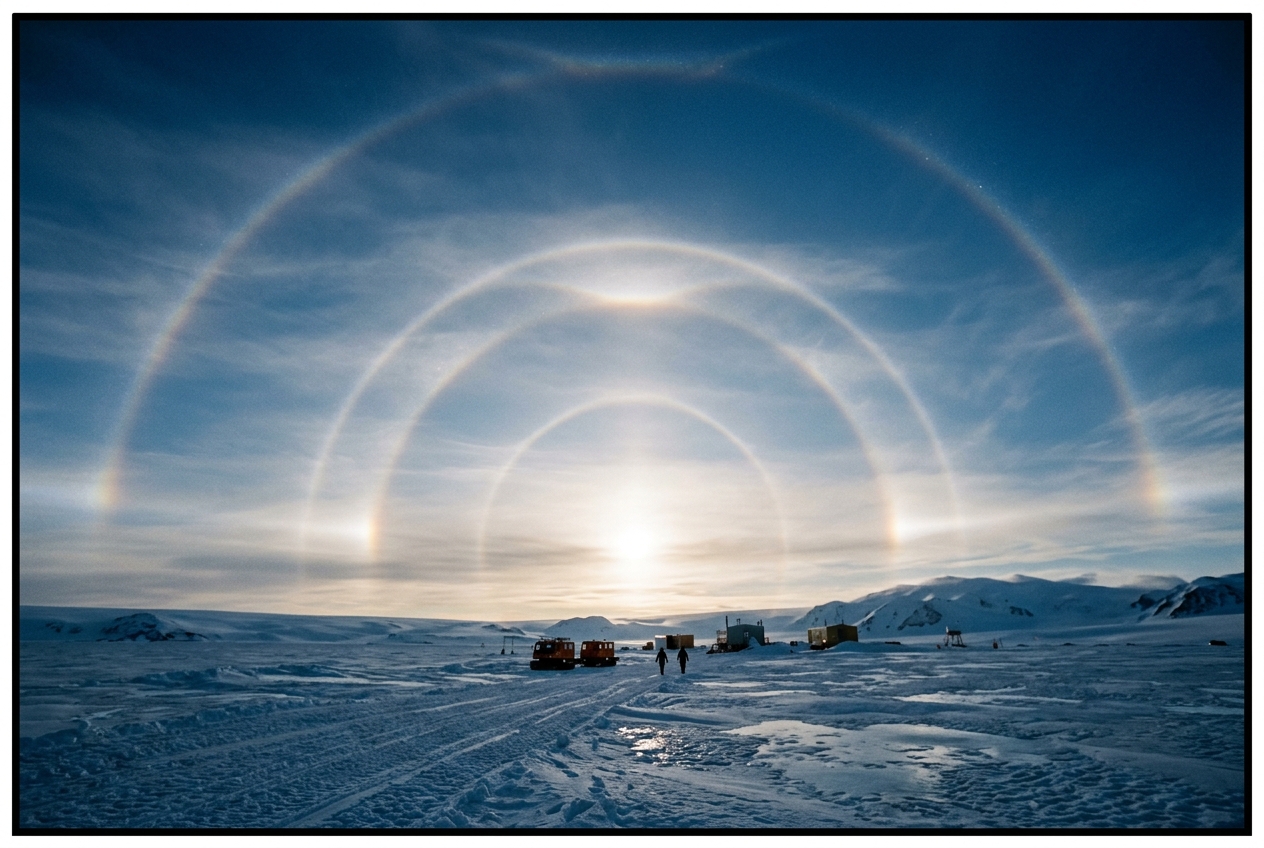
1. Opening Scene
The cold does not merely chill on the polar plateau; it immobilises. At thirty-two degrees below zero on the high plains of Fairbanks, Alaska, the morning air possesses an uncanny, vitreous stillness. There is no wind to rustle the stunted black spruce, nor any cloud deck obscuring the pale blue vault above. Yet the atmosphere is far from empty. Suspended in the sub-zero inversion layer is a glittering, subterranean mist of unearthly brilliance—what meteorologists term diamond dust. Each microscopic airborne ice crystal catches the low Arctic sun, turning the landscape into a shimmering chamber of suspended mirrors.
When you look toward the solar disk, carefully eclipsing the blinding central glare behind the outstretched limb of a spruce or the edge of a timber cabin, something extraordinary occurs. Most winter observers are familiar with the standard circular halo: that crisp, ubiquitous ring of light sitting precisely twenty-two degrees away from the sun, occasionally flanked by brilliant sundogs. But today, the sky has fractured into an intricate, concentric tapestry of ghostly illumination.
                       . - ~ ~ ~ - .
                   . '       |       ' .
                 /         .-"-*         \
                /        /   |   \        \
               |        |  -(O)-  |  9°    |
               |         \   |   /         |
                \          '-.-'          /
                 \           |           /
                   . _       |       _ .  18°
                       ' - _ _ _ - '      20°
                            ...           23° / 24°
                      (   35° Halo   )
Nested intimately inside the familiar 22° boundary is a compact, sharply etched ring glowing at an impossibly tight 9° from the sun. Just beyond it sits a distinct 18° halo, followed by a delicate 20° ring that presses against the inner rim of the standard circular halo. Further out, slicing through the sky at 23°, 24°, and an expansive 35°, additional luminous circles encircle the sun like the calibrated reticles of a celestial instrument. The sky is behaving like a complex optical kaleidoscope, baffling the classical textbook rules of meteorological optics and displaying the rare, bewitching family of odd-radius halos.
2. What's Actually Happening — Plain English First
To understand why these surreal, concentric solar rings form, we must first reconsider how ordinary ice makes ordinary halos. Think of standard atmospheric ice crystals as microscopic pencils: six-sided hexagonal prisms with flat, blunt ends. When sunlight enters one flat side of the pencil and exits through an alternate side, it passes through a 60-degree glass-like wedge. This 60-degree wedge bends the light by roughly 22 degrees, casting the familiar 22° circular ring that millions of people observe every year in cirrus clouds.
       ORDINARY COLUMN                   PYRAMIDAL CRYSTAL
         __________                         ___________
        /          \                       /     /\    \
       /   BASAL    \                     /     /  \    \  Pyramidal
      |    FACET     |                   |  ---'----'--- |  Facets {1011}
      |              |                   |   HEXAGONAL   |
      |  PRISM BODY  |                   |     BODY      |
      |              |                   |  ---.----.--- |
       \            /                     \     \  /    /
        \__________/                       \     \/    /
                                            \_________/
     (Yields 22° & 46°)                (Yields 9°, 18°, 20°, 23°, 24°, 35°)
Odd-radius halos occur because nature occasionally refuses to make simple pencils. Under very specific thermodynamic conditions in the upper troposphere or during polar freezes, ice crystals sprout pointed, faceted ends—resembling a pencil that has been sharpened at one or both tips. In the language of mineralogy and crystallography, these are pyramidal ice crystals.
Instead of possessing only flat hexagonal sides and blunt ends, these crystals feature twelve additional slanted facets known as pyramidal faces.
Imagine holding a rough-cut diamond up to a beam of light versus holding a simple rectangular pane of glass. A simple pane bends light in only one predictable way. The diamond, however, is covered in angled facets, creating dozens of novel geometric pairings. A ray of sunlight can plunge into an upper pyramidal slope, shoot through the crystal's interior, and emerge through a lower pyramid slope, a prism side, or a basal base.
Because each combination of crystal faces meets at a unique, fixed geometric angle, each pair acts as an optical prism with its own distinct bending power. When millions of these faceted crystal tops tumble randomly through the air, they cast not one, but an entire family of concentric rings around the sun. Each ring corresponds precisely to light taking a specific journey through a different pair of crystal facets.
3. The Science (for those who want to go deeper)
Crystallography and Growth Dynamics
The formation of pyramidal ice habits is governed by the delicate physics of crystal growth from water vapor. Ordinary ice in Earth's atmosphere crystallizes in the hexagonal system ($I_h$). While standard plates and columns are bounded strictly by the six prism faces ${10\bar{1}0}$ and the two basal pinacoids ${0001}$, pyramidal crystals develop intermediate, semi-polar faces: the ${10\bar{1}1}$ pyramidal forms.
These pyramidal faces do not appear at random. They require specific ranges of ambient temperature—predominantly between $-20^\circ\text{C}$ and $-40^\circ\text{C}$—accompanied by low water vapor supersaturation with respect to ice ($S_i \approx 2\text{ to }10\%$). In high-supersaturation environments, rapid vapor deposition drives unstable growth at the crystal corners, yielding dendritic snowflakes. Conversely, when the vapor supply is exceptionally sparse and stable, the growth rate along the secondary crystallographic axes slows to an equilibrium state, allowing the inclined ${10\bar{1}1}$ facets to stabilize and form complete bipyramidal or barrel-shaped habits.
                  Miller-Bravais Facet Anatomy
                             c-axis
                               ^
                             / | \   Basal Facet (0001) [Face 1 or 2]
                            /  |  \
                 {1011} -> /---+---\ <- Pyramidal Facets (Faces 13-24)
                          |    |    |
                 {1010} ->|    |    |   Prism Facets (Faces 3-8)
                          |    |    |
                           \---+---/
                            \  |  /
                             \ | /
                               v
In the standard crystallographic notation established in atmospheric halo optics (formalized by halo researchers such as Walter Tape and Jarmo Moilanen), crystal faces are indexed by convention: - Basal faces: 1 (top) and 2 (bottom). - Prism faces: 3 through 8 (arranged cyclically around the hexagonal waist). - Upper pyramidal faces: 13 through 18 (inclined directly above prism faces 3–8). - Lower pyramidal faces: 19 through 24 (inclined directly below prism faces 3–8).
Crystallographic measurements reveal that the normal to a ${10\bar{1}1}$ pyramidal facet is inclined to the crystal’s principal $c$-axis at an angle of $\beta \approx 28.04^\circ$. From this fundamental lattice constant, the internal wedge angles ($\alpha$) between any two interacting faces can be derived using spherical trigonometry.
Refraction Geometry and Wedge Angles
When a light ray traverses an optical prism, the total angle of deviation depends on the angle of incidence. However, because crystals in a diamond dust cloud or cirrostratus layer are randomly oriented in three dimensions, light spreads out across a spectrum of deviation angles. The crucial feature that creates a visible halo edge is the minimum deviation angle ($\theta_{\text{min}}$). At this specific angle, the derivative of deviation with respect to incidence is zero, meaning that light rays "pile up" at this caustic boundary, creating a distinct ring of concentrated brightness on the observer's eye.
According to Snell's Law of Refraction, the minimum deviation $\theta_{\text{min}}$ for a prism with apex wedge angle $\alpha$ and refractive index $n$ occurs when the ray passes symmetrically through the crystal:
$$\theta_{\text{min}} = 2 \arcsin\left(n \sin\frac{\alpha}{2}\right) - \alpha$$
For solid water ice in the middle of the visible spectrum ($\lambda \approx 589\text{ nm}$, sodium D-line), the refractive index is $n \approx 1.309 \approx 1.31$.
Let us examine the explicit face pairings, derive their wedge angles $\alpha$, and calculate the resulting minimum deviation halos:
1. The 9° Halo (Ray Path: Face 13 to 23 or Adjacent Pyramids)
- Geometry: The ray passes between two adjacent pyramidal facets on opposite ends of the crystal that share an apex slope angle.
- Apex Wedge Angle: $\alpha \approx 28.0^\circ$.
- Calculation: $$\sin\left(\frac{28.0^\circ}{2}\right) = \sin(14.0^\circ) \approx 0.24192$$ $$n \sin(14.0^\circ) = 1.31 \times 0.24192 = 0.31692$$ $$\arcsin(0.31692) \approx 18.475^\circ$$ $$\theta_{\text{min}} = 2(18.475^\circ) - 28.0^\circ = 36.95^\circ - 28.0^\circ = 8.95^\circ \approx 9.0^\circ$$
2. The 18° Halo (Ray Path: Face 13 to 15 or Alternate Upper Pyramids)
- Geometry: The ray enters one upper pyramidal face and exits through an alternate upper pyramidal face across the hexagonal symmetry.
- Apex Wedge Angle: $\alpha \approx 52.4^\circ$.
- Calculation: $$\sin\left(\frac{52.4^\circ}{2}\right) = \sin(26.2^\circ) \approx 0.44151$$ $$n \sin(26.2^\circ) = 1.31 \times 0.44151 = 0.57838$$ $$\arcsin(0.57838) \approx 35.337^\circ$$ $$\theta_{\text{min}} = 2(35.337^\circ) - 52.4^\circ = 70.67^\circ - 52.4^\circ = 18.27^\circ \approx 18.3^\circ$$
3. The 20° Halo (Ray Path: Face 13 to 16 / Opposite Upper Pyramids or Face 1 to 14)
- Geometry: The ray enters a basal face and exits an upper pyramidal face, or passes through opposing upper pyramidal slopes.
- Apex Wedge Angle: $\alpha \approx 56.0^\circ$.
- Calculation: $$\sin\left(\frac{56.0^\circ}{2}\right) = \sin(28.0^\circ) \approx 0.46947$$ $$n \sin(28.0^\circ) = 1.31 \times 0.46947 = 0.61501$$ $$\arcsin(0.61501) \approx 37.953^\circ$$ $$\theta_{\text{min}} = 2(37.953^\circ) - 56.0^\circ = 75.91^\circ - 56.0^\circ = 19.91^\circ \approx 20.0^\circ$$
4. The 23° / 24° Halos (Ray Path: Face 13 to 20 or Face 13 to 24)
- Geometry: The ray enters an upper pyramidal facet and exits a semi-opposed lower pyramidal facet.
- Apex Wedge Angle: $\alpha \approx 62.8^\circ$ (for the 23° path) to $\alpha \approx 63.8^\circ$ (for the 24° path).
- Calculation (for $\alpha = 62.8^\circ$): $$\sin\left(\frac{62.8^\circ}{2}\right) = \sin(31.4^\circ) \approx 0.52101$$ $$n \sin(31.4^\circ) = 1.31 \times 0.52101 = 0.68252$$ $$\arcsin(0.68252) \approx 43.041^\circ$$ $$\theta_{\text{min}} = 2(43.041^\circ) - 62.8^\circ = 86.08^\circ - 62.8^\circ = 23.28^\circ \approx 23.3^\circ$$ (Note: A slight shift in facet geometry to $\alpha = 63.8^\circ$ produces $\theta_{\text{min}} \approx 23.8^\circ$, frequently perceived together as a blended 23°–24° ring structure).
5. The 35° Halo (Ray Path: Face 13 to 26 / Upper Pyramid to Distant Lower Pyramid)
- Geometry: The ray enters an upper pyramidal facet and exits through a steep, non-adjacent lower pyramidal facet near the opposite base.
- Apex Wedge Angle: $\alpha \approx 80.2^\circ$.
- Calculation: $$\sin\left(\frac{80.2^\circ}{2}\right) = \sin(40.1^\circ) \approx 0.64412$$ $$n \sin(40.1^\circ) = 1.31 \times 0.64412 = 0.84380$$ $$\arcsin(0.84380) \approx 57.545^\circ$$ $$\theta_{\text{min}} = 2(57.545^\circ) - 80.2^\circ = 115.09^\circ - 80.2^\circ = 34.89^\circ \approx 35.0^\circ$$
Crystallographic Summary of Odd-Radius Halos
The comprehensive optical architecture of the pyramidal ice habit is synthesized in the matrix below:
| Observed Halo Radius ($\theta_{\text{min}}$) | Active Crystal Face Pair | Effective Wedge Angle ($\alpha$) | Refractive Index ($n$) | Theoretical Minimum Deviation |
|---|---|---|---|---|
| 9° Halo | 13 – 23 (Pyramid to Adjacent Pyramid) | $28.0^\circ$ | 1.31 | $8.95^\circ$ |
| 18° Halo | 13 – 15 (Pyramid to Alternate Pyramid) | $52.4^\circ$ | 1.31 | $18.27^\circ$ |
| 20° Halo | 13 – 16 / 1 – 14 (Basal to Pyramid) | $56.0^\circ$ | 1.31 | $19.91^\circ$ |
| 22° Halo (Classic) | 3 – 5 (Prism to Alternate Prism) | $60.0^\circ$ | 1.31 | $21.84^\circ$ |
| 23° / 24° Halo | 13 – 20 / 13 – 24 (Pyramid to Cross-Lower) | $62.8^\circ - 63.8^\circ$ | 1.31 | $23.28^\circ - 23.82^\circ$ |
| 35° Halo | 13 – 26 (Pyramid to Distant Lower Pyramid) | $80.2^\circ$ | 1.31 | $34.89^\circ$ |
| 46° Halo (Classic) | 1 – 3 (Basal to Prism Face) | $90.0^\circ$ (via end) | 1.31 | $45.73^\circ$ |
4. Practical Outdoor Guidance
Observing odd-radius halos requires training your visual system to look past the overwhelming brilliance of the sun and recognizing subtle differences in angular scale. The World Meteorological Organization (WMO) International Cloud Atlas and the UK Met Office categorize halos as photometeors, but odd-radius displays require specific observation discipline.
               HAND-SPAN ANGULAR MEASUREMENT GUIDE
                     (Arm Fully Extended)

       [ ONE FINGER ]        [ CLENCHED FIST ]       [ OPEN HAND SPAN ]
          Width: 1°-2°           Width: ~10°             Span: ~20°-25°
              ||                     ___                    \  |  /
              ||                   /     \                   \ | /
             [  ]                 |  FIST |                   \ /
             |  |                  \ ___ /                     v
      (Finds 9° Boundary)      (Separates 9° & 18°)     (Separates 20°, 22°, 24°)
Field Identification Rules
- Always Occult the Sun: Never stare directly at the sun. Use a solid foreground object—a telephone pole, rooftop corner, or street lamp—to block the blinding solar disk. Alternatively, hold up a coin, thumb, or opaque disc at arm’s length.
- Apply the Hand-Span Rule: - Extend your arm fully. A single clenched fist subtends an angle of approximately $10^\circ$ across your knuckles. If a bright inner ring fits completely inside your clenched fist centered on the occulted sun, you are witnessing the elusive 9° halo. - Spread your hand from the tip of your thumb to the tip of your little finger; this spans roughly $20^\circ\text{ to }25^\circ$. The standard 22° halo sits right at the perimeter of this span. A halo sitting just inside your knuckles is the 20° ring, while a ring resting just beyond your outer fingertips is the 23°–24° complex.
- Use a Linear Polarizing Filter: Light deflected at minimum deviation through ice prisms exhibits slight linear polarization oriented radially (tangent to the halo ring). Rotating a polarizing filter or polarized sunglasses will modulate the intensity of the faint odd-radius rings, pulling them out of the diffuse, unpolarized sky glare.
- Photographic Contrast Enhancement: If you photograph a suspected display, shoot in RAW format with underexposure (-1.0 to -2.0 EV) to prevent sensor clipping. In digital post-processing, apply an unsharp mask or a radial luminance subtractive curve centered on the solar coordinates. This technique strips away the smooth background glare and reveals faint, concentric 9°, 18°, and 35° rings that are invisible to the naked eye.
Synoptic and Meteorological Context
To hunt odd-radius halos, observers should track specific synoptic atmospheric conditions cataloged by institutions like NOAA's National Weather Service:
- Surface High-Pressure Freezes: During strong winter continental high-pressure events (anticyclones over Siberia, northern Canada, or the Arctic basin), radiational cooling creates extreme ground inversions. Surface temperatures drop below $-25^\circ\text{C}$ with calm winds, creating pristine diamond dust conditions where pyramidal crystals settle stably through the lowest 100 meters of the boundary layer.
- Warm Frontal Alrostratus Inversion Transitions: In temperate latitudes, odd-radius halos appear not at the surface, but high aloft in cirrostratus decks herald by an advancing warm front. Watch the barometer: when surface pressure falls steadily following a clear, freezing spell, and the sky fills with a milky, structureless cirrostratus layer at $-30^\circ\text{C}$ to $-40^\circ\text{C}$, pyramidal crystal growth is favored at the cirrus nucleation level.