Pollen Coronae & Bioaerosol Diffraction Dynamics: How Aerodynamically Aligned Pine Grains and Non-Spherical Apertures Forge Multi-Lobed Solar Rings
1. Opening Scene
On a late May afternoon across the temperate pinelands of the Northern Hemisphere, the atmosphere settles into a deceptive, golden equilibrium. The blustery frontal winds of mid-spring have yielded to a broad, warm anticyclone. The barometric pressure creeps steadily upward, and the air smells heavily of sun-baked pine resin, dry forest litter, and volatile terpenes. Step onto a forest track, and every footfall kicks up an almost imperceptible plume of chartreuse dust. On the surface of nearby drainage ditches and woodland puddles, a vibrant, sulfur-coloured scum gathers in swirling, marbled ribbons.
The sky overhead is not the deep, razor-sharp cobalt of a clean polar airmass, but a bleached, milky azure—washed out by an immense atmospheric suspension of billions of microscopic vegetative spores. When you tilt your gaze toward the sun—shielding the blinding disc behind the rough, scaly silhouette of a Scots pine (Pinus sylvestris) branch—the surrounding sky does not exhibit the uniform, washed-out white of ordinary forward Mie scattering, nor does it reveal the familiar, perfectly circular pastel rings of a cloud-droplet corona.
       [ SOLAR DISC ]  (Occluded behind branch)
             |
       .---'   '---.      <-- Inner Elliptical Aureole (Golden-White)
     /   .-------.   \
    |   /  .-*-.  \   |   <-- Distorted, Multi-Lobed Rings
    |  |  ( (o) )  |  |       (Elongated along vertical axis)
    |   \  '-*-'  /   |
     \   '-------'   /    <-- Vivid Diamond/Oval Boundary
       '---.   .---'          (Red outer fringe at 3°- 4°)
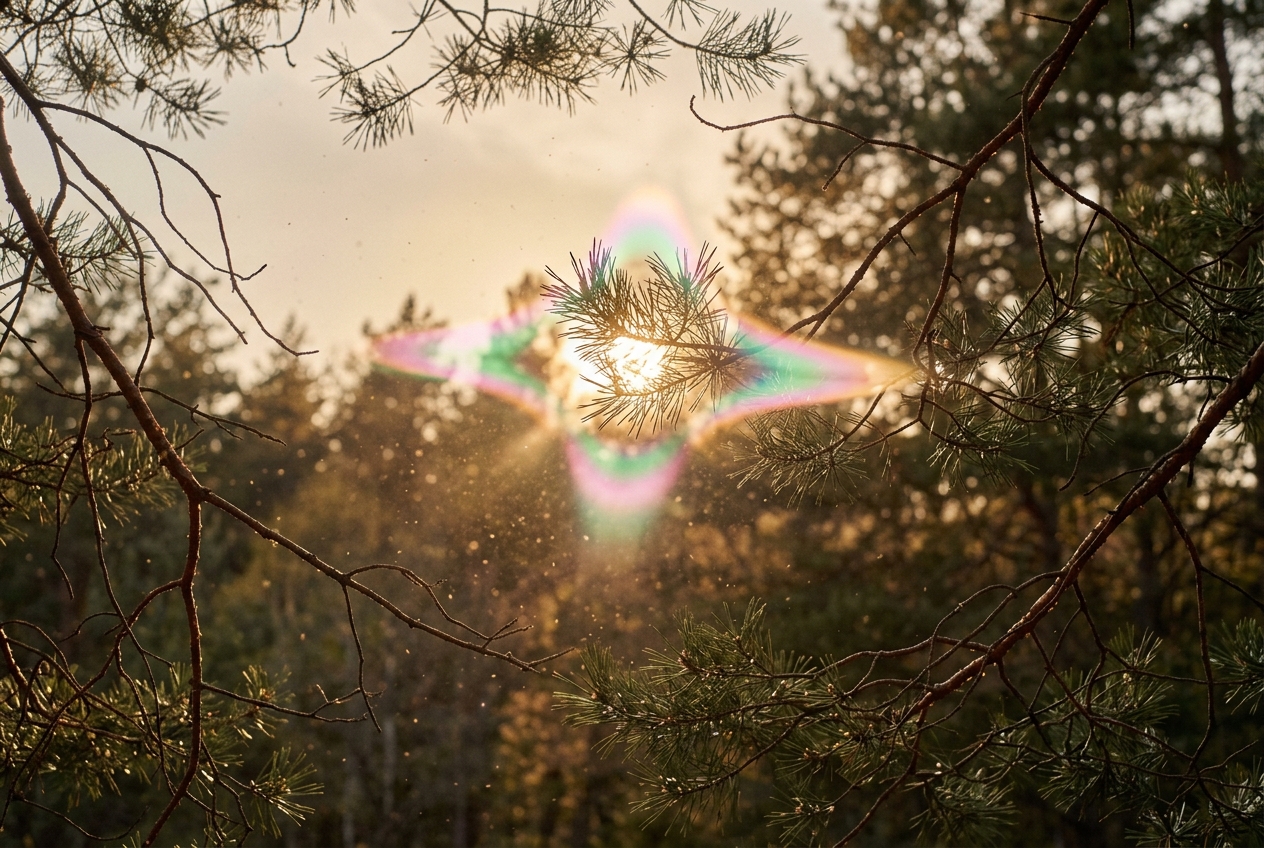
Instead, an astonishing optical structure emerges. Wrapped tightly around the occluded solar core is an intensely luminous, distinctly non-circular aureole. Rather than conforming to the strict concentric geometry painted by spherical water droplets in an altocumulus deck, this solar crown is visibly distorted: an exquisite, vertically stretched oval, pinched at its flanks or flaring into an ornate, four-lobed diamond. Pale violet and emerald hues fringe the inner aureole, terminating in a crisp, rust-red outer ring only three to four degrees from the solar limb.
You are standing beneath an airborne ocean of biological matter. Without a single cloud in the troposphere, the reproductive biology of the forest has hijacked the wave nature of sunlight, transforming the lower boundary layer into an immense, aerodynamically ordered optical diffraction grating.
2. What's Actually Happening — Plain English First
To understand why the sky displays an oval or diamond-shaped aura rather than a standard circular halo, we must first examine how light behaves when it collides with small airborne obstacles.
When parallel rays of sunlight encounter a microscopic particle suspended in the air, the light does not simply bounce off the surface or cast a sharp shadow behind it. Because light propagates as electromagnetic waves, it bends around the edges of the obstacle and spreads outward into the shadow zone—a fundamental physical phenomenon known as diffraction.
Think of ocean swell striking a solitary breakwater post in a calm harbour: as the waves pass the post, circular ripples fan out behind it. When multiple ripples overlap, their peaks reinforce one another to create taller crests (constructive interference), while peaks meeting troughs cancel the motion entirely (destructive interference). When trillions of identical microscopic obstacles float between your eye and the sun, their individual diffraction ripples combine across the sky. The constructive interference patterns manifest as concentric bands of colored light surrounding the light source: an atmospheric corona.
Spherical Droplets vs. Sculpted Tree Pollen
In standard meteorological coronae, the diffracting particles are liquid cloud droplets inside an altocumulus or cirrocumulus layer. Governed by surface tension, liquid droplets are near-perfect spheres. A sphere presents an identical circular profile to incoming light regardless of how it rotates in the wind. As a result, cloud coronae are invariably circular, concentric, and symmetric in all radial directions.
Pollen grains from wind-pollinated (anemophilous) trees are entirely different. They are rigid, intricately sculpted biological capsules that deviate sharply from spherical geometry:
- Conifers (Pinus, Picea, Abies): Pine pollen grains possess a central body flanked by two hollow, buoyant, air-filled bladders known as sacculi (bisaccate pollen). This architecture resembles a microscopic pair of water wings or a dual-lobed peanut.
- Birch (Betula) & Alder (Alnus): These grains are oblate, flattened spheroids perforated by protruding equatorial pores (triporate or stephanoporate), presenting triangular or polygonal cross-sections.
       CONIFER POLLEN (Pinus)                 BIRCH POLLEN (Betula)
          [Air Sacculi]                          [Triporate Oblate]
          .---.   .---.                                .-----.
         /     \ /     \                              /  / \  \
        (  Air  | Body  )                            |  |   |  |
         \     / \     /                              \  \ /  /
          '---'   '---'                                '-----'
        (Bisaccate peanut shape)                 (Flattened triangular prism)
The Aerodynamic Glider Effect
If these non-spherical grains tumbled randomly in turbulent air, their varying silhouettes would average out across millions of particles, yielding a blurry, circular ring. But the atmosphere’s lowest layer does not treat these grains randomly.
As conifer pollen drifts downward under the influence of gravity through still, viscous air, the buoyant air bladders act like the feathers of an aerodynamic shuttlecock. Viscous forces dominate over inertia, causing the grains to settle with a highly preferred orientation: their long, bisaccate axis aligns horizontally, parallel to the ground.
When parallel sunlight strikes billions of pollen grains all resting in the same horizontal alignment, the diffracting edges are no longer radially symmetrical. Because diffraction spreads light most aggressively perpendicular to the narrowest dimension of an obstacle, a horizontally elongated pollen grain bends light widely along the vertical axis. The resulting celestial corona is transformed from a mundane circular ring into an elongated ellipse or a multi-lobed diamond.
3. The Science (For Those Who Want to Go Deeper)
To mathematically model this bioaerosol optical display, we combine low-Reynolds-number fluid dynamics with classical Fraunhofer diffraction theory via Babinet's principle.
Aerodynamic Alignment in Creeping Flow
A pollen grain falling through the planetary boundary layer operates in a hydrodynamic regime governed by Stokes flow (creeping motion), where the particle Reynolds number ($Re$) is far below unity. The Reynolds number quantifies the ratio of inertial forces to viscous forces within the fluid medium:
$$Re = \frac{\rho_{\text{air}} \, v_{\text{term}} \, D_h}{\mu_{\text{air}}}$$
Where: * $\rho_{\text{air}} \approx 1.205\text{ kg/m}^3$ is the density of ambient air at sea level ($20^\circ\text{C}$). * $v_{\text{term}}$ is the terminal settling velocity of the pollen grain ($\text{m/s}$). * $D_h$ is the characteristic hydrodynamic diameter of the grain ($\text{m}$). * $\mu_{\text{air}} \approx 1.82 \times 10^{-5}\text{ Pa}\cdot\text{s}$ is the dynamic viscosity of air.
Worked Example: Reynolds Number of Falling Pine Pollen
Consider a bisaccate Pinus sylvestris grain with an effective hydrodynamic diameter $D_h = 50\,\mu\text{m} = 5.0 \times 10^{-5}\text{ m}$ settling at a measured terminal velocity $v_{\text{term}} = 0.025\text{ m/s}$ (2.5 cm/s):
$$Re = \frac{(1.205\text{ kg/m}^3) \times (0.025\text{ m/s}) \times (5.0 \times 10^{-5}\text{ m})}{1.82 \times 10^{-5}\text{ Pa}\cdot\text{s}} = \frac{1.506 \times 10^{-6}}{1.82 \times 10^{-5}} \approx 0.083$$
Because $Re \approx 0.083 \ll 1$, inertial turbulence is completely absent. Viscous shear forces exert an aerodynamic restoring torque on the asymmetric grain. The low center of mass relative to the center of hydrodynamic drag (stabilized by the buoyant, hollow sacculi) forces the particle's long axis to remain strictly horizontal during its gravitational descent.
Babinet's Principle and the Fraunhofer Diffraction Integral
According to Babinet’s principle, the diffraction pattern produced by an opaque, absorbing particle is identical in intensity distribution (outside the geometric beam) to that produced by a clear aperture of the exact same size and silhouette cut into an opaque screen.
For an incident plane wave of monochromatic light with wavelength $\lambda$, the far-field (Fraunhofer) diffracted electric field $E(\theta_x, \theta_y)$ at angular coordinates $(\theta_x, \theta_y)$ relative to the optical axis is given by the spatial two-dimensional Fourier transform of the aperture transmission function $A(x,y)$:
$$E(\theta_x, \theta_y) \propto \iint_{\text{Aperture}} \exp\left[-i \frac{2\pi}{\lambda} \left(x \theta_x + y \theta_y\right)\right] dx \, dy$$
For a classical spherical particle of diameter $d$, the aperture is circular with radius $a = d/2$. Integrating over polar coordinates yields the classic circularly symmetric Airy pattern intensity distribution:
$$I(\theta) = I_0 \left( \frac{2 J_1(k a \sin\theta)}{k a \sin\theta} \right)^2 \approx I_0 \left( \frac{2 J_1(\pi d \theta / \lambda)}{\pi d \theta / \lambda} \right)^2$$
where $J_1$ is the Bessel function of the first kind of order one, and $k = 2\pi/\lambda$ is the optical wavenumber.
The Inverse Aspect-Ratio Rule
When the diffracting aperture is non-circular—such as an ellipse with major semi-axis $a$ along the horizontal $x$-direction and minor semi-axis $b$ along the vertical $y$-direction ($a > b$)—the coordinate scaling theorem of Fourier transforms dictates an inverse geometric relationship.
Performing the coordinate transformation $x' = x/a$ and $y' = y/b$, the elliptical aperture maps to a unit circle, and the argument of the resulting Bessel function scales inversely with the aperture dimensions:
$$I(\theta_x, \theta_y) = I_0 \left( \frac{2 J_1\left(\frac{2\pi}{\lambda} \sqrt{a^2 \theta_x^2 + b^2 \theta_y^2}\right)}{\frac{2\pi}{\lambda} \sqrt{a^2 \theta_x^2 + b^2 \theta_y^2}} \right)^2$$
Lines of constant optical intensity (isophotes) satisfy the condition:
$$a^2 \theta_x^2 + b^2 \theta_y^2 = \text{constant} \implies \left(\frac{\theta_x}{1/a}\right)^2 + \left(\frac{\theta_y}{1/b}\right)^2 = C$$
Angular Separation of Diffraction Minima
The angular radii $\theta_m$ of the destructive interference minima (the dark bands separating the brilliant colored rings) for a particle of characteristic dimension $d$ are governed by the zeros of the Bessel function:
$$\theta_m \approx \left(m + 0.22\right) \frac{\lambda}{d} \quad \text{for } m = 1, 2, 3\dots$$
Where: * $\theta_m$ is the angular radius of the $m$-th dark minimum in radians. * $m$ is the integer index of the diffraction order ($m = 1$ denotes the outer boundary of the inner aureole). * $\lambda$ is the wavelength of the observed light. * $d$ is the dimension of the particle along the axis of diffraction.
Worked Example: Angular Span of a Pine Pollen Corona
Let us calculate the angular radius of the first minimum ($\theta_1$) and first bright ring for green light ($\lambda = 550\text{ nm} = 0.55\,\mu\text{m}$) and deep red light ($\lambda = 680\text{ nm} = 0.68\,\mu\text{m}$) scattering off the vertical cross-section ($d_y = 32\,\mu\text{m}$) versus the horizontal cross-section ($d_x = 58\,\mu\text{m}$) of an aerodynamically aligned pine pollen grain.
+-------------------------------------------------------------------------------+
|                      POLLEN CORONA ANGULAR RADII MATRIX                       |
|                          (Calculated for m = 1 Minimum)                       |
+---------------------+-------------------------+-------------------------------+
| Axis / Dimension    | Green Light (550 nm)    | Red Light (680 nm)            |
+---------------------+-------------------------+-------------------------------+
| Horizontal ($58 \mu\text{m}$) | $\theta_{1,x} = 1.22 \frac{0.55}{58} = 0.66^\circ$ | $\theta_{1,x} = 1.22 \frac{0.68}{58} = 0.82^\circ$ |
| Vertical ($32 \mu\text{m}$)   | $\theta_{1,y} = 1.22 \frac{0.55}{32} = 1.20^\circ$ | $\theta_{1,y} = 1.22 \frac{0.68}{32} = 1.48^\circ$ |
+---------------------+-------------------------+-------------------------------+
-
Horizontal Semi-Axis of the First Minimum: $$\theta_{1,x}(\text{green}) = 1.22 \times \frac{0.55 \times 10^{-6}\text{ m}}{58 \times 10^{-6}\text{ m}} = 0.01157\text{ rad} \approx 0.663^\circ$$ $$\theta_{1,x}(\text{red}) = 1.22 \times \frac{0.68 \times 10^{-6}\text{ m}}{58 \times 10^{-6}\text{ m}} = 0.01430\text{ rad} \approx 0.819^\circ$$
-
Vertical Semi-Axis of the First Minimum: $$\theta_{1,y}(\text{green}) = 1.22 \times \frac{0.55 \times 10^{-6}\text{ m}}{32 \times 10^{-6}\text{ m}} = 0.02097\text{ rad} \approx 1.201^\circ$$ $$\theta_{1,y}(\text{red}) = 1.22 \times \frac{0.68 \times 10^{-6}\text{ m}}{32 \times 10^{-6}\text{ m}} = 0.02593\text{ rad} \approx 1.486^\circ$$
Because the red ring forms at a significantly larger scattering angle than the blue and green rings ($\theta_{\text{red}} > \theta_{\text{green}} > \theta_{\text{blue}}$), each order of the corona presents a distinct chromatic sequence: bluish-white nearest the sun, grading smoothly into yellow-green, and terminating in a crisp brownish-red outer edge.
Furthermore, because $d \sim 30\text{--}60\,\mu\text{m}$ is significantly larger than typical cloud droplets ($d \sim 5\text{--}15\,\mu\text{m}$), the entire pollen corona is extremely compact. While a cloud corona often sprawls $10^\circ\text{ to }15^\circ$ across the sky, a pollen corona concentrates its light within an intense $2^\circ\text{ to }6^\circ$ disc, creating dramatic, saturated optical rings nestled right against the solar glare.
4. Practical Outdoor Guidance
Observing a pollen corona requires a blend of meteorological awareness, phenological timing, and strict eye safety protocols. Because pollen coronae form within mere degrees of the solar disc, never look directly at the unshielded sun with the naked eye or through any optical instrument.
+---------------------------------------------------------------------------------------------------+
|                            DIAGNOSTIC ATMOSPHERIC OPTICS TAXONOMY                                 |
+-----------------------+---------------------+----------------------+------------------------------+
| Optical Feature       | Typical Angular Size| Geometric Shape      | Physical Mechanism / Medium  |
+-----------------------+---------------------+----------------------+------------------------------+
| Pollen Corona         | $2^\circ - 6^\circ$ | Elliptical / Diamond | Forward Diffraction: Pollen  |
| Water Droplet Corona  | $5^\circ - 15^\circ$| Strictly Circular    | Forward Diffraction: Droplets|
| 22° Ice Crystal Halo  | $22^\circ$ Exact    | Circular Ring        | Refraction: Hexagonal Ice    |
| Bishop's Ring         | $15^\circ - 28^\circ$| Broad Circular Ring  | Diffraction: Volcanic Dust   |
+-----------------------+---------------------+----------------------+------------------------------+
1. Field Observation Protocol
- Solar Occlusion: Position yourself so that the brilliant disc of the sun is physically blocked behind a sharp, solid obstruction. A telephone pole, a distant building corner, or a heavy conifer bough located 15 to 30 meters away works best. Blocking the direct solar beam cuts out overpowering glare, allowing the faint $2^\circ\text{--}6^\circ$ diffractive rings to stand out vividly against the forward sky.
- Neutral Density & Polarizing Filters: Wear high-quality UV-rated sunglasses equipped with linear polarizers or use a certified ND4/ND8 neutral density photographic filter. Tilting your head while observing through polarized lenses will reveal that unlike Rayleigh scattered blue sky (which is strongly polarized at $90^\circ$ from the sun), forward Fraunhofer diffraction retains the unpolarized state of direct solar illumination.
- Smartphone & Camera Capture: Set your smartphone camera exposure to minimum (lock exposure on the bright sky edge) while keeping the sun hidden just behind a lamp post. Digital sensors can resolve the subtle green-to-magenta transitions in the second-order ring ($3.5^\circ\text{--}5.0^\circ$) that human ocular photopic bleaching often washes out.
2. Meteorological & Phenological Indicators
To forecast when a pollen corona will appear, monitor the following meteorological variables: * The Barometer: Watch for a persistent, high-pressure ridge ($> 1020\text{ hPa}$) following 48 hours after a warm spring frontal passage. Anticyclonic subsidence suppresses vertical cloud development, leaving a dry, cloud-free boundary layer. * The Thermometer & Hygrometer: Look for unseasonably warm afternoon temperatures ($> 18^\circ\text{C}$) paired with falling relative humidity ($< 45\%$). Rapid drying triggers the explosive dehiscence of male strobili (cones) in gymnosperms and catkins in angiosperms. * Anemometer & Boundary Layer Stability: Moderate morning surface winds ($8\text{--}15\text{ knots}$) lift millions of metric tons of pollen into the mixed layer. As winds die down in late afternoon to a gentle laminar drift ($< 4\text{ knots}$), aerodynamic alignment takes over, transforming chaotic dust into a coherent diffraction screen.
Authoritative atmospheric optics resources, such as the Atmospheric Optics guide to Pollen Coronae and the World Meteorological Organization International Cloud Atlas, document that the most extreme elliptical displays occur in boreal zones during the synchronous flowering of birch (Betula pendula) and Scots pine (Pinus sylvestris).
5. Today's Meteorological Rule of Thumb
To explore further research on atmospheric optical scatter and aerosol dynamics, consult the Met Office Cloud and Optical Phenomena Guide, examine the NOAA National Weather Service Glossary, review bioaerosol tracking via the NASA Earth Observatory, or inspect classical wave diffraction mechanics in the Fraunhofer Diffraction archive.