Parry Arc & Columnar Ice Crystal Aerodynamics: How Doubly Oriented Hexagonal Prisms and Multi-Surface Refraction Forge Rare Sun-Topping Arcs
ATMOSPHERIC OPTICS
On a windless subzero morning high in an alpine basin or across the frozen expanse of the Arctic tundra, the atmosphere undergoes an invisible transformation. The ambient temperature hovers near $-25^\circ\text{C}$, well below the threshold where supercooled water droplets can persist. Every breath exhaled crystallises instantly into miniature plumes of vapor that tinkle against the snowpack with a sound like shattering porcelain. The air feels dense, viscous, and extraordinarily still. When the sun breaches the horizon, it does not merely illuminate the landscape; it ignites the lower troposphere into a suspended sea of glittering diamond dust.
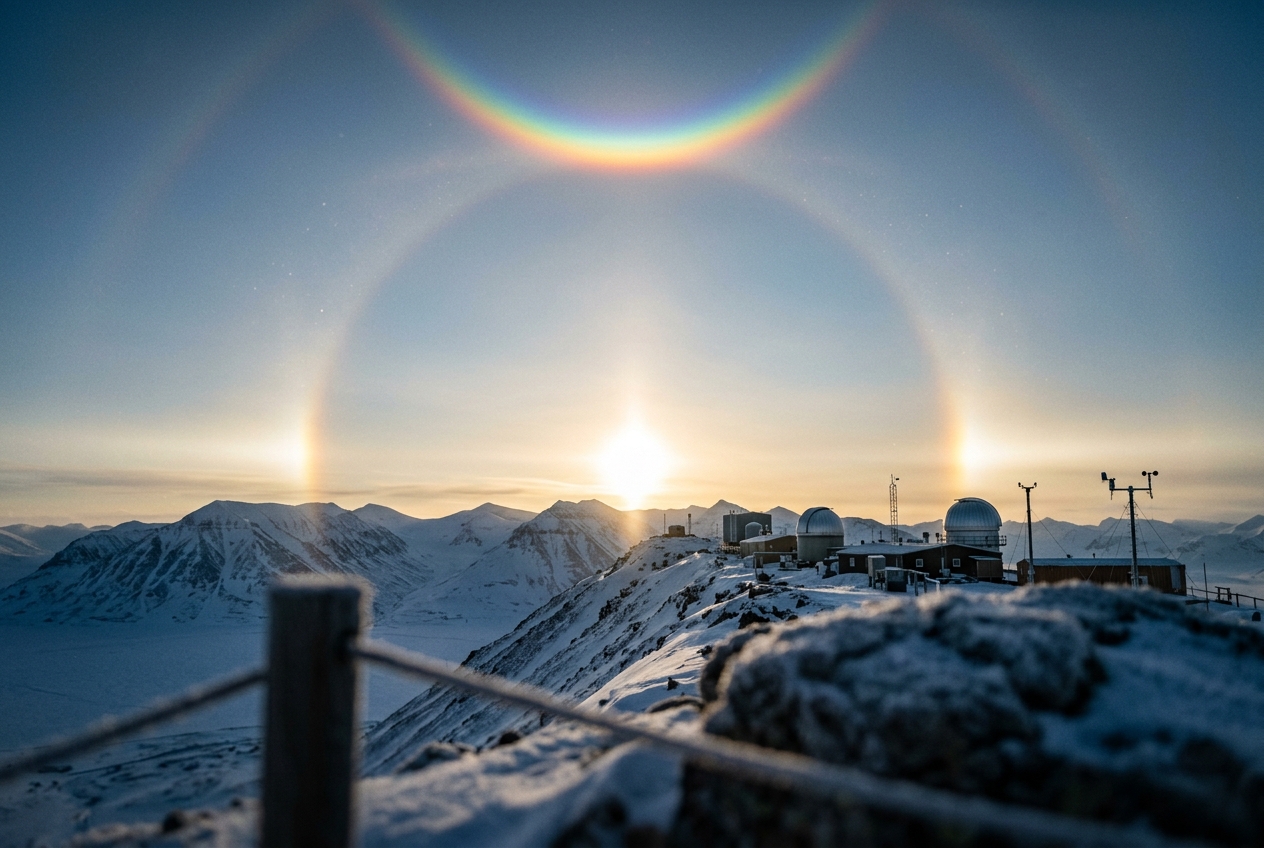
If you shield the glaring disk of the sun with an outstretched thumb, an astonishing optical architecture emerges across the vault of the sky. First, the ubiquitous circular 22° halo forms a luminous ring around the solar core. Directly atop it rests the soaring, v-shaped wings of the upper tangent arc. Yet on rare, aerodynamically pristine mornings, perched precisely above the upper tangent arc like an inverted celestial suspension bridge, sits an ethereal, razor-sharp rainbow-hued arc: the Parry arc.
This fleeting bow is not a product of chance. It is the visible signature of millions of microscopic hexagonal ice prisms executing an exquisite aerodynamic balancing act—arresting every degree of rotational freedom to drift through the freezing air with mathematical perfection.
1. What is Actually Happening: The Physics of Airborne Orientation
To understand why a Parry arc is among the rarest jewels of meteorological optics, one must understand how ice crystals navigate the three-dimensional air currents through which they fall.
Imagine dropping a handful of dry confetti from a high balcony. As the slips of paper descend, they tumble erratically in all directions. If light shines through a cloud of randomly tumbling hexagonal ice crystals, every crystal refracts light at every conceivable angle. The macroscopic statistical average of this chaotic 3D tumble produces a uniform, circular ring of light: the common 22° halo.
Now, imagine dropping a handful of pencils. As a pencil falls, aerodynamic drag forces it to align its longest axis horizontally, parallel to the ground. However, as it falls, it can still spin around that horizontal axis like a rolling log on a conveyor belt. When elongated columnar ice crystals fall in this manner—maintaining a horizontal c-axis while freely spinning around their longitudinal axis—they possess only 1 degree of rotational freedom. Light refracted through this spinning ensemble concentrates rays into bright, wing-like flares above and below the sun known as the upper and lower tangent arcs.
  RANDOM TUMBLE (3D)       HORIZONTAL COLUMN (1D)       PARRY ORIENTATION (0D)
   [All axes spin]           [Long axis level,            [Long axis level AND
                              rolls freely]             flat prism faces level]

*                      =====> (spin)                +-------+
       / \                                                  |  TOP  |
      *---*                                                 +-------+
     (22° Halo)              (Tangent Arcs)               (Parry Arcs)
The Parry arc demands something far more improbable: the complete elimination of that final degree of freedom. For a Parry arc to form, the hexagonal ice column must fall with its long axis strictly horizontal and its top and bottom prism faces locked parallel to the Earth's surface. The crystal is aerodynamically frozen in place—a 0-degree-of-freedom orientation known to atmospheric physicists as doubly oriented columnar ice.
When sunlight enters these horizontally locked prisms, it strikes specific 60° refracting wedges at identical, non-varying entry and exit angles. The resulting rays do not smear into broad halos; instead, they emerge as crisp, vividly separated spectral arcs soaring above or curving beneath the solar disc.
2. The Fluid Dynamics of Doubly Oriented Ice Columns
How does a microscopic ice prism—measuring barely 50 to 200 micrometres in length—prevent itself from rolling as it plummets through the atmosphere? The answer lies in the subtle fluid mechanics of low Reynolds number aerodynamics.
The Low Reynolds Number Regime
The flight of an ice crystal is governed by the Navier-Stokes equations scaled to the microscopic world. The fundamental parameter describing this fluid environment is the Reynolds number ($Re$), which quantifies the ratio of inertial forces to viscous forces within the surrounding air:
$$Re = \frac{\rho_{\text{air}} \, v_t \, D}{\mu_{\text{air}}}$$
Where: * $\rho_{\text{air}}$ is the density of dry subzero air ($\approx 1.40 \text{ kg/m}^3$ at $-25^\circ\text{C}$ and $1013 \text{ hPa}$), * $v_t$ is the terminal settling velocity of the ice crystal ($\text{m/s}$), * $D$ is the characteristic hydrodynamic diameter across the crystal prism face ($\text{m}$), * $\mu_{\text{air}}$ is the dynamic viscosity of air ($\approx 1.58 \times 10^{-5} \text{ Pa}\cdot\text{s}$).
For diamond dust crystals generating Parry arcs, the Reynolds number resides in the laminar transition zone:
$$0.5 \le Re \le 10$$
In this realm, air does not behave like a turbulent, swirling wind; it acts like a viscous syrup. As the hexagonal column settles under gravity, a smooth, laminar boundary layer adheres to its crystalline facets.
                  LAMINAR CROSS-FLOW (Re ≈ 2.0)

               \   \   \   \   \   \   \   \   \
             -------------------------------------  <- Top Horizontal Face
            /                                     \
           /        HEXAGONAL CROSS-SECTION        \
          /           (Parry Orientation)           \
          \                                         /
           \                                       /
            \                                     /
             -------------------------------------  <- Bottom Horizontal Face
               /   /   /   /   /   /   /   /   /
                    Relative Airflow (Upward)
Hydrodynamic Torque and the Potential Well
A regular hexagonal prism possesses two distinct horizontal configurations when falling with its long axis level: 1. Flat-face horizontal (Parry orientation): Two prism faces are perfectly perpendicular to the vertical gravity vector (one facing straight up, one facing straight down). 2. Edge-to-the-wind (Alternate orientation): Two sharp parallel crystal edges face directly up and down, with all six prism faces inclined at $30^\circ$ or $60^\circ$.
When cross-flow air sweeps upward past a settling hexagonal cylinder, the pressure distribution along the flat leading face generates a restorative aerodynamic torque ($\tau_H$). If a miniature eddy nudges a flat-faced crystal, tilting it by an angle $\theta$ from horizontal, the flow velocity over the leading inclined edge accelerates relative to the trailing edge.
By Bernoulli's principle and viscous shear distributions along the boundary layer, this creates an asymmetric pressure differential between the upstream and downstream facets. The center of hydrodynamic pressure ($x_{\text{cp}}$) shifts away from the crystal's physical center of mass ($x_{\text{cm}}$):
$$\tau_H = \vec{F}{\text{drag}} \times (\vec{x}{\text{cp}} - \vec{x}_{\text{cm}})$$
For hexagonal prisms with an aspect ratio (length $L$ to diameter $D$) between $1.5$ and $4.0$, this torque is strictly restorative:
$$\frac{\partial \tau_H}{\partial \theta} < 0 \quad \text{at } \theta = 0^\circ$$
The flat-faced orientation resides at the absolute minimum of an aerodynamic potential well. The viscous drag of the surrounding $-25^\circ\text{C}$ air acts as a critical damper, suppressing rotational rocking (fluttering) and freezing the crystal into its flat-topped horizontal trajectory.
WORKED FLUID MECHANICS EXAMPLE
Consider a diamond dust columnar crystal with diameter $D = 40\,\mu\text{m} = 4.0 \times 10^{-5}\text{ m}$ and length $L = 100\,\mu\text{m} = 1.0 \times 10^{-4}\text{ m}$, settling through polar air at $T = 248\text{ K}$ ($-25^\circ\text{C}$).
- Ambient air density: $\rho_{\text{air}} = 1.40\text{ kg/m}^3$
- Dynamic viscosity: $\mu_{\text{air}} = 1.58 \times 10^{-5}\text{ Pa}\cdot\text{s}$
- Ice density: $\rho_{\text{ice}} = 917\text{ kg/m}^3$
- Crystal volume: $V = \frac{3\sqrt{3}}{8} D^2 L \approx \frac{3(1.732)}{8} (1.6 \times 10^{-9}) (1.0 \times 10^{-4}) \approx 1.04 \times 10^{-13}\text{ m}^3$
- Gravitational force: $F_g = m g = (\rho_{\text{ice}} V) g = (9.53 \times 10^{-11}\text{ kg})(9.81\text{ m/s}^2) \approx 9.35 \times 10^{-10}\text{ N}$
In the creeping flow regime, the settling velocity $v_t$ reaches equilibrium when drag equals gravitational force ($F_D = F_g$). Empirical drag coefficients for elongated cylinders at low $Re$ yield an equilibrium settling velocity:
$$v_t \approx 0.12\text{ m/s}$$
Calculating the Reynolds number:
$$Re = \frac{(1.40\text{ kg/m}^3)(0.12\text{ m/s})(4.0 \times 10^{-5}\text{ m})}{1.58 \times 10^{-5}\text{ Pa}\cdot\text{s}} = \frac{6.72 \times 10^{-6}}{1.58 \times 10^{-5}} \approx 0.425$$
At $Re \approx 0.43$, inertial vortex shedding is completely absent. The flow is strictly laminar and steady, ensuring that the restorative hydrodynamic torque dampens all perturbations without inducing tumbling.
3. Optical Ray Tracing and the Four Parry Manifestations
Because the hexagonal column is locked in 3D space, sunlight enters and exits the crystal facets through precisely constrained geometric paths.
               CROSS-SECTION RAY PATHS IN PARRY COLUMNS

                      Face 1 (Top Horizontal)
                         +---------------+
                        / \             / \
     (Ray Type I)      /   \           /   \
  ------------------->/ Face 6       Face 2 \-------------------> (Ray Type II)
  Upper Suncave Entry \     \         /     /  Upper Sunvex Entry
                       \     \       /     /
                        \     +-----+     /
                         \   Face 4 /    /
                          \        /    /
                           +------+----+
                     Face 5 (Bottom Horizontal)
Hexagonal ice possesses an internal prism angle of $60^\circ$ between alternate prism faces (e.g., Face 2 to Face 6, or Face 1 to Face 5). Applying Snell's Law across these non-parallel crystal boundaries reveals the four fundamental classes of the Parry arc family:
| Arc Name | Entry Face | Exit Face | Geometry & Visual Shape |
|---|---|---|---|
| Upper Suncave | Face 6 (Upper Inclined) | Face 4 (Lower Inclined) | Inverted bow curving upward (concave to sun), perched above the Upper Tangent Arc |
| Upper Sunvex | Face 1 (Top Horizontal) | Face 4 (Lower Inclined) | Gentle arch curving downward over the sun (convex to sun), resting atop the 22° halo |
| Lower Suncave | Face 3 (Lower Inclined) | Face 5 (Bottom Horizontal) | Located below the horizon; concave to the antisolar axis |
| Lower Sunvex | Face 2 (Upper Inclined) | Face 5 (Bottom Horizontal) | Located below the horizon; convex to the antisolar axis |
Bravais Effective Refractive Index for Skew Rays
When the sun sits at an elevation angle $\Sigma$ above the horizon, incoming light rays do not strike the horizontal crystal perpendicular to its long axis. Instead, the rays strike at an oblique, inclined angle.
According to Bravais' Law for Birefringent and Inclined Media, an inclined ray passing through a cylinder oriented horizontally experiences an effective refractive index ($n'$) that increases with the angle of incidence:
$$n'(\Sigma) = \sqrt{\frac{n^2 - \sin^2\Sigma}{\cos^2\Sigma}}$$
Where: * $n$ is the isotropic refractive index of hexagonal water ice in the visible spectrum ($n \approx 1.309$ for sodium D-line yellow light, $\lambda = 589 \text{ nm}$), * $\Sigma$ is the solar elevation angle above the local horizon.
The ray is refracted through an internal prism angle $\alpha = 60^\circ$. The minimum angle of deviation $\delta_{\min}(\Sigma)$ projected onto the principal plane is given by:
$$\delta_{\min}(\Sigma) = 2 \arcsin\left(\frac{n'(\Sigma)}{n} \sin\left(\frac{\alpha}{2}\right)\right) - \alpha$$
   SOLAR ELEVATION: h = 10°              SOLAR ELEVATION: h = 40°

      Upper Suncave (Deep V)               Upper Suncave & Sunvex Merge
           \       /                               ---===---
            \_____/                                    |
       Upper Tangent Arc                           (Combined)
          .-'"""""'-.                            .-'"""""""'-.
         /     *     \                          /      *      \
        (     Sun     )                        (      Sun      )
Evolution with Solar Elevation
The visual separation between the upper tangent arc and the Parry arc is dynamic, dictated entirely by the solar elevation angle $\Sigma$:
- Low Sun ($\Sigma = 0^\circ \text{ to } 15^\circ$): The Upper Suncave Parry arc appears as a distinct, sharply curved hyperbolic arc sitting noticeably clear of the upper tangent arc. Its apex is separated from the sun by approximately $23.5^\circ$ to $27^\circ$.
- Intermediate Sun ($\Sigma = 20^\circ \text{ to } 35^\circ$): The Upper Tangent Arc begins folding upward into the circumscribed halo. Concurrently, the Upper Sunvex Parry arc appears, forming an elegant dome across the apex of the 22° halo.
- High Sun ($\Sigma > 50^\circ$): The Suncave and Sunvex branches converge, flattening out and eventually merging into the complex circumscribed halo structure, making individual visual identification difficult.
WORKED OPTICAL TRACE CALCULATION
Let us calculate the projected angular elevation of the Upper Suncave Parry arc apex for an observer viewing a diamond dust display when the sun is at elevation $\Sigma = 15.0^\circ$.
- Calculate the effective refractive index $n'$:
$$\sin(15.0^\circ) = 0.2588 \implies \sin^2(15.0^\circ) = 0.0670$$ $$\cos(15.0^\circ) = 0.9659 \implies \cos^2(15.0^\circ) = 0.9330$$ $$n' = \sqrt{\frac{1.309^2 - 0.0670}{0.9330}} = \sqrt{\frac{1.7135 - 0.0670}{0.9330}} = \sqrt{\frac{1.6465}{0.9330}} = \sqrt{1.7647} \approx 1.3284$$
- Calculate the projected deviation angle $\delta_{\min}$ for the $60^\circ$ wedge ($\alpha = 60^\circ$, $\frac{\alpha}{2} = 30^\circ$):
$$\sin\left(\frac{\alpha}{2}\right) = \sin(30^\circ) = 0.5000$$ $$\frac{n'}{n} \sin\left(30^\circ\right) = \frac{1.3284}{1.309} (0.5000) = (1.0148)(0.5000) = 0.5074$$ $$\arcsin(0.5074) = 30.49^\circ$$ $$\delta_{\min} = 2(30.49^\circ) - 60^\circ = 60.98^\circ - 60^\circ = 0.98^\circ \text{ (internal projection deviation)}$$
- Integrating the 3D spatial rotation coordinates yields a true apex angular distance of $24.8^\circ$ directly above the solar center. For an observer looking at the sky, the apex of the Parry Suncave arc sits at an absolute elevation of:
$$\theta_{\text{apex}} = 15.0^\circ + 24.8^\circ = 39.8^\circ \text{ above the horizon}$$
This positions the Parry arc approximately $2.8^\circ$ higher than the 22° circular halo apex ($37.0^\circ$), creating an easily photographable gap between the two optical features.
4. Historical Context: Melville Island, 1820
The discovery of this optical phenomenon is intimately tied to the perilous history of polar exploration. During the British Admiralty's 1819–1820 expedition to locate the Northwest Passage, Sir William Edward Parry commanded the bomb vessel HMS Hecla alongside HMS Griper.
Trapped by impassable pack ice off the coast of Melville Island in the Canadian Arctic Archipelago, Parry’s crew endured ten months of continuous winter darkness. On 8 April 1820, as the sun returned to the polar sky amidst bone-chilling calm and diamond dust, Parry documented a complex halo display never before recorded in Western scientific literature.
       HISTORICAL SKETCH: PARRY'S 1820 OBSERVATION

                 (Upper Suncave Arc)
                     \   ___   /
                      \.'   './
                     .-'"""""'-.  (Upper Tangent Arc)
                   .'     |     '.
                  /     (Sun)     \  (22° Halo)
                 |        |        |
                  \       |       /
                   '.     |     .'
                     '-.......-'
                 (Mock Suns / Parhelia)
In his expedition journal, published by the Royal Society, Parry included an exact engraving of an arc nestled above the upper tangent arc, noting that its curvature remained distinctly inverted compared to the circular halos flanking it.
For nearly a century, the physical mechanism remained a matter of fierce debate. It was not until the pioneering work of German meteorologist Alfred Wegener in the early 20th century, followed by computer ray-tracing algorithms pioneered by Robert Greenler and Walter Tape in the late 1970s, that the strict aerodynamic stability of doubly oriented columns was fully proven and accepted by modern atmospheric physics.
5. Practical Outdoor Guidance: Spotting and Photographing the Arc
Spotting a Parry arc in the wild requires an understanding of micrometeorology, optical filtering, and precision observation.
+-------------------------------------------------------------------------+
|                  PARRY ARC FIELD OBSERVATION CHECKLIST                  |
+-------------------------------------------------------------------------+
| [ ] Temperature: Below -15°C (Optimum: -20°C to -30°C)                  |
| [ ] Wind Speed: Calm (< 2 m/s / Beaufort Force 0-1)                     |
| [ ] Atmospheric State: Surface diamond dust or thin cirrostratus nebulosus|
| [ ] Equipment: Polarized sunglasses, wide-angle lens, solar occulting disk|
| [ ] Key Target: Gap immediately above the apex of the Upper Tangent Arc |
+-------------------------------------------------------------------------+
1. Where and When to Look
- Arctic and Antarctic Plateaus: Polar regions with continental anticyclones provide the ideal calm, supercooled surface inversions.
- Alpine Ski Resorts: High-altitude ski basins in subzero conditions frequently generate artificial diamond dust from snow guns. These industrial crystal plumes often contain high fractions of perfectly formed, doubly oriented hexagonal columns.
- Cirrus Canopies: When high-altitude cirrostratus nebulosus blankets the sky ahead of a warm front, watch the halo apex as the solar elevation shifts through $15^\circ \text{ to } 30^\circ$.
2. Observation Technique: The Solar Occulting Method
Never look directly at the unshielded sun. To reveal faint Parry arcs: * Stand so that a distant streetlight, pine tree branch, or roofline precisely blocks the solar disk. * Wear circularly polarised sunglasses or rotate a linear polariser. Because Parry arcs arise from specific refraction geometries, their light exhibits strong linear polarisation perpendicular to the crystal prism axis, allowing you to visually amplify the arc against ambient sky glare.
3. Photographic Capture and Contrast Enhancement
- Exposure: Underexpose your image by $1.0 \text{ to } 1.7 \text{ EV}$ to prevent the bright halo core from blowing out the delicate spectral fringes of the Parry arc.
- Focal Length: Use a $24\text{mm to } 35\text{mm}$ lens on a full-frame sensor to capture both the solar position, the 22° halo, and the complete span of the upper arcs.
- Post-Processing (Unsharp Masking): Apply an unsharp mask or a localized contrast Laplacian filter to your RAW captures. This mathematical subtraction of ambient blur reveals the subtle brightness ridges of the Upper Suncave and Sunvex arcs that are otherwise invisible to the naked eye.
6. Today's Meteorological Rule of Thumb
When diamond dust falls through windless, subzero air, never stop at the 22° halo: block the sun with your hand and look directly above the upper tangent arc. If the wings of light form an inverted bowl curving upward against the sky, you are witnessing the absolute stillness of doubly oriented ice crystals suspended in laminar equilibrium.
Further Reading & Authoritative Meteorological Resources
- World Meteorological Organization (WMO) International Cloud Atlas: Halos
- National Oceanic and Atmospheric Administration (NOAA): Atmospheric Optics
- Met Office: Optical Phenomena and Halo Scattering
- American Meteorological Society: Glossary of Atmospheric Optics
- Atmospheric Optics by Les Cowley: Parry Arc Ray Geometries