Parhelic Circle & Internal Reflection Dynamics: How Vertically Oriented Crystal Faces and Azimuthal Ray Deflection Forge Luminous Horizontal Halo Rings
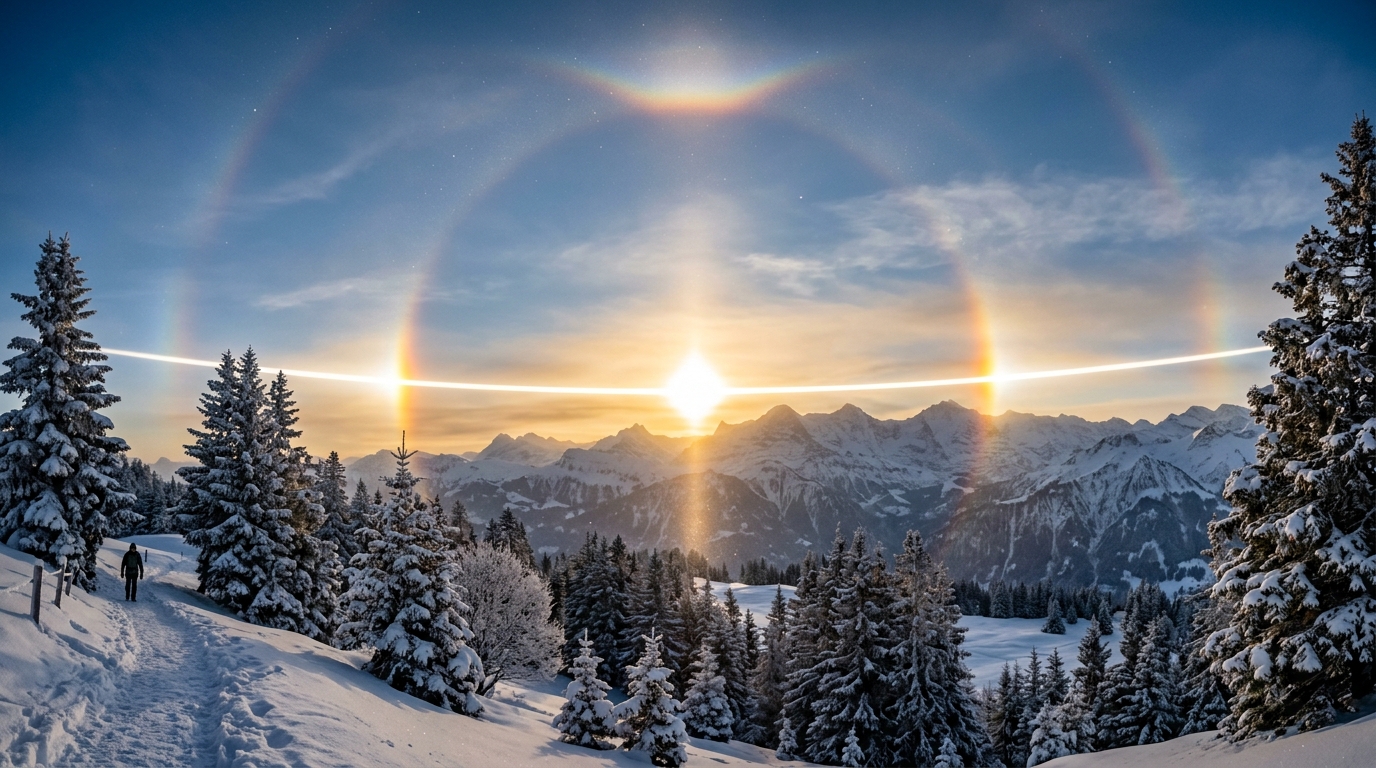
1. The Alabaster Ribbon Across a Sub-Zero Sky
Step outside onto an alpine plateau or an Arctic tundra on a morning when the mercury has plunged past minus twenty degrees Celsius. The air does not merely feel cold; it feels physically solid, sharp against the bronchial lining, and completely stripped of ambient moisture. Overhead, the sky does not boast the deep, saturated azure of midsummer. Instead, a sheer, translucent veil of cirrostratus nebulosus washes the celestial dome in milky, pearl-grey hues.
As the sun climbs twenty-five degrees above the southern horizon, something extraordinary occurs. Extending outward from the blinding solar disc is not merely the familiar pair of flanking parhelia—the vibrant, chromatic "sun dogs" burning red on their inner flanks and azure on their tails—but an expansive, ghostly white band of light.
                                  ZENITH
                                    +
                                    |
                         . - ~ ~ ~  |  ~ ~ ~ - .
                     . '            |            ' .
                   /                |                \
                 /                  |                  \
  120° Parhelion *                  |                  * 120° Parhelion
               /                    |                    \
  ------------|-------------------(SUN)-------------------|------------ SOLAR ALMUCANTAR
              |  \                / | \                /  |             (Parhelic Circle)
              |    *------------*---|---*------------*    |
              | 22° Parhelion       |       22° Parhelion |
               \                    |                    /
                 \                  |                  /
                   \                |                /
                     ' .            |            ' .
                         ' - ~ ~ ~  |  ~ ~ ~ - .
                                    |
                                HORIZON
This luminous ribbon does not curve toward the earth like a rainbow, nor does it encircle the sun like the common 22-degree halo. Instead, it runs entirely parallel to the ground, maintaining an unwavering elevation across the entire celestial sphere. If you turn your back completely to the sun, looking north toward the anti-solar point, the band continues uninterrupted, cutting through the azimuths like an immaculate, drawn-silk equator.
The phenomenon is entirely devoid of chromatic dispersion. There are no prismatic reds, greens, or violets; it is a ribbon of pure, stark alabaster light. Looking up into this vast horizontal ring—known formally in meteorological optics as the parhelic circle—one is gazing not at an optical illusion of perspective, but at a macroscopic optical instrument spanning tens of square kilometres, composed of trillions of microscopic ice crystals floating in immaculate hydrodynamic equilibrium.
2. What Is Actually Happening: A Carousel of Microscopic Mirrors
To grasp the physics of the parhelic circle without drowning in vector calculus, imagine sitting at the bottom of a swimming pool on a tranquil day, looking up at thousands of beer mats or playing cards drifting slowly toward the floor.
When a flat, thin, hexagonal disc falls through a viscous fluid like air, it does not tumble chaotically edge-over-edge. Aerodynamic drag exerts stabilizing pressure on the broadest surface. As the disc descends, air resistance forces its flat basal faces to remain nearly horizontal, while its six rectangular edge faces stand upright, acting as tiny vertical mirrors.
       TOP BASAL FACE (0001) - Kept Horizontal by Aerodynamic Drag
            +-----------------------------+
           /                             / \
          /                             /   \
         +-----------------------------+     +
         |                             |     |
         |                             |     | <-- VERTICAL PRISM FACE (10-10)
         |                             |     |     Functions as a vertical mirror
         +-----------------------------+     +
          \                             \   /
           \                             \ /
            +-----------------------------+
      BOTTOM BASAL FACE (000-1) - Parallel to Ground
Now, replace the swimming pool with the upper troposphere, and replace the beer mats with hexagonal ice crystals measuring between 50 and 500 micrometres across. Trillions of these crystals drift downward through cirrostratus clouds or polar diamond dust. Because of their flat geometry, they fall with their basal pinacoid faces strictly parallel to the horizon. Consequently, their six prism side faces are aligned vertically.
When sunlight strikes this colossal armada of falling crystals, the vertical faces act like a 360-degree hall of mirrors:
- Pure External Reflection: Sunlight strikes the outside vertical face of an ice crystal and bounces off, exactly like a beam of light hitting a mirror wall in an amusement park.
- Internal Total Reflection: Sunlight enters through the crystal's flat horizontal top face, refracts downward, strikes one or more vertical side faces inside the crystal, bounces internally, and exits through the flat horizontal bottom face.
Why is the parhelic circle completely white, whereas ordinary halos and rainbows shimmer with brilliant spectral colors?
Think of a triangular glass prism on a laboratory desk. When white light passes through non-parallel faces, red light bends less than blue light because the refractive index of glass and ice varies with wavelength—a phenomenon known as chromatic dispersion. This angular separation creates the rainbow palette of the 22-degree halo and the circumzenithal arc.
However, in the parhelic circle, light either undergoes simple external reflection (where no light penetrates the ice, meaning zero refraction and zero dispersion occurs), or it enters and exits through strictly parallel horizontal faces. When light enters the top surface and exits the bottom surface of a plate crystal, the angle of refraction at the exit boundary precisely reverses the angle of refraction at the entry boundary. Every wavelength is restored to its original vertical inclination. The ice behaves like a flat window pane: light changes direction in azimuth (horizontally), but emerges without any net spectral splitting. The result is pure, unblemished white light.
3. The Science: Aeromechanics, Invariant Ray Paths, and Elevation Proofs
Hydrodynamic Orientation and Aerodynamic Stability
The formation of a parhelic circle requires precise crystal orientation. Randomly tumbling ice crystals produce only the diffuse, spherical 22-degree and 46-degree halos. The parhelic circle demands that hexagonal plate crystals (or oriented columnar prisms known as Parry or Lowitz crystals) maintain their principal $c$-axes strictly vertical.
          ^ Vertical c-axis [0001]
          |
    +-----+-----+
   /             \
  +   ICE PLATE   +  <--- Flow velocity vector v_inf (falling)
   \             /
    +-----+-----+
          |
In fluid mechanics, the settling behavior of an ice crystal is governed by its Reynolds number ($Re$):
$$Re = \frac{v_{\text{term}} d}{\nu}$$
where $v_{\text{term}}$ is the terminal fall velocity ($\approx 0.1\text{ to }0.5\text{ m s}^{-1}$), $d$ is the crystal diameter, and $\nu$ is the kinematic viscosity of air at cirrus altitudes ($\approx 3.0 \times 10^{-5}\text{ m}^2\text{ s}^{-1}$). For typical cloud ice plates ($d \approx 100\text{ }\mu\text{m}$), the Reynolds number falls in the range $0.5 < Re < 20$.
In this intermediate flow regime, viscous shear forces and inertial pressure gradients generate a hydrodynamic restoring torque $\mathbf{T}_{\text{aero}}$. If a falling plate tilts by an angle $\alpha$ relative to the horizontal, asymmetric pressure distribution across the leading and trailing edges immediately creates a counter-torque:
$$\mathbf{T}{\text{aero}} \propto - C{\text{D}} \rho_{\text{air}} v_{\text{term}}^2 d^3 \sin(2\alpha)$$
This torque forces the crystal back toward $\alpha = 0$, aligning the basal plane ${0001}$ horizontal to within an angular variance of less than $0.5^\circ$. This creates an array of vertical prism facets ${10\bar{1}0}$ pointing in all $360^\circ$ of azimuth across the tropospheric column.
The Optical Invariant: Proof of Constant Elevation ($\theta_{\text{exit}} = \theta_{\text{sun}}$)
Why must the parhelic circle strictly occupy the solar almucantar (the horizontal circle of constant altitude equal to the solar elevation angle $\theta_{\text{sun}}$)? We can prove this using the wave vector decomposition of light traversing a horizontal ice plate.
Consider an incident solar ray with elevation angle $\theta_{\text{sun}}$ above the horizon. The Cartesian coordinate system is defined such that the $z$-axis is normal to the horizontal basal faces of the crystal (parallel to the local zenith).
                 Incident Ray (Elevation = theta_sun)
                     \
                      \
   Top Basal Face =====\========================= [z = 0]
                        \ (Refraction: theta')
                         \
                          | \
                          |   \ (Internal reflection on vertical wall)
    Vertical Prism Face   |     \
    [x-y plane mirror]    |       \
                          |         \
   Bottom Basal Face =====|==========\=========== [z = -h]
                          |            \
                          |             \
                                         v Exit Ray (Elevation = theta_exit)
The wave vector in air $\mathbf{k}_{\text{air}}$ has a magnitude of $k_0 = 2\pi / \lambda$, with vertical component:
$$k_z = -k_0 \sin \theta_{\text{sun}}$$
Step 1: Entry Refraction at the Top Basal Face $(0001)$
When the ray enters the horizontal top surface, Snell's law governs the transformation. Because the boundary lies entirely within the $xy$-plane, the horizontal components of the wave vector ($k_x, k_y$) are conserved across the interface. Inside the ice crystal, where the refractive index is $n_{\text{ice}} \approx 1.31$, the internal vertical wave vector component becomes:
$$k_{z,\text{int}} = -\sqrt{(n_{\text{ice}} k_0)^2 - (k_x^2 + k_y^2)} = -k_0 \sqrt{n_{\text{ice}}^2 - \cos^2 \theta_{\text{sun}}}$$
The internal angle of inclination $\theta'$ relative to the horizontal satisfies:
$$\cos \theta_{\text{sun}} = n_{\text{ice}} \cos \theta' \implies \sin \theta' = \frac{\sqrt{n_{\text{ice}}^2 - \cos^2 \theta_{\text{sun}}}}{n_{\text{ice}}}$$
Step 2: Specular Reflection off Vertical Prism Faces ${10\bar{1}0}$
The ray propagates through the crystal and strikes one of the six vertical prism side faces. Because these faces are strictly parallel to the $z$-axis, their surface normal vector $\mathbf{\hat{n}}{\text{prism}}$ lies entirely in the horizontal $xy$-plane ($\mathbf{\hat{n}}{\text{prism}} \cdot \mathbf{\hat{z}} = 0$).
By the law of specular reflection, the change in the internal wave vector is governed by:
$$\mathbf{k}'{\text{int}} = \mathbf{k}{\text{int}} - 2(\mathbf{k}{\text{int}} \cdot \mathbf{\hat{n}}{\text{prism}})\mathbf{\hat{n}}_{\text{prism}}$$
Taking the scalar product with the vertical unit vector $\mathbf{\hat{z}}$:
$$\mathbf{k}'{\text{int}} \cdot \mathbf{\hat{z}} = (\mathbf{k}{\text{int}} \cdot \mathbf{\hat{z}}) - 2(\mathbf{k}{\text{int}} \cdot \mathbf{\hat{n}}{\text{prism}})(\mathbf{\hat{n}}_{\text{prism}} \cdot \mathbf{\hat{z}})$$
Since $\mathbf{\hat{n}}_{\text{prism}} \cdot \mathbf{\hat{z}} = 0$, the second term vanishes identically:
$$k'{z,\text{int}} = k{z,\text{int}}$$
The vertical momentum component of the light wave is strictly invariant under any arbitrary number of reflections off vertical prism faces.
Step 3: Exit Refraction at the Bottom Basal Face $(000\bar{1})$
The ray reaches the bottom horizontal face and refracts back into the ambient air. Applying Snell's law at the lower interface:
$$k_{z,\text{exit}} = -\sqrt{k_0^2 - (k_{x,\text{exit}}^2 + k_{y,\text{exit}}^2)} = -\sqrt{k_0^2 - (n_{\text{ice}}^2 k_0^2 - k_{z,\text{int}}^2)}$$
Substituting $k_{z,\text{int}}^2 = k_0^2 (n_{\text{ice}}^2 - \cos^2 \theta_{\text{sun}})$:
$$k_{z,\text{exit}} = -\sqrt{k_0^2 - \left[n_{\text{ice}}^2 k_0^2 - k_0^2(n_{\text{ice}}^2 - \cos^2 \theta_{\text{sun}})\right]} = -k_0 \sqrt{\cos^2 \theta_{\text{sun}}} = -k_0 \sin \theta_{\text{sun}}$$
Setting $k_{z,\text{exit}} = -k_0 \sin \theta_{\text{exit}}$, we arrive at the elevation invariant equation:
$$\sin \theta_{\text{exit}} = \sin \theta_{\text{sun}} \implies \theta_{\text{exit}} \equiv \theta_{\text{sun}}$$
Worked Numerical Example
Let us trace a solar ray through this optical path under realistic winter conditions.
- Solar Elevation ($\theta_{\text{sun}}$): $30.0^\circ$
- Refractive Index of Ice ($n_{\text{ice}}$): $1.309$ (for sodium-D yellow light, $\lambda = 589\text{ nm}$) and $1.317$ (for violet light, $\lambda = 404\text{ nm}$)
================================================================================
OPTICAL PARAMETER                YELLOW LIGHT (589 nm)    VIOLET LIGHT (404 nm)
================================================================================
Solar Elevation (theta_sun)      30.000°                  30.000°
Refractive Index (n_ice)         1.3090                   1.3170
Internal Ray Angle (theta')      48.514°                  48.918°
Vertical Invariance (d k_z / dz) 0.000                    0.000
Exit Ray Angle (theta_exit)      30.000°                  30.000°
Net Angular Dispersion (Delta)   0.000°                   0.000°
================================================================================
-
Calculate the internal angle $\theta'$ for yellow light: $$\cos \theta' = \frac{\cos 30.0^\circ}{1.309} = \frac{0.8660}{1.309} = 0.6616 \implies \theta' = \arccos(0.6616) = 48.514^\circ$$
-
Calculate the internal angle $\theta'$ for violet light: $$\cos \theta' = \frac{\cos 30.0^\circ}{1.317} = \frac{0.8660}{1.317} = 0.6576 \implies \theta' = \arccos(0.6576) = 48.918^\circ$$
-
Compute the exit angle after one internal vertical reflection: $$\sin \theta_{\text{exit}} = \sqrt{1 - \cos^2 \theta_{\text{exit}}} = \sqrt{1 - (n_{\text{ice}} \cos \theta')^2}$$ * Yellow light: $\cos \theta_{\text{exit}} = 1.309 \times 0.6616 = 0.8660 \implies \theta_{\text{exit}} = 30.000^\circ$ * Violet light: $\cos \theta_{\text{exit}} = 1.317 \times 0.6576 = 0.8660 \implies \theta_{\text{exit}} = 30.000^\circ$
Both wavelengths emerge at precisely $30.000^\circ$. Because $\Delta \theta = \theta_{\text{exit}}(\text{violet}) - \theta_{\text{exit}}(\text{yellow}) = 0.000^\circ$, there is zero chromatic dispersion. The parhelic circle is rendered as a clean, achromatic white band across the sky.
Fresnel Reflection and Ancillary Optical Gems
The azimuthal distribution of light along the circle is governed by the Fresnel reflection coefficients for unpolarized incident solar radiation:
$$R = \frac{1}{2} \left[ \left( \frac{\sin(\theta_i - \theta_t)}{\sin(\theta_i + \theta_t)} \right)^2 + \left( \frac{\tan(\theta_i - \theta_t)}{\tan(\theta_i + \theta_t)} \right)^2 \right]$$
Because internal rays undergo total internal reflection when striking vertical faces at angles exceeding the critical angle $\theta_c = \arcsin(1/n_{\text{ice}}) \approx 49.8^\circ$, specific internal geometric trajectories concentrate photons at distinct azimuthal deviations from the sun:
                            THE PARHELIC RING SYSTEM
                                (Azimuth Map)

0° (Sun & 22° Sundogs)
                         \       /
                          \     /
                           \   /
      -120° Parhelion ------ O ------ +120° Parhelion
                            / \
                           /   \
                          /     \
                     180° (Anthelion)
- The 120° Parhelia (Paranthelia): Light enters the horizontal basal face $(0001)$, undergoes two successive internal reflections off adjacent vertical prism faces oriented at $60^\circ$ to one another, and exits through the opposite basal face. This double internal reflection produces an azimuthal shift of $\Delta \phi = 2 \times 60^\circ = 120^\circ$, creating bright, diamond-like white spots exactly $120^\circ$ away from the sun on both sides of the parhelic circle. Readers can explore ray-path simulations of these features on the Atmospheric Optics 120° Parhelia Archive.
- The Anthelion: Located at an azimuth of $180^\circ$ (directly opposite the sun along the solar almucantar), this luminous patch is generated by complex multi-reflection paths (e.g., Wegener and Hastings ray paths) inside columnar and plate crystals, concentrating backward-scattered light.
- Liljequist Parhelia: Faint luminous brightenings that occasionally appear near azimuths of $150^\circ\text{ to }160^\circ$, produced by internal reflections within thin plate crystals where light undergoes total internal reflection near the critical angle.
4. Practical Outdoor Guidance: Field Observation and Synoptic Diagnostics
Spotting a parhelic circle is one of the most rewarding experiences in observational meteorology. While parhelia (sun dogs) are relatively common, witnessing a complete 360-degree parhelic circle requires a dense, uniform population of aerodynamically stable plate crystals.
+-----------------------------------------------------------------------------------+
|                           FIELD OBSERVATION CHECKLIST                             |
+===================================================================================+
| ATMOSPHERIC CONDITIONS:                                                           |
| [ ] Cloud Type: Cirrostratus fibratus or thin cirrostratus nebulosus             |
| [ ] Barometric Tendency: Falling (0.5 to 1.5 hPa/hr indicates warm front)         |
| [ ] Surface Temperature: High-altitude cold or sub-zero surface conditions        |
|                                                                                   |
| OBSERVATION METHODOLOGY:                                                          |
| [ ] Occult the Sun: Use a solid object (pole, rooftop) to block direct glare      |
| [ ] Trace the Almucantar: Scan horizontally at the sun's exact altitude           |
| [ ] Polarization Check: Rotate polarized sunglasses to enhance contrast           |
| [ ] Look for Ancillary Gems: Check azimuths at 120° and 180° (Anthelion)          |
+-----------------------------------------------------------------------------------+
What to Look For in the Sky
- Occult the Solar Disc: The parhelic circle near the sun is often overwhelmed by forward diffraction glare. Position yourself so that a lamppost, tree limb, or building roofline blocks the direct solar disc.
- Scan the Solar Almucantar: Keep your eyes locked at the exact vertical angle of the sun above the horizon, then rotate your gaze horizontally across the entire sky. Look for a thin, straight, chalk-white line spanning through east, north, and west.
- Inspect the Quadrants: Pay close attention to the points $120^\circ$ to the left and right of the sun. These are the locations of the rare $120^\circ$ parhelia. Finally, look directly opposite the sun at the anti-solar azimuth for the diffuse, glowing spot of the anthelion. For extended image galleries and ray simulations, consult the Atmospheric Optics Parhelic Circle Guide and the comprehensive Wikipedia Parhelic Circle Reference.
Meteorological Instrumentation and Synoptic Diagnostics
The presence of a parhelic circle provides valuable real-time information about upper-tropospheric structure:
- Barometric Pressure: Watch your aneroid or digital barometer. If the parhelic circle appears within a thickening sheet of cirrostratus accompanied by a steady pressure drop ($0.8\text{ to }1.5\text{ hPa h}^{-1}$), you are observing the overrunning warm, moist conveyor belt of an approaching mid-latitude cyclone. Precipitation typically follows within 12 to 24 hours. For detailed synoptic forecasting tools, consult resources from the National Oceanic and Atmospheric Administration (NOAA) and the Royal Meteorological Society (RMetS).
- Surface Temperature & Humidity: In polar regions or high-latitude continental interiors (e.g., Siberia, the Canadian Yukon, or the Antarctic Plateau), parhelic circles frequently form in boundary-layer "diamond dust" under strong radiative cooling inversions. Surface temperatures will typically register below $-15^\circ\text{C}$, with wind speeds under 3 knots ($<1.5\text{ m s}^{-1}$) to prevent mechanical turbulence from disrupting crystal orientation.
- Optical Verification with Polarizers: Because external reflections off vertical prism faces produce strongly s-polarized light, viewing the parhelic circle through a rotating linear polarizing filter (or polarized sunglasses) will cause the circle's brightness to modulate dramatically as the transmission axis changes from horizontal to vertical.
5. Today's Meteorological Rule of Thumb
The Almucantar Mirror Rule: Whenever you observe sun dogs, block the sun and scan horizontally at that exact altitude around the entire horizon. If the ring is pure white and flat, you are looking at billions of horizontally floating ice plates acting as vertical mirrors; if a falling barometer accompanies the display, expect a warm front to arrive within twenty-four hours.