Moilanen Arc & V-Shaped Halo Dynamics: How 34° Tilted Ice Facets and Crystal Twinning Forge Rare V-Shaped Sky Chevrons
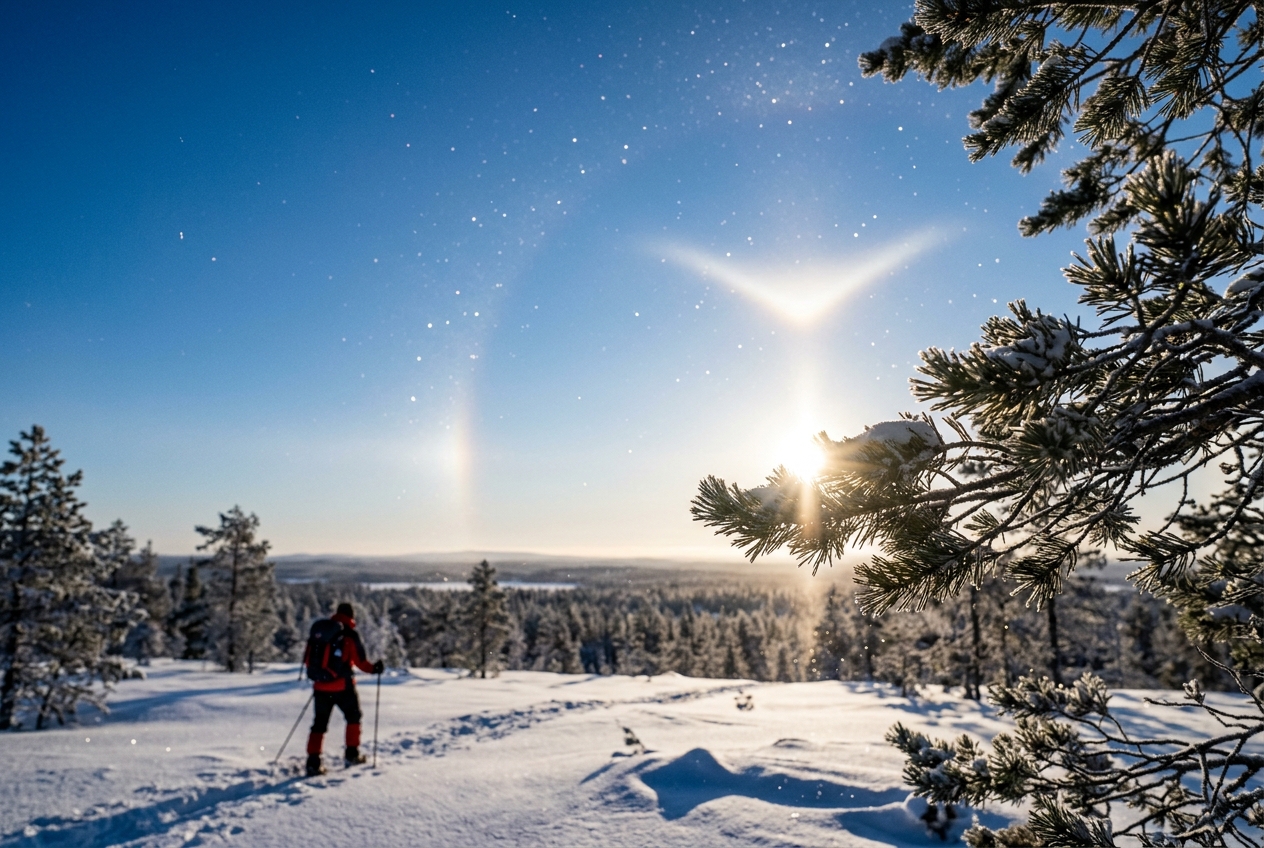
In the quiet, sub-zero landscapes of the high latitudes, where suspended ice dust turns the air into a shimmering hall of mirrors, atmospheric scientists long believed they had mapped every geometric trick light could play. Yet in 1995, an amateur observer in Finland looked toward the sun and documented a phantom V-shaped chevron hovering where optical theory insisted the sky should be utterly dark. Here is the definitive story, crystallography, and mathematical proof of the Moilanen arc.
1. The Frost-Locked Dawn: An Encounter with Diamond Dust
The air at minus twenty-eight degrees Celsius does not merely feel cold; it feels structural. Stepping out onto the snow-crusted shore of the Gulf of Bothnia near Vaasa, Finland, just before dawn, the atmosphere possesses a glassy, breathless stillness. Every inhalation delivers a sharp, dry sting to the mucous membranes, smelling faintly of clean mineral frost and ozone. There is no wind. The barometric pressure has climbed steadily over forty-eight hours beneath a massive Scandinavian Arctic anticyclone, settling into a dense, stagnant cold pool that pins the planetary boundary layer to the earth.
As the pale disc of the low winter sun clears the pine-studded horizon, the ambient air suddenly ignites with millions of microscopic points of light. This is diamond dust—what meteorologists classify as un-nucleated, slow-settling ice crystals suspended in a clear sky, free of any visible cloud deck. Light glints off these drifting micro-prisms like pulverized crystal.
       \   /            <-- Moilanen Arc (V-Chevron ~10.6° above Sun)
        \ /
         V
         •              <-- The Sun (Low Elevation)
    ___________
   /           \
  /    22°      \       <-- Classical 22° Halo Boundary
 /     Halo      \
A seasoned skywatcher naturally anticipates the classical atmospheric pantheon: the familiar circular 22° halo, the brilliant flanking parhelia (sun dogs) burning like twin lanterns, and perhaps the sweeping, bird-like wings of the upper tangent arc touching the halo’s apex.
Yet on this morning, nested deep inside the dark, unilluminated moat between the sun and the 22° ring, something impossible appears. Directly above the solar disc, at roughly half the distance of the standard halo—no more than ten or eleven degrees overhead—a small, distinct, upward-pointing V-shaped chevron of pure white light hovers in absolute defiance of classical textbook optics. It does not blur into a circle, nor does it conform to the known geometry of hexagonal columns or plates. It hangs in the freezing air like a luminous arrowhead, sharp, mysterious, and radically out of place.
2. What Is Actually Happening: The Sky as an Optical Laboratory
To appreciate why this miniature chevron bewildered atmospheric physicists for decades, one must understand how standard ice crystals process sunlight.
Think of ordinary atmospheric ice crystals as microscopic hexagonal pencils or stop-sign-shaped plates drifting through the sky. Just like glass prisms on a laboratory bench, these crystals have flat faces intersecting at strictly defined geometric angles dictated by the molecular lattice of solid water ($H_2O$ in its standard terrestrial form, known as Ice Ih).
In a classical hexagonal crystal, there are only two primary refracting angles available to passing rays of sunlight: 1. The 60° Wedge: Formed between alternating prism side faces. When sunlight enters one side face and exits through another separated by an intervening face, the light bends by a minimum of approximately 22 degrees. This single interaction generates the universally recognized 22° solar halo and flanking sun dogs. 2. The 90° Wedge: Formed between the flat top or bottom base (the basal pinacoid) and any of the six vertical side faces. Light taking this path bends by roughly 46 degrees, forging the fainter, expansive 46° halo and the vivid circumzenithal arc.
For over three centuries, from René Descartes and Sir Isaac Newton to modern computational atmospheric opticians, the law was considered absolute: a simple hexagonal ice prism cannot bend light by less than 22 degrees. The angular gap between the sun and the 22° halo is theoretically an optical void—a region of forbidden angles where simple refraction cannot cast light.
Classical Hexagonal Prism Angles vs. The Anomalous Moilanen Wedge:

Classical 60° Prism               Classical 90° Prism               Moilanen 34° Wedge
         (Yields 22° Halo)                 (Yields 46° Halo)               (Yields ~10.6° Arc)

/\                                _____                              /\
            /60\                              |     |                            /34°\
           /    \                             |     |                           /     \
          /______\                            |_____|                          /       \
     Refraction Angle: 22°             Refraction Angle: 46°             Refraction Angle: 10.6°
When Finnish halo researcher Jarmo Moilanen first photographed this sub-22° V-shaped feature on May 9, 1995, over Vaasa, it was initially dismissed by skeptics as a localized reflection artifact, a camera flare, or an optical illusion caused by distant illuminated terrain.
However, subsequent sightings during extreme diamond dust outbreaks—often triggered in the vicinity of artificial snowmaking guns at ski resorts—confirmed that the feature was indisputably real.
The explanation required a radical crystallographic leap. The atmosphere was not populated solely by perfect, single-crystal hexagonal prisms. Instead, under specific conditions of rapid thermal quenching and supercooled vapor deposition, ice crystals undergo twinning—a phenomenon where two separate crystal domains grow conjoined across a shared crystallographic boundary, or develop non-standard pyramidal facets.
These twinned structures create an exotic, non-classical prism: an apex wedge angle of approximately 34 degrees. When sunlight enters one face of this twinned junction and exits the other, it undergoes a far shallower refraction than anything possible in a standard hexagonal column, casting light directly into the "forbidden" 8°–11° zone above the sun.
3. The Science: Crystallographic Twinning and the Mathematics of Minimum Deviation
To mathematically quantify the Moilanen arc, we turn to the foundational mechanics of prism refraction and Snell's Law. When a monochromatic ray of light traverses a symmetric triangular prism with apex angle $A$ and refractive index $n$, the total angle of deviation $D$ varies according to the angle of incidence. The light concentrates intensely at the angle of minimum deviation ($D_{\text{min}}$), where the internal ray path travels perfectly parallel to the prism base.
3.1 Step-by-Step Mathematical Proof of Minimum Deviation
Consider a symmetrical ice prism with apex angle $A$, surrounded by air (refractive index $n_{\text{air}} \approx 1.000$). Let the refractive index of solid water ice be $n = 1.309$ (for yellow sodium D-line light at $\lambda = 589\,\text{nm}$ at sub-zero temperatures).
Geometry of Symmetrical Ray Path at Minimum Deviation:

Apex Angle (A)
                          / \
                         /   \
  Incident Ray i1       /     \       Emergent Ray i2
 --------------------->/\  r1 |r2 /\--------------------->
                        \     |  /
                         \    | /
                          \___|/
                           Base
                   Total Deviation: D_min
- Internal Angles at Symmetry: At minimum deviation, the angle of incidence equals the angle of emergence ($i_1 = i_2 = i$), and the internal refraction angles at both faces are identical ($r_1 = r_2 = r$).
- Prism Geometry Relation: The sum of the internal angles must equal the apex angle of the prism: $$r_1 + r_2 = A \implies 2r = A \implies r = \frac{A}{2}$$
- Total Angular Deviation: The total deviation $D$ experienced by the ray across both surfaces is the sum of the deviations at entry and exit: $$D_{\text{min}} = (i_1 - r_1) + (i_2 - r_2) = 2i - 2r = 2i - A$$
- Applying Snell's Law: At the first air-ice boundary: $$\sin(i) = n \cdot \sin(r)$$ Substituting $r = \frac{A}{2}$: $$\sin(i) = n \cdot \sin\left(\frac{A}{2}\right)$$ Solving for the external angle of incidence $i$: $$i = \arcsin\left(n \cdot \sin\left(\frac{A}{2}\right)\right)$$
- The Master Minimum Deviation Equation: Substituting the expression for $i$ back into the total deviation formula yields: $$D_{\text{min}} = 2 \arcsin\left(n \cdot \sin\left(\frac{A}{2}\right)\right) - A$$
3.2 Worked Example: The Classical 60° Prism vs. The 34° Moilanen Wedge
Let us execute the rigorous calculations comparing classical halo mechanics against the Moilanen wedge.
Case A: Classical Hexagonal Prism ($A = 60^\circ$, $n = 1.309$)
$$\frac{A}{2} = 30^\circ$$ $$\sin(30^\circ) = 0.5000$$ $$n \cdot \sin\left(\frac{A}{2}\right) = 1.309 \times 0.5000 = 0.6545$$ $$i = \arcsin(0.6545) \approx 40.884^\circ$$ $$D_{\text{min}} = 2(40.884^\circ) - 60^\circ = 81.768^\circ - 60^\circ = \mathbf{21.77^\circ} \approx \mathbf{22^\circ}$$ Result: This produces the inner boundary of the standard 22° circular halo.
Case B: The Non-Standard Moilanen Wedge ($A = 34^\circ$, $n = 1.309$)
$$\frac{A}{2} = 17^\circ$$ $$\sin(17^\circ) \approx 0.29237$$ $$n \cdot \sin\left(\frac{A}{2}\right) = 1.309 \times 0.29237 \approx 0.38271$$ $$i = \arcsin(0.38271) \approx 22.503^\circ$$ $$D_{\text{min}} = 2(22.503^\circ) - 34^\circ = 45.006^\circ - 34^\circ = \mathbf{11.01^\circ}$$
Taking into account slight dispersion across the visible spectrum ($n \approx 1.307$ for red light, $n \approx 1.314$ for violet) and crystal wedge variations between $33.7^\circ$ and $34.0^\circ$, the theoretical minimum deviation angle spans: $$\mathbf{D_{\text{min}} \approx 10.6^\circ - 11.0^\circ}$$
This matches the observed solar-topping distance of the Moilanen arc.
3.3 Crystallographic Mechanics: Twinning Planes and Miller Indices
How does nature construct an apex angle of precisely 34° in an ice lattice governed by hexagonal symmetry?
In standard crystallography, the lattice of ordinary ice (Ice Ih) belongs to the space group $P6_3/mmc$, with lattice parameters $a \approx 4.52\,\text{Å}$ and $c \approx 7.36\,\text{Å}$. In normal conditions, crystals grow along the prism faces ${10\bar{1}0}$ and the basal pinacoids ${0001}$.
Crystallographic Twinning on the Pyramidal (10-12) Plane:

Sub-Crystal 1                   Sub-Crystal 2
           c-Axis [0001]                   c-Axis [0001]
               ^                               ^
               |       Twin Boundary          /
               |      Plane (10-12)          /
               |            /               /
               |           /  34° Wedge    /
               |          /   \           /
               |         /     \         /
               |        /       \       /
               |_______/_________\_____/
Under rapid supersaturation, crystal growth can undergo contact twinning. When two ice crystals twin along a pyramidal plane—most notably the ${10\bar{1}2}$ or ${11\bar{2}2}$ semi-pyramidal growth planes—the primary optic axes ($c$-axes) of the two conjoined sub-crystals become tilted relative to one another at an angle of roughly $70.5^\circ$ or $109.5^\circ$.
This structural rotation forces the external prism faces of the twin to meet at an inclined dihedral angle. As detailed in optical ray-tracing research by Finnish physicist Michael Sillanpää and American mathematician Walter Tape, the intersection between a prism face of the host crystal and an adjacent face of the twinned component forms an effective exterior and interior wedge of $33.7^\circ \approx 34^\circ$.
3.4 Aerodynamic Orientation and V-Chevron Caustic Formation
Why does the Moilanen arc manifest as an upright, flaring V-shape rather than a circular 10.6° halo ring?
If the 34° twinned ice crystals were tumbling randomly in three-dimensional space, the minimum deviation caustics would project isotropically in all directions around the solar disc, producing a faint, continuous $10.6^\circ$ circular ring.
However, falling ice crystals are aerodynamic bodies. When crystals reach diameters exceeding $30\,\mu\text{m}$, viscous aerodynamic drag in the Stokes flow regime forces them to align with their largest cross-sectional area perpendicular to the relative airflow.
Ray Path Creating the Upright V-Chevron:

\   Moilanen Arc Rays   /
               \                     /
                \                   /
                 \                 /
                  \               /
            _______\_____________/_______
           |                             |
           |      Twinned Ice Column     |  <-- Horizontal Axis Orientation
           |      with 34° Top Facet     |
           |_____________________________|
                         ^
                         |
                   Sunlight from Below
For twinned columnar or plate aggregates, aerodynamic stability fixes the twin boundary horizontal, with the 34° refractive wedge oriented upward along the solar vertical meridian: 1. Vertical Solar Meridian Rays: Rays entering the lower facet and exiting the upper facet of the horizontal wedge undergo a pure vertical upward deflection equal to $D_{\text{min}} \approx 10.6^\circ$. This generates the sharp, dense vertex of the "V" positioned directly above the sun. 2. Skew Rays: Rays striking the prism at oblique horizontal angles experience an increased effective apex angle, causing higher total deviations that sweep upward and laterally outward. 3. The Caustic Surface: The mathematical envelope of these skew rays forms a hyperbolic fold in spherical sky coordinates. To an earthbound observer, this caustic projects as an upward-opening chevron: the classic V-geometry.
4. Practical Outdoor Guidance: Field Identification Protocols
Spotting a Moilanen arc requires deliberate observation techniques, specific atmospheric prerequisites, and diagnostic rigor to avoid confusing it with common optical relatives.
4.1 Atmospheric Prerequisites and Trigger Environments
The Moilanen arc is exceptionally rare in natural cirrus cloud formations because the delicate 34° twinned crystal morphology is easily disrupted by atmospheric turbulence. To find it, seek out these conditions:
- Surface Temperature: Lower than $-15^\circ\text{C}$ ($+5^\circ\text{F}$), with optimal crystal fidelity occurring between $-22^\circ\text{C}$ and $-35^\circ\text{C}$.
- Atmospheric Stability: Extreme surface temperature inversions (where air temperature rises with height) beneath high-pressure systems. Look for barometric pressure exceeding $1025\,\text{hPa}$ and calm surface winds ($< 2\,\text{m/s}$).
- Artificial Nucleation Zones (The "Ski Resort Effect"): The vast majority of modern Moilanen arc sightings occur downwind of ski resorts or industrial sites operating high-pressure snow guns. Snow cannons spray supercooled water droplets into sub-zero air, creating rapid, non-equilibrium vapor condensation that triggers high rates of crystallographic twinning.
DIAGNOSTIC MATRIX: UNRAVELING SOLAR-TOPPING ARCS

Feature             Angular Distance    Geometry             Origin Facet / Wedge
-----------------------------------------------------------------------------------------
Moilanen Arc        10° – 11° above Sun  Sharp Upward "V"     34° Twinned Wedge Facet
Upper Tangent Arc   22° above Sun       Curved "Wings"       60° Prism (Horizontal Column)
Parry Arc           24° – 28° above Sun  Flat/Concave Bow     60° Prism (Parry Orientation)
Pyramidal 9° Halo   9° circular ring    Faint Circular Ring  Pyramidal Faces {10-11}
4.2 Diagnostic Protocol: How to Differentiate the Arcs
When an optical feature appears above the sun during an ice dust outbreak, execute the following step-by-step field verification:
                  [ Bright Feature Detected Overhead ]
                                  |
            Is it within or outside the 22° Halo distance?
             /                                          \
    [ Inside 22° Ring ]                         [ Outside 22° Ring ]
           |                                              |
    Measure Angle to Sun:                        Check Angular Position:
           |                                              |
    ~9° to 11° Above Sun?                         22° to 28° Above Sun?
     /                 \                                /             \
[ Sharp "V" Shape ]  [ Faint Circle ]        [ Curved Wings ]   [ Flat Upper Arc ]
        |                   |                       |                   |
  MOILANEN ARC       PYRAMIDAL 9° HALO      UPPER TANGENT ARC       PARRY ARC
-
Rule Out the Upper Tangent Arc: - Measurement: Extend your fist at arm's length (which subtends approximately $10^\circ$). Place the bottom of your fist on the sun (shielding the solar disc with your thumb). - Result: The standard 22° halo and its upper tangent arc sit two full fist-widths above the sun. The Moilanen arc sits exactly one fist-width above the sun.
-
Rule Out Parry Arcs: - Measurement: Parry arcs are produced by column crystals floating with both their long axis and basal faces strictly horizontal. They appear above the 22° halo (between $24^\circ$ and $28^\circ$ altitude), never inside the 22° ring.
-
Rule Out 9° Pyramidal Rings: - Measurement: True pyramidal ice crystals can produce a 9° circular halo. However, a 9° pyramidal halo forms a continuous, diffuse circular ring encircling the sun, lacking the sharp, upward-flaring arms and tight vertex of the Moilanen V-chevron.
FIELD OBSERVATION CHECKLIST
[ ] Solar Elevation: Low (between 2° and 18° above the horizon)
[ ] Eye Protection: Use a solid object (building edge, lamppost, or outstretched thumb) to occult the blinding solar disc.
[ ] Camera Settings: Manual focus locked to infinity; aperture f/8 to f/11; underexpose by -1.0 to -2.0 EV to prevent clipping white caustics.
[ ] Optical Filter: Linear polarizers help enhance contrast against blue sky, though diamond dust halos are largely unpolarized at minimum deviation.
5. Today's Meteorological Rule of Thumb
The 10° Arctic Rule: When standing in sub-zero diamond dust, if you spot a sharp, upward-pointing chevron exactly one fist-width ($10^\circ$) above the sun—nested deep inside the standard two-fist ($22^\circ$) halo ring—you are witnessing the rare optical footprint of twinned 34° ice crystals: the Moilanen arc.
Further Reading & Authoritative Meteorological Resources
- World Meteorological Organization (WMO) International Cloud Atlas — Comprehensive reference on halo phenomena and ice hydrometeors.
- Atmospheric Optics by Les Cowley — In-depth ray-tracing models and crystallographic simulations of rare halos.
- NOAA National Weather Service: Optical Phenomena — Field guides to cold-weather atmospheric displays.
- Met Office: Halos and Atmospheric Optical Effects — UK meteorological guide to atmospheric ice refraction.
- Wikipedia: Moilanen Arc — Historical discovery and optical classification archives.