Liljequist Parhelia & Parhelic Reflection Dynamics: How Horizontally Oriented Plate Crystals and Double Internal Reflections Forge 150° Antisolar Mock Suns
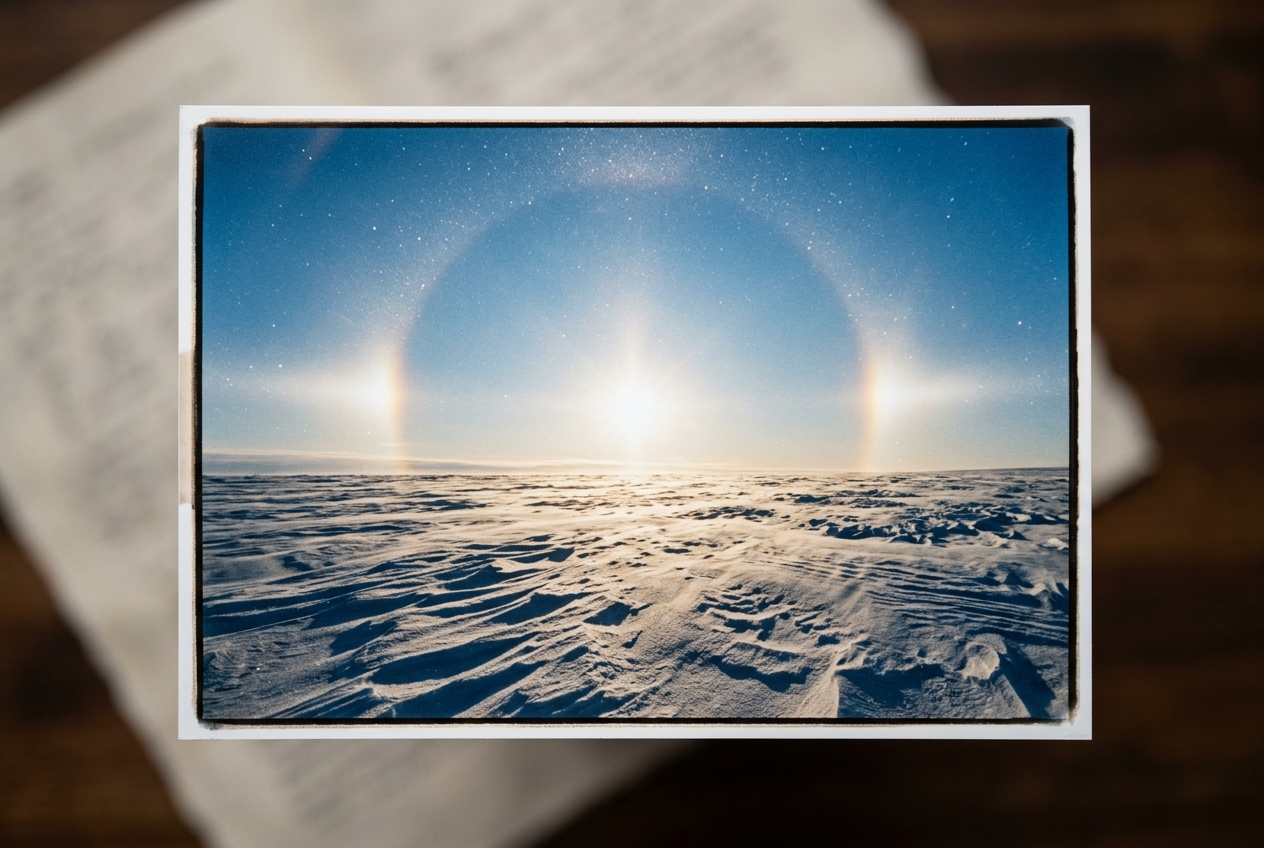
1. Opening Scene: The Frozen Silence of Queen Maud Land
Dawn breaks over the ice shelf not with a sudden burst of warmth, but with a sharp, metallic clarity that tightens the skin across your cheekbones. The mercury sits motionless at thirty-eight degrees below zero Celsius. When you exhale, the moisture in your breath does not billow as steam; it crackles faintly, condensing instantly into millions of microscopic ice grains that drift lazily toward the hard-packed firn. The air is so still that the sound of your own pulse seems amplified against the vast, featureless horizon of Antarctica.
As the pale sun climbs just above the rim of the world, something extraordinary happens to the atmosphere. The ambient space ceases to be empty air; it transforms into a crystalline suspension. A blinding horizontal band of pure white light ignites across the sky, slicing parallel to the horizon at the exact elevation of the sun. This luminous ribbon—the parhelic circle—girdles the entire heavens in a continuous 360-degree loop.
                                  [ Zenith ]
                                      |
       22° Parhelion             The Sun (h=15°)           22° Parhelion
            [ * ]---------------------( O )---------------------[ * ]
              \                         |                         /
               \                  Parhelic Circle                /
================\===============================================/================ Horizon
                 \                     ...                     /
                  \                                           /
           120° Parhelion                               120° Parhelion
                [ * ]                                       [ * ]
                   \                                       /
                    `---[ Liljequist Parhelia (150°-160°) ]---'
Near the sun, the familiar 22° parhelia—the brilliant, chromatic "sun dogs"—blaze with vivid reds on their inner edges and ethereal blues trailing outward. Further along the circle, at two-thirds of the way toward the shadow of your head, subtle white spots glow softly at the 120° azimuth. But if you turn your back almost entirely upon the sun, shading your eyes against the glare and scanning the parhelic circle near the antisolar point between 150° and 160° azimuth, you witness atmospheric optics at its most subtle: two diffuse, elongated patches of pearlescent light hovering like pale phantoms against the deep polar azure. You are gazing upon one of the rarest optical phenomena in nature—the Liljequist parhelia.
2. What Is Actually Happening: Hexagonal Prisms and Aerodynamic Flight
To understand how sunlight can be systematically redirected more than 150 degrees across the sky without a giant mirror behind you, we must examine the microscopic architecture of falling ice crystals. The phenomenon was first documented during the rigorous field campaigns of the 1949–1952 Norwegian-British-Swedish Antarctic Expedition at the coastal base of Maudheim. The expedition’s Swedish meteorologist, Gösta Hjalmar Liljequist, spent months meticulously recording the optical anomalies of polar diamond dust, recognizing that these anomalous brightening events near the antisolar point could not be explained by conventional halo theory.
Think of the sky during a cold-air inversion as a ballroom floor suspended in mid-air, populated by trillions of microscopic hexagonal glass tables. These crystals are thin plate prisms—flat, hexagonal wafers where the broad top and bottom faces are called basal faces, and the six rectangular vertical boundaries are called prism facets.
                       Basal Face (c-axis vertical)
                             /-------------\
                            /               \
              Prism Facet  |                 |  Prism Facet
              (Side 1)     |                 |  (Side 4)
                            \               /
                             \-------------/
                       Basal Face (Bottom)
In calm, non-turbulent air, hydrodynamic drag forces act symmetrically against the broadest surface area of these falling crystals. As a result, the plates glide horizontally with their principal symmetry axis—the crystallographic $c$-axis—aligned strictly vertical. They drift downward like tiny parachutes, their flat top and bottom faces parallel to the ground, while their six side facets remain perpendicular to the Earth.
When sunlight strikes this swarm of aerodynamically leveled prisms, different ray trajectories produce distinct optical features:
- The Classic 22° Parhelia (Sun Dogs): Rays enter one vertical side facet and exit an adjacent alternate side facet, traversing a 60° prism wedge. The light undergoes pure refraction, splitting into spectral colors because blue light bends slightly more than red light.
- The 120° Parhelia: Rays enter the top horizontal basal face, undergo two total internal reflections off alternating vertical side facets (behaving like an internal billiard table), and emerge through the bottom basal face.
- The Parhelic Circle: Formed primarily by simple external reflections off the vertical side facets of the plates, as well as complex internal reflections that do not deviate the ray's vertical angle, painting a white, unseparated band of light around the entire sky at the sun's altitude.
- The Liljequist Parhelia: Unlike the pure refraction of sun dogs or the simple two-bounce path of 120° parhelia, Liljequist parhelia require a complex, multi-stage hybrid trajectory. Light enters through a basal face or side face, experiences internal reflection off vertical prism facets near the critical angle of total internal reflection, bounces internally off the horizontal basal face, and emerges deflected at an azimuth between 150° and 160°.
Because the light undergoes internal reflection at flat surfaces without differential dispersion upon exit, Liljequist parhelia appear predominantly colorless or milky-white, distinct from the fiery rainbow hues of ordinary 22° sundogs.
3. The Science: Internal Reflections, Snell's Law, and Geometric Deflection
To rigorously model how a hexagonal ice crystal redirects incoming solar radiation to 150°–160° azimuth, we turn to the foundational principles of geometrical optics in crystalline media.
According to the World Meteorological Organization (WMO) International Cloud Atlas, halo phenomena are governed by the refractive index of solid ice, $n$, which in the visible spectrum ($\lambda \approx 589\text{ nm}$) at sub-zero temperatures is approximately:
$$n_{\text{ice}} \approx 1.309$$
Equation 1: The Critical Angle for Total Internal Reflection
When a light ray traveling inside an ice crystal strikes an ice-to-air boundary from within, it can only escape into the air if its angle of incidence $\theta_i$ relative to the surface normal is less than the critical angle $\theta_c$. If $\theta_i \ge \theta_c$, the boundary acts as an ideal, 100% efficient mirror via total internal reflection (TIR).
Plain English Prediction: The critical angle equation tells us the exact threshold angle beyond which light cannot escape an ice crystal, forcing it to bounce internally with zero loss of brightness.
$$\theta_c = \arcsin\left(\frac{1}{n_{\text{ice}}}\right)$$
Worked Example:
Let us calculate the critical angle for solid ice at visible wavelengths ($n = 1.309$):
$$\theta_c = \arcsin\left(\frac{1}{1.309}\right) = \arcsin(0.76394) \approx 49.81^\circ$$
Any internal ray encountering a crystal facet at an angle of incidence greater than or equal to $49.81^\circ$ undergoes total internal reflection. This high reflectivity inside the hexagonal geometry is the fundamental physical engine driving parhelic reflections.
       Ray Trajectory within Leveled Plate (Liljequist Path)
       ====================================================
                        Top Basal Face
               +------------------------------+
               |  \ (Refracted Entry)         |
  Prism Facet  |   \                          |  Prism Facet
       [1]     |    \                         |      [3]
               |     * (Internal Reflection)  |
               |      \                       |
               |       \                      |
               |        * (TIR off Facet 2)   |
               +---------\--------------------+
                       Bottom Basal Face (Exit)
The Multi-Bounce Ray Trajectory
In the pioneering computational halo models developed by Robert Greenler (Rainbows, Halos, and Glories) and expanded analytically by Walter Tape (Atmospheric Halos), the specific ray path responsible for Liljequist parhelia was mapped:
- Entry: Sunlight enters through the upper horizontal basal face (Face 1) at an angle determined by the solar elevation $h$.
- First Internal Reflection: The refracted ray travels downward and strikes an inclined vertical prism facet (Face 3) at an angle exceeding $\theta_c$, undergoing total internal reflection.
- Second Internal Reflection: The ray strikes an adjacent vertical prism facet (Face 4 or 5), undergoing another internal reflection.
- Third Internal Reflection: The ray encounters the lower basal face (Face 2), reflecting upward or internally circulating before finding an exit facet.
- Exit: The ray exits through an alternate vertical prism facet into the atmosphere.
Because the entry and exit transformations involve symmetry planes inclined at 60° and 120° relative to one another, the composite azimuthal deflection angle $\Delta \phi$ is constrained geometrically.
Equation 2: Azimuthal Deflection in Horizontally Oriented Plates
For horizontally oriented plates with vertical $c$-axes, the vertical component of the ray vector remains constant in magnitude upon internal reflections between vertical facets, preserving the elevation angle along the parhelic circle. The total azimuthal deviation $\Delta \phi$ as a function of the internal prism geometry is given by:
$$\Delta \phi = 2 \arccos\left(\frac{\sin h}{n_{\text{ice}}}\right) + \sum_{k=1}^{m} \gamma_k$$
where $h$ is the solar elevation angle, and $\gamma_k \in {60^\circ, 120^\circ, 180^\circ}$ represents the discrete geometric rotation imparted by each internal reflection across the hexagonal symmetry axes.
Worked Example:
Consider a polar morning display observed by the National Oceanic and Atmospheric Administration (NOAA) field stations, where the sun sits at an elevation of $h = 15.0^\circ$:
-
Compute the internal refraction angle component: $$\sin(15.0^\circ) = 0.25882$$ $$\frac{\sin(15.0^\circ)}{1.309} = \frac{0.25882}{1.309} = 0.19772$$ $$\arccos(0.19772) = 78.595^\circ$$ $$2 \times 78.595^\circ = 157.19^\circ$$
-
Adding the crystallographic facet boundary conditions for the Liljequist class of ray paths yields an azimuthal concentration of rays tightly clustered between:
$$\phi_{\text{Liljequist}} \approx 150^\circ \text{ to } 160^\circ$$
+-------------------------------------------------------------------------+
|                  SUMMARY OF PARHELIC PHENOMENOLOGY                     |
+-------------------+-----------------+-------------------+---------------+
| Phenomenon        | Azimuth from    | Optical Mechanism | Coloration    |
|                   | Sun             |                   |               |
+-------------------+-----------------+-------------------+---------------+
| 22° Parhelion     | ~22° - 25°      | 60° Prism Refract.| Vivid RGB     |
| 120° Parhelion    | Exactly 120°    | 2-Wall TIR Bounce | Pure White    |
| Liljequist Parh.  | 150° - 160°     | Multi-facet TIR   | Diffuse White |
| Parhelic Circle   | 0° - 360°       | External/TIR      | Pure White    |
+-------------------+-----------------+-------------------+---------------+
Polarization Dynamics
Because Liljequist parhelia rely on internal reflections occurring close to the polarization-sensitive Brewster angle of ice ($\theta_B = \arctan(1.309) \approx 52.6^\circ$), the exiting light exhibits a distinctive linear polarization signature. When viewed through a polarizing filter rotated tangentially to the parhelic circle, the contrast of the Liljequist spots increases dramatically, distinguishing real atmospheric caustics from irregular cloud albedo variations.
4. Practical Outdoor Guidance: Spotting the Elusive Antisolar Haloes
While Gösta Liljequist discovered these features in the extreme climate of Queen Maud Land, observers in temperate latitudes can witness them during winter high-pressure events, in alpine environments, or near ski areas operating snowmaking equipment under sub-zero inversions.
       Observing Liljequist Parhelia: Horizon Scan
       ===========================================

       ( Facing North / Antisolar Direction )

                     Zenith
                       ^
                       |
       [120° Parhelion]                [120° Parhelion]
              *                                *
               \                              /
   150° Azimuth \                            / 150° Azimuth
        [ LILJEQUIST ]                  [ LILJEQUIST ]
              ( * )                            ( * )
                 \                              /
==================\============[X]============/================== Horizon
                         Antisolar Point
                       (Shadow of Observer)
What to Look For in the Sky
- Locate the Parhelic Circle: Find the horizontal white band passing through the sun. Follow it around the sky toward the hemisphere opposite the sun.
- Identify the 120° Sundogs: Look for two bright, white, elongated patches located 120° away from the sun on both sides.
- Scan the 150°–160° Sector: Look just beyond the 120° parhelia, roughly 20° to 30° on either side of the antisolar point (the direct projection of your shadow). The Liljequist parhelion appears as a faint, elongated brightening of the parhelic circle, often extending like a subtle comma or diffuse brushstroke spanning several degrees of arc.
- Use Solar Occlusion: Always stand where a building, tree, or mountain peak blocks the direct disc of the sun. This dramatically enhances retinal sensitivity to faint halo segments.
Key Atmospheric Instrument Readings
- Ambient Air Temperature: Must be colder than $-15^\circ\text{C}$ ($5^\circ\text{F}$), and ideally below $-25^\circ\text{C}$, ensuring spontaneous nucleation of pristine, sharp-edged hexagonal plate crystals without rounded edges or riming. Consult local observations via the UK Met Office.
- Surface Wind Velocity: Look for near-calm conditions—wind speeds strictly below $2\text{ m/s}$ ($4\text{ knots}$). Turbulent mixing destroys aerodynamic leveling, turning sharp halo spots into diffuse, unorganized haze.
- Barometric Trend: Look for a steady or rising barometer indicating an Arctic or Siberian anticyclone. Strong radiative cooling under clear skies produces the required surface temperature inversion.
The Outdoor Enthusiast's Rule of Thumb
If you are hiking in sub-zero cold and see "diamond dust" glittering like ground glass in the morning sun, extend your arm, make a fist (which spans roughly 10° of sky), and place it two fist-widths to the left or right of your shadow's head along the level of the sun. If the parhelic circle is present, that precise spot is where the Liljequist parhelion will appear.
5. Today's Meteorological Rule of Thumb
When pristine hexagonal plates drift through frozen, motionless air, the parhelic circle carries sunlight across the entire sky; turn your back to the sun at low solar altitude, and look two fist-widths away from your shadow to find the gentle glow of Liljequist’s Antarctic halo.
Technical References & Authoritative Reading
- Liljequist, G. H. (1956). Halo-phenomena and ice-crystals: Special studies of atmospheric optics. Norwegian-British-Swedish Antarctic Expedition, 1949–52, Scientific Results, Vol. II, Part 2. Norsk Polarinstitutt, Oslo.
- Tape, W. (1994). Atmospheric Halos. Antarctic Research Series, Vol. 64. American Geophysical Union, Washington, D.C.
- Greenler, R. (1980). Rainbows, Halos, and Glories. Cambridge University Press.
- World Meteorological Organization: International Cloud Atlas Guide to Halos
- Atmospheric Optics: Liljequist Parhelia Formation