ELVES Dynamics & Ionospheric EMP Wavefronts: How Severe Lightning Discharges and High-Altitude Electron Heating Forge Expanding Mesospheric Light Rings
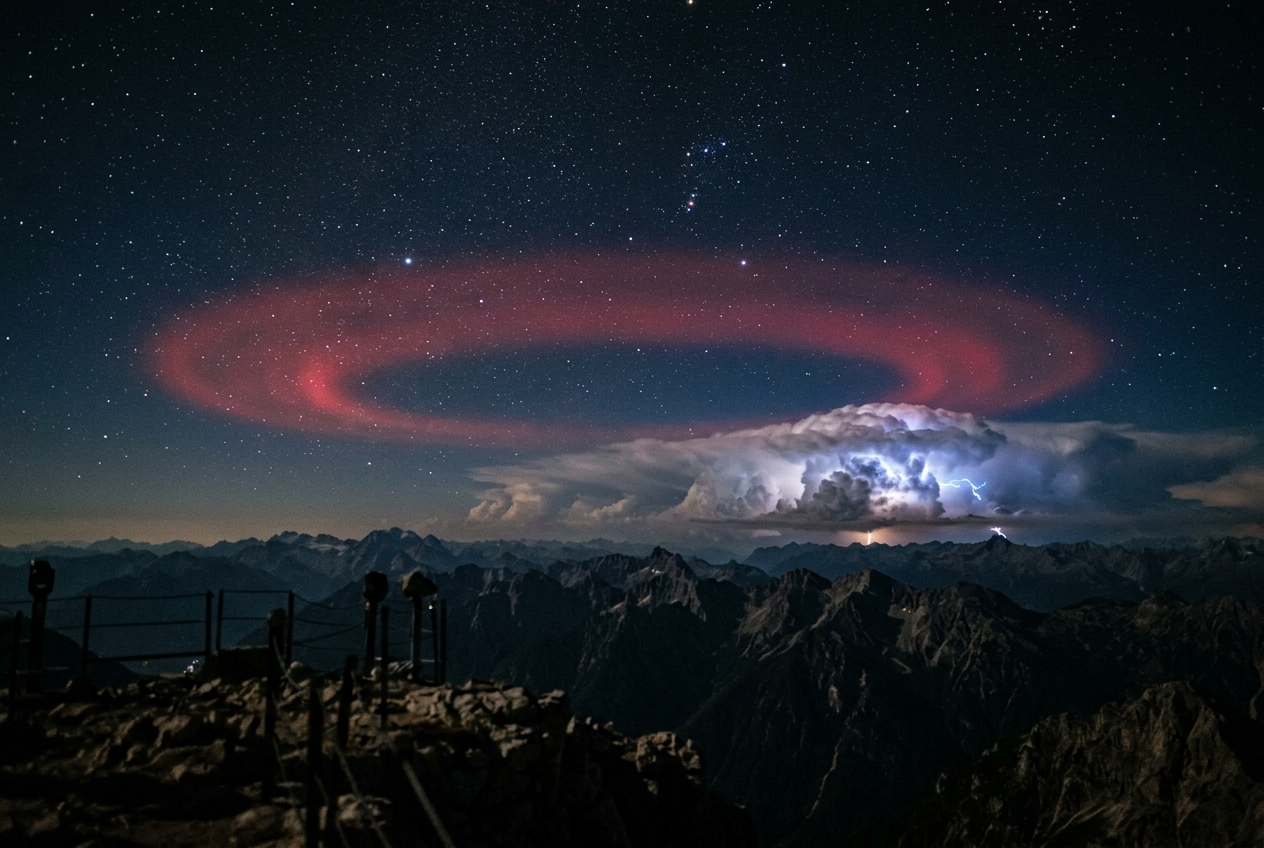
1. Opening Scene: The Silent Flash Above the Horizon
Stand on the high, open expanse of an arid plateau at two o’clock in the morning, two hundred miles from the nearest illuminated metropolis. The air around you is cool, dry, and motionless, carrying only the faint scent of crushed sage and desiccated earth. Yet, low on the eastern horizon, the atmosphere tells an entirely different story. A massive mesoscale convective system—a sprawling fortress of severe thunderstorms spanning entire counties—churns against the blackness. The cloud tops, boiling upward past forty thousand feet, flicker continuously with deep, muffled pulses of intracloud lightning. The thunder is far too distant to be heard; the only sound is the quiet hiss of a light breeze rising through the grass.
As you watch the distant anvils, your eyes adjust to the pristine velvet of the night sky. The Milky Way arches overhead in sharp, crystalline clarity. Suddenly, your peripheral vision registers something impossible: an instantaneous, diffuse sweep of pale crimson and violet light directly above the storm, not inside the clouds, but perched impossibly high in the starry vault of space. It does not flicker or crackle like a normal lightning bolt. It is vast—spanning hundreds of miles of the upper sky in a single, silent breath—and it vanishes in less than a thousandth of a second, so quickly that your visual cortex struggles to confirm whether you witnessed a physical phenomenon or an optical illusion.
You have just caught the elusive optical signature of an ELVE—a luminous doughnut of excited gas ignited at the boundary where Earth's atmosphere yields to the vacuum of space.
2. What's Actually Happening: Plain English First
To understand what creates this phantom flash, think of the Earth’s atmosphere as a vast, layered cake. The lowest layer, where we live and where all our familiar weather occurs, is the dense troposphere. Above that lie the calm, dry stratosphere and the frigid mesosphere. Finally, between fifty and six hundred miles up, sits the Ionosphere—a rarefied realm where solar radiation has stripped electrons from ambient molecules, leaving behind a delicate soup of electrically charged ions and free electrons.
Altitude (km)
  100 +---------------------------------------------------------+
      |  IONOSPHERE (D-Region Plasma: 85 - 95 km)               |  <-- Optical ELVE Ring
   90 |  . . . * * * * * * * * * * * * * * * * * * * * * * . .  |      Excited Nitrogen
      +---------------------------------------------------------+
   80 |                                                         |
      |  MESOSPHERE (Rarefied neutral atmosphere)               |
   60 |                                                         |
      +---------------------------------------------------------+
   40 |  STRATOSPHERE (Ozone layer)                             |
      +---------------------------------------------------------+
   20 |  TROPOSPHERE (Active Weather)                           |
    0 +-------------------[ Lightning Stroke ]------------------+
When an exceptionally violent bolt of lightning strikes the ground—a stroke carrying over one hundred thousand amperes of electrical current—it does not simply heat the local air into a channel of glowing plasma. It acts like a colossal radio transmitter. The sudden, violent surge of electric charge radiates a tremendous, expanding bubble of electromagnetic energy: an electromagnetic pulse, or EMP.
Imagine dropping a heavy boulder into a glassy mountain lake. A circular ripple expands rapidly across the surface. Now imagine that ripple expanding not just across a flat surface, but outward in all directions as a rapidly expanding sphere of invisible electromagnetic force travelling at the speed of light.
As the upper half of this spherical wavefront rockets upward through the stratosphere and mesosphere, it encounters virtually no resistance because the air is neutral and non-conductive. But around fifty-five miles (ninety kilometres) above the ground, the wavefront slams into the base of the ionosphere.
Here, the intense electric field embedded within the wavefront grabs the free electrons in the ionospheric plasma and accelerates them violently. These energized electrons collide with nearby nitrogen molecules, momentarily kicking their orbital electrons into higher energy states. When those nitrogen molecules relax back to their normal resting state fractions of a microsecond later, they shed that excess energy as photons of light.
Because the electromagnetic pulse is a sphere expanding through a flat, horizontal layer of the upper atmosphere, the zone of intersection is not a solid disc, but a rapidly widening ring—a luminous, expanding halo spanning up to three hundred miles across. Scientists christened this phenomenon with an evocative acronym: ELVES (Emission of Light and Very Low Frequency Perturbations due to Electromagnetic Pulse Sources), a key class of Upper-atmospheric lightning.
First predicted theoretically by atmospheric physicists Umran Inan and his team at Stanford University in 1991, ELVES were confirmed empirically later that decade by space shuttle video cameras and ground-based photometric arrays like Fly's Eye and PIPER. Unlike red sprites—which are intricate, vertical, jellyfish-like plasma filaments lasting tens of milliseconds—ELVES are strictly planar, horizontally uniform, and disappear in under a single millisecond.
3. The Science: Electrodynamics and Apparent Superluminal Expansion
For those wishing to examine the underlying physics, the generation and visual geometry of ELVES can be described through two primary physical frameworks: the electrodynamic radiation field of the lightning return stroke and the relativistic geometry of spherical wavefront intersections.
A. The Radiation Field and Dielectric Breakdown
A cloud-to-ground lightning return stroke is modelled as a rapidly rising line current. The radiated azimuthal electric field $E_{\text{rad}}$ at a distance $r$ and polar angle $\theta$ (measured from the vertical lightning channel) in free space is governed by Maxwell's equations and dipole antenna theory:
$$E_{\text{rad}}(r, \theta, t) = \frac{\mu_0}{4\pi r} \frac{d I(t - r/c)}{dt} \sin\theta \approx \frac{\mu_0 I_{\text{peak}} v_{\text{ret}}}{4\pi r} \sin\theta$$
Where: * $\mu_0 = 4\pi \times 10^{-7}\text{ H/m}$ is the vacuum permeability, * $I_{\text{peak}}$ is the peak return stroke current (amperes), * $v_{\text{ret}}$ is the return stroke propagation velocity along the channel (typically $0.3c$ to $0.5c$), * $r$ is the radial distance to the observation point in the ionosphere, * $\theta$ is the radiation angle relative to the vertical lightning channel.
In the lower atmosphere at sea level, the neutral gas number density $N_0 \approx 2.5 \times 10^{25}\text{ m}^{-3}$ is so dense that electrons cannot gain sufficient kinetic energy between collisions to initiate secondary ionization; the breakdown electric field is roughly $E_k \approx 3 \times 10^6\text{ V/m}$. However, atmospheric density decreases exponentially with altitude $z$ according to the barometric scale height $H \approx 6.5\text{ km}$:
$$N(z) = N_0 \exp\left(-\frac{z}{H}\right)$$
At the lower ionospheric D-region ($z \approx 90\text{ km}$), the neutral density drops by six orders of magnitude to $N \approx 2.5 \times 10^{19}\text{ m}^{-3}$. Consequently, the local threshold field required to accelerate electrons to optical excitation energies scales directly with density:
$$E_k(z) = E_{k,0} \left(\frac{N(z)}{N_0}\right) \approx (3 \times 10^6\text{ V/m}) \times 10^{-6} \approx 3\text{ V/m}$$
In atmospheric electrodynamics, this is characterized by the reduced electric field $E/N$, expressed in Townsend units ($1\text{ Td} = 10^{-21}\text{ V}\cdot\text{m}^2$). When the lightning EMP delivers an $E/N$ exceeding roughly $100\text{--}120\text{ Td}$ at $90\text{ km}$, ambient electrons are accelerated past the excitation thresholds of molecular nitrogen:
- $N_2$ First Positive Band ($B^3\Pi_g \to A^3\Sigma_u^+$): Optical transitions emitting predominantly in the red and near-infrared spectrum ($600\text{--}900\text{ nm}$).
- $N_2$ Second Positive Band ($C^3\Pi_u \to B^3\Pi_g$): Higher-energy electronic transitions producing intense ultraviolet and blue emission ($300\text{--}400\text{ nm}$).
Worked Example: Field Strength at the Ionosphere
Let us calculate the electric field delivered to the ionosphere at $z = 90\text{ km}$ directly above a colossal positive cloud-to-ground strike with a peak current $I_{\text{peak}} = 150\text{ kA}$ and a current rise time $\Delta t = 5\,\mu\text{s}$ over a channel length $L = 5\text{ km}$.
The average rate of current change is: $$\frac{dI}{dt} \approx \frac{150 \times 10^3\text{ A}}{5 \times 10^{-6}\text{ s}} = 3.0 \times 10^{10}\text{ A/s}$$
For a vertical dipole, radiation straight upward ($\theta = 0$) has zero transverse electric field, but at an angle $\theta = 45^\circ$ ($\sin\theta \approx 0.707$) and an oblique distance $r = \sqrt{90^2 + 90^2}\text{ km} \approx 127.3\text{ km} = 1.273 \times 10^5\text{ m}$:
$$E_{\text{rad}} = \left(\frac{4\pi \times 10^{-7}}{4\pi \times 1.273 \times 10^5}\right) \times (3.0 \times 10^{10}\text{ A/s}) \times (5000\text{ m} / c) \times 0.707$$
Substituting $c = 3.0 \times 10^8\text{ m/s}$:
$$E_{\text{rad}} = (10^{-12}) \times (3.0 \times 10^{10}) \times (1.667 \times 10^{-5}) \times 0.707 \approx 18.5\text{ V/m}$$
Because $18.5\text{ V/m}$ substantially exceeds the local breakdown threshold of $E_k \approx 3\text{ V/m}$, the field violently accelerates local ionospheric electrons, triggering immediate optical excitation.
B. Geometric Intersection and Apparent Superluminal Expansion
One of the most striking physical properties of an ELVE is its apparent horizontal expansion rate across the sky, which begins at speeds significantly faster than the speed of light ($v > c$).
                    IONOSPHERE (Altitude h = 90 km)
         . . . . . . . . . . . . . . . o . . . . . . . . . . . . . . .
                              .       /|      .
                       .             / |        .   Wavefront R(t) = c*t
                .                   /  |          .
         .                         /   |            .
                                  /    |
                                 /     | h (90 km)
                                /      |
                               /       |
                              / theta  |
                             +---------+
                          Lightning Stroke (Origin)
Consider the lightning return stroke at the coordinate origin $(0,0,0)$. At time $t = 0$, an EMP is emitted, expanding outward as a spherical shell of radius:
$$R(t) = c \cdot t$$
This expanding sphere intersects a flat ionospheric layer at fixed height $z = h \approx 90\text{ km}$. The horizontal radius $r(t)$ of the circle formed by this intersection is given by the Pythagorean relationship:
$$r(t) = \sqrt{R(t)^2 - h^2} = \sqrt{c^2 t^2 - h^2} \quad \text{for } t \ge \frac{h}{c}$$
To find the apparent horizontal expansion velocity $v_{\text{app}}(t)$ of the glowing optical ring, we differentiate $r(t)$ with respect to time $t$:
$$v_{\text{app}}(t) = \frac{dr}{dt} = \frac{c^2 t}{\sqrt{c^2 t^2 - h^2}} = \frac{c}{\sin\theta(t)}$$
Where $\sin\theta(t) = \frac{r(t)}{R(t)} = \frac{\sqrt{c^2 t^2 - h^2}}{c t}$.
Worked Example: The Apparent Speed of the Ring
Let us track the expansion of the ring at an altitude $h = 90\text{ km}$ ($h = 90,000\text{ m}$). The pulse first arrives at the zenith directly above the storm at time:
$$t_0 = \frac{h}{c} = \frac{90,000\text{ m}}{3.0 \times 10^8\text{ m/s}} = 300.0\,\mu\text{s}$$
At $t = 300.0\,\mu\text{s}$, $r = 0$ and the denominator $\sqrt{c^2 t^2 - h^2}$ is zero, meaning:
$$\lim_{t \to t_0^+} v_{\text{app}}(t) = \infty$$
Now consider the ring just $5\,\mu\text{s}$ later, at $t = 305.0\,\mu\text{s}$ ($3.05 \times 10^{-4}\text{ s}$):
$$R(t) = (3.0 \times 10^8\text{ m/s}) \times (3.05 \times 10^{-4}\text{ s}) = 91,500\text{ m}$$ $$r(t) = \sqrt{91,500^2 - 90,000^2} = \sqrt{8,372,250,000 - 8,100,000,000} = \sqrt{272,250,000} \approx 16,500\text{ m} = 16.5\text{ km}$$
Now calculate the apparent horizontal velocity at this moment:
$$v_{\text{app}}(305\,\mu\text{s}) = \frac{(3.0 \times 10^8)^2 \times (3.05 \times 10^{-4})}{16,500} = \frac{2.745 \times 10^{13}}{16,500} \approx 1.66 \times 10^9\text{ m/s} \approx 5.55 \, c$$
This apparent "superluminal" velocity ($5.55 \times c$) does not violate Einstein's theory of special relativity. No matter, energy, or information is traveling horizontally through the ionosphere from the center of the ring to its outer edge. Rather, the expanding ring is a geometric phase intersection—independent packets of electromagnetic radiation arriving sequentially at different spatial coordinates along the ionospheric plane, much like a rotating laser beam swept across the face of the moon.
As time progresses and the ring expands to immense distances ($r \gg h$), $\sin\theta \to 1$, and the apparent expansion velocity asymptotically approaches the true speed of light:
$$\lim_{r \to \infty} v_{\text{app}} = c$$
At $r = 150\text{ km}$ ($t \approx 583\,\mu\text{s}$), the ring's expansion has slowed to approximately $1.16\,c$, before eventually fading into the background airglow as the electric field falls below the breakdown threshold $E_k$.
4. Modern Detection: Spaceborne Eyes and Terrestrial Arrays
Because ELVES persist for less than a millisecond, they were completely invisible to standard thirty-frame-per-second video cameras, which simply blurred their luminescence into the background noise of the parent lightning flash.
Modern detection relies on specialized high-speed photometers and satellite instruments:
- Terrestrial Photometric Arrays: Systems such as the Fly's Eye and the Photometric Imaging of Precipitating Electron Radiation (PIPER) array utilize multi-anode photomultiplier tubes capable of sub-microsecond time resolution. By collimating narrow horizontal and vertical fields of view across the sky, these instruments map the radial expansion of the optical ring microsecond by microsecond, confirming the theoretical $\csc\theta$ velocity profile.
- Spaceborne Platforms: The Imager of Sprites and Upper Atmospheric Lightnings (ISUAL) experiment aboard Taiwan's FORMOSAT-2 satellite and the Atmosphere-Space Interactions Monitor (ASIM) mounted on the International Space Station have observed thousands of ELVES from low Earth orbit. Viewing limb-on and nadir from space eliminates cloud obscuration and atmospheric Rayleigh scattering, providing pristine spectral measurements of the $N_2$ 1st and 2nd positive emission lines.
- Geophysical Diagnostic Value: Data compiled by atmospheric monitoring networks such as NOAA and the World Meteorological Organization demonstrate that ELVES are not random curiosities; they are direct diagnostic signatures of convective intensity. Only storms with exceptionally powerful vertical charge separation and violent return stroke velocities produce EMP fields strong enough to ignite the D-region. Tracking ELVES provides real-time insights into the lightning energetics of oceanic supercells and severe continental squall lines.
5. Practical Outdoor Guidance: Observing the Unseen
While capturing an ELVE requires specialized instrumentation, an informed outdoor observer can position themselves to witness the atmospheric conditions that spawn them.
       Viewer Position                                      Parent Thunderstorm
      +---------------+                                      +---------------+
      | High Plateau  | <---- 150 to 400 km Clear Sky ---->  | Mesoscale     |
      | Dark Skies    |                                      | Convective    |
      | (Bortle 1-3)  |     Look 15°-30° Above Horizon       | System (MCS)  |
      +---------------+                                      +---------------+
What to Look for in the Sky
- Distance is Essential: You cannot observe an ELVE if you are underneath the storm; thick cloud cover will obscure the upper atmosphere, and local lightning flashes will blind you. The ideal vantage point is 100 to 250 miles (150 to 400 km) away from an active, severe mesoscale convective system.
- Look Above, Not At, the Clouds: Direct your gaze to the clear sky approximately $15^\circ$ to $30^\circ$ above the distant anvil tops (roughly one to two hand-widths held at arm’s length above the horizon).
- Dark Adaptation: Choose a location with low light pollution (Bortle Class 1–3). Allow your eyes at least twenty minutes to achieve full scotopic vision. While the eye cannot resolve the ring's expansion, observers often perceive a momentary, faint, reddish-purple wash across a broad swath of the sky synchronized with a powerful distant flash.
Instrumental Readings to Monitor
- Digital Barometer: Watch for a sharp drop followed by a sudden rise (the "thunderstorm wake low" and "mesohigh"), indicating a mature, organized storm complex with intense updrafts.
- VLF Radio Receivers (Sferics): A simple radio receiver tuned to Very Low Frequency ($3\text{--}30\text{ kHz}$) will emit a distinct, sharp "click" or "pop" when an intense EMP is radiated. ELVES-producing lightning strokes produce prominent VLF wave signatures that propagate thousands of miles within the Earth-ionosphere waveguide.
- High-Speed Cameras: High-sensitivity CMOS astronomy cameras running at 1,000+ frames per second with fast lenses ($f/1.2$ or $f/1.4$) can successfully resolve the brief flashes when triggered by optical or radio sferic signals.
The Observer’s Rule of Thumb
The Horizon Geometry Rule:
If an active thunderstorm anvil is visible just above your distant horizon (roughly three fingers above the skyline at arm's length), the ionospheric D-region directly above that storm ($90\text{ km}$ altitude) sits precisely between $15^\circ$ and $25^\circ$ in your clear night sky. That patch of stars directly overhead is where the invisible EMP ring expands.
6. Today's Meteorological Rule of Thumb
The Lightning EMP Law:
Whenever a thunderstorm produces a return stroke exceeding one hundred thousand amperes, the atmosphere at the edge of space does not remain passive—it converts the storm's electromagnetic shockwave into an expanding halo of light spanning the width of a nation, faster than the blink of an eye.
Further Reading & Authoritative Sources
- Track severe convective weather and mesoscale convective systems via the NOAA Storm Prediction Center.
- Explore upper-atmospheric lightning monitoring and space weather research at the Met Office.
- Learn about global thunderstorm observation protocols at the World Meteorological Organization.
- Read detailed scientific instrumentation mission summaries for the Atmosphere-Space Interactions Monitor on the International Space Station.
- Study the physics of mesospheric optical phenomena through the ISUAL Satellite Experiment.