Circumzenithal Arc & Bravais Refraction Dynamics: How Flat Hexagonal Plate Crystals and 90° Prism Geometries Forge the Zenith's Upside-Down Rainbow
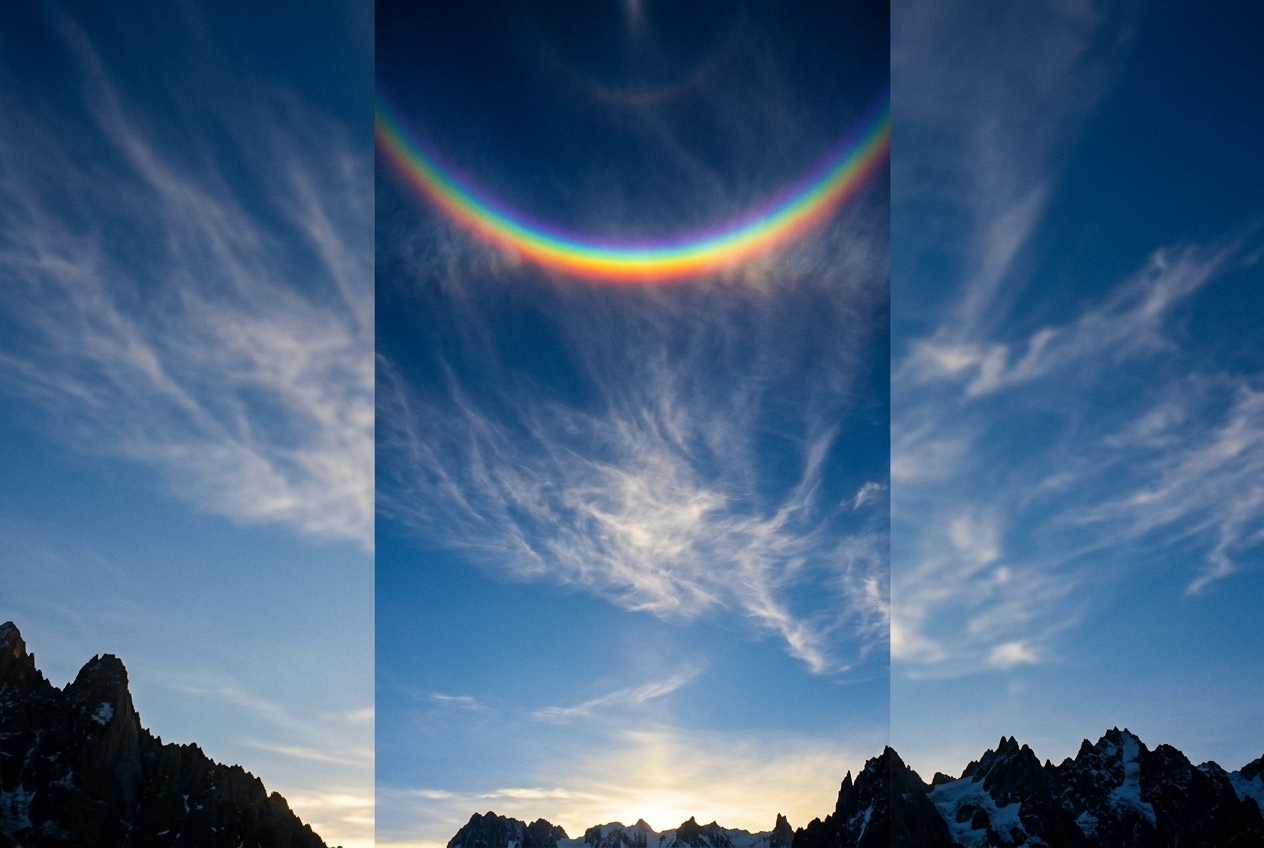
The air on an early December morning holds a peculiar, brittle silence. Out on an open ridge, hours before the midday sun reaches its modest winter culmination, the atmosphere feels suspended. A subtle barometric shift is underway: high above the boundary layer, a warm frontal system is sliding over the entrenched cold surface air. The wind at ground level is virtually still, yet overhead, the deep cobalt of the troposphere begins to soften into a milky, translucent veil. This is not the dark, ominous underbelly of a cumulonimbus shelf cloud, nor the turbulent gray of nimbostratus; rather, it is a delicate sheet of cirrostratus fibratus, swimming silently at an altitude of nine kilometres where the ambient temperature plummets below $-35^\circ\text{C}$.
                  ZENITH (Directly Overhead)
                            |
                     .------v------.
                    /   VIOLET      \
                   |     BLUE        |  <-- Circumzenithal Arc
                   |     GREEN       |      (Pure Spectral Halo)
                    \    RED        /
                     '-------------'
                            |
                            |   Angular distance ≈ 46° - 48°
                            |   (along the solar vertical)
                            |
                           (O)  <-- Sun (Low on horizon: hs < 32.2°)
               ___________________________ HORIZON
If you resist the instinctive urge to track the sun and instead tilt your head straight up toward the celestial zenith, you are met with one of nature’s most arresting optical masterpieces: an ethereal, intensely pure band of spectral light curving gracefully across the highest point of the sky. Colloquially termed the "upside-down rainbow" or the "smile in the sky," the circumzenithal arc (CZA) displays an extraordinary brilliance. Its center of curvature sits precisely at the zenith, with its convex side facing the sun. The colors do not bleed into the washed-out pastels typical of lower-altitude atmospheric phenomena; instead, the arc blazes with an electric violet and deep indigo at its uppermost edge, transitioning through emerald green, bright yellow, and ending in a clean, sharp crimson along its sunward rim. It appears out of nowhere against what seems to be a dry, cloudless patch of sky, glowing with an optical purity that puts ordinary raindrops to shame.
What’s Actually Happening: The Cloud as a Skywide Prism Array
To understand why this inverted arc appears, we must first look at what constitutes the cirrus cloud drifting silently overhead. While low-level rain clouds are composed of billions of liquid water droplets—spherical microscopic spheres that bounce and scatter light internally—high-altitude cirrus clouds are composed entirely of solid ice crystals.
Think of the atmosphere as a vast, layered fluid column. In the frigid upper reaches of the troposphere, water vapor freezes not into amorphous frost, but into geometrically pristine hexagonal crystals. When the growth conditions exhibit low ice supersaturation at temperatures between $-20^\circ\text{C}$ and $-40^\circ\text{C}$, these crystals grow much faster along their basal planes than along their vertical c-axis. The result is millions of microscopic hexagonal plates: ultra-thin, flat, six-sided wafers of solid ice.
       Incoming Solar Ray (from inclined elevation hs)
                 \
                  \  i1
      _____________v_____________  <-- Basal Face (0001) [Top Horizontal]
     |                           |
     |        r1 \               |
     |            \              |
     |             \             |
     |              \ i2         |
     |_______________\___________|
     |               |           |
                     |----------> \
              Exit Prism Face      \  theta_exit (Refracted downward
                {10-10}             v              to observer)
As these hexagonal plates gently settle through the calm, non-turbulent air of the upper troposphere, they behave precisely like microscopic parachutes or falling dinner plates. Fluid dynamics dictates that when a flat object descends through a viscous fluid at low Reynolds numbers ($Re \sim 0.5\text{ to }50$), aerodynamic drag forces exert a stabilizing torque that forces the broad, flat basal faces to align horizontally, parallel to the ground. They do not tumble chaotically unless disturbed by severe wind shear; instead, they drift downward in unison, maintaining a horizontal orientation with a tilt variance often less than a single degree.
Each suspended plate crystal effectively becomes a stationary, horizontally oriented $90^\circ$ optical prism. The top flat face represents the crystal’s basal plane (designated crystallographically as the $(0001)$ face), while the six vertical sides represent the prism faces (the ${10\bar{1}0}$ planes). Sunlight streaming down from an angled position hits the flat horizontal top face of the crystal, enters the ice, travels diagonally through the crystal matrix, and exits through one of the vertical side faces.
Because the entry face and the exit face meet at a right angle ($90^\circ$), the light is bent severely—refracted in a clean, single-pass trajectory without undergoing any internal reflections. When sunlight passes through billions of these identically oriented crystals simultaneously, they act collectively as an enormous, skywide optical spectrometer, casting a brilliant, dispersion-separated ring of light centered squarely above the observer's head.
The Science: Ray Tracing, Bravais Refraction, and the 32.2° Limit
To appreciate the mathematical precision of the circumzenithal arc, we must examine the path of an individual light ray traversing a hexagonal ice plate with an orientation where its optic c-axis is vertical ($\mathbf{c} \parallel \mathbf{z}$).
                  +z (Zenith Normal)
                   |
     Sun Ray       |
        \ hs       |
         \-------->| (90° - hs)
          \        |
___________v_______|____________________ Basal Face (0001)
                   |
                   | r1
                    \
                     \
                      \          +x (Horizontal Normal)
                       \          |
                        \ i2      |
-------------------------v--------|----- Prism Face (10-10)
                          \       |
                           \      | theta_exit
                            v     |
1. The Geometry of Ray Ingress
Let the sun reside at a solar elevation angle $h_s$ above the astronomical horizon. A ray of sunlight travels downward and strikes the flat, horizontal top basal face $(0001)$. The surface normal to this top face is aligned with the vertical $z$-axis (the zenith).
The angle of incidence at this top face, measured with respect to the vertical normal, is: $$i_1 = 90^\circ - h_s$$
Applying Snell's Law of Refraction at the air-ice interface, where the refractive index of air is $n_{\text{air}} \approx 1.000$ and that of ice is $n$ (approximately $1.31$ for visible wavelengths), we determine the internal angle of refraction $r_1$ relative to the vertical: $$\sin(i_1) = \sin(90^\circ - h_s) = \cos(h_s) = n \sin(r_1)$$
Rearranging this yields the vertical internal angle: $$\sin(r_1) = \frac{\cos(h_s)}{n}$$
2. Bravais’ Law for Inclined Rays and Side-Face Egress
The refracted ray now travels internally toward one of the six vertical prism faces ${10\bar{1}0}$. The normal to any of these vertical faces lies entirely in the horizontal plane ($xy$-plane). Because the top basal face and the vertical prism face are perpendicular ($A = 90^\circ$), the angle of incidence $i_2$ at the vertical exit face is complementary to the internal angle $r_1$: $$i_2 = 90^\circ - r_1$$
Consequently: $$\sin(i_2) = \sin(90^\circ - r_1) = \cos(r_1)$$
Using the fundamental trigonometric identity $\cos(r_1) = \sqrt{1 - \sin^2(r_1)}$, we substitute the expression for $\sin(r_1)$: $$\sin(i_2) = \sqrt{1 - \left(\frac{\cos(h_s)}{n}\right)^2} = \frac{\sqrt{n^2 - \cos^2(h_s)}}{n}$$
When the ray strikes the vertical exit face, it attempts to refract back out into the air. Let $\theta_{\text{exit}}$ be the angle of emergence measured from the horizontal surface normal of the vertical face. Applying Snell’s Law once more at the second interface: $$n \sin(i_2) = \sin(\theta_{\text{exit}})$$
Substituting our derived expression for $\sin(i_2)$ eliminates the internal refractive index $n$ entirely: $$\sin(\theta_{\text{exit}}) = n \left( \frac{\sqrt{n^2 - \cos^2(h_s)}}{n} \right) = \sqrt{n^2 - \cos^2(h_s)}$$
This remarkably elegant equation governs the emergence of light forming the circumzenithal arc. In the three-dimensional formulation popularized by Auguste Bravais (known as Bravais' Law of Refraction for inclined rays traversing a prism), the effective refractive index $n'$ in the horizontal plane of incidence is represented as: $$n' = \frac{\sqrt{n^2 - \sin^2(h_s)}}{\cos(h_s)}$$
3. Proof of the Critical Solar Elevation Cutoff ($h_s \le 32.2^\circ$)
For the ray to physically emerge from the side face of the crystal into the atmosphere, the argument under the square root must satisfy the boundary conditions of real-valued trigonometry. Specifically, the exiting sine cannot exceed unity ($\sin(\theta_{\text{exit}}) \le 1$). If $\sin(i_2)$ exceeds the critical angle of the ice-air interface ($\sin(i_{\text{crit}}) = 1/n$), the ray experiences Total Internal Reflection (TIR) within the ice plate and is trapped or deflected into non-CZA ray paths.
Setting the condition for real ray emergence: $$\sin(\theta_{\text{exit}}) \le 1 \implies \sqrt{n^2 - \cos^2(h_s)} \le 1$$
Squaring both sides: $$n^2 - \cos^2(h_s) \le 1$$ $$\cos^2(h_s) \ge n^2 - 1$$ $$\cos(h_s) \ge \sqrt{n^2 - 1}$$
Let us evaluate this using the standard refractive index of solid ice for yellow sodium D-line light ($\lambda = 589.3\text{ nm}$), where $n = 1.309$: $$n^2 - 1 = (1.309)^2 - 1 = 1.713481 - 1 = 0.713481$$ $$\sqrt{n^2 - 1} = \sqrt{0.713481} \approx 0.844678$$
Now, we solve for the maximum allowable solar elevation angle $h_{s,\text{max}}$: $$h_{s,\text{max}} = \arccos(0.844678) \approx 32.36^\circ$$
For shorter wavelengths (blue light, where $n \approx 1.317$), $\sqrt{n^2 - 1} \approx 0.8570$, giving $h_{s,\text{max}} \approx 31.0^\circ$. For mean visible light ($n \approx 1.310$), the absolute theoretical cutoff is universally established in atmospheric physics as: $$h_{s,\text{cutoff}} \approx 32.2^\circ$$
The 32.2° Solar Elevation Limit If the sun rises higher than $32.2^\circ$ above the horizon, $\cos(h_s) < \sqrt{n^2 - 1}$, causing the internal angle $i_2$ to exceed the critical angle. Total internal reflection occurs at the vertical face, completely extinguishing the circumzenithal arc.
       SOLAR ELEVATION vs. CZA FORMATION REGIME
 0°              15°             22.1°            32.2°               90°
 |-- Low Arc ----|-- Brightest --|-- Fading Arc --|--- TOTAL INTERNAL ---|
 |   (Near Zen.) |   Intensity   |   (Near 46°)   |    REFLECTION (TIR)  |
 +---------------+---------------+----------------+----------------------+
                 ^ Max flux concentration          ^ Hard optical cutoff
4. Mathematical Origin of Maximum Intensity at $h_s \approx 22.1^\circ$
The brightness of the circumzenithal arc is not uniform across all allowable solar angles ($0^\circ < h_s \le 32.2^\circ$). The intensity peaks sharply when the solar elevation is approximately $22.1^\circ$.
This peak is governed by the principle of symmetric refraction (minimum deviation) through the effective $90^\circ$ wedge. When $h_s \approx 22.1^\circ$: $$\sin(r_1) = \frac{\cos(22.1^\circ)}{1.31} = \frac{0.9265}{1.31} \approx 0.7072 \implies r_1 \approx 45.0^\circ$$ Because $i_2 = 90^\circ - r_1 = 45.0^\circ$, the angle of entry relative to the internal path precisely equals the angle of exit ($r_1 = i_2 = 45^\circ$).
Under this symmetric transmission condition: 1. The angular dispersion spread $\frac{d\theta_{\text{exit}}}{dn}$ achieves maximum collimation. 2. Geometric transmission loss from Fresnel reflections at both interfaces is minimized. 3. The refracted ray bundle maintains an optimal cross-sectional area through the hexagonal crystal matrix, maximizing the total radiant flux directed toward an observer on the ground.
At this specific solar elevation ($h_s \approx 22.1^\circ$), the arc sits at an elevation of approximately $67.9^\circ$, positioning it exactly $22.1^\circ$ below the zenith and precisely $45.8^\circ$ (roughly $46^\circ$) above the sun along the solar vertical.
Comparison: Why the Circumzenithal Arc Outshines the Rainbow
To the naked eye, the circumzenithal arc exhibits a spectral saturation that far exceeds that of the familiar primary rainbow. This is not an optical illusion; it is rooted in fundamental differences in crystal versus droplet microphysics.
| Characteristic | Circumzenithal Arc (CZA) | Primary Rainbow |
|---|---|---|
| Refracting Medium | Flat hexagonal ice plates | Spherical liquid water droplets |
| Crystal / Droplet Shape | Planar, aerodynamically stabilized | Spheroidal / deformed sphere |
| Ray Trajectory | Pure 2-refraction pass (Basal $\to$ Prism) | 2 refractions + 1 internal reflection |
| Caustic Overlap | Minimal; discrete angular exit paths | Severe; superposed Descartes caustics |
| Color Purity / Saturation | Exceptionally high; pure monochromatic bands | Moderate; significant desaturating white-light overlap |
| Angular Center | Celestial Zenith ($z = 0^\circ$) | Antisolar Point ($180^\circ$ from Sun) |
| Solar Angle Constraint | Strictly visible only when $h_s \le 32.2^\circ$ | Visible at any $h_s \le 42^\circ$ |
In a spherical water droplet, light rays strike the surface at an infinite variety of impact parameters, generating a continuum of deflection angles bounded by the classical Descartes rainbow ray. This geometric caustic produces an overlapping continuum where scattered rays of longer wavelengths bleed into shorter wavelengths, diluting the colors with an underlying white-light sheet.
By contrast, hexagonal plate crystals are flat, planar prisms. Because all crystals are aerodynamically constrained to lie in the exact same horizontal plane, every ray of light entering the basal face at solar angle $h_s$ enters at the exact same angle $i_1$. There is no caustic blurring across a curved surface; the ice plate acts as a laboratory-grade spectrometer, producing an arc of near-monochromatic color purity.
Practical Outdoor Guidance: The Observer's Field Guide
Spotting a circumzenithal arc requires knowing when the microphysical conditions are primed and knowing where to cast your gaze. Because the arc forms high overhead near the zenith, casual observers looking toward the horizon almost always miss it.
       FIELD MEASUREMENT OF SOLAR ELEVATION (h_s)

              [Zenith: 90° Overhead]
                     ^
                     |
                     |  <-- Look here for CZA (when hs < 32°)
                     |
      .------------. |
      | OUTSTRETCHED| |  ~20° span (Thumb to Pinky)
      |    HAND    | |
      '------------' |
                     |
      .------------. |
      |   CLOSED   | |  ~10° span across knuckles
      |    FIST    | |
      '------------' v
     ================================ HORIZON
1. Atmospheric Signposts and Sky Conditions
- Cloud Morphology: Watch for high-altitude cirrus clouds, specifically cirrostratus fibratus or thin cirrostratus nebulosus. These veils indicate an upper tropospheric layer stabilized by laminar flow—the exact aerodynamic condition required for plate crystals to settle horizontally without tumbling.
- Companion Optical Phenomena: The CZA rarely appears in total isolation. Because it relies on horizontally oriented hexagonal plates, it belongs to the same crystal-habit family as sundogs (parhelia). If you see brilliant sundogs flanking the sun at $22^\circ$ to the left and right, plate crystals are present in abundance. Immediately look straight up to the zenith to check for the CZA.
- Synoptic Barometry: Track barometric trends. The high cirrostratus sheets carrying plate crystals frequently form 12 to 24 hours ahead of a warm front or occluded system. A steadily falling barometer accompanied by high-altitude cirrus streaks running from southwest to northeast is prime territory for halo hunting.
2. The Rule-of-Thumb Hand Measurement Technique
To verify if the sun is below the critical $32.2^\circ$ threshold without instruments: 1. Extend your arm fully toward the horizon. 2. Form a closed fist; the angular width across your knuckles at arm's length subtends approximately $10^\circ$ of arc. 3. Spread your fingers wide (from thumb tip to pinky tip); this span subtends approximately $20^\circ$. 4. Stack your measurements from the horizon up to the sun: - One Fist + One Outstretched Hand ($\approx 30^\circ$): If the sun is above three stacked fists ($>30^\circ$), the solar angle is approaching or past the critical cutoff; the CZA will be physically impossible due to total internal reflection. - One to Two Fists ($10^\circ - 22^\circ$): This is the prime viewing window. The sun is low, dispersion is maximized, and the arc will blaze near maximum intensity roughly two to three fists below the zenith.
Today’s Meteorological Rule of Thumb
The Golden Law of the Zenith Smile
Whenever bright sundogs flank a low winter sun, never look forward—look straight up: if the sun is lower than three stacked fists above the horizon, the sky’s purest spectral arc is shining directly overhead.
Authoritative Atmospheric & Meteorological References
- World Meteorological Organization (WMO) International Cloud Atlas: Halos and Optical Phenomena
- National Oceanic and Atmospheric Administration (NOAA) Earth System Research Laboratories
- Met Office UK: Atmospheric Optics and Cloud Types
- American Meteorological Society (AMS) Glossary of Meteorology: Circumzenithal Arc
- Atmospheric Optics: Computer Simulations and Crystal Ray Paths