Blue Jet Dynamics & Stratospheric Streamer Propagation: How Cloud-Top Charge Imbalances and Upward Ionization Cones Penetrate the Stratosphere
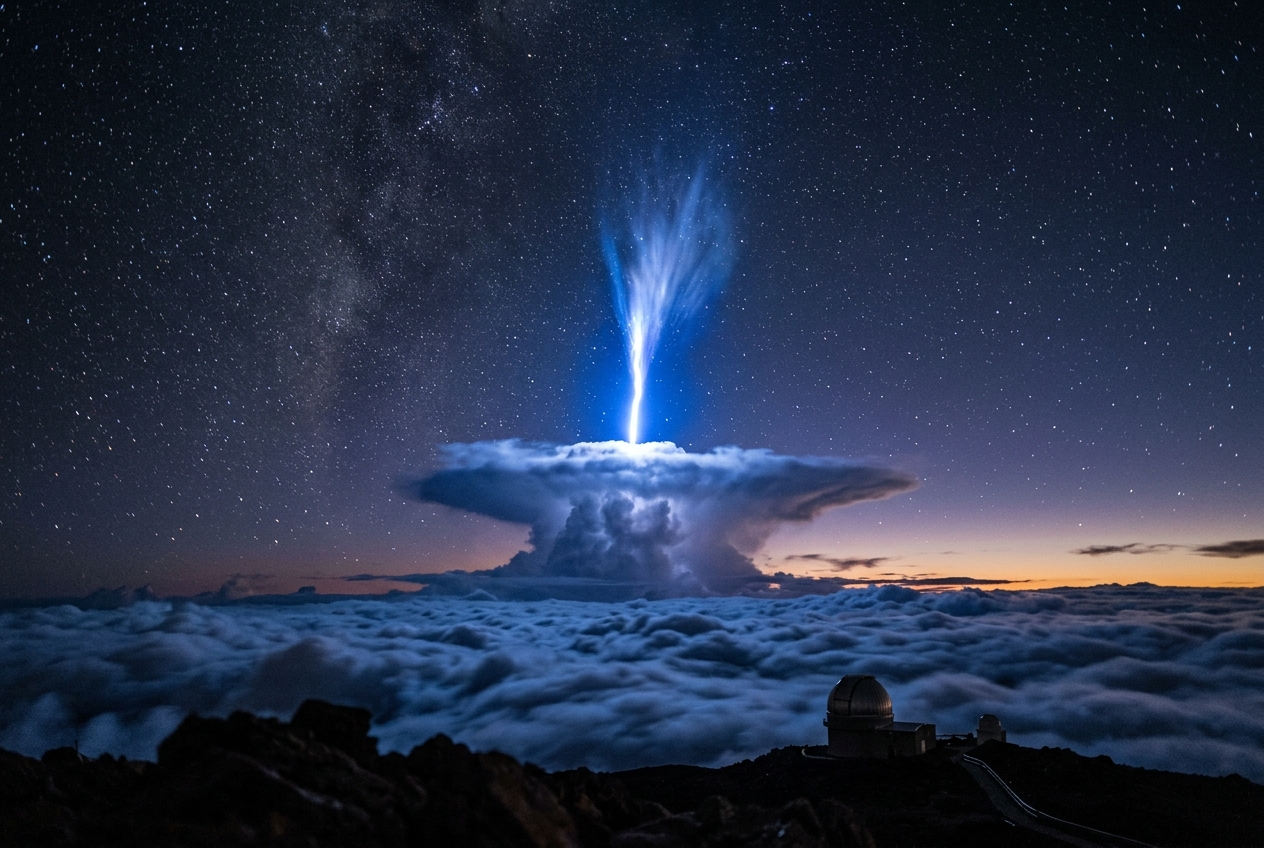
1. Opening Scene
Standing on the high, arid lip of a desert plateau at two o'clock in the morning, the terrestrial world feels strangely quiet, yet the distant horizon tells a story of violent atmospheric upheaval. More than two hundred kilometres to the east, a colossal supercell thunderstorm churns against the black vault of the night. You do not hear the thunder; at this distance, the acoustic shock waves have long since scattered and attenuated into the planetary boundary layer. What you experience instead is a silent, rhythmic pulsing of light. Every few seconds, intra-cloud lightning illuminates the anvil from within, casting the thunderhead’s mountainous cauliflower turrets in stark silhouette against the backdrop of the Milky Way.
The air around you is dry and cold, smelling faintly of dusty stone and dry sagebrush, but the barometric trend on your field altimeter has been steadily tilting downward over the past three hours. Down in the lowlands beneath that convective anvil, the atmosphere is a cauldron of suffocating humidity, frantic wind shifts, and the sharp, metallic tang of ozone mingling with wet soil. Up here, under an unobstructed dome of crystal-clear stars, the distant cloud top looks almost static—until an anomaly occurs.
Above the central dome of the storm, in a region where the storm’s ferocious core punches through the tropopause into the calm stratosphere, the black sky suddenly splits. There is no warning. A razor-sharp, narrow needle of vivid ultramarine and violet light erupts straight upward out of the cloud top. It does not flicker or branch like jagged ground lightning; it surges skyward as a brilliant, perfectly collimated cone of sapphire fire, ascending at mind-boggling speed toward the stars. For a fraction of a second, the fountain ascends through the lower atmosphere, fanning outward into a delicate, luminous trumpet before dissolving into the silent void forty-five kilometres above the Earth. Before your brain can fully process the geometry of what you have witnessed, the phantom beam has vanished, leaving the dark silhouette of the thunderhead pulsing innocently beneath the constellations.
       Altitude (km)
          50 + - - - - - - - - - - - - - - - - - - - - - - - - -
             |              . : * : .           <-- Diffuse Streamer Fan Extinction
          40 |            . : * * * : .             (E_local < E_stab)
             |           . : * * * * : .
          30 |            \ * * * * /           <-- Streamer Corona Fan
             |             \ * * * /                (Pure Blue/UV Transitions)
          20 |              \ * * /
             |               | * |              <-- Highly Ionized Leader Channel
          15 | - - - - - - - | * | - - - - - - - <-- Overshooting Top / Tropopause
             |        + + + + + + + + + + +     <-- Massive Positive Charge Core
          10 |        - - - - - - - - - - -     <-- Screening / Negative Layer
             +----------------------------------
2. What’s Actually Happening — Plain English First
To understand the spectacle of this blue stratospheric fountain—known in modern meteorology as a blue jet—we must re-evaluate our fundamental assumptions about how thunderstorms discharge electricity. Most of us grew up learning that lightning is a simple conversation between a cloud and the ground. A storm gathers negative charge at its belly, induces a positive charge on the earth below, and eventually snaps a spark across the intervening gap.
However, the atmosphere does not end at the cloud deck; it extends upward in progressively thinning layers, like a vast, stratified sponge.
The Atmospheric Layer Cake
Think of the atmosphere as a multi-layered capacitor. The troposphere—the turbulent bottom layer where we live and where weather brews—is dense, wet, and heavy. Directly above it lies the stratosphere, a dry, stable, and rarefied realm where commercial jets cruise and ozone absorbs ultraviolet light. When an exceptionally violent thunderstorm forms, its internal updrafts act like an immense mechanical conveyer belt, churning millions of tonnes of ice crystals and soft hail into an electrical generator of staggering power.
Inside these towering supercells, ascending ice crystals collide violently with heavier, falling pellets of slushy ice called graupel. Through microscopic friction, electrons are stripped away: the light ice crystals carry positive charges to the very summit of the storm, while the heavier graupel concentrates negative charges in the middle and lower regions. In ordinary storms, this electrical tension discharges internally or strikes the ground.
In severe storms that pierce the stratosphere—producing what meteorologists call an overshooting top—the accumulation of positive charge at the summit becomes so monstrously concentrated that it overwhelms the local insulating capacity of the air. The cloud cannot wait to strike the earth; instead, it ruptures upward.
Because the air above the storm thins rapidly with altitude, the electrical resistance of the atmosphere drops dramatically. The storm unleashes an upward-propagating electrical spear—a self-propagating electrical "leader"—that drills through the stratosphere at roughly one hundred kilometres per second.
Why is it brilliant blue rather than the blinding white-yellow of ground lightning or the crimson red of high-altitude sprites? The answer lies in the dense molecular air of the lower stratosphere. When the electrical energy slams into nitrogen molecules, it kicks their electrons into higher energy states. In the dense air between 15 and 40 kilometres, collisions between molecules are so frequent that they literally choke out the slower, red-wavelength emissions before they can radiate, leaving only the ultrafast, high-energy blue and near-ultraviolet photons to escape into the night.
3. The Science (for those who want to go deeper)
To transition from conceptual intuition to rigorous physical mechanics, we must examine blue jets through the combined lenses of electrohydrodynamics, plasma physics, and molecular quantum spectroscopy.
+-----------------------------------------------------------------------------------------+
|                              TRANSIENT LUMINOUS EVENT (TLE) TAXONOMY                    |
+------------------------------------+--------------------+-------------------------------+
| Phenomenon                         | Altitude Domain    | Primary Physical Mechanism    |
+------------------------------------+--------------------+-------------------------------+
| Red Sprites                        | 50 - 90 km         | Mesospheric quasi-electro-    |
|                                    | (Mesosphere)       | static field breakdown post-CG|
+------------------------------------+--------------------+-------------------------------+
| Gigantic Jets                      | 15 - 90 km         | Fully bridging leader-streamer|
|                                    | (Tropo to Iono)    | discharge to lower ionosphere |
+------------------------------------+--------------------+-------------------------------+
| Blue Jets                          | 15 - 45/50 km      | Upward positive leader/streamer|
|                                    | (Stratosphere)     | breakdown from overshooting top|
+------------------------------------+--------------------+-------------------------------+
| Blue Starters                      | 15 - 25 km         | Low-energy, aborted upward    |
|                                    | (Low Stratosphere) | leader failing to form streamer|
+------------------------------------+--------------------+-------------------------------+
Observations from instruments such as the Atmosphere-Space Interactions Monitor (ASIM) mounted on the International Space Station, alongside coordinated ground campaigns documented by the NOAA National Severe Storms Laboratory, have conclusively isolated blue jets as a distinct class of Transient Luminous Events (TLEs).
Unlike mesospheric red sprites—which are diffuse, secondary glow discharges ignited tens of kilometres above a storm by the sudden removal of charge following an intense positive cloud-to-ground ($+CG$) lightning strike—blue jets require no parent cloud-to-ground stroke. They are direct, upward-initiated dielectric breakdowns emerging from the storm core itself.
3.1 The Electrodynamic Engine & Dielectric Breakdown
The convective engine of a jet-producing storm is governed by intense non-inductive charging. Within the violent updraft core (exceeding vertical velocities of $w > 30\text{ m/s}$), graupel-ice collisions occurring in the presence of supercooled liquid water charge the upper storm anvil positively, forming an immense positive charge core ($+Q \sim 100\text{--}300\text{ C}$) at altitudes between $z = 14\text{ km}$ and $18\text{ km}$. Surrounding the uppermost boundary of this cloud dome is a thin, highly concentrated layer of negative screening charge ($-Q_{\text{screen}}$), created as cosmic-ray-generated ambient ions are attracted to the cloud boundary.
Under normal conditions, this screening layer acts as an electrostatic shield, containing the positive potential within the cloud. However, when an overshooting top rapidly penetrates through the tropopause, turbulent mixing and localized charge deposition disrupt the screening equilibrium. If the local electric field between the upper positive charge core and the negative screening boundary exceeds the threshold for conventional dielectric breakdown, an upward-propagating positive leader is initiated.
The threshold electric field required to initiate and sustain conventional dielectric breakdown in air, $E_k(z)$, is fundamentally proportional to the neutral atmospheric number density $n(z)$ or mass density $\rho(z)$. Because atmospheric density decreases exponentially with altitude according to the barometric law, the breakdown threshold field scales identically.
       Dielectric Breakdown Threshold vs Altitude
       Altitude z (km)
         50 |* (E_k ~ 3.1 kV/m)
            | *
         40 |  * (E_k ~ 12.3 kV/m)
            |    *
         30 |      * (E_k ~ 49.3 kV/m)
            |          *
         20 |              * (E_k ~ 197.6 kV/m)
            |                      *
         10 |                                * (E_k ~ 791.7 kV/m)
            |                                           *
          0 |------------------------------------------------* (E_0 = 3.2 MV/m)
            0       0.5      1.0      1.5      2.0      2.5      3.0      3.5
                               Electric Field E_k (MV/m)
Mathematical Formulation: The Altitude-Dependent Breakdown Field
The critical breakdown field $E_k(z)$ at any altitude $z$ is formalized by:
$$E_k(z) \approx E_0 \left(\frac{\rho(z)}{\rho_0}\right) = E_0 \exp\left(-\frac{z}{H_n}\right)$$
Where: * $E_0 \approx 3.2 \times 10^6\text{ V/m}$ represents the standard sea-level dielectric breakdown strength of dry air at standard temperature and pressure ($T_0 = 273.15\text{ K}$, $P_0 = 1013.25\text{ hPa}$). * $\rho(z)$ is the atmospheric mass density at altitude $z$, and $\rho_0 = 1.225\text{ kg/m}^3$ is sea-level density. * $H_n \approx 7.2\text{ km}$ is the effective neutral scale height of the atmosphere in the upper troposphere/lower stratosphere.
Worked Example: Breakdown Potential at the Overshooting Top
Consider an extreme continental supercell with an overshooting top reaching the lower stratosphere at an altitude of $z = 18.0\text{ km}$. Let us determine the local electric field required to initiate an upward positive leader from the cloud dome.
Using our scaling relationship:
$$E_k(18\text{ km}) = (3.2 \times 10^6\text{ V/m}) \times \exp\left(-\frac{18.0\text{ km}}{7.2\text{ km}}\right)$$
Evaluating the exponential exponent:
$$-\frac{18.0}{7.2} = -2.50$$
$$\exp(-2.50) \approx 0.082085$$
Now, calculating the critical field strength:
$$E_k(18\text{ km}) \approx 3.2 \times 10^6 \times 0.082085 \approx 2.63 \times 10^5\text{ V/m} = 263\text{ kV/m}$$
If the positive charge core holds a net potential difference of $V = 50\text{ MV}$ across a screening boundary layer of thickness $d = 150\text{ m}$, the local electric field is:
$$E_{\text{local}} = \frac{V}{d} = \frac{5.0 \times 10^7\text{ V}}{150\text{ m}} \approx 3.33 \times 10^5\text{ V/m} = 333\text{ kV/m}$$
Because $E_{\text{local}} (333\text{ kV/m}) > E_k (263\text{ kV/m})$, catastrophic dielectric breakdown occurs instantaneously, launching an upward-propagating positive leader without any preceding downward discharge to ground.
3.2 Molecular Spectroscopy & Collisional Quenching Kinetics
The striking colouration of blue jets is rooted in the non-equilibrium plasma physics of molecular nitrogen ($N_2$). When energetic electrons within the ionization front collide with ambient air, they electronically excite neutral and ionized nitrogen molecules into specific quantum energy states:
- The Second Positive System of Neutral Nitrogen ($N_2$ 2P):
Transition: $N_2(C^3\Pi_u \to B^3\Pi_g)$
Primary emission wavelengths: $\lambda = 337.1\text{ nm}$ (near-UV), $357.7\text{ nm}$, and $380.5\text{ nm}$. - The First Negative System of Ionized Nitrogen ($N_2^+$ 1N):
Transition: $N_2^+(B^2\Sigma_u^+ \to X^2\Sigma_g^+)$
Primary emission wavelengths: $\lambda = 391.4\text{ nm}$ (violet) and $427.8\text{ nm}$ (deep blue). - The First Positive System of Neutral Nitrogen ($N_2$ 1P):
Transition: $N_2(B^3\Pi_g \to A^3\Sigma_u^+)$
Primary emission wavelengths: Broad band across $\lambda = 650.0\text{--}890.0\text{ nm}$ (deep red to near-infrared).
In red sprites (occurring in the thin mesosphere at $z = 50\text{--}85\text{ km}$), the red $N_2$ 1P system dominates the visible spectrum. Why, then, are blue jets completely devoid of red emissions in the stratosphere ($z = 15\text{--}40\text{ km}$)?
The mechanism responsible is collisional de-excitation, or quenching. An excited nitrogen molecule can shed its excess energy in one of two competing ways: * Spontaneously emit a photon after a characteristic radiative lifetime $\tau_0$. * Collide with another neutral molecule ($N_2$ or $O_2$) and transfer its electronic excitation into thermal/kinetic energy without releasing light.
The probability that an excited molecule successfully radiates a photon is defined by the quantum efficiency $\eta$, formalized via the Stern-Volmer relationship:
$$\eta(z) = \frac{A_r}{A_r + k_q n(z)} = \frac{1}{1 + \tau_0 k_q n(z)}$$
Where: * $A_r = \frac{1}{\tau_0}$ is the Einstein spontaneous emission transition rate ($\text{s}^{-1}$). * $\tau_0$ is the unquenched radiative lifetime of the excited electronic state. * $k_q$ is the rate coefficient for collisional quenching with neutral atmospheric species ($\text{m}^3/\text{s}$). * $n(z)$ is the neutral atmospheric number density at altitude $z$ ($\text{molecules/m}^3$).
         Quenching Mechanism: Radiative Decay vs Collisional Loss

         Excited State N_2*
               |
               +-----------------------------------+
               |                                   |
         (Slow or Fast)                     (Density Dependent)
         Radiative Decay: A_r = 1/\tau_0     Collisional Quenching: k_q * n(z)
               |                                   |
               v                                   v
         [ PHOTON EMISSION ]                [ NON-RADIATIVE HEAT ]
         (Blue/UV survives;                 (Red 1P extinguished in
          Red 1P quenched)                   dense stratosphere)
Comparison of Radiative Lifetimes:
- For the Red $N_2(B^3\Pi_g)$ state (1P): The radiative lifetime is exceptionally long: $\tau_0 \approx 6.0 \times 10^{-6}\text{ s}$ ($6\text{ }\mu\text{s}$).
- For the Blue/UV $N_2(C^3\Pi_u)$ state (2P): The radiative lifetime is exceptionally short: $\tau_0 \approx 4.0 \times 10^{-8}\text{ s}$ ($40\text{ ns}$).
- For the Violet/Blue $N_2^+(B^2\Sigma_u^+)$ state (1N): $\tau_0 \approx 6.0 \times 10^{-8}\text{ s}$ ($60\text{ ns}$).
Worked Example: Spectral Quenching at 25 km Altitude
Let us compute and compare the optical emission efficiency $\eta$ for the Red ($N_2$ 1P) and Blue ($N_2$ 2P) states in the mid-stratosphere at $z = 25\text{ km}$.
At $z = 25\text{ km}$, standard atmospheric number density is approximately:
$$n(25\text{ km}) \approx 8.6 \times 10^{23}\text{ molecules/m}^3$$
The collisional quenching rate coefficients with air are: * For Red $N_2(B^3\Pi_g)$: $k_{q,\text{red}} \approx 3.0 \times 10^{-16}\text{ m}^3/\text{s}$ * For Blue $N_2(C^3\Pi_u)$: $k_{q,\text{blue}} \approx 1.1 \times 10^{-17}\text{ m}^3/\text{s}$
Step 1: Compute Quenching for the Red State ($N_2$ 1P):
$$\tau_0 k_{q,\text{red}} n(z) = (6.0 \times 10^{-6}\text{ s}) \times (3.0 \times 10^{-16}\text{ m}^3/\text{s}) \times (8.6 \times 10^{23}\text{ m}^{-3})$$
$$\tau_0 k_{q,\text{red}} n(z) = 1.8 \times 10^{-21} \times 8.6 \times 10^{23} \approx 1548$$
$$\eta_{\text{red}}(25\text{ km}) = \frac{1}{1 + 1548} = \frac{1}{1549} \approx 0.000645 \quad (\mathbf{0.065\%})$$
Step 2: Compute Quenching for the Blue State ($N_2$ 2P):
$$\tau_0 k_{q,\text{blue}} n(z) = (4.0 \times 10^{-8}\text{ s}) \times (1.1 \times 10^{-17}\text{ m}^3/\text{s}) \times (8.6 \times 10^{23}\text{ m}^{-3})$$
$$\tau_0 k_{q,\text{blue}} n(z) = 4.4 \times 10^{-25} \times 8.6 \times 10^{23} \approx 0.3784$$
$$\eta_{\text{blue}}(25\text{ km}) = \frac{1}{1 + 0.3784} = \frac{1}{1.3784} \approx 0.7255 \quad (\mathbf{72.55\%})$$
+-----------------------------------------------------------------------------------------+
|                    QUANTUM EFFICIENCY RESULTS AT 25 KM STRATOSPHERE                     |
+----------------------+--------------------+---------------------+-----------------------+
| State / Transition   | Radiative Lifetime | Optical Efficiency  | Physical Outcome      |
+----------------------+--------------------+---------------------+-----------------------+
| N_2 1P (Red Band)    | 6.0 microseconds   | 0.065% (eta ~ 1/1549)| Completely Quenched   |
| N_2 2P (Blue/UV Band)| 40 nanoseconds     | 72.55% (eta ~ 1/1.38)| Efficiently Radiated  |
+----------------------+--------------------+---------------------+-----------------------+
3.3 Leader vs. Streamer Morphology & Stratospheric Extinction
High-speed imaging from the European Space Agency's ASIM observatory reveals that blue jets exhibit a distinct two-phase evolutionary morphology:
Altitude
  50 km + . . . . . . . . . . . . . . . . . . . . . . . . . . . . . . . (Extinction Front)
        :                                                             :
  40 km + - - - - - - - - - - - - - - - - - - - - - - - - - - - - - - +
        |                     / * * * * * \                           |
        |                    / * * * * * * \       <-- Corona Streamer Fan
  30 km +                   / * * * * * * * \          (Diffuse, Broad Cone)
        |                  / * * * * * * * * \                        |
        |                 / * * * * * * * * * \                       |
  20 km + - - - - - - - -+ - - - - - - - - - - + - - - - - - - - - - -+
        |                        | * |             <-- High-Current Leader
  15 km + - - - - - - - - - - - -| * |- - - - - - - - (Collimated Channel Base)
-
The Basal Leader Channel ($z = 15\text{--}25\text{ km}$):
The jet originates at the cloud top as a bidirectional, thermalized plasma channel (a positive leader). This core channel is narrow (tens of metres wide), carries substantial electrical current ($I \sim 1\text{--}10\text{ kA}$), and propagates upward at velocities between $v \approx 50\text{--}100\text{ km/s}$. Because the leader is hot and highly conductive, it transfers the extreme electric potential of the storm summit directly to its advancing tip. -
The Corona Streamer Fan ($z = 25\text{--}45\text{ km}$):
At the tip of the advancing leader, an immense crown of non-thermal corona streamers propagates into the virgin air. Streamers are cold, self-sustaining ionization waves driven by electron impact ionization in their space-charge heads. As the leader advances into the thinner stratosphere, the streamer zone expands into a widening geometric cone with a half-angle opening of approximately $\theta \approx 15^\circ\text{--}30^\circ$. -
Stratospheric Extinction at 40–50 km:
Unlike gigantic jets—which possess sufficient charge moment to drive their leaders entirely through the stratosphere into the conductive ionosphere at $z = 85\text{--}90\text{ km}$—standard blue jets extinguish within the upper stratosphere ($z \approx 40\text{--}50\text{ km}$).
As the streamer fan fans out geometrically, its total capacitance increases, dispersing the available potential over an expanding surface area. Simultaneously, the distance from the storm's cloud-top positive charge core increases, diminishing the ambient electrostatic potential gradient.
Propagation ceases abruptly when the local electric field at the streamer tips falls below the streamer stability field, $E_{\text{stab}}(z)$:
$$E_{\text{local}}(z) < E_{\text{stab}}(z) \approx E_{\text{stab},0} \left(\frac{\rho(z)}{\rho_0}\right)$$
Where $E_{\text{stab},0} \approx 4.5 \times 10^5\text{ V/m}$ is the sea-level positive streamer stability field. When $E_{\text{local}} < E_{\text{stab}}$, avalanche ionization halts, electron attachment to molecular oxygen dominates, and the blue jet dissolves into the neutral stratosphere.
Sub-Phenomena: Starters and Pixies
- Blue Starters: Upward-propagating discharges that ignite at the cloud summit but possess insufficient electrostatic energy to establish a fully developed streamer fan. They ascend at similar velocities ($\sim 100\text{ km/s}$) but stall and extinguish abruptly below $z \approx 25\text{ km}$.
- Pixies: Sub-millisecond, pinpoint optical flashes observed directly on the upper domes of overshooting tops. They represent localized micro-scale dielectric breakdowns across individual charge cells along the screening layer that fail to launch an upward leader.
4. Practical Outdoor Guidance & Field Detection Techniques
For high-altitude field observers, severe weather chasers, and astrophotographers, capturing a blue jet represents the ultimate optical achievement. Because blue jets emit predominantly in the near-ultraviolet and deep blue ($\lambda = 337.1\text{ nm}$ and $391.4\text{ nm}$), Rayleigh scattering in the lower atmosphere severely attenuates their light over long distances. Specialized observational geometry and sensor configurations are vital.
       Ideal Ground Observation Geometry for Blue Jets

       Observer Location                              Target Supercell
       (Dark Site, High Alt)                          (Overshooting Top)
             /\                                              _ . - - . _
            /  \                                           (             )
           /    \                                         (   + + + + +   )
          /  h   \  <--------- Distance d = 150 - 300 km --------> (  - - - - -  )
         /________\                                       (_______________)
         ==================================================================
         Curvature of Earth shields lower troposphere; reveals stratospheric dome
4.1 Optimal Viewing Geometry
- Observation Distance: Position yourself between $100\text{ km}$ and $300\text{ km}$ from the convective core. If you are closer than $100\text{ km}$, the storm anvil blocks the view of the overshooting top. If you are further than $350\text{ km}$, atmospheric Rayleigh scattering and the Earth's curvature will suppress the faint blue/UV signal.
- Vantage Point: Seek high-elevation observation platforms (mountain passes, plateaus, or high ridges above $1,500\text{ m}$) to minimize the column of dense, hazy boundary-layer air between your lens and the storm.
- Horizon & Sky Darkness: Total absence of urban light pollution is mandatory. The storm cell should ideally be situated over an unpopulated plain or ocean, with moonless skies ($\text{Bortle Class } 1\text{--}3$).
4.2 Barometric and Radar Signatures to Monitor
To anticipate a blue-jet-producing cell, track high-resolution Doppler radar data from sources such as the World Meteorological Organization (WMO) or national services like the Met Office: * Overshooting Top Persistence: Look for radar echo tops punching at least $2\text{--}4\text{ km}$ above the equilibrium level (tropopause height), typically exceeding $15\text{--}18\text{ km}$ altitude. * Rapid Charge Restructuring: Intense intra-cloud ($IC$) flash rates exceeding $100\text{ flashes/min}$ with a sudden, anomalous lull in cloud-to-ground ($CG$) activity indicates massive cloud-top charge accumulation. * Surface Barometry: At your field station, a rapidly plunging barometric trace followed by an aggressive surge in mid-level convective available potential energy ($CAPE > 3000\text{ J/kg}$) upstream signals supercell severity.
4.3 Sensor, Lens, and Optical Filtration Configurations
Because blue jets last between $50\text{ ms}$ and $300\text{ ms}$, standard long exposures (e.g., $10\text{--}30\text{ s}$) will wash out the faint stratospheric emission against celestial background light and anvil scatter.
- Sensor Type: Back-illuminated (BSI) full-frame CMOS sensors with high quantum efficiency in the $350\text{--}450\text{ nm}$ spectral window.
- Optics: Fast, wide-aperture lenses ($f/1.2$ to $f/1.8$) constructed with minimal UV-absorbing coatings. Avoid heavy multicoated teleconverters that attenuate UV/violet transmission below $400\text{ nm}$.
- Frame Rates & Exposure Times:
- For continuous high-speed video: Run sensors capable of $50\text{--}500\text{ frames per second}$ at maximum analog gain.
- For interval astrophotography: Run sequential exposures of $0.5\text{ s}$ to $1.0\text{ s}$ at $\text{ISO } 6400\text{--}12800$.
- Filtration: While narrowband filters ($\lambda_0 = 337.1\text{ nm}$ or $391.4\text{ nm}$ with $\text{FWHM } 10\text{ nm}$) isolate the discharge cleanly in scientific photometers, for visual photography a wideband UV/deep-blue pass filter or no filter at all (with standard astronomical UV/IR cut removed) maximizes photon capture.
5. Today’s Meteorological Rule of Thumb
When watching a distant, violent supercell whose overshooting anvil rises crisp and clear above the horizon, remember: the more intense the intra-cloud lightning churning within the cloud's summit, the higher the electric field climbing into the upper sky. If you are positioned 200 kilometres away on a pristine, dark night, fix your gaze not on the belly of the cloud, but ten degrees into the starry void directly above its crown—where the atmosphere's thinnest air invites the storm to unleash its invisible potential in sudden, breathtaking fountains of electric blue.