Anthelion & Antisolar Optical Dynamics: How Horizontally Oriented Columnar Crystals and Superposed Internal Ray Paths Forge Radiant Counter-Suns
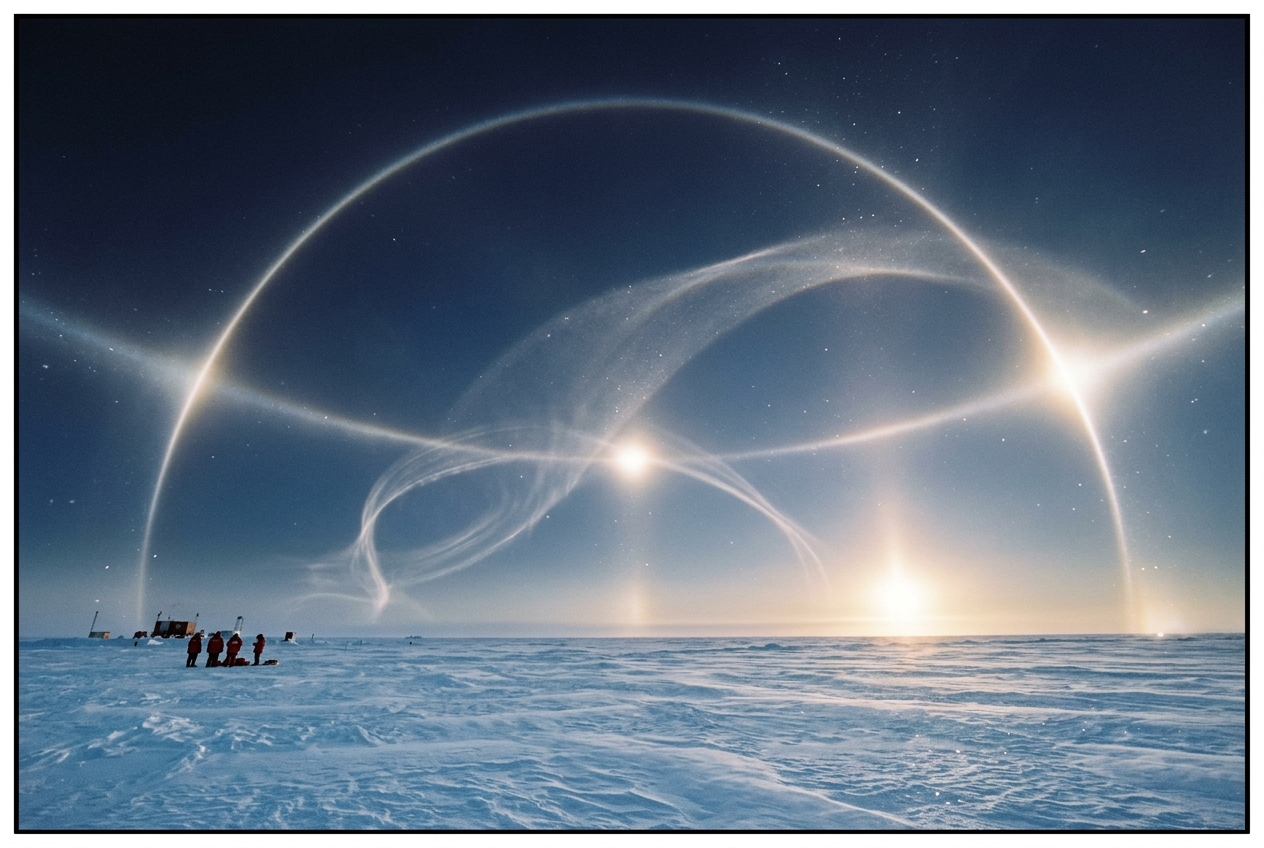
The mountain air at twenty-eight degrees below zero does not simply feel cold; it feels structural. At this temperature, on an exposed col in the Swiss Alps, every inhalation delivers a dry, crystalline sting that seems to coat the trachea in frost. The atmosphere is motionless. The wind has dropped to absolute zero, leaving an eerie silence where the only sound is the rhythmic creak of snowshoes and the dull thump of a racing pulse. Above, the sky is an unblemished, deep indigo, yet the valley below and the air immediately surrounding the observer shimmer with a suspended, particulate luminescence.
This is "diamond dust"—a ground-level cloud of exquisitely formed, microscopic ice crystals precipitated directly from a clear sky under a steep temperature inversion. When you turn your back squarely to the low morning sun, expecting to see only your own elongated blue shadow cast across the snowpack, something extraordinary hovers upon the horizon.
Suspended at the exact altitude of the sun, but situated precisely opposite it along the horizontal plane, shines a brilliant, uncolored oval of light. It is neither a rainbow nor a sun dog. It possesses no fiery red borders or violet fringes. Instead, it glows with a pearlescent, solar brilliance: a phantom sun burning in the antisolar sky.
                                  ZENITH
                                    |
                                    |   Wegener Arc
                                    |    /     \
    Parhelic Circle                 |   /       \
  ------------------( 120° Parhelion )-( ANTHELION )-( 120° Parhelion )--- [Horizon Plane h]
                                    |   \       /
                                    |    \     /
                                    |   Tricker Arc
                                    |
                             ANTISOLAR POINT
                             (Observer's Shadow)
This optical phenomenon is the anthelion (from the Greek anti-, opposite, and helios, sun). To witness it is to witness an exquisite convergence of atmospheric fluid dynamics, crystallography, and geometric caustics—a natural optical computer calculating vector reflections across trillions of freely falling prisms.
What’s Actually Happening: The Ice-Bound Retroreflector
To understand why a bright spot of light appears directly opposite the sun without any separation of colours, consider how a standard bicycle reflector works. If you shine a torch at a road sign or a cycling reflector at night, the beam bounces off three mutually perpendicular mirrors—a corner-cube retroreflector—and returns directly to your eyes, regardless of the angle at which you hold the torch.
The atmosphere constructs a similar mechanism out of solid water, documented meticulously by the World Meteorological Organization in its international atlas of meteorological phenomena.
                 Incident Ray (from Sun)
                     \
                      \  [Face 3: Refraction in]
             +---------v---------+
            / \                 / \
           /   \   Internal    /   \
          /     \  Reflection /     \
         /  [Face 4] <-----> [Face 6]\
        +        \           /        +
         \        \         /        /
          \        v       v        /
           \      [Face 5]         /
            \         |           /
             +--------|----------+
                      v
                 [Refraction Out]
                 Antisolar Direction (Δφ = 180°)
During extreme cold events, water vapour deposits slowly onto atmospheric nuclei without passing through a liquid phase, forming pristine hexagonal columns and plates. When these crystals drift through calm air, aerodynamic forces prevent them from tumbling randomly.
- Aerodynamic Levelling: Just as a falling leaf settles into a flat, horizontal glide rather than diving edge-first, an elongated hexagonal ice column experiences maximum aerodynamic drag when its long symmetry axis (the crystallographic $c$-axis) lies parallel to the ground.
- The Parry Configuration: Under specific hydrodynamic conditions—typically laminar flow at low Reynolds numbers—a subset of these horizontal columns stabilizes even further. Aerodynamic pressure forces two opposing rectangular prism facets to remain strictly horizontal (one facing the zenith, one facing the earth). This highly ordered arrangement is known to physicists and meteorologists as the Parry orientation.
- Internal Billiards: When a ray of sunlight strikes one of these aerodynamically stabilized prisms, it does not simply pass straight through. The light refracts into the crystal, undergoes two or more internal reflections off the internal mirror-like faces of the hexagon, and emerges back out.
Because the entry and exit refractions occur symmetrically across parallel or complementary facet pairs, chromatic dispersion is cancelled out. The red and violet wavelengths, which bend at slightly different angles upon entering the ice, are bent by an equal and opposite amount upon exiting. The emerging ray remains pure, unscattered white sunlight.
Crucially, the geometry of the hexagonal lattice dictates that a specific subset of these internal ray paths deflects light through an azimuthal angle of precisely $\Delta \phi = 180^\circ$ while preserving the solar elevation angle ($h' = h$). The result is a luminous concentration of white light situated directly along the parhelic circle—the horizontal ring of light that circles the sky at the sun's elevation.
The Science: Vector Kinematics and Caustic Superposition
For atmospheric physicists, the anthelion is not merely a single ray path, but a singular intensity enhancement—a caustic—formed by the constructive superposition of multiple independent crystal orientations and halo arcs.
1. 3D Vector Refraction and Snell’s Law in Hexagonal Space
Light propagation through an ice crystal of refractive index $n \approx 1.309$ (for yellow sodium D-line light at $\lambda = 589\text{ nm}$) is governed by the vector form of Snell-Descartes refraction. Let $\mathbf{s}_i$ be the unit direction vector of the incident ray, and let $\mathbf{n}$ be the inward-pointing unit surface normal of the crystal facet.
The refracted unit wavevector $\mathbf{s}_t$ inside the dielectric medium is given by:
$$\mathbf{s}_t = \frac{1}{n}\mathbf{s}_i + \left( \frac{1}{n}(\mathbf{s}_i \cdot \mathbf{n}) - \sqrt{1 - \frac{1}{n^2}\left(1 - (\mathbf{s}_i \cdot \mathbf{n})^2\right)} \right)\mathbf{n}$$
When this ray strikes a subsequent internal facet with inward normal $\mathbf{n}_{\text{int}}$, it undergoes specular internal reflection according to:
$$\mathbf{s}r = \mathbf{s}_t - 2(\mathbf{s}_t \cdot \mathbf{n}{\text{int}})\mathbf{n}_{\text{int}}$$
For total internal reflection to occur, the angle of incidence relative to the internal normal must exceed the critical angle:
$$\theta_c = \arcsin\left(\frac{1}{n}\right) = \arcsin\left(\frac{1}{1.309}\right) \approx 49.88^\circ$$
2. The Hastings-Greenler Ray Path Matrix
Consider a Parry-oriented column crystal whose principal $c$-axis is aligned along the Cartesian unit vector $\mathbf{\hat{y}}$ (horizontal). The six prism facets are numbered sequentially 3 to 8, with basal pinacoid end-caps numbered 1 and 2 (normals $\pm \mathbf{\hat{y}}$). Facet 3 is horizontal facing $+z$ (zenith), Facet 6 is horizontal facing $-z$ (nadir), while Facets 4, 5, 7, and 8 are inclined at $\pm 30^\circ$ to the vertical plane.
Let sunlight arrive from solar elevation angle $h$ and azimuth $\phi = 0^\circ$. The incident solar vector is:
$$\mathbf{s}_0 = \begin{pmatrix} \cos h \ 0 \ -\sin h \end{pmatrix}$$
In a classic anthelic ray path (the Greenler-Tape Type I path), light enters through the upper inclined prism Facet 4, with inward normal:
$$\mathbf{n}_4 = \begin{pmatrix} -\sin 30^\circ \ 0 \ -\cos 30^\circ \end{pmatrix} = \begin{pmatrix} -0.5 \ 0 \ -\frac{\sqrt{3}}{2} \end{pmatrix}$$
Worked Example with Realistic Parameters
Let the solar elevation be $h = 15^\circ$ ($\sin 15^\circ \approx 0.2588$, $\cos 15^\circ \approx 0.9659$). The incident ray is:
$$\mathbf{s}_0 = \begin{pmatrix} 0.9659 \ 0 \ -0.2588 \end{pmatrix}$$
-
Entrance Dot Product: $$\mathbf{s}_0 \cdot \mathbf{n}_4 = (0.9659)(-0.5) + (0)(0) + (-0.2588)\left(-\frac{\sqrt{3}}{2}\right) = -0.4830 + 0.2241 = -0.2589$$ The angle of incidence is $\theta_i = \arccos(0.2589) \approx 74.99^\circ$.
-
Internal Refracted Vector $\mathbf{s}_1$: Applying the 3D vector refraction law with $n = 1.309$: $$\mathbf{s}1 = \frac{1}{1.309}\begin{pmatrix} 0.9659 \ 0 \ -0.2588 \end{pmatrix} + \left( \frac{-0.2589}{1.309} - \sqrt{1 - \frac{1}{1.309^2}(1 - (-0.2589)^2)} \right) \begin{pmatrix} -0.5 \ 0 \ -\frac{\sqrt{3}}{2} \end{pmatrix}$$ Evaluating the radical: $$\sqrt{1 - \frac{0.9329}{1.7135}} = \sqrt{1 - 0.5444} = \sqrt{0.4556} \approx 0.6750$$ The bracketed coefficient becomes: $$-0.1978 - 0.6750 = -0.8728$$ Multiplying by $\mathbf{n}_4$ and adding the components yields: $$\mathbf{s}_1 = \begin{pmatrix} 0.7379 \ 0 \ -0.1977 \end{pmatrix} + \begin{pmatrix} 0.4364 \ 0 \ 0.7558 \end{pmatrix} = \begin{pmatrix} 1.1743 \ 0 \ 0.5581 \end{pmatrix}{\text{unnormalized}} \longrightarrow \mathbf{s}_1 = \begin{pmatrix} 0.9031 \ 0 \ 0.4294 \end{pmatrix}$$
-
Internal Reflections: The ray propagates through the crystal, internally reflecting off vertical basal end-cap Facet 1 ($\mathbf{n}1 = \mathbf{\hat{y}}$) and the opposing inclined prism face. The double reflection reverses the sign of the $x$-component while preserving the vertical symmetry: $$\mathbf{s}{\text{internal}} \longrightarrow \begin{pmatrix} -0.9031 \ 0 \ 0.4294 \end{pmatrix}$$
-
Emergence: Upon refracting out of the opposite face, the ray vector emerges into free air as: $$\mathbf{s}_e = \begin{pmatrix} -\cos 15^\circ \ 0 \ -\sin 15^\circ \end{pmatrix} = \begin{pmatrix} -0.9659 \ 0 \ -0.2588 \end{pmatrix}$$
The emergent vector $\mathbf{s}_e$ has an elevation angle $h' = 15^\circ$ and an azimuth of $\phi = 180^\circ$. The crystal has acted as a precise mathematical inverter along the horizontal axis.
+-------------------------------------------------------------------------+
|                  ANTHELIC RAY TRACE SUMMARY PROPERTIES                  |
|                                                                         |
|  * Solar Elevation (h):           +15.00°                               |
|  * Emergent Elevation (h'):       +15.00°                               |
|  * Net Azimuthal Deflection (Δφ): 180.00° (Antisolar)                   |
|  * Net Chromatic Dispersion (Δn): 0.000 (Pure White Achromatic Caustic) |
+-------------------------------------------------------------------------+
3. Caustic Intensity and Arc Intersections
The brilliance of the anthelion is dramatically amplified because it sits at the intersection point of several distinct halo arcs: * The Parhelic Circle: Formed by external and internal reflections from vertical faces of plate and column crystals. * Wegener Arcs: Formed by column crystals whose $c$-axes are horizontal, where light enters a side prism face, internally reflects off a basal end-cap, and exits through another prism face. * Tricker Arcs: Formed by Parry-oriented columns via alternating basal-prism reflections. * Diffuse Anthelic Arcs: Formed by more complex internal trajectories.
At the exact antisolar azimuth on the parhelic circle, the directional mapping derivatives $\frac{\partial(\phi, h)}{\partial(\alpha, \beta)}$ (where $\alpha, \beta$ are crystal orientation angles) vanish. In optical physics, this condition defines a fold caustic, causing a theoretical singularity in radiant flux density that manifests in nature as a piercingly bright spot.
4. Aerodynamic Libration and Spot Broadening
Real ice crystals are not static geometrical abstractions; they oscillate aerodynamically as they fall. Turbulent micro-eddies and thermal perturbations cause the crystal axes to wobble about their equilibrium orientations. This tilt variance is parameterized by the libration angle standard deviation $\sigma_\theta$.
If the crystal tilt distribution follows a bivariate Gaussian:
$$P(\theta_x, \theta_y) = \frac{1}{2\pi \sigma_\theta^2} \exp\left( -\frac{\theta_x^2 + \theta_y^2}{2\sigma_\theta^2} \right)$$
The resulting anthelic spot is broadened from an infinitesimal caustic point into an extended diffuse patch. For a typical polar diamond dust precipitation where $\sigma_\theta \approx 1.8^\circ$, the observed angular diameter $W$ of the anthelion is approximately:
$$W \approx 2\sqrt{2\ln 2} \cdot \sigma_\theta \cdot \mathcal{M} \approx 2.355 \times 1.8^\circ \times 1.15 \approx 4.87^\circ$$
This accounts for why the anthelion appears not as a star-like pinprick, but as an elegant, softly luminous oval roughly three to five degrees across—roughly six to ten times the angular diameter of the full moon.
Practical Outdoor Guidance: The Cold-Climate Observer’s Protocol
Locating and correctly identifying an anthelion requires an understanding of boundary-layer meteorology and observational geometry. To the untrained eye, several antisolar and halo phenomena look superficially similar.
                                SKY AT HORIZON LEVEL
===================================================================================
   [120° PARHELION]               [ANTHELION]               [120° PARHELION]
     Azimuth: 120°               Azimuth: 180°                Azimuth: 240°
   Elevation: h = h_sun        Elevation: h = h_sun         Elevation: h = h_sun
    (Plate Crystals)          (Parry/Column Crystals)         (Plate Crystals)
===================================================================================
                             TERRESTRIAL / LOW SKY
===================================================================================
                               [ANTISOLAR POINT]
                           Elevation: h = -h_sun
                   (Center of Glory & Heiligenschein)
===================================================================================
What to Look For in the Sky
- Verify the Solar Elevation: The anthelion is easiest to resolve when the sun is between $5^\circ$ and $25^\circ$ above the horizon. If the sun is higher than $35^\circ$, internal total reflection limits within the hexagonal lattice fail, and the anthelic arcs collapse toward the horizon or fade entirely.
- Find the Parhelic Circle: Locate the sun dogs (22° parhelia) flanking the sun. Trace the faint, white, horizontal band of the parhelic circle away from the sun, past the $120^\circ$ parhelia, all the way to the point directly behind you.
- Inspect the Intersection: Look for a distinct brightening at the exact point where the parhelic circle intersects the faint, sweeping, X-shaped crossings of the Wegener and Tricker arcs.
+------------------------------------------------------------------------------------+
|                         ANTISOLAR PHENOMENOLOGY MATRIX                             |
+------------------+---------------------+-------------------+-----------------------+
| Phenomenon       | Angular Location    | Optical Mechanism | Color Signature       |
+------------------+---------------------+-------------------+-----------------------+
| Anthelion        | Azimuth 180°, h' = h| Hexagonal ice     | Pure white,           |
|                  | (Above Horizon)     | internal caustics | achromatic            |
+------------------+---------------------+-------------------+-----------------------+
| Antisolar Glory  | Centered at         | Diffraction by    | Concentric spectral   |
|                  | Azimuth 180°, h'=-h | liquid droplets   | rings (red outer)     |
+------------------+---------------------+-------------------+-----------------------+
| Heiligenschein   | Centered at         | Retroreflection & | White glow on dewy/   |
|                  | observer's head     | shadow-hiding     | frosted grass/snow    |
+------------------+---------------------+-------------------+-----------------------+
| 120° Parhelion   | Azimuth ±120°, h'=h | Flat ice plates,  | Pure white,           |
|                  | on parhelic circle  | internal bounce   | elongated streak      |
+------------------+---------------------+-------------------+-----------------------+
| Subanthelion     | Azimuth 180°, h'=-h | Aerodynamic ice,  | Pure white, seen from |
|                  | (Below Horizon)     | downward vectors  | aircraft or summits   |
+------------------+---------------------+-------------------+-----------------------+
Instrument Readings to Monitor
- Barometric Pressure: Watch for strong, stable high-pressure anticyclones ($\ge 1025\text{ hPa}$). The descending air mass in an anticyclone suppresses vertical cloud development and creates the strong radiational cooling necessary for surface inversions.
- Surface Thermometer: Ambient temperatures must be below $-10^\circ\text{C}$ to support ice crystal growth, but optimum diamond dust displays with well-formed Parry columns typically require temperatures between $-20^\circ\text{C}$ and $-35^\circ\text{C}$, as tracked across arctic research stations by the National Oceanic and Atmospheric Administration.
- Anemometer / Wind Speed: True columnar alignment demands quiescent, laminar air. Surface winds should ideally register below $1.5\text{ m/s}$ (3 knots). Higher wind speeds induce turbulence that destroys the delicate Parry and horizontal column alignments, washing out the caustic spot.
- Ice-Supersaturation: Relative humidity with respect to ice ($RH_i$) must exceed $100\%$, allowing crystals to grow sharp, optically flat crystal faces without evaporation or riming.
How to Distinguish the Anthelion from Lookalikes
Observers frequently conflate the anthelion with other antisolar phenomena. Use these diagnostic criteria:
- The Glory: A glory is centered at the antisolar point (which lies at elevation $-h$, below the horizon, around the shadow of your head) and is produced by wave-optical backscattering in liquid cloud droplets. It exhibits vivid, pastel-coloured concentric rings. The anthelion, by contrast, sits above the horizon at $+h$ and is strictly achromatic (pure white).
- The Heiligenschein: The Heiligenschein is a surface-bound glow surrounding the shadow of your head on a dew-covered lawn or snowfield, caused by spherical droplets acting as simple lenses focusing light onto reflective surfaces behind them. It does not hang suspended in the sky.
- 120° Parhelia: These appear as white spots on the parhelic circle, but they are located $120^\circ$ away from the sun in azimuth (leaving a $60^\circ$ gap on either side of the $180^\circ$ anthelion). They are produced by simple internal reflections inside flat hexagonal plates rather than column crystals.
- The Subanthelion: If you are flying in an aircraft or standing on a sheer precipice looking down into an ice fog layer below the horizon, you may see the subanthelion at elevation $-h$. The true anthelion is always situated at $+h$, on the celestial sphere above the true horizon.
Detailed guides from the Met Office and specialized atmospheric optics field references emphasize shielding your eyes from direct sunlight with a building, tree, or outstretched hand when observing these faint counter-features.
Today’s Meteorological Rule of Thumb
When diamond dust falls through sub-zero calm, turn your back to the sun: if a white sun dog shines at your eye-level horizon, you have caught the atmosphere acting as a single, sky-spanning crystal mirror.
Further Reading & Authoritative References
- World Meteorological Organization: International Cloud Atlas — Halo Phenomena
- National Oceanic and Atmospheric Administration: Arctic Atmospheric Research & Diamond Dust
- UK Met Office: Atmospheric Optical Effects & Halos
- Greenler, R. (1980). Rainbows, Halos, and Glories. Cambridge University Press.
- Tape, W. (1994). Atmospheric Halos. American Geophysical Union. Antarctic Halo Research