Zhen Jiu Feng Yuan: Navigating Li Xuechuan's 361 Point Canon, Unified Channel Cartography, and Precision Acupressure Protocols
1. Opening — A Problem This Solves Today
If you sit at a desk under fluorescent lights, you are likely familiar with a distinct constellation of modern distress: an afternoon fog that dulls your concentration, a persistent low-grade tightness across your neck and jaw, postprandial bloating that lingers for hours after a rushed lunch, and a nocturnal restlessness where your mind races even as your limbs feel leaden. In contemporary biomedical terms, this state is recognized as a dysregulation of the autonomic nervous system—a persistent sympathetic overdrive paired with vagal withdrawal and microvascular constriction across visceral and myofascial tissues.
Long before the advent of autonomic monitors or electromyography, physicians of the late imperial Chinese dynasties recognized that these seemingly disconnected symptoms—digestive stagnation, emotional agitation, cranial tension, and systemic fatigue—were expressions of an underlying structural and energetic disequilibrium.
+-----------------------------------------------------------------------------------+
|                           THE 1817 STANDARDIZATION ARCH                               |
|                                                                                   |
|  Pre-1817 Discrepancies         Li Xuechuan's Synthesis        Modern Science     |
|  * Divergent channel charts  -> [ Zhen Jiu Feng Yuan ]    ->   * Fascial planes   |
|  * Variable point tallies       (1817 CE / Qing Dynasty)       * Neurovascular    |
|  * Fragmented cun ratios        "361 Regular Channel Points"     integrin pathways|
|                                 across 14 Meridians            * WHO Standard     |
+-----------------------------------------------------------------------------------+
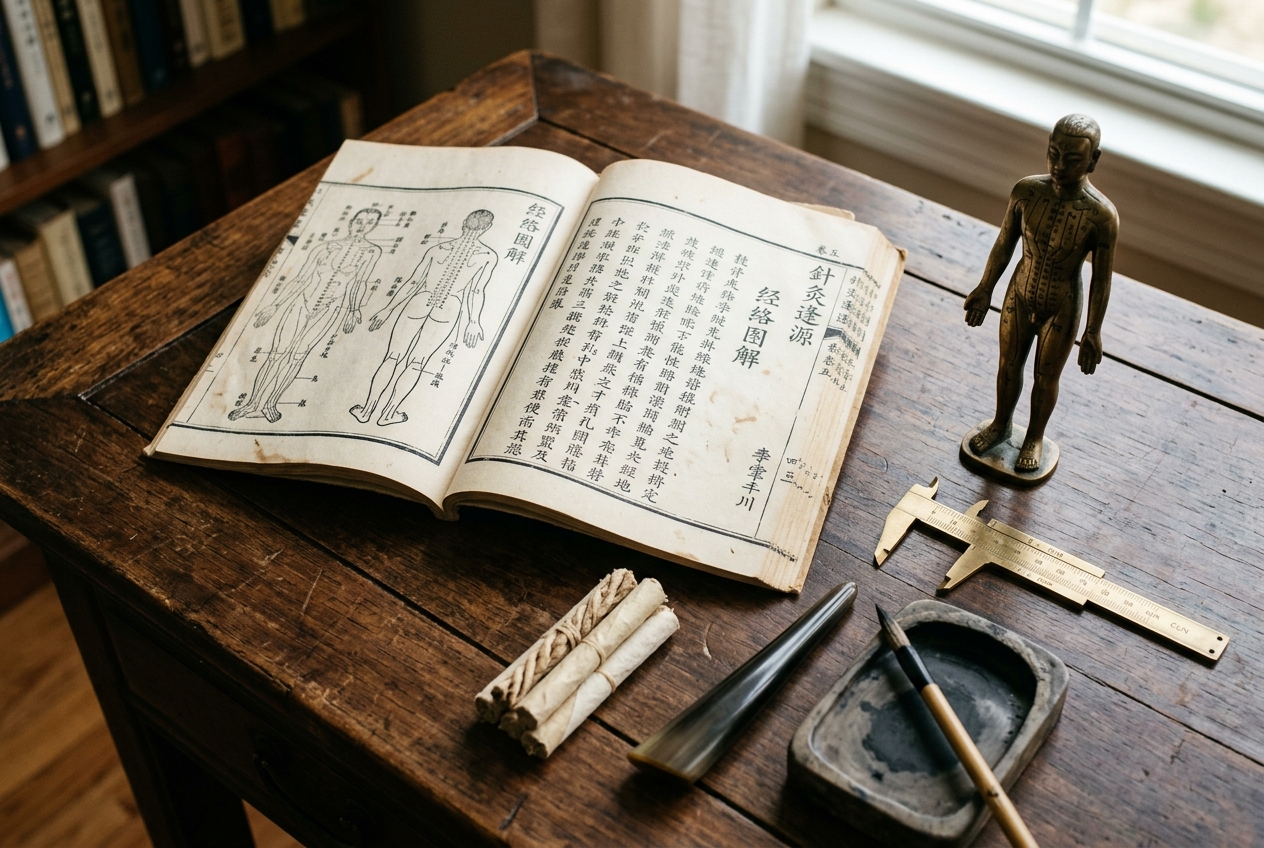
For centuries, practitioners struggled with conflicting lineages, regional discrepancies, and diverging anatomical charts. The breakthrough came in 1817 during the Qing Dynasty, when the imperial scholar-physician Li Xuechuan (李学川) published his monumental medical treatise, Zhen Jiu Feng Yuan (针灸逢源 — Sourcing the Fundamentals of Acupuncture and Moxibustion). Li meticulously harmonized the classical canons—integrating the ancient physiological tenets of the Huangdi Neijing (Inner Canon of the Yellow Emperor) with rigorous anatomical bone-proportional measurements (Gudu Zheliang, 骨度折量).
Crucially, Zhen Jiu Feng Yuan established the definitive canon of exactly 361 regular acupoints distributed across the Fourteen Channels (the twelve primary bilateral organ meridians plus the two primary midline conduits: the Ren Mai or Conception Vessel, and the Du Mai or Governing Vessel). This rigorous cartography corrected centuries of transcriptional errors and remains the direct historical blueprint for the modern World Health Organization (WHO) Standard Acupuncture Point Locations.
=====================================================================================
                      HISTORICAL CONCORDANCE: 14 MERIDIANS & 361 POINTS
=====================================================================================
 Meridian Classification       TCM Channel Name (Pinyin)     Points per Side / Midline
-------------------------------------------------------------------------------------
 Lung (LU)                     Hand Taiyin (手太阴肺经)                 11
 Large Intestine (LI)          Hand Yangming (手阳明大肠经)             20
 Stomach (ST)                  Foot Yangming (足阳明胃经)               45
 Spleen (SP)                   Foot Taiyin (足太阴脾经)                 21
 Heart (HT)                    Hand Shaoyin (手少阴心经)                 9
 Small Intestine (SI)          Hand Taiyang (手太阳小肠经)              19
 Bladder (BL)                  Foot Taiyang (足太阳膀胱经)              67
 Kidney (KI)                   Foot Shaoyin (足少阴肾经)                27
 Pericardium (PC)              Hand Jueyin (手厥阴心包经)                9
 Triple Burner / Sanjiao (TB)  Hand Shaoyang (手少阳三焦经)             23
 Gallbladder (GB)              Foot Shaoyang (足少阳胆经)               44
 Liver (LV)                    Foot Jueyin (足厥阴肝经)                 14
 Ren Mai (Conception Vessel)   Midline Anterior (任脉)                  24
 Du Mai (Governing Vessel)     Midline Posterior (督脉)                 28
-------------------------------------------------------------------------------------
 TOTAL REGULAR ACUPOINTS STANDARDIZED BY LI XUECHUAN (1817):            361
=====================================================================================
Today, whether exploring classical point energetics or applying precise, non-invasive acupressure at your desk, this meridian system offers an extraordinarily practical physiological map. By stimulating discrete surface loci, we engage the body's intrinsic neurofascial architecture to restore homeostatic balance across organ systems.
2. The Meridian Path — A Journey Through the Body
To understand how stimulating a point on the lower leg or hand can alleviate a tension headache or settle gastric reflux, one must trace the continuous topographical pathways formalized in Zhen Jiu Feng Yuan. In Chinese medical theory, meridians (Jingluo) are not isolated hollow tubes; they represent an interconnected web of kinetic, fascial, and neurovascular trajectories.
       MERIDIAN CONTINUITY & NEUROFASCIAL ANCHORS

       (Cranial / Cephalic Region)
                  |
         [ Trigeminal Nuclei ]
                  |
     =============+============= <--- Superficial & Deep Fascia
    /                           \
[LI4 Hegu]                 [ST36 Zusanli]
(Radial Nerve /             (Peroneal Nerve /
 Forearm Extensors)          Tibialis Anterior)
    \                           /
     =============+============= <--- Interstitial Mechanical Signaling
                  |
       [ Vagal-Adrenal Axis ]
                  |
       (Visceral Homeostasis)
Consider the course of the Stomach Meridian (Foot Yangming), the most energetically vital channel for systemic nourishment: 1. The Cephalic Origin: The pathway begins directly below the pupil of the eye, descends around the corner of the mouth, curves along the angle of the jaw, and ascends past the temple to the hairline. 2. The Thoracoabdominal Descent: Descending through the neck along the carotid sheath, it crosses the collarbone and drops straight down the chest—passing through the mammillary line—before traversing the abdomen four finger-widths lateral to the navel along the rectus abdominis sheath. 3. The Femoral and Crural Track: Continuing down the front-outer aspect of the thigh, it crosses the lateral border of the kneecap and journeys down the fleshy muscular ridge of the shinbone—the tibialis anterior muscle belly that aches after long hikes or standing on concrete. 4. The Pedal Termination: It courses across the high instep of the foot, traveling between the long extensor tendons to terminate at the lateral corner of the second toenail.
+-----------------------------------------------------------------------------------+
|                        THE DUAL REALITY OF MERIDIAN PATHWAYS                      |
|                                                                                   |
| Classical Cartography (1817)           Modern Neurofascial Science (2020s)        |
| ------------------------------------   ------------------------------------------ |
| * Qi flows through 14 Jingluo          * Interstitial fluid channels in loose CT  |
| * Longitudinal somatic conduits        * Continuous myofascial chains (Myers)     |
| * Bone-proportional cun landmarks      * Intermuscular septa & neurovascular axes |
| * Points as 'caves' (Xue, 穴)          * High-density mechanoreceptor clusters    |
+-----------------------------------------------------------------------------------+
From a modern biomedical perspective, this trajectory corresponds directly with what fascia researchers term the Superficial Front Line—a continuous transmission sheet of collagenous connective tissue linking the cranial galea, sternocleidomastoid, rectus abdominis, rectus femoris, and tibialis anterior.
Recent research indexed on NCBI PubMed on the Neuroanatomical Basis of Acupuncture Points confirms that classical acupoints standardized by Li Xuechuan do not exist in arbitrary spaces. Over 80% of these 361 loci coincide with intermuscular connective tissue septa, perforating neurovascular bundles, and high concentrations of unmyelinated free nerve endings, Ruffini corpuscles, and Pacinian mechanoreceptors.
When mechanical pressure is applied to these sites, mechanical deformation of the extracellular matrix triggers cellular mechanotransduction—converting physical pressure into biochemical cascades that modulate local microcirculation, down-regulate substance P, and project afferent signals directly into the spinal cord and brainstem.
3. Key Foundational Points You Can Press Right Now
Li Xuechuan's Zhen Jiu Feng Yuan emphasized that clinical mastery relies not on treating hundreds of scattered points, but on commanding foundational regular points whose anatomical depth and systemic reach are profound. Below are five foundational points standardized in the 1817 treatise, detailing their physical topography, somatosensory verification (Deqi), mechanotransduction pathways, and clinical applications.
====================================================================================================
               SUMMARY: FOUNDATIONAL ACUPOINTS ACROSS THE FOURTEEN CHANNELS
====================================================================================================
 Acupoint Code & Name   Channel              Physical Landmark                 Primary Clinical Actions
----------------------------------------------------------------------------------------------------
 ST36 (Zusanli)         Foot Yangming        4 fingers below knee, outer shin  GI motility, fatigue, vagal tone
 LI4 (Hegu)             Hand Yangming        Webbing between thumb & index     Cranial pain, jaw tension, sinus
 LV3 (Taichong)         Foot Jueyin          Valley behind 1st & 2nd toes      Stress, anger, ocular strain
 SP6 (Sanyinjiao)       Foot Taiyin          4 fingers above medial ankle      Pelvic health, sleep, fluid balance
 PC6 (Neiguan)          Hand Jueyin          3 fingers above wrist crease      Nausea, palpitations, anxiety
====================================================================================================
Point 1: ST36 — Zusanli (足三里, "Leg Three Miles")
- Historical Note: Li Xuechuan designated Zusanli as the primary commanding point for all pathologies of the abdomen, noting its unique capacity to tonify Zheng Qi (upright physiological vitality).
                      ANATOMICAL TOPOGRAPHY: ST36 (ZUSANLI)

                               [ Patella / Kneecap ]
                                        |
                                [ Infrapatellar Fossa ]
                                        |
   Tibial Tuberosity (Shin Crest) <--- 3 cun ---> [ Outer Depression ]
                |                                      |
                |====== 1 finger-width lateral =======> * ST36 Zusanli
                |                                      (Tibialis Anterior Belly)
                |
                V (Descending to Foot)
- Everyday Physical Location: Sit with your knees bent at 90 degrees. Place the palm of your hand over your kneecap; your four fingers will rest naturally along your shinbone. The point lies roughly four finger-widths down from the bottom edge of your kneecap, and about one thumb-width outward from the prominent bony ridge of your shin, nestled directly in the fleshy belly of the muscle (tibialis anterior).
- What You Will Feel (Deqi): Upon applying firm, perpendicular pressure, you will elicit a distinctive dull ache, a heavy spreading sensation, or a mild tingling warmth radiating down the outer lower leg toward the second and third toes.
- Biomedical & Fascial Mechanism: Stimulation engages the deep peroneal nerve and branches of the anterior tibial artery. Laboratory investigations cataloged in PubMed studies on acupuncture and autonomic modulation demonstrate that mechanical excitation of ST36 stimulates vagal efferent pathways via the somatosensory-vagal-adrenal axis, suppressing systemic pro-inflammatory cytokines (such as TNF-α and IL-6) while up-regulating gastric peristalsis and gastric mucosal blood flow.
- How to Press: Use the tip of your thumb or a firm knuckle. Apply firm, steady perpendicular pressure with small circular micro-kneading motions. Maintain for 2 to 3 minutes per leg while breathing slowly and diaphragmatically.
- Daily Indications: Postprandial bloating, slow digestion, chronic fatigue, low resistance to seasonal illness, and general mental-physical exhaustion.
Point 2: LI4 — Hegu (合谷, "Joining Valleys")
- Historical Note: Standardized in the Zhen Jiu Feng Yuan as the premier distal point for the face, sensory orifices, and head.
                      ANATOMICAL TOPOGRAPHY: LI4 (HEGU)

                         [ Index Finger Metacarpal ]
                                     \
                                      \   * LI4 Hegu (Apex of Muscle Mound)
                                       \ /
                                        X  <--- Radial Webbing
                                       / \
                                      /   \
                          [ Thumb Metacarpal ]
- Everyday Physical Location: Look at the back of your hand. Squeeze your thumb tightly against your index finger. You will see a prominent mound of muscle bulge outward in the fleshy webbing between the two bones. The point is located at the highest point of that muscular bulge (the first dorsal interosseous muscle). When you relax your hand, slide your opposite thumb into that valley, angling your pressure slightly underneath the long bone of your index finger (the second metacarpal).
- What You Will Feel (Deqi): A sharp, deep, spreading soreness or heavy sensation that often travels upward along the outer forearm toward the elbow.
- Biomedical & Fascial Mechanism: Stimulates the superficial and deep branches of the radial nerve. Modern neuroimaging studies demonstrate that activating LI4 Hegu induces significant signal modulation in the primary somatosensory cortex and the trigeminal nucleus caudalis, prompting the release of endogenous opioids (beta-endorphins and enkephalins) that inhibit central pain processing for the entire cephalic region.
- How to Press: Grasp your hand in a pincer grip, placing your opposite thumb on top of the point and your index finger on the palm side for support. Apply firm, steady, pulsing pressure angled toward the index finger bone for 1 to 2 minutes per hand.
- Daily Indications: Tension headaches, frontal sinus pressure, temporomandibular (TMJ) jaw clenching, stiff neck from computer work, and acute stress-induced tension.
Point 3: LV3 — Taichong (太冲, "Great Surge")
- Historical Note: Categorized by Li Xuechuan as the Shu-Stream and Yuan-Source point of the Liver channel, essential for smoothing stagnant Qi and subduing emotional volatility and somatic hyperarousal.
                      ANATOMICAL TOPOGRAPHY: LV3 (TAICHONG)

                             [ Big Toe ]     [ Second Toe ]
                                  \               /
                                   \             /
                                    \   Valley  /
                                     \         /
                                      \   *   /  <--- LV3 Taichong
                                       \     /        (Depression between metatarsals)
                                        \   /
                                     [ Metatarsal Junction ]
- Everyday Physical Location: On the top of your bare foot, place your index finger in the webbing between your big toe and second toe. Slide your finger upward along the groove between the two long bones toward your ankle. About two finger-widths up, your finger will fall into a distinct, soft depression just before the bones join together in a "V" shape.
- What You Will Feel (Deqi): Highly sensitive to pressure; you will immediately feel a pronounced, tender, bruised sensation, sometimes accompanied by a localized electrical tingle that runs across the top of the foot.
- Biomedical & Fascial Mechanism: Positioned over the deep peroneal nerve and the dorsal venous rete of the foot. Mechanical stimulation triggers peripheral vasodilation via nitric oxide release, reduces sympathetic tone, and stabilizes blood pressure surges triggered by emotional stress or acute autonomic arousal.
- How to Press: Use the tip of your thumb to press downward and slightly backward toward your ankle. Apply moderate, sustained pressure—firm enough to feel the tenderness without causing muscular guarding—for 2 minutes on each foot.
- Daily Indications: Irritability, eye strain from digital screens, throbbing vertex or temporal headaches, menstrual cramps, and stress-related hypertension.
Point 4: SP6 — Sanyinjiao (三阴交, "Three Yin Intersection")
- Historical Note: One of the most famous clinical junctions in Zhen Jiu Feng Yuan, where the three Yin meridians of the leg—Spleen (Taiyin), Kidney (Shaoyin), and Liver (Jueyin)—converge to coordinate fluid dynamics, blood storage, and hormonal harmony.
                      ANATOMICAL TOPOGRAPHY: SP6 (SANYINJIAO)

                                  (Medial Shin)
                                        |
                          * SP6 Sanyinjiao (Posterior Tibial Border)
                                        |
                                      3 cun
                               (4 finger-widths)
                                        |
                         [ Medial Malleolus (Inner Ankle Bone) ]
- Everyday Physical Location: Locate the highest, most prominent point of your inner ankle bone (medial malleolus). Place your four fingers horizontally across the inner side of your lower leg, starting from that ankle peak. Directly above the top finger, in the soft groove just behind the rear border of your shinbone, lies SP6.
- What You Will Feel (Deqi): A distinct, warm, radiating tenderness that often travels upward along the inner calf or down into the sole of the foot.
- Biomedical & Fascial Mechanism: Traverses the tibial nerve and posterior tibial neurovascular bundle. Acupressure here promotes pelvic parasympathetic activation, enhances microvascular perfusion in lower abdominal viscera, and balances neuroendocrine output.
- How to Press: Place your thumb flat against the back edge of the shinbone, pressing inward toward the bone. Maintain moderate, circular pressure for 2 minutes per leg.
- Daily Indications: Menstrual discomfort, insomnia, fluid retention in the ankles, lower abdominal cramping, and evening restlessness.
Point 5: PC6 — Neiguan (内关, "Inner Gate")
- Historical Note: Standardized as the Luo-Connecting point of the Pericardium channel and the master opening point of the Yin Wei Mai (Yin Linking Vessel), governing the thorax, epigastrium, and psyche (Shen).
                      ANATOMICAL TOPOGRAPHY: PC6 (NEIGUAN)

                         [ Flexor Carpi Radialis ]     [ Palmaris Longus ]
                                    \                       /
                                     \      * PC6 Neiguan  /
                                      \   (Between Tendons)/
                                       \                  /
                                        ================== <--- Distal Wrist Crease
                                                |
                                             [ Palm ]
- Everyday Physical Location: Turn your hand so your palm faces upward. Look at the transverse crease where your wrist meets your palm. Place three fingers of your opposite hand across your wrist crease, pointing toward your elbow. The point lies just past the third finger, centered directly in the valley between the two prominent cord-like tendons (palmaris longus and flexor carpi radialis) that stand out when you make a tight fist and curl your wrist slightly inward.
- What You Will Feel (Deqi): A deep, tingling, or numbing sensation that radiates outward into the palm and up the middle of the inner forearm.
- Biomedical & Fascial Mechanism: Lies directly over the median nerve sheath. Peer-reviewed clinical trials documented on NCBI PubMed regarding Pericardium 6 Neuromodulation confirm that mechanical stimulation of PC6 suppresses nausea centers in the brainstem (area postrema) and enhances Heart Rate Variability (HRV) by stimulating cardiac vagal afferents, thereby reducing tachyarrhythmia and acute anxiety.
- How to Press: Use the tip of your thumb to press deeply into the space between the two tendons, angling straight down. Hold with continuous, firm pressure while taking slow, deep diaphragmatic breaths for 2 minutes on each wrist.
- Daily Indications: Motion sickness, post-meal nausea, acid reflux, panic sensations, sudden chest tightness, and anticipatory anxiety.
4. A Point Combination for One Common Issue: The Nocturnal Autonomic Reset
=====================================================================================
            THE NOCTURNAL AUTONOMIC RESET PROTOCOL (10-MINUTE CLINICAL TIMELINE)
=====================================================================================
 Step   Point Code       Bilateral / Unilateral   Duration   Primary Action
-------------------------------------------------------------------------------------
 1      LI4 (Hegu)       Bilateral (both hands)   2 minutes  De-escalates cranial tension
 2      LV3 (Taichong)   Bilateral (both feet)    2 minutes  Opens peripheral microvessels
 3      PC6 (Neiguan)    Bilateral (both wrists)  2 minutes  Enhances HRV & vagal tone
 4      ST36 (Zusanli)   Bilateral (both legs)    2 minutes  Settles epigastric churning
 5      SP6 (Sanyinjiao) Bilateral (both legs)    2 minutes  Induces parasympathetic sleep
=====================================================================================
 Total Protocol Time: 10 Minutes | Optimal Posture: Supine with bolster under knees
The Clinical Scenario
You have finished a long, stressful workday behind digital displays. Your eyes burn, your shoulders are glued to your ears, your stomach feels distended and sour, and despite utter exhaustion, your brain is firing with repetitive, anxious thoughts. You lie in bed unable to shift into restorative sleep.
The "Four Gates" + Visceral Harmony Protocol
In traditional medicine, combining bilateral LI4 (Hegu) with bilateral LV3 (Taichong) is known as the renowned classical formula Si Guan (四关 — The Four Gates). Li Xuechuan's Zhen Jiu Feng Yuan elevated this combination as the definitive strategy to open all somatic channels, discharge trapped pathogenic tension, and harmonize ascending and descending energetic dynamics.
When augmented with PC6 (Neiguan), ST36 (Zusanli), and SP6 (Sanyinjiao), this sequence acts as a multi-tiered autonomic reset.
       THE SYNERGISTIC CASCADE OF THE FOUR GATES + VISCERAL AXIS

     [ LI4: Cranial Sedation ]  <=======>  [ LV3: Vascular Relaxation ]
                 |                                      |
                 +------------------+-------------------+
                                    |
                        [ Central Parasympathetic ]
                        [      Activation Gate    ]
                                    |
                 +------------------+-------------------+
                 |                                      |
     [ PC6: Cardiac Vagal Tone ]            [ ST36/SP6: Visceral Motility ]
                 |                                      |
                 +==================+===================+
                                    |
                        [ Restorative Slow-Wave Sleep ]
Step-by-Step "Do This Tonight" Execution:
- Preparation and Posture (0:00): Lie flat on your back in a quiet, dimly lit room. Place a small pillow under your head and a bolster or rolled towel beneath your knees to relax your abdominal wall and lumbar spine. Begin rhythmic, diaphragmatic breathing: inhale through the nose for 4 seconds, and exhale slowly through slightly parted lips for 6 to 8 seconds.
- Step 1: Open Upper Cranial Tension with LI4 Hegu (0:00 – 2:00): Grasp your left LI4 with your right thumb and index finger. Apply firm, circular pressure for 60 seconds while exhaling tension from your jaw and forehead. Switch to the right LI4 for 60 seconds.
- Step 2: Descend Frustration and Stress with LV3 Taichong (2:00 – 4:00): Reach down to your left foot. Locate LV3 in the groove behind your big toe. Press firmly into the hollow with your left thumb for 60 seconds. Repeat on the right foot for 60 seconds. Notice the sensation of heat or heaviness descending from your head down into your feet.
- Step 3: Quiet Palpitations and Settle the Chest with PC6 Neiguan (4:00 – 6:00): Bring your arms back to your chest. Press your right thumb deep between the two tendons of your left inner wrist at PC6. Maintain continuous, steady pressure for 60 seconds while focusing on the sensation of your heart rate slowing. Switch and press your right PC6 for 60 seconds.
- Step 4: Harmonize Digestion with ST36 Zusanli (6:00 – 8:00): Move your hands to the outer shin muscle below your knees. Press both thumbs simultaneously into left and right ST36. Apply deep, rhythmic, circular pressure for 2 minutes to relieve epigastric fullness and anchor your breath into your lower abdomen.
- Step 5: Induce Somnolence with SP6 Sanyinjiao (8:00 – 10:00): Finish by pressing the inner borders of your lower legs at SP6 with your thumbs. Hold gentle, steady pressure for 60 seconds on each side. Close your eyes, release your limbs flat onto the bed, and let your natural breathing rhythm take over.
5. Safety & Sense: Clinical Boundaries, Precautions, and Contraindications
While acupressure is an extraordinarily safe, non-pharmacological self-care modality, applying mechanical force to biologically active neurovascular zones requires clinical discernment and anatomical respect.
+-----------------------------------------------------------------------------------+
|                           CRITICAL SAFETY ALERTS & BOUNDARIES                     |
|                                                                                   |
|  [!] ABSOLUTE PREGNANCY CONTRAINDICATIONS                                         |
|      * LI4 (Hegu) & SP6 (Sanyinjiao): Strongly down-bearing; promote oxytocic-like|
|        uterine smooth muscle contractions. STRICTLY AVOID throughout pregnancy.  |
|      * Abdominal & Sacral Points (Ren 3-6, BL 31-34): Never deeply stimulate.     |
|                                                                                   |
|  [!] TISSUE INTEGRITY & INFLAMMATION                                              |
|      * Never apply acupressure over broken skin, open wounds, burns, or bruises.  |
|      * Absolute contraindication over active deep vein thrombosis (DVT),          |
|        varicose ulcerations, or localized acute soft-tissue infections.           |
|                                                                                   |
|  [!] SENSATION & PRESSURE THRESHOLD                                               |
|      * Therapeutic sensation (Deqi): Dull ache, distension, warmth, mild soreness.|
|      * Unacceptable pain: Sharp, piercing, electric shock sensations (nerve       |
|        compression). If sharp pain occurs, immediately ease pressure.            |
+-----------------------------------------------------------------------------------+
When to Transition from Self-Care to Professional Medical Care
Acupressure is designed for functional symptom modulation, stress regulation, and somatic self-maintenance. It is not a substitute for emergency medicine or definitive diagnostic workups. Seek immediate conventional medical evaluation if you experience: * Sudden, severe, unprecedented headache ("thunderclap" onset), visual loss, or unilateral facial/arm weakness. * Crushing substernal chest pressure radiating to the jaw, neck, or left arm. * Acute, rigid, or rebound abdominal pain accompanied by fever, persistent vomiting, or black/tarry stools. * Progressive neurological deficits, motor loss, or unexplained severe weight loss.
For complex chronic issues—such as chronic autoimmune disorders, severe pelvic pain, or refractory insomnia—consult a licensed acupuncturist certified by national regulatory bodies (such as the NCCAOM in the United States or the British Acupuncture Council in the UK), working in tandem with your primary medical physician.
6. Today's Takeaway: The Two-Minute Desk Reset
You do not need to wait for a full evening routine to experience the physiological shift mapped by Li Xuechuan two centuries ago. Before closing this window, perform this simple Two-Minute Bilateral PC6 Reset:
+-----------------------------------------------------------------------------------+
|                           THE 2-MINUTE DESK RESET PROTOCOL                        |
|                                                                                   |
|  1. PLACE: 3 fingers across inside wrist; locate PC6 between the central tendons. |
|  2. PRESS: Firm perpendicular thumb pressure until a deep, warm ache arrives.     |
|  3. BREATHE: Inhale 4s through nose -> Exhale 6s slowly through lips.             |
|  4. DURATION: 60 seconds on left wrist -> 60 seconds on right wrist.             |
|  RESULT: Instant vagal engagement, reduced heart rate, release of chest tension.  |
+-----------------------------------------------------------------------------------+
- Rest your forearms flat on your desk with palms turned upward.
- Place the index, middle, and ring fingers of your right hand across the crease of your left wrist. Just above your index finger, identify the groove between the two prominent tendons in the center of your forearm: PC6 (Neiguan).
- Place your right thumb directly into that valley. Press down firmly until you feel a dull, spreading ache.
- Close your eyes. Take three slow, diaphragmatic breaths: inhale for 4 seconds, exhale for 6 seconds.
- Maintain pressure for 60 seconds, then switch hands and repeat on your right wrist for 60 seconds.
As you release your wrists, take note of the subtle physiological shift: your shoulders drop from your ears, the tight band around your chest softens, saliva returns to your mouth, and your focus sharpens. In two minutes, you have engaged the ancient, standardized architecture of Zhen Jiu Feng Yuan—bridging an 1817 Qing Dynasty masterpiece with the living, responsive neurobiology of your own body.