Zhen Jiu Da Quan: Navigating Xu Feng's Ming Dynasty Channel Anthology, Eight Confluent Pairings, and Precision Acupressure Protocols
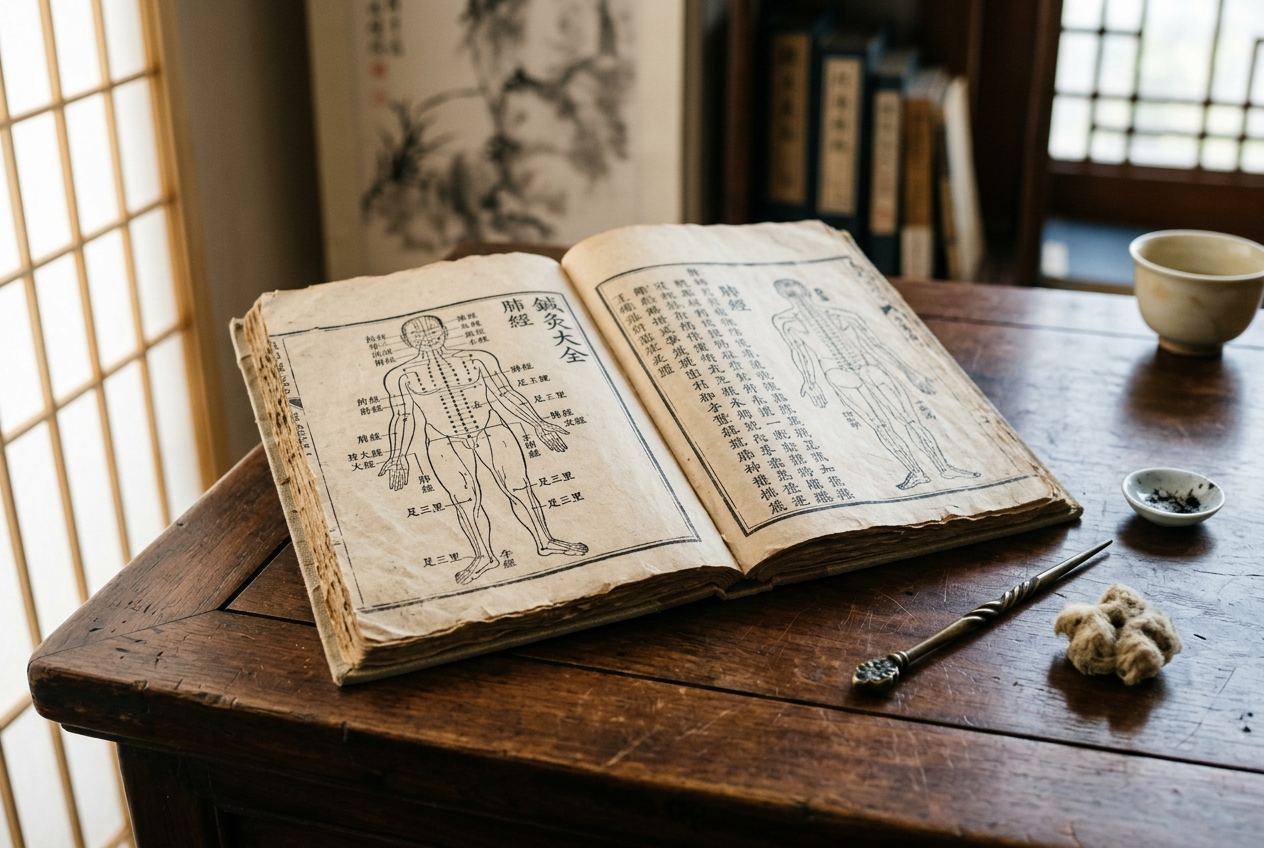
By synthesizing the hidden intersections of the human vascular and fascial networks, Ming Dynasty physician Xu Feng created a clinical roadmap that modern mechanobiology and neurocardiology are only now beginning to explain.
1. Opening — A Problem This Solves Today
Consider a pattern of distress that has become almost universal in contemporary life: you sit at a desk under artificial lighting, shoulder muscles locked in sustained isometric contraction, while an incessant stream of digital alerts maintains your central nervous system in a state of low-grade, unrelenting alarm. By late afternoon, a subtle constriction grips the throat—a sensation traditional clinicians termed plum-pit qi (mei he qi) and modern medicine classifies as globus pharyngeus. Simultaneously, your breathing turns shallow, confined entirely to the upper ribcage; the epigastrium feels tight, bloated, and unresponsive to digestion; and as evening falls, a tired-yet-wired insomnia sets in, punctuated by sudden nocturnal palpitations.
When presented to modern primary care, these symptoms are frequently fragmented across multiple specialties: gastroenterology for the functional dyspepsia, pulmonology or otorhinolaryngology for the throat tightness and dyspnea, and psychiatry for the sympathetic hyperarousal. Yet in the living organism, these are not isolated dysfunctions of discreet organs. They represent a systemic, longitudinal failure of autonomic regulation and myofascial tension distribution.
+-----------------------------------------------------------------------------------+
| CLINICAL PROFILE: THE MODERN AUTONOMIC-VISCERAL CONVERGENCE                       |
+-----------------------------------------------------------------------------------+
| Primary Manifestations : Thoracic constriction, globus sensation, epigastric      |
|                          fullness, sleep-onset insomnia, tachyarrhythmic spikes.  |
| Underlying Dysfunction : Sympathetic hyperactivity coupled with interstitial and  |
|                          fascial shear strain along the anterior kinetic chain.   |
| Classical Diagnosis   : Disharmony of the Conception (Ren) and Thoroughfare       |
|                          (Chong) Vessels with constrained Heart-Spleen Qi.        |
+-----------------------------------------------------------------------------------+
More than five centuries ago, a Chinese scholar-physician named Xu Feng (徐凤) recognized that the human body possesses systemic bypass channels capable of resolving these exact constellation patterns in a single, coordinated intervention. Published in 1439 during the zenith of the Ming Dynasty, his magnum opus, Zhen Jiu Da Quan (针灸大全, Complete Collection of Acupuncture and Moxibustion), codified a mathematical and clinical framework that bridges the twelve standard organ meridians with the deep, embryological reservoirs known as the Eight Extraordinary Meridians (Qi Jing Ba Mai).
Rather than treating a headache as a cranial event or nausea as a stomach malfunction, Xu Feng established that by stimulating specific, paired regulatory nodes—the Eight Confluent Points (Ba Mai Ba Xue)—a practitioner can modulate entire dimensional planes of the human body. Today, as contemporary researchers map the piezoelectric properties of the interstitial collagen matrix, Xu Feng’s classical treatise emerges not as mystical dogma, but as an extraordinarily sophisticated manual of bio-tensegrity, neurovisceral reflex arcs, and somatic downregulation.
2. The Meridian Path — A Journey Through the Living Matrix
To understand Xu Feng’s revolutionary contribution, one must first visualize the human body not as a collection of static anatomical illustrations, but as a dynamic hydraulic and electrical continuum. The twelve primary meridians resemble standard municipal rivers: they flow predictably through the superficial and muscular layers, each tethered directly to an internal organ system. However, when systemic stress, postural collapse, or metabolic exhaustion overwhelms these primary channels, the body relies on its deep floodgates and structural reservoirs: the Eight Extraordinary Vessels.
                          =================================
                          THE EXTRAORDINARY VESSEL RESERVOIR
                          =================================

Primary Meridians                   Extraordinary Vessels
             (12 Organ Channels)                 (8 Deep Basins / Reservoirs)
           +---------------------+                 +----------------------+
           |  Day-to-day energy  |  Excess Surge   |   Constitutional,    |
           |   distribution &    | --------------> |  primordial reserve  |
           |  metabolic exchange | <-------------- |  & structural matrix |
           +---------------------+  Depletion Draw +----------------------+
                      ^                                       ^
                      |                                       |
                      +-------------------+-------------------+
                                          |
                               [ EIGHT CONFLUENT NODES ]
                             Codified by Xu Feng (1439)
Unlike the primary meridians, the extraordinary vessels do not possess their own dedicated sequences of superficial points (with the exception of the midline Ren and Du vessels). Instead, they traverse the deepest fascial planes of the body, governing embryological development, core structural stability, and autonomic equilibrium:
- The Conception Vessel (Ren Mai): Originating deep within the pelvic floor, it ascends along the exact anterior midline of the body, passing through the pubic symphysis, navel, solar plexus, throat, and terminating at the depression below the lower lip. It governs all Yin structures, the parasympathetic rest-and-digest response, and the anterior fascial kinetic chain.
- The Yin Heel Vessel (Yin Qiao Mai): Rising from the medial calcaneus behind the inner ankle bone, it tracks up the innermost seam of the leg, crosses the groin, ascends through the deep abdomen and chest into the neck, and terminates at the inner corner of the eye. It dictates lower-limb muscular tone, medial postural balance, and the circadian transition from alertness into sleep.
- The Thoroughfare Vessel (Chong Mai): Known as the "Sea of Blood and Twelve Channels," it surges upward from the pelvic cavity, dispersing across the deep visceral organs of the abdomen, wrapping around the stomach and diaphragm, traversing the heart and throat, and radiating to the face. It acts as the central vascular and visceral shock absorber of the core.
- The Yin Linking Vessel (Yin Wei Mai): Weaving through the lateral and medial muscular boundaries of the lower leg, ascending the inner thigh, anchoring into the lateral abdominal wall, sweeping through the ribs, and converging at the throat, this vessel links all Yin channels together to stabilize emotional processing, mediastinal expansion, and heart-rate variability.
Xu Feng’s Synthesis and the Jin Zhen Fu
Before Xu Feng compiled the Zhen Jiu Da Quan in 1439, the practical application of these vessels was fragmented across disparate lineages, notably influenced by Jin-Yuan masters such as Dou Hanqing. Xu Feng performed an invaluable service to medical history by systematizing these teachings into structured, mnemonically accessible verse.
His seminal poem, the Jin Zhen Fu (金针赋, Ode of the Gold Needle), along with the Ba Mai Ba Xue Ba Fa Ge (Song of the Eight Methods of the Eight Confluent Points), transformed abstract cosmological concepts into operational clinical algorithms. Xu Feng established that each extraordinary vessel has a precise master communication node—an acupuncture point located on the distal extremities below the elbows or knees—that directly accesses and commands the reservoir of that vessel:
+----------------------------------------------------------------------------------------------------+
| XU FENG'S EIGHT CONFLUENT POINT MATRIX (BA MAI BA XUE)                                             |
+----------------------+--------------------+-----------------------+--------------------------------+
| Confluent Node       | Primary Meridian   | Extraordinary Vessel  | Anatomical / Clinical Domain   |
+----------------------+--------------------+-----------------------+--------------------------------+
| LU7 (Lieque)         | Lung Channel       | Ren Mai (Conception)  | Chest, throat, lungs, diaphragm|
| KI6 (Zhaohai)        | Kidney Channel     | Yin Qiao Mai (Heel)   | Throat, inner eyes, pelvic base|
| SP4 (Gongsun)        | Spleen Channel     | Chong Mai (Thorough.) | Epigastrium, stomach, heart    |
| PC6 (Neiguan)        | Pericardium        | Yin Wei Mai (Linking) | Mediastinum, chest, solar plex.|
| SI3 (Houxi)          | Small Intestine    | Du Mai (Governing)    | Spine, neck, occiput, brain    |
| BL62 (Shenmai)       | Bladder Channel    | Yang Qiao Mai (Heel)  | Lateral leg, back, eyes        |
| GB41 (Zulinqi)       | Gallbladder        | Dai Mai (Girdling)    | Hypochondrium, waist, pelvis   |
| TE5 (Waiguan)        | Triple Energizer   | Yang Wei Mai (Linking)| Lateral neck, temples, ears    |
+----------------------+--------------------+-----------------------+--------------------------------+
Crucially, Xu Feng did not merely catalog these points; he codified their master-couple synergies (Zhu-Ke pairing). He recognized that stimulating an upper-body point on an arm meridian in tandem with a lower-body point on a leg meridian creates a closed bio-electrical and fascial loop.
From the perspective of modern biophysics, these distal confluent points sit at sites of dense fascial convergence where planes of epimysial, perimysial, and neurovascular sheaths intersect. When mechanical force is applied at these sites, the resulting deformation of collagen bundles triggers fascial mechanotransduction, propagating electrical signals via interstitial fluid channels and resetting autonomic tone via the somatic-visceral reflex arc.
3. Key Points You Can Palpate and Press Right Now
To directly experience the clinical reality codified in the Zhen Jiu Da Quan, one does not require needles. Non-invasive, focused manual compression (acupressure) generates sufficient piezoelectric deformation and neural activation to elicit the characteristic de qi (得气) sensation—a neuro-fascial signaling event characterized by a dull, spreading ache, subtle warmth, or a localized feeling of pressure release.
Below are the four foundational Yin confluent points that constitute Xu Feng’s most celebrated therapeutic pairings, localized according to standard anatomical landmarks defined by the World Health Organization Standard Acupuncture Point Locations.
          LU7 (Lieque)                                PC6 (Neiguan)
     Proximal to Styloid Process                 Between Tendons of Forearm
         [ 1.5 Cun Above Crease ]                    [ 2 Cun Above Crease ]
               \                                         /
                \                                       /
                 +=====================================+
                 |            ANTERIOR FOREARM         |
                 +=====================================+
                                    |
                                    | (Axial Kinetic Chain)
                                    v
                 +=====================================+
                 |               LOWER EXTREMITY       |
                 +=====================================+
                /                                       \
               /                                         \
        SP4 (Gongsun)                               KI6 (Zhaohai)
   Base of 1st Metatarsal Bone                  Inferior to Medial Malleolus
Node 1: LU7 (Lieque — Broken Sequence)
Master Point of the Conception Vessel (Ren Mai)
+------------------------------------------------------------------------------------+
| PALPATION & MECHANOTRANSDUCTION: LU7 (LIEQUE)                                      |
+------------------------------------------------------------------------------------+
| Landmark Target : Radial styloid process, proximal forearm.                        |
| Classical Method: Interlock thumbs; index finger rests directly over the point.    |
| Tissue Texture  : A distinct V-shaped bony groove between the tendons of           |
|                   brachioradialis and abductor pollicis longus.                    |
| De Qi Sensation : Dull, spreading ache radiating into the thumb or up the forearm. |
+------------------------------------------------------------------------------------+
- Location via Natural Landmarks: Extend your hand as if shaking someone’s hand. Interlock the web spaces of your thumbs and index fingers. Your opposite index finger will come to rest on the outer edge of your forearm bone, just above your wrist. Beneath the tip of your finger, you will feel a prominent bony projection (the radial styloid process). Slide your finger just off the peak of this bone toward your elbow; you will drop into a subtle, tender notch between two distinct tendons. This is LU7.
- Tactile and Palpatory Cues: Upon palpation, the tissue will feel slightly denser and more fibrotic than surrounding areas. When accurate pressure is applied, you will not feel a sharp skin prick, but rather a deep, radiating ache that frequently travels down to the base of the thumb or upward toward the inner elbow.
- Manual Application: Apply firm pressure using the thumb tip directed obliquely toward the elbow at a 45-degree angle against the bone. Maintain continuous, steady pressure for 90 to 120 seconds while maintaining diaphragmatic breathing.
- Daily Indications: Relieves tension headaches at the back of the skull and neck, releases acute throat constriction, eases shallow breathing or asthma, and disperses tension across the anterior chest wall.
Node 2: KI6 (Zhaohai — Shining Sea)
Master Point of the Yin Heel Vessel (Yin Qiao Mai) / Coupled with LU7
+------------------------------------------------------------------------------------+
| PALPATION & MECHANOTRANSDUCTION: KI6 (ZHAOHAI)                                     |
+------------------------------------------------------------------------------------+
| Landmark Target : Medial aspect of the foot, below the inner ankle bone.          |
| Structural Site : Direct depression located 1 body-inch below the malleolar apex.  |
| Tissue Texture  : Soft, spongy cleft bounded by the flexor retinaculum.            |
| De Qi Sensation : Localized heavy fullness, warm spreading sensation into throat.  |
+------------------------------------------------------------------------------------+
- Location via Natural Landmarks: Sit comfortably with one ankle crossed over your opposite knee. Locate the prominent, rounded bone on the inside of your ankle (the medial malleolus). Slide your thumb directly downward about one thumb-width into the soft hollow immediately below the lower border of this bone. As you flex and point your foot slightly, you will feel a clear, well-defined anatomical cup or depression. This is KI6.
- Tactile and Palpatory Cues: The area is rich in neurovascular structures and the flexor retinaculum. The target site presents as a spongy indentation that feels noticeably sensitive or tender to moderate pressure compared to adjacent bone. The sensation often manifests as a spreading wave of warmth or mild numbness radiating into the sole of the foot or ascending the inner calf.
- Manual Application: Press perpendicularly into the hollow using your thumb tip or knuckle, directing the force vector slightly upward toward the center of the ankle joint. Hold with medium-firm pressure for 2 minutes.
- Daily Indications: Counteracts chronic dry throat and nighttime thirst, reduces sleep-onset insomnia, calms pelvic floor tension, and alleviates inner-ankle soreness resulting from prolonged standing.
Node 3: PC6 (Neiguan — Inner Pass)
Master Point of the Yin Linking Vessel (Yin Wei Mai)
+------------------------------------------------------------------------------------+
| PALPATION & MECHANOTRANSDUCTION: PC6 (NEIGUAN)                                     |
+------------------------------------------------------------------------------------+
| Landmark Target : Anterior forearm, 2 cun proximal to wrist crease.               |
| Structural Site : Channel between flexor carpi radialis & palmaris longus tendons. |
| Tissue Texture  : Deep, resilient fascial trench overlying median nerve sheath.    |
| De Qi Sensation : Intense distending ache (*suan zhang*) tracking to solar plexus. |
+------------------------------------------------------------------------------------+
- Location via Natural Landmarks: Turn your palm upward. Lay the three middle fingers of your opposite hand across your wrist crease; the distance of these three fingers marks the precise anatomical height of PC6 (2 proportional cun). The point lies directly on the midline of the inner forearm, centered precisely in the canyon between the two prominent, cord-like tendons that stand out when you make a fist and curl your wrist upward.
- Tactile and Palpatory Cues: Gently shifting your finger across this tendon groove reveals a taut fascial band overlying the deep median nerve pathway. When the point is precisely engaged, a profound, distending ache (suan zhang) is immediately felt, frequently sending a soothing, electric branch through the palm or traveling up the inside of the bicep into the chest.
- Manual Application: Apply deep, steady vertical pressure with the thumb. Slowly incorporate minute circular rotations (1–2 mm oscillations) without sliding across the surface of the skin. Continue for 2 to 3 minutes.
- Daily Indications: Rapidly suppresses motion sickness, nausea, and gastrointestinal reflux; alleviates emotional panic and palpitations; downregulates acute stress responses; and expands chest tightness caused by postural slouching.
Node 4: SP4 (Gongsun — Grandfather-Grandson)
Master Point of the Thoroughfare Vessel (Chong Mai) / Coupled with PC6
+------------------------------------------------------------------------------------+
| PALPATION & MECHANOTRANSDUCTION: SP4 (GONGSUN)                                     |
+------------------------------------------------------------------------------------+
| Landmark Target : Medial foot arch, base of the first metatarsal bone.             |
| Structural Site : Junction where the red and white skin meet on the inner foot.    |
| Tissue Texture  : Subtle bony flare and tender fascial pocket on plantar margin.    |
| De Qi Sensation : Deep aching sensation radiating along the medial arch and tibia. |
+------------------------------------------------------------------------------------+
- Location via Natural Landmarks: Run your thumb along the inner side of your foot, starting from the base of your big toe and tracing backward along the bone toward your heel. You will pass the large, rounded knuckle of the big toe joint; continue sliding along the shaft of the bone until you feel your thumb hit a distinct flare or bump at the base of the bone, where it meets the midfoot arch. In the depression immediately behind and below this bony ridge, right at the border where the darker skin of the top of the foot meets the paler skin of the sole, lies SP4.
- Tactile and Palpatory Cues: This junction between the abductor hallucis muscle and the tarsal bones is exceptionally responsive. It feels like a distinct, tender pocket in the connective tissue. When engaged, a deep, resonant ache will spread through the arch of the foot and can often be felt ascending the inner shin along the deep fascia.
- Manual Application: Use your thumb or the knuckle of your index finger to press inward and slightly upward against the inferior margin of the foot bone. Maintain a sustained, rhythmic compression for 2 minutes.
- Daily Indications: Resolves post-meal stomach bloating, relieves acute menstrual cramps, balances irregular appetite, and calms churning or unsettled digestive sensations related to stress.
4. A Point Combination for One Common Issue
The "Overstimulated and Depleted" Protocol: Resetting the Core Axis
When prolonged occupational stress combines with poor posture, the body commonly locks into a state of Sympathetic Dominance with Thoraco-Abdominal Stagnation. The clinical presentation includes shallow clavicular breathing, tension in the epigastrium and solar plexus, a racing mind, and an inability to fall asleep.
To resolve this multi-system pattern, we employ the classical Master-Couple Cross-Body Sequence derived from Xu Feng’s Zhen Jiu Da Quan, pairing SP4 + PC6 (to unlock the diaphragm, stomach, and mediastinum) with LU7 + KI6 (to clear the throat, open the respiratory tree, and anchor parasympathetic tone).
======================================================================================
     THE EVENING AUTONOMIC RESET PROTOCOL (10-MINUTE CLINICAL SEQUENCE)
======================================================================================

[ PHASE 1: PREPARATION & POSITIONING ]
     Lie supine or semi-reclined. Bolster under knees. Begin 4-7-8 respiration.
                                  |
                                  v
     [ PHASE 2: VISCERO-VASCULAR UNLOCKING (SP4 & PC6) ]
     Press Right SP4 (2 min) -------> Press Left PC6 (2 min)
     (Opens Chong Mai / Stomach)      (Opens Yin Wei Mai / Cardiac & Mediastinal Core)
                                  |
                                  v
     [ PHASE 3: RESPIRATORY-PARASYMPATHETIC CONDUCTION (LU7 & KI6) ]
     Press Left LU7 (2 min) --------> Press Right KI6 (2 min)
     (Opens Ren Mai / Thorax)         (Opens Yin Qiao Mai / Lower Calcaneal Anchor)
                                  |
                                  v
     [ PHASE 4: CONVERGENCE & REST ]
     Place palms over lower abdomen. 2 minutes of silent integration.
======================================================================================
Step-by-Step Implementation
- Posture and Environment: Perform this protocol immediately before sleep or upon concluding a high-stress workday. Lie flat on your back on a supportive surface with a small pillow under your head and a bolster under your knees to relax the abdominal wall. Dim the ambient lighting.
- Step 1: Open the Mid-Core and Viscera (Right SP4)
- Locate SP4 on the inner arch of your Right Foot.
- Apply firm, steady pressure with your right thumb or opposite heel.
- Hold for 2 minutes, maintaining slow, unforced nasal breathing.
- Mechanism: Engages the Thoroughfare Vessel (Chong Mai), releasing spasm in the mesenteric vessels and easing pressure across the solar plexus.
- Step 2: Unbind the Mediastinum and Heart (Left PC6)
- Locate PC6 on the inner side of your Left Forearm.
- Press straight down into the space between the two tendons using your right thumb.
- Hold with a firm, pulsing pressure (pressing slightly deeper on your exhalations) for 2 minutes.
- Mechanism: Closes the circuit with the Yin Linking Vessel (Yin Wei Mai), promoting autonomic regulation and heart-rate variability.
- Step 3: Clear the Throat and Expand the Ribcage (Left LU7)
- Locate LU7 on your Left Wrist.
- Press the notch above the bony ridge using your right index finger or thumb, directing the angle toward your elbow.
- Hold for 2 minutes, consciously visualizing your breath descending deeply past your throat into your pelvis.
- Mechanism: Activates the Conception Vessel (Ren Mai), relaxing the scalene and intercostal musculature.
- Step 4: Anchor the Rest-and-Digest State (Right KI6)
- Locate KI6 directly below the inner ankle bone of your Right Foot.
- Press firmly inward and slightly upward for 2 minutes.
- Mechanism: Couples with the Yin Heel Vessel (Yin Qiao Mai), signaling the central nervous system to shift from adrenergic vigilance to restorative delta-wave sleep readiness.
- Step 5: Somatic Integration (2 Minutes)
- Release all manual pressure. Place both palms flat over your lower abdomen (two inches below the navel).
- Take five deep, diaphragmatic breaths, noticing the sensations of warmth and space in your throat, chest, and stomach.
5. Safety, Sense, and Clinical Discernment
Acupressure is an inherently safe, non-invasive intervention, but it relies on mechanical force to stimulate complex neurovascular structures. Proper practice requires precise clinical judgment, anatomical awareness, and an understanding of physical boundaries.
+-----------------------------------------------------------------------------------+
| CLINICAL CAUTION: PREGNANCY CONTRAINDICATIONS                                      |
+-----------------------------------------------------------------------------------+
| * STRICTLY AVOID heavy downward stimulation of points such as SP6 (Sanyinjiao),   |
|   LI4 (Hegu), BL60 (Kunlun), and GB21 (Jianjing) during pregnancy, as these are   |
|   classically and clinically documented to promote uterine motility.              |
| * When working with the Eight Confluent Points in pregnant individuals, maintain  |
|   gentle, non-dynamic touch, and avoid the lower abdomen and lumbosacral regions. |
+-----------------------------------------------------------------------------------+
The Sensation Gradient: De Qi versus Noxious Trauma
It is essential to understand the difference between therapeutic stimulation and tissue damage:
- Therapeutic De Qi: Characterized by a heavy, dull, spreading ache, a sense of muscular release, a warm glow, or mild localized soreness. This indicates appropriate engagement with the fascial plane and mechanoreceptors.
- Tissue Trauma / Nerve Impingement: Sharp, piercing, lancinating pain, burning sensations, or sudden numbness traveling aggressively down an extremity. If you encounter this, you are compressing a superficial nerve trunk or bruising local capillaries. Immediately reduce pressure or adjust your finger position by several millimeters.
======================================================================================
                         PRESSURE SENSATION SPECTRUM
======================================================================================
[ 1 - 3: Superficial Touch ]   -> Ineffective for deep fascial mechanotransduction.
[ 4 - 7: Therapeutic De Qi ]   -> Deep, dull ache, heavy, spreading warmth. (OPTIMAL)
[ 8 - 10: Noxious Nerve Pain ] -> Sharp, electric, pinching, burning. (CEASE IMMEDIATELY)
======================================================================================
When to Seek Immediate Medical Attention
Acupressure is designed to regulate functional, stress-mediated, and musculoskeletal imbalances; it is not a substitute for emergency biomedical care. You must seek prompt, professional medical evaluation if you experience: * Crushing chest pressure, pain radiating down the left jaw or arm, or unexplained acute shortness of breath. * Sudden, severe abdominal pain that is rigid to the touch (peritoneal signs). * Progressive neurological deficits, such as sudden limb weakness, facial drooping, or loss of bowel/bladder control. * Chronic, unexplained weight loss, night sweats, or intractable fever.
For chronic, complex systemic conditions, self-administered acupressure should serve as a daily home-care adjunct to treatment from a licensed acupuncturist (L.Ac. / Dipl. Ac.) and your primary medical provider.
6. Today’s Takeaway: The 2-Minute Vagal Reset
If you have only two minutes right now before closing this page, perform this single, highly concentrated intervention to interrupt sympathetic fight-or-flight arousal and reset your breathing.
+------------------------------------------------------------------------------------+
| 2-MINUTE VAGAL DOWN-REGULATION EXERCISE                                            |
+------------------------------------------------------------------------------------+
| Point     : PC6 (Neiguan — Inner Pass).                                            |
| Location  : 3 finger-widths above the inner wrist crease, between the two tendons. |
| Duration  : 60 seconds per arm.                                                    |
| Breathwork: Inhale through nose for 4 counts, exhale through mouth for 7 counts.   |
+------------------------------------------------------------------------------------+
          [ INHALE: 4 Seconds ]               [ EXHALE: 7 Seconds ]
        Diaphragm lowers smoothly           Firm vertical thumb pressure
         Palmaris Longus Tendon            Flexor Carpi Radialis Tendon
                 \                              /
                  \                            /
                   +--------------------------+
                   |    PC6 NEURO-FASCIAL     |
                   |      PRESSURE POINT      |
                   +--------------------------+
- Place: Lay your right thumb into the center of your left inner forearm, two thumb-widths up from the wrist crease, directly between the two central tendons.
- Press: Apply firm, steady vertical pressure until you feel a distinct, heavy, dull ache spread into your palm and inner arm.
- Breathe: Close your eyes. Inhale quietly through your nose for a count of 4, allowing your belly to expand. Then, smoothly and completely exhale through slightly parted lips for a count of 7.
- Repeat: Complete 5 of these extended breath cycles while holding steady pressure on the left arm (approx. 60 seconds). Switch and repeat on the right arm for 60 seconds.
Within two minutes, you will notice a release of tension in your throat, a drop in resting heart rate, a softening of the abdominal wall, and a return to physiological clarity—a direct clinical inheritance passed down across 580 years from Master Xu Feng's timeless cartography of the human body.
Authoritative References & Further Reading
- World Health Organization Standard Acupuncture Point Locations in the Western Pacific Region
- Langevin HM, et al. Connective Tissue Fibroblast Response to Acupuncture. NCBI PMC / Anat Rec
- Wikipedia: Extraordinary Meridians in Traditional Chinese Medicine
- National Center for Biotechnology Information: Autonomic Nervous System Regulation and Acupressure
- Wikipedia: Classical Acupuncture Point System and Nodal Anatomy
- NCBI: Neurobiological Mechanisms of Classical Meridian Acupoint Stimulation