Zhen Jiu Da Cheng: Navigating Yang Jizhou's Encyclopedic Channel Synthesis, Classical Point Formulations, and Precision Acupressure Protocols
1. OPENING — THE SOMATIC BURDEN OF MODERN DYSREGULATION
Consider a physical state that has become the unspoken baseline of modern existence: you finish a rushed meal at your desk, and within twenty minutes, an uncomfortable distension tightens your epigastrium. Your shoulders have crept upward toward your ears, locked in a chronic, low-grade defensive posture. Simultaneously, a diffuse, throbbing tension begins to radiate across your temples, accompanied by a subtle cognitive haze and a persistent, low-humming anxiety regarding pending deadlines. You are not suffering from an acute structural pathology, yet your physiology is unmistakably dysregulated. The autonomic nervous system is caught in a sympathetic loop; gastrointestinal motility has stalled; and peripheral fascial sheets have contracted into ischemic knots.
To modern biomedicine, these symptoms are often fractured across disparate clinical specialties: gastroenterology for the post-prandial bloating, neurology for the tension cephalea, and psychiatry or endocrinology for the chronic stress response. Yet, more than four centuries ago, an imperial physician working in the waning decades of the Ming Dynasty recognized that these ostensibly fragmented complaints were expressions of an interconnected somatic highway.
+-----------------------------------------------------------------------------------+
|                           THE PROTOCOL AT A GLANCE                                |
| Historical Anchor: Zhen Jiu Da Cheng (针灸大成), Compiled by Yang Jizhou (1601 CE) |
| Biophysical Paradigm: Interstitial Mechanotransduction & Neurovascular Reflex Arcs  |
| Key Master Loci: ST36 (Zusanli), LV3 (Taichong), LI4 (Hegu), SP6 (Sanyinjiao),    |
|                  PC6 (Neiguan)                                                    |
| Primary Somatic Target: Sympathetic-Vagal Recalibration & Myofascial Unwinding     |
+-----------------------------------------------------------------------------------+
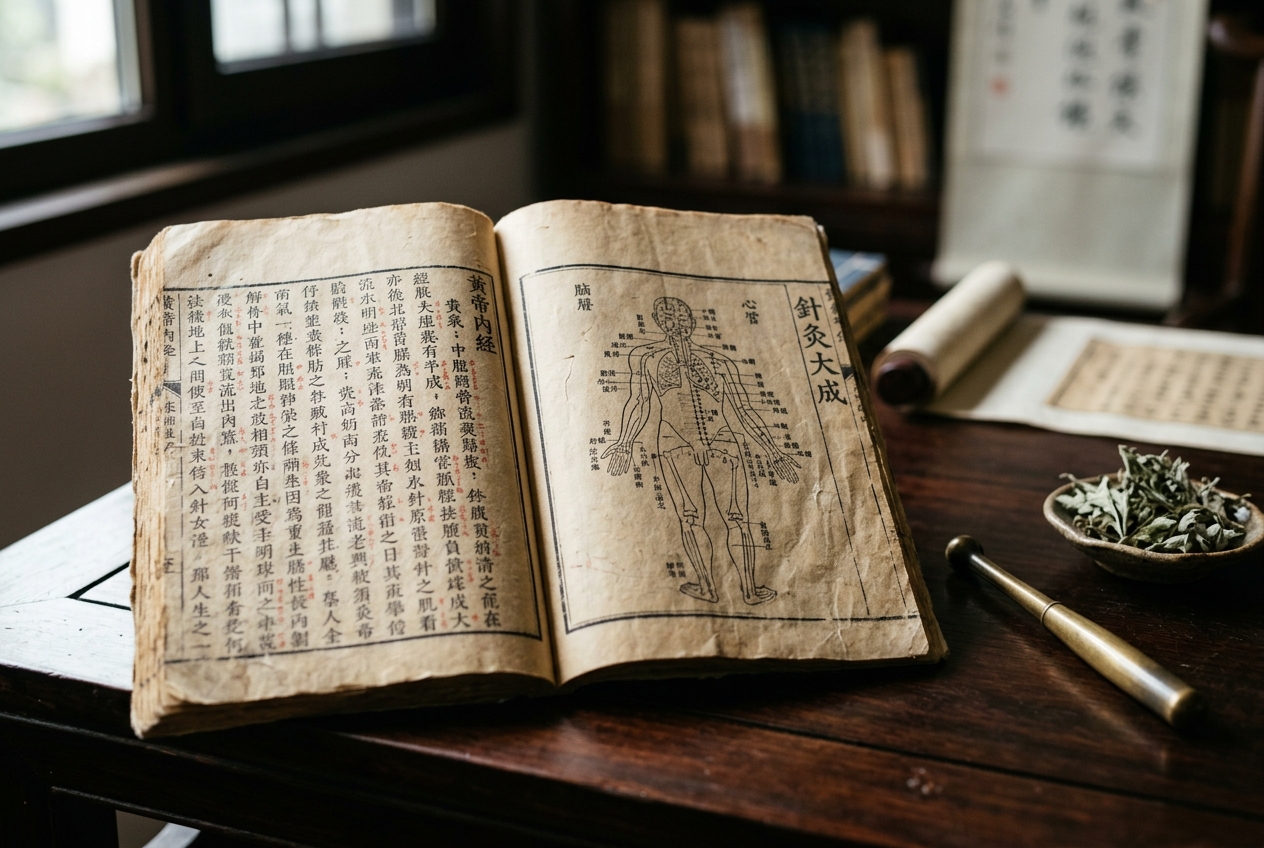
In 1601, Yang Jizhou published his magnum opus, Zhen Jiu Da Cheng (The Great Compendium of Acupuncture and Moxibustion). This ten-volume imperial compendium did not invent Chinese channel theory from a vacuum; rather, it represented the grandest encyclopedic synthesis of classical medicine ever undertaken in East Asia. Yang Jizhou systematically aggregated, critiqued, and codified two millennia of empirical clinical observation, reconciling foundational doctrines from the Han Dynasty Huangdi Neijing (The Yellow Emperor's Inner Classic) and the Nan Jing (Classic of Difficult Issues) with the esoteric lineage odes, bronze statue cartographies (Tongren Shuxue Zhenjiu Tujing), and clinical case records of the Song, Jin, and Yuan dynasties.
Yang's insight was as radical then as it is now: the human soma is governed by an integrated network of fourteen principal channels (Jing-Luo) along which specific nodes—acupoints (Shu-Xue)—act as bio-mechanical and bio-electrical gateways. When the system is constrained by emotional distress, dietary irregularity, or postural stasis, manual stimulation along these pathways can release somatic stagnation, down-regulate systemic inflammation, and restore visceral homeostasis.
2. THE MERIDIAN PATH — A PHYSIOLOGICAL AND FASCIAL ODYSSEY THROUGH THE FOURTEEN CHANNELS
To understand the practical brilliance of Yang Jizhou’s cartography, one must abandon the misconception that meridians are mystical, invisible conduits. When translated into contemporary biophysical and anatomical concepts, the fourteen channels documented in the Zhen Jiu Da Cheng correspond with striking fidelity to planes of cleavage within the deep fascia, major neurovascular bundles, and lines of continuous myofascial transmission.
========================================================================================
             THE THREE-DIMENSIONAL CONTINUUM OF THE FOURTEEN CHANNELS
========================================================================================

ANTERIOR / YIN AXIS                LATERAL / AXIS                POSTERIOR / YANG AXIS
 (Visceral & Calming)             (Pivoting & Motor)             (Defensive & Postural)
         |                                |                                |
 [Ren Mai & Spleen/Lung]          [Gallbladder & Sanjiao]          [Du Mai & Bladder]
         |                                |                                |
 Ventral Visceral Organs           Lateral Myofascial Seams        Paraspinal Neural Chain
 Deep Connective Fascia           Musculoskeletal Transitions      Cerebrospinal Axis
         v                                v                                v
 PARASYMPATHETIC ACTIVATION       NEUROSTRUCTURAL EQUILIBRIUM      SOMATOSENSORY CALIBRATION
========================================================================================
The meridian network comprises twelve primary bilateral conduits linked to the visceral organs (Zang-Fu) and two extraordinary midline vessels: the Ren Mai (Conception Vessel) running up the front midline of the torso, and the Du Mai (Governor Vessel) ascending the posterior midline over the spine and cranium.
Rather than relying on abstract coordinates, Yang’s text maps these pathways using tangible, somatic geography that anyone can trace along their own living anatomy:
- The Anterior Digestive Highway (The Stomach & Spleen Channels): Beginning just below the eye socket, this channel descends across the jawline, travels down through the chest and the muscular sheath of the rectus abdominis, plunges through the groin crease, and sweeps down the outer-front edge of your thigh. It traverses the prominent muscular ridge on the front-outside of your shinbone—the precise muscular compartment that aches when walking uphill or standing for hours—before terminating at the lateral tip of the second toe. Internally, this tract governs the mechanical breakdown of food, metabolic assimilation, and the distribution of cellular energy.
- The Medial Emotional Reservoir (The Liver & Spleen Channels): Originating at the dorsal aspect of the great toe, this pathway hugs the inner arch of the foot, ascends past the prominent bony knob on the inside of the ankle, and continues up the soft, tender inner surface of the calf and thigh. This is the anatomical territory of the deep fascia enveloping the adductor muscles and the saphenous nerve—a region notoriously reactive to chronic emotional frustration, pelvic congestion, and hormonal shifts.
- The Lateral Pivot and Sensory Shield (The Gallbladder & Large Intestine Channels): Sweeping across the temples, over the crest of the trapezius muscle across the shoulder, and down the muscular crest of the outer arm and forearm, this pathway bridges the neck, shoulder girdle, and the fleshy webbing between the thumb and index finger. It acts as the body's primary somatic shock absorber against environmental stress and mechanical strain.
Recent research published in biomedical literature demonstrates that acupoints possess a significantly higher density of unmyelinated free nerve endings, TRPV1 thermal receptors, and mast cells embedded in loose connective tissue matrices than non-point tissue. According to studies indexed in the NCBI PubMed database on the fascial interstitium and meridians, manual stimulation of these nodes initiates a mechanical wave through the collagenous extracellular matrix—a phenomenon known as mechanotransduction. This physical deformation induces local adenosine release, stimulates nitric oxide synthesis, and transmits somatosensory signals through the dorsal horn of the spinal cord directly to the limbic and autonomic control centers of the brainstem.
3. MASTER ACUPOINTS OF THE GREAT COMPENDIUM: ANATOMY, SENSATION, AND TRANSLATIONAL SCIENCE
In Volumes 6 and 7 of the Zhen Jiu Da Cheng, Yang Jizhou provides painstaking descriptions of point locations, needle depths, and therapeutic actions. For the non-invasive practitioner, five points emerge across his formulas as foundational master switches capable of systemic somatic regulation.
+----------------------------------------------------------------------------------------------------------+
|                                    MASTER ACUPOINT MATRIX (1601 CE)                                      |
+-----------+----------------------+-----------------------------+-----------------------------------------+
| Acupoint  | Classical Name       | Somatosensory Action        | Neurofascial Correlate                  |
+-----------+----------------------+-----------------------------+-----------------------------------------+
| ST36      | Zusanli (足三里)     | Tonifies Qi, Harmonizes Gut | Deep Peroneal Nerve / Tibialis Anterior |
| LV3       | Taichong (太冲)      | Unbinds Constrained Qi      | Medial Branch of Deep Peroneal Nerve    |
| LI4       | Hegu (合谷)          | Dispels Wind, Clears Pain   | First Dorsal Interosseous Muscle        |
| SP6       | Sanyinjiao (三阴交)  | Nourishes Blood & Yin       | Posterior Tibial Nerve / Medial Fascia  |
| PC6       | Neiguan (内关)       | Calms Shen, Regulates Heart | Median Nerve between Flexor Tendons     |
+-----------+----------------------+-----------------------------+-----------------------------------------+
I. Zusanli (ST36) – "Leg Three Miles"
- The Bodily Landmark: Locate the bottom edge of your kneecap while seated with your knee bent at a right angle. Place four fingers horizontally across your shinbone, starting just beneath the kneecap. Move your finger approximately one finger-width outward toward the muscular ridge on the lateral side of your shin. You will fall into a distinct, cup-like depression within the belly of the tibialis anterior muscle.
- The Living Sensation (Deqi): When properly engaged, ST36 yields a rich, deep, dull ache that often sends a subtle, warming tingle down the anterior compartment of the lower leg toward the second and third toes.
- Depth-Stratified Technique: Apply firm, perpendicular, cyclical pressure using the pad of the thumb or a reinforced knuckle. Depress past the superficial skin layer (0–5mm), through the investing deep fascia (5–12mm), until you encounter the firm resistance of the muscle body near the interosseous membrane. Maintain steady, rhythmic, clockwise circular kneading for 2 to 3 minutes per limb.
- Clinical Indications: Documented by the World Health Organization Standard Acupuncture Point Locations, ST36 is the supreme metabolic and homeostatic point. It addresses chronic physical exhaustion, post-prandial bloating, epigastric distress, and, via vagal efferent modulation, down-regulates systemic pro-inflammatory cytokines, as evidenced by NCBI PubMed research on autonomic modulation.
                      ANATOMICAL LOCATION: ST36 (ZUSANLI)
      Patella (Kneecap)
         [======]
            ||
            ||  <-- 4 finger-widths down from lower border of kneecap
            ||
    Tibial  ||  [ ST36 ]  <-- 1 finger-width lateral to the tibial crest
    Crest   ||  (Tender depression in tibialis anterior muscle belly)
    (Shin)  ||
            ||
            ||
            \/ Down toward ankle
II. Taichong (LV3) – "Great Surge"
- The Bodily Landmark: Look down at the top of your bare foot. Find the webbing between your great toe and your second toe. Slide your index finger backward along the valley between the two long metatarsal bones toward your ankle joint. Approximately two thumb-widths up from the webbing, your finger will drop into a tender, triangular hollow just before the junction of the two bones.
- The Living Sensation (Deqi): Exceptionally sensitive in individuals enduring high psychological stress; elicits a sharp, spreading, bruised sensation that rapidly transforms into a release of vascular tension across the dorsum of the foot.
- Depth-Stratified Technique: Use the tip of your thumb angled slightly toward the head of the metatarsal bone. Apply moderate, sustained, stationary pressure for 90 to 120 seconds per side while taking deep, diaphragmatic breaths.
- Clinical Indications: The premier point in the Zhen Jiu Da Cheng for clearing internal "Liver Wind" and emotional frustration. It alleviates temporal headaches, visual strain from computer monitors, teeth grinding (bruxism), and autonomic irritability.
                      ANATOMICAL LOCATION: LV3 (TAICHONG)
               [Great Toe]       [2nd Toe]
                     \               /
                      \  Webbing    /
                       \   (LV2)   /
                        \         /
                         |       |
                         |  LV3  | <-- Valley between 1st & 2nd metatarsal bones
                         |   (*) |     (Depression ~2 thumb-widths above web)
                         |       |
                        /         \
                 [Bony Junction of Metatarsals]
III. Hegu (LI4) – "Joining Valley"
- The Bodily Landmark: Bring your thumb and index finger flush together. Observe the muscular mound that rises on the back of your hand at the base of the index finger. Now relax your hand. Place the thumb of your opposing hand onto the highest point of that fleshy mound. Press firmly inward, directing your force toward the bone of the index finger (the second metacarpal), rather than into the empty center of the webbing.
- The Living Sensation (Deqi): A potent, spreading, heavy distension that often radiates through the first dorsal interosseous muscle into the palm and up the radial side of the forearm.
- Depth-Stratified Technique: Direct your pressure obliquely against the radial border of the second metacarpal bone. Apply firm, pulsing pressure (1 second compress, 1 second release) for 2 minutes on each hand.
- Clinical Indications: In Yang Jizhou's text, LI4 is designated the master regulator of the head, face, and sensory orifices. Contemporary somatic medicine utilizes LI4 for tension headaches, temporomandibular joint (TMJ) dysfunction, sinus congestion, and systemic pain moderation via the central nervous system's endogenous opioid release, as supported by NCBI PubMed studies on neurobiological pain gating.
                      ANATOMICAL LOCATION: LI4 (HEGU)
                                 [ Index Finger ]
                                       |
                                       | 2nd Metacarpal Bone
                       [LI4] --------> * (Press against the bone)
                      /               / \
             [Thumb]                 /   \
                 \                  /     \
                  \______Web Space_/       \
                         \                  /
                          \________________/
                                [Wrist]
IV. Sanyinjiao (SP6) – "Three Yin Intersection"
- The Bodily Landmark: Locate the apex of the prominent bony protrusion on the inside of your ankle (the medial malleolus). Place four fingers horizontally across your lower calf, aligning your pinky finger with the tip of the ankle bone. Directly above your index finger, right behind the posterior edge of your shinbone (tibia), lies a tender, subtle groove.
- The Living Sensation (Deqi): A distinct, dull ache that can radiate up the medial aspect of the calf or downward into the sole of the foot.
- Depth-Stratified Technique: Press the flat of your thumb flat against the posterior tibial border, applying gradual, sustained pressure perpendicular to the bone. Hold for 2 minutes per leg, avoiding sharp, shearing motions.
- Clinical Indications: The point of anatomical intersection for the Spleen, Liver, and Kidney channels. Yang Jizhou highlighted SP6 for gynecological vitality, lower abdominal cramping, insomnia due to mental overwork, and fluid retention in the lower extremities.
                      ANATOMICAL LOCATION: SP6 (SANYINJIAO)
                               |  |
                  Tibia (Shin) |  | (Calf Muscle)
                               |  |
       4 finger-widths above   |  *  <-- [ SP6 ] In depression directly
       ankle bone              |  |              behind posterior tibial border
                               |  |
                               |  |
                       [ Medial Malleolus ] (Inner Ankle Bone)
                              /    \
                             / Foot \
V. Neiguan (PC6) – "Inner Gate"
- The Bodily Landmark: Turn your hand palm-up. Locate the primary flexion crease where your wrist meets your hand. Place three fingers horizontally across the inside of your wrist, starting from the wrist crease and moving toward your elbow. Directly beneath your index finger, in the exact center of the forearm between the two prominent, rope-like tendons (the flexor carpi radialis and palmaris longus), lies the point.
- The Living Sensation (Deqi): A delicate, electric, or expanding sensation that often ripples through the palm and fingers or travels up the anterior midline of the forearm.
- Depth-Stratified Technique: Using the tip of your thumb, press directly downward into the inter-tendinous space. Apply a gentle, steady, circular vibration for 2 to 3 minutes while maintaining slow, unhurried exhalations.
- Clinical Indications: Volume 9 of the Zhen Jiu Da Cheng lists PC6 as the paramount point for unbinding the chest and harmonizing the Stomach. Modern clinical trials confirm its efficacy for nausea, motion sickness, stress-induced palpitations, and nocturnal anxiety.
                      ANATOMICAL LOCATION: PC6 (NEIGUAN)
                    ===============================
                              [ PALM UP ]
                    ===============================
                    [ Primary Wrist Flexion Crease ]
                         |                 |
                         | 3 Finger-Widths |
                         |   Down Arm      |
                         |                 |
                    (Tendon)   [ PC6 ]   (Tendon)
                    Flexor        *      Palmaris
                    Carpi     (Between   Longus
                    Radialis   Tendons)
4. CLASSICAL SYNTHESIS — MASTER POINT COMBINATIONS AND SOMATOSENSORY PROTOCOLS
One of the definitive structural achievements of the Zhen Jiu Da Cheng is its formalization of syndromic point pairings. Yang Jizhou recognized that single-point stimulation produces localized reflex arcs, whereas systematic point combinations generate systemic, synergistic recalibrations across the central nervous system.
+===================================================================================+
|                     CLASSICAL DUAL-GATE INTEGRATION: SI GUAN                      |
|                                                                                   |
|      UPPER BODY / QI REGULATION              LOWER BODY / BLOOD REGULATION        |
|             LI4 (Hegu)                                LV3 (Taichong)              |
|                  \                                  /                             |
|                   \                                /                              |
|                    v                              v                               |
|        ========================================================                   |
|         NEUROLOGICAL HOMEOSTASIS & CORTICAL DESENSITIZATION                       |
|         - Clears Craniofacial & Musculoskeletal Tension                           |
|         - Restores Enteric Motility & Smooth Muscle Function                      |
|         - Dampens Hyperactive Sympathetic Tone                                    |
|        ========================================================                   |
+===================================================================================+
The "Four Gates" (Si Guan) Protocol for Systemic Neural Decompression
The most celebrated formulation in Yang's compendium is Si Guan (The Four Gates), consisting of the bilateral pairing of LI4 (Hegu) on the hands with LV3 (Taichong) on the feet.
In classical physiological terms, LI4 governs the ascending and dispersing dynamics of Qi throughout the upper extremities and cranium, while LV3 governs the descending and smoothing dynamics of Blood and Yin in the lower extremities and viscera. Together, they open the body's four physiological sluice gates.
Modern neuroimaging indicates that simultaneously stimulating upper-extremity (median/radial nerve branches) and lower-extremity (deep peroneal nerve branches) somatosensory inputs produces widespread desensitization of the limbic network, down-regulating hyperactive thalamocortical pain processing and inducing rapid vascular relaxation.
========================================================================================
     EVENING SOMATIC RESTORATION PROTOCOL: THE DIGITAL DECOMPRESSION SEQUENCE
========================================================================================
 Target Scenario: Tension headache, stiff neck, post-prandial bloating, and nocturnal
                  cognitive restlessness following prolonged screen exposure.
 Total Duration:  10 Minutes
 Posture:         Supine (lying flat on back) with knees slightly bent over a pillow.
----------------------------------------------------------------------------------------

PHASE 1: UNBINDING THE PERIPHERAL SHIELD (Minutes 0:00 – 4:00)
   1. Engage Right LI4 with Left Thumb: Apply pulsing, circular pressure directed
      against the second metacarpal bone. (2 Minutes)
   2. Switch: Engage Left LI4 with Right Thumb. (2 Minutes)
   * Somatic Marker: Spreading warmth in the palms; spontaneous dropping of the shoulders.

PHASE 2: LOWERING THE COGNITIVE CHARGE (Minutes 4:00 – 8:00)
   1. Engage Right LV3 with Right Thumb: Apply sustained, downward pressure into the
      valley between the 1st and 2nd metatarsal bones. (2 Minutes)
   2. Switch: Engage Left LV3 with Left Thumb. (2 Minutes)
   * Somatic Marker: Softening of the jawline; cessation of unconscious teeth clenching.

PHASE 3: HARMONIZING THE VISCERAL AXIS (Minutes 8:00 – 10:00)
   1. Engage PC6 on Non-Dominant Wrist: Press downward between the flexor tendons with
      a gentle circular vibration while inhaling for 4 counts and exhaling for 6 counts.
      (2 Minutes)
   * Somatic Marker: Audible borborygmus (stomach gurgling indicating return of peristalsis);
      deep, involuntary yawning.
========================================================================================
5. CLINICAL PRUDENCE — CONTRAINDICATIONS, BIOMECHANICAL THRESHOLDS, AND RED FLAGS
While non-invasive acupressure carries a remarkable safety profile compared to pharmaceutical or surgical interventions, rigorous clinical practice demands an uncompromising understanding of somatic contraindications and physiological boundaries.
+-----------------------------------------------------------------------------------+
|                        CRITICAL CLINICAL CONTRAINDICATIONS                        |
|                                                                                   |
|  [!] PREGNANCY WARNING:                                                           |
|      LI4 (Hegu) and SP6 (Sanyinjiao) are potent oxytocic points historically      |
|      indicated for inducing labor and expediting difficult delivery.              |
|      -> ABSOLUTELY CONTRAINDICATED during all trimesters of pregnancy.            |
|                                                                                   |
|  [!] VASCULAR & LOCAL TISSUE BOUNDARIES:                                          |
|      - Never apply direct pressure over acute fractures, open wounds, local       |
|        infections, or areas of active phlebitis / deep vein thrombosis (DVT).     |
|      - Avoid aggressive, deep pressure on the carotid triangle or directly over   |
|        pulsating aneurysmal vessels.                                              |
|                                                                                   |
|  [!] SENSATION CALIBRATION:                                                       |
|      The sensation of *Deqi* is a rich, dull, therapeutic distension. Sharp,      |
|      lancinating, or searing electrical pain signals direct nerve compression.    |
|      -> Immediately reduce pressure or reposition the contact angle.              |
+-----------------------------------------------------------------------------------+
When to Seek Professional Consultation
Self-applied acupressure is a restorative and preventative somatic hygiene practice. It is not an alternative to emergency medical care or comprehensive diagnosis. Consult a licensed medical doctor or certified practitioner if you experience: * Sudden, severe, unprecedented head pain ("thunderclap" headache). * Radiating chest tightness, left arm pain, or unexplained shortness of breath. * Unexplained, persistent involuntary weight loss, night sweats, or chronic fever. * Severe, acute abdominal pain accompanied by rebound tenderness or hematochezia.
6. TODAY’S SOMATOSENSORY TAKEAWAY — THE TWO-MINUTE RESET
You do not need an entire clinical suite or an hour of leisure to experience the somatic wisdom synthesized in the Zhen Jiu Da Cheng. You can initiate a tangible physiological reset before moving to your next task.
+===================================================================================+
|                          THE 120-SECOND SOMATIC PAUSE                             |
|                        Target: Immediate Vagal Tone Reset                         |
+===================================================================================+
| 1. POSTURE: Sit upright in your chair. Drop your feet flat to the floor. Uncross  |
|    your legs and allow your abdominal wall to soften completely.                  |
|                                                                                   |
| 2. CONTACT: Rest your left arm palm-up on your desk. Place your right thumb onto  |
|    Neiguan (PC6)—three finger-widths down from the wrist crease, directly between |
|    the two central tendons.                                                       |
|                                                                                   |
| 3. ENGAGEMENT: Press straight downward until you feel a distinct, dull, expanding|
|    ache. Close your eyes.                                                         |
|                                                                                   |
| 4. RESPIRATION: Breathe in through your nose for a count of 4, expanding your     |
|    belly; exhale slowly through pursed lips for a count of 7.                     |
|                                                                                   |
| 5. DURATION: Maintain this rhythmic, gentle compression for exactly 60 seconds.   |
|    Switch to the right wrist and repeat for 60 seconds.                           |
+===================================================================================+
As you complete this two-minute practice, notice the subtle shifts: the drop in heart rate, the moistening of the mouth, the loosening of the neck musculature. You have just engaged the exact neurofascial circuits codified by Yang Jizhou in 1601—proving that the human body's internal architecture of healing remains as vibrant, accessible, and essential today as it was four centuries ago.
Authoritative References & Further Reading
- Wikipedia: Zhenjiu Dacheng (Great Compendium of Acupuncture and Moxibustion)
- World Health Organization: WHO Standard Acupuncture Point Locations
- NCBI PubMed: Neurobiological Mechanisms of Acupuncture and Somatosensory Stimulation
- NCBI PubMed: The Fascial Interstitium and Anatomical Correlates of Meridian Systems
- NCBI PubMed: Autonomic Modulation and Neurovisceral Control via Acupoint Stimulation
- Wikipedia: Huangdi Neijing (Yellow Emperor's Inner Classic)