Zhen Jing Zhi Nan: Navigating Dou Hanqing's Jin-Yuan Channel Canon, Eight Confluent Foundations, and Precision Acupressure Protocols
1. OPENING — A PROBLEM THIS SOLVES TODAY
Consider a constellation of symptoms familiar to anyone living in the slipstream of contemporary life: a persistent, band-like constriction tightening across the diaphragm by mid-afternoon, an epigastric knot that stalls digestion after even modest meals, shallow clavicular breathing, and a peculiar state of exhausted hyperarousal where the mind races while the physical body feels entirely depleted. Conventional diagnostic workups frequently categorize these presentations under nebulous labels such as functional dyspepsia, stress-induced somatic tension, or generalized autonomic dysregulation. The sufferer is left with disparate management strategies that treat the gut, the nervous system, and the musculoskeletal frame as entirely disconnected silos.
Yet within the classical architecture of Asian medicine, this constellation is neither mysterious nor fragmented. It represents a coherent, predictable failure of systemic distribution—a breakdown in the coordinated flow of bio-mechanical and energetic resources across the body's fascial planes. More than seven centuries ago, amid the turbulent political and intellectual upheaval of the Jin-Yuan medical renaissance, the physician-scholar Dou Hanqing (窦汉卿, 1196–1280 CE) formulated a unified diagnostic and therapeutic taxonomy specifically designed to resolve these complex, multi-system gridlocks.
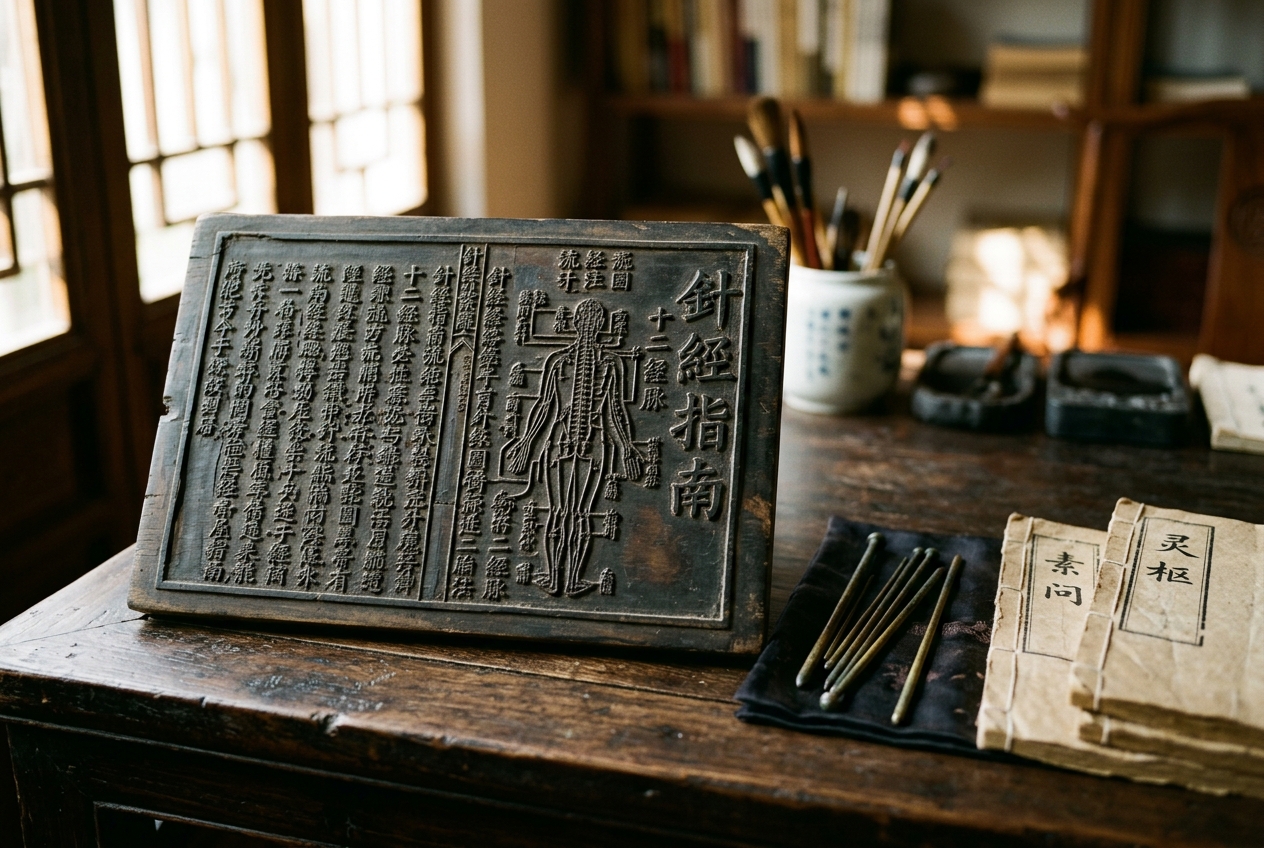
Dou recognized that the human body does not govern its visceral and psychological functions through isolated conduits, but through intersecting matrices that can be regulated via precise, high-potency somatic control points. In his masterwork, Zhen Jing Zhi Nan (針經指南, The Guide to the Classic of Needling), Dou provided the clinical world with a rigorously synthesized map of these structural relationships. Today, as contemporary neuroscience and connective tissue biology reveal the profound neurovascular and mechanotransductive properties of these exact loci, Dou’s 13th-century insights provide an exceptionally practical, non-invasive method for unwinding the physical and psycho-emotional stagnation of the modern condition.
+-----------------------------------------------------------------------------------+
|                        CLASSICAL MEETS MODERN DYNAMICS                            |
|                                                                                   |
|  13th-Century Jin-Yuan Theory          21st-Century Biophysical Correlates         |
|  ----------------------------          ----------------------------------         |
|  • Ba Mai Ba Xue (8 Confluent Points)  • Fascial Intersection & Tensegrity Hubs   |
|  • De Qi ("Arrival of Qi")             • Mechanotransduction & Collagen Winding   |
|  • Dao Qi (Directional Guidance)       • Afferent Somato-Autonomic Reflex Arcs    |
|  • Qi Stagnation / Spleen-Heart Axis   • Sympathetic Tone & Enteric Dysregulation |
+-----------------------------------------------------------------------------------+
2. THE MERIDIAN PATH — A JOURNEY THROUGH THE BODY & ITS THEORETICAL FOUNDATIONS
The Jin-Yuan Medical Renaissance and the Birth of Zhen Jing Zhi Nan
To appreciate the clinical power of Dou Hanqing’s work, one must understand the intellectual revolution in which he operated. The Jin-Yuan period (1115–1368 CE) represented a seismic paradigm shift in East Asian medicine. Moving away from the dogmatic replication of ancient herbal formulas that characterized the preceding Song imperial bureau, Jin-Yuan masters subjected canonical texts—principally the Han dynasty foundations of the Huangdi Neijing (Inner Canon of the Yellow Emperor) and the Nanjing (Classic of Difficult Issues)—to rigorous empirical testing and systematic revision, as chronicled in the broader history of Chinese medicine.
Dou Hanqing emerged as the supreme master of channel dynamics during this transformative era. In Zhen Jing Zhi Nan, written around 1241 CE and expanded in subsequent decades, Dou performed an unprecedented synthesis. He unified the theoretical elegance of Han canonical channel theory with the demanding, pragmatic realities of clinical traumatology, internal medicine, and emergency intervention. Dou codified his clinical principles into memorable poetic treatises, most notably the celebrated Biao You Fu (標幽賦, Ode to Elucidate Mysteries), ensuring that complex spatial and dynamic concepts could be reliably internalized and executed by generations of practitioners.
                       CANONICAL SYNTHESIS (1241 CE)
      +-------------------------------------------------------------+
      |  Huangdi Neijing & Nanjing (Canonical Han Channel Theory)   |
      +------------------------------+------------------------------+
                                     |
                                     v
      +-------------------------------------------------------------+
      |   Dou Hanqing's Zhen Jing Zhi Nan (Guide to the Classic)    |
      |   • Codification of Ba Mai Ba Xue (8 Confluent Points)     |
      |   • Phenomenological Mechanics of De Qi & Dao Qi            |
      |   • Biao You Fu (Ode to Elucidate Mysteries)                |
      +------------------------------+------------------------------+
                                     |
                                     v
      +-------------------------------------------------------------+
      |      Modern Neurofascial & Mechanotransductive Science      |
      |      (Connective Tissue Cleavage, Piezoelectric Signaling) |
      +-------------------------------------------------------------+
Codification of the Eight Confluent Points (Ba Mai Ba Xue)
Dou Hanqing’s most celebrated and permanent contribution to medical science was his systematic codification of the Ba Mai Ba Xue (八脈八穴)—the Eight Confluent Points. Prior to Dou, the Twelve Primary Channels (Zheng Jing, which govern the twelve organ systems) and the Eight Extraordinary Vessels (Qi Jing Ba Mai, deep embryological reservoirs that regulate systemic homeostasis, hormonal cycles, and structural posture) were often treated in clinical practice as separate energetic and structural tiers.
Dou established that specific master points located along the extremities serve as dynamic gates directly accessing, opening, and draining these deep extraordinary reservoirs. By pairing these points into synergistic dyads, Dou created a clinical architecture capable of treating whole quadrants of the human body simultaneously:
- The Thoracic and Epigastric Master Coupling: Linking Neiguan (PC6, Pericardium Channel) to the Yin Linking Vessel (Yinwei Mai) and Gongsun (SP4, Spleen Channel) to the Penetrating Vessel (Chong Mai). This master pairing regulates the entire anterior trunk, stabilizing cardiac rhythm, releasing diaphragmatic constriction, and harmonizing gastric peristalsis.
- The Cranio-Respiratory and Fluid Coupling: Linking Lieque (LU7, Lung Channel) to the Conception Vessel (Ren Mai) and Zhaohai (KI6, Kidney Channel) to the Yin Motility Vessel (Yinqiao Mai). This pairing commands the throat, chest, craniocervical junction, and pelvic floor, resolving respiratory oppression and structural stiffness along the inner legs and spine.
- The Musculoskeletal Regulator: Dou further elucidated systemic balancing systems such as the Si Guan (Four Gates)—pairing Hegu (LI4) on the hand with Taichong (LV3) on the foot—to dissolve systemic neuromuscular spasm and recalibrate neuro-affective tension throughout the somatic frame.
Detailed anatomical coordinates for these classic points have been standardized in modern times through the World Health Organization (WHO) Standard Acupuncture Point Locations, validating Dou's topological accuracy.
+------------------------------------------------------------------------------------+
|                DOU HANQING'S MASTER CONFLUENT DYADS (BA MAI BA XUE)                |
+-------------------+----------------------+--------------------+--------------------+
| Primary Acupoint  | Channel Affiliation  | Resonating Vessel  | Somatic Territory  |
+-------------------+----------------------+--------------------+--------------------+
| Neiguan (PC6)     | Pericardium (Hand)   | Yinwei Mai         | Heart, Chest,      |
| Gongsun (SP4)     | Spleen (Foot)        | Chong Mai          | Diaphragm, Stomach |
+-------------------+----------------------+--------------------+--------------------+
| Lieque (LU7)      | Lung (Hand)          | Ren Mai            | Neck, Throat,      |
| Zhaohai (KI6)     | Kidney (Foot)        | Yinqiao Mai        | Lungs, Pelvis      |
+-------------------+----------------------+--------------------+--------------------+
| Hegu (LI4)        | Large Intest. (Hand) | Primary Yang       | Head, Face, Sensorium|
| Taichong (LV3)    | Liver (Foot)         | Primary Yin        | Spasmolysis, Flow  |
+-------------------+----------------------+--------------------+--------------------+
The Phenomenology of De Qi and Directional Dao Qi
Central to Dou’s treatise was his revolutionary clarification of the somatic sensation known as De Qi (得氣, the "arrival of Qi") and the deliberate technique of Dao Qi (導氣, directing or guiding the Qi). In the Biao You Fu, Dou famously employed poetic imagery to capture the tactile reality of tissue response, writing that when Qi arrives, the practitioner's instrument feels "as if a fish has suddenly swallowed the hook and pulls downward into the deep," whereas an ineffective, uncalibrated application feels "loose, hollow, and vacant, like an empty birdcage suspended in the wind."
Far from being mystical, Dou’s phenomenology described the measurable mechanical engagement of living anatomical tissue. Dou emphasized that therapeutic efficacy relies on stimulating this exact somatosensory response—characterized in the patient by a deep, radiating, non-painful ache, mild warmth, or tingling sensation—and subsequently directing that vector along fascial planes (Dao Qi) toward the affected viscera or joint.
Modern Mechanobiology: Fascia, Piezoelectricity, and Neuro-Reflexive Arcs
Twenty-first-century biophysics and connective tissue histology have provided an empirical explanation for Dou Hanqing’s observations. Groundbreaking research led by neuroscientist Dr. Helene Langevin, documented in landmark studies on neurofascial interstitial collagen signaling, reveals that acupoints are not random surface coordinates; they correspond with high statistical significance to intermuscular and intramuscular connective tissue cleavage planes, neurovascular bundles, and areas enriched with unmyelinated free nerve endings.
                       MECHANOTRANSDUCTION PATHWAY
 +-------------------------------------------------------------------------+
 | Sustained Non-Invasive Compression (2–3 kg/cm² Perpendicular Force)     |
 +------------------------------------+------------------------------------+
                                      |
                                      v
 +-------------------------------------------------------------------------+
 | Interstitial Fluid Displacement & Mechanical Shear of Extracellular Matrix |
 +------------------------------------+------------------------------------+
                                      |
                                      v
 +-------------------------------------------------------------------------+
 | Activation of Mechanosensitive Ion Channels (Piezo1 / Piezo2) on Fibroblasts|
 +------------------------------------+------------------------------------+
                                      |
                                      v
 +-------------------------------------------------------------------------+
 | Paracrine Release of Adenosine / ATP & Calcitonin Gene-Related Peptide  |
 +------------------------------------+------------------------------------+
                                      |
                                      v
 +-------------------------------------------------------------------------+
 | Somato-Autonomic Reflex: Downregulation of Sympathetic Output via Vagus |
 +-------------------------------------------------------------------------+
When manual compression or needling is applied to a point such as PC6 or SP4, mechanical shear forces displace the interstitial fluid and strain the collagen-elastic matrix. As detailed in comprehensive literature on acupoint mechanotransduction mechanisms, this mechanical distortion stimulates mechanosensitive ion channels (such as Piezo1 and Piezo2) on the membranes of resident fibroblasts and sensory afferents.
This triggers a cascade of intracellular ATP synthesis, enzymatic conversion into adenosine (a potent local analgesic and vasodilator), and the propagation of slow-wave electrical signals along the uninterrupted fascial web. Simultaneously, sensory afferents (A-delta and C fibers) project signals directly to the dorsal horn of the spinal cord, modulating autonomic output through the vagus nerve and downregulating systemic sympathetic tone, as demonstrated by clinical investigations into acupressure at Pericardium 6 for autonomic modulation. Through this biophysical lens, Dou Hanqing’s 13th-century manual methods are revealed as sophisticated, non-invasive bio-mechanical interventions.
3. KEY THERAPEUTIC LOCI YOU CAN ENGAGE RIGHT NOW
The beauty of Dou Hanqing’s system is its immediate therapeutic accessibility. Using standard manual pressure—calibrated to deliver firm, perpendicular compression without tissue trauma—one can engage the identical mechanosensitive networks that Dou modulated with fine metal needles.
                          UPPER BODY LOCI (PC6 & LU7)

            (Radial Side / Thumb)              (Ulnar Side / Pinky)
                      \                             /
                       \                           /
                        +-------------------------+
                        |      WRIST CREASE       |
                        +-------------------------+
                                    |
            [LU7: In bony cleft]    |   [PC6: Between two central tendons,
             approx. 2 finger-      |    approx. 3 finger-widths up
             widths up on radial    |    from the wrist crease]
             edge of forearm]       |
                                    v
                                (Forearm)
                          LOWER BODY LOCI (SP4 & KI6)

                                (Medial Ankle)
                                       |
                                       v
                        +------------------------------+
                        |  MEDIAL MALLEOLUS (Anklebone)|
                        +------------------------------+
                                       |
                   [KI6: Directly in soft depression below]
                                       |
                                       v
                                (Medial Foot Edge)
                                       |
        +--------------------------------------------------------------+
        | [SP4: Base of 1st metatarsal bone, where skin tone changes]  |
        +--------------------------------------------------------------+
                                       |
                                       v
                                  (Great Toe)
1. Neiguan (PC6 - "Inner Frontier Gate")
- Anatomical Mapping: Turn your palm upward. Trace a line starting from the middle of the principal crease at the base of your wrist, moving approximately three finger-widths up your forearm toward the elbow. You will feel two prominent, cord-like tendons (the flexor carpi radialis and palmaris longus). Neiguan sits directly in the soft inter-tendinous valley between them.
- The Somatosensory Arrival (De Qi): When your perpendicular thumb pressure reaches the appropriate fascial depth, you will not feel a sharp surface pain, but rather a profound, dull, spreading ache that frequently sends a pleasant tingling or electrical branch downward toward the middle finger or upward along the forearm.
- Biomechanical Execution: Apply steady, perpendicular pressure using the tip or pad of your thumb. Maintain an applied force of roughly 2.0 to 3.0 kg/cm²—firm enough that the nail bed of your pressing thumb blanches pale, but well beneath any threshold of bruising or sharp distress. Hold continuously for 3 to 5 minutes, synchronizing your compression with slow, diaphragmatic exhalations.
- Clinical Indications: Rapidly halts nausea, motion sickness, and functional gastric reflux; alleviates emotional hyperarousal, chest constriction, and resting tachycardia; restores parasympathetic dominance.
2. Gongsun (SP4 - "Grandfather-Grandson")
- Anatomical Mapping: On the inner arch of the foot, locate the large joint at the base of the big toe. Slide your thumb backward along the bottom edge of the long bone (the first metatarsal) toward the heel. Right where the shaft of this bone flares outward into its joint base—before the high arch begins—you will drop into a noticeable, tender depression at the boundary where the red, sun-exposed skin of the upper foot meets the white, pale skin of the sole.
- The Somatosensory Arrival (De Qi): A deeply seated, expanding sensation of visceral warmth or mild tenderness that resonates along the inner border of the foot, often accompanied by an immediate gurgling or relaxation of the gastrointestinal tract (borborygmus).
- Biomechanical Execution: Hook the thumb pad upward against the lower shelf of the metatarsal bone. Exert firm, sustained pressure (2.5 kg/cm²) for 3 to 4 minutes per foot. Maintain a calm, unhurried respiratory rhythm throughout.
- Clinical Indications: Dou’s primary point for opening the Chong Mai; resolves abdominal bloating, acute epigastric spasms, postprandial lethargy, and menstrual cramping.
3. Lieque (LU7 - "Broken Sequence")
- Anatomical Mapping: Interlock the webs of your thumbs and index fingers so that your hands form a natural handshake clasp. The index finger of your upper hand will rest across the bony styloid process on the thumb-side edge of the opposite wrist. In the exact spot where the tip of that index finger lands, you will feel a distinct cleft or notch between two small tendons resting on the bone.
- The Somatosensory Arrival (De Qi): A subtle, radiating lightness or mild ache that travels upward along the radial edge of the forearm and frequently creates an immediate clearing sensation across the nape of the neck, temples, and sinus passages.
- Biomechanical Execution: Direct your pressure obliquely toward the elbow rather than straight down into the bone. Apply moderate pressure for 2 to 3 minutes, using minute, circular micro-rotations to engage the fascial cleft.
- Clinical Indications: Opens the Ren Mai; relieves tension-type headaches, occipital stiffness from prolonged screen use, early-stage respiratory congestion, and acute throat dryness.
4. Zhaohai (KI6 - "Shining Sea")
- Anatomical Mapping: Locate the prominent, rounded bone on the inside of your ankle (the medial malleolus). Slide your thumb directly below this bony peak by approximately one thumb-width. You will locate a distinct, cup-like hollow situated between the lower edge of the anklebone and the underlying ligamentous structures.
- The Somatosensory Arrival (De Qi): A soft, grounding, warm sensation that spreads through the inner heel and upward along the inner line of the calf muscle.
- Biomechanical Execution: Press straight inward into the depression with steady, calming thumb pressure for 3 to 5 minutes, focusing on drawing your cognitive attention down toward the soles of the feet.
- Clinical Indications: Opens the Yinqiao Mai; resolves sleep-onset insomnia, night-time restlessness, dry or scratchy throat, and somatic agitation.
5. The "Four Gates" Dyad: Hegu (LI4) & Taichong (LV3)
- Anatomical Mapping:
- Hegu (LI4): On the back of the hand, in the muscular mound between the thumb and index finger bones, leveled with the midpoint of the second metacarpal bone.
- Taichong (LV3): On the top of the foot, in the hollow between the first and second toe bones, roughly two finger-widths backward from the web margin.
- The Somatosensory Arrival (De Qi): A pronounced, highly localized ache that quickly gives way to a systemic sensation of somatic lightness and muscular release across the jaw, neck, and lower back.
- Biomechanical Execution: Press Hegu with your opposite thumb angled slightly toward the index finger bone; simultaneously or sequentially press Taichong with firm downward pressure for 2 to 3 minutes on each limb.
- Clinical Indications: The foundational master-pairing for breaking systemic neuro-muscular spasm, reducing tension headaches, halting stress-induced tooth grinding (bruxism), and restoring overall autonomic circulation.
4. A CLINICAL PROTOCOL FOR SOMATOVISCERAL RESET: THE "EVENING DECOMPRESSION" SEQUENCE
When cognitive hyper-focus, stress, and physical immobility create a state of sympathetic lock—manifesting as upper-back tightness, a heavy and distended stomach, and an inability to unwind before sleep—execute the following clinical protocol codified from Dou Hanqing’s confluent pairing principles.
+-----------------------------------------------------------------------------------+
|               EVENING DECOMPRESSION PROTOCOL (TOTAL DURATION: 14 MIN)             |
+------+-----------------------+----------------------+--------------------+--------+
| Step | Acupoint Pairing      | Target Axis          | Pressure & Rhythm  | Time   |
+------+-----------------------+----------------------+--------------------+--------+
| 1    | PC6 (Left) + SP4 (Rt) | Yinwei & Chong Mai   | 2.5 kg/cm², 4-sec  | 4 min  |
|      |                       | (Thoracic-Epigastric)| Inhale / 6-sec Out |        |
+------+-----------------------+----------------------+--------------------+--------+
| 2    | LU7 (Rt) + KI6 (Left) | Ren & Yinqiao Mai    | 2.0 kg/cm², Deep   | 4 min  |
|      |                       | (Cranio-Cervical)    | Diaphragmatic      |        |
+------+-----------------------+----------------------+--------------------+--------+
| 3    | LI4 (Both) + LV3 (Both)| Si Guan / Four Gates | 3.0 kg/cm², Micro- | 6 min  |
|      |                       | (Systemic Spasmolysis)| rotations         |        |
+------+-----------------------+----------------------+--------------------+--------+
          STEP-BY-STEP SOMATIC ANCHORING

          [Step 1: Epigastric / Vagal Axis]
          PC6 (Forearm) <===================> SP4 (Medial Foot Arch)
          * Releases diaphragm, lowers pulse rate, drains abdominal bloating *
                                  |
                                  v
          [Step 2: Cranio-Respiratory Axis]
          LU7 (Radial Wrist) <================> KI6 (Inner Ankle)
          * Relaxes neck/occiput, deepens tidal volume, calms mental chatter *
                                  |
                                  v
          [Step 3: Neuromuscular Spasmolysis]
          LI4 (Hand Web) <====================> LV3 (Foot Dorsum)
          * Unlocks structural tension, triggers endogenous endorphin release *
Step-by-Step Procedure:
- Preparation and Posture: Sit comfortably in a quiet space with your feet flat on the floor or recline in a semi-seated position with the spine supported and knees slightly bent. Loosen any restrictive clothing around the waist and collar.
- Phase One: Engaging the Yinwei–Chong Dyad (4 Minutes): * Locate Neiguan (PC6) on your left arm and Gongsun (SP4) on your right foot (cross-lateral stimulation maximizes central neurological integration). * Apply sustained perpendicular pressure to PC6 for two minutes while breathing deeply through the nose; then switch down to SP4 for two minutes. * Therapeutic Intention: Release the respiratory diaphragm, halt gastric fullness, and initiate vagal downregulation.
- Phase Two: Engaging the Ren–Yinqiao Dyad (4 Minutes): * Locate Lieque (LU7) on your right wrist and Zhaohai (KI6) on your left ankle. * Apply gentle, rhythmic pressure to LU7 for two minutes, feeling for the release of tension along the base of your skull. Follow immediately with two minutes of steady, grounding pressure into the hollow of KI6 below the inner ankle. * Therapeutic Intention: Deepen the breath into the lower abdomen and soothe racing thoughts.
- Phase Three: Unlocking the Four Gates (6 Minutes): * Conclude by addressing Hegu (LI4) on both hands (90 seconds each), followed by Taichong (LV3) on both feet (90 seconds each). * Maintain a six-second slow, unforced exhalation on every compression cycle. * Therapeutic Intention: Dissolve peripheral muscular guarding and prepare the autonomic nervous system for restorative stage-four delta-wave sleep.
5. SAFETY, SENSE, AND CLINICAL BOUNDARIES
While manual acupressure is an extraordinarily safe and non-invasive therapeutic modality, it operates upon powerful neurovascular and fascial structures that demand clinical respect and intelligent application.
+-----------------------------------------------------------------------------------+
|                        CRITICAL CLINICAL SAFETY GUIDELINES                        |
|                                                                                   |
|  [!] PREGNANCY CONTRAINDICATIONS:                                                 |
|      Strictly avoid heavy downward compression on Hegu (LI4), Sanyinjiao (SP6),   |
|      and Jianjing (GB21). These loci stimulate strong downward uterine vectors    |
|      and can induce oxytocinergic contractions prematurely.                       |
|                                                                                   |
|  [!] TISSUE INTEGRITY & LOCAL PATHOLOGY:                                          |
|      Never exert deep pressure over open abrasions, localized ecchymosis,         |
|      varicose veins, acute phlebitis, or areas of suspected deep vein thrombosis. |
|                                                                                   |
|  [!] FORCE PARAMETERS:                                                            |
|      "More force" does not equal "better results." The goal is mechanoreceptor    |
|      engagement (2–3 kg/cm²), NOT structural tissue trauma or intense pain.       |
|                                                                                   |
|  [!] RED FLAGS FOR EMERGENCY REFERRAL:                                            |
|      Acupressure is a restorative and adjunct regulatory discipline. It is NEVER  |
|      a substitute for emergency care in unstable angina, acute abdominal peritonitis|
|      (e.g., appendicitis), sudden neurological deficits, or severe sepsis.        |
+-----------------------------------------------------------------------------------+
Understanding the Pressure Threshold
The sensation of De Qi should always feel satisfying, heavy, and therapeutic—what patients historically described as Suan Ma Zhang Zhong (酸麻脹重: sour/dull ache, numbness, distension, and heaviness). If an application creates sharp, piercing, or defensive pain that causes you to hold your breath, flinch, or clench your jaw, you have applied excessive mechanical force or missed the fascial cleavage plane. Back off your pressure by 30 to 50 percent and re-center your thumb directly over the anatomical depression.
6. TODAY'S TAKEAWAY: THE TWO-MINUTE DIAPHRAGMATIC RESET
If you have only two minutes right now before closing this document, perform this single, highly potent maneuver derived directly from Dou Hanqing’s Pericardium channel mappings:
+-----------------------------------------------------------------------------------+
|                        TWO-MINUTE QUICK-CALIBRATION EXERCISE                      |
+-----------------------------------------------------------------------------------+
|  1. LOCATE PC6: Find the center valley between the two forearm tendons,           |
|     three finger-widths above your left wrist crease.                             |
|                                                                                   |
|  2. COMPRESS: Place your right thumb pad squarely on the point. Press firmly      |
|     downward (2.5 kg/cm²) until you feel a dull, spreading ache.                 |
|                                                                                   |
|  3. SYNCHRONIZE BREATHING:                                                        |
|     • Inhale smoothly through your nose for a count of 4 seconds.                 |
|     • Exhale slowly through slightly parted lips for a count of 6 seconds.       |
|     • As you exhale, gently increase your thumb compression by 10%.               |
|                                                                                   |
|  4. DURATION: Maintain this uninterrupted cadence for 12 complete breath cycles   |
|     (approx. 2 minutes). Then release slowly.                                     |
+-----------------------------------------------------------------------------------+
Notice the physiological shift: your shoulders drop, the tight band around your solar plexus yields, and your breathing deepens naturally into the lower abdomen. You have just engaged the living fascial and neurological continuum mapped with such devotion by Dou Hanqing more than 750 years ago. In an era that constantly threatens to scatter our attention and strain our physical foundations, these ancient somatic keys remain as vital, precise, and transformative as the day they were first committed to silk and paper.