Zhan Zhuang Qigong (Zhan Zhuang Fa) Meridian Dynamics: Governing Static Postural Alignment, Plantar Rooting Ground Forces, Dantian Qi Consolidation, and Myofascial Tonic Flow in Traditional Chinese Medicine
1. Opening Scene — A Moment You’ll Recognise
It is 3:30 in the afternoon, and your body has begun its daily structural collapse. Your chin drifts forward toward your computer monitor, your thoracic spine rounds into a dull C-curve, and your breath becomes shallow, fluttering high in the chest. Despite having consumed lunch hours ago, a profound heaviness settles behind your eyes and across your midsection—a distinct sensation of being simultaneously exhausted and wired. You drink another cup of coffee, but instead of vital energy, it generates an internal tremor: your heart rate elevates, yet your feet remain cold and your lower back aches with a hollow, draining fatigue.
In modern Western terms, this state represents the chronic down-regulation of postural endurance musculature paired with sympathetic nervous system overdrive. In Traditional Chinese Medicine (TCM), this sensation marks the upward dispersion of Yang energy away from its biological root, leaving the metabolic engine—governed by the Spleen and Kidney organ networks—functionally depleted. The body is floating, structurally fractured, and energetically starved.
The solution preserved for centuries in classical Chinese medicine is paradoxical: rather than moving faster, stretching aggressively, or lying down in passive collapse, one simply stands. This is the foundational practice of Zhan Zhuang (站桩, literally "standing like a post" or "stake standing")—an isometric postural discipline that transforms static alignment into a profound engine of somatic rejuvenation and cellular repair.
2. What This Organ System Does: The Visceral Engine of Vitality
To understand why standing motionless can revitalize a depleted human organism, one must first understand how Chinese medical physiology conceptualises internal vitality (Qi) and metabolic sustenance. The human body does not operate as an assembly of isolated anatomical parts, but rather as an integrated functional collective (Zang-Fu systems) supported by three fundamental treasures: Jing (essence or constitutional reserve), Qi (functional energy and metabolic movement), and Shen (conscious awareness and spirit).
At the core of functional stamina are two primary organ networks:
- The Spleen System (Pǐ, 脾): Responsible for the transformation and transportation of nutrients. Think of the Spleen as the body’s metabolic furnace and logistics manager. It receives food from the Stomach, extracts its refined essence (Gu Qi), and ascends this bio-energy upward to nourish muscles, clear the mind, and maintain physical tissue tone. When the Spleen functions optimally, physical limbs feel light, digestion is effortless, and cognitive focus is sharp.
- The Kidney System (Shèn, 肾): Considered the constitutional root of life and the reservoir of Yuan Qi (primordial vitality). The Kidneys house the genetic blueprint and endocrine-like reserves (Jing), governing thermoregulation via Kidney Yang (the body's internal fire) and cellular hydration via Kidney Yin (the body's cooling, lubricating fluids).
- The Lower Dantian (Xià Dāntián, 下丹田): Located roughly three finger-widths below the umbilicus and deep within the pelvic bowl (centered around acupuncture points Guanyuan CV4 and Qihai CV6), the Dantian is the structural and energetic epicenter where gathered breath (Kong Qi), transformed nutrition (Gu Qi), and inherited essence (Jing) consolidate into usable biological vitality.
When chronic cognitive stress, sedentary postures, and shallow breathing dominate, this internal engine de-synchronises. Metabolic fuel fails to consolidate in the lower abdomen; instead, it dissipates upward, manifesting as brain fog, ocular tension, and systemic fatigue. Zhan Zhuang acts as a systemic re-alignment protocol, mechanically and bio-energetically guiding dispersed resources back down into the lower visceral reservoir.
3. How You Can Feel It: Signs of Balance and Imbalance
When the metabolic and organ matrices are compromised, the body broadcasts unambiguous physical, somatic, and psycho-emotional distress signals. Conversely, a resilient organ system manifests through distinct structural and visceral qualities.
Self-Assessment: Evaluating Your Systemic Grounding
Take 60 seconds to perform this diagnostic somatic inventory:
- Examine Your Abdominal Pressure: Place a palm flat over your lower abdomen (below your navel). Is this area hollow, weak, and cold, or does it feel warm, gently pressurized, and responsive to your breath?
- Evaluate Your Peripheral Temperature: Touch your lower toes and the back of your neck. If your neck and forehead are hot while your feet and lumbar spine are chronically chilled, your Yang energy is floating upward rather than anchoring in the Kidney reservoir.
- Inspect Your Tongue: In natural daylight, look at your tongue in a mirror. A pale, swollen tongue with tooth marks (scalloping) along the lateral margins indicates Spleen Qi deficiency and impaired fluid metabolism. A thin, red tongue with minimal coating points toward depleted Kidney Yin and ungrounded internal heat.
- Observe Your Stance: Stand casually. Are your knees locked backward in hyperextension, forcing your lumbar spine into excessive lordosis and compressing your sacrum? Hyperextending the knees mechanically severs the myofascial pathway through which energy grounds into the earth.
4. Qigong & Movement Practice: The Didactic Anatomy of Zhan Zhuang
Zhan Zhuang Fa is an exacting discipline of dynamic internal equilibrium disguised as complete external stillness. Far from passive resting, it involves a rigorous reorganization of the musculoskeletal, myofascial, and neurovascular systems based on principles of biotensegrity and ground reaction forces.
Step-by-Step Biomechanical Breakdown
Phase 1: The Wuji Stance (The Void of Origin)
The preparatory foundation designed to neutralize habitual somatic distortions.
- Base and Grounding (Yongquan, KI1): Stand with feet parallel, shoulder-width apart, toes pointing straight forward. Distribute your weight evenly across the tripod of each foot: the base of the first metatarsal, the base of the fifth metatarsal, and the calcaneus (heel). Gently dome the plantar arch, allowing the bubbling spring point (Yongquan, KI1) to suction slightly upward while the foot roots into the floor.
- Knee Micro-Flexion: Never lock the knee joints. Soften the patellae with a 3- to 5-degree micro-flexion. This unlocks the popliteal fossa, permitting unobstructed arterial and venous flow through the popliteal vessels and continuous neural conduction via the tibial nerve.
- Releasing the Inguinal Creases (Song Kua, 松胯): The Kua refers to the inguinal fold where the femur articulates with the acetabulum. Consciously relax this crease, allowing the pelvis to settle downward as if preparing to sit on the edge of a high barstool. This slight posterior-neutral pelvic tilt decrescents lumbar lordosis and opens the "Door of Life" (Mingmen, GV4), creating space across the L4–S1 vertebrae.
- Axial Cranial Suspension (Baihui, GV20): Imagine an invisible silk thread attached to the vertex of the cranium (Baihui, GV20), gently suspending the skull toward the sky. Lightly retract the chin, lengthening the suboccipital musculature and decompressing the cervical spine.
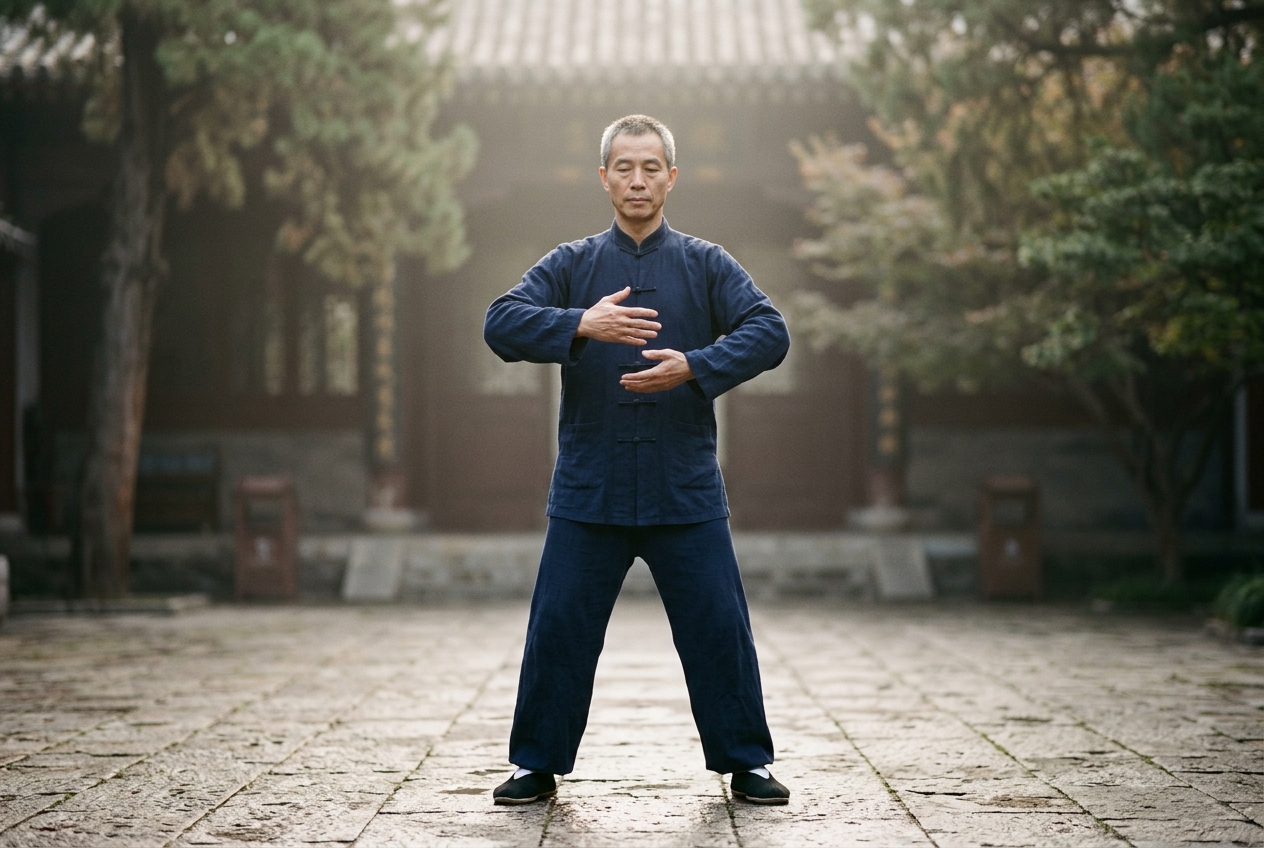
- Lower Dantian Consolidation: Place both palms over the lower abdomen (men right hand over left; women left hand over right). Allow the inhalation to gently expand the lower abdominal wall in a 360-degree circumference; allow the exhalation to softly settle deeper into the pelvic floor. Maintain this for 2 to 3 minutes until breathing slows below 8 breaths per minute.
Phase 2: The Chengbao Stance (Embracing the Tree)
The primary therapeutic stance for activating systemic microvascular circulation and fascial tensegrity.
- Arm Elevation and Circular Geometry: From the Wuji posture, slowly float both arms upward to mid-chest height. Shape the arms into a wide, horizontal embrace, as though holding a large paper lantern or tree trunk. Keep the fingertips roughly 10–15 centimeters apart, pointing toward one another, with the palms angled back toward your own chest.
- Scapular Protraction and Axillary Hollows: Drop the shoulders away from the ears (Chen Jian, 沉肩) and allow the elbows to sink below the level of the wrists (Zhui Zhou, 坠肘). Broaden the space between the shoulder blades, gently hollowing the chest (Han Xiong Ba Bei, 含胸拔背). Maintain a hollow space inside the armpits large enough to cradle an egg without crushing it; this prevents compression of the brachial plexus and axillary lymph nodes.
- Tensegrity and Isometric Balance: Maintain the posture without rigid isometric bracing. Seek Song (松)—a state of active, buoyant relaxation where only the deep postural tonic muscles are engaged while superficial phasic muscles remain soft.
- Duration and Progressive Overload:
- Beginners: 5 minutes daily.
- Intermediate: 15–20 minutes daily.
- Advanced Clinical Dose: 30–40 minutes daily.
- Sensory Milestones: Within 3 to 7 minutes, practitioners typically experience localized muscle tremors (fasciculations). This is normal: it signals that fatigued superficial muscles are yielding their load to the deep stabilizing fascial network. As tonic micro-adjustments stabilize, sensations of warmth, fullness, or light electrical tingling (deqi) will spread into the palms and soles of the feet, driven by capillary dilation.
Neurophysiological and Myofascial Mechanisms
Scientific investigations into static postural holding—such as those indexed by the National Center for Biotechnology Information (NCBI)—reveal that Zhan Zhuang operates through precise physiological cascades:
- Mechanotransduction and Myofascial Integration: The continuous, low-amplitude loading across an aligned skeleton transmits mechanical strain directly through the extracellular matrix via integrins to cell nuclei (mechanotransduction). This stimulates fibroblast remodeling, enhances fascial tensile strength, and hydrates the deep fascial planes without producing joint wear or micro-tearing.
- Microvascular Perfusion via Tonic Oscillations: Although visually motionless, the standing body undergoes constant involuntary postural swaying. These continuous micro-adjustments generate an alternating contraction-relaxation cycle within deep postural muscles (soleus, deep spinal rotators, pelvic floor). This acts as an auxiliary muscular pump, dramatically increasing venous return, enhancing microvascular capillary recruitment, and triggering endothelial nitric oxide release without driving up systolic blood pressure.
- Autonomic Repatterning Toward Parasympathetic Equilibrium: The co-activation of diaphragmatic descent, pelvic relaxation, and suboccipital elongation stimulates the afferent pathways of the vagus nerve. Studies on mind-body therapies and autonomic regulation confirm that sustained static qigong downregulates systemic sympathetic tone, lowers salivary cortisol, enhances heart rate variability (HRV), and promotes physiological recovery.
- Vessel Channel Activation (Yin/Yang Qiao Mai and Dai Mai): In TCM channel theory, static standing directly recruits the Qiao Mai (Heel/Stepping Vessels), which regulate lower-limb biomechanics and postural stability. Concurrently, relaxing the Kua and establishing 360-degree abdominal breath engages the Dai Mai (Girdling Vessel)—the only horizontal meridian in the body—binding the twelve primary vertical meridians together and anchoring visceral organs within the abdominal vault.
Clinical Indications and Safety Parameters
- Indications: Chronic metabolic fatigue, postural orthostatic deconditioning, adrenal burnout, generalized Spleen Qi deficiency, mild-to-moderate lumbar instability, digestive sluggishness, and stress-induced sleep fragmentation.
- Contraindications & Modifications:
- Absolute Contraindications: Acute systemic infections, uncompensated congestive heart failure, severe acute vertigo, or late-stage structural joint inflammation.
- Modifications: Individuals with severe hypertension must keep arm height below the level of the heart to prevent transient increases in peripheral vascular resistance. Practitioners with knee osteoarthritis should reduce stance depth to a virtually straight (yet unlocked) knee angle.
5. Acupressure Points You Can Try Today
To amplify the systemic effects of Zhan Zhuang, incorporate targeted manual stimulation onto three primary somatic acupoints that govern grounding, metabolic transformation, and energy consolidation.
1. Yongquan (Kidney 1, 涌泉) — "Gushing Spring"
The prime rooting point on the body, vital for draining excess cranial heat and drawing energy into the feet.
- Anatomical Location: On the plantar surface of the foot, in the depression formed when the toes curl downward. It lies approximately one-third of the distance along a line drawn from the base of the second and third toes to the back of the heel.
- Technique: Use the tip of your thumb or a rounded knuckle to apply direct, perpendicular pressure into the depression. Maintain firm, steady pressure with small circular kneading motions for 2 to 3 minutes per foot. You should feel a distinct, dull ache spreading across the sole.
- Daily Clinical Application: Invaluable for evening restlessness, hot flashes, hypertension spikes, mental over-rumination, and cold feet.
2. Zusanli (Stomach 36, 足三里) — "Leg Three Miles"
The sovereign metabolic point in East Asian medicine, renowned for fortifying Spleen Qi and relieving systemic fatigue.
- Anatomical Location: On the anterolateral aspect of the lower leg, four finger-widths below the inferior border of the patella, and one finger-breadth lateral to the anterior crest of the tibia (in the belly of the tibialis anterior muscle).
- Technique: Apply firm, deep pressure using your thumb or middle knuckle, angled slightly toward the tibia. Maintain steady pressure for 1 to 2 minutes while slowly taking deep abdominal breaths. The sensation should feel deeply invigorating, radiating downward toward the dorsal foot.
- Daily Clinical Application: Indicated for post-meal bloating, brain fog, chronic physical exhaustion, weak digestion, and low postural endurance.
3. Guanyuan (Conception Vessel 4, 关元) — "Gate of Origin"
The central nexus for tonifying primordial Qi and anchoring the lower Dantian.
- Anatomical Location: On the anterior midline of the lower abdomen, precisely four finger-widths (three inches) directly below the center of the umbilicus.
- Technique: Place your middle three fingers flat over the point. Do not gouge with sharp pressure; instead, sink inward with gentle, warm, progressive compression on an exhalation. Hold for 3 to 5 minutes, visualizing breath warmth filling the entire pelvic basin.
- Daily Clinical Application: Essential for deep physical exhaustion, lower back coldness, frequent nocturnal urination, menstrual cramping, and emotional ungroundedness.
6. Food & Lifestyle: Small Changes for Today
Sustainable energetic health requires coordinating external movement practices with dietary thermodynamics and daily circadian patterns. In classical Chinese medicine, the metabolic fires of the Spleen and Kidney are easily extinguished by cold temperatures, excessive raw food, and irregular routines.
The Thermal Architecture of Nutrition
- Emphasize Thermal Warmth: The Spleen performs enzymatic digestion and energetic transformation optimally at biological core temperatures. Replace cold breakfast smoothies and refrigerated lunches with warm porridge, steel-cut oats with cinnamon, poached eggs, and root vegetable soups.
- Incorporate Spleen and Kidney Tonics: Daily staples should feature naturally sweet and earthy whole foods: pumpkin, sweet potatoes, carrots, parsnips, and slow-simmered bone or shiitake mushroom broths. Add a tablespoon of black sesame seeds or a small handful of walnuts daily to fortify Kidney Jing.
- Limit Cold Dampness: Drastically reduce iced drinks, dairy overload, refined sugar, and heavy, greasy take-out foods. These place an enormous metabolic burden on the Spleen, leading to internal humidity (dampness) that manifests clinically as brain fog, heavy limbs, and sinus congestion.
Ergonomics and Circadian Alignment
- The Postural Interruption: For every 45 minutes of seated desk work, stand for two minutes. Reset your pelvic alignment: soften your knees, drop the tailbone, lengthen the back of the neck, and take three diaphragmatic breaths into the Dantian.
- Grounding and Footwear: Restrict narrow, rigid shoes that constrict the metatarsal arches and desensitize the Yongquan point. Whenever possible, spend 5 to 10 minutes walking barefoot on natural grass, unpolished wood, or natural stone to stimulate plantar mechanoreceptors.
- The Evening Foot Bath (Pao Jiao): Submerge both feet in a basin of comfortably hot water (roughly 40–42°C) for 15 minutes before bed. This draws stagnant blood and hyperactive thoughts down from the brain toward the peripheral extremities, soothing the autonomic nervous system and promoting deep sleep.
7. Today’s Takeaway
If you do nothing else today, take five uninterrupted minutes away from all screens, shoes removed, and stand in basic Wuji alignment. Place your feet parallel at shoulder width, soften your knees by just a fraction of an inch, drop your tailbone as if resting on a high stool, place both hands flat over your lower abdomen, and suspend the crown of your head upward. Breathe slowly into your palms without forcing the pace. In these brief five minutes of stillness, you step off the modern treadmill of constant physical depletion, reconnect your structural tensegrity, and invite your metabolic energy to settle back into its rightful, calm foundation.