Za Bing Xue Fa Ge: Navigating Classical Miscellaneous Disease Verses, Differential Acupoint Matrices, and Precision Acupressure Protocols
1. Opening — A Problem This Solves Today: Somatic Disharmony and the Classical Cartography of Distress
If you have ever concluded a relentless workday with a throbbing occipital tension headache, a contracted diaphragm that resists deep inhalation, a churning epigastrium, or a pervasive, low-grade autonomic anxiety that refuses to abate, you have encountered the precise somatic constellation targeted by classical Chinese medicine. Modern life frequently traps the nervous system in a state of sympathetic hyperarousal: the trapezius muscles lock in defensive bracing, peripheral microcirculation diminishes, visceral motility slows, and cerebral perfusion becomes erratic. In conventional clinical settings, these diffuse, multisystem functional complaints are frequently fragmented into distinct, isolated diagnoses—tension cephalalgia, functional dyspepsia, or generalized distress—often addressed with disjointed pharmacotherapies that suppress symptoms without restoring systemic equilibrium.
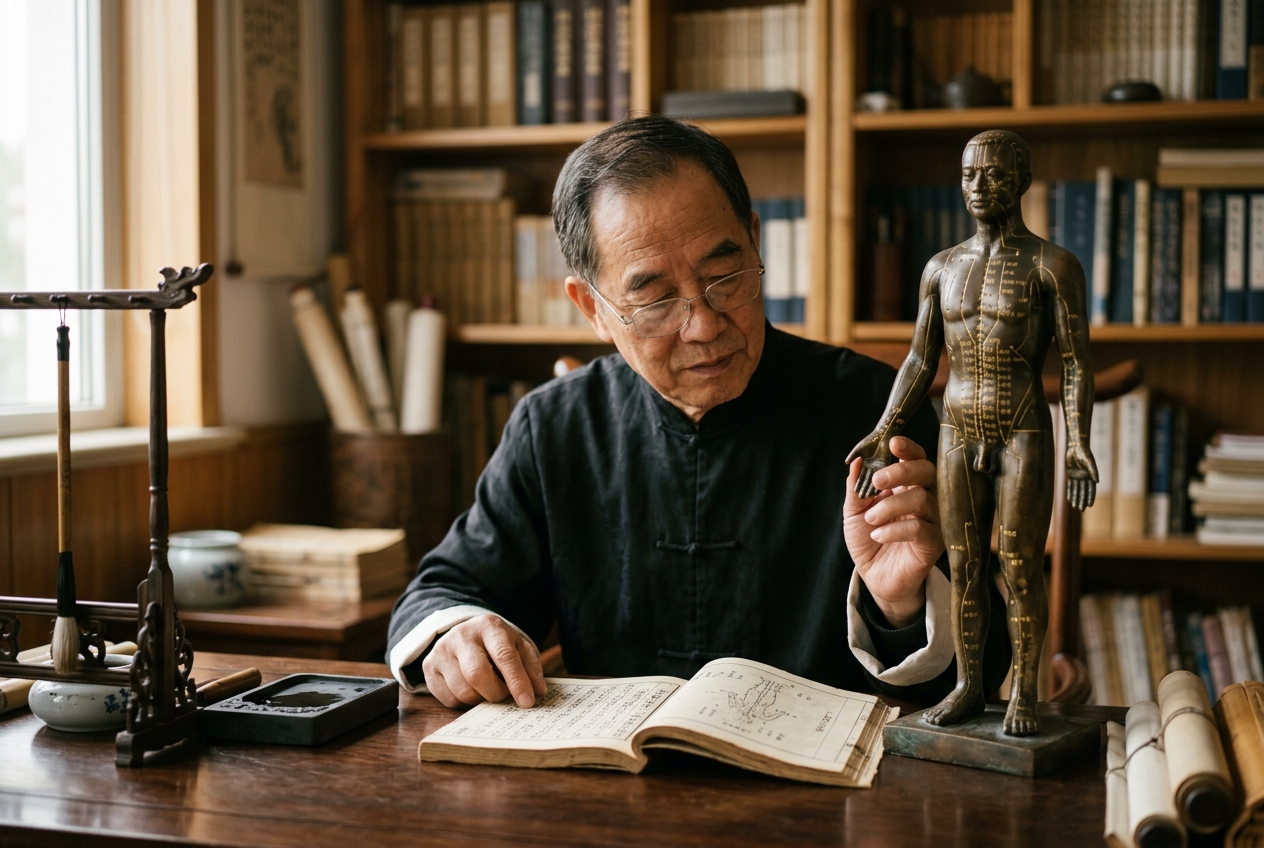
Four centuries ago, the late Ming Dynasty physician Yang Jizhou (楊繼洲, 1522–1620) confronted identical patterns of multifaceted human suffering. In his masterwork, the Zhen Jiu Da Cheng (《針灸大成》, The Great Compendium of Acupuncture and Moxibustion, published in 1601), Yang compiled and synthesized centuries of clinical wisdom. Central to this compendium is the celebrated didactic poem Za Bing Xue Fa Ge (《雜病穴法歌》, Song of Point Methods for Miscellaneous Diseases). Understanding that acute clinical emergencies and complex internal dysfunctions require immediate, structured point synergies rather than guesswork, master physicians codified their therapeutic formulas into rhythmic, easily memorized verse mnemonics.
The fundamental insight animating the Za Bing Xue Fa Ge is that no single acupoint exists in isolation; instead, points act as biological transceivers positioned along interconnected myofascial, vascular, and neural pathways. By deconstructing the classical couplets of this historic poem through modern neuroanatomy, mechanobiology, and fascial continuum models, we reveal a sophisticated manual interface for human physiology. Far from mystical conjecture, the point pairings codified in this classical song represent reproducible, evidence-based configurations for modulating visceral reflexes, calming cortical distress, and restoring somatic harmony.
2. The Meridian Path — A Journey Through the Body: Neurofascial Continuities and Topographical Kinetic Chains
To apply these classical insights, one must first comprehend the pathways through which therapeutic stimuli travel. Classical East Asian medicine describes channels (Jing-Luo) not as abstract lines painted on the skin, but as dynamic, interstitial conduits traversing the body’s fascial planes, neurovascular bundles, and muscular septa. Modern research published in Langevin et al.'s connective tissue studies via NCBI PubMed demonstrates that acupuncture meridians correspond significantly to the cleavage planes of interstitial connective tissue, where mechanical tension triggers cellular cascades.
Consider the three foundational longitudinal conduits that govern our central visceral and cranial axes:
The Front-Line Expressway: The Yangming (Stomach & Large Intestine) Axis
The Yangming meridian system forms the great somatic and metabolic highway along the front of the body. In the upper limb, the Large Intestine channel begins at the radial tip of the index finger, ascends through the fleshy muscular web between the thumb and first finger, traces the lateral border of the forearm muscles, crests the top of the shoulder, and terminates beside the nostrils. In the lower limb, the Stomach channel descends from below the orbit of the eye, courses across the jaw, travels down through the throat, chest, and abdominal wall (lateral to the rectus abdominis), passes over the hip crease, plunges down the muscular swell of the anterior thigh, and runs directly down the lateral side of the shinbone—the precise muscular compartment (tibialis anterior) that aches after hours of uphill walking—terminating at the second toe. Topographically, Yangming represents the superficial front kinetic line, richly supplied by sensory spinal roots and sympathetic fibers that regulate metabolic energy, facial sensation, and gut propulsion.
The Medial Stabilizing River: The Taiyin (Spleen & Lung) Axis
Running along the inner, softer aspects of the extremities, the Taiyin axis governs fluid transformation, respiratory mechanics, and immune surveillance. In the leg, the Spleen channel originates at the medial corner of the big toenail, traverses the inner arch of the foot, passes directly behind the prominent inner ankle bone, ascends the rear border of the shinbone, and courses up the medial thigh into the lower abdomen and spleen-pancreas beds. In the arm, the Lung channel emerges from the subclavicular chest wall, tracks along the biceps, crosses the crease of the elbow just lateral to the biceps tendon, descends the radial forearm, and finishes at the thenar eminence of the thumb. This pathway maps directly to the deep investing fascial sheaths enclosing major lymphatic vessels and deep veins.
The Inner Axis of Equilibrium: The Jueyin (Pericardium & Liver) Axis
The Jueyin system mediates cardiovascular flexibility, emotional composure, and diaphragmatic smooth-muscle tone. The Pericardium channel commences deep within the pericardial sac, branches through the diaphragm, surfaces near the axilla, travels precisely down the midline of the inner arm between the two prominent flexor tendons of the forearm, and ends at the tip of the middle finger. Its lower-extremity partner, the Liver channel, begins at the lateral big toe, crosses the dorsum of the foot between the first and second metatarsal bones, ascends the inner leg anterior to the Spleen path, and sweeps through the inner thigh into the costal margin and liver capsule. Neurologically, this axis aligns with the median nerve in the upper extremity and the saphenous/deep peroneal nerve arborizations in the lower extremity—vital highways for somatovisceral reflex integration.
As codified in the World Health Organization Standard Acupuncture Point Locations, these topographical conduits provide an anatomically consistent grid across distinct human phenotypes, enabling precise physical intervention.
3. Key Points You Can Press Right Now: Classical Verse Deconstruction and Somatosensory Biomechanics
The Za Bing Xue Fa Ge highlights several master acupuncture nodes that serve as the command hubs for multi-meridian formulas. Below are three indispensable point pairings immortalized in the poem, accompanied by their precise anatomical landmarks, physical sensations, manual vectors, and physiological actions.
1. Hegu (LI4, 合谷 - "Joining Valleys") & Taichong (LV3, 太衝 - "Great Surge"): The "Four Gates" (Si Guan)
The Classical Verse Mandate:
“For headaches, facial swelling, and lockjaw, seek Hegu; to smooth the liver, pacify wind, and dispel internal stagnation, open Taichong.”
Somatosensory Landmarking & Anatomical Substrate
- Hegu (LI4): Located on the dorsum of the hand, in the muscular valley between the first and second metacarpal bones, situated at the midpoint of the second metacarpal bone along its radial border. When you gently pinch the thumb and index finger together, a small muscular bulge forms at the top of the web; LI4 lies in the hollow just beside the peak of this mound. Anatomically, this site overlies the first dorsal interosseous muscle, innervated by the superficial radial and deep ulnar nerves.
- Taichong (LV3): Located on the top surface of the foot, in the hollow junction between the first and second metatarsal bones. Slide your finger upward from the web between your big toe and second toe along the valley until your finger is caught in the V-shaped notch before the bones meet. Here lies LV3, situated over the deep peroneal nerve and the dorsal venous network of the foot.
Somatosensory De Qi Sensation
Upon correct engagement, the practitioner will not feel a sharp, cutaneous prick, but rather De Qi (得氣)—a distinct, spreading sensation characterized by dull aching, deep fullness, localized warmth, or a pleasant radiating heaviness (suan, ma, zhang, zhong).
Manual Acupressure Protocol
- Vector: Apply perpendicular pressure to LI4 angled slightly toward the second metacarpal bone. For LV3, direct the pressure proximally into the bony crevice at a 75-degree angle toward the ankle joint.
- Biomechanical Firmness: Apply steady, firm, sustained pressure (3 to 5 kg of manual force), sufficient to produce a discernible, deep ache without bruising superficial tissue.
- Rhythmic Cycles (Bu / Xie Dynamics): For acute stress, tension headaches, or irritability, employ the Sedating (Xie) Technique: rotate your thumb counter-clockwise with a deep, oscillating knead for 60 seconds per limb. For generalized fatigue, employ the Tonifying (Bu) Technique: exert rhythmic, pulsating downward pressure held for 5 seconds and released for 2 seconds, repeated for 2 minutes.
- Clinical Indications: Tension and migraine headaches, jaw clenching (bruxism), sinus pressure, emotional irritability, generalized somatic tension, and dysmenorrhea.
2. Zusanli (ST36, 足三里 - "Leg Three Miles"): The Grand Homeostatic Node
The Classical Verse Mandate:
“When the stomach is cold, digestion stalls, or chronic debility drains the vital force, apply pressure to Zusanli to revive the center.”
Somatosensory Landmarking & Anatomical Substrate
To locate ST36 without complex measurements, sit with your knees bent at a 90-degree angle. Place the palm of your right hand over your right kneecap (patella), with your fingers pointing downward along your shin. The tip of your ring finger will naturally fall into a small, tender muscular indentation located approximately one finger-width to the outside of your sharp shinbone crest (tibialis anterior muscle belly). Neurologically, this site corresponds to the muscular branches of the deep peroneal and tibial nerves.
Somatosensory De Qi Sensation
Compression produces a characteristic radiating ache that frequently travels downward along the lateral lower leg into the dorsum of the foot, often eliciting immediate borborygmus (digestive gurgling) as gastrointestinal motility activates.
Manual Acupressure Protocol
- Vector: Direct the force perpendicularly and slightly medially toward the posterior border of the tibia.
- Biomechanical Firmness: Moderate to heavy sustained pressure.
- Rhythmic Cycles: Apply circular, clockwise friction combined with deep, sustained compressions held for 10 seconds, repeated across 12 cycles (totaling approximately 2 to 3 minutes per leg).
- Physiological Mechanism: Groundbreaking neuroanatomical research by Ma et al. in Nature demonstrated that stimulation of ST36 selectively activates PROKR2-Cre-marked sensory nerve fibers, driving the vagal-adrenal anti-inflammatory axis to trigger systemic cytokine suppression and regulate gastric motility via the dorsal motor nucleus of the vagus (DMV).
- Clinical Indications: Postprandial bloating, epigastric pain, chronic fatigue, gastrointestinal dysmotility, lower-limb weakness, and immune exhaustion.
3. Neiguan (PC6, 內關 - "Inner Pass") & Sanyinjiao (SP6, 三陰交 - "Three Yin Intersection"): The Cardiothoracic & Pelvic Regulators
The Classical Verse Mandate:
“For oppression of the chest, cardiac palpitation, and nausea, select Neiguan; for lower abdominal masses, menstrual irregularities, and pelvic dysfunctions, combine with Sanyinjiao.”
Somatosensory Landmarking & Anatomical Substrate
- Neiguan (PC6): Turn your forearm palm-up. Place the three middle fingers of your opposite hand across your wrist crease. The point sits directly below the index finger edge, precisely in the central valley between the two prominent, rope-like tendons of the inner forearm (flexor carpi radialis and palmaris longus). Deep to this point lies the main trunk of the median nerve.
- Sanyinjiao (SP6): Locate the highest, most prominent point of your inner ankle bone (medial malleolus). Place four fingers flat horizontally above this bony peak along the inner edge of your shin. SP6 lies in the soft, tender depression situated directly along the posterior edge of the tibia bone. This junction is the intersection of the Spleen, Liver, and Kidney meridians, richly innervated by the tibial nerve (spinal segments L4–S2).
Somatosensory De Qi Sensation
PC6 generates an electric, tingling warmth that courses into the palm and middle digits; SP6 exhibits an exquisitely tender, deep ache that can radiate upward through the medial calf into the pelvic basin.
Manual Acupressure Protocol
- Vector: For PC6, compress perpendicularly straight down into the space between the tendons. For SP6, direct the pressure slightly obliquely behind the posterior border of the tibia bone.
- Biomechanical Firmness: Moderate firmness; maintain consistent, non-wavering pressure for 90 to 120 seconds per point.
- Clinical Indications: Motion sickness, psychogenic nausea, cardiac palpitations, insomnia, premenstrual tension, pelvic cramping, and circadian disruption. Supported by comprehensive clinical reviews available at NCBI PubMed Central on Acupuncture Neurobiology.
4. A Point Combination for One Common Issue: The Classical Formula for Cranio-Cervical Dysautonomia and Stress Cephalalgia
Modern desk-bound workers routinely suffer from a vicious physiological cycle: prolonged screen exposure and forward-head posture compress the suboccipital nerve plexus, while mental stress drives sympathetic outflow, resulting in bilateral occipital-frontal headaches, ocular fatigue, and a contracted epigastrium.
The Za Bing Xue Fa Ge offers a master formula for this exact pattern: the pairing of Fengchi (GB20), Hegu (LI4), and Taichong (LV3). This combination utilizes the "Four Gates" to open systemic peripheral circulation while unlocking local suboccipital tension at the cranial base.
The "Do This Tonight" Step-by-Step Clinical Protocol
Preparation & Posture (0:00 – 1:00)
Dim the lighting. Assume a comfortable supine position with a small rolled towel beneath your cervical spine, or sit upright in a high-backed chair with your feet flat on the floor. Establish a 4-second diaphragmatic inhalation followed by an elongated 6-second exhalation to prime parasympathetic tone.
Phase 1: Suboccipital Decompression at Fengchi (GB20, 風池 - "Wind Pool") (1:00 – 3:00)
- Location: Clasp your hands behind your head, interlocking your fingers. Place your thumbs into the two large hollows beneath the base of your skull, positioned between the thick trapezius muscle ridge and the sternocleidomastoid muscle (approximately two inches lateral to the spine).
- Manipulation: Lean your head slightly backward against your thumbs. Direct an upward, inward pressure vector angled toward the center of your forehead (toward the opposite eye). Maintain this continuous, deep pressure while executing slow, micro-circular oscillations (1 Hz frequency) for 2 continuous minutes.
- Neurobiology: This releases hypertonic suboccipital muscles, decompressing the greater occipital nerve and modulating trigeminocervical nucleus excitability.
Phase 2: Distal Trigeminal Gating at Hegu (LI4) (3:00 – 5:00)
- Manipulation: Switch focus to the left hand. Grasp the first web space with your right thumb and index finger. Apply a deep, penetrating Xie (sedating) compression against the radial bone margin for 60 seconds, eliciting a robust De Qi ache. Repeat on the right hand for 60 seconds.
- Neurobiology: High-threshold mechanoreceptor input triggers cross-segmental spinal gate closure in the cervical dorsal horn, arresting ascending nociceptive pain volleys to the somatosensory cortex.
Phase 3: Descending Autonomic Grounding at Taichong (LV3) (5:00 – 7:00)
- Manipulation: Place your right thumb into the left foot's dorsal metatarsal notch (LV3). Apply a firm, sliding proximal stroke toward the ankle for 60 seconds, followed by deep static compression. Repeat on the right foot for 60 seconds.
- Neurobiology: Recruits deep peroneal afferents, augmenting baroreflex sensitivity, reducing blood pressure spikes, and dampening sympathetic hyper-reactivity as corroborated by Cochrane and PubMed Meta-Analyses on Acupoint Stimulation.
5. Safety, Sensory Thresholds, and Clinical Escalation: Navigating Contraindications and Neurovascular Boundaries
While manual acupressure is an extraordinarily safe, non-invasive modality, its clinical efficacy depends upon strict adherence to physiological boundaries, contraindications, and appropriate diagnostic triage.
The Obstetric Mandate
Points that possess strong downward energetic and mechanical vectors—most notably Hegu (LI4), Sanyinjiao (SP6), Jianjing (GB21), and Kunlun (BL60)—are strictly contraindicated during pregnancy (unless intentionally utilized under qualified clinical supervision for labor induction). These points stimulate oxytocinergic pathways and induce uterine myometrial contractions, posing significant risks during early or mid-term gestation.
Differentiating Therapeutic "De Qi" from Tissue Damage
Acupressure must never be practiced with destructive, bruising force. Understanding the sensory hierarchy is paramount: 1. Therapeutic Threshold (De Qi): A deep, diffuse ache, a spreading sensation of warmth, a mild electrical hum, or a muscular feeling of satisfying tension release. This reflects appropriate recruitment of unmyelinated C-fibers and thinly myelinated A-delta afferents. 2. Pathological Threshold: Sharp, searing, lancinating, or burning pain accompanied by involuntary defensive muscular guarding. This signals direct mechanical compression of a major nerve trunk or capillary shearing. If encountered, immediately reduce pressure and adjust the angle of your vector.
When to Seek Immediate Medical Attention
Acupressure is indicated for functional, stress-induced, and mild chronic disorders. It must never substitute for emergency medical care. Seek prompt evaluation if you experience any of the following "red flag" symptoms: * Sudden, severe "thunderclap" headache unlike any experienced previously. * Acute, rigid, tender abdominal pain accompanied by fever or rebound tenderness. * Chest pain radiating to the jaw, neck, or left arm, accompanied by diaphoresis and dyspnea. * Unexplained unilateral limb swelling, redness, and heat (indicative of acute deep vein thrombosis). * Progressive neurological deficits, including facial drooping, motor weakness, slurred speech, or bowel/bladder incontinence.
For a deeper exploration of traditional Chinese medical foundations, consult the historical archives documented in the Zhen Jiu Da Cheng Historical Lineage on Wikipedia and the National Library of Medicine on Classical Chinese Medicine.
6. Systematic Diagnostic-to-Treatment Matrix: Classical Verse to Modern Clinical Translation
The following comprehensive matrix decodes the primary clinical stanzas of Yang Jizhou’s Za Bing Xue Fa Ge, bridging ancient verse mnemonics with precise meridian classifications, classical TCM syndrome differentiations, modern neuroanatomical substrates, and contemporary clinical applications.
| Classical Verse Couplet (Za Bing Xue Fa Ge) | Target Meridian Systems | Traditional Chinese Medicine Pattern | Synergistic Acupoint Formula | Neuroanatomical & Physiological Substrate | Modern Clinical Translation |
|---|---|---|---|---|---|
| 頭面之疾針合谷 "For disorders of the head and face, needle Hegu." |
Hand Yangming (LI) Foot Yangming (ST) |
Wind-Heat invasion; Yangming Heat excess; Qi stagnation in cranial collaterals. | Hegu (LI4) + Neiting (ST44) + Taiyang (EX-HN5) | Trigeminal sensory nucleus gating; First dorsal interosseous nerve afferents modulating descending pain pathways via the thalamus. | Tension cephalalgia, temporomandibular joint (TMJ) dysfunction, acute sinusitis, trigeminal neuralgia, and dental pain. |
| 胃脘痛兮太衝穴 "For epigastric and stomach pain, resolve through Taichong." |
Foot Jueyin (LV) Foot Yangming (ST) |
Liver Qi invading the Stomach; Epigastric Qi constriction; Disharmony of wood and earth. | Taichong (LV3) + Zusanli (ST36) + Zhongwan (RN12) | Deep peroneal nerve afferents; PROKR2-vagal anti-inflammatory axis; Splanchnic visceral reflex modulation through T5–T9 spinal roots. | Functional dyspepsia, gastroesophageal reflux (GERD), stress-induced gastritis, and biliary dyskinesia. |
| 心胸痞滿瀉內關 "For fullness and oppression in the chest and heart, sedate Neiguan." |
Hand Jueyin (PC) Foot Taiyin (SP) |
Heart and Pericardium Qi stagnation; Phlegm-Turbidity confounding the chest; Upper Jiao obstruction. | Neiguan (PC6) + Gongsun (SP4) + Danzhong (RN17) | Median nerve C6–T1 arborization; Nucleus tractus solitarius (NTS) cardiac vagal outflow modulation; Reduction of sympathetic myocardial tone. | Panic attacks, psychogenic palpitations, motion sickness, chemotherapy-induced nausea, and costochondritis. |
| 脅肋疼痛取支溝 "For hypochondriac and flank pain, select Zhigou." |
Hand Shaoyang (TE) Foot Shaoyang (GB) |
Shaoyang constraint; Gallbladder and Liver damp-heat; Stagnation of hypochondriac collateral network. | Zhigou (TE6) + Yanglingquan (GB34) + Qimen (LV14) | Posterior interosseous nerve; Lower thoracic intercostal nerve gating (T6–T10); Modulation of hepatobiliary visceral nociception. | Intercostal neuralgia, post-herpetic neuralgia along thoracic dermatomes, flank strain, and chronic rib cage tension. |
| 腰背虛痛按委中 "For deficiency and pain in the lumbar spine and back, compress Weizhong." |
Foot Taiyang (BL) Du Mai (Governing Vessel) |
Taiyang channel stasis; Kidney deficiency failing to nourish lumbar collaterals; Local Qi stagnation. | Weizhong (BL40) + Shenshu (BL23) + Taixi (KI3) | Popliteal neurovascular bundle; Tibial nerve trunk S1–S2 afferents; Descending periaqueductal gray (PAG) endorphinergic activation. | Acute and chronic lumbago, sacroiliac joint dysfunction, sciatica, hamstring strain, and postural fatigue. |
| 腹內冷痛刺三里 "For cold, cramping abdominal pain, needle Zusanli." |
Foot Yangming (ST) Foot Taiyin (SP) |
Middle Jiao Cold-Damp; Spleen-Yang deficiency; Hypofunction of digestive transformation. | Zusanli (ST36) + Guanyuan (RN4) + Yinlingquan (SP9) | Deep peroneal nerve stimulation; Enteric nervous system pacemaking; Interstitial cells of Cajal (ICC) electrophysiological regulation. | Irritable bowel syndrome (IBS-D/IBS-C), abdominal cramping, postprandial chilliness, and chronic enteric dysbiosis. |
| 婦人經滯三陰交 "For female menstrual stagnation and delay, rely on Sanyinjiao." |
Foot Taiyin (SP) Foot Jueyin (LV) Foot Shaoyin (KI) |
Blood stasis in the uterus (Bao Gong); Liver-Spleen disharmony; Deficiency of the Chong and Ren vessels. | Sanyinjiao (SP6) + Taichong (LV3) + Xuehai (SP10) | Tibial nerve sensory branches (L4–S2); Pelvic splanchnic parasympathetic efferents; Endocrine modulation of the hypothalamic-pituitary-ovarian (HPO) axis. | Primary dysmenorrhea, amenorrhea, premenstrual dysphoric disorder (PMDD), and pelvic floor hypertonicity. |
7. Today's Takeaway: The 2-Minute "Four Gates" Bilateral Reset
You do not need an entire afternoon or specialized clinical equipment to experience the systemic regulatory power of the Za Bing Xue Fa Ge. You can conduct a foundational reset of your autonomic nervous system right now in just two minutes.
- Minute 1 (The Cranial Gate): Locate Hegu (LI4) on your left hand. Place your right thumb directly over the radial edge of the second metacarpal bone. Apply firm, circular, pulsing pressure for 30 seconds while breathing slowly. You will feel a deep, satisfying ache spread through the web of the hand. Switch and apply the same technique to the right hand for 30 seconds.
- Minute 2 (The Somatic Ground): Slip off your shoes and locate Taichong (LV3) on your left foot in the soft V-shaped valley behind your first and second toes. Press your thumb firmly downward and slightly backward toward your ankle joint for 30 seconds. Feel the descending heaviness and the immediate drop in cranial tension. Repeat on the right foot for 30 seconds.
As you finish this simple, two-minute protocol, take one complete, unimpeded diaphragmatic breath. Notice the subtle drop of your shoulders, the release of tension in your jaw, and the quiet return of somatic equilibrium. In this moment, you are utilizing the living wisdom of Yang Jizhou’s classical verse—reconnecting modern neuroscience with the timeless art of somatic healing.