Dietary Health Cultivation (Yin Shi Yang Sheng Fa) Daily Holistic Dynamics: Governing Gastric Capacity Regulation, Spleen-Stomach Warming, Five Flavors Equilibrium, and Chrono-Nutritional Homeostasis in Traditional Chinese Medicine
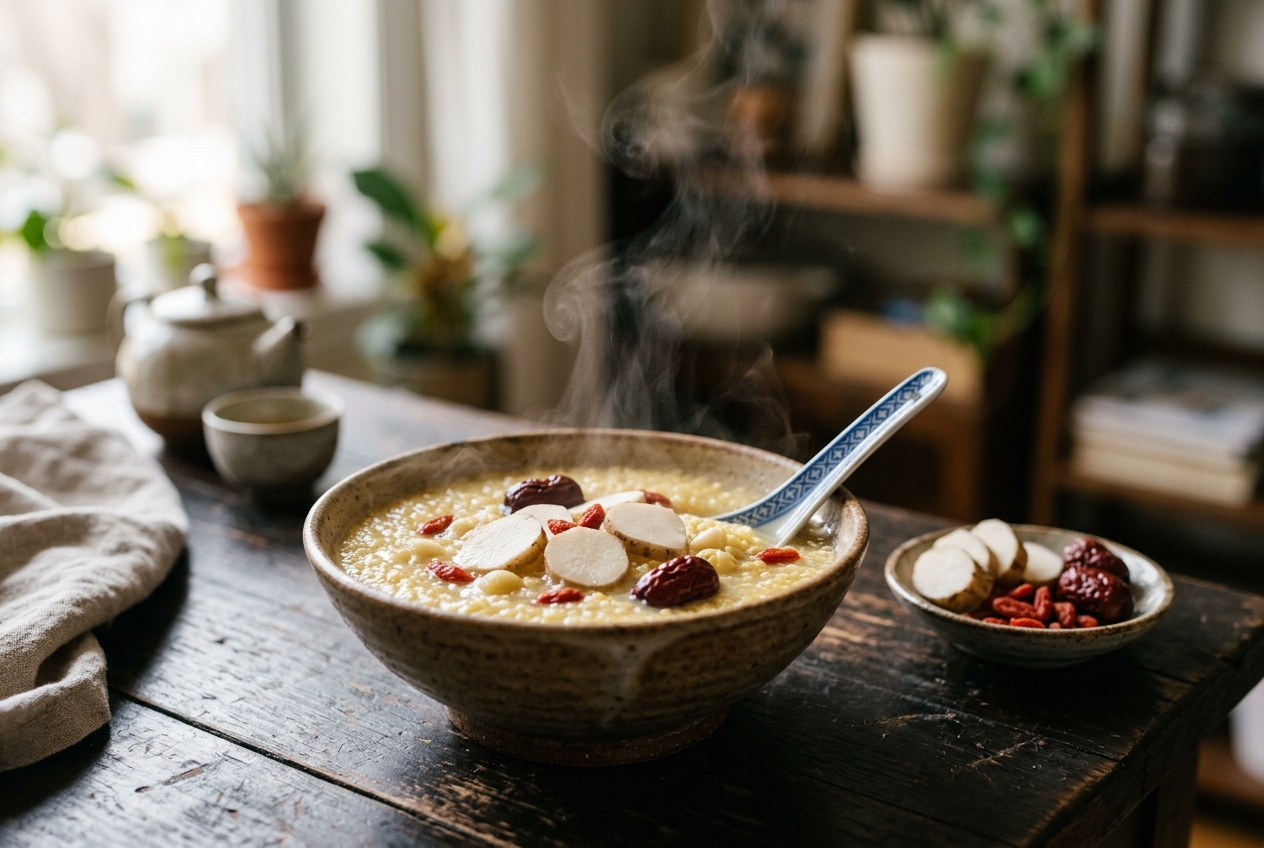
1. Opening Scene — A Moment You'll Recognise
It is 2:15 on a Tuesday afternoon. You have just returned to your desk after what seemed like an impeccably virtuous lunch: a towering bowl of raw kale, chilled quinoa, cherry tomatoes, and grilled chicken, washed down with a large tumbler of iced sparkling water.
Within twenty minutes, an unmistakable heaviness settles behind your eyes. Your limbs feel as though they have been cast in lead; a dense, cotton-like fog blankets your prefrontal cortex, bringing complex cognitive work to an abrupt standstill. Below the diaphragm, your abdomen begins to distend against the waistband of your trousers—not with the gentle fullness of nourishment, but with a taut, gassy coolness. You reach instinctively for a double espresso or a sugary biscuit to pierce the lethargy, unaware that you are attempting to ignite a fire by pouring more damp wood onto an already suffocated hearth.
In the diagnostic language of Traditional Chinese Medicine, this ubiquitous mid-afternoon collapse is not an inevitable consequence of caloric intake, nor is it a personal failing of willpower. It is the distress signal of an overwhelmed Middle Burner (Zhong Jiao / 中焦)—the foundational energetic and anatomical digestive cauldron comprised of the Spleen and Stomach. You have subjected your internal metabolic furnace to a dual thermal and volumetric shock. By flooding a warm, enzymatic environment with raw, frigid material, the body is forced to divert vast reserves of systemic vitality merely to raise the ingested mass to body temperature before biochemical processing can even begin.
Understanding how to restore this internal engine requires stepping beyond the reductionist paradigm of isolated macronutrients and entering the sophisticated, time-tested framework of Yin Shi Yang Sheng Fa (饮食养生法)—the art of dietary health cultivation.
2. What This Organ System Does: The Classical Physiology of the Middle Burner
In the foundational texts of East Asian medicine, digestion is conceived not as a passive chemical vat, but as an active, dynamic thermodynamic transformation. At the centre of this landscape sits the Spleen-Stomach dyad, celebrated across millennia as the "Root of Postnatal Essence" (Hou Tian Zhi Ben / 后天之本). While our constitutional reserve (Congenital Essence or Xian Tian Zhi Qi) is inherited from our parents and stored within the Kidneys, all daily physical energy, immunological defense, and mental acuity must be continuously manufactured from the air we breathe and the food we ingest.
The Classical Canon: Suwen and Pi Wei Lun
The classical mechanics of this system were codified in two seminal medical corpora: 1. The Huangdi Neijing Suwen (The Yellow Emperor’s Inner Classic, Basic Questions): Dating to the Han dynasty, the Huangdi Neijing established the supreme principle of Yin Shi You Jie (饮食有节)—dietary moderation in both timing and volume. The Suwen warns that when food and drink are consumed without rhythmic regulation, the visceral architecture collapses: "If dietary intake is doubled, the Spleen and Stomach will be injured" (饮食自倍,肠胃乃伤). 2. Li Dong-yuan's Pi Wei Lun (Treatise on the Spleen and Stomach, 1249 CE): During the Jin-Yuan period, master physician Li Dong-yuan formulated the revolutionary thesis that internal damage to the Middle Burner is the primary etiological root of systemic pathology: "When the Spleen and Stomach are damaged, the hundred diseases arise" (脾胃一伤,百病由生). Li established that the digestive fire is the ultimate guarantor of systemic homeostasis; if the central pivot fails, the clear Yang cannot ascend to nourish the brain, and turbid Yin cannot descend into the bowels.
The Mechanics of "Transformation and Transportation" (Yun Hua)
To translate these classical metaphors into physiological terms: - The Stomach (Wei / 胃) acts as the "Sea of Water and Grain" (Shui Gu Zhi Hai). It is a Yang organ whose natural movement is downward (Jiang / 降). It receives food, begins the process of "rotting and ripening" (enzymatic breakdown and mechanical maceration), and moves the turbid remnants downward to the small and large intestines. Because it generates heat through mechanical churning, the Stomach naturally prefers moist, lubricating foods and easily suffers from dehydration and excess heat. - The Spleen (Pi / 脾)—which in TCM encompasses not merely the anatomical lymphoid organ, but the entire functional neuro-endocrine-pancreatic digestive axis—is a Yin organ whose natural movement is upward (Sheng / 升). It performs Yun Hua (运化): the extraction of fine nutrients (Gu Qi or Grain Essence) from the ingested bolus and their upward transmission to the Lungs and Heart. There, Gu Qi combines with atmospheric oxygen to generate Defensive Qi (Wei Qi, our immunological barrier) and Blood (Xue, which nourishes the tissues and anchors the mind). - The Central Yang (Zhong Yang / 中阳): This is the metabolic pilot light. The Spleen is fundamentally averse to cold and dampness (Xi Zao E Shi / 喜燥恶湿). It requires a warm, dry internal microenvironment to effectively vaporize food into biological fuel. When fed icy or raw substances, this Central Yang is extinguished, leaving the digestive terrain boggy, sluggish, and inefficient.
Global health authorities, including the World Health Organization Traditional Medicine Strategy, increasingly emphasize the integration of these lifestyle and holistic nutritional frameworks to manage the burgeoning global burden of functional gastrointestinal and metabolic disorders.
3. How You Can Feel It — Signs of Balance and Imbalance
Because the Spleen-Stomach axis manufactures the body’s daily supply of Qi and Blood, its functional state is directly reflected in your waking energy, mental sharpness, gastrointestinal comfort, and tissue integrity.
Pathological Patterns of Middle Burner Dysfunction
When the Spleen and Stomach fall out of equilibrium, the imbalance typically manifests in one of three classic clinical presentations:
1. Spleen Qi Deficiency (Pi Qi Xu / 脾气虚)
- Somatic Indicators: Chronic postprandial fatigue, shallow breathing, faint voice, limb weakness, spontaneous bruising (as Spleen Qi loses its capacity to "hold" blood within the vessels), and loose stools containing undigested food particles.
- Psychospiritual Aspect: The Spleen houses the Yi (意)—the cognitive faculty of intention, reflection, and focused memory. When Spleen Qi is deficient, healthy reflection degenerates into pathological rumination (Si / 思), chronic overthinking, obsessive worry, and mental inertia.
2. Spleen Yang Deficiency with Internal Dampness (Pi Yang Xu Yu Shi / 脾阳虚与湿)
- Somatic Indicators: Profound cold intolerance, chilly extremities, heavy edema in the ankles, abdominal distension relieved by warmth and pressure, and a persistent sensation of bodily heaviness—as if wearing a sodden woolen sweater.
- Diagnostic Signs: The tongue appears pale, swollen, and scalloped along the margins (tooth marks caused by fluid logging against the dental arcade), covered by a thick, greasy white coating.
3. Stomach Heat and Yin Deficiency (Wei Re & Wei Yin Xu / 胃热与胃阴虚)
- Somatic Indicators: Rapid, voracious hunger paired with gastric burning, acid reflux, bad breath, bleeding gums, dry mouth with a desire for cold drinks, and stubborn constipation with hard, dry stools.
- Diagnostic Signs: A crimson tongue body with yellow, dry coating or geographic patches stripped entirely of coating (denoting the depletion of gastric fluids).
The Quantitative Law: The Principle of 70–80% Gastric Satiety (Qi Fen Bao)
One of the most vital clinical principles of Yin Shi Yang Sheng Fa is the rule of Qi Fen Bao (七分饱)—eating until the stomach is precisely seven to eight-tenths full.
Classical treatises illustrate the stomach as a cooking pot positioned over a flame. For the heat to circulate and thoroughly transform the ingredients, there must remain unoccupied space within the vessel. When an individual eats to 100% capacity (or beyond), the mechanical mass smothers the flame of Central Yang. The digestive churn grinds to a halt, creating Food Stagnation (Shi Zhi / 食滞), which rapidly ferments into toxic internal heat, dampness, and phlegm.
The Five Flavors (Wu Wei) and Their Visceral Tropism
Traditional Chinese dietetics categorises all foods according to the Five Flavors (五味), each demonstrating a specific directional and organ-specific affinity (Visceral Tropism / 归经), detailed in contemporary pharmacology and classical texts indexed via the NCBI PubMed Database.
Classical Warning from the Neijing Suwen:
"If the diet is excessively Salty, the bones ache and flesh shrinks, and the Heart Qi becomes depressed; if excessively Sweet, the Heart Qi is suffocated, the complexion darkens, and Kidney Qi is unbalanced."
4. Qigong & Movement Practice: "Regulating the Spleen and Stomach by Raising Single Arms"
To physically assist the Middle Burner in its ascending and descending mechanics, the ancient masters of the Song dynasty codified a specific movement within the renowned Baduanjin qigong (Eight Brocades) sequence: "Tiao Li Pi Wei Xu Dan Ju" (调理脾胃须单举 — Regulating the Spleen and Stomach by Raising Single Arms).
This exercise applies dynamic antagonistic traction to the myofascial lines corresponding precisely with the Stomach meridian (running down the anterior torso and thigh) and the Spleen meridian (running up the medial leg and anterolateral chest), stimulating the coeliac plexus and enhancing mesenteric lymphatic flow.
Step-by-Step Execution Protocol
-
Initial Posture & Grounding (Wuji Stance): - Stand with feet parallel, shoulder-width apart. Unlock your knees slightly. - Tuck the pelvis neutrally to flatten the lumbar spine. Rest the tip of your tongue lightly against the hard palate behind the upper front teeth (bridging the Ren and Du vessels). - Rest your hands in front of your lower abdomen (Dan Tian), palms facing upward, fingers loosely pointing toward each other.
-
Inhalation & The Opposing Separation: - Begin a slow, deep diaphragmatic inhalation through the nose over a count of 4 seconds. - Bring both hands up to the solar plexus. Turn the left palm upward and press it smoothly above your head toward the sky, fingers pointing rightward, elbow slightly rounded. - Simultaneously, turn the right palm downward and press it down beside your right hip toward the ground, fingers pointing forward. - Gently rotate your thoracic spine and stretch the torso vertically. Feel the left side of your ribcage and epigastric zone expand while the right side compresses.
-
The Micro-Pause & Meridian Stretch: - At the peak of inhalation, hold the breath effortlessly for 2 seconds. - Direct your internal gaze (Yi) into the epigastrium (Middle Burner). Feel the physical opening of the gastro-hepatic space.
-
Exhalation & Return to Center: - Exhale slowly and smoothly through the nose over a count of 4 to 6 seconds. - Relax the vertical tension. Let the left hand descend and the right hand rise, meeting once again at the level of the solar plexus, palms facing inward.
-
Reciprocal Side Execution: - Inhale again, this time pressing the right hand upward to support Heaven while the left hand presses downward to stabilize Earth. - Continue alternating with smooth, unbroken fluidity.
Prescribed Dosage and Somatic Markers
- Repetitions: Perform 8 full cycles (8 times per side, 16 movements total).
- Duration: Approximately 5 to 7 minutes each morning or 30 minutes before the midday meal.
- Somatic Benchmarks: Look for a warm, spreading glow in the solar plexus, spontaneous salivation (precious fluids / Jin Ye, indicating parasympathetic activation), gentle intestinal borborygmi (gurgling), and an immediate sensation of thoracic decompression.
5. Acupressure Points You Can Try Today
Acupressure offers a non-invasive, direct method to stimulate the neuromuscular junctions and neurovascular bundles of the Middle Burner. Apply firm, steady circular pressure using the pad of the thumb or knuckle. Maintain pressure for 2 to 3 minutes per point, breathing deeply into the lower abdomen.
1. Zusanli (ST-36 / 足三里 — "Leg Three Miles")
- Anatomical Location: Sit with your knees bent at 90 degrees. Place the four fingers of your hand horizontally across the shin, immediately below the bottom edge of the kneecap (patella). Zusanli is located at that level, exactly one thumb-width lateral to the sharp anterior crest of the shinbone (tibia), in the belly of the tibialis anterior muscle.
- Pressure Technique: Apply firm, deep pressure angled slightly toward the bone. Maintain for 2 minutes on each leg. You should elicit the characteristic De Qi (得气) sensation—a dull, heavy, spreading ache that may radiate downward toward the third toe.
- Clinical Applications: Renowned for thousands of years as the primary tonification point of the human body. Stimulating ST-36 modulates vagal nerve activity, suppresses systemic pro-inflammatory cytokines, stimulates gastric motility, and relieves chronic fatigue, postprandial bloating, and generalized weakness.
2. Zhongwan (RN-12 / 中脘 — "Middle Cavity / Front-Mu of the Stomach")
- Anatomical Location: Lie flat on your back or sit relaxed. Locate the lower tip of your breastbone (xiphoid process) and your belly button (umbilicus). RN-12 lies on the anterior midline, exactly halfway between these two anatomical landmarks (approximately 4 thumb-widths above the navel).
- Pressure Technique: Use the combined pads of your index, middle, and ring fingers. Apply gentle, rhythmic circular kneading in a clockwise direction, pressing inward only to a depth of comfort (1 to 2 centimetres). Coordinate with slow exhalations over 2 to 3 minutes.
- Clinical Applications: As the Front-Mu (alarm/collecting) point of the Stomach, RN-12 acts as the direct emergency switch for the Middle Burner. It rapidly disperses acute indigestion, epigastric pain, acid reflux, nervous stomach spasms, and the emotional "knot" held in the diaphragm during periods of high stress.
3. Sanyinjiao (SP-6 / 三阴交 — "Three Yin Intersection")
- Anatomical Location: On the inner aspect of the lower leg. Locate the highest tip of your inner ankle bone (medial malleolus). Place four fingers horizontally above this point along the back border of the shinbone. The point lies in a small, tender depression just behind the posterior edge of the tibia.
- Pressure Technique: Apply moderate, steady thumb pressure angled anteriorly toward the bone for 2 minutes per limb.
- Clinical Applications: This is the profound intersection where the Spleen, Liver, and Kidney channels converge. It strengthens Spleen Earth, resolves pathological internal dampness and water retention, stabilizes erratic blood sugar, and soothes an overactive nervous system to promote restorative sleep. (Note: Contraindicated during pregnancy).
6. Food & Lifestyle — Small Changes for Today: Yin Shi Yang Sheng Fa in Action
Modern dietetics frequently evaluates food through a static lens of calories, grams of protein, and glycemic index. Traditional Chinese dietary therapy incorporates these components into an operational framework of thermal energetics, moisture dynamics, and chronobiology.
The Thermal Rule: Eliminate the Ice and Raw Excess
The human stomach functions at a core physiological temperature of approximately 37°C. When a 4°C iced beverage or cold raw salad enters the stomach, the gastric microvasculature constricts instantly, enzymatic secretion drops, and the internal environment freezes. To digest this mass, the body must burn its own cellular battery—the Central Yang—simply to bring the bolus to physiological temperature.
- Actionable Shift: Transition from cold, raw breakfasts (smoothies, iced coffee, refrigerated yogurt) to warm, easily assimilable meals:
- Congee (Rice Porridge / 粥): White rice simmered with water or broth at a 1:8 or 1:10 ratio for 1–2 hours until the grains burst into an emollient, easily absorbed soup. Add fresh grated ginger and a pinch of sea salt.
- Stewed Fruits: Lightly simmer sliced apples or pears with cinnamon and cloves rather than consuming them raw from the refrigerator.
Circadian Chronobiology: The Horary Meridian Clock (Zi Wu Liu Zhu)
In Chinese medicine's chronobiological framework, known as Zi Wu Liu Zhu (子午流注 / The Chinese Body Clock), each visceral meridian experiences a two-hour peak of maximal energetic and metabolic perfusion during the 24-hour cycle.
- The Morning Golden Window: 7:00 AM – 9:00 AM (Chen Hour / 辰时): - This is the absolute apex of the Stomach Meridian. The digestive fire is at its highest thermodynamic strength. This is when the largest, most nutrient-dense meal of the day should be consumed. The body can transform substantial calories into functional energy with zero risk of food stagnation.
- The Assimilation Window: 9:00 AM – 11:00 AM (Si Hour / 巳时): - The Spleen Meridian reaches peak activity, transporting the extracted Gu Qi upward to fuel cognitive focus, muscular work, and systemic vitality.
- The Evening Sunset: Prior to 7:00 PM (Before the Xu Hour / 戌时): - Between 7:00 PM and 9:00 PM, energy shifts inward to the Pericardium and vascular maintenance; the digestive capacity drops to its lowest diurnal point. Heavy, late-night dinners consumed after 7:30 PM cannot be properly transformed; they stagnate in the lower bowels, generating nocturnal damp-heat, disrupting REM sleep, and precipitating fatty liver deposition.
Constitutional Personalisation: Tailoring the Plate
A central axiom of Yin Shi Yang Sheng Fa is that there is no universal diet; food is medicine only when matched to the individual’s internal pattern (Bian Zheng Shi Zhi / 辨证施治).
Further insights into constitutional patterns, classical formulas, and clinical applications can be explored through academic databases such as the National Center for Biotechnology Information (NCBI) and the digital resources of the Zang-fu Organ Systems Canon.
7. Today's Takeaway
If you do only one thing for your Middle Burner today, retire all iced beverages and replace them with warm, boiled water or a simple infusion of fresh sliced ginger consumed between meals. Make a conscious commitment at your next meal to stop eating the precise moment you reach 70% satiety—leaving that vital quarter of empty space in your gastric cauldron so your Spleen-Stomach fire can burn cleanly, transforming your food into radiant, unshakeable vitality.