Yijinjing Qigong (Yi Jin Jing) Meridian Dynamics: Governing Tendon-Muscle Transformation, Twelve Sinew Channel Tensioning, Fascial Spiral Torsion, and Bone Marrow Qi Permeation in Traditional Chinese Medicine
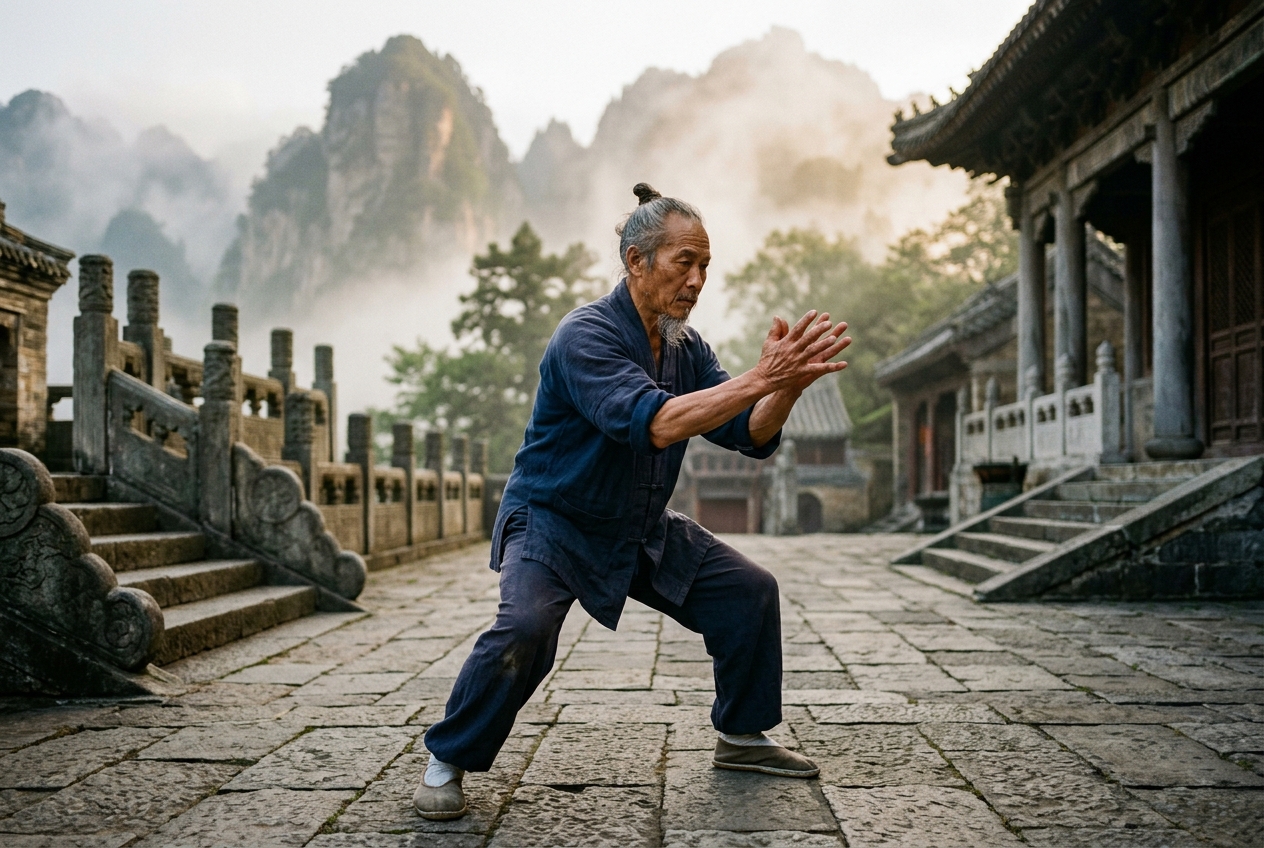
You swing your legs out of bed on a brisk morning, and before your feet even touch the floor, you feel it: an unyielding, leathery stiffness gripping the base of your skull, pulling taut down your thoracolumbar spine, and shortening the calves. As you reach across the nightstand for a glass of water, your fingers open with a creaking reluctance, your shoulder capsule resists abduction, and a vague, persistent irritability clouds your focus before the day has properly begun. When you glance into the mirror, your eyes appear fatigued, dry, and faintly bloodshot despite eight hours in bed.
In contemporary medicine, this constellation of somatic tension is frequently filed away under postural fatigue, myofascial trigger points, or the inevitable wear of a sedentary, screen-bound existence. Yet within the diagnostic framework of Traditional Chinese Medicine (TCM)—formally codified in international healthcare nomenclatures through the World Health Organization (WHO) ICD-11 Traditional Medicine Module—these symptoms are not isolated mechanical defects. They are the hallmark signature of an uncoordinated Liver (Gān) system and a malnourished network of Sinew Channels (Jing Jin).
When your inner kinetic scaffolding loses its hydration, suppleness, and functional glide, the entire bodily biomechanics collapse inward. Your muscles must work twice as hard to perform mundane actions, your microcirculation stagnates, and the nervous system remains locked in a low-grade state of sympathetic hyperarousal. To restore elastic recoil, freedom of motion, and visceral harmony, ancient physicians and martial scholars turned to a sophisticated system of neuromuscular reconditioning: Yijinjing (易筋经), the Muscle-Tendon Changing Classic.
2. What This Organ System Does
To understand how Yijinjing works on a cellular and systemic level, we must first examine the physiological role of the Liver (Gān) and its intimate partnership with the body’s structural tissues. In Chinese medical physiology, the Liver is designated the "General of the Body," tasked with strategic governance, emotional composure, and two primary systemic functions: storing the Blood (Gān Cáng Xuè) and governing the smooth, uninhibited dispersal of Qi (Gān Zhǔ Shū Xiè).
In plain clinical terms, "Qi" refers to the dynamic energetic and neurovascular drive behind metabolic function, tissue perfusion, and neuromuscular communication, while "Blood" (Xuè) encompasses both oxygenated hemoperfusion and the biofluid matrix carrying nutrients to cellular substrates. When the Liver functions harmoniously:
- It Regulates Microvascular Perfusion: The Liver acts as a dynamic reservoir, releasing blood into peripheral musculature and connective tissues during physical exertion and pulling it back to central organs during rest.
- It Governs the Sinews (Gān Zhǔ Jīn): In classical nomenclature, Jīn encompasses tendons, ligaments, deep muscular fascia, aponeuroses, and joint capsules. The supple integrity, tensile strength, and elastic recoil of your entire connective tissue network depend entirely on the nourishment provided by Liver Blood and the unobstructed flow of Liver Qi.
- It Coordinates the Twelve Sinew Channels (Jing Jin): Rather than isolated muscles acting across single joints, the Jing Jin are continuous, longitudinally organized myofascial pathways that distribute kinetic force, protect internal viscera (Zang-Fu), and maintain upright posture against gravity.
- It Interfaces with the Gallbladder (Dǎn): As the Liver's paired Yang organ, the Gallbladder governs physiological decisiveness and the lateral myofascial kinetic chains (the Gallbladder Sinew Channel), which dictate rotational stability and side-to-side adaptability.
Modern fascia research published through the National Center for Biotechnology Information (NCBI) reveals a striking correspondence between this ancient model and the science of biotensegrity. Connective tissue is not an inert biological packing material; it is a continuous, fluid-hydrated liquid-crystal matrix of type-I and type-III collagen, elastin, and proteoglycans. When this matrix is deprived of dynamic movement and fluid exchange, hyaluronan chains become dense and viscous, creating micro-adhesions across endomysial and perimysial sheaths.
By applying helical twisting, static isometric tension, and rhythmic intra-abdominal pressure changes, Yijinjing stimulates cellular mechanotransduction. According to research on piezoelectric mechanobiology in human connective tissue, mechanical deformation of collagen fibrils generates tiny electrical potentials that signal fibroblasts to synthesize healthy extracellular matrix (ECM), restore fascial glide, and down-regulate chronic inflammatory cytokines.
3. How You Can Feel It — Signs of Balance and Imbalance
Because the Liver-Sinew network spans both structural biomechanics and emotional-visceral regulation, imbalances show up in distinct, observable somatic patterns. When Liver Qi becomes stagnant (Gān Qì Yù Jié) or Liver Blood is depleted (Gān Xuè Xū), the body gives clear, daily warning signals.
Self-Assessment: Evaluating Your Liver-Sinew Status
Take 60 seconds to review these diagnostic indicators in your own body:
- The Range of Motion Check: Stand upright and slowly rotate your neck, shoulders, and hips through their full ranges of motion. Do you experience smooth, silent gliding, or do you feel dry, grinding resistance and sharp fascial restriction along the lateral torso and shoulder girdle?
- The Ocular Strain Check: Close your eyes after working at your computer. Do your orbits feel hot, dry, and irritated, accompanied by tension radiating up the suboccipital ridge? (The Liver channel internally connects with the optic system; ocular strain directly consumes Liver Blood).
- The Peri-Diaphragmatic Tension Check: Place both hands over your lower ribs and take a deep breath. Does your ribcage expand laterally with ease, or do you feel a tight band across the epigastrium and an involuntary impulse to sigh?
- The Circadian Rhythm Marker: Do you awaken alert and revitalized at dawn, or do you find yourself waking between 1:00 AM and 3:00 AM (the peak energetic window of the Liver Channel in classical chrono-acupuncture) with racing thoughts and somatic heat?
4. Qigong & Movement Practice: The Biomechanics of Yijinjing
Originating in the deep meditative and martial traditions of the Shaolin Temple and codified across centuries of Daoyin (guiding and pulling) literature—as catalogued in the historical records of the Yijin Jing traditions—Yijinjing is distinguished by three interconnected physiological engines:
- Spiral Myofascial Pre-Tensioning (Xuán Zhuǎn Jīn Luò): Movement occurs through three-dimensional helical corkscrewing rather than simple linear flexion and extension. This wrings out metabolic waste from deep fascial sheaths and recruits multi-planar muscle chains.
- Diaphragmatic Reverse Abdominal Breathing (Nì Fù Shì Hū Xī): On the inhale, the lower abdominal wall is gently contracted inward while the pelvic floor (Huiyin, CV-1) is drawn upward, driving the diaphragm downward against resisting visceral structures. On the exhale, the abdomen relaxes outward. This creates a powerful reciprocating pressure wave that massages the liver parenchyma, portal vein, and inferior vena cava.
- Static Isometric Pre-Tension with Progressive Neuromuscular Release: At the peak of each posture, a low-intensity (20–30% maximal voluntary contraction) isometric co-contraction is held, recruiting deep stabilizers and stimulating Golgi tendon organ (GTO) autogenic inhibition to reset resting muscle tone.
The 12 Classical Postural Sequences
- Wei Tuo Presenting the Pestle I (Wéi Tuó Xiàn Chǔ Dì Yī Shì): Palms joined before the chest at the Tanzhong (CV-17) locus, establishing meditative neutral balance and opening the pericardium and chest fascia.
- Wei Tuo Presenting the Pestle II (Wéi Tuó Xiàn Chǔ Dì Èr Shì): Arms extended laterally at shoulder height with wrists dorsiflexed 90 degrees and fingers drawn back, loading the superficial front arm line (Lung and Large Intestine Sinew Channels).
- Wei Tuo Presenting the Pestle III (Wéi Tuó Xiàn Chǔ Dì Sān Shì): Palms pressed upward toward the zenith while rising onto the metatarsal heads, opening the Triple Burner (San Jiao) fascia and tractioning the axial skeleton.
- Plucking a Star and Exchanging a Star (Zhuā Xīng Huàn Dǒu Shì): One arm reaches diagonally overhead with palm rotated toward the occiput while the opposite arm wraps behind the lumbar spine (Mingmen), imparting a powerful rotational shear across the thoracolumbar junction to balance Spleen and Stomach transport.
- Pulling Nine Oxen by Their Tails (Dào Qiān Jiǔ Niú Wěi Shì): Deep asymmetric bow-and-arrow stance (Gong Bu) with opposing spiral arm pulls, loading the posterior myofascial chain (Bladder and Small Intestine Sinew channels) to clear back stagnation.
- Displaying Claws and Spreading Wings (Chū Zhǎo Liàng Chì Shì): Rhythmic forward palm thrusts with intense retroflexion of the wrists followed by claw-like finger retraction, clearing heat from the chest and mobilizing deep hand flexors/extensors.
- Nine Ghosts Drawing Sabres (Jiǔ Guǐ Bá Mǎ Dāo Shì): Complex asymmetric helical rotation where one hand reaches over the shoulder to grasp the opposite ear while the other ascends behind the back, wringing out the lateral Gallbladder Sinew Channel and intercostal spaces.
- Sinking the Three Bodily Portions (Sān Pán Luò Dì Shì): Wide horse stance squat (Ma Bu) with palms pressing downward in progressive steps, stabilizing the lower dantian and training the deep adductor/iliopsoas core complex.
- Black Dragon Displaying Claws (Qīng Lóng Tàn Zhǎo Shì): Lateral lunging with transverse torso rotation, extending a single clawed hand horizontally across the body to stimulate the Liver and Spleen collateral vessels (Luo Mai).
- Crouching Tiger Pouncing on Prey (Wò Hǔ Pū Shí Shì): Prone isometric extension supported on fingertips and toes with the spine arched, engaging the entire ventral and dorsal kinetic chains to tonify Kidney essence (Jing) and the Governing Vessel (Du Mai).
- Bowing Down in Salutation (Dǎ Gōng Shì): Forward spinal flexion with palms cupping the suboccipital region and index fingers snapping against the mastoid process ("Beating the Heavenly Drum"), decompressing the craniosacral axis.
- Wagging the Tail to Extinguish Heart Fire (Diào Wěi Shì): Deep forward fold with interlocked fingers circling above the ground, harmonizing the cerebrospinal fluid dynamics and integrating Qi throughout all twelve meridian channels.
Step-by-Step Home Practice Protocol: The Helical Sinew Reset
To immediately experience the revitalizing effects of Yijinjing, practice this accessible 3-phase hybrid sequence derived from Plucking a Star and Displaying Claws.
Phase 1: Setup and Grounding (Neutral Zhan Zhuang)
- Stand with your feet parallel, hip-width apart. Let your knees soften so they are springy, not locked.
- Suspend the crown of your head (Baihui, GV-20) upward as if suspended by a silk cord from above. Drop your tailbone down toward the earth, flattening the excessive curvature of the lumbar spine.
- Rest your tongue against the upper palate behind the upper incisors to close the Conception and Governing vessels. Rest your hands gently over the lower abdomen (Dan Tian).
- Take three natural diaphragmatic breaths, letting all shoulder tension melt downward.
Phase 2: Dynamic Helical Torsion (Plucking a Star)
- The Inhale & Wind-Up (4 seconds): Slowly inhale through your nose using reverse abdominal breathing—gently draw your navel inward toward your spine. As you do, sweep your right hand across your midline, turning the palm skyward as it reaches diagonally overhead above your left ear. Simultaneously, sweep your left hand behind your back, placing the back of your left wrist against the lumbar spine (Mingmen, GV-4).
- The Isometric Hold (3–5 seconds): Gaze upward toward your raised right palm. Rotate your torso 15 degrees further to the left. Engage a gentle, 20% isometric stretch: reach the top palm toward the ceiling while pressing your feet firmly into the floor. Feel the continuous, diagonal spiral of tension winding from your right foot, through your outer hip, up the latissimus dorsi, and out through your right fingertips.
- The Exhale & Release (5 seconds): Slowly exhale through your nose, releasing the abdominal contraction and allowing the belly to expand naturally. Unwind the spiral, bringing both hands back to the lower abdomen as your torso returns to center.
- Repetitions: Complete 6 alternating repetitions per side (12 cycles total).
Phase 3: What Sensations to Look For
- Thermal Flush: A distinct sensation of warmth radiating down the lateral ribs and into the palms, indicating microcirculatory vasodilation.
- Fascial Release: A subtle "melting" or popping sensation along the thoracolumbar fascia as hyaluronan adhesions yield under helical shear.
- Autonomic Shift: Spontaneous salivation (Yù Yè or Jade Fluid), deeper unforced respiration, and an immediate drop in emotional reactivity.
5. Acupressure Points You Can Try Today
Acupressure offers a direct, non-invasive method to stimulate focal points along the Sinew and Primary Channels where neurovascular bundles penetrate deep fascial septa. Practice these three foundational points to support sinew flexibility and dispel Liver stagnation.
1. Taichong (LIV-3 — Great Surge / 太冲)
- How to Find It: Sit comfortably with one foot resting across the opposite knee. Slide your finger from the webbing between your big toe and second toe upward along the top of your foot for about 1.5 to 2 finger-widths. Your finger will slip into a tender, triangular depression just before the junction of the first and second metatarsal bones.
- Application Technique: Apply firm, sustained pressure using your thumb tip at a 90-degree angle. Rotate the thumb in micro-circles. The sensation should be a dull, spreading ache (De Qi), not sharp or bruising.
- Duration: 2 to 3 minutes per foot while taking slow, deep abdominal breaths.
- Clinical Benefits: The primary source point (Yuan-Source) of the Liver meridian. It resolves tension headaches, eases emotional irritability, relieves menstrual cramping, and disperses ocular heat.
2. Yanglingquan (GB-34 — Yang Mound Spring / 阳陵泉)
- How to Find It: Locate the bony bump on the outer side of your leg just below and outside your knee joint (the head of the fibula). Move your finger slightly forward and downward into the soft muscular depression immediately in front of and below this bony landmark.
- Application Technique: Press deeply using your thumb or middle knuckle, angling the vector slightly upward toward the knee joint. Maintain firm, steady pressure with small circular kneading.
- Duration: 2 minutes on each leg.
- Clinical Benefits: Renowned across acupuncture traditions as the Influential Hui-Meeting Point of all Sinews and Tendons. It provides rapid relief for lateral knee pain, tight iliotibial (IT) bands, sciatic discomfort, neck stiffness, and generalized fascial tightness throughout the body.
3. Hegu (LI-4 — Joining Valley / 合谷)
- How to Find It: On the back of your hand, look at the webbing between your thumb and index finger. Bring your thumb against the side of your index finger—a small muscle mound will rise. Place your opposite thumb at the highest point of this mound, then relax your hand and press inward toward the bone of the index finger.
- Application Technique: Apply firm, pulsing pressure directed toward the second metacarpal bone for 90 seconds per hand. (Note: Contraindicated during pregnancy).
- Clinical Benefits: Clears pain and wind-heat from the head and sensory orifices, eases jaw tension and toothache, and works synergistically with LIV-3 (a classical pairing known as the "Four Gates" or Si Guan) to open systemic circulation and calm the nervous system.
6. Food & Lifestyle — Small Changes for Today
Nourishing the Liver-Sinew network does not require rare herbal compounds or complex preparations. Everyday, accessible dietary additions, mindful culinary habits, and simple lifestyle adjustments can steadily restore your connective tissue and liver vitality.
1. Dietary Adjustments for Sinew Hydration and Liver Flow
- Incorporate the Sour Flavor Mindfully: In Five-Phase theory (Wu Xing), the sour taste enters and tonifies the Liver system. Sour compounds gently astringe fluids and stimulate biliary secretion. Begin your morning with a mug of warm water infused with a generous squeeze of fresh lemon or a teaspoon of raw apple cider vinegar.
- Eat Dark, Bitter-Greens: Deep green vegetables are rich in chlorophyll, magnesium, and sulfur compounds that support phase I and phase II hepatic detoxification. Add lightly steamed dandelion greens, arugula, watercress, spinach, and broccoli florets to your daily meals.
- Provide Collagen Substrates for the ECM: Connective tissue repair requires adequate amino acid building blocks—specifically glycine, proline, and hydroxyproline. Incorporate slow-simmered bone broths, tendon stews, or mineral-rich seaweed broths into your weekly meal rotation to provide direct structural substrate for fascial remodeling.
- What to Reduce:
- Trans-fats and ultra-processed industrial seed oils: These promote systemic arachidonic-acid inflammatory cascades that stiffen the fascial matrix.
- Excessive refined sugar and alcohol: Directly induces hepatic steatosis and creates Advanced Glycation End-products (AGEs), which chemically cross-link collagen fibers and destroy their elastic recoil.
- Cold, iced drinks during meals: Iced liquids constrict the celiac and mesenteric microcirculation, impairing the Spleen's ability to extract nutrients and generate blood.
2. Circadian & Lifestyle Habits for Fascial Health
- Protect Liver Blood with the 20-20-20 Ocular Rule: According to the Huangdi Neijing (The Yellow Emperor’s Classic of Internal Medicine), "The Liver opens into the eyes; when the eyes receive blood, they can see." Staring continuously at digital screens without blinking drains the central nervous system and depletes Liver Blood. Every 20 minutes, gaze at an object 20 feet away for 20 seconds to allow the ciliary muscles to relax.
- Respect the 11:00 PM Sleep Threshold: The Gallbladder and Liver channels govern the circadian window between 11:00 PM and 3:00 AM. Lying down horizontally allows blood to pool back into the hepatic parenchyma for filtration, cellular repair, and neurochemical synthesis. Late-night wakefulness directly undermines connective tissue repair and exacerbates morning joint stiffness.
7. Today's Takeaway
If you do only one thing today for your Liver and sinews, take five uninterrupted minutes before lunch: stand up from your chair, locate Yanglingquan (GB-34) just below your outer knee, apply firm circular pressure for sixty seconds on each side, and immediately complete six slow, spiral repetitions of "Plucking a Star and Exchanging a Star" while engaging reverse abdominal breathing. By combining focal acupressure stimulation with helical myofascial loading, you instantly break up connective tissue cross-linking, restore microvascular perfusion to restricted tissues, and reconnect your body's ancient, resilient biotensegrity architecture from head to toe.