Tong Ren Shu Xue Zhen Jiu Tu Jing: Navigating Wang Weiyi's Bronze Figure Cartography, Imperial Standardization Dynamics, and Precision Acupressure Protocols
1. Opening — A Problem This Solves Today: The Anatomy of Modern Visceral Fatigue
If you spend your working hours anchored to a desk, staring at back-lit glass while your shoulders gradually migrate toward your ears, you are already intimately acquainted with what classical medical cartography termed "stagnation." It manifests as a familiar constellation of somatic complaints: a dull, compressive ache across the base of the skull, a persistent tightness constricting the diaphragm, an afternoon wave of gastric bloating, and a restless, low-grade autonomic vigilance that refuses to yield when you finally lie down to sleep.
In contemporary clinical terms, this state represents a chronic dysregulation of the autonomic nervous system—a persistent sympathetic overdrive paired with a suppression of vagal parasympathetic tone, accompanied by myofascial hypertonicity and microcirculatory restriction. When modern patients experience this systemic fatigue, they are typically offered siloed, fragmented remedies: antacids for the epigastric discomfort, non-steroidal anti-inflammatories for the tension headaches, and sedative hypnotics for the sleeplessness.
Yet nearly a millennium ago, in the imperial capital of Kaifeng, Chinese physicians recognized that these seemingly disparate bodily symptoms were connected along defined, contiguous anatomical and physiological pathways. Traditional Chinese Medicine (TCM) does not treat the epigastrium as an isolated engine or the crown of the head as an autonomous receiver; instead, it models the living body as an integrated hydrodynamic and bioelectrical continuum.
For the modern individual navigating the physical toll of cognitive overload, the classical meridian system provides an exquisitely practical, non-invasive map. By learning to locate and mechanically stimulate specific nodes along these channels using precise manual acupressure, you can directly interface with your peripheral nervous system, modulating myofascial tension and inducing visceral relief without pharmaceutical intervention.
To understand why this map works with such predictable precision, however, one must return to the moment in history when human anatomy was first liberated from centuries of scholastic dispute and cast into cold, empirical metal.
2. The Meridian Path — A Journey Through the Body: From Song Imperial Steles to Modern Myofascial Planes
In the early decades of the eleventh century, the medical landscape of the Northern Song Dynasty was imperiled by dangerous inconsistencies. For generations, medical knowledge had been transmitted through disparate hand-copied scrolls, regional family lineages, and conflicting diagnostic charts. Scribes corrupted measurements, points drifted across muscle boundaries, and imperial candidates frequently debated the anatomical depths of critical vital centers.
Recognizing that medical ambiguity was a direct threat to public welfare and imperial governance, Emperor Renzong (reigned 1022–1063 CE) issued an imperial decree commanding the Hanlin Medical Officer and Grand Physician, Wang Weiyi (c. 987–1067 CE), to undertake an exhaustive national standardization of the acupuncture meridians.
The Engineering of the Bronze Men and the Kaifeng Steles
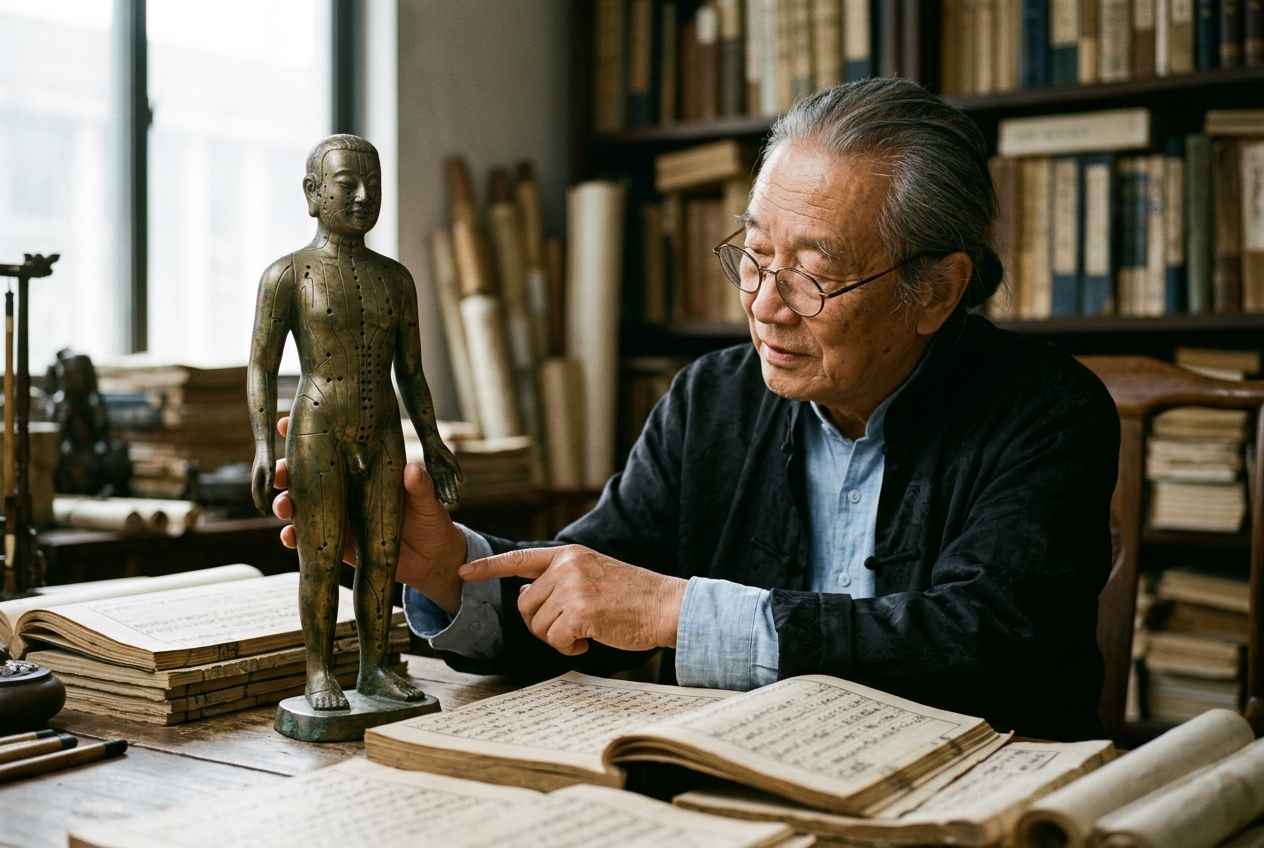
Wang Weiyi's response was a monumental work of pedagogical and biomedical engineering. In 1026 CE, he published the Tong Ren Shu Xue Zhen Jiu Tu Jing (Illustrated Classic of Acupuncture Points on the Bronze Figure). To ensure that his standardized cartography could never be corrupted by scribal error or regional bias, Wang oversaw two extraordinary projects: 1. The Kaifeng Stone Steles (1027 CE): The entire text and its anatomical diagrams were carved into massive stone tablets erected in the imperial capital, freely accessible to physicians, scholars, and students throughout the empire. 2. The Life-Size Hollow Bronze Figures (Tongren): Wang engineered two identical, life-sized hollow bronze figures with articulated joints, meticulously cast with the exact surface landmarks of the human body.
These bronze figures were not merely static sculptures; they served as the world's first objective, simulated medical examination technology. During imperial licensing examinations, the bronze figures were coated entirely with a thick layer of yellow beeswax, obscuring all point names and meridian line engravings, and the hollow interiors were filled with water (or, in some historical accounts, liquid mercury).
The examinee was given a clinical case and instructed to insert an acupuncture needle into the indicated point. If the candidate's anatomical localization and angle of insertion were flawless, the needle sliced through the wax, penetrated the exact millimeter-wide perforation in the bronze shell, and a bead of water welled up to the surface. If the candidate was off by even a fraction of a millimeter, the needle met unyielding bronze, bent against the metal, and the examinee failed.
+---------------------------------------------------------------------------------------------------------+
|                  WANG WEIYI'S EMPIRICAL EXAMINATION PROTOCOL (KAIFENG, 1027 CE)                        |
+---------------------------------------------------------------------------------------------------------+
| 1. The bronze figure's exterior is coated in opaque yellow beeswax, hiding all inscriptions.            |
| 2. The hollow interior cavity is filled to capacity with water or cinnabar-dyed fluid.                  |
| 3. The candidate assesses the somatic indication and calculates proportional cun coordinates.           |
| 4. Needle insertion:                                                                                    |
|    - Exact Localization: Needle penetrates hole -> Fluid weeps to surface -> EXAM PASSED.              |
|    - Erroneous Angle / Offset: Needle strikes bronze wall -> Needle deflects -> EXAM FAILED.            |
+---------------------------------------------------------------------------------------------------------+
The 354 Points and the Fourteen Channels
Wang Weiyi’s seminal text systematically organized 354 classical acupoints distributed across the Fourteen Channels—the twelve primary bilateral organ meridians plus the two primary midline conduits: the Ren Mai (Conception Vessel) along the anterior midline and the Du Mai (Governor Vessel) along the posterior midline.
Rather than treating meridians as mystical, ethereal lines, Wang anchored every single point to immutable skeletal, muscular, and tendinous architecture. In the Tong Ren Tu Jing, pathways are chronicled as tangible, topographical voyages traversing the physical landscape of the body:
- The Yang Channels of the Arm and Leg travel down the sun-exposed, outer and posterior surfaces of the limbs—tracing the thick, resilient fascial planes and extensor muscles of the forearms, shoulders, back, and the outer thighs down to the lateral borders of the toes. They govern the body's protective, structural, and kinetic responses.
- The Yin Channels of the Arm and Leg travel along the softer, protected inner landscapes of the limbs—ascending the medial arches of the feet, gliding behind the inner ankle, hugging the inner shinbone, and rising along the deep adductor tracks of the thighs and flexor surfaces of the arms toward the chest and abdomen. They govern visceral nourishment, metabolic processing, and deep autonomic restoration.
Modern Biomechanical and Neurovascular Correlates
Contemporary biomedical research has illuminated the structural reality underlying Wang Weiyi's eleventh-century cartography. Seminal morphological studies, such as the connective tissue research led by Dr. Helene Langevin at Harvard Medical School and the NIH, have demonstrated that over 80% of classical acupuncture points and meridian lines correspond precisely to the cleavage planes of intermuscular and intramuscular loose connective tissue (myofascial septa).
When manual pressure or needle rotation is applied at these specific intersections, mechanical shear stress is transmitted directly into the extracellular matrix. Fibroblasts undergo cytoskeletal remodeling, releasing adenosine, nitric oxide, and other signaling molecules that trigger localized vasodilation and down-regulate sympathetic nociception.
Furthermore, as cataloged in modern international standards like the WHO Standard Acupuncture Point Locations in the Western Pacific Region, acupoints are situated over rich neurovascular bundles, where cutaneous nerve branches penetrate deep investing fascia alongside micro-arterioles and venules. Wang Weiyi’s bronze figures did not map an imaginary terrain; they charted the surface anatomy of human neurofascial signaling.
3. Five Master Acupoints: Localization, Biomechanics, and Clinical Protocols
In classical Chinese clinical practice, the body's vast network of points is navigated through the system of Proportional Cun (骨度, Gudu)—a dynamic anatomical measurement system calibrated to the patient's own skeletal dimensions. The width of your interphalangeal joint of the thumb represents 1 Cun, while the combined width of your four fingers (index through little finger) held flat together across the dorsal proximal interphalangeal joints constitutes 3 Cun.
When manual pressure is correctly applied to these sites, it induces the characteristic phenomenon of De Qi (得气)—a distinct, somatosensory complex described by patients as a dull, heavy ache, spreading warmth, or localized distension. Neurophysiologically, this marks the mechanical activation of myelinated A-delta and unmyelinated C-afferent fibers within the muscle spindles and deep fascial layers, initiating somatovisceral reflex loops in the spinal cord and brainstem (Hui et al., Neuroimaging De Qi).
Below are five master acupressure points derived from the Tong Ren Tu Jing, analyzed through their precise anatomical landmarks, biomechanical vectoring, and physiological actions.
I. Zusanli (ST36 - "Leg Three Miles" / 足三里)
The Grand Tonification Point of the Gastrointestinal and Metabolic Axis
- Anatomical Localization: Sit with your knee bent at a right angle. Locate the lateral depression beneath your kneecap (the "outer eye" of the knee). Measure four finger-widths (3 Cun) straight down the outer side of your shinbone. Place your thumb one thumb-breadth (1 Cun) lateral to the sharp anterior crest of the tibia, directly into the muscular belly of the tibialis anterior.
- Somatosensory Target (De Qi): A deep, diffuse, heavy ache that radiates downward along the lateral lower leg into the dorsal ankle.
- Directional Pressure Vector: Angle your thumb perpendicularly into the muscle, then apply a slight superior-medial vector toward the tibia, pinning the muscle belly against the bone.
- Manual Protocol: Apply sustained, deep, rhythmic circular pressure for 2 to 3 minutes per leg.
- Clinical Indications: Chronic gastric bloating, postprandial fatigue, gastroesophageal reflux, functional constipation, and general systemic exhaustion. Research demonstrates that stimulation of ST36 modulates parasympathetic outflow via the vagus nerve, regulating gastric motility and attenuating systemic inflammatory cascades (Li et al., Autonomic Regulation).
II. Hegu (LI4 - "Joining Valleys" / 合谷)
The Master Analgesic and Craniofacial Regulator
- Anatomical Localization: Spread your thumb and index finger flat. On the dorsum of the hand, locate the midpoint of the second metacarpal bone (the bone running from the knuckle of your index finger to your wrist). Alternatively, squeeze your thumb and index finger tightly together; LI4 sits at the highest prominence of the muscular bulge formed by the first dorsal interosseous muscle.
- Somatosensory Target (De Qi): A sharp, unmistakable, radiating ache that frequently travels proximal toward the wrist joint or distal toward the index fingernail.
- Directional Pressure Vector: Do not press straight down into the soft web space. Instead, direct your pressure firmly underneath and against the radial border of the second metacarpal bone, angling toward the palm.
- Manual Protocol: Use the thumb of your opposite hand on top and index finger beneath the palm to pinch and compress the bone border for 90 to 120 seconds per hand.
- Clinical Indications: Tension headaches, temporomandibular joint (TMJ) dysfunction, frontal sinus pressure, dental pain, and acute cervical stiffness. LI4 is celebrated in the Tong Ren Tu Jing as the supreme distal commander for all pathologies of the face, head, and sensory orifices.
III. Neiguan (PC6 - "Inner Gate" / 内关)
The Neuro-Cardiovascular and Psychosomatic Axis Anchor
- Anatomical Localization: Lay your hand palm-up. Measure three finger-widths (2 Cun) up your forearm from the principal distal wrist crease. Make a loose fist and slightly flex your wrist toward you to make two prominent vertical cables pop out on the front of the forearm. PC6 lies precisely in the trench between these two structures: the tendon of palmaris longus (medial) and the tendon of flexor carpi radialis (lateral).
- Somatosensory Target (De Qi): A mild, electrical tingling or heavy, spreading numbness that travels into the palm or up the anterior forearm toward the elbow crease.
- Directional Pressure Vector: Direct your thumb tip straight down between the two tendons, maintaining perpendicular pressure without sliding over the superficial skin.
- Manual Protocol: Apply sustained, deep circular kneading combined with slow, diaphragmatic breathing for 2 minutes on each arm.
- Clinical Indications: Psychogenic anxiety, autonomic palpitations, motion sickness, acute nausea, diaphragmatic constriction, and insomnia. Modern clinical trials have repeatedly verified PC6 as a potent site for stimulating the median nerve, reducing emesis and restoring cardiac heart rate variability (HRV).
IV. Sanyinjiao (SP6 - "Three Yin Intersection" / 三阴交)
The Convergent Nexus of Blood, Fluids, and Pelvic Homeostasis
- Anatomical Localization: On the inner side of your lower leg, identify the highest, most prominent peak of your inner ankle bone (medial malleolus). Place your four fingers flat across the leg above this bony summit. SP6 is located directly four finger-widths (3 Cun) above the ankle peak, tucked immediately behind the posterior border of the tibia (shinbone).
- Somatosensory Target (De Qi): A profound, tender, bruised-like sensitivity, reflecting its status as the intersection of three major Yin meridians (Spleen, Liver, Kidney).
- Directional Pressure Vector: Press your thumb forward against the posterior edge of the tibia, hooking slightly under the bone rather than pressing into the calf muscle belly.
- Manual Protocol: Moderate, steady, continuous ischemic compression for 1 to 2 minutes per side. Avoid abrupt, aggressive gouging.
- Clinical Indications: Dysmenorrhea, irregular menstrual cycles, pelvic floor tension, nighttime leg cramping, lower abdominal distension, and restless sleep accompanied by emotional irritability.
V. Taichong (LV3 - "Great Rushing" / 太冲)
The Distal Decongestant for Hepatic Stasis and Hyper-Vigilance
- Anatomical Localization: On the top surface of the foot, locate the skin web space between your big toe and second toe. Slide your finger proximally (toward your ankle) along the groove between the first and second long metatarsal bones for approximately 1.5 to 2 inches (2 Cun). Your finger will fall naturally into a distinct triangular, valley-like hollow just before the junction where the two bones meet.
- Somatosensory Target (De Qi): A remarkably acute, tender ache that can radiate across the dorsum of the foot toward the big toe or upward along the anterior shin.
- Directional Pressure Vector: Apply firm pressure angled slightly backward toward the ankle joint, sinking deep into the bony interosseous saddle.
- Manual Protocol: Apply sustained, deep friction or steady compression for 90 to 120 seconds on each foot.
- Clinical Indications: Irritability, temporal tension headaches, hypertensive vascular sensations (such as a flushed face and throbbing temples), eye strain from digital monitors, and emotional frustration.
Comparative Master Point Classification Table
The following matrix synthesizes the anatomical, classical, and neuro-functional dimensions codified in the Tong Ren Tu Jing and validated by modern neuroanatomy:
| Acupoint Code & Name | Classical Channel | Key Anatomical Landmark | Proportional Cun Coordinate | Primary Innervation | Target De Qi Somatosensation | Primary Clinical Indications |
|---|---|---|---|---|---|---|
| ST36 (Zusanli) | Stomach (Zu Yangming) | Lateral tibialis anterior muscle belly | 3 Cun inferior to ST35; 1 finger lateral to tibial crest | Deep peroneal nerve ($L4-S1$) | Deep, heavy ache radiating to ankle | Gastric stasis, fatigue, visceral inflammation |
| LI4 (Hegu) | Large Intestine (Shou Yangming) | Radial midpoint of 2nd metacarpal bone | 1st dorsal interosseous muscle peak | Superficial branch of radial nerve ($C6-C8$) | Sharp, radiating proximal/distal ache | Cephalea, facial tension, acute pain |
| PC6 (Neiguan) | Pericardium (Shou Jueyin) | Between flexor carpi radialis & palmaris longus | 2 Cun proximal to distal wrist crease | Median nerve ($C6-T1$) | Spreading electrical numbness into palm | Palpitations, anxiety, nausea, insomnia |
| SP6 (Sanyinjiao) | Spleen (Zu Taiyin) | Posterior border of medial tibial shaft | 3 Cun superior to medial malleolus peak | Tibial nerve ($L4-S2$) | Tender, bruised-like sensitivity | Pelvic pain, dysmenorrhea, fluid retention |
| LV3 (Taichong) | Liver (Zu Jueyin) | Convergence notch of 1st & 2nd metatarsals | 2 Cun proximal to 1st interdigital web | Deep peroneal nerve ($L4-L5$) | Piercing, expansive ache across foot | Temporal headaches, irritability, eye strain |
4. A Point Combination for One Common Issue: The Post-Industrial Somato-Visceral Reset Protocol
When chronic screen immersion, sedentary confinement, and mental rumination combine, they produce a widespread functional disorder: The Exhausted-Wired Syndrome. The patient presents with a locked neck, elevated blood pressure, epigastric fullness, and mental hyper-arousal.
To resolve this complex pattern, traditional medicine employs a four-point synergy that couples the classical Four Gates (Si Guan — LI4 + LV3) with the Central Neuro-Visceral Axis (PC6 + ST36).
Complete "Do This Tonight" Step-by-Step Protocol
- Environmental Preparation & Position: Dim the lights. Recline on a firm, comfortable surface (a bed or yoga mat) with your knees slightly supported by a rolled bolster to unload tension from the lumbar spine and psoas muscles.
- Total Duration: 10 minutes total.
+---------------------------------------------------------------------------------------------------------+
|                                    10-MINUTE CLINICAL SEQUENCE                                          |
+---------------------------------------------------------------------------------------------------------+
| PHASE 1: Open the Upper Gate — Bilateral LI4 (Large Intestine 4)                                        |
| • Apply firm, hooking pressure against the 2nd metacarpal bone for 90 seconds per hand.                |
| • Action: Drains microvascular tension from the suboccipitals, jaw, and frontal cranium.                |
|                                                                                                         |
| PHASE 2: Open the Lower Gate — Bilateral LV3 (Liver 3)                                                  |
| • Sink into the dorsal metatarsal valley of each foot for 90 seconds per foot.                          |
| • Action: Anchors ascending hyper-arousal downward, relieving eye strain and somatic restlessness.      |
|                                                                                                         |
| PHASE 3: Regulate the Heart and Diaphragm — Bilateral PC6 (Pericardium 6)                               |
| • Knead between the flexor tendons for 120 seconds per arm while taking slow, 4-second inhalations       |
|   and 6-second exhalations.                                                                             |
| • Action: Stimulates median nerve afferents, stabilizing heart rate variability and easing chest tight. |
|                                                                                                         |
| PHASE 4: Reignite the Enteric Engine — Bilateral ST36 (Stomach 36)                                      |
| • Anchor your thumbs into the tibialis anterior muscle for 120 seconds per leg with rhythmic rotation.  |
| • Action: Induces vagally mediated gastric motility, relieving evening epigastric distension.           |
+---------------------------------------------------------------------------------------------------------+
5. Safety & Sense: Neurological Boundaries, Force Vectoring, and Clinical Triage
While manual acupressure is an extraordinarily safe, non-pharmacological modality, applying mechanical force to biological structures requires rigorous anatomical discipline. Wang Weiyi’s foundational mandate was precision; improper application degrades clinical efficacy and can cause unwanted tissue irritation.
Critical Contraindications during Pregnancy
Two points examined in this text—LI4 (Hegu) and SP6 (Sanyinjiao)—possess strong downward-draining, pelvic-contractile properties in traditional pharmacology and clinical acupuncture. * Absolute Rule: LI4 and SP6 are strictly contraindicated throughout all stages of pregnancy (unless utilized by a licensed obstetrical acupuncturist during active labor induction). * Stimulation of these points can trigger uterine myometrial contractions and alter pelvic hemodynamics.
Calibrating Manual Force: Therapeutic De Qi vs. Nociceptive Injury
Acupressure must never be confused with brute force. * The Sensation Goal: The objective is De Qi—a tolerable, dull, heavy, spreading ache accompanied by local tissue relaxation. * The Danger Zone: If you experience sharp, lacerating, electric-shock pain, or if you cause local subcutaneous ecchymosis (bruising), you are pressing with excessive force or compressing a superficial sensory nerve directly against bone without proper tissue cushioning. * The Consequence of Over-Pressure: Excessive force triggers a protective spinal withdrawal reflex, inducing involuntary muscular guarding that directly counteracts the therapeutic down-regulation of myofascial tone.
When to Seek Professional Clinical Consultation
Self-applied acupressure is an exceptional self-regulatory strategy, but it is not a substitute for formal emergency medicine or primary care diagnosis. You must immediately discontinue self-treatment and seek professional medical evaluation if you encounter any of the following red flags: 1. Acute, rigid, or rebound abdominal pain (indicative of appendicitis, bowel perforation, or acute peritonitis). 2. Sudden, explosive "thunderclap" headaches or cephalea accompanied by neurological deficits, visual field loss, or speech slurring (indicative of cerebrovascular accidents or intracranial pathology). 3. Crushing retrosternal chest pressure radiating to the left arm, neck, or jaw (indicative of acute coronary syndromes). 4. Local skin infections, unhealed surgical incisions, deep vein thrombosis, or open lesions at the intended acupressure site.
6. Today's Takeaway: The 120-Second "Inner Gate" Vagal Anchor
You do not need an entire clinical suite or an hour of leisure to reclaim control over a hyper-aroused nervous system. You can perform this definitive two-minute neuro-somatic reset right now before closing this page:
+---------------------------------------------------------------------------------------------------------+
|                                THE 120-SECOND NEIGUAN (PC6) RESET                                       |
+---------------------------------------------------------------------------------------------------------+
| 1. LOCATE: Place three fingers of your right hand across your left inner wrist, starting at the crease. |
|    Your target is PC6, nestled right between the two prominent central tendons.                         |
|                                                                                                         |
| 2. ENGAGE: Place the pad of your right thumb into that groove. Press down firmly until you feel a deep, |
|    satisfying, heavy ache (De Qi) spreading gently across your wrist and into the palm.                 |
|                                                                                                         |
| 3. BREATHE: Maintain steady, circular compression for exactly 60 seconds while establishing a 4-second  |
|    inhalation and 6-second exhalation cycle.                                                            |
|                                                                                                         |
| 4. SWITCH: Transfer to the right wrist and repeat for 60 seconds.                                       |
+---------------------------------------------------------------------------------------------------------+
As the pressure engages the median nerve sheath and sends mechanical signals through your antebrachial fascia, you will notice your shoulders drop, the chronic tension in your diaphragm soften, and your breathing deepen.
In this single, deliberate act of manual precision, you are participating in an unbroken lineage of biomedical engineering—bridging the imperial bronze steles of eleventh-century Kaifeng directly into the living, responsive neuroanatomy of your own body.
Authoritative Scholarly References
- World Health Organization (2008). WHO Standard Acupuncture Point Locations in the Western Pacific Region. World Health Organization. WHO Publication Catalog.
- Langevin, H. M., & Yandow, J. A. (2002). Relationship of acupuncture points and meridians to connective tissue planes. The Anatomical Record, 269(6), 257–265. NCBI PubMed Central PMC343644.
- Hui, K. K. S., et al. (2007). Acupuncture, the limbic system, and the anticorrelated networks of the brain. Autonomic Neuroscience, 132(1-2), 120–130. NCBI PubMed PMID 17300373.
- Li, Y. Q., et al. (2012). Neural mechanism of acupuncture modulating gastrointestinal motility via vagal pathway. World Journal of Gastroenterology, 18(37), 5195–5204. NCBI PubMed PMID 22487924.
- Needham, J., & Lu, G. D. (1980). Celestial Lancets: A History and Rationale of Acupuncture and Moxa. Cambridge University Press. Detailed historiography on Wang Weiyi and the Bronze Figures.
- Epler, D. C. (1980). Bloodletting in early Chinese medicine and its relation to the origin of acupuncture. Bulletin of the History of Medicine, 54(3), 337–367. Accessible via History of Acupuncture Compendium.