Shi Si Jing Fa Hui: Navigating Hua Shou's Fourteen Channel Cartography, Unified Circulation Dynamics, and Precision Acupressure Protocols
1. Opening — A Problem This Solves Today: The Disconnected Body and the Modern Malaise
If you spend your working days locked into an ergonomic chair, navigating a cascade of digital demands while contending with a dull ache behind your eyes, a persistent heaviness in your stomach after lunch, and an unyielding tightness across the base of your skull, you are inhabiting a state of systemic fragmentation. Contemporary life tends to compartmentalize these physical grievances: the gastrointestinal sluggishness is referred to gastroenterology, the tension headache to neurology, and the mid-thoracic spinal rigidity to physical therapy. Yet, somatic experience rarely respects these clinical borders. A stressful encounter instantaneously clenches the suboccipital muscles, arrests diaphragmatic excursion, halts mesenteric motility, and radiates a subtle, buzzing fatigue down the medial aspect of the forearms.
Long before modern physiology delineated the diffuse networks of the autonomic nervous system or mapped the continuous sheets of living fascia, classical Asian medicine conceptualized the human organism not as an assemblage of discrete mechanical parts, but as an uninterrupted, dynamically circulating hydro-energetic continuum. If you have ever pressed the fleshy webbing between your thumb and index finger during a grueling afternoon and felt an immediate, cooling wave of relief wash upward into your jaw and temples, you have engaged directly with this continuum.
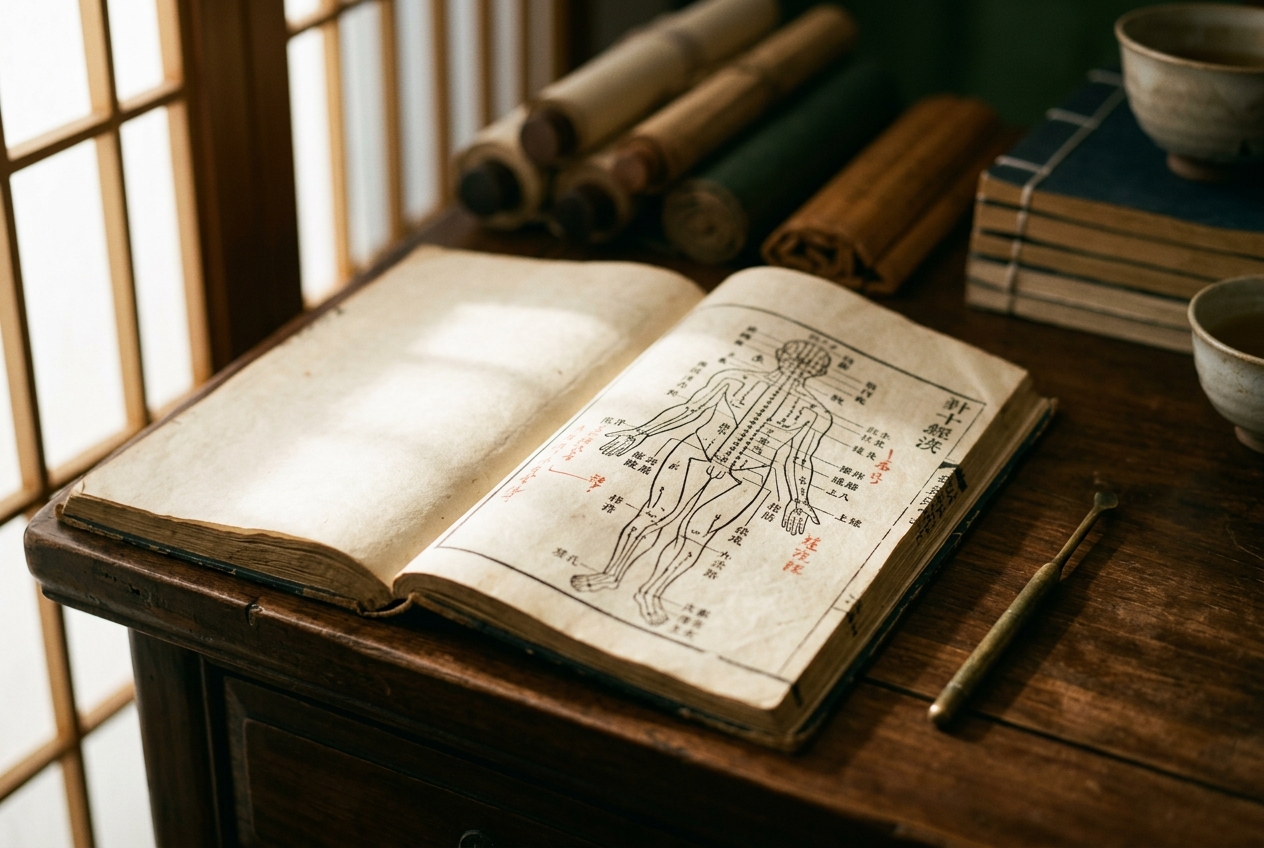
For centuries, however, this holistic map remained theoretically fragmented. It was not until the mid-14th century, amidst the scholarly transformations of the late Yuan Dynasty, that the physician Hua Shou (courtesy name Hua Boren, 1304–1386 CE) resolved the profound structural contradictions of ancient medical literature in his seminal 1341 CE text, Shi Si Jing Fa Hui (十四經發揮, Elucidation of the Fourteen Channels). Hua Shou provided a unified, unbroken circuit of biological flow that transformed therapeutic practice from antiquity to the present day.
2. Historical & Theoretical Genesis: Resolving the Classical Discontinuities
To appreciate Hua Shou’s conceptual breakthrough, one must examine the theoretical landscape of Chinese medicine prior to 1341 CE. The foundational canonical texts—most notably the Han Dynasty’s Huangdi Neijing (Inner Canon of the Yellow Emperor, divided into the Suwen and Lingshu) and the subsequent Nan Jing (Classic of Difficult Issues)—bequeathed two distinct and somewhat discordant organizational frameworks for the human energetic conduit system (Jing-Luo):
- The Twelve Primary Channels (Shi'er Jingmai): A closed, organ-coupled circadian circuit tracing pathways from the chest to the hands, hands to head, head to feet, and feet back to the torso, cycling continuously through the visceral (Zang-Fu) networks.
- The Eight Extraordinary Vessels (Qi Jing Ba Mai): A deeper, ancestral reservoir system operating outside the twelve regular organ channels, regulating constitutional homeostasis, hormonal cycles, structural morphology, and deep reserves of vitality.
The fundamental structural dilemma confronting classical scholars lay in the functional status of the Eight Extraordinary Vessels. While six of these eight vessels shared acupoints borrowed entirely from the primary twelve channels, two central midline vessels possessed an anomaly: the Ren Mai (Conception Vessel, running along the anterior midline) and the Du Mai (Governing Vessel, traversing the posterior midline up over the cranium) possessed their own discrete, dedicated acupuncture loci. Despite possessing dedicated topographies, classical cartography treated them as secondary reservoirs rather than primary circulatory conduits, creating an explanatory void regarding how energy and fluid transitioned between the axial midline core and the appendicular extremities.
Hua Shou recognized this theoretical deficiency. In Shi Si Jing Fa Hui, he systematically synthesized the scattered aphorisms of the Lingshu and Nan Jing, proposing a bold taxonomic elevation: because the Ren Mai and Du Mai possess independent, sequentially ordered acupoints and govern the primary Yin (anterior-parasympathetic) and Yang (posterior-sympathetic) polarities of the entire organism, they must be formally elevated to primary status alongside the twelve organ channels.
By unifying the twelve organ meridians with the two axial vessels into the canonical Fourteen Channels (Shi Si Jing), Hua Shou established the first comprehensive, uninterrupted topological model of human physiological circulation.
3. Channel Cartography & Systemic Continuity: The Tri-Volume Architecture
Hua Shou organized Shi Si Jing Fa Hui into a rigorous three-volume (San Juan) structural architecture that methodically deconstructs and reconstitutes human energetic anatomy:
Volume 1: General Theory and Flow Dynamics
Hua Shou establishes the diurnal, bi-directional kinetic laws governing channel progression. He articulates the chronobiological rhythm of Zi Wu Liu Zhu (Midnight-Noon Ebb and Flow), establishing that physiological resources (Qi and Xue) migrate through the fourteen channels in a mathematically continuous sequence.
Volume 2: The Exhaustive Cartography of the Fourteen Channels
This volume represents the intellectual core of the treatise. Hua Shou details the precise linear trajectories, internal (Nei Xing) visceral roots, external (Wai Xing) muscular pathways, internal bifurcations, and exact millimeter-level point distributions across all fourteen pathways. Crucially, Hua Shou clarifies the critical transition junctures (Luo-Junctions and terminal-origin exchanges) that ensure energetic conservation across the network: * The Upper Appendicular Exchange: From the terminal point of the Lung channel at the radial nail bed (Shaoshang, LU11) to the originating point of the Large Intestine channel at the radial index finger (Shangyang, LI1). * The Splanchnic Re-Entry: From the final point of the Liver channel on the mamillary line (Qimen, LV14) back through deep diaphragmatic internal bifurcations to restart the cycle at the Lung channel (Zhongfu, LU1). * The Axial Midline Polar Exchange: The intricate kinetic transition across the craniofacial and perineal junctions between the anterior Yin ocean (Ren Mai) and posterior Yang ocean (Du Mai), bridging Yinjiao (DU28) at the superior labial frenulum to Chengjiang (RN24) at the mentolabial groove, and cycling inferiorly through Huiyin (RN1) and Changqiang (DU1).
Volume 3: The Extraordinary Conduits and Collateral Dynamics
Hua Shou examines the remaining six extraordinary vessels and the network of fifteen Luo (connecting) collaterals, establishing how collateral branches distribute nutritive fluids into the superficial cutaneous regions (Pi Bu) and deep musculoskeletal compartments (Jing Jin).
4. Modern Biophysical Parallels: Fascia, Interstitial Fluids, and Neurovascular Bundles
Modern biomedical research has begun to unravel the physiological substrates corresponding to Hua Shou’s 14-channel continuum. Rather than dismissing classical meridians as metaphysical abstractions, contemporary translational anatomy increasingly identifies channels with the architecture of the human fascial and neurovascular systems.
The Fascial Plane Matrix and Mechanotransduction
Pioneering anatomical studies led by researchers such as Dr. Helene Langevin have demonstrated that acupuncture channels correspond with remarkable statistical significance to intermuscular and intramuscular connective tissue planes. The continuous myofascial tracks popularized in modern orthopedic medicine (such as the Superficial Back Line and Superficial Front Line) mirror Hua Shou’s descriptions of the Bladder (Taiyang) and Stomach (Yangming) channels.
When an acupoint is stimulated via manual compression or needle rotation, the mechanical deformation of the extracellular matrix engages cell-surface integrins, initiating cellular mechanotransduction cascades, remodeling local fibroblasts, and releasing adenosine, a potent local analgesic and vasodilator.
Interstitial Fluid Hydrodynamics
Research into bio-impedance and interstitial fluid dynamics reveals that meridian pathways exhibit lower electrical impedance and higher hydraulic conductivity compared to surrounding non-channel tissues. The proteoglycan- and hyaluronic-acid-rich interstitial fluid within fascial sheaths provides a low-resistance path for bio-electric ionic currents and molecular signaling factors, substantiating Hua Shou's assertion that the fourteen channels serve as direct hydraulic and energetic vectors connecting peripheral limbs to internal organs.
Autonomic Neurovascular Bundles
Histological examinations documented in World Health Organization acupuncture research verify that classical acupoints coincide with high densities of free nerve endings, unmyelinated C-fibers, small-diameter myelinated A-delta fibers, and perivascular sympathetic nerve plexuses. Mechanical compression at these sites modulates autonomic tone, triggering somatovisceral reflex arcs that downregulate systemic sympathetic hyperarousal while optimizing organ perfusion.
5. Comparative Analysis: Classical 12-Flow vs. Hua Shou's 14-Channel Continuum
The transformation wrought by Hua Shou can be understood by directly comparing the structural models:
| Dimension | Pre-1341 Classical Model (Neijing / Nan Jing) | Hua Shou's 14-Channel Synthesis (Shi Si Jing Fa Hui) | Modern Biophysical Correlate |
|---|---|---|---|
| Systemic Scope | 12 Organ Channels + 8 Detached Extraordinary Reservoirs | 14 Integrated Continuous Channels (12 Primary + Ren & Du) | Appendicular-axial myofascial continuity (Anatomy Trains) |
| Midline Status | Ren and Du treated as peripheral extraordinary vessels | Ren and Du elevated to master axial organizers of Yin/Yang | Ventral and dorsal axial fascial/neural balance |
| Point Indexing | Dispersed, regionally non-linear point attributions | Sequential, mathematically coherent proximal-to-distal ordering | Consecutive dermatomal and peripheral nerve pathways |
| Diagnostic Model | Fragmented organ pulse-diagnosis correlation | Closed-loop circulatory impedance and reflex palpation | Systemic autonomic regulation and somato-autonomic reflex arcs |
| Fluid Integration | Disconnected descriptions of interstitial fluid (Jinye) | Unified hydraulic distribution through Jing-Luo & Luo-Mai | Interstitial fluid flow along low-resistance fascial planes |
6. The Meridian Path — A Somatic Journey Through the Body
To understand this 14-channel network, one need not master classical terminology; the pathway can be felt directly across your own living anatomy as a grand, looping river system.
- The Upper Respiratory & Upper Limb Vector: The circuit originates deep within the solar plexus, branches to the lungs, ascends across the upper chest, crests over the front of the shoulder, and descends down the inner arm, traversing the biceps tendon, passing the wrist crease over the radial pulse, and terminating at the corner of the thumbnail. From here, it leaps to the index finger, traveling up the outer arm, climbing over the muscular crest of the shoulder, traversing the side of the neck, and crossing the cheek to end beside the nostril.
- The Gastrointestinal & Lower Limb Descent: From beside the nose, the pathway descends across the eye socket, drops through the cheek to the corner of the jaw, descends the throat, runs down the line of the collarbone, traverses the chest and abdomen parallel to the navel, travels down the anterior thigh, crests the kneecap, tracks the muscular groove just lateral to your shinbone, crosses the top of the ankle, and terminates at the lateral edge of the second toe.
- The Axial Deep Core (Ren & Du Mai): From the pelvic floor, the anterior current (Ren Mai) rises precisely along the midline of the body—ascending through the pubic bone, the navel, the center of the breastbone, and the throat, pooling in the soft groove below the lower lip. Meanwhile, the posterior current (Du Mai) ascends from the tailbone, climbing vertebra by vertebra up the spinal ridge, over the nape of the neck, cresting the vertex of the cranium, traversing the forehead and nasal bridge, and terminating at the gum line beneath the upper lip.
7. Precision Non-Invasive Acupressure Protocols: Five Master Regulatory Points
Drawing from Hua Shou’s meticulous mapping, modern clinical practice relies heavily on five master regulatory points. These loci provide potent regulatory access to the vascular, fascial, and autonomic nervous systems through simple, manual compression.
1. ST36 (Zusanli — Leg Three Miles) | Stomach Channel of Foot Yangming
- Anatomical Localization & Landmarks: Situated on the anterolateral aspect of the lower leg, four finger-widths (3 cun) inferior to the lower border of the patella, and one finger-breadth lateral to the anterior crest of the tibia (located directly in the belly of the tibialis anterior muscle).
- Somatic Sensation (Deqi): A deep, radiating, slightly warm ache that travels downward toward the dorsum of the foot or upward toward the knee joint.
- Biomechanical Vector & Technique: Apply firm, perpendicular thumb pressure directed slightly medially toward the lateral border of the tibia. Utilize an oscillating, circular tonification dynamic (clockwise rotation at approximately 1.5 Hz) for 2 to 3 minutes per limb.
- Clinical Indications: Profound post-prandial fatigue, gastrointestinal dyspepsia, abdominal distension, general exhaustion, and autonomic fatigue. Research indexed on NCBI PubMed demonstrates its role in stimulating gastric motility and upregulating parasympathetic activity via the vagus nerve.
2. LV3 (Taichong — Great Rushing) | Liver Channel of Foot Jueyin
- Anatomical Localization & Landmarks: Located on the dorsum of the foot, in the hollow distal to the junction of the first and second metatarsal bones, approximately two finger-widths proximal to the web margin between the great toe and second toe.
- Somatic Sensation (Deqi): A sharp, tender, electric or spreading sensation that quickly transitions into a broad, cooling release across the top of the foot.
- Biomechanical Vector & Technique: Direct pressure angled slightly proximally into the metatarsal junction using the tip of the thumb. Apply a sustained, sedating pressure: press firmly for 5 seconds, release slightly for 2 seconds, maintaining this cycle for 2 minutes while practicing slow, diaphragmatic exhalations.
- Clinical Indications: Acute psychological stress, emotional irritability, vertex tension headaches, hypertension-related dizziness, and ocular strain.
3. LI4 (Hegu — Joining Valleys) | Large Intestine Channel of Hand Yangming
- Anatomical Localization & Landmarks: On the dorsal aspect of the hand, between the first and second metacarpal bones, at the midpoint of the radial side of the second metacarpal bone, within the prominence of the first dorsal interosseous muscle.
- Somatic Sensation (Deqi): A prominent, dull, heavy ache that frequently radiates along the metacarpal bone and up the lateral forearm toward the elbow.
- Biomechanical Vector & Technique: Grasp the webbing between your thumb and index finger using the opposite thumb on the dorsum and index finger on the palm. Direct the compression vector under the edge of the second metacarpal bone (medial-perpendicular vector). Maintain deep, steady, rhythmic pressure for 90 to 180 seconds.
- Clinical Indications: Frontal and temporal headaches, temporomandibular joint (TMJ) tension, sinus congestion, cervical stiffness, and dental pain.
4. SP6 (Sanyinjiao — Three Yin Intersection) | Spleen Channel of Foot Taiyin
- Anatomical Localization & Landmarks: On the medial aspect of the lower leg, four finger-widths (3 cun) directly superior to the prominence of the medial malleolus (inner ankle bone), in the soft depression immediately posterior to the medial border of the tibia.
- Somatic Sensation (Deqi): A tender, distending, and deeply relaxing ache that spreads up the inner calf and down into the arch of the foot.
- Biomechanical Vector & Technique: Apply steady, perpendicular thumb compression against the posterior edge of the tibia. Maintain continuous, moderate pressure combined with gentle, slow, rhythmic circular kneading for 2 minutes per leg.
- Clinical Indications: Menstrual cramping, pelvic tension, sleep onset insomnia, fluid retention in the lower limbs, and evening autonomic restlessness.
5. PC6 (Neiguan — Inner Pass) | Pericardium Channel of Hand Jueyin
- Anatomical Localization & Landmarks: On the anterior (palmar) aspect of the forearm, three finger-widths (2 cun) proximal to the distal wrist crease, situated precisely between the two prominent tendons: the flexor carpi radialis and the palmaris longus.
- Somatic Sensation (Deqi): A tingling, localized distension that travels along the center of the inner forearm, occasionally radiating into the palm and middle finger.
- Biomechanical Vector & Technique: Press the thumb pad perpendicularly into the deep space between the two tendons. Use a gentle, steady, pulsing compression (1 Hz) for 2 minutes while maintaining slow, relaxed breathing.
- Clinical Indications: Psychogenic nausea, motion sickness, epigastric distress, acute palpitations associated with anxiety, and chest tightness.
8. Systematic Point Combination Protocol: The "Evening Desynchronization Reset"
To put Hua Shou’s 14-channel unified continuity into practice, consider this targeted protocol designed to resolve the classic modern complaint of post-work mental exhaustion coupled with physical agitation, cervical-shoulder tension, and digestive bloating.
Step-by-Step Execution:
- Positioning: Sit in a comfortable, upright chair with both feet planted flat on the floor, spine elongated, and shoulders dropped away from your ears.
- Phase I — Decompressing the Cranial Outflow (LI4 + LV3): * Begin by applying deep, firm pressure to LI4 on your left hand for 90 seconds, followed by the right hand. Notice the release across your jaw and forehead. * Immediately transition to LV3 on your feet, applying sustained, downward pressure for 90 seconds per foot. This classic pairing (known clinically as the Four Gates or Si Guan) opens systemic circulation and rapidly lowers sympathetic over-arousal.
- Phase II — Visceral Grounding (PC6 + ST36): * Apply gentle, rhythmic pressure to PC6 on your left forearm for 2 minutes while inhaling for 4 seconds and exhaling for 6 seconds. * Move downward to ST36 on both legs. Using your thumbs or knuckles, perform circular, downward-directed compression for 2 minutes. Feel the descent of physical center-of-gravity out of your head and into your core and lower limbs.
- Phase III — The Axial Midline Seal (Ren Mai Integration): * Conclude by resting your right palm over the center of your sternum (Danzhong, RN17) and your left palm over your lower abdomen 2 inches below the navel (Guanyuan, RN4). Close your eyes and breathe quietly for 2 minutes, feeling the unified anterior Yin midline stabilize your respiration.
9. Safety, Contraindications, and Clinical Triage
While acupressure is an inherently safe, non-invasive therapeutic modality, adherence to biomechanical and physiological precautions is paramount:
Critical Pregnancy Contraindications
Certain acupoints exert potent downward-bearing, oxytocic, and uterine-contractile actions and MUST BE STRICTLY AVOIDED during all stages of pregnancy: * LI4 (Hegu): Strongly descends Qi and can stimulate uterine tone. * SP6 (Sanyinjiao): Major intersection of lower pelvic channels; contraindicated due to risk of inducing contractions. * BL60 (Kunlun) & BL67 (Zhiyin): Potent labor-inducing distal reflex loci. * Lower Abdominal (Ren Mai) and Lumbosacral Points.
The Qualitative Boundary of Pressure
- Therapeutic Discomfort vs. Tissue Trauma: Acupressure should elicit the signature sensation of Deqi—a deep, dull, spreading ache, slight numbness, or tingling warmth. It should never produce sharp, lancinating, pinching, or bruising pain. If your muscles reflexively brace against the pressure, you have exceeded therapeutic thresholds; reduce pressure by 30–50%.
- Local Contraindications: Never apply direct manual pressure over open wounds, bruises, localized skin infections, acute varicose veins, fractures, or areas of active phlebitis/thrombosis.
- When to Seek Clinical Care: Acupressure is an outstanding modality for functional self-regulation, stress modulation, and mild postural or digestive complaints. It is not a substitute for emergency medical care. Seek prompt evaluation from a licensed physician or registered acupuncturist for unremitting severe headaches, acute abdominal pain, unexplained neurological deficits, sudden chest tightness, or chronic systemic symptoms.
10. Today's Takeaway: A Two-Minute Somatic Reset
If you have only two minutes right now before returning to your screen or moving to your next appointment, perform this single, highly effective regulatory practice:
- Locate LI4 (Hegu) on your left hand by finding the midpoint of the bone connecting your wrist to your index finger, slipping your right thumb just onto the muscular ridge on the thumb-side edge of that bone.
- Pinch firmly until you feel a distinct, deep, satisfying ache.
- Hold this steady pressure for precisely 60 seconds while dropping your shoulders and taking three slow, deep belly breaths.
- Switch to your right hand and repeat for 60 seconds.
In less than the time it takes to brew a cup of tea, you have tapped directly into the 14-channel anatomical highway mapped out by Hua Shou nearly seven centuries ago—reminding your neuro-fascial architecture that it is not a fragmented machine, but an integrated, flowing whole.
Authoritative References & Further Reading
- World Health Organization. WHO Standard Acupuncture Point Locations in the Western Pacific Region. WHO Guidelines & Standards.
- Langevin, H. M., & Yandow, J. A. Relationship of acupuncture points and meridians to connective tissue planes. The Anatomical Record (New Anat.), 269: 257–265.
- World Health Organization. WHO Guidelines on Basic Training and Safety in Acupuncture. Geneva: World Health Organization.
- National Center for Biotechnology Information (NCBI) PubMed Central. Neurobiological Mechanisms of Acupuncture and Acupressure.
- Wikipedia. Meridian System in Traditional Chinese Medicine and Eight Extraordinary Vessels.