Bei Ji Qian Jin Yao Fang: Navigating Sun Simiao's Tang Dynasty Channel Cartography, Ashi Point Genesis, and Precision Acupressure Protocols
I. OPENING — A PROBLEM THIS SOLVES TODAY: SOMATOSENSORY DYSREGULATION AND THE TANG DYNASTY MATRIX
If you regularly experience a tight, vice-like tension across the base of your skull after hours of cognitive labor, a heavy post-prandial lethargy accompanied by abdominal distension, or a persistent low-grade nocturnal restlessness where your mind races despite physical exhaustion, you are inhabiting the physiological crossroads of the modern neurovegetative crisis. In contemporary clinical terms, these daily afflictions represent functional disturbances of the autonomic nervous system: sympathetic hyperarousal, impaired vagal tone, and localized myofascial ischemia caused by prolonged postural stasis and chronic psychological stress.
Centuries before the emergence of modern autonomic neurophysiology, the seventh-century Chinese physician-philosopher Sun Simiao (581–682 CE)—venerated in East Asian medical history as the Yao Wang (King of Medicine)—confronted these exact patterns of functional somatic distress. In his monumental 652 CE compendium, the Bei Ji Qian Jin Yao Fang (Essential Formulas for Emergencies Worth a Thousand Pieces of Gold), Sun Simiao did not merely catalogue herbal remedies; he revolutionized somatic medicine by establishing an empirical, cartographic, and tactile matrix of the human body.
In Volumes 29 and 30 of this seminal masterwork, Sun Simiao synthesized centuries of fragmented anatomical observation into an actionable meridian system. He demonstrated that localized mechanical stimulation of specific somatic nodes—what we now identify as peripheral neurovascular bundles and myofascial condensations—can systematically reset central autonomic reactivity, modulate visceral motility, and extinguish chronic pain pathways. By translating Sun Simiao’s Tang Dynasty clinical treatises into the language of modern somatic practice, we unlock an exceptionally precise manual for reclaiming bodily equilibrium.
+---------------------------------------------------------------------------------------+
|                                HISTORICAL CONTEXT BRIEF                               |
|                                                                                       |
|  Masterwork:  Bei Ji Qian Jin Yao Fang (备急千金要方), Vol. 29 & 30                   |
|  Author:      Sun Simiao (孙思邈, 581–682 CE), Tang Dynasty Physician                 |
|  Breakthroughs: Unification of fragmented Han-Jin channel texts; codification of      |
|                 Ashi (阿是) reactive points; creation of the tri-color Ming Tang      |
|                 meridian cartography; standardization of proportional Cun metrics.    |
+---------------------------------------------------------------------------------------+
II. THE CANONICAL SYNTHESIS: UNIFYING DISPARATE HISTORICAL TRADITIONS
To appreciate the intellectual magnitude of Volumes 29 and 30 of the Bei Ji Qian Jin Yao Fang, one must understand the epistemological fragmentation that preceded Sun Simiao. Prior to the early Tang dynasty, channel theory and acupuncture practice were divided across disparate textual lineages and competing clinical traditions:
- The Theoretical Archetypes of the Han Dynasty: The foundational concepts preserved in the Huangdi Neijing (Inner Canon of the Yellow Emperor) and the Nan Jing (Classic of Difficult Issues) provided sophisticated cosmological and energetic models of the twelve primary channels (Jingmai) and eight extraordinary vessels (Qimai), yet they frequently lacked standardized spatial coordinates for bedside practice.
- The Systematic Codification of the Jin Dynasty: Huangfu Mi’s 3rd-century Zhenjiu Jiayi Jing (Systematic Classic of Acupuncture and Moxibustion) had organized 349 classical points, establishing an essential diagnostic baseline. However, its anatomical descriptions remained purely textual, leading to widespread regional divergence in point localization across the Six Dynasties period (220–589 CE).
- The Lineage Fragments of the Six Dynasties: Competing familial and monastic lineages guarded idiosyncratic point selections, moxibustion measurements, and secret needle manipulations, resulting in clinical variance that threatened the therapeutic reliability of the discipline.
Sun Simiao addressed this crisis with rigorous scholastic synthesis and empirical pragmatism. Having absorbed Daoist self-cultivation practices, Buddhist compassionate ethics—immortalized in his famous introductory treatise Da Yi Jing Cheng (On the Absolute Sincerity of the Great Physician)—and Confucian scholarship, he recognized that clinical efficacy demanded absolute cartographic and palpatory standardization.
In Volumes 29 and 30 of the Qian Jin Yao Fang, Sun Simiao critically collated these ancestral fragments into an integrated diagnostic-therapeutic continuum. He reconciled contradictory channel courses, systematized point nomenclature, and anchored theoretical channel trajectories to palpable, reproducible musculoskeletal landmarks. In doing so, he transformed channel theory from an abstract metaphysical doctrine into a reliable bedside clinical science.
III. CARTOGRAPHY & REVOLUTION: THE MING TANG SAN REN TU INNOVATION
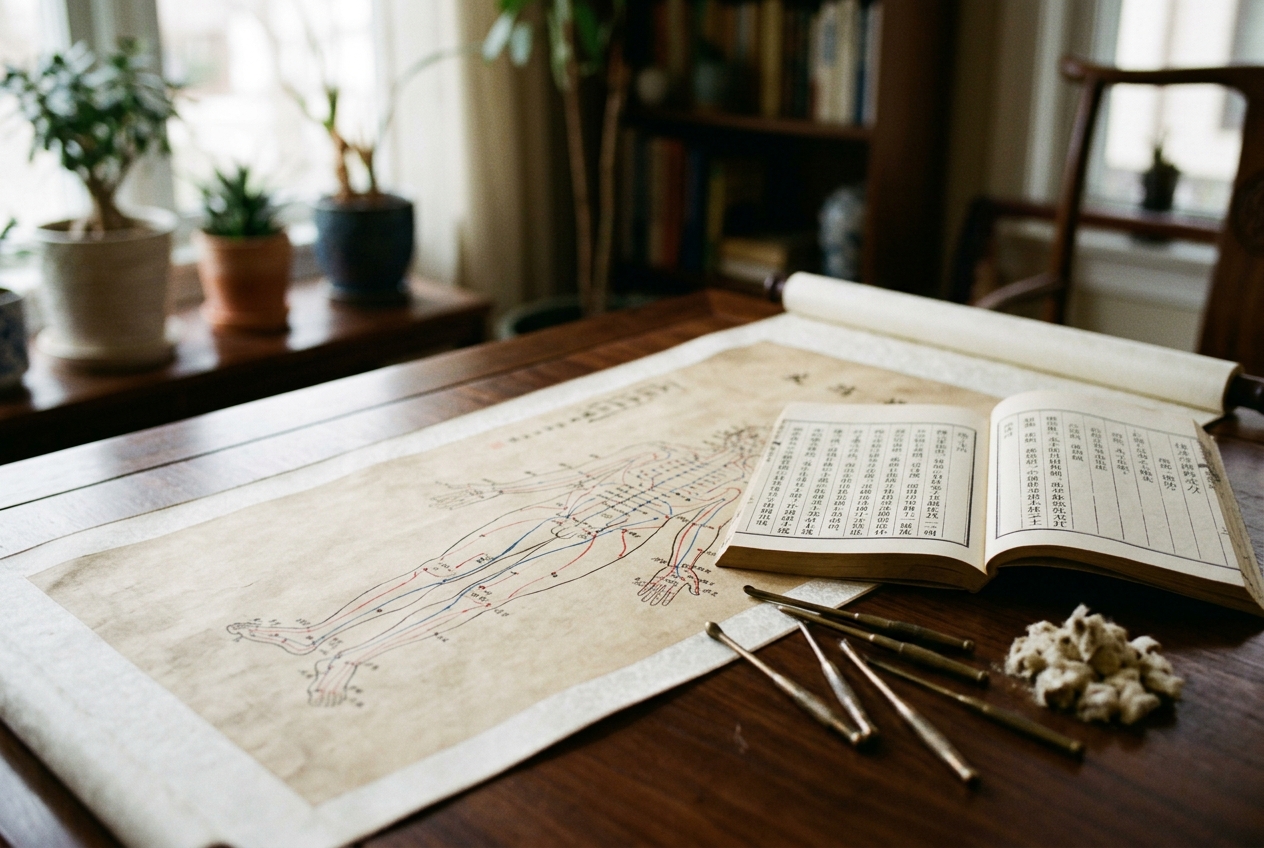
Sun Simiao’s most visually profound contribution to medical history was the design of the Ming Tang San Ren Tu (明堂三人图, Illustrated Diagrams of the Hall of Light Depicting Three Figures). Recognizing that dense, unillustrated text inevitably caused dangerous localization errors during acute clinical emergencies, Sun commissioned and designed the world’s first standardized, multi-colored, three-dimensional planar anatomical charts for meridian medicine.
1. The Tri-Color Chromatographic Scheme
Sun Simiao’s cartography utilized a sophisticated three-color chromatic hierarchy to eliminate visual ambiguity: * Cinnabar Red (Zhu): Allocated to the primary Yang channels (Governing Vessel, Stomach, Large Intestine, Small Intestine, Bladder, Gallbladder, San Jiao), capturing their dynamic, outward, protective somatic distribution across the dorsal and lateral surfaces of the body. * Deep Mineral Black / Indigo (Mo/Qing): Allocated to the primary Yin channels (Conception Vessel, Lung, Spleen, Heart, Kidney, Pericardium, Liver), mapping their interior, nourishing trajectories along the anterior and medial aspects of the limbs and torso. * Mineral Yellow / Green / Ochre: Allocated to the Eight Extraordinary Vessels (Qi Jing Ba Mai) and secondary collateral networks (Luo Mai), distinguishing deep reservoir pathways from superficial channel courses.
2. Tri-Planar Anatomical Projections
The San Ren Tu depicted the human organism across three distinct planar orientations: * The Anterior (Frontal / Coronal) Aspect: Revealing the Yin channels converging upon the thoracic and abdominal visceral centers (Mu points) and the anterior surface of the lower extremities. * The Posterior (Dorsal) Aspect: Delineating the extensive sensory and autonomic columns of the Bladder Meridian (Taiyang) and Governing Vessel (Du Mai), mapping the segmental Back-Shu neuro-reflective points. * The Lateral (Sagittal) Aspect: Charting the complex, zig-zagging pathways of the Gallbladder Meridian (Shaoyang) through the cranium, temporomandibular joint, intercostal spaces, and iliotibial band.
       FRONTAL (Yin)              LATERAL (Shaoyang)             DORSAL (Yang)
   +--------------------+       +--------------------+       +--------------------+
   |   • Lung (LU)      |       |   • Gallbladder    |       |   • Bladder (BL)   |
   |   • Spleen (SP)    |       |     (GB)           |       |   • Du Mai (GV)    |
   |   • Heart (HT)     |  ==>  |   • San Jiao (SJ)  |  ==>  |   • Small Int.     |
   |   • Kidney (KI)    |       |   • Lateral Axis   |       |     (SI)           |
   |   • Ren Mai (CV)   |       |     Equilibrium    |       |   • Segmental Shu  |
   +--------------------+       +--------------------+       +--------------------+
3. The Proportional Measurement Standard (Gudu Cun)
To ensure these graphic illustrations could be accurately applied to bodies of varying habitus, Sun Simiao unified and refined the system of proportional bone-meter measurement (Gudu Cun / 骨度). He discarded absolute linear measurements (which failed on patients of diverse height or limb length) in favor of individual physiological ratios—such as the transverse width of the interphalangeal joint of the patient's own thumb (1 cun) or the combined width of the four fingers at the proximal interphalangeal crease (3 cun). This proportional scaling model remains the international clinical benchmark recognized by the World Health Organization's Standard Acupuncture Point Locations.
IV. THE PHENOMENOLOGY OF PAIN: THE CODIFICATION OF ASHI POINTS (阿是穴)
In Volume 30 of the Bei Ji Qian Jin Yao Fang, Sun Simiao articulated one of the most clinically revolutionary principles in the history of physical medicine: the discovery and systematic codification of Ashi Points (阿是穴, A-shi Xue).
Sun wrote with characteristic clinical directness:
"There is a method of determining the point of illness: wherever there is pain or distress, press upon the flesh. When you reach the exact site, the patient experiences a profound sensation of soreness, ache, or relief, and involuntarily cries out: 'Ah, yes!' (A-shi!). This is the genuine point. Apply moxibustion or pressure here; it will yield immediate therapeutic efficacy, regardless of whether it corresponds to a named canonical point on the twelve channels."
+---------------------------------------------------------------------------------------+
|                            THE ASHI POINT PARADIGM SHIFT                              |
|                                                                                       |
|  Canonical Classical Points: Fixed anatomical coordinates, established channel       |
|                             topography, systemic visceral/homeostatic actions.        |
|                                                                                       |
|  Ashi (Reactive) Points:    Dynamically emergent, state-dependent sites of soft-      |
|                             tissue strain, hyperalgesic sensitivity, and local        |
|                             neurovascular entrapment.                                 |
+---------------------------------------------------------------------------------------+
Palpatory Diagnostic Criteria
Sun Simiao established rigorous tactile criteria for identifying true Ashi loci, instructing practitioners to search for: 1. Focal Hyperalgesia (Tong Dian): A distinct, sharp or deep aching sensitivity upon palpation that is disproportionate to the surrounding baseline tissue. 2. Subcutaneous Nodular Induration (Jie Jie): Palpable fibrous "knots," taut bands, or granular condensations within the deep fascial matrix. 3. Referred Sensation (Chuan Dao): Elicitation of a spreading, radiating somatosensory wave when sustained mechanical pressure is directed perpendicularly into the nidus.
Modern Parallels: Myofascial Trigger Points and Neurofascial Planes
In the late 20th and early 21st centuries, Western physical medicine "rediscovered" Sun Simiao’s Ashi principle through the pioneering work of Drs. Janet Travell and David Simons on Myofascial Trigger Points (MTrPs). Landmark epidemiological and anatomical studies—such as the seminal analysis published in Acupuncture in Medicine / PubMed—have demonstrated an astounding 71% to 93.3% spatial and clinical correspondence between classical acupoints/Ashi points and myofascial trigger points.
+---------------------------------------------------------------------------------------+
|                    COMPARATIVE ANATOMICAL & PHYSIOLOGICAL MATRIX                      |
+------------------------------------+--------------------------------------------------+
| Tang Dynasty Ashi Phenomenon       | Modern Neurofascial Trigger Point (MTrP)         |
+------------------------------------+--------------------------------------------------+
| "Ah, yes!" involuntary vocalization| Patient jump sign / localized pain recognition   |
| Palpable fibrous knot (Jie Jie)    | Taut skeletal muscle band with hyperirritable nodule|
| Suan / Zhang / Ma (De Qi) radiating| Somatic referred pain pattern via dorsal horn     |
| Local twitch / release upon touch  | Local twitch response (LTR) via spinal reflex arc |
| Resolves regional Qi stagnation    | Re-perfuses ischemic tissue, clears local algogens|
+------------------------------------+--------------------------------------------------+
Modern histological and bioengineering research led by Dr. Helene Langevin confirms that these reactive loci reside predominantly at inter-muscular and intramuscular loose connective tissue cleavages. When mechanical pressure or shear strain is introduced at an Ashi point, the underlying fibroblasts undergo cytoskeletal remodeling, initiating a cellular signaling cascade that downregulates local inflammatory cytokines (substance P, CGRP, bradykinin) and stimulates microcirculatory perfusion, as documented in comprehensive reviews on the Neurobiological Mechanisms of Acupuncture.
V. THE MERIDIAN PATH — A JOURNEY THROUGH THE HUMAN LANDSCAPE
To understand how Sun Simiao's cartography functions on your own body, we can trace three of the primary meridian highways featured prominently in the Qian Jin Yao Fang. By replacing archaic terminology with living anatomical landmarks, the body transforms into an intuitive, legible landscape.
1. The Stomach Channel of Foot-Yangming: The Great Descending Pathway
- The Living Pathway: Originating just below the orbital ridge of the eye, this channel courses downward through the hollow under the cheekbone, wraps around the jaw angle, and descends the front of the throat to the collarbone. It drops straight down the chest along the mammillary line, traverses the muscular column of the rectus abdominis two finger-widths lateral to the navel, and passes through the inguinal crease into the front of the thigh. It tracks down the fleshy belly of the quadriceps, crosses the kneecap, and travels one finger-width lateral to the sharp ridge of your shinbone (the anterior border of the tibia)—the exact muscular furrow that burns when you walk briskly uphill—before terminating at the lateral corner of the second toenail.
- Functional Domain: Governs the digestion of food, the downward propulsion of gastrointestinal contents, the generation of systemic blood and fluid, and the clearing of acute cognitive heat (restlessness, mania, facial tension).
2. The Pericardium Channel of Hand-Jueyin: The Central Axis of Heart & Calm
- The Living Pathway: Emerging from the deep fascia of the chest lateral to the nipple, it ascends into the armpit and travels straight down the exact midline of the inner arm. It passes through the center of the elbow crease, tracks down the soft, sensitive center of the forearm between two thick, rope-like flexor tendons, crosses the center of the inner wrist crease, passes through the palm between the second and third metacarpal bones, and terminates at the very tip of the middle finger.
- Functional Domain: Acts as the dynamic somatic shield for cardiovascular rhythm and emotional equilibrium, modulating autonomic cardiac output, vagal tone, and resolving nausea or diaphragm constriction.
3. The Spleen Channel of Foot-Taiyin: The Foundation of Fluid & Vital Reserve
- The Living Pathway: Starting at the inner edge of the big toenail, this channel skirts along the border where the pale skin of the sole meets the red skin of the top of the foot. It curves in front of and beneath the inner ankle bone, travels upward directly along the posterior border of the shinbone on the inner leg, ascends across the inner knee and inner thigh, enters the lower abdomen four finger-widths lateral to the midline, and terminates along the lateral ribcage in the sixth intercostal space.
- Functional Domain: Governs metabolic fluid transformation, venous return from the lower limbs, pelvic organ integrity, and the physical stability of connective tissues.
VI. TANG DYNASTY EMPIRICAL POINT FORMULATIONS
In Volumes 29 and 30, Sun Simiao formulated point combinations based on acute clinical synergy. These classical pairings remain fundamental to both clinical acupuncture and advanced acupressure protocols.
+---------------------------------------------------------------------------------------+
|                     TANG DYNASTY CANONICAL POINT FORMULATIONS                         |
+----------------------+--------------------------+-------------------------------------+
| Clinical Objective   | Point Combination        | Physiological Mechanisms            |
+----------------------+--------------------------+-------------------------------------+
| Emergency Resuscitation| GV26 (Renzhong) +        | Rapid trigeminal-vagal stimulation; |
| & Syncope Collapse   | PC6 (Neiguan) +          | elevates vasomotor tone; activates  |
|                      | KI1 (Yongquan)           | ascending reticular activating system|
+----------------------+--------------------------+-------------------------------------+
| Prophylaxis of Wind- | ST36 (Zusanli) +         | Downregulates sympathetic tone;     |
| Stroke (Zhong Feng)  | GB39 (Xuanzhong)         | enhances cerebral collateral flow;  |
|                      |                          | reduces arterial shear stress       |
+----------------------+--------------------------+-------------------------------------+
| Visceral & Autonomic | CV12 (Zhongwan) +        | Synchronizes enteric nervous system;|
| Triad Harmonization  | PC6 (Neiguan) +          | modulates gastric slow waves;       |
|                      | SP6 (Sanyinjiao)         | balances parasympathetic vagal drive|
+----------------------+--------------------------+-------------------------------------+
1. Emergency Resuscitation and Syncope Protocol
- Point Cluster: GV26 (Shuigou / Renzhong) paired with PC6 (Neiguan) and KI1 (Yongquan).
- Classical Rationale: Sun Simiao designated GV26 as the preeminent revival point for acute sudden loss of consciousness, shock, or hysteric syncope.
- Modern Neurobiology: High-intensity stimulation of GV26 engages the maxillary branch of the trigeminal nerve ($CN\ V_2$), evoking immediate sympathetic vasomotor activation, increasing cerebral perfusion pressure, and stimulating the respiratory center in the brainstem. Concurrently, KI1 engages the deep plantar nerve to anchor sensory proprioception, while PC6 stabilizes cardiac rhythm via vagal efferent modulation.
2. The Prophylactic Wind-Stroke (Zhong Feng) Combination
- Point Cluster: ST36 (Zusanli) bilateral paired with GB39 (Xuanzhong / Juegu).
- Classical Rationale: Sun Simiao famously recorded that individuals over the age of thirty who experience transient dizziness, heaviness in the limbs, or premonitory signs of Wind-Stroke (Zhong Feng / cerebrovascular accidents) must regularly apply moxibustion or firm pressure to ST36 and GB39 to "drain pathogenic wind and prevent hemiplegia."
- Modern Neurobiology: GB39 (the Influential Point of Marrow) sits directly over the superficial peroneal nerve, while ST36 stimulates the deep peroneal nerve and anterior tibial vascular network. Co-activation of these nodes produces systemic arterial vasodilation, downregulates elevated plasma renin-angiotensin levels, and promotes cerebral microcirculatory collateralization, mitigating ischemic risk.
3. The Visceral Harmony Triad
- Point Cluster: CV12 (Zhongwan) + PC6 (Neiguan) + SP6 (Sanyinjiao).
- Classical Rationale: The quintessential formula for regulating the Middle and Lower Burners (San Jiao), clearing epigastric fullness, calming affective anxiety, and harmonizing reproductive-urinary dynamics.
- Modern Neurobiology: CV12 acts directly over the celiac plexus and epigastric cutaneous nerve branches, resetting gastric smooth muscle tone. PC6 modulates upper gastrointestinal motility through the dorsal motor nucleus of the vagus nerve. SP6 provides multi-segmental L4–S1 spinal afferent input, regulating pelvic visceral tone and systemic parasympathetic balance.
VII. KEY POINTS YOU CAN PRESS RIGHT NOW
To experience the precision of Sun Simiao’s methodology, integrate the following three master acupoints into your daily somatic routine. Each point is described using direct physical landmarks, validated palpatory signs, and specific biomechanical parameters adhering to standard clinical guidelines from the WHO Benchmarks for the Practice of Acupuncture.
   =============================================================================
   POINT 1: ZUSANLI (ST36) — "Leg Three Miles"
   =============================================================================
   [ANATOMICAL LOCATION]:
   Sit with your knees bent at a 90-degree angle. Place the palm of your hand
   directly over your kneecap. Your ring finger will naturally rest in a small,
   distinct depression about four finger-widths below the bottom of the knee,
   one finger-width outward from the sharp edge of your shinbone (in the belly
   of the tibialis anterior muscle).

[PALPATORY CUE & TISSUE MARKER]:
   Slide your thumb across the muscle until you feel a firm, rubbery band that
   is noticeably tender when pressed. When properly located, firm pressure will
   produce a distinct, dull, deep ache that may radiate downward into the ankle.

[APPLICATION MECHANICS]:
   • Vector: Perpendicular to the skin surface, pressing slightly inward toward the shinbone.
   • Pressure Intensity: 2.5 to 3.0 kg/cm² (firm, deep pressure; should feel intense but
     not sharp or bruising).
   • Duration: Sustained 90 to 120 seconds per leg, with subtle circular friction (0.5 Hz).

[CLINICAL UTILITY]:
   1. Relieves acute post-prandial bloating, stomach cramps, and sluggish digestion.
   2. Combats profound midday physical fatigue and muscular weakness in the legs.
   3. Downregulates systemic nervous system fatigue and chronic mental fog.
   =============================================================================
   POINT 2: NEIGUAN (PC6) — "Inner Gate"
   =============================================================================
   [ANATOMICAL LOCATION]:
   Turn your arm so your palm faces upward. Look at the prominent crease at the
   base of your wrist. Measure three finger-widths up your arm toward the elbow.
   Make a loose fist and curl your wrist slightly inward until two thick, rope-like
   cords (tendons) stand out. The point lies directly between these two tendons.

[PALPATORY CUE & TISSUE MARKER]:
   Upon deep palpation between the tendons (flexor carpi radialis and palmaris
   longus), you will feel a sensitive, springy depression. Correct localization
   evokes an unmistakable tingling, spreading warmth, or heavy ache that travels
   into the center of the palm or up the forearm.

[APPLICATION MECHANICS]:
   • Vector: Strictly perpendicular into the inter-tendinous space.
   • Pressure Intensity: 2.0 to 2.5 kg/cm² (calibrated, steady thumb pad compression).
   • Duration: Sustained 90 seconds while practicing deep diaphragmatic breathing
     (4-second inhale, 6-second exhale).

[CLINICAL UTILITY]:
   1. Rapidly calms acute situational anxiety, heart palpitations, and nervous throat constriction.
   2. Extinguishes motion sickness, nausea, and stress-induced acid reflux.
   3. Releases tight chest tension and restores relaxed, deep respiratory rhythm.
   =============================================================================
   POINT 3: SANYINJIAO (SP6) — "Three Yin Intersection"
   =============================================================================
   [ANATOMICAL LOCATION]:
   Locate the highest, most prominent tip of your inner ankle bone. Place four
   fingers flat across your inner leg, starting directly above that bony peak.
   The point is located just above the top edge of your fourth finger, resting in
   a tender groove immediately behind the back edge of the shinbone.

[PALPATORY CUE & TISSUE MARKER]:
   Press your thumb tip inward against the posterior margin of the tibia. You
   will discover a pronounced tender indentation where the calf muscle attaches
   to the bone. This spot is notoriously sensitive; expect a rich, heavy ache.

[APPLICATION MECHANICS]:
   • Vector: Angled slightly forward toward the posterior border of the bone.
   • Pressure Intensity: 2.0 to 2.5 kg/cm²; start gently and progressively increase depth.
   • Duration: Sustained 90 to 120 seconds per side.

[CLINICAL UTILITY]:
   1. Relieves lower abdominal cramping, pelvic congestion, and menstrual discomfort.
   2. Settles nighttime restlessness, racing thoughts, and nocturnal insomnia.
   3. Promotes fluid drainage from swollen ankles and tired, heavy lower legs.
VIII. A POINT COMBINATION FOR ONE COMMON ISSUE: THE "POST-DIGITAL RECOVERY PROTOCOL"
Modern screen-based cognitive work induces a recognized somatic symptom cluster: suboccipital stiffness, ocular strain, shallow thoracic breathing, and sluggish post-dinner digestion caused by sympathetic autonomic lock. Sun Simiao’s treatises provide the ideal multi-point sequential release protocol.
========================================================================================
           THE 10-MINUTE "POST-DIGITAL SOMATIC RESET" PROTOCOL (DO THIS TONIGHT)
========================================================================================

PREPARATION & POSTURE:
• Sit comfortably in an upright armchair with your feet uncrossed and flat on the floor,
  or recline comfortably in bed with your knees supported by a small pillow.
• Loosen any constrictive clothing around the neck and waist.
• Close your eyes and take three complete abdominal cycles (4s inhale / 7s hold / 8s exhale).

STEP 1: PC6 (Neiguan) — Decompress the Diaphragm & Calm the Mind
• Apply firm, steady thumb pressure to PC6 on your left wrist for 90 seconds.
• Maintain steady, perpendicular force (2.0–2.5 kg/cm²). Feel the spreading warmth into the palm.
• Switch to the right wrist and repeat for 90 seconds.
• Physiological Target: Resets vagal efferent balance; downregulates mental urgency.

STEP 2: ST36 (Zusanli) — Ignite Digestive Peristalsis & Ground Nervous Tension
• Move your thumbs to ST36 on both legs simultaneously.
• Apply firm, downward-inward pressure (2.5–3.0 kg/cm²) for 120 seconds, maintaining a
  gentle circular oscillation (0.5 Hz).
• Concentrate on feeling the deep, dull ache (*De Qi*) settling into your shins and abdomen.
• Physiological Target: Promotes gastric emptying, relieves abdominal fullness, grounds cranial heat.

STEP 3: SP6 (Sanyinjiao) — Anchor Systemic Fluid Reserves & Induce Sleep Readiness
• Reposition your thumbs to SP6 behind the shinbone on both inner lower legs.
• Apply steady, unhurried pressure (2.0–2.5 kg/cm²) for 90 seconds.
• Allow your exhalations to lengthen as the aching sensation softens muscle tone in the pelvic floor.
• Physiological Target: Calms the sensory cortex; prepares the neuroendocrine axis for restorative slow-wave sleep.

STEP 4: SENSATION INTEGRATION
• Release all pressure. Rest your hands open on your thighs for 60 seconds.
• Notice the tangible sensation of systemic warmth, decreased ocular pressure, and audible
  gastrointestinal gurgling (borborygmi)—the clinical hallmark of parasympathetic reactivation.
========================================================================================
IX. PRECISION ACUPRESSURE PROTOCOLS: THE BIOPHYSICS OF DE QI
To achieve clinical efficacy equivalent to Tang Dynasty medical standards, modern self-practitioners must understand the exact biomechanical and neurophysiological parameters of acupressure application.
1. The Perpendicular Pressure Vector
A common error in acupressure is superficial, tangential rubbing of the skin, which merely stimulates cutaneous tactile receptors ($A\beta$ fibers) without engaging deep fascial mechanoreceptors. * The Clinical Standard: The pressure vector must be oriented perpendicular ($90^\circ$) to the anatomical contour of the underlying muscle or bone. * Force Calibration: Apply a measured force of 2.0 to 3.0 kilograms per square centimeter ($\text{kg/cm}^2$). You can calibrate this sensation by pressing your thumb onto a standard digital kitchen scale until it reads between 2.0 and 3.0 kg.
2. Compression Duration and Rhythm
- Sustained Compression: Maintain unyielding, continuous pressure for 90 to 120 seconds. Fascial viscoelasticity requires at least 60 seconds of sustained load to initiate thixotropic remodeling (the transition of viscous ground substance from a gel to a more fluid sol state).
- Rhythmic Oscillation: Superimpose a slow, rhythmic rotary micro-oscillation at approximately 0.5 Hz (one gentle circular cycle every two seconds) without breaking skin contact.
3. Somatosensory De Qi (得气) Verification
In classical Chinese medical epistemology, no point stimulation is therapeutically active without the arrival of De Qi (the arrival of vital sensory responsiveness). In modern somatic practice, you know you have engaged the target point when the patient or you experience four distinct somatosensory phenomena: 1. Suan (酸): A deep, profound, and pleasant ache within the muscle belly. 2. Zhang (胀): A distinct feeling of fullness, swelling, or localized hydraulic expansion. 3. Ma (麻): A faint, pleasant tingling or vibrational resonance along the channel tract. 4. Zhong (重): A sensation of physical heaviness, anchoring the limb to the earth.
From a neurobiological standpoint, this constellation of sensations indicates the successful mechanical activation of type II and III mechanoreceptors and group III ($A\delta$) and IV ($C$) sensory afferents. This triggers the release of endogenous opioids (dynorphins, enkephalins, $\beta$-endorphin) within the periaqueductal gray and rostral ventromedial medulla, producing systemic analgesia and central autonomic recalibration.
X. SAFETY, SENSE, AND CLINICAL BOUNDARIES
While acupressure is an extraordinarily safe, non-invasive somatic modality, its potency requires informed clinical respect and clear boundary awareness.
+---------------------------------------------------------------------------------------+
|                               CONTRAINDICATION MATRIX                                 |
+------------------------------------+--------------------------------------------------+
| Clinical State                     | Precautionary Directive & Action                 |
+------------------------------------+--------------------------------------------------+
| Pregnancy (All Trimesters)         | STRICT CONTRAINDICATION for points that provoke  |
|                                    | uterine contractions: SP6 (Sanyinjiao), LI4      |
|                                    | (Hegu), BL60 (Kunlun), BL67 (Zhiyin), GB21.      |
+------------------------------------+--------------------------------------------------+
| Acute Local Pathology              | NEVER press over broken skin, open wounds, active|
|                                    | shingles/herpetic lesions, acute hematomas, or   |
|                                    | sites of suspected Deep Vein Thrombosis (DVT).   |
+------------------------------------+--------------------------------------------------+
| Severe Osteopenia / Fragility      | Reduce pressure vectors to < 1.0 kg/cm²; avoid   |
|                                    | heavy compression over bony prominences.         |
+------------------------------------+--------------------------------------------------+
| Red-Flag Systemic Symptoms         | Immediate medical referral required for crushing |
|                                    | chest pain, unilateral facial drooping, slurred   |
|                                    | speech, explosive thunderclap headaches, or shock.|
+------------------------------------+--------------------------------------------------+
1. Pregnancy Contraindications
Certain acupressure points exert a profound descending, pelvic-clearing energetic effect that stimulates uterine smooth muscle contractions. Pregnant women must completely avoid deep pressure on SP6 (Sanyinjiao), LI4 (Hegu), GB21 (Jianjing), and BL60 (Kunlun), except under the direct, hands-on supervision of a licensed practitioner during active labor induction.
2. Calibrating "Too Much Pressure"
Acupressure should evoke a sensation described in classical literature as tong kuai—"painful pleasure" or a satisfying, therapeutic ache. If the pressure causes you to grimace, hold your breath, clench your jaw, or tense your surrounding musculature, you have crossed the physiological threshold into sympathetic defensive activation. Excessive force causes localized capillary rupture, micro-hematomas, and reactive myofascial spasm, defeating the therapeutic objective.
3. Knowing When to Seek a Professional
Self-administered acupressure is an empowering tool for functional health optimization, stress reduction, and minor symptom management. However, it is not a substitute for comprehensive medical diagnosis. You should consult a qualified physician or licensed East Asian Medicine practitioner if you experience unremitting chronic pain, unexplained weight loss, persistent fever, neurological deficits, or when self-treatment yields no discernible improvement after several consecutive days.
XI. TODAY'S TAKEAWAY: A TWO-MINUTE SOMATIC RESET
You do not need to master all 361 classical points to transform your immediate physiological state. Before you close this article, take exactly two minutes to experience the living reality of Sun Simiao’s Tang Dynasty cartography.
+---------------------------------------------------------------------------------------+
|                         YOUR 2-MINUTE IMMEDIATE PRACTICE                              |
|                                                                                       |
|  TARGET POINT:  PC6 (Neiguan) — The "Inner Gate"                                      |
|  OBJECTIVE:     Immediate Dissolution of Mental Urgency & Chest Tightness             |
|                                                                                       |
|  THE 120-SECOND PROTOCOL:                                                             |
|  1. Find the point: Rest your right arm palm-up. Measure three finger-widths down     |
|     from your wrist crease, dead-center between the two thick tendons.                |
|  2. Anchor your thumb: Press your left thumb firmly straight down into the space      |
|     until you feel a deep, spreading, sweet ache (2.0 kg/cm²).                        |
|  3. Breathe with intent: Close your eyes. Inhale slowly through your nose for 4       |
|     seconds into your lower belly; exhale smoothly through your mouth for 6 seconds.  |
|  4. Hold steady: Maintain uninterrupted, quiet compression for 60 seconds.            |
|  5. Switch and repeat: Place your right thumb onto your left PC6 for 60 seconds.      |
|                                                                                       |
|  THE RESULT:                                                                          |
|  Open your eyes. Notice the sudden softness in your jaw, the natural deepening of     |
|  your breath, and the quiet clarity returning to your mental landscape.               |
+---------------------------------------------------------------------------------------+
Sun Simiao’s seventh-century genius lay in his realization that the human body is not a collection of isolated anatomical compartments, but an interconnected, resonant continuum. By uniting the precise cartography of the Ming Tang San Ren Tu, the intuitive tenderness of the Ashi points, and the biophysical laws of deep tissue compression, the Bei Ji Qian Jin Yao Fang offers us far more than an ancient text: it provides an enduring, elegant science of human self-restoration.
Authoritative References & Academic Resources
- Sun Simiao's Historical Medical Contributions — Encyclopedia Britannica & Wikipedia
- Bei Ji Qian Jin Yao Fang (Essential Formulas Worth a Thousand Gold Pieces)
- World Health Organization (WHO) Standard Acupuncture Point Locations
- WHO Benchmarks for the Practice of Acupuncture
- National Center for Biotechnology Information (NCBI / PMC): Neurobiological Mechanisms of Acupuncture
- PubMed Central: Anatomical and Clinical Relationships Between Myofascial Trigger Points and Acupuncture Points