Qi Jing Ba Mai Kao: Navigating Li Shizhen's Extraordinary Vessel Cartography, Reservoir Energetics, and Precision Acupressure Protocols
1. Opening — A Problem This Solves Today: The Architecture of Exhaustion
There is a distinct, pervasive category of exhaustion familiar to modern life that sleep cannot seem to touch. It is not merely the muscular fatigue that follows vigorous physical exercise, nor the brief mental fog that descends after an arduous afternoon at a desk. Rather, it manifests as a profound, cellular depletion—a feeling that the foundational battery of the body has been drained to its casing. You wake up after eight hours of sleep feeling unanchored; your digestion is fickle, oscillating between sluggishness and inflammation; your lower back carries a dull, chronic ache; and your nervous system hums with a low-grade, persistent vigilance that makes genuine relaxation impossible.
In the language of contemporary biomedicine, this constellation of symptoms is frequently mapped to chronic autonomic nervous system dysregulation, hypothalamic-pituitary-adrenal (HPA) axis dysfunction, and compromised systemic homeostasis, as documented in clinical research indexed by the National Center for Biotechnology Information (NCBI) PubMed. Yet long before the endocrine and autonomic pathways were charted through hormonal assays and bio-impedance, traditional East Asian medicine developed an extraordinarily sophisticated anatomical and energetic framework to explain and treat this exact state of deep constitutional deficit: the system of the Eight Extraordinary Vessels (Qi Jing Ba Mai, 奇經八脈).
================================================================================
                    THE CLASSICAL HYDROLOGICAL TAXONOMY
================================================================================
  12 PRIMARY MERIDIANS (Shí'èr Zhèng Jīng)     8 EXTRAORDINARY VESSELS (Qí Jīng Bā Mài)
  --------------------------------------     ---------------------------------------
  • Continuous circulating rivers            • Deep inland lakes, seas & reservoirs
  • Transport Ying (Nutritive) & Wei (Wei)   • Store ancestral Jing & Constitutional Yuan
  • Bound to specific Zang-Fu organs         • Trans-organ, regulatory, systemic matrix
  • Diurnal 24-hour rhythmic flow            • Activated during overflow or exhaustion
================================================================================
When daily life overdraws our functional energy, the body initially attempts to compensate through the twelve primary meridians—the active, surface-to-organ channels that circulate nutritive energy (Ying Qi) and defensive immunity (Wei Qi). But when stress becomes chronic, these surface rivers run dry. To survive, the organism must tap into its deep reservoirs—the ancestral lakes of energy that hold our primal vitality (Jing).
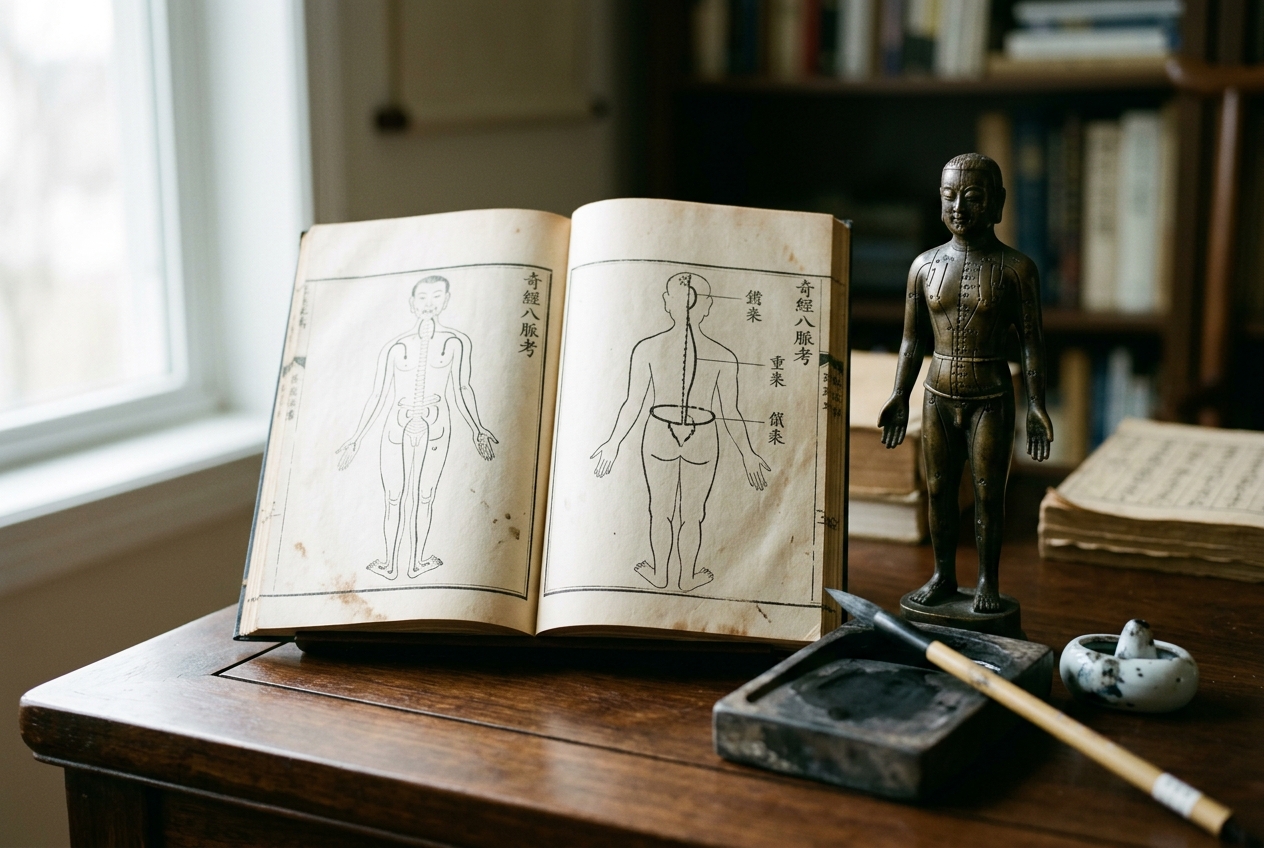
Understanding how to access, balance, and replenish these deep reservoirs is the enduring gift of one of history’s greatest medical treatises: the 1572 masterwork Qi Jing Ba Mai Kao (奇經八脈考, Study of the Eight Extraordinary Vessels) by the legendary Ming Dynasty physician and naturalist Li Shizhen. By translating Li Shizhen’s classical insights into contemporary, non-invasive acupressure protocols, we acquire an empowering set of physiological levers to restore deep constitutional resilience from the inside out.
2. The Meridian Path — A Journey Through the Body
The Historical Context: Li Shizhen and Ming Dynasty Channel Epistemology
During the Ming Dynasty (1368–1644 CE), Chinese medical scholarship underwent a profound renaissance of synthesis and empirical refinement. While Li Shizhen is most celebrated worldwide for his monumental 52-volume pharmacopoeia, the Bencao Gangmu (Compendium of Materia Medica), his 1572 monograph Qi Jing Ba Mai Kao represents his most profound contribution to channel theory and acupuncture science.
+-----------------------------------------------------------------------------+
|                      LI SHIZHEN'S HISTORICAL SYNTHESIS (1572)               |
+-----------------------------------------------------------------------------+
|                                                                             |
|   Early Han Classics              Daoist Internal Alchemy       Li Shizhen  |
|  [Huangdi Neijing & Nan Jing] +   [Neidan & Microcosmic Orbit] = [Qi Jing   |
|   Foundational vessel paths       Experiential bio-feedback      Ba Mai Kao]|
|                                                                             |
+-----------------------------------------------------------------------------+
Prior to Li Shizhen, references to the Eight Extraordinary Vessels were scattered across ancient texts, notably the Huangdi Neijing (Inner Canon of the Yellow Emperor) and the Nan Jing (Classic of Difficult Issues). The vessels were frequently treated as esoteric, secondary pathways subordinate to the twelve primary organ channels. Li Shizhen revolutionized this paradigm. Integrating clinical observation with insights drawn from Daoist internal alchemy (Neidan) and somatic cultivation, he demonstrated that the extraordinary vessels are in fact the primordial energetic matrix of the human organism—laid down in embryogenesis before the primary organ meridians even differentiate.
Li Shizhen immortalized this relationship through a celebrated hydrological metaphor:
"The twelve primary channels are like rivers and irrigation canals, whereas the eight extraordinary vessels are like deep lakes, inland seas, and natural reservoirs. When the rivers are full and overflow, they discharge into the lakes; when the rivers run dry and are parched, the reservoirs release their waters back into the riverbeds."
When an individual experiences sudden emotional shock, traumatic physical injury, or protracted illness, the twelve primary channels cannot maintain equilibrium on their own. The Eight Extraordinary Vessels act as biological capacitors: absorbing excess pathological forces (such as acute inflammation, heat, or emotional agitation) and discharging constitutional reserves to prevent total organ failure during periods of extreme depletion.
The Anatomical and Functional Architecture of the Eight Vessels
To navigate this internal landscape, we must trace the courses of these eight extraordinary channels. Rather than abstract energetic conduits, they map directly to key myofascial planes, neurovascular bundles, and visceral core axes.
1. Du Mai (督脈) — The Governing Vessel: "The Sea of Yang"
- The Bodily Path: Beginning at the pelvic floor between the tailbone and anus, the Du Mai ascends directly through the center of the spinal column. It crosses the nape of the neck, crests over the midline of the skull to the vertex, travels down the forehead and nose, and terminates at the junction of the upper gum and inside of the upper lip.
- Physiology & Bio-Mechanics: As the Sea of Yang (Yang Mai Zhi Hai), it governs all yang meridians, the central nervous system, spinal biomechanics, postural tone, and the brain—classically termed the "Sea of Marrow" (Sui Hai).
- Pathological Indicators: Spinal stiffness, neuro-cognitive exhaustion, chronic back pain, mental depression, tremors, vertigo, and an inability to maintain upright postural extension.
2. Ren Mai (任脈) — The Conception Vessel: "The Sea of Yin"
- The Bodily Path: Arising from the pelvic floor, the Ren Mai ascends the anterior midline of the body, traveling up the pubic bone, navel, solar plexus, sternum, and throat, before terminating in the groove beneath the lower lip.
- Physiology & Bio-Mechanics: Known as the Sea of Yin (Yin Mai Zhi Hai), it governs cellular nourishment, fluid metabolism, reproduction, hormonal cycling, and the parasympathetic relaxation response.
- Pathological Indicators: Chronic abdominal pain, reproductive disharmony, digestive stagnation, pelvic floor weakness, dry mucosal membranes, and night sweats.
3. Chong Mai (衝脈) — The Penetrating Vessel: "The Sea of Blood"
- The Bodily Path: Originating deep within the lower abdomen (the pelvic basin and uterus), it branches into multiple pathways: one surges upward along the core of the spine and through the deep abdomen parallel to the kidney channel; another spreads through the chest and throat to the face; a third descends down the inner thighs along the deep femoral neurovascular bundle to the soles of the feet.
- Physiology & Bio-Mechanics: It is the "Sea of the Twelve Channels" and the primary regulator of systemic hemodynamics, visceral blood distribution, and primal vitality (Yuan Qi).
- Pathological Indicators: A sensation of energy or heat surging upward into the chest and throat (rebellious Qi), cardiac palpitations, acute menstrual cramping, and deep visceral anxiety.
4. Dai Mai (帶脈) — The Girdling Vessel: "The Belt Channel"
- The Bodily Path: The only purely horizontal vessel in the human body. Originating beneath the lower rib cage (around the 11th floating rib), it encircles the waistline and lower abdomen like a wide cummerbund.
- Physiology & Bio-Mechanics: It binds, constrains, and integrates all vertical meridians. It stabilizes the lumbar-pelvic girdle, coordinates the upper and lower halves of the body, and supports visceral containment.
- Pathological Indicators: A sensation of coldness or weakness in the lumbar spine as if sitting in icy water, abdominal distension, pelvic floor laxity, hip instability, and feelings of physical or emotional fragmentation.
5. Yangqiao Mai (陽蹻脈) — The Yang Motility / Heel Vessel
- The Bodily Path: Originates below the outer ankle bone (lateral malleolus), ascends the lateral aspect of the lower leg and thigh, travels along the lateral ribcage and rear shoulder, climbs the neck to the cheek, and terminates at the inner corner of the eye.
- Physiology & Bio-Mechanics: Regulates lateral musculoskeletal agility, extensor muscle tone, dynamic balance, sensory alertness, and the waking state.
- Pathological Indicators: Insomnia with excessive nocturnal alertness, tight outer leg muscles with slack inner leg muscles, lateral hip pain, and chronic tension headaches localized around the temples and eyes.
6. Yinqiao Mai (陰蹻脈) — The Yin Motility / Heel Vessel
- The Bodily Path: Originates directly beneath the inner ankle bone (medial malleolus), ascends the inner calf and thigh into the groin, traverses the abdomen and chest, ascends the throat, and terminates at the inner canthus of the eye, where it joins the Yangqiao Mai.
- Physiology & Bio-Mechanics: Regulates medial musculoskeletal tone, flexor coordination, internal stillness, parasympathetic restorative recovery, and the initiation of sleep.
- Pathological Indicators: Hypersomnia (constant lethargy and heavy eyelids), tight inner leg/adductor musculature with weak outer leg musculature, lower abdominal cramping, and night-time throat dryness.
7. Yangwei Mai (陽維脈) — The Yang Linking Vessel
- The Bodily Path: Commences below the outer ankle, runs along the lateral leg and hip, crosses the back of the shoulder, wraps around the sides of the head (over the parietal bone), and terminates at the forehead above the center of the eyebrows.
- Physiology & Bio-Mechanics: Connects and harmonizes all the yang channels. It acts as the body's defensive boundary, managing immune responsiveness to external environmental factors and regulating the transition between internal states and external demands.
- Pathological Indicators: Alternating chills and fever, chronic neck and shoulder stiffness, acute sensitivity to cold and wind, lateral headaches, and feelings of vulnerability to external stressors.
8. Yinwei Mai (陰維脈) — The Yin Linking Vessel
- The Bodily Path: Originates on the inner calf, ascends along the inner thigh into the lower abdomen, climbs through the chest and solar plexus, and reaches the throat, where it meets the Ren Mai.
- Physiology & Bio-Mechanics: Connects and harmonizes all the yin channels. It governs the internal psychological landscape, emotional memory, cardiac emotional stability, and the nourishment of the Heart-Shen (consciousness).
- Pathological Indicators: Heartbreak, profound internal sorrow, chest tightness accompanied by anxiety, phobias, digestive spasms triggered by emotional stress, and a subjective sense of internal vulnerability.
3. Key Points You Can Press Right Now: The Master-Couple Matrix
In clinical acupuncture and acupressure practice, the Eight Extraordinary Vessels are not accessed via hundreds of dispersed points. Instead, they are opened and regulated through an elegant matrix of eight specialized distal points known as the Eight Confluent Points (Ba Mai Ba Xue, 八脈八穴).
According to classical channel dynamics, these points function in complementary pairs—a Master Point (Zhu Xue) and a Couple Point (Pei Xue). Activating these pairs simultaneously or sequentially generates a synergistic resonant circuit between two interconnected extraordinary vessels. Standard point locations comply with the established World Health Organization Standard Acupuncture Point Locations.
Below are three foundational regulatory points drawn from this matrix and primary channel cross-roads that you can locate and stimulate immediately:
Point 1: Neiguan (PC6 — Inner Pass)
Master Point of the Yinwei Mai (Linking the Interior)
- How to Find It on Your Body: Turn your hand palm-up. Place the three middle fingers of your opposite hand across the inside of your wrist, with your ring finger resting on the main wrist crease. The point sits just past your index finger, exactly in the center of your forearm, nestled between the two prominent, cord-like tendons (the flexor carpi radialis and palmaris longus).
- What You Will Feel: When gently pressing into the groove between the tendons, you will feel a distinct, deep, spreading sensation—often described as a pleasant, heavy ache, mild numbness, or a subtle warmth traveling toward your palm or chest.
- How to Press: Use the tip of your thumb. Apply steady, perpendicular pressure directly into the groove. Maintain firm but comfortable pressure, making micro-circular oscillations for 2 to 3 minutes while breathing deeply through your nose.
- What It Solves in Daily Life: Rapidly relieves acute emotional anxiety, tight chest constriction, nausea, travel sickness, and digestive knots caused by nervous tension. Scientific mechanisms for autonomic modulation via PC6 stimulation are detailed in clinical reviews published by PubMed Central.
Point 2: Zhaohai (KI6 — Shining Sea)
Master Point of the Yinqiao Mai (Opening Rest & Yin Recovery)
- How to Find It on Your Body: Locate the highest, most prominent point of your inner ankle bone (the medial malleolus). Slide your finger directly downward approximately one finger-width into the distinct soft depression or cleft directly below the lower border of the bone.
- What You Will Feel: Unlike the muscular areas of the body, this point is rich in nerve endings and connective tissue. You will experience an immediate, sharp yet sweet tenderness, tingling, or a soothing sensation that radiates into the sole of your foot or up the inner leg.
- How to Press: Angle your thumb slightly upward toward the underside of the inner ankle bone. Apply moderate, sustained pressure for 2 to 3 minutes.
- What It Solves in Daily Life: Eases difficulty falling asleep due to an overactive mind, soothes chronic dry or scratchy throat, and relieves deep pelvic and lower back tension.
Point 3: Sanyinjiao (SP6 — Three Yin Intersection)
Systemic Crossing Point of Spleen, Liver, and Kidney Meridians
- How to Find It on Your Body: Place the four fingers of your opposite hand horizontally across the inside of your lower leg, starting with your pinky finger aligned with the crest of your inner ankle bone. The point sits directly above the level of your index finger, tucked just behind the posterior border of the shinbone (the tibia).
- What You Will Feel: This is often one of the most tender points on the lower extremity. You will encounter a noticeable, deep, bruised-like sensitivity even with moderate pressure, signaling its high density of regulatory neural pathways.
- How to Press: Press your thumb tip inward and slightly forward against the back edge of the shinbone. Maintain gentle, steady pressure, breathing smoothly through any intensity for 1 to 2 minutes.
- What It Solves in Daily Life: Highly effective for menstrual cramps, lower abdominal bloating, chronic fatigue, water retention, and nervous exhaustion accompanied by mood volatility.
4. A Point Combination for One Common Issue: The Evening Neuro-Visceral Reset
The Scenario: Autonomic Burnout and Night-Time Restlessness
You have spent 10 hours seated before digital screens. Your neck and upper trapezius muscles are locked, your breathing is shallow and trapped in your upper chest, your stomach feels distended from rushed meals, and your mind is spinning with uncompleted tasks. You need to down-regulate your central nervous system, drain tension from the head, and prime your body for restorative, deep-wave sleep.
================================================================================
                 EVENING PROTOCOL: 3-STAGE NEURO-VISCERAL RESET
================================================================================

STAGE 1: Open the Chest & Settle the Shen (Minutes 0–4)
  --------------------------------------------------------
  • Point: Neiguan (PC6) bilaterally (2 min per side)
  • Physiological Target: Yinwei Mai (Autonomic down-regulation, heart ease)

STAGE 2: Ground the Fluid Body & Cool the Mind (Minutes 4–8)
  ------------------------------------------------------------
  • Point: Zhaohai (KI6) bilaterally (2 min per side)
  • Physiological Target: Yinqiao Mai / Ren Mai (Vagal tone, sleep induction)

STAGE 3: Smooth the Stagnant Qi & Unbind the Core (Minutes 8–12)
  ---------------------------------------------------------------
  • Point: Taichong (LV3) + Sanyinjiao (SP6) (2 min per side)
  • Physiological Target: Primary Channel Grounding & Visceral Decongestion
================================================================================
The "Do This Tonight" Protocol
Preparation and Posture
- Dim the room lighting. Sit comfortably in a supportive armchair or lie flat on your back on a firm mattress or yoga mat with a small pillow beneath your knees to relax the abdominal myofascia.
- Take three slow, diaphragmatic breaths: inhale through the nose for a count of 4, feeling your belly expand; exhale through the mouth for a count of 6, feeling your ribcage soften.
Step 1: Open the Chest and Settle the Shen via Neiguan (PC6)
- Target: PC6 on the left forearm first, followed by the right.
- Execution: Locate PC6 three finger-widths down from the wrist crease. Place your thumb on the point and your fingers on the back of your wrist to pinch the forearm gently.
- Application: Apply firm, rotating pressure for 2 minutes per arm.
- Sensation & Integration: Close your eyes. As the dull ache develops, consciously drop your shoulders away from your ears. Feel your breath descend naturally into your lower ribs.
Step 2: Cool the Brain and Anchoring the Yin via Zhaohai (KI6)
- Target: KI6 beneath the inner ankle bone on both legs.
- Execution: Bend your knees outward in a loose butterfly posture or cross one leg over the other knee.
- Application: Hook your thumbs into the notch directly beneath your inner ankle bones. Apply firm, upward-angled pressure for 2 minutes per foot.
- Sensation & Integration: Focus your attention on the soles of your feet. You will feel a release of pressure behind the eyes and a cooling sensation through the throat and chest.
Step 3: Descend the Rebellious Qi via Taichong (LV3) to Sanyinjiao (SP6)
- Target: Taichong (LV3 — located on top of the foot in the webbing valley between the big toe and second toe, two finger-widths backward) paired with Sanyinjiao (SP6).
- Execution: With your thumb on LV3 and your middle finger wrapped to SP6 on the same leg, press both points simultaneously for 2 minutes. Repeat on the opposite leg.
- Sensation & Integration: This creates the classical "Four Gates" downward drainage circuit, pulling residual cognitive hyperactivity down through the lower extremities and anchoring it in the earth.
5. Safety, Sensibility, and Clinical Boundaries
While acupressure is an inherently safe, non-invasive therapeutic modality with millennia of clinical refinement, working with the body's master regulatory conduits requires discernment and respect for anatomical boundaries.
The Sensation of Deqi: Calibrating Your Pressure
In classical acupuncture, efficacy depends on obtaining Deqi (得氣)—the arrival of physiological connection. When applying manual acupressure: * The Correct Feeling: A deep, spreading, dull ache, a feeling of muscular release, warmth, or mild tingling along the channel. It should feel deeply relieving, even if moderately tender. * Incorrect / Excessive Pressure: Sharp, stabbing pain, superficial skin burning, or defensive muscular tensing. If your body tenses or you hold your breath to endure the pressure, you are applying too much force. Ease off immediately; more force does not equal more healing.
Critical Contraindications
- Pregnancy: Strong stimulation of points that descend Qi or move pelvic blood—specifically Sanyinjiao (SP6), Hegu (LI4), Jianjing (GB21), and deep manipulation of points along the lower abdomen (Ren Mai and Chong Mai)—is strictly contraindicated during pregnancy, as it can induce premature uterine contractions.
- Local Tissue Integrity: Never apply direct acupressure over broken skin, varicose veins, acute surgical incisions, localized inflammation, swollen lymph nodes, or areas of active phlebitis/deep vein thrombosis.
When to Seek Professional Care
Self-administered acupressure is a powerful daily self-care and maintenance tool, but it is not a substitute for comprehensive medical evaluation. If you experience crushing chest pain, unexplained syncope, sudden loss of motor control, chronic severe gastrointestinal bleeding, or intractable migraines, consult a physician or licensed acupuncturist certified by bodies recognized in international frameworks such as the Standard Acupuncture Nomenclature (WHO).
6. Today’s Takeaway: The Two-Minute Inner Gate Reset
You do not need an hour of leisure or specialized tools to access the regulatory power of Li Shizhen’s extraordinary vessel system. You can execute this foundational two-minute practice right now, at your desk, before navigating away from this page.
================================================================================
             TODAY'S 2-MINUTE PRACTICE: NEIGUAN (PC6) AUTONOMIC RESET
================================================================================

Step 1: Locate (0:00 - 0:15)
  • Find PC6: 3 finger-widths below the wrist crease, between the two tendons.

Step 2: Engage (0:15 - 1:00)
  • Press your thumb tip firmly into the groove until a heavy, spreading ache
    blooms across your forearm.

Step 3: Harmonize (1:00 - 2:00)
  • Inhale through your nose for 4 seconds, feeling your belly expand.
  • Exhale slowly through slightly parted lips for 6 seconds.
  • Maintain rhythmic circular pressure for 60 seconds on the left arm,
    then repeat on the right.
================================================================================
By stimulating Neiguan (PC6)—the master gateway to the Yinwei Mai—you immediately signal your cardiovascular and autonomic circuits to down-regulate from sympathetic fight-or-flight into parasympathetic restorative poise. In just two minutes, you open the deep reservoir, replenishing the parched riverbeds of daily stress with the enduring, ancestral vitality that has sustained human health for centuries.