Movement Health Cultivation (Yun Dong Yang Sheng Fa) Daily Holistic Dynamics: Governing Dynamic-Static Equilibrium, Myofascial Kinetic Conditioning, Smooth Qi-Blood Circulation, and Somatic Vitality Homeostasis in Traditional Chinese Medicine
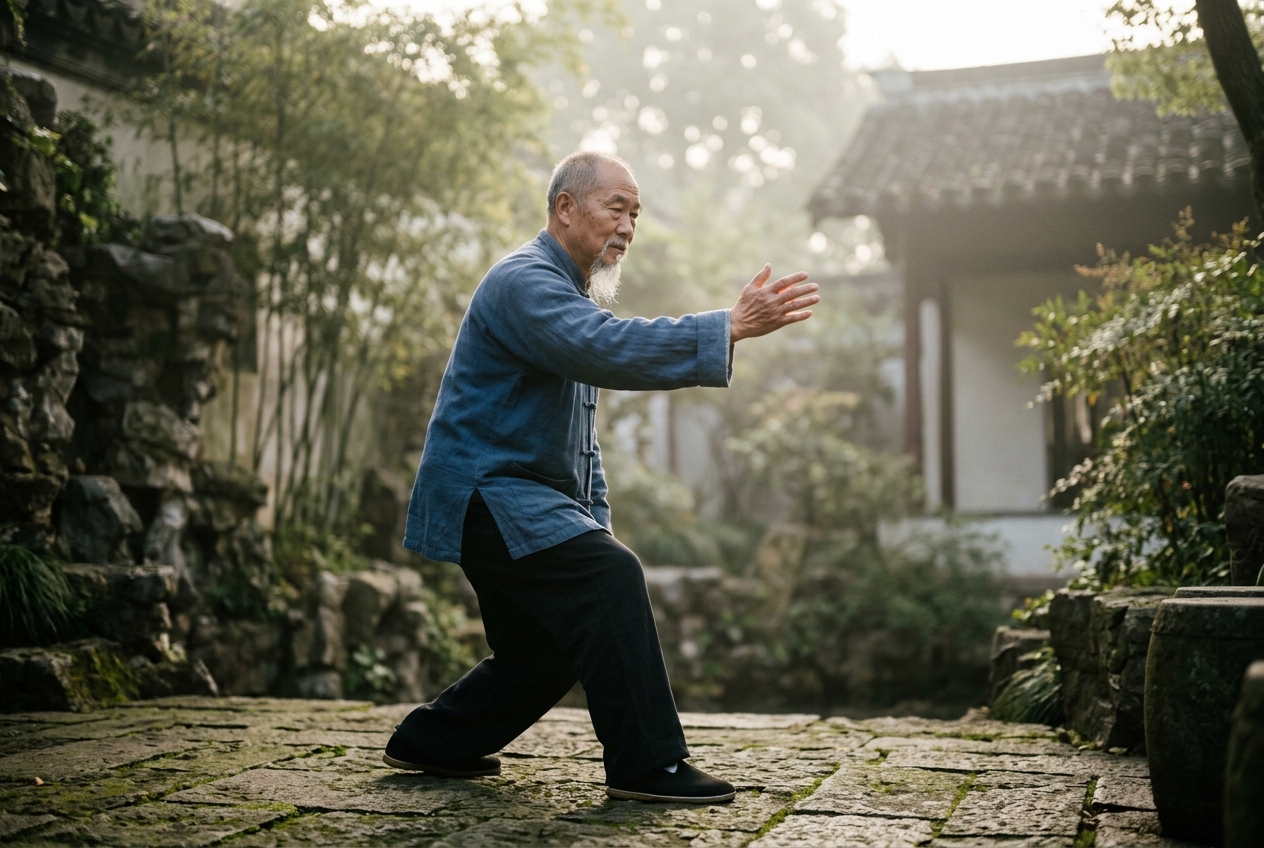
1. Opening Scene — A Moment You'll Recognise
It is 3:45 on a Tuesday afternoon, and a familiar physical heavy-limbed lethargy begins to settle behind your eyes. Your shoulders have crept upward toward your ears in an unconscious defensive posture, your mid-thoracic spine feels cast in brittle mortar, and your breath has shallowly retreated into the apex of your collarbones. You have been seated in an ergonomically calibrated chair for six consecutive hours, barely moving save for the micro-twitches of your fingertips across a keyboard. In response, you might tell yourself that what you need this evening is a punishing, sixty-minute high-intensity interval training session—a cardiovascular purge to burn off accumulated stress and exhaust your restless nervous system.
Yet, when modern professionals subject their already depleted bodies to exhaustive, high-strain regimens, they frequently discover a frustrating paradox: instead of feeling revitalised, they experience systemic exhaustion, worsening musculoskeletal stiffness, and a persistent, wired-yet-tired insomnia.
In Traditional Chinese Medicine (TCM), this state is understood not merely as muscle tightness, but as a failure of kinetic circulation. Centuries before the emergence of modern biomechanics, the classical physician Sun Simiao (孙思邈) formulated a foundational principle in his seventh-century compendium Qianjin Yaofang (Essential Formulas Worth a Thousand Gold Pieces): “Flowing water never stagnates, and door hinges never become worm-eaten” (Liu Shui Bu Fu, Hu Shu Bu Du 流水不腐,户枢不蠹). The human organism is designed as a continuous, dynamic hydraulic system. When kinetic movement ceases, the vital substances pool, thicken, and stagnate; conversely, when movement is excessive and violent, vital resources are depleted beyond recovery. Bridging this ancient dilemma is the science of Yun Dong Yang Sheng Fa (运动养生法)—the art of movement health cultivation.
2. What This Organ System Does: The Kinetic Symphony of Qi, Blood, and the Twelve Channels
To understand how movement operates as medicine in classical Chinese thought, one must dismantle the Western cartesian dichotomy that separates structural anatomy from energetic physiology. In the framework codified within the foundational Han Dynasty text Huangdi Neijing (The Yellow Emperor’s Inner Classic), physical movement is the primary mechanical pump that circulates Qi (vital metabolic energy and functional drive) and Xue (nutrient-rich Blood) through the Jingluo (经络)—the network of Twelve Primary Channels that traverses the body's connective tissues and internal organs.
+--------------------------------------------------------------------------------------------------+
|                    CLASSICAL ORGAN-TISSUE KINETIC GOVERNANCE                                     |
+--------------------------------------------------------------------------------------------------+
|  ORGAN SYSTEM (ZANG)  |  TISSUE GOVERNED (TI)    |  KINETIC & PHYSIOLOGICAL FUNCTION             |
+-----------------------+--------------------------+-----------------------------------------------+
|  Liver (Gān 肝)       |  Sinews & Fascia (Jīn 筋)|  Smooth glide, flexibility, tension release   |
|  Spleen (Pǐ 脾)       |  Flesh & Muscles (Ròu 肉)|  Muscular tone, limb strength, nutrition      |
|  Kidneys (Shèn 肾)    |  Bones & Marrow (Gǔ 骨)  |  Structural integrity, joint lubrication      |
|  Lungs (Fèi 肺)       |  Skin & Defensive Qi     |  Breath rhythm, atmospheric exchange          |
|  Heart (Xīn 心)       |  Vessels & Shen (Mài 脉) |  Circulatory rhythm, psycho-somatic coherence |
+--------------------------------------------------------------------------------------------------+
Rather than treating muscles in isolation, TCM views bodily movement through an integrated matrix governed by three core visceral axes:
- The Liver (Gān 肝) and the Sinews (Jīn 筋): The Liver is responsible for the smooth, uninhibited dispersal of Qi throughout the entire organism and directly governs the sinews—a classical category encompassing tendons, ligaments, and the entire fascial web. When the Liver functions harmoniously, sinews remain pliable, hydrated, and elastic. When physical or emotional stress arrests this flow (Liver Qi Stagnation), the fascial matrix contracts, producing chronic tension, neck stiffness, and irritability.
- The Spleen (Pǐ 脾) and the Flesh (Ròu 肉): The Spleen governs the transformation and transportation of nourishment, generating the metabolic energy that fuels the four limbs (Sì Zhī 四肢). In TCM, the strength, tone, and vitality of muscular flesh depend entirely on Spleen Qi. If an individual remains sedentary, Spleen Qi weakens, leading to metabolic dampness (Shī 湿), muscular atrophy, and post-prandial heaviness.
- The Kidneys (Shèn 肾) and the Bones (Gǔ 骨): The Kidneys store Jing (Essence) and govern the structural integrity of the skeletal framework, bone density, and the deep synovial fluids that lubricate the joints.
The Doctrine of Dynamic-Static Equilibrium (Dong Jing Jie He 动静结合)
At the philosophical and clinical core of Yun Dong Yang Sheng Fa lies the imperative of Dynamic-Static Equilibrium (Dong Jing Jie He 动静结合). Classical masters observed that modern human suffering oscillates between two pathogenic extremes: absolute physical inertia (which breeds stagnation) and unrestrained, exhaustive physical exertion, termed Lao Shang (劳伤, taxation fatigue).
When modern training pushes the body into prolonged anaerobic exhaustion, it depletes Yuan Qi (primordial constitutional energy), injures the Yin fluids, and consumes the Liver Blood that hydrates the tendons. Conversely, true movement cultivation insists that: * Within Movement, Seek Stillness (Dong Zhong Qiu Jing 动中求静): While the physical body articulates fluidly through space, the mind (Xin) remains rooted in relaxed, parasympathetic stillness, ensuring that adrenaline does not burn through delicate cellular reserves. * Within Stillness, Maintain Movement (Jing Zhong Qiu Dong 静中求动): Even during seated stillness or standing meditation (Zhan Zhuang), the internal breath, blood, and micro-fascial hydraulic pressures continue to circulate vigorously.
Through this equilibrium, moderate, circular, and continuous physical activity conditions the Jin Gu (sinews and bones 筋骨), preserves joint architecture, and optimizes constitutional longevity without triggering inflammatory catabolism.
3. How You Can Feel It — Signs of Balance and Imbalance
The state of your kinetic meridian network reflects instantly in your daily somatic experience. Because Qi and Blood must constantly circulate to nourish tissues and clear cellular debris, blockages manifest as distinct sensory patterns.
+--------------------------------------------------------------------------------------------------+
|                            SOMATIC BALANCE ASSESSMENT MATRIX                                     |
+------------------------------------+-------------------------------------------------------------+
| PATHOLOGICAL STAGNATION (IMBALANCE)| KINETIC HARMONY (YANG SHENG CULTIVATION)                    |
+------------------------------------+-------------------------------------------------------------+
| Waking joint stiffness > 20 mins   | Joints feel warm, supple, and lubricated upon waking        |
| Post-prandial cerebral brain fog   | Digestion proceeds silently with stable, alert energy       |
| Tendency to hold breath during work| Diaphragmatic, rhythmic breathing throughout the workday    |
| Post-workout exhaustion & soreness | Post-exercise lightness, clear focus, invigorated calm      |
| Sighing frequently, tight trapezius| Open chest, dropped shoulders, free emotional regulation    |
| Cold hands and feet despite layers | Uniform systemic warmth distributed to the extremities      |
+------------------------------------+-------------------------------------------------------------+
Diagnostic Breakdown: Reading Your Physical State
- The Stagnant Profile (Qi & Blood Stasis): You awaken feeling heavier than when you went to bed. Your joints crack dryly, and your hamstrings feel like rigid cables. When seated at your desk, you find yourself sighing deeply—the body’s unconscious attempt to mechanically force open a constricted liver-diaphragm axis. After exercise, instead of a clean surge of vitality, you crash into systemic brain fog, requiring stimulants to function.
- The Harmonious Profile (Free Flow of Qi & Xue): Your movement possesses what classical texts term Song (松)—an alert, buoyant relaxation free of dead weight or rigid bracing. Joints articulate without friction; your extremities are warm due to unimpeded peripheral microcirculation; and physical movement acts as an immediate decompressor for mental stress rather than an additional physiological burden.
A 60-Second Self-Assessment You Can Perform Right Now
- The Diaphragmatic Rib Check: Place your palms flat against your lower lateral ribcage (the realm of Liver and Spleen meridians). Inhale naturally. Do your lower ribs expand smoothly outward like the gills of a fish, or does your chest simply hitch upward toward your throat? Upward hitching indicates diaphragm freezing and Liver Qi stagnation.
- The Ankle-Tendon Mobility Test: Stand barefoot. Slowly rotate one ankle through its fullest possible circle. Does the rotation feel smooth, fluid, and circular, or is it notched, clunky, and accompanied by audible snapping? Notched movement reveals dehydration and fascial densification in the Jīn (sinew) networks of the lower leg channels.
4. Qigong & Movement Practice: The Dual Pillar of Dynamic Decompression
To experience the immediate therapeutic effects of Yun Dong Yang Sheng Fa, we turn to two foundational, non-strenuous kinetic practices drawn from the ancient Baduanjin Qigong (Eight Pieces of Brocade) lineage, synthesized with post-prandial locomotion.
+--------------------------------------------------------------------------------------------------+
| STEP-BY-STEP EXERCISE: SUPPORTING THE HEAVENS TO REGULATE THE SANJIAO                            |
| (Shuāng Shǒu Tuō Tiān Lǐ Sān Jiāo 双手托天理三焦)                                                |
+--------------------------------------------------------------------------------------------------+
       [ Phase 1: Grounding ]           [ Phase 2: Ascent ]             [ Phase 3: Extension ]
              (Wuji)                      (Inhale / Rise)                (Hold / Decompress)
               O                                O                                \O/
              /|\                              /|\                                |
              / \                              / \                               / \
         Feet Parallel                   Hands Sweep Up                     Palms to Sky
     Yongquan Rooted (KID-1)           Fascial Line Lengthens            Full Visceral Lift
Step 1: Structural Setup and Starting Posture (Wuji Stance)
- Foundation: Stand barefoot or in flat shoes with feet precisely shoulder-width apart, outer edges of feet parallel. Soften your knees by two degrees—never lock the joint capsules.
- Rooting: Distribute your body weight evenly across the tripod of each foot, consciously relaxing the Yongquan (KID-1, "Bubbling Spring") point located in the depression behind the ball of the foot.
- Spinal Alignment: Gently tuck the coccyx downward as if resting on a high stool, allowing the lumbar curve to flatten slightly. Suspend the crown of the head from above (Baihui, GV-20), gently drawing the chin inward to lengthen the cervical spine. Let the shoulders sink away from the ears.
Step 2: Movement and Breath Integration
- The Gathering Phase (Exhale): Interlace your fingers lightly in front of your lower abdomen (Dantian), palms facing upward. Soften your gaze toward the horizon.
- The Ascending Rotation (Inhale): Inhale slowly and silently through the nose over a 4-second count. Draw the interlaced hands upward along the midline of the torso. As the hands reach chest level, rotate the wrists outward so the palms face forward and begin pressing upward toward the sky.
- The Celestial Extension (Peak Inhalation): Press the heels of the palms firmly toward the ceiling while pressing your feet firmly into the floor. Feel an unbroken line of fascial tension travel from the soles of your feet, through the abdomen, along the ribcage, and out through the palms. Look slightly upward at your hands without straining the neck. Hold this gentle stretch for 2 seconds.
- The Descending Descent (Exhale): Release the fingers and sweep the arms slowly out to the sides in a wide, circular arc over a 6-second count, exhaling smoothly through the nose. Imagine clearing stagnant heat and metabolic debris downward through the body. Let the hands settle back at the lower abdomen.
Parameters and Sensations
- Repetitions: Complete 8 to 12 unbroken repetitions every morning or during the mid-afternoon energy lull.
- Sensation to Look For: You should experience a distinct warming sensation along the midline of the torso and extremities, accompanied by a feeling of spinal decompression. Modern research into Fascial Mechanotransduction demonstrates that this sustained tensile vector stimulates fibroblasts to release lubricating hyaluronic acid into connective tissue sheets, restoring intra-fascial sliding and relieving thoracic stagnation.
5. Acupressure Points You Can Try Today: Unlocking the Kinetic Channels
When specific joints or fascial planes become locked by sedentary habits, targeted manual stimulation of designated neurovascular and energetic hubs (acupoints) can instantly release tension and restore channel conductivity.
+--------------------------------------------------------------------------------------------------+
|                   ANATOMICAL ACUPRESSURE PROTOCOL FOR MOVEMENT RECOVERY                          |
+--------------------------------------------------------------------------------------------------+
  [ GB-34: Yanglingquan ]              [ ST-36: Zusanli ]                [ LR-3: Taichong ]
    Below Lateral Knee                  Below Patella / Tibia              Dorsum of Foot
          ( O )                               ( O )                             \   /
           | |                                 | |                              ( * )
          [ * ] GB-34                         [ * ] ST-36                       /   \
           | |                                 | |                             1st & 2nd
       (Fibula Head)                      (Tibia Crest)                       Metatarsals
1. Yanglingquan (GB-34, 阳陵泉) — "Yang Mound Spring"
- Classical Designation: The Influential Hui-Meeting Point of Sinews (Jīn Huì 筋会).
- Precise Location: Sit with knees bent at 90 degrees. Locate the prominent bony bump on the outer side of your lower leg, just below the knee (the head of the fibula). Slide your finger slightly forward and down into the natural soft, tender depression located about one finger-breadth anterior and inferior to this bony landmark.
- Technique: Apply firm, direct pressure with the tip of your thumb, angling slightly upward toward the knee joint. Maintain a pressure of 6/10 on the discomfort scale for 2 minutes per leg, while gently flexing and pointing the foot to mobilize the peroneal nerve and fascial compartment.
- Daily Application: Essential for relieving tight IT bands, hip stiffness, sciatica, knee tension, and overall muscular contracture.
2. Zusanli (ST-36, 足三里) — "Leg Three Miles"
- Classical Designation: He-Sea Point of the Stomach Meridian; Master Point for Vital Energy and Lower Extremity Power.
- Precise Location: Place the palm of your hand over the center of your kneecap on the same side. Your ring finger will naturally rest on a spot four finger-widths below the lower border of the patella, approximately one thumb-width lateral to the sharp anterior crest of the shinbone (tibia). You will feel a palpable muscular groove in the tibialis anterior muscle.
- Technique: Use the knuckle of your index finger or a firm thumb to apply deep, circular, kneading pressure in a clockwise direction. Continue for 2 to 3 minutes per side until an aching, radiating sensation (De Qi) spreads down the shin into the foot.
- Daily Application: Reverses post-prandial lethargy, stimulates digestive motility, combats lower-limb heaviness, and reinforces systemic Spleen Qi.
3. Taichong (LR-3, 太冲) — "Great Surge"
- Classical Designation: Shu-Stream and Yuan-Source Point of the Liver Meridian.
- Precise Location: On the top of the foot, locate the webbing junction between the big toe and the second toe. Slide your finger upward along the groove between the first and second metatarsal bones toward your ankle for about 1.5 to 2 inches until your finger drops into a distinct, sensitive valley just before the two bones meet.
- Technique: Press firmly downward and slightly toward the ankle bone with your thumb. Apply steady, pulsing pressure for 90 seconds while taking slow, deep diaphragmatic breaths.
- Daily Application: Disperses trapped Liver Qi, alleviates tension headaches, calms psycho-emotional frustration, and reduces generalized neuromuscular spasm throughout the body.
6. Food & Lifestyle — Daily Kinetic Rhythms and Chronobiology
Movement cultivation is not an isolated 30-minute workout; it is a chronobiological rhythm embedded within the natural cycles of the day and year. Classical TCM organizes daily life around the Chinese Organ Clock (Zi Wu Liu Zhu 子午流注), matching specific kinetic intensities to optimal physiological windows.
+--------------------------------------------------------------------------------------------------+
|                    THE 24-HOUR YANG SHENG KINETIC CHRONO-SCHEDULE                                |
+-----------------------+-----------------------------+--------------------------------------------+
| TIME WINDOW           | ACTIVE MERIDIAN / SYSTEM    | OPTIMAL KINETIC ACTIVITY                   |
+-----------------------+-----------------------------+--------------------------------------------+
| 07:00 – 09:00 (Chén)  | Stomach (Stomach Qi High)   | Morning joint spirals, gentle walking      |
| 09:00 – 11:00 (Sì)    | Spleen (Metabolic Peak)     | Peak intellectual & light postural movement|
| 13:00 – 15:00 (Wèi)   | Small Intestine             | Post-prandial 300-step stroll (Bai Bu Zou) |
| 17:00 – 19:00 (Yǒu)   | Kidneys (Essence Storage)   | Moderate resistance or Qigong cultivation  |
| 21:00 – 23:00 (Hài)   | Sanjiao (Triple Burner)     | Slow restorative floor stretches & rest    |
+--------------------------------------------------------------------------------------------------+
The Post-Prandial Stroll (Fan Hou Bai Bu Zou 饭后百步走)
A cornerstone of Ming and Qing dynasty longevity texts is the ironclad rule: “Walk one hundred steps after a meal, and you will live to ninety-nine” (饭后百步走,活到九十九). * The Method: Within 15 minutes of concluding lunch or dinner, engage in a slow, unhurried 10-to-15 minute walk (Bai Bu Zou 百步走). Keep the arms loosely swinging at your sides; refrain from checking digital screens or engaging in contentious debates. * Physiological Action: Modern metabolic trials validate this ancient prescription: light, non-strenuous post-prandial ambulation engages the soleus muscle pump, dramatically blunting post-meal glucose spikes, supporting Spleen transformation, and preventing the accumulation of toxic metabolic dampness without shunting blood away from the visceral digestive beds.
Dietary Support for Fascial and Sinew Health
To keep the Jin (sinews) hydrated and the channels smooth, the diet must actively nourish Liver Blood and Kidney Yin while preventing the cold-damp stagnation that stiffens connective tissue.
+--------------------------------------------------------------------------------------------------+
|                      KINETIC NUTRITION: NOURISHING SINEWS & CHANNELS                             |
+---------------------------------------------------+----------------------------------------------+
| WHAT TO ADD (NOURISH SINEWS & WARM CHANNELS)      | WHAT TO REDUCE (PREVENT FASCIAL CONGESTION)  |
+---------------------------------------------------+----------------------------------------------+
| Bone broths & gelatinous slow-cooked soups        | Ice-cold drinks & raw, unheated smoothies    |
| Black sesame seeds, walnuts, and goji berries     | Refined industrial seed oils & trans fats    |
| Warming spices: fresh ginger root, cinnamon, turmeric| Excess refined cane sugar (causes glycation)|
| Dark leafy greens: spinach, chard, steamed kale   | Heavy, deep-fried, greasy foods (creates damp)|
| Fermented foods: miso, organic tamari, sauerkraut | Late-night meals consumed after 20:00        |
+---------------------------------------------------+----------------------------------------------+
- Thermal Hydration: Never drink iced beverages during or immediately after exercise. Classical physiology notes that introducing cold fluids into a warm, dilated internal environment instantly constricts the microvasculature of the Stomach and Liver, creating cold-induced fascial cramping and stasis. Always consume room-temperature or warm water infused with a slice of fresh ginger.
7. Modern Biomedical Synthesis: The Science of Fascial Flow and Vagal Tone
When classical Chinese texts describe the unblocking of the Jingluo through gentle movement, they are describing phenomena that contemporary physiology now identifies as the optimization of the interstitial fluid matrix and the autonomic nervous system.
+--------------------------------------------------------------------------------------------------+
|                        BRIDGING TRADITION AND BIOMEDICAL SCIENCE                                 |
+------------------------------------+-------------------------------------------------------------+
| CLASSICAL TCM CONCEPT              | CONTEMPORARY BIOMEDICAL TRANSLATION                         |
+------------------------------------+-------------------------------------------------------------+
| Smooth flow of Qi and Blood        | Unimpeded microvascular perfusion & endothelial NO release  |
| Free glide of Sinews (*Jīn* 筋)   | Hyaluronan-mediated myofascial shearing (Anatomy Trains)    |
| Dynamic-Static Equilibrium         | Sympathovagal balance & high Heart Rate Variability (HRV)   |
| Stagnant Dampness (*Shī* 湿)      | Lymphatic congestion & inflammatory extracellular matrix     |
| Primordial Energy (*Yuan Qi*)      | Mitochondrial reserve & parasympathetic endocrine baseline  |
+------------------------------------+-------------------------------------------------------------+
Clinical research archived on PubMed on Fascia and Meridians reveals that the pathways of classical acupuncture meridians correlate to an extraordinary degree with the intermuscular and intramuscular cleavage planes of human connective tissue. When we perform slow, rotational, whole-body movements: 1. Myofascial Shearing and Hydration: Fascia is predominantly composed of collagen fibers embedded in a proteoglycan-rich ground substance. Sedentary behavior causes this gel to cross-link and solidify, trapping metabolic waste. Gentle multidirectional movement acts as a mechanical sponge, squeezing out old fluid and pulling in fresh, nutrient-rich water. 2. Lymphatic Propulsion: Unlike the cardiovascular system, the lymphatic network possesses no central mechanical pump; it depends entirely on rhythmic skeletal muscle contractions and deep diaphragmatic pressure fluctuations to clear cellular toxins. 3. Autonomic Recalibration: Studies synthesized by the World Health Organization on Traditional Medicine and academic reviews on the Therapeutic Effects of Qigong confirm that slow, synchronized kinetic practices stimulate the vagus nerve, downregulating the hypothalamic-pituitary-adrenal (HPA) axis, lowering serum cortisol, and elevating heart rate variability (HRV).
8. Today's Takeaway
+--------------------------------------------------------------------------------------------------+
|                                  THE 5-MINUTE DAILY KINETIC RESET                                |
+--------------------------------------------------------------------------------------------------+
| Stand from your desk right now, step away from all electronic screens, and complete 8 slow,     |
| circular repetitions of "Supporting the Heavens" (双手托天), matching each upward reach to a   |
| 4-second nasal inhalation and each release to a 6-second exhalation. Follow this with a brief,   |
| unhurried 300-step stroll, allowing your arms to swing naturally like pendulums. In five minutes,|
| you will have decompressed your thoracic spine, restored hyaluronan glide to your fascial sheets,|
| and stimulated the free flow of Qi and Blood throughout your entire organ network—proving the     |
| ancient maxim that flowing water never stagnates, and the body in motion never rusts.            |
+--------------------------------------------------------------------------------------------------+