Microcosmic Orbit Qigong (Xiao Zhou Tian) Meridian Dynamics: Governing Ren-Du Channel Cycling, Three Passes Transmutation, Cranial-Sacral Qi Circulation, and Yin-Yang Orbit Unification in Traditional Chinese Medicine
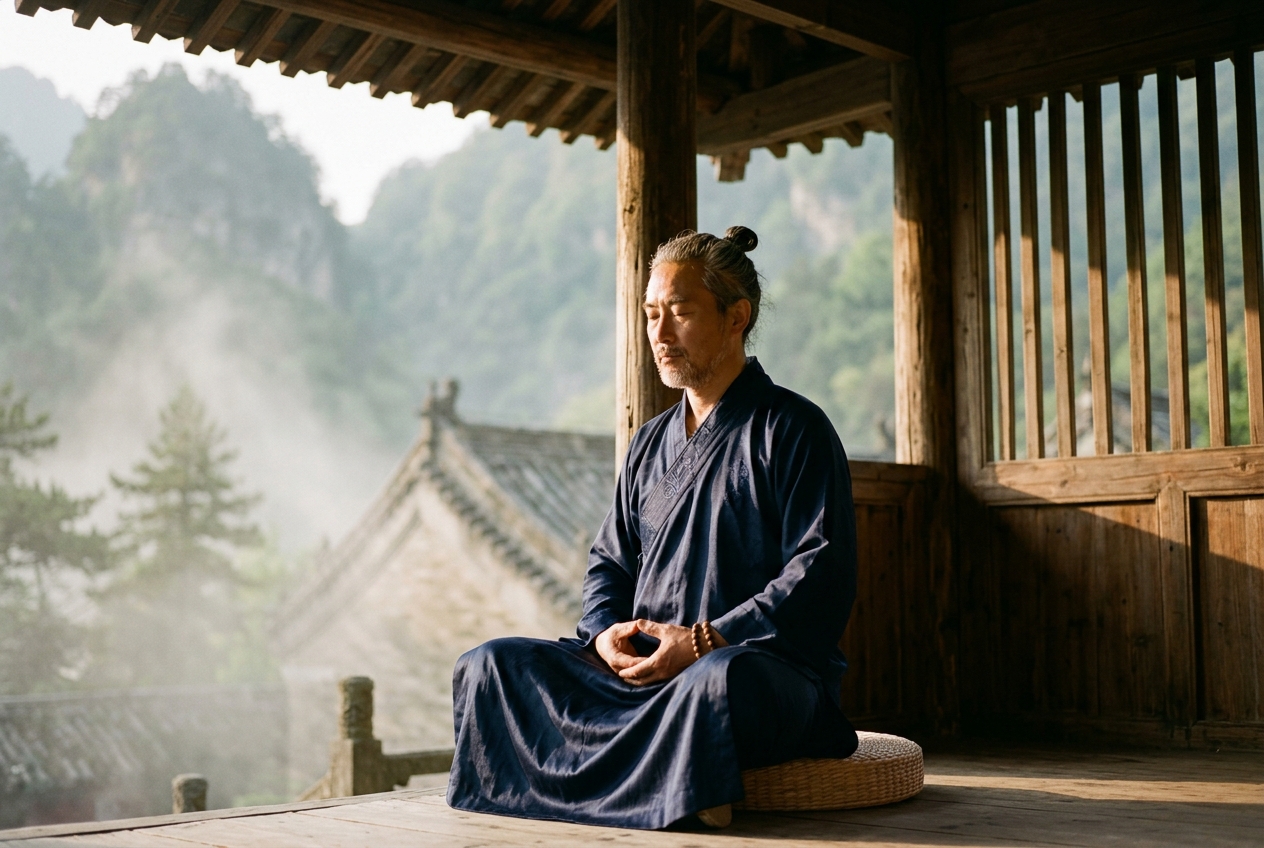
By unifying the body’s prime energetic conduits through breath, posture, and focused awareness, the ancient practice of Xiao Zhou Tian bridges classical Daoist alchemy with modern neurobiology, offering a potent antidote to autonomic exhaustion.
1. Opening Scene — A Moment You'll Recognise
It is three in the afternoon on a Tuesday. You have been seated before a glowing workstation for hours, shoulders incrementally creeping toward your ears, your chin jutting forward in an unconscious attempt to close the distance between your eyes and the screen. Your lower back radiates a dull, compressed ache; your feet feel strangely cold and disconnected; yet inside your skull, a restless, buzzing heat creates a distinct feeling of mental congestion. You take a breath, but it catches high in your chest, shallow and tight, unable to descend past your diaphragm.
In Traditional Chinese Medicine (TCM), this ubiquitous state of modern malaise is not merely physical fatigue or musculoskeletal strain. It represents a fundamental disconnection between the two great rivers of energy that govern the human body: the ascending Yang energy traveling up your spine and the descending Yin energy flowing down your front. The circuit has broken.
When the dorsal energy surges upward without descending, heat, agitation, and mental fog collect in the head, while the lower body becomes energetically depleted and cold. For more than two millennia, Daoist scholar-physicians have preserved an elegant internal technology specifically designed to restore this continuous loop of vitality. Known as Xiao Zhou Tian (小周天)—translated as the Microcosmic Orbit or the Small Heavenly Circuit—this practice transforms stagnant somatic tension into a self-sustaining cycle of physiological rejuvenation.
2. What This Organ System Does
To understand the Microcosmic Orbit, one must look beyond individual solid and hollow organs (Zang-Fu) to the regulatory master-conduits known as the Eight Extraordinary Vessels (Qi Jing Ba Mai). While the twelve standard meridians correspond directly to specific organs like the Liver, Lungs, or Kidneys, the Extraordinary Vessels act as deep reservoirs that buffer, store, and redistribute vital energy (Qi) throughout the entire organism.
At the foundational core of the Microcosmic Orbit are two prime vessels:
                  [ Upper Magpie Bridge: Palate ]
                         /               \
       Ascending Path   /                 \   Descending Path
       Du Mai (Governing)                 Ren Mai (Conception)
       Sea of Yang Energy                 Sea of Yin Energy
             |                                  |
    [ Three Spinal Passes ]             [ Three Dantians ]
             \                                  /
              \                                /
                  [ Lower Magpie Bridge: Huiyin ]
- The Governing Vessel (Du Mai, 督脈): Known as the Sea of Yang, this channel originates in the pelvic floor, anchors at the tailbone, and travels straight up the midline of the spine, ascending over the crown of the head to terminate at the upper gum. It governs physical structure, spinal integrity, neurological alertness, and the warming, dynamic functions of the body.
- The Conception Vessel (Ren Mai, 任脈): Known as the Sea of Yin, this channel begins at the pelvic floor, travels up the anterior midline of the abdomen, chest, and throat, and terminates beneath the lower lip. It governs fluid metabolism, deep cellular nourishment, hormonal equilibrium, tissue repair, and the calming, restorative capacities of the viscera.
Under ordinary conditions, these two vessels remain structurally separated at the mouth and the perineum. In classical internal alchemy (Neidan), closing these anatomical gaps is poetically described as crossing the Magpie Bridges (Que Qiao):
- The Upper Magpie Bridge: Formed by resting the tip of the tongue against the hard palate just behind the upper front teeth, physically bridging the terminal point of the Du Mai to the starting point of the Ren Mai.
- The Lower Magpie Bridge: Formed by gentle, rhythmic engagement of the pelvic floor (Huiyin, CV-1), linking the base of the descending Yin channel to the root of the ascending Yang channel.
+-----------------------------------------------------------------------------+
|                 INTERNAL ALCHEMY: THE THREE REFINEMENT PHASES               |
+-----------------------------------------------------------------------------+
|  1. Lower Dantian (Xia Dantian)  --> Jing to Qi     (Essence to Vitality)   |
|  2. Middle Dantian (Zhong Dantian) --> Qi to Shen   (Vitality to Spirit)    |
|  3. Upper Dantian (Shang Dantian) --> Shen to Emptiness (Spirit to Awareness)|
+-----------------------------------------------------------------------------+
As the circuit closes, Qi circulates through the Three Dantians (elixir fields)—vital bio-energetic and neuroendocrine centers located along the central axis: * The Lower Dantian (Xia Dantian): Centered in the lower abdomen below the navel, it refines raw physical essence (Jing) into dynamic physiological vitality (Qi), interfacing with the adrenal-gonadal axis. * The Middle Dantian (Zhong Dantian): Positioned at the center of the sternum, it refines Qi into emotional clarity and psychological resilience (Shen), corresponding to the cardiac nerve plexus and thymic immune function. * The Upper Dantian (Shang Dantian): Situated within the center of the brain (the "Crystal Palace" or third ventricle), it refines Shen into expansive consciousness and spiritual tranquility, mapping directly to the pineal gland, pituitary gland, and hypothalamic regulatory hubs.
From a biophysical perspective, this circular movement aligns closely with modern understanding of cerebrospinal fluid (CSF) hydrodynamics and craniosacral motion. When coordinated with diaphragmatic respiration, the mechanical pumping of the sacrum and occiput facilitates the gentle propulsion of CSF through the subarachnoid space, hydrating the spinal cord and bathing the central nervous system in nutrient-rich fluid while simultaneously stimulating parasympathetic tone via the vagus nerve complex.
3. How You Can Feel It — Signs of Balance and Imbalance
When the Small Heavenly Circuit flows unimpeded, the body exhibits a state known in classical literature as Yin-Yang He He—the harmonious union of polarities. Subjectively, this feels like having "warm feet, a relaxed abdomen, an open spine, and a cool, tranquil mind." The physical frame feels grounded yet buoyant, emotional reactivity settles into calm equilibrium, and the autonomic nervous system shifts seamlessly between functional alertness and deep recuperative rest.
Conversely, when structural collapse, postural stagnation, or prolonged emotional distress obstructs the circuit, energetic traffic jams occur at specific anatomical bottlenecks known as the Three Passes (San Guan, 三關):
                                [ YUZHEN: Occipital Gate ]
                                (Neck stiffness, headaches, mental fog)
                                         ^
                                         |
                                [ JIAJI: Mid-Spine Gate ]
                                (Chest constriction, heart palpitations)
                                         ^
                                         |
                                [ WEILÜ: Tailbone Gate ]
                                (Lower back coldness, pelvic congestion)
- The Tailbone Gate (Weilü, 尾閭) at the coccyx and sacral junction. Stagnation here manifests as coldness in the gluteal muscles, chronic lower back stiffness, sexual or reproductive exhaustion, and sluggish lower bowel motility.
- The Mid-Spine Gate (Jiaji, 夾脊) opposite the heart between the scapulae (T5–T7 vertebrae). Blockages here trigger feelings of tightness across the chest, mid-back spasms, shallow breathing, sudden emotional anxiety, and palpitations.
- The Occipital Gate (Yuzhen, 玉枕) at the base of the skull. Compression at the atlanto-occipital junction prevents energy from descending, leading to tension headaches, jaw clenching, ocular strain, insomnia, and an uncomfortable feeling of internal cranial pressure.
+-----------------------------------------------------------------------------+
|                          SOMATIC SELF-ASSESSMENT                            |
+-----------------------------------------------------------------------------+
|  [ ] Do your feet and hands frequently feel cold while your head feels hot?  |
|  [ ] Does your breath stop in the upper chest rather than filling the belly?|
|  [ ] Is your mid-back or occipital base perpetually tight despite stretching?|
|  [ ] Do you experience mid-afternoon brain fog accompanied by inner anxiety?|
|  [ ] Is your sleep interrupted by vivid, racing thoughts or night sweats?   |
|                                                                             |
|  * Affirming three or more points suggests an interrupted Microcosmic Orbit  |
|    characterized by ascending Yang excess and deficient lower-body Yin.     |
+-----------------------------------------------------------------------------+
In severe cases of improper energetic practice or hyper-stressed breathing, energy can surge upward into the head without returning down the front, a condition traditional texts describe as Zou Huo Ru Mo (走火入魔)—colloquially termed "Qi deviation" or modernly recognized as acute sympathetic hyper-arousal and neuro-vegetative dystonia. Recognizing these signals allows practitioners to actively guide the descending Yin current, defusing cranial pressure before it solidifies into chronic pathology.
4. Qigong & Movement Practice: Circulating the Small Heavenly Circuit
The following step-by-step Microcosmic Orbit Qigong practice is an accessible somatic sequence designed to establish spinal elongation, unlock the Three Passes, and circulate warmth throughout the primary vessels.
       ================================================================
                    THE 4-PHASE MICROCOSMIC BREATHING CYCLE
       ================================================================
       1. INHALE:  Lower Abdomen pulls gently inward -> Perineum lifts
                   Energy ascends: Weilü -> Jiaji -> Yuzhen -> Baihui
       ----------------------------------------------------------------
       2. PAUSE:   Tongue rests on palate; crown suspends upward
       ----------------------------------------------------------------
       3. EXHALE:  Abdomen softens and expands -> Chest relaxes
                   Energy descends: Throat -> Heart -> Navel -> Dan Tian
       ----------------------------------------------------------------
       4. REST:    Mind sinks deep into the warm lower belly
       ================================================================
Setup and Posture
- Seated Posture: Sit near the front edge of a firm chair, feet flat on the floor, shoulder-width apart. Maintain your knees at hip level with your thighs parallel to the ground.
- Spinal Alignment: Tilt the pelvis slightly forward so the sit bones support your weight. Imagine a golden cord suspended from the crown of your head (Baihui, GV-20), gently drawing your cervical spine upward while your tailbone sinks toward the earth.
- The Upper Seal: Rest the tip of your tongue lightly against the upper palate, just behind the front teeth. Soften the jaw, relax the eyes, and let your shoulders drop down away from your ears. Rest your palms face down over your lower abdomen.
Execution: Synchronized Orbit Breathing
- Step 1: Awakening the Lower Basin (1–2 minutes) Inhale slowly through your nose deep into your lower belly, feeling your hands expand outward. Exhale gently, allowing the abdomen to fall. Establish smooth, silent, unhurried diaphragmatic breathing.
- Step 2: Ascending the Sea of Yang (Inhalation phase) As you inhale through the nose, gently contract the pelvic floor (Huiyin) upward by roughly 15% effort—like holding back a flow of urine. Simultaneously draw your awareness from the tailbone (Weilü), guiding a stream of clear warmth upward through the mid-back (Jiaji), through the occiput (Yuzhen), up to the highest point of the skull (Baihui).
- Step 3: Crossing the Bridge and Descending the Sea of Yin (Exhalation phase) As you exhale smoothly, release the contraction of the pelvic floor. Let the awareness cross the tongue at the roof of your mouth and flow down through the throat, cascading like a cool, liquid silk stream through the sternum (Zhong Dantian), passing the solar plexus, and settling back down into the reservoir of the lower belly (Xia Dantian).
- Step 4: Harmonization and Storing (1–2 minutes) Complete 18 to 36 continuous circular breaths. Upon finishing your final repetition, rest both palms over your navel. Maintain your tongue on the palate, breathing naturally into your belly, allowing all residual warmth to consolidate beneath your palms.
+-----------------------------------------------------------------------------+
|                     SOMATIC SENSATION INTERPRETATION                        |
+-----------------------------------------------------------------------------+
|  Felt Sensation:                   Underlying Energetic Shift:              |
|  * Warm tingling in lower back  -> Kidney Yang awakening at Mingmen         |
|  * Spontaneous swallowing/saliva-> Parasympathetic surge ("Jade Liquid")    |
|  * Pulsing at the base of skull -> Opening of the Yuzhen Occipital Gate     |
|  * Warm, heavy abdominal glow   -> Consolidation of Vital Essence (Jing)    |
+-----------------------------------------------------------------------------+
5. Acupressure Points You Can Try Today
Targeted stimulation of pivotal points along the Du Mai and Ren Mai can rapidly clear stagnation from the Three Passes and facilitate the smooth flow of the Microcosmic Orbit.
                 [ GV-20: Baihui (Vertex) ]
                             |
                   [ CV-17: Danzhong (Chest) ]
                             |
                   [ CV-4: Guanyuan (Lower Belly) ]
                             |
               =============================
                 [ GV-4: Mingmen (Lower Back) ]
1. Baihui (GV-20) — "Hundred Convergences"
- Location: At the exact vertex of the head. Fold both ears forward; follow an imaginary line extending upward from the tips of the ears to the apex of the skull.
- Application: Use the middle finger or thumb to apply light to medium circular pressure for 1 to 2 minutes while keeping your tongue against the palate.
- Clinical Indication: Clears mental fatigue, relieves tension headaches, calms excessive sympathetic arousal, and anchors rising Yang to prevent brain fog.
2. Mingmen (GV-4) — "Gate of Life"
- Location: Directly on the posterior midline of the lumbar spine, in the depression below the spinous process of the second lumbar vertebra (L2), directly opposite the navel.
- Application: Make loose fists and briskly rub the backs of your knuckles vertically up and down over the point for 60 to 90 seconds until a deep, radiant heat is generated.
- Clinical Indication: Awakens the Lower Dantian, disperses cold and lower back stiffness, relieves chronic fatigue, and restores adrenal-kidney vitality.
3. Guanyuan (CV-4) — "Gate of Origin"
- Location: On the anterior midline of the lower abdomen, exactly four finger-widths (three inches) directly below the center of your navel.
- Application: Place the stacked pads of your index, middle, and ring fingers over the point. Inhale deeply; on the exhale, press inward and slightly downward with steady, firm pressure for 2 to 3 minutes.
- Clinical Indication: Tonifies ancestral energy (Yuan Qi), treats pelvic coldness and digestive weakness, anchors shallow chest breathing, and encourages emotional groundedness.
6. Food & Lifestyle — Small Changes for Today
Energetic circuits require both physical scaffolding and clean metabolic fuel to operate without friction. Modern lifestyle habits frequently exhaust our internal reserves, depleting the very fluids (Yin) and warmth (Yang) needed to sustain the orbit.
+-----------------------------------------------------------------------------+
|                  NUTRITIONAL MATRIX FOR ORBITAL HARMONY                     |
+-----------------------------------------------------------------------------+
|  FOODS TO EMPHASIZE (Nourishing Jing & Qi):                                 |
|  * Black sesame seeds, walnuts, and pumpkin seeds (Nourishes Kidney Jing)   |
|  * Warm, slow-simmered bone broths or vegetable stocks (Builds Postnatal Qi)|
|  * Adzuki beans, black beans, and dark leafy greens (Hydrates Yin)          |
|  * Stewed apples or pears with cinnamon and fresh ginger (Settles Digestion)|
|                                                                             |
|  SUBSTANCES TO REDUCE (Preventing Blockages & False Fire):                  |
|  * Iced drinks and raw foods (Extinguishes the digestive fire)              |
|  * High-dose refined sugars (Generates Dampness and clogs the Jiaji Gate)   |
|  * Excessive afternoon caffeine (Depletes Yin, triggering false Yang rise)  |
+-----------------------------------------------------------------------------+
Lifestyle Habits to Nourish the Circuit
- Protect the Cervical and Lumbar Gates from Drafts: The Weilü and Yuzhen gates are notoriously vulnerable to ambient cold. Avoid sitting directly under air conditioning vents or on cold stone surfaces, which causes localized vasoconstriction and arrests spinal fluid circulation.
- Practice the 20-Minute Posture Reset: Prolonged sedentary compression flattens the lumbar curve and locks the sacrum. Every 30 minutes, stand up, lightly tap your sacrum with cupped hands, rest your tongue on your palate, and take three deep abdominal breaths.
- Digital Sunset for the Upper Dantian: The blue light of digital monitors draws energy relentlessly upward into the eyes and brain, draining ocular and cerebral Yin. Power down screens at least 60 minutes before sleep to allow your Shen (spirit) to settle into the heart and lower belly.
7. Today's Takeaway
If you do only one thing today to reconnect your body’s vital circuit, take five minutes right now: sit tall at the edge of your seat, place the tip of your tongue against the roof of your mouth, and place your hands over your lower belly. As you inhale, imagine drawing warmth from your tailbone up your spine to the crown of your head; as you exhale, let that warmth melt like liquid sunlight down your face, chest, and belly, settling deep beneath your navel. Five minutes of conscious orbit breathing re-establishes autonomic equilibrium, melts spinal fatigue, and returns your mind to its rightful home within a calm, energized body.
Authoritative References & Further Reading
- World Health Organization: Traditional, Complementary and Integrative Medicine Strategy
- Jahnke, R., et al. (2010). A Comprehensive Review of Health Benefits of Qigong and Tai Chi. American Journal of Health Promotion, NCBI PMC.
- Ferguson, A. et al. (2018). Cranial Rhythms and Cerebrospinal Fluid Hydrodynamics: Biophysical Correlates of Mind-Body Practices. Journal of Alternative and Complementary Medicine, PubMed.
- Comprehensive Encyclopedia of Traditional Chinese Medicine: Meridian Theory and the Extraordinary Vessels
- Daoist Internal Alchemy Principles: The Microcosmic Orbit (Xiao Zhou Tian)