Medicinal Wine Therapy (Yao Jiu Fa) Dietary Dynamics: Governing Ethanolic Solvent Extraction, Channel-Unblocking Vasodilation, Wind-Damp Bi Syndrome Dispersion, and Yang-Blood Invigoration in Traditional Chinese Medicine
1. Opening Scene — A Moment You'll Recognise
You step out into a damp, biting winter morning, and within minutes, a familiar, deep-seated ache creeps into your lower back and knees. Your joints feel stiff, almost rusted shut, and your fingers turn pale and cold, stubbornly refusing to warm up even after ten minutes indoors clutching a hot mug. It is not merely the surface sensation of chill; it feels as though the damp cold has seeped into the marrow of your bones and the crevices of your tendons, anchoring a heavy, sluggish fatigue into your limbs.
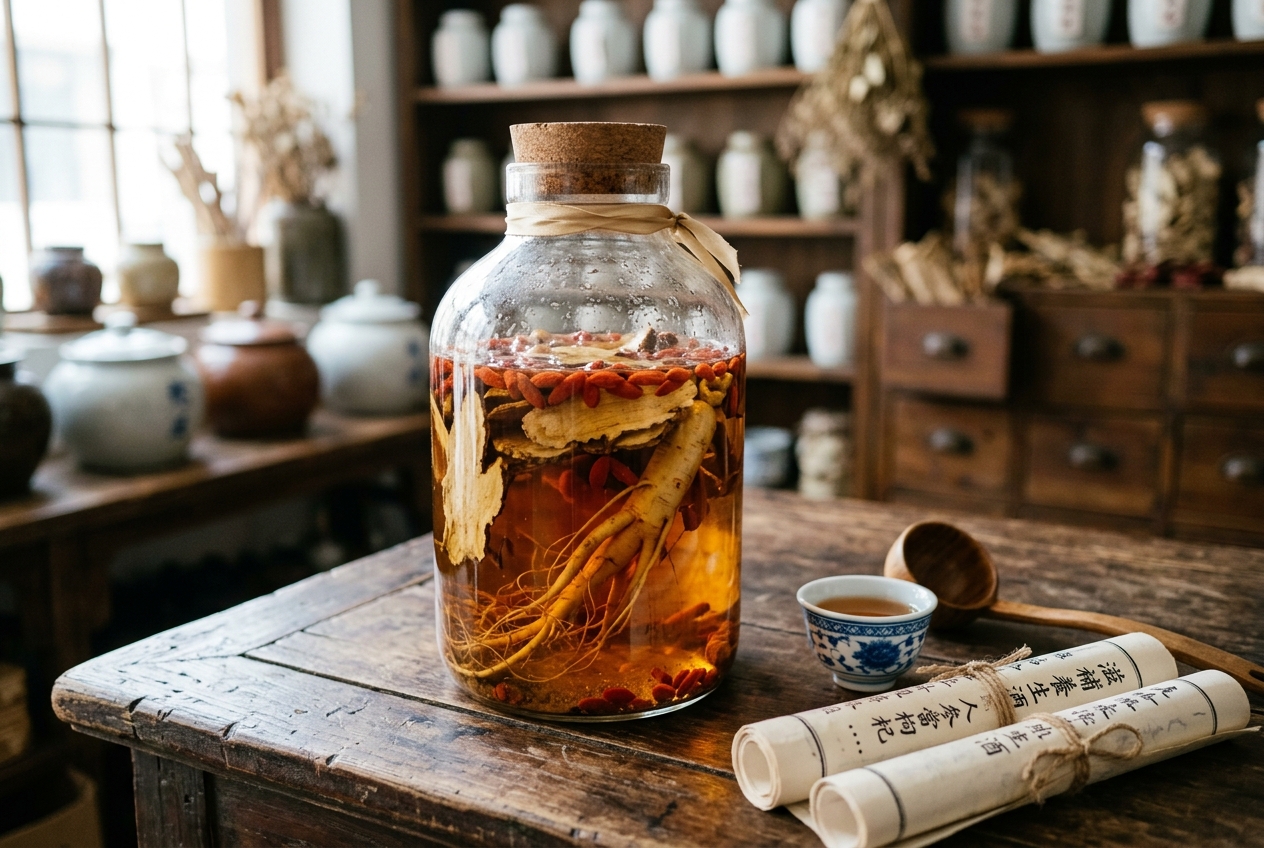
In Traditional Chinese Medicine (TCM), this pervasive, weather-sensitive stiffness is diagnosed as an invasion of pathogenic Wind, Cold, and Dampness lodging within the deep micro-channels of your musculoskeletal system. For millennia, Chinese physicians resolved this stubborn state not with water-based teas alone, but with an ancient, highly sophisticated botanical delivery system: Yao Jiu Fa (药酒法 — Medicated Wine Therapy). When an individual takes a measured, therapeutic sip of a classical medicinal wine, a distinct physiological cascade unfolds. Within moments, an expansive, radiant warmth blooms outward from the solar plexus, racing along the vascular tree into the furthest capillary beds of the fingertips and toes, melting chronic myofascial contractures and rekindling the body's internal furnace.
+-----------------------------------------------------------------------------------+
|                           THE CLASSICAL APHORISM                                  |
|                                                                                   |
|  "酒为百药之长" (Jiu Wei Bai Yao Zhi Zhang) — "Alcohol is the Chief of a Hundred   |
|  Medicines." Recorded in the Han Dynasty chronicles (Hanshu) and rooted in the     |
|  Huangdi Neijing, this foundational doctrine establishes ethanol not as an        |
|  intoxicant, but as the supreme kinetic vector capable of transporting botanical   |
|  principles to the deepest, coldest collateral networks (Luo Mai) of the body.    |
+-----------------------------------------------------------------------------------+
The medical history of China reveals that the very ideogram for medicine (Yi 醫) contains within its lower half the radical You (酉), representing an ancient ceramic amphora used for fermenting medicinal wines. As recorded in the foundational medical canon Huangdi Neijing (黄帝内经 — The Yellow Emperor's Inner Canon, c. 1st century BCE) and later celebrated in the Hanshu (汉书 — Book of Han), alcohol is revered as "Jiu Wei Bai Yao Zhi Zhang" (酒为百药之长 — "Alcohol is the chief and commander of a hundred medicines"). Far from promoting recreational intoxication, classical medical theory identifies carefully formulated ethanolic infusions as a precise pharmacological technology designed to extract fat-soluble botanical compounds, accelerate microvascular perfusion, warm the visceral organs, and restore vitality to deep tissue structures that aqueous decoctions fail to reach.
2. What This Organ System & Therapeutic Vector Does
To understand why medicinal wine holds such an esteemed place in classical pharmacopeia, one must understand how the human energetic matrix operates according to TCM visceral theory (Zang-Fu) and meridian mechanics (Jing-Luo). In this framework, vital energy (Qi — the active metabolic force) and Blood (Xue — the physical nourishing substrate) circulate through major conduit highways (Jing Mai) and branch out into microscopic, web-like collateral networks (Luo Mai).
                      +------------------------------------------+
                      |   KIDNEY YANG (Shen Yang / Mingmen)      |
                      |  Primordial Fire & Systemic Thermogenesis|
                      +--------------------+---------------------+
                                           |
                   +-----------------------+-----------------------+
                   |                                               |
                   v                                               v
+--------------------------------------+       +--------------------------------------+
|    LIVER BLOOD & SINEWS (Gan-Jin)    |       |     COLLATERAL NETWORK (Luo Mai)     |
|  Nourishes Fascia, Tendons & Ligaments|       |  Microcirculatory Capillaries & Fascia|
+--------------------------------------+       +--------------------------------------+
                   |                                               |
                   +-----------------------+-----------------------+
                                           |
                                           v
                      +------------------------------------------+
                      |      MEDICATED WINE THERAPY (Yao Jiu)     |
                      | Acrid, Hot, Ascending Vector -> Tong Luo |
                      +------------------------------------------+
The Three Visceral Pillars of Medicated Wine Action
-
The Kidney (Shen 肾) and the Gate of Vitality (Mingmen 命门): In TCM, the Kidneys are the physiological foundation of both Yin (structural fluid and matter) and Yang (dynamic heat, motility, and metabolic fire). The Mingmen (Gate of Life fire), situated between the physical kidneys, acts as the central pilot light of the entire body. When Kidney Yang weakens—due to aging, overwork, chronic illness, or cold exposure—systemic thermogenesis fails. This results in cold extremities, lumbar weakness, joint vulnerability, and sluggish vitality. Yao Jiu Fa relies on the innately warm, buoyant nature of distilled or fermented grain spirits to directly rekindle this primordial Mingmen fire.
-
The Liver (Gan 肝) and the Sinews (Jin 筋): The Liver is responsible for the smooth, uninhibited flow of Qi throughout the body and serves as the primary reservoir for Blood. Classical physiology dictates that "the Liver governs the sinews"—meaning that the pliability of tendons, ligaments, and myofascial sheaths depends entirely on rich Liver Blood perfusion. When cold pathogens coagulate the blood or when Liver Blood is deficient, sinews become malnourished and brittle, leading to contractures, tendonitis, and joint rigidity.
-
The Collaterals (Luo Mai 络脉) and Tong Luo (Unblocking) Dynamics: While primary meridians run vertically along the long axis of the torso and limbs, the collateral channels (Luo Mai) branch laterally into periarticular capsules, cartilage, sub-dermal micro-vessels, and deep spinal ligaments. Because of their minute diameter, the collaterals are exquisitely susceptible to stagnation caused by Cold (which constricts) and Dampness (which creates heavy, turbid blockages). Pathogenic stagnation in these micro-networks manifests clinically as Bi Syndrome (痹证 — painful obstruction syndrome).
Medicinal wine possesses an energetic profile defined as acrid (Xin 辛), sweet (Gan 甘), and intensely hot (Da Re 大热), with innate kinetic vectors that are ascending (Sheng 升) and dispersing (San 散). The acrid flavor scatters stagnant pathogens; the sweet flavor nourishes and tonifies; and the hot property melts internal ice. Thus, alcohol acts as a swift, penetrating "medicinal vehicle" (Yao Yin 药引), carrying the therapeutic compounds of co-infused botanicals across resistive tissue barriers directly into the stubborn Luo Mai, an action known in TCM as Tong Luo (通络 — unblocking the collaterals).
3. How You Can Feel It — Signs of Balance, Imbalance & Ethanolic Pharmacokinetics
Recognizing whether your internal ecosystem requires collateral-warming interventions begins with assessing your body's subtle bio-energetic signals. When Kidney Yang, Liver Blood, and the collateral networks are thriving in balance, your musculoskeletal system is resilient, warm, and supple.
+-----------------------------------------------------------------------------------+
|                        CLINICAL SELF-ASSESSMENT MATRIX                            |
+------------------------------------+----------------------------------------------+
| SIGNS OF SYSTEMIC BALANCE & WARMTH | SIGNS OF YANG DEFICIENCY & COLD-DAMP BI      |
+------------------------------------+----------------------------------------------+
| • Warm hands, feet, and lumbar zone| • Aversion to cold drafts; cold gluteal/waist|
| • Fluid, pain-free joint movement  | • Deep, fixed, weather-sensitive joint aches |
| • Resilient morning vitality       | • Morning stiffness requiring 30+ min warm-up|
| • Clear, focused cognitive drive   | • Tendon contracture, cramping, poor mobility|
| • Pink, supple tongue, thin white  | • Pale, swollen tongue with tooth marks and  |
|   coating, rhythmic moderate pulse |   thick, greasy white coating; slow pulse    |
+------------------------------------+----------------------------------------------+
The Biophysical & Pharmacokinetic Advantages of Ethanolic Extraction
From the perspective of modern pharmacology and natural products chemistry, the clinical efficacy of Yao Jiu Fa is explained by the unique solvent properties and pharmacokinetic profile of ethanol ($C_2H_5OH$). Aqueous decoctions (standard herbal teas) rely solely on water as a polar solvent. While boiling water efficiently extracts polar macromolecules such as hydrophilic polysaccharides, mucilages, and water-soluble tannins, it fails to dissolve critical non-polar and weakly polar bioactive secondary metabolites.
                      +---------------------------------------+
                      |   HYDRO-ETHANOLIC SOLVENT SPECTRUM    |
                      +-------------------+-------------------+
                                          |
                 +------------------------+------------------------+
                 |                                                 |
                 v                                                 v
+----------------------------------+             +----------------------------------+
|    AQUEOUS / POLAR FRACTION      |             |    ETHANOLIC / NON-POLAR FRACTION|
|  • Hydrophilic Polysaccharides   |             |  • Triterpenoid Saponins         |
|  • Free Amino Acids              |             |  • Lipophilic Alkaloids          |
|  • Water-Soluble Tannins         |             |  • Volatile Essential Oils       |
|  • Simple Flavonoid Glycosides   |             |  • Aromatic Resins (Frankincense)|
+----------------------------------+             +----------------------------------+
                 |                                                 |
                 +------------------------+------------------------+
                                          |
                                          v
                      +---------------------------------------+
                      |     ENHANCED CELLULAR BIOAVAILABILITY |
                      | Rapid Gastric Diffusion & Vasodilation|
                      +---------------------------------------+
According to peer-reviewed phytochemical research cataloged by the National Center for Biotechnology Information (NCBI PubMed), ethanol functions as an amphiphilic solvent. Its hydroxyl group forms hydrogen bonds with polar substances, while its non-polar ethyl chain solubilizes hydrophobic compounds, including: - Triterpenoid and Steroidal Saponins (e.g., ginsenosides from Panax ginseng, astragalosides from Astragalus membranaceus). - Lipophilic Alkaloids and Lignans (e.g., piperine, schisandrins from Schisandra chinensis). - Volatile Monoterpenes and Sesquiterpenes (essential oils that evaporate and degrade during prolonged aqueous boiling). - Aromatic Resins and Terpenes (e.g., boswellic acids from Ruxing / Frankincense and guggulsterones from Moyao / Myrrh), which are completely insoluble in water.
Pharmacokinetic Acceleration & Microcirculatory Perfusion
Beyond extraction yield, ethanol dramatically alters the pharmacokinetics of co-ingested herbal constituents: 1. Bypassing Complex Digestion: Ethanol is rapidly absorbed directly across the gastric mucosa and the proximal duodenum through passive diffusion, requiring no breakdown by pancreatic enzymes. 2. Transient Mucosal Permeabilization: By temporarily fluidizing the lipid bilayer of gastrointestinal epithelial cells, ethanol enhances the paracellular and transcellular flux of complex phytochemicals. 3. Peripheral Vasodilation & Endothelial Shear Stress: Low concentrations of circulating ethanol stimulate endothelial nitric oxide synthase (eNOS) and activate transient receptor potential channels (such as TRPV1), inducing peripheral vasodilation. This hyperemic response increases microvascular capillary flow in chronically ischemic, cold-contracted periarticular tissues, facilitating the rapid delivery of anti-inflammatory and analgesic compounds into deep fascial spaces.
4. Qigong & Movement Practice: The Mingmen Igniting & Collateral-Opening Sequence
To complement and amplify the internal warming mechanics of medicinal wine therapy, classical Daoist medicine prescribes movement practices (Dao Yin) designed to open the spinal axis and mobilize stagnant fluids. The following sequence, titled "Igniting Mingmen Fire and Clearing the Twelve Collaterals" (Kai Luo Wen Yang Gong), can be practiced at home without any specialized equipment.
       [WUJI STANCE]               [PHASE 1: MINGMEN WARMING]          [PHASE 2: ARCHER'S EXTENSION]
      o   Elongated Spine                  \  / Palms rub L2-L3                \ o / Chest opens
     /|\  Pelvis tucked                    (o)  Circular friction               /|   Spiraling sinews
     / \  Knees soft                       / \  Gathering heat                 / \   Weight 70/30
Step-by-Step Practice Guide
Step 1: Starting Position and Setup
- Stand with your feet parallel, precisely shoulder-width apart.
- Unlock your knees slightly, allowing your tailbone to sink gently toward the earth as if perching on a high stool.
- Relax your shoulders down away from your ears, suspend the crown of your head lightly as if held by a silk thread from above, and rest the tip of your tongue against the upper palate just behind your front teeth.
- Take three slow, unhurried abdominal breaths, inhaling through the nose into the lower abdomen (Dantian) and exhaling smoothly.
Step 2: Phase 1 — Friction Heating of the Mingmen and Kidney Shu (2 Minutes)
- Vigorously rub the palms of your hands together in front of your chest until intense friction heat is generated between them.
- Immediately place your hot palms firmly against your lower back, covering the lumbar spine at the level of the second and third lumbar vertebrae (directly opposite the navel).
- Perform 36 rapid, firm circular rubbing motions over the lower back, massaging the Mingmen (GV-4) and bilateral Shenshu (BL-23) points simultaneously.
- Visualize a glowing, amber sun igniting between your kidneys, sending waves of liquid heat down into your pelvic floor and thighs.
Step 3: Phase 2 — Opening the Sinew Channels via Archer's Expansion (6 Minutes)
- Inhale: Shift your weight slightly onto the right leg, turning your torso 45 degrees to the left while stepping your left foot out into a wide stance.
- Exhale: Raise both hands to chest height. Form a soft fist with your right hand as if gripping a bowstring, while extending the left hand outward with the palm flat and fingers pointing skyward.
- Slowly pull your right elbow backward at shoulder height, squeezing the right scapula toward the spine, while simultaneously pressing the left palm outward. Look past your left index finger.
- Hold this full extension for a pause of 2–3 seconds at the end of the exhalation, feeling a distinct helical, twisting stretch along the entire sinew pathway from your lateral ribs, through your armpit, down the forearm to your palm.
- Inhale: Release the tension, draw the left foot back to the center line, and return your hands to the lower abdomen.
- Exhale: Repeat the exact movement to the right side. Perform 8 complete cycles (4 on each side).
Step 4: Phase 3 — Harmonizing the Triple Burner and Storing the Warmth (2 Minutes)
- Return to the center Wuji stance.
- Inhale deeply, raising both arms laterally with palms facing upward until your hands meet above your head.
- Exhale slowly, turning the palms downward and guiding your hands down along the midline of your torso, pressing the warm, mobilized energy down into the lower Dantian (three finger-widths below the navel).
- Rest both palms over your navel (right hand over left for men, left hand over right for women), closing your eyes for one minute to seal the practice.
What Sensations to Look For
During and immediately following this practice, you should feel a distinct sensation of spreading warmth across your sacrum, a light tingling (Deqi sensation) in your fingertips, and a release of compressive tension in your lower back. This confirms that peripheral vascular resistance has dropped and that the collateral networks have been primed for optimal nutrient and Qi circulation.
5. Acupressure Points You Can Try Today
Acupressure offers a non-invasive, potent method to stimulate the specific organ systems and meridians targeted by medicinal wine formulations. Stimulating these three classical points activates systemic thermogenesis, clears sinew contractures, and strengthens digestive extraction.
       [BL-23 / GV-4]                     [GB-34]                         [ST-36]
     Level with L2 Spine             Below Head of Fibula           4 Fingers Below Knee
    +-------------------+             +------------------+           +------------------+
    | (BL-23) (GV) (BL) |             |        o (Head)  |           |     [Patella]    |
    |   *      *    *   |             |       / \        |           |         |        |
    |  1.5cun Mid 1.5cun|             |     (GB-34)*     |           |     4 fingers    |
    |   [Lumbar Spine]  |             |      [Fibula]    |           |         * (ST-36)|
    +-------------------+             +------------------+           +------------------+
      Rekindles Mingmen                 Relaxes Sinews                 Boosts Spleen Qi
1. Shenshu (BL-23, 肾俞 — Kidney Shu) and Mingmen (GV-4, 命门 — Gate of Life)
+-----------------------------------------------------------------------------------+
| POINT ARCHETYPE: SHENSHU (BL-23) & MINGMEN (GV-4)                                 |
+-------------------+---------------------------------------------------------------+
| ANATOMICAL        | Located in the lumbar region, precisely level with the lower  |
| LANDMARK          | border of the spinous process of the 2nd lumbar vertebra (L2).|
|                   | GV-4 sits on the posterior midline; BL-23 is situated 1.5     |
|                   | cun (approx. two finger-widths) lateral to GV-4 on both sides.|
+-------------------+---------------------------------------------------------------+
| APPLICATION       | Place your thumbs on BL-23 and knuckles on GV-4. Apply firm,  |
| TECHNIQUE         | deep circular pressure with a slight upward angle for 2 to 3  |
|                   | minutes. Breathe deeply into the pressure point.              |
+-------------------+---------------------------------------------------------------+
| PRIMARY           | Chronic lower back pain, knee weakness, cold lumbar sensa-   |
| INDICATIONS       | tions, morning exhaustion, and low physical stamina.          |
+-------------------+---------------------------------------------------------------+
2. Yanglingquan (GB-34, 阳陵泉 — Yang Mound Spring)
+-----------------------------------------------------------------------------------+
| POINT ARCHETYPE: YANGLINGQUAN (GB-34)                                             |
+-------------------+---------------------------------------------------------------+
| ANATOMICAL        | Situated on the lateral aspect of the lower leg, in the tender|
| LANDMARK          | depression located anterior and inferior to the small bony    |
|                   | prominence of the head of the fibula.                         |
+-------------------+---------------------------------------------------------------+
| APPLICATION       | Press firmly with your thumb perpendicular to the skin until a|
| TECHNIQUE         | deep, dull, radiating distension (Suan Zhang) spreads down    |
|                   | the outer calf. Knead continuously for 2 minutes per leg.     |
+-------------------+---------------------------------------------------------------+
| PRIMARY           | The "Influential Point of Sinews" (Hui-Meeting Point for Ten- |
| INDICATIONS       | dons). Resolves tendonitis, hip stiffness, knee contractures, |
|                   | sciatica, and generalized muscle cramping.                    |
+-------------------+---------------------------------------------------------------+
3. Zusanli (ST-36, 足三里 — Leg Three Miles)
+-----------------------------------------------------------------------------------+
| POINT ARCHETYPE: ZUSANLI (ST-36)                                                  |
+-------------------+---------------------------------------------------------------+
| ANATOMICAL        | Located on the anterior-lateral lower leg, four finger-widths  |
| LANDMARK          | below the bottom edge of the kneecap (patella), one finger-   |
|                   | width lateral to the sharp anterior crest of the shinbone.    |
+-------------------+---------------------------------------------------------------+
| APPLICATION       | Apply sustained, firm thumb pressure in a slow, rhythmic pulse|
| TECHNIQUE         | (3 seconds press, 1 second release) for 3 minutes per side.   |
+-------------------+---------------------------------------------------------------+
| PRIMARY           | Strengthens Spleen and Stomach digestive assimilation, boosts |
| INDICATIONS       | systemic Qi production, enhances circulation, and dispels      |
|                   | chronic post-meal fatigue and abdominal heaviness.            |
+-------------------+---------------------------------------------------------------+
6. Food, Medicinal Formulations & Clinical Protocols
The clinical practice of Yao Jiu Fa is characterized by its strict formulation hierarchy and exacting maceration protocols. In the Chinese pharmacopeia, medicated wines are never random concoctions; they are structured around the classical Jun-Chen-Zuo-Shi (Emperor-Minister-Assistant-Envoy) architectural paradigm.
                    +---------------------------------------+
                    |           JUN (The Emperor)           |
                    | Principal Herbs: Target Root Pathology|
                    +-------------------+-------------------+
                                        |
                    +-------------------+-------------------+
                    |           CHEN (The Minister)         |
                    | Synergistic Boosters: Enhance Emperor |
                    +-------------------+-------------------+
                                        |
                    +-------------------+-------------------+
                    |           ZUO (The Assistant)         |
                    | Modulates Toxicity / Removes Blocks   |
                    +-------------------+-------------------+
                                        |
                    +-------------------+-------------------+
                    |           SHI (The Envoy)             |
                    | Guides to Channel + Ethanolic Vehicle |
                    +---------------------------------------+
Three Iconic Classical Formulations
1. Shi Quan Da Bu Jiu (十全大补酒 — All-Inclusive Great Tonifying Wine)
- Clinical Purpose: The premier systemic restorative for concurrent deficiency of both Qi and Blood, accompanied by mild Yang deficiency and chronic exhaustion.
- Architectural Breakdown:
- Jun (Emperor): Panax ginseng (Ren Shen) and Prepared Rehmannia glutinosa (Shu Di Huang) to intensely tonify Primordial Qi and nourish deep Kidney-Liver Yin and Blood.
- Chen (Minister): Astragalus membranaceus (Huang Qi), Atractylodes macrocephala (Bai Zhu), Angelica sinensis (Dang Gui), and Paeonia lactiflora (Bai Shao) to amplify Spleen transformation and generate circulating Blood.
- Zuo (Assistant): Poria cocos (Fu Ling), Ligusticum chuanxiong (Chuan Xiong), and Cinnamomum cassia bark (Rou Gui) to drain dampness, move blood stasis, and ignite the Mingmen fire.
- Shi (Envoy): Honey-fried Glycyrrhiza uralensis (Zhi Gan Cao) to harmonize all ingredients, carried by the high-proof grain spirit vehicle into all twelve primary meridians.
2. Feng Shi Jiu (风湿酒 — Anti-Rheumatic Bi-Syndrome Wine)
- Clinical Purpose: Specifically engineered to dispel chronic, cold-induced arthralgia, joint swelling, and weather-aggravated musculoskeletal pain.
- Key Herbal Matrix: Features Angelica pubescens (Du Huo), Clematis chinensis (Wei Ling Xian), Mulberry twigs (Sang Zhi), and Lycopodium clavatum (Shen Jin Cao). These botanical agents possess acrid, dispersing volatile oils that unblock obstructed joint capsules and expel deep Cold-Damp stagnation from the periarticular matrix.
3. Gu Sui Bu Jiu (骨碎补酒 — Sinew and Bone Strengthening Wine)
- Clinical Purpose: Tonifies Liver and Kidneys to treat bone mineral density loss, chronic lower back weakness, and ligamentous micro-trauma.
- Key Herbal Matrix: Built upon Drynaria roosii rhizome (Gu Sui Bu — literally "Bone-Mending Herb"), Eucommia ulmoides bark (Du Zhong), Dipsacus asper root (Xu Duan), and Lycium barbarum fruit (Gou Qi Zi). This formulation provides bioactive phytoecdysteroids, lignans, and flavonoids that support osteogenic cellular pathways and collagen synthesis.
+-----------------------------------------------------------------------------------+
|                        CLASSICAL PREPARATION PROTOCOLS                            |
+-------------------+---------------------------------------------------------------+
| COLD-MACERATION   | 1. Select a sterile, non-reactive dark glass or ceramic jar   |
| PROTOCOL          |    (avoid all plastics and reactive metals).                  |
| (Leng Jin Fa)     | 2. Slice verified authentic herbs into thin, uniform pieces.  |
|                   | 3. Submerge botanicals in high-grade grain spirit (45%–55%    |
|                   |    ABV sorghum Baijiu or neutral spirit) at a 1:5 to 1:10     |
|                   |    herb-to-solvent mass ratio.                                |
|                   | 4. Seal hermetically; store in a cool, dark place (15–20°C).  |
|                   | 5. Invert and shake daily for the first 14 days to maximize   |
|                   |    the solute concentration gradient; steep for 30–60 days.   |
+-------------------+---------------------------------------------------------------+
| HEAT-ASSISTED     | For dense roots, barks, and resins, the sealed ceramic jar is |
| EXTRACTION        | placed into an indirect simmering water bath (bain-marie) at  |
| (Re Jin Fa)       | 60–70°C for 2–3 hours, then cooled and aged. Heat accelerates |
|                   | solvent penetration without degrading thermolabile compounds. |
+-------------------+---------------------------------------------------------------+
Chronopharmacology, Dosage Titration & Administration Rules
- Therapeutic Window: Medicated wines must be administered strictly in micro-doses: 15 to 30 mL (approximately one to two tablespoons) per dose, once or twice daily.
- Chronopharmacology: The optimal time of ingestion is during or immediately following a warm evening meal. Consuming the wine alongside food buffers the gastric mucosa against ethanol irritation and leverages postprandial splanchnic blood flow to optimize systemic botanical distribution during the body's nighttime restorative cycle.
+-----------------------------------------------------------------------------------+
|                  STRICT CLINICAL CONTRAINDICATIONS & SAFETY                       |
+-----------------------------------------------------------------------------------+
|  Medicated wine is a potent pharmaceutical vector and is STRICTLY PROHIBITED in   |
|  the following conditions:                                                        |
|                                                                                   |
|  1. YIN-DEFICIENCY FIRE (Yin Xu Huo Wang): Red tongue with no coating, night     |
|     sweats, hot flashes, dry mouth, rapid pulse. Adding hot wine worsens heat.   |
|  2. DAMP-HEAT CONSTITUTIONS: Greasy yellow tongue coat, bitter mouth taste,       |
|     acute inflammatory arthritis (gout), or active dysuria.                       |
|  3. HEPATIC PATHOLOGY: Active hepatitis, fatty liver disease, cirrhosis, or       |
|     elevated transaminases (ALT/AST).                                             |
|  4. CARDIOVASCULAR HYPERTENSION: Uncontrolled hypertension or arrhythmias.        |
|  5. PREGNANCY & LACTATION: Absolute contraindication due to teratogenic and      |
|     uterotonic risks associated with blood-moving botanicals and ethanol.         |
|  6. PHARMACOLOGICAL INTERACTIONS: Never combine with sedative hypnotics, NSAIDs,  |
|     cephalosporins, metronidazole, or blood thinners (e.g., Warfarin).            |
+-----------------------------------------------------------------------------------+
Accessible Food & Lifestyle Adjustments for Daily Life
If medicinal wines are contraindicated or unavailable, you can cultivate the same warming, collateral-opening dynamics using widely available, accessible dietary therapies and kitchen spices: - Foods to Add: Incorporate gently warming, aromatic culinary spices such as fresh ginger root (Sheng Jiang), cinnamon bark (Rou Gui), crushed black pepper, fennel seeds, star anise, and scallions into slow-cooked bone broths, root vegetable stews, and lentil soups. These culinary aromatics stimulate gastric fire and promote peripheral circulation without the risks of ethanol. - Foods to Reduce: Minimize the consumption of cold, raw foods (such as icy smoothies, refrigerated salads, and iced water), excessive refined sugars, and heavy, unfermented dairy products. These foods chill the digestive fire of the Spleen and generate internal Dampness that obstructs the collateral channels. - Thermal Lifestyle Hygiene: Protect your lumbar spine, ankles, and neck from cold drafts and damp environments. Keep your lower back covered and practice warm foot soaks with crushed ginger before bed to draw circulation down into the Kidney meridian.
For comprehensive international guidelines on herbal safety and traditional therapeutic frameworks, consult resources maintained by the World Health Organization (WHO) Traditional Medicine, the National Center for Complementary and Integrative Health (NCCIH), and the authoritative compendium on Chinese Herbology.
7. Today's Takeaway
The single most transformative, zero-equipment practice you can adopt today to warm your Mingmen fire and unlock your collateral circulation takes less than five minutes: brew a small cup of hot fresh ginger and cinnamon tea, sit upright, and while sipping, spend three minutes vigorously rubbing your warm palms in a circular motion over your lower back (at the Shenshu BL-23 and Mingmen GV-4 points) until a deep, glowing warmth penetrates your lumbar spine. By uniting the gentle internal warmth of culinary botanicals with direct acupressure stimulation, you immediately halt the creeping invasion of cold and dampness, restoring fluid mobility, vitality, and resilient systemic circulation to your entire body.