Medicinal Juice Therapy (Yao Zhi Fa) Dietary Dynamics: Governing Fresh Botanical Fluid Extraction, Rapid Yin-Fluid Replenishment, Febrile Heat Clearance, and Cellular Hydration in Traditional Chinese Medicine
1. Opening Scene — A Moment You'll Recognise
You wake up after a punishing viral fever, a transatlantic flight, or a prolonged period of unrelenting cognitive stress, and your body feels utterly desertified. Your mouth is dry, your throat feels like sandpaper, and your eyes burn with a gritty, desiccated heat. You reach for a tall glass of iced tap water and gulp it down, but ten minutes later, the water seems to have passed straight through your bladder without quenching the cellular parchedness inside your tissues. Your chest still feels tight, your voice remains hoarse, and an elusive, irritable heat hums beneath your skin.
In the conceptual architecture of Traditional Chinese Medicine (TCM), you are not merely suffering from basic systemic hypovolemia; you are experiencing an acute exhaustion of Jin-Ye (津液, body fluids) and a collapse of Yin (the cooling, moistening, and structural substrate of the body).
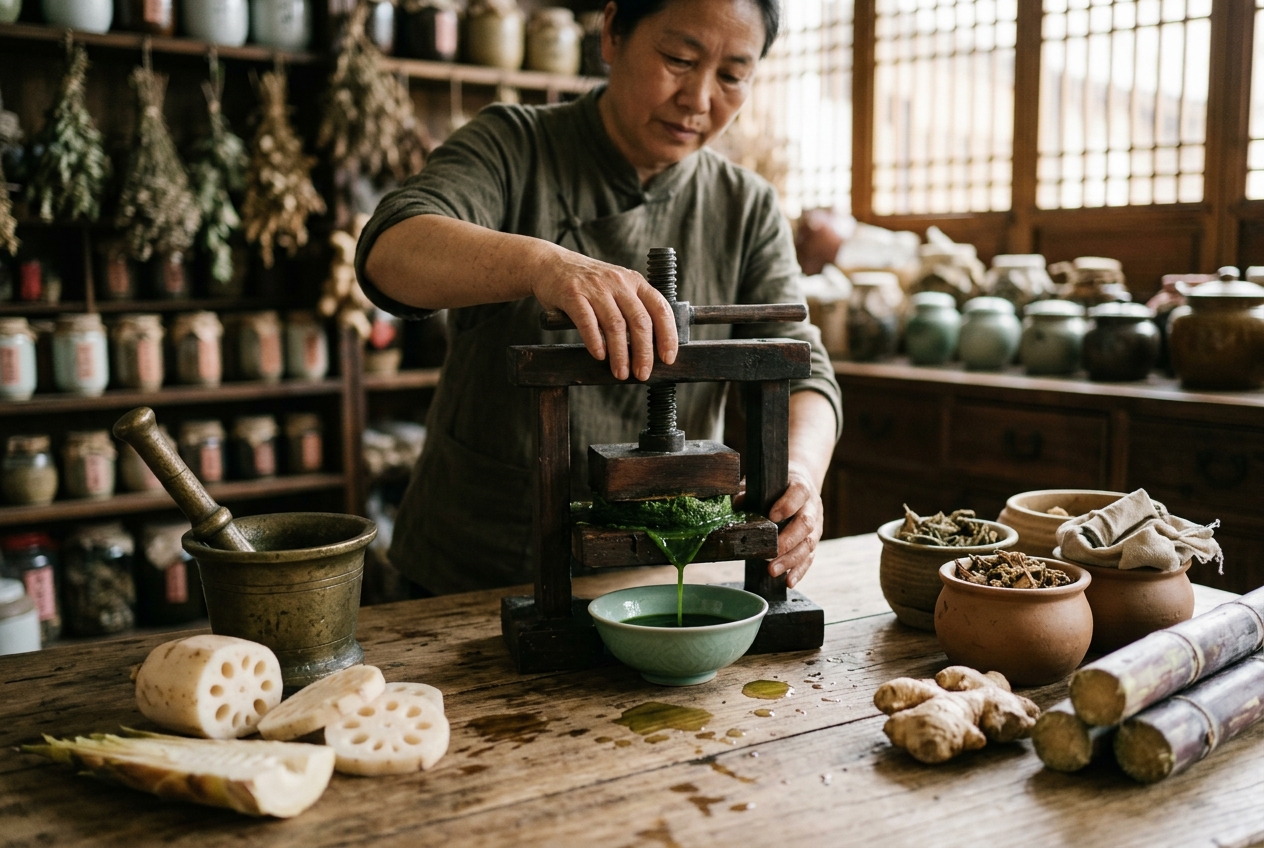
For over two millennia, Chinese imperial physicians faced an identical clinical dilemma during the onslaught of epidemic febrile diseases (Wen Bing, 温病). When an aggressive internal heat scorched the patient’s mucosal lining and vital fluids, standard thermal decoctions—boiling woody roots and bitter barks in clay pots—were often too harsh, heating, or slow to absorb. The clinical solution was both elegant and radical: Medicinal Juice Therapy (Yao Zhi Fa, 药汁法). By mechanically expressing the living, unheated cellular fluids of targeted medicinal botanicals—from the crisp tubers of the lotus root to the pyroligneous sap of fresh bamboo—physicians bypassed the digestive burden of standard digestion to achieve immediate cellular rehydration, extinguish pathogenic fire, and restore biological homeostasis.
2. What This Organ System and Therapeutic Modality Does
To understand why raw, expressed botanical fluids hold such a revered status in classical pharmacology, one must first examine the physiological engine of fluid metabolism in East Asian medicine. In classical physiology, body fluids (Jin-Ye) are categorized into two distinct functional grades: - Jin (津 - Thin Fluids): Clear, light, and rapidly circulating liquids distributed across the skin, muscles, and mucous membranes to moisten tissue interfaces, facilitate perspiration, and lubricate the exterior. - Ye (液 - Dense Fluids): Turbid, viscous, and deeply nourishing fluids that permeate the bone marrow, articular joints, spinal canal, and interior viscera (Zang-Fu).
Fluid dynamics are regulated through an integrated visceral axis: the Stomach (Wei, 胃) acts as the "Sea of Water and Grain," receiving oral liquids; the Spleen (Pi, 脾) governs Yun Hua (运化, transportation and transformation), extracting refined essences; the Lung (Fei, 肺) functions as the "Upper Source of Water," disseminating mist-like moisture downward; and the Kidney (Shen, 肾) provides the foundational metabolic fire (Yang Qi) that vaporizes and circulates clean water while excreting waste.
Theoretical Foundations and the Historical Canon
The systematic lineage of Yao Zhi Fa spans the foundational epochs of Chinese medical literature:
- Shennong Bencao Jing (Divine Farmer's Classic of Materia Medica, c. 200 CE): First cataloged the therapeutic properties of fresh, unheated botanical saps, noting that raw plant juices retain pristine primordial Qi (Yuan Qi) capable of extinguishing acute visceral heat.
- Sun Simiao’s Qian Jin Yao Fang (Essential Prescriptions Worth a Thousand Pieces of Gold, 652 CE): Codified cold-expressed juices as frontline emergency interventions for stroke triage, sudden fainting, and toxic delirium, establishing the administration of fresh ginger juice (Sheng Jiang Zhi) and bamboo sap (Zhu Li) to clear life-threatening airway obstructions.
- Wu Jutong’s Wen Bing Tiao Bian (Systematic Differentiation of Warm Diseases, 1798 CE): Elevated Yao Zhi Fa to its highest therapeutic peak. Wu recognized that when high epidemic fevers invade the Qi, Ying (nutritive), and Xue (blood) levels, thermal boiling denatures the delicate, heat-clearing phytochemicals required to salvage collapsing cellular water.
Classical Canon Insight: Wu Jutong on Fluid Preservation
"When pathogenic Heat consumes the Yin fluids of the Lung and Stomach, bitter-cold herbs dry the tissues further, and sweet-warm herbs feed the fire. Only the unboiled, sweet-cold expressed juices can immediately moisten the parched earth without injuring the vital Qi."
— Wen Bing Tiao Bian, Chapter on Autumn Dryness and Summerheat.
Biochemical and Mechanical Extraction Dynamics
Why extract cold juice rather than brew a standard thermal decoction (Tang Ji, 汤剂)? Modern pharmacognosy and botanical biochemistry validate what classical physicians observed empirically:
When botanical tissues undergo cold cellular lysis via pressing, the mechanical rupture of plant vacuoles releases bioavailable phytochemicals in their native matrix: - Preservation of Volatile Aromatics: Volatile constituents such as the monoterpenes and gingerols in ginger root are preserved without thermal evaporation. - Enzymatic Integrity: Thermolabile botanical enzymes (e.g., superoxide dismutase analogs, bromelain-like proteases) remain structurally active. - Electrolyte Bioavailability: Potassium, magnesium, and organic malate complexes stay suspended in structured colloidal water, matching physiological osmolarity. - Submucosal Absorption Kinetics: Free of heavy structural starches and cooked polysaccharides, the unheated juice requires minimal enzymatic breakdown by the Spleen (Pi), diffusing directly through the gastric and upper intestinal mucosa to rehydrate depleted vascular and interstitial compartments.
3. How You Can Feel It — Signs of Balance and Imbalance
Fluid metabolism and Yin-Yang harmony are dynamic biological states that provide clear clinical signatures. Use the diagnostic matrix below to assess your current state of Jin-Ye hydration and visceral balance:
Pathological Patterns of Fluid Depletion
- Lung & Stomach Yin Collapse (Fei Wei Yin Xu): Triggered by dry environments, chronic dehydration, or post-febrile convalescence. Symptoms include a persistent tickling dry cough, hoarseness, insatiable thirst where cold liquids only provide fleeting relief, cracked tongue fissures, and hard, dry stools.
- Turbid Phlegm-Heat Obstructing the Orifices (Tan Re Meng Qiao): Caused by chronic dietary inflammation and internal heat condensing body fluids into thick, gluey phlegm. Manifests as a heavy sensation in the chest, viscous yellow sputum, mental fog, restless insomnia, and a thick, greasy yellow tongue coating.
- Spleen-Kidney Yang Deficiency (Pi Shen Yang Xu — Contraindication Flag): When the metabolic fires are cold, the body cannot process cold, raw fluids. Symptoms include cold extremities, loose watery stools, abdominal bloating aggravated by raw food, pale scalloped tongue, and sluggish water retention.
4. Qigong & Movement Practice: Cultivating the "Jade Fluid" (Yu Ye Huan Dan)
In classical internal alchemy (Neidan) and medical qigong, endogenous fluid generation is paired directly with exogenous juice therapy. The practice of Cultivating the Jade Fluid (Yu Ye, 玉液) stimulates the submandibular and parotid salivary glands to generate enzymatic saliva, which is ritually swallowed into the Lower Dantian to descend Stomach fire and moisten the internal viscera.
Step-by-Step Protocol
- Starting Position & Setup: Sit upright on a firm cushion or chair with your feet flat on the floor. Keep the spine erect, shoulders relaxed, and eyes half-closed. Rest your hands over your lower abdomen (Lower Dantian, two inches below the navel).
- Movement & Breath Synchronization: 1. Tongue Orbiting: Close your mouth. Circle the tip of your tongue along the outer surfaces of your teeth and gums—18 times clockwise, then 18 times counter-clockwise. This stimulates the parotid reflex. 2. Jade Fluid Churning: As clear saliva pools under the tongue, close your lips and gently "swish" the fluid inside your oral cavity 36 times, as if rinsing with water, aerating and charging the fluid with Qi. 3. The Triple Swallow: Divide the accumulated fluid into three equal portions. Swallow the first portion with an audible, conscious gulp (Tu Yan), visualizing the cool liquid descending down the Conception Vessel (Ren Mai) through the chest and stomach into the Lower Dantian. Repeat with the second and third portions. 4. Settling Breath: Inhale smoothly into the lower abdomen, feeling a cool, mist-like nourishment moistening the gut; exhale gently, releasing residual tension from the throat.
- Duration & Frequency: Perform 3 complete cycles (approx. 5 minutes total) upon waking, before meals, or whenever the throat feels parched.
- Sensations to Look For: An instant reduction in salivary viscosity, a soothing cooling sensation descending behind the sternum, relaxation of the solar plexus, and immediate relief from dry throat irritation.
5. Acupressure Points You Can Try Today
Target these classical acupoints along the Kidney, Lung, and Stomach meridians to stimulate endogenous fluid secretion, clear heat, and enhance mucosal hydration:
1. Zhaohai (KI-6, 照海 — "Shining Sea")
- Anatomical Location: On the inner aspect of the foot, in the distinct soft depression situated directly one finger-breadth below the prominence of the medial malleolus (inner ankle bone).
- Application Method: Apply firm, sustained pressure using the tip of your thumb. Work in slow, circular clockwise rotations for 2 to 3 minutes on each foot while practicing slow abdominal breathing.
- Clinical Indication: Directly commands the Yin fluids of the Kidney channel; clears dry nocturnal cough, chronic hoarseness, parched pharynx, and insomnia characterized by heat sensations in the palms and soles.
2. Chize (LU-5, 尺泽 — "Cubit Marsh")
- Anatomical Location: In the transverse crease of the elbow, on the radial (lateral) side of the thick tendon of the biceps brachii muscle.
- Application Method: Press your thumb perpendicularly into the tendon border until a distinct dull, distending ache (De Qi) is elicited. Maintain firm pressure with slight vibration for 1 to 2 minutes per arm.
- Clinical Indication: As the He-Sea and Water point of the Lung channel, it drains pathogenic Lung Heat, relaxes spasmodic airway tension, and descends rebellious Qi to restore fluid misting.
3. Zusanli (ST-36, 足三里 — "Leg Three Miles")
- Anatomical Location: On the anterolateral aspect of the lower leg, four finger-widths below the lower border of the kneecap (patella), and one finger-width lateral to the anterior crest of the tibia bone.
- Application Method: Apply deep, steady kneading using the knuckle of your thumb or index finger for 2 to 3 minutes on each leg.
- Clinical Indication: The primary command point for the gastrointestinal tract; boosts digestive enzyme activity, harmonizes the Stomach, and facilitates the systemic transport (Yun Hua) of ingested fluids.
6. Classical Botanical Juices, Empirical Formulations & Food Strategies
Traditional Chinese dietetics does not view botanical juicing as an indiscriminate raw food trend. Instead, Yao Zhi Fa is an exact pharmacodynamic discipline where specific botanical structures are harvested to target distinct visceral pathologies.
Deep Dive into Classical Botanical Juices
1. Fresh Lotus Root Juice (Ou Zhi / 藕汁)
- Source: Fresh rhizome of Nelumbo nucifera.
- Energetic Dynamics: Sweet, Cold; enters the Heart, Liver, and Stomach channels.
- Biochemical & Clinical Actions: Raw lotus root juice possesses a unique dual mechanism celebrated in the Bencao Gangmu: it clears pathogenic Heat from the nutritive and blood levels (Ying-Xue), quenches extreme thirst, and arrests internal hemorrhaging (such as epistaxis or hemoptysis) without precipitating blood stasis. While boiled lotus root is tonifying and warming to the Spleen, the unheated fresh juice breaks down coagulated extravasated blood while cooling vascular inflammation through its rich polyphenol, proanthocyanidin, and organic tannin matrix.
2. Fresh Ginger Juice (Sheng Jiang Zhi / 生姜汁)
- Source: Fresh rhizome of Zingiber officinale.
- Energetic Dynamics: Acrid, Slightly Warm; enters the Lung, Spleen, and Stomach channels.
- Biochemical & Clinical Actions: Known as the "Holy Herb of Emesis" (Ou Jia Sheng Yao), cold-pressed ginger juice contains high concentrations of gingerols and shogaols. Its volatile acridity cuts through thick, turbid cold-phlegm, opens constricted bronchial passages, and harmonizes Stomach Qi to stop persistent nausea. In classical emergency formulas, tiny drops of fresh ginger juice were instilled sublingually to revive patients from stupor caused by phlegm obstructing the heart orifices.
3. Fresh Bamboo Sap (Zhu Li / 竹沥)
- Source: Pyroligneous sap expressed and collected from fresh green bamboo stalks (Phyllostachys nigra) via heat-assisted mechanical expression.
- Energetic Dynamics: Sweet, Very Cold, Slippery (Hua); enters the Heart, Lung, and Stomach channels.
- Biochemical & Clinical Actions: Unsurpassed in its penetrative power. While standard herbs clear phlegm from the respiratory lumen, Zhu Li possesses a "slippery" bio-molecular action that travels into the deep musculoskeletal channels, tendons, and collaterals (Luo Mai). It dissolves chronic, heat-coagulated phlegm responsible for post-stroke hemiplegia, neurological twitching, and acute delirium.
The Master Formulation: The Classical Five Juice Drink (Wu Zhi Yin, 五汁饮)
Codified by Wu Jutong in the Wen Bing Tiao Bian, the Five Juice Drink remains East Asian medicine's premier botanical formulation for acute dehydration, post-infectious convalescence, and severe febrile dryness.
Formulation Architecture & Synergy:
- Fresh Pear Juice (Li Zhi / 梨汁 - 2 parts): Moistens the Lung parenchyma, resolves dry heat-phlegm, and soothes the vocal cords.
- Fresh Water Chestnut Juice (Bi Qi Zhi / 荸荠汁 - 1 part): Clears intense Stomach heat, dissolves stubborn phlegm nodules, and promotes urinary excretion of metabolic toxins.
- Fresh Lotus Root Juice (Ou Zhi / 藕汁 - 1 part): Extinguishes vascular heat, harmonizes the liver, and prevents blood extravasation.
- Fresh Sugarcane Juice (Gan Zhe Zhi / 甘蔗汁 - 1 part): Supplies bioavailable sucrose, fructose, and raw electrolytes to replenish Stomach Yin and soothe ulcerated mucosal walls without causing glycation spikes.
- Fresh Rehmannia Juice or Ophiopogon Decoction (Sheng Di Huang Zhi / Rehmannia glutinosa or Mai Dong Zhi / Ophiopogon japonicus - 1 part): Anchors Kidney water, cools systemic blood-heat, and rebuilds deep cellular Yin.
Clinical Preparation Protocols, Hygiene & Safety Standards
Because unheated botanical fluids bypass thermal sterilization, strict preparation protocols must be observed to prevent adverse events:
- Mechanical Extraction Standards: Always utilize a slow cold-press (masticating) juicer operating below 60 RPM. High-speed centrifugal juicers generate friction heat and introduce excessive atmospheric oxygen, initiating immediate enzymatic browning and polyphenol degradation.
- Administration Window: Fresh medicinal juices must be consumed within 15 to 20 minutes of extraction to avoid microbial proliferation and oxidative destruction of heat-labile enzymes.
- The Golden Rule of Temperature Moderation: Never drink medicinal juices straight from the refrigerator. Ingestion of ice-cold liquids causes acute vasoconstriction of the gastric capillaries, stunning the Middle Burner and impairing Spleen Yun Hua. Always warm the extracted juice in a gentle hot-water bath until it reaches room temperature or blood heat (30–37°C).
- Contraindications & Precautions:
- Strictly Contraindicated: In patients presenting with chronic Spleen-Kidney Yang Deficiency, chronic morning diarrhea, pale swollen tongues, or acute damp-cold gastroenteritis.
- Modification for Weak Digestion: If a patient requires fluid replenishment but has weak digestion, add 3–5 drops of Fresh Ginger Juice (Sheng Jiang Zhi) to the formula to protect the Stomach Qi.
7. Today's Takeaway
If your body feels dry, overheated, or depleted today, the single most restorative five-minute practice you can perform requires no exotic pharmacy: take one fresh, ripe Asian pear, cold-press it with a thin half-inch coin of fresh ginger root, warm the expressed amber nectar in a small bowl of hot water until it matches your body temperature, and sip it slowly in silent mindfulness while performing the three-part Jade Fluid Swallow (Yu Ye Huan Dan). Within minutes, this synthesis of living botanical electrolytes and conscious qigong descent will soothe your parched mucosal membranes, quench the deeper visceral thirst in your tissues, and restore balance to your inner ecosystem.
Authoritative Scientific & Clinical References
- World Health Organization: WHO Traditional, Complementary and Integrative Medicine Global Benchmarks
- National Center for Biotechnology Information (NCBI): Bioactive Compounds and Pharmacodynamics of Zingiber officinale
- PubMed Central / NCBI: Pharmacological Profile and Phytochemistry of Nelumbo nucifera (Lotus)
- NCBI Medical Database: Ophiopogon japonicus Polysaccharides and Mucosal Membrane Therapeutics
- Botanical Sciences Library: Taxonomy, Energetics, and Chemistry of Rehmannia glutinosa