Medicinal Dew Therapy (Yao Lu Fa) Dietary Dynamics: Governing Steam Distillation Extraction, Volatile Aromatic Condensation, Upper Burner Heat Clearance, and Delicate Visceral Harmonization in Traditional Chinese Medicine
=========================================================================================
                               CLINICAL MONOGRAPH & LONG-READ
Topic: Middle Burner (Spleen-Stomach) Energetics & Medicinal Dew Therapy (药露法, Yao Lu Fa)
Historical Authorities: Zhao Xuemin (1765), Wang Shixiong (1861)
Primary Actions: Vapor-Phase Bioactive Delivery, Aromatic Spleen Awakening, Fluid Restoration
=========================================================================================
1. Opening Scene — A Moment You'll Recognise
You have just completed what should have been a restorative meal, yet within thirty minutes, a heavy, leaden stupor settles across your limbs. Your abdomen feels swollen, taut as a drum, while an unyielding cognitive fog clouds your thoughts. When you reach for a cup of strong tea, a conventional herbal tonic, or a heavy nutritional supplement to revive your flagging energy, your stomach rebels—nausea churns in your throat, the epigastrium feels waterlogged, and your system feels incapable of digesting even the remedy meant to heal it.
In the language of Traditional Chinese Medicine (TCM), your Middle Burner—the central metabolic engine governed by the Spleen (Pǐ) and Stomach (Wèi)—has stalled. When this digestive axis falters, it cannot transform food into vibrant energy (Qì) and vital fluids (Jīn Yè). Instead, metabolic waste stagnates into internal dampness, dragging down your vitality.
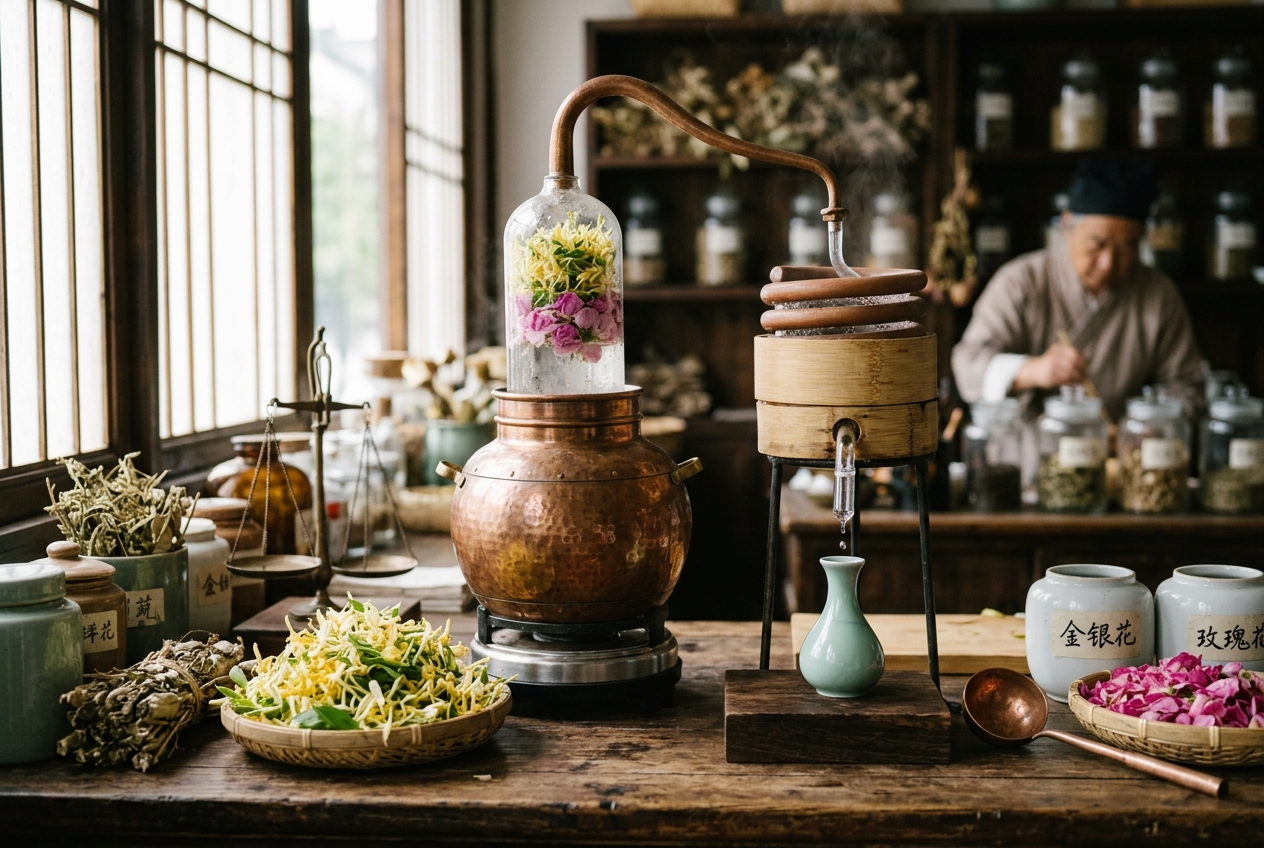
Standard botanical remedies present a historical paradox: the very decoctions, roots, and dense tonics prescribed to rebuild bodily strength are frequently too heavy, bitter, or astringent for an already collapsed digestive fire to break down. During the height of the Qing dynasty, Imperial physicians confronted this clinical challenge by perfecting an extraordinarily refined, non-burdensome branch of dietary therapeutics known as Medicinal Dew Therapy (Yào Lù Fǎ, 药露法). By harnessing steam distillation to capture the volatile, lipophilic essences of fresh medicinal herbs as pure aqueous hydrosols, Chinese medical masters discovered they could bypass digestive fatigue altogether—delivering potent therapeutic compounds in a crystal-clear, aromatic vapor that awakens the viscera without imposing any metabolic tax.
2. What This Organ System Does: The Middle Burner, Visceral Harmony, and the Science of Vaporous Delivery
To understand why delicate distillates exert such profound physiological effects, one must examine the energetic architecture of the body according to the classical Zang-fu organ system theory. In this traditional paradigm:
- The Spleen (Pǐ) is not merely an anatomical lymphoid organ, but the primary physiological engine of transformation and transportation (Yùn Huà). It acts as the body's digestive refinery, extracting fine nutritional essence (Gǔ Qì) from ingested food and fluid, and propelling it upward to nourish the heart, lungs, and brain.
- The Stomach (Wèi) serves as the receiving vat, responsible for rotting and ripening (Shóu Shú) food boluses and directing turbid waste downward.
- The Liver (Gān) regulates the smooth, unimpeded coursing of Qi throughout the entire vascular and visceral network—acting like a metropolitan traffic controller. When emotional tension or stress constricts the Liver, its Qi stagnates and aggressively invades the digestive centre (Gān Qì Fàn Wèi), halting peristalsis and causing painful distension.
- The Lung (Fèi) sits in the Upper Burner as the canopy of the visceral tree, governing respiration and dispersing clear fluids outward to the skin and downward to the kidneys.
The health of this entire triad hinges on a dynamic known as the Ascension of the Clear (Qīng) and the Descension of the Turbid (Zhuó). The Spleen loves dryness and warmth, responding eagerly to light, aromatic stimulants that "wake it up" (Xīng Pǐ), while the Stomach requires gentle moisture to maintain its mucous lining and digestive juices.
The Historical Evolution of Yao Lu Fa
While rudimentary distillation apparatuses existed in ancient China, the formalization of Medicinal Dew Therapy as an elite medical discipline reached its zenith during the late Ming and Qing dynasties. In his landmark 1765 pharmaceutical treatise Běn Cǎo Gǎng Mù Shí Yí (本草綱目拾遺, Supplements to the Compendium of Materia Medica), the polymath physician Zhao Xuemin documented over forty specialized botanical dews, declaring:
"The medicinal properties of dews reside entirely in their ethereal, vaporous essence (Qì). Dense decoctions (Tāng Jì) carry thick, turbid flavors that burden the stomach; medicinal dews carry pure, ascending aromatics that penetrate directly into the channels and collaterals without generating cloying stagnation."
A century later, the Qing dynasty master of dietary therapy Wang Shixiong (Wang Mengying) reinforced this principle in his 1861 classic Suí Xí Jū Yǐn Shí Pǔ (隨息居飲食譜, Dietary Recipes from the Sui Breath Studio). Wang noted that during virulent summer epidemics and post-febrile convalescence, traditional thick broths and heavy herbal decoctions caused what physicians termed Nì Wèi (胃逆, gastric rebellion and cloying obstruction). Dews, by contrast, acted as "liquid breath"—clear as mountain spring water, subtly scented, and immediately assimilated by the oral and gastric mucosa.
+---------------------------------------------------------------------------------------------------+
|                        CLASSICAL PHARMACOPEIA: HISTORICAL PERSPECTIVES                            |
|                                                                                                   |
|  "Dew is the pure essence of heaven and earth. When herbs are distilled into dew, their harsh,    |
|   bitter, and heavy dregs remain in the cauldron, while their pure, uplifting soul rises with the  |
|   steam. It travels through the triple burner like mist through a forest, clearing fire without   |
|   injuring Yang, and moistening dryness without creating dampness."                               |
|                                                                                                   |
|   — Zhao Xuemin, Běn Cǎo Gǎng Mù Shí Yí (1765)                                                    |
+---------------------------------------------------------------------------------------------------+
Physicochemical Mechanics and Modern Pharmacokinetics
From the perspective of contemporary chemistry and pharmacognosy, Yào Lù is a concentrated botanical hydrosol—an aqueous condensate containing both suspended micro-droplets of volatile essential oils and water-soluble (hydrophilic) aromatic fractions.
During the distillation cycle: 1. Vapor-Phase Thermal Extraction: Low-pressure steam breaks the glandular trichomes and cellular membranes of fresh botanical petals, leaves, or rinds. 2. Volatile Fractionation: Low-molecular-weight monoterpenes, sesquiterpene alcohols, aldehydes, and aromatic esters (such as linalool, geraniol, eugenol, and 1,8-cineole) vaporize at temperatures far below the degradation point of delicate polyphenols. Heavy, bitter tannins, toxic alkaloids, and indigestible structural resins remain sequestered in the distillation retort. 3. Cold Condensation: The saturated steam passes across a chilled condenser surface, precipitating into a micro-emulsion where volatile organic molecules are homogeneously dispersed in water clusters.
Modern peer-reviewed literature indexed on NCBI PubMed confirms that volatile aromatic molecules interact rapidly with olfactory receptors and transient receptor potential (TRP) channels in the gastrointestinal tract. Research published across the PubMed Central database on hydrosols and volatile compounds indicates that these light aromatic distillates stimulate gastric mucosal microcirculation, modulate the enteric nervous system, and exert potent antimicrobial and anti-inflammatory actions without requiring heavy enzymatic breakdown by the liver or pancreas.
3. How You Can Feel It — Signs of Balance and Imbalance
When the Middle Burner and its intersecting Liver-Lung axes are operating in homeostatic equilibrium, the body exhibits distinct physical and psychological characteristics:
- Signs of Visceral Balance: Rapid, effortless digestion; clear, radiant skin; sharp mental focus and decisive executive function; consistent daytime vitality without postprandial slumps; a clean, fresh breath; and a tongue body that is supple, pale red, with a thin, moist, translucent white coating.
When the Spleen-Stomach Qi is compromised and internal stagnation develops, symptoms emerge across multiple bodily systems:
+--------------------------------------------------------------------------------------------------+
|                             MIDDLE BURNER DYSFUNCTION MATRIX                                     |
+--------------------------+-------------------------------------+---------------------------------+
| System Domain            | Clinical Manifestations of Excess   | Clinical Manifestations of      |
|                          | / Heat Stagnation (Shí / Rè)        | Deficiency / Cold Damp (Xū/Shī) |
+--------------------------+-------------------------------------+---------------------------------+
| Gastrointestinal         | Epigastric burning, acid reflux,    | Postprandial bloating, dull     |
|                          | bad breath, insatiable hunger       | ache eased by warmth, loose     |
|                          | followed by immediate nausea, dry   | stools, slow gastric emptying,  |
|                          | hard stools, red tongue with yellow | sweet cravings, pale scalloped  |
|                          | greasy coat.                        | tongue with thick white coat.   |
+--------------------------+-------------------------------------+---------------------------------+
| Affective & Cognitive    | Irritability, impulsive anger,      | Chronic worry, obsessive        |
|                          | tension headaches, insomnia with    | rumination (Sī, 思), mental     |
|                          | vivid dreams, sensation of a lump in| cloudiness, profound morning    |
|                          | the throat (Plum-pit Qi).           | apathy, low physical stamina.   |
+--------------------------+-------------------------------------+---------------------------------+
| Somatosensory            | Flushed cheeks, dry throat, thirst  | Heaviness in the four limbs,    |
|                          | for cold water, restless heat in    | puffiness around eyes and       |
|                          | the chest and palms.                | ankles, aversion to cold drinks.|
+--------------------------+-------------------------------------+---------------------------------+
Self-Assessment: Check Your Middle Burner Vitality
Perform this quick diagnostic self-check right now: 1. Examine Your Tongue in a Mirror: Are the lateral borders imprinted with teeth marks (scalloping)? Is the central third blanketed by a thick, greasy, or discolored coating? Scalloping indicates Spleen Qi deficiency failing to hold fluids, while a thick central coating reveals accumulated damp turbidity in the Stomach. 2. Palpate Your Upper Abdomen: Gently press your fingertips into the space halfway between your breastbone and navel (Zhongwan CV-12). Does it feel soft, warm, and yielding, or is there a hard, tender, knot-like resistance? Tenderness or distension suggests stalled Middle Burner Qi. 3. Evaluate Your Post-Meal State: Do you regularly experience an overwhelming urge to sleep after eating, accompanied by a heavy, weighted feeling in your legs and an inability to concentrate? This classic sign indicates that your digestive fire is pulling all available energy from your periphery simply to churn stagnant food.
4. Qigong & Movement Practice: Regulating the Spleen and Stomach by Raising Single Arms (Tiáo Lǐ Pí Wèi Xū Dān Shǒu Jǔ)
To mechanically release intra-abdominal pressure, stimulate peristalsis, and coordinate the diaphragmatic pump with Spleen-Stomach energetics, practice this classical sequence from the ancient Eight Pieces of Brocade (Bā Duàn Jǐn).
Step-by-Step Execution Protocol
-
Starting Position and Grounding:
- Stand with your feet parallel, hip-width apart. Unlock your knees slightly.
- Relax your pelvic floor, allowing your tailbone to sink gently toward the earth.
- Rest both hands in front of your lower abdomen (Lower Dān Tián), palms facing upward, fingers loosely pointing toward one another as if cradling a sphere of warm light.
- Rest the tip of your tongue lightly against the roof of your mouth behind your upper front teeth to connect the Conception (Ren) and Governing (Du) meridians.
-
Movement Phase (Inhalation & Ascendancy):
- Inhale deeply through your nose for a count of four, directing your breath into the lower abdomen and lateral ribs.
- Simultaneously draw your left palm upward along the midline of your torso. When it reaches chest level, rotate the palm outward and press it smoothly upward toward the ceiling, fingers pointing right, pressing the heel of the palm toward the sky ("Pushing Heaven").
- At the exact same moment, rotate your right palm downward and press the heel of the right hand firmly toward the floor beside your right hip, fingers pointing forward ("Pressing Earth").
- Gently stretch your spine axially. Feel the opposing vertical vectors opening the hypochondriac region, stretching the stomach and spleen meridians along your left flank and the liver and gallbladder channels on your right.
-
Release Phase (Exhalation & Descendancy):
- Hold the extended posture for a pause of one second at the top of the breath.
- Exhale slowly through your nose for a count of six.
- Rotate both palms back toward the body's midline and glide them smoothly down, returning both hands to the starting position at the Lower Dān Tián.
- Feel the abdominal wall soften, allowing accumulated visceral tension to drain downward.
-
Alternation and Repetitions:
- Repeat the movement on the opposite side: right hand presses upward to the sky while the left hand presses downward to the earth.
- Perform 8 complete cycles (4 per side), moving with slow, fluid, unbroken continuity. Total duration: approximately 5 to 7 minutes.
-
Sensory Feedback & Physiological Correlates:
- What to look for: A distinct sensation of warmth radiating through the epigastrium, spontaneous gentle gurgling in the intestines (borborygmi, indicating the return of healthy parasympathetic peristalsis), and an involuntary deep sigh or yawning as diaphragmatic constriction releases.
- Mechanism: The counter-directional pull creates alternating negative and positive intra-abdominal pressure, mechanically massaging the liver, stomach, and spleen while mobilizing the peritoneal fascia.
5. Acupressure Points You Can Try Today: Unlocking the Gastric Channels
These three classical acupressure points form an exceptionally potent clinical triad for regulating Middle Burner Qi, pacifying Liver fire, and resolving abdominal discomfort.
Point 1: Zúsānlǐ (足三里, ST-36) — "Leg Three Miles"
- Anatomical Location: Sit with your knees bent at 90 degrees. Place the four fingers of your hand horizontally across your shin directly beneath the bottom edge of your kneecap (patella). Zusanli lies four finger-widths down from the patella and one finger-width toward the outside of your shinbone (tibia), located in the soft belly of the tibialis anterior muscle.
- Application Technique: Use the tip of your thumb or a rounded knuckle to apply deep, vertical, circular pressure. Maintain a firm pressure that generates a noticeable dull, aching, slightly electric distending sensation (Dé Qì). Massage for 2 to 3 minutes per leg.
- Clinical Utility: As the primary He-Sea and Earth point of the Stomach Channel, ST-36 is the premier point in traditional medicine for tonifying digestive Qi, relieving fatigue, speeding gastric emptying, and enhancing systemic immune competence.
Point 2: Zhōngwǎn (中脘, CV-12) — "Central Venter"
- Anatomical Location: Lie flat on your back or sit upright in a comfortable chair. Locate the base of your breastbone (xiphoid process) and your belly button (navel). Zhongwan sits exactly on the anterior midline of your abdomen, halfway between these two landmarks (approximately 4 cun / four thumb-widths above the navel).
- Application Technique: Place the stacked pads of your index, middle, and ring fingers over the point. Inhale deeply; as you exhale, sink your fingers gently inward and slightly upward toward the diaphragm to a depth of 1 to 1.5 inches (firm but never sharp or painful). Hold steady pressure while taking 10 slow, smooth abdominal breaths.
- Clinical Utility: Zhongwan is the Front-Mu point of the Stomach and the Influential Point of the Fu (Hollow) Organs. It immediately relieves epigastric fullness, acid regurgitation, nervous stomach cramps, and food stagnation.
Point 3: Tàichōng (太衝, LR-3) — "Great Surge"
- Anatomical Location: On the top (dorsum) of your foot, locate the webbing between your big toe and second toe. Slide your finger upward along the groove between the first and second metatarsal bones until your finger falls into a natural hollow or depression just before the joint junctions.
- Application Technique: Apply focused, angled pressure using your thumb tip, pressing toward the ankle joint. This point is often exceptionally tender in individuals experiencing high stress or digestive tension. Massage firmly with small circular motions for 1 to 2 minutes on each foot.
- Clinical Utility: The Shu-Stream and Yuan-Source point of the Liver Channel, LR-3 subdues rising Liver Yang, disperses emotional constraint, and prevents stagnant Liver Qi from attacking the Stomach, thus clearing headaches, irritability, and stress-induced digestive spasms.
6. Food & Lifestyle — Small Changes for Today: Classical Hydrosols and Middle Burner Dietary Therapeutics
The true brilliance of Yào Lù Fǎ lies in its targeted botanical specificity. Unlike generic tisanes or dense herbal decoctions, single and compound medicinal dews target specific visceral imbalances without causing digestive stagnation (Nì Wèi).
+---------------------------------------------------------------------------------------------------------+
|                               CLASSICAL MEDICINAL DEWS (YÀO LÙ) PROFILE                                 |
+---------------------+-----------------------+-----------------------------+-----------------------------+
| Classical Dew       | Botanical Source      | Energetic Actions           | Clinical Target             |
+---------------------+-----------------------+-----------------------------+-----------------------------+
| Honeysuckle Dew     | Lonicera japonica     | Clears Toxic Heat, Cools    | Pediatric fevers, acute     |
| (Jīn Yín Huā Lù)    | (Flos Lonicerae)      | Upper Burner, Generates     | sore throat, post-viral dry |
|                     |                       | Body Fluids (Shēng Jīn)     | cough, mucosal inflammation |
+---------------------+-----------------------+-----------------------------+-----------------------------+
| Rose Flower Dew     | Rosa rugosa           | Harmonises Liver & Stomach, | Stress-induced gastralgia,  |
| (Méi Gui Huā Lù)    | (Flos Rosae Rugosae)  | Regulates Qi, Relieves      | PMS irritability, emotional |
|                     |                       | Somatic Constriction        | heaviness, lump in throat   |
+---------------------+-----------------------+-----------------------------+-----------------------------+
| Lotus Leaf Dew      | Nelumbo nucifera      | Clears Summer-Heat, Resolves| Damp-heat lethargy, heavy   |
| (Hé Yè Lù)          | (Folium Nelumbinis)   | Turbid Dampness, Awakens    | limbs, postprandial stupor, |
|                     |                       | Clear Spleen Yang           | loose waterlogged stools    |
+---------------------+-----------------------+-----------------------------+-----------------------------+
Detailed Monograph of Classical Hydrosols
1. Honeysuckle Dew (Jīn Yín Huā Lù, 金銀花露)
- Source & Extraction: Distilled from the fresh, unopened buds of Lonicera japonica. Contemporary studies cataloged on NCBI PubMed on Lonicera japonica constituents demonstrate that Lonicera contains high concentrations of chlorogenic acid, luteolin, and volatile monoterpenoids.
- Traditional Indications: Sweet, aromatic, and cold; it enters the Lung, Stomach, and Large Intestine meridians.
- Clinical Paradigm: Indispensable for pediatric fevers and post-febrile fluid depletion. Children suffering from high fever frequently refuse bitter decoctions or vomit dense medicines. Honeysuckle dew tastes as sweet and pure as spring water, clearing heat from the blood and re-hydrating delicate mucous membranes without chilling the immature pediatric Spleen.
2. Rose Flower Dew (Méi Gui Huā Lù, 玫瑰花露)
- Source & Extraction: Distilled from freshly harvested petals of Rosa rugosa. Pharmacological evaluations on PubMed on Rosa rugosa bioactivities reveal rich profiles of citronellol, geraniol, phenylethyl alcohol, and bioactive flavonoids.
- Traditional Indications: Sweet, slightly bitter, warm; it enters the Liver and Spleen channels.
- Clinical Paradigm: The premier remedy for emotional and functional digestive disharmony (Gān Wèi Bù Hé). In patients suffering from chronic stress, depressive stagnation, and functional dyspepsia, Rose Dew gently mobilizes stagnant blood and Qi, relaxing the smooth muscle of the biliary duct and stomach wall without causing dryness or thermal heat.
3. Lotus Leaf Dew (Hé Yè Lù, 荷葉露)
- Source & Extraction: Distilled from the pristine green leaves of Nelumbo nucifera.
- Traditional Indications: Bitter, astringent, neutral; it enters the Liver, Spleen, and Stomach meridians.
- Clinical Paradigm: Geriatric and metabolic recovery. In older adults or sedentary individuals overwhelmed by internal dampness, lotus leaf dew gently raises the clear Yang of the Spleen, clears summer heat from the vascular system, and resolves metabolic sluggishness without depleting essential kidney fluids.
+---------------------------------------------------------------------------------------------------+
|                        CLINICAL PARADIGMS ACROSS THE LIFESPAN                                     |
|                                                                                                   |
|  * Pediatric Care: Infants and young children possess an anatomically delicate Spleen (Pí Cháng  |
|    Bù Zú). Medicinal dews offer zero-irritation fluid delivery for pediatric fevers and colic.    |
|  * Geriatric Convalescence: Elderly patients with diminished digestive enzyme output cannot       |
|    process heavy, resinous herbs. Dews replenish depleted fluids (Jīn Yè) without cloying.       |
|  * Post-Febrile Recovery: After systemic viral or bacterial infections, residual heat lingers in   |
|    the interior while gastric juices are parched. Dews clear low-grade heat and moisten dryness.  |
+---------------------------------------------------------------------------------------------------+
Home Preparation: The Inverted-Lid Hydrosol Protocol
You can easily prepare an authentic medicinal dew in your kitchen using standard culinary equipment:
- Assembly: Place a stainless-steel vegetable steamer or heat-proof ceramic stand in the center of a wide, deep stockpot. Place a clean, heat-resistant glass or ceramic collection bowl atop the stand.
- Botanical Base: Surround the central stand with 2 to 3 cups of fresh, organic botanicals (e.g., fresh culinary rose petals, peppermint leaves, or fresh orange blossoms) and add 4 cups of filtered spring water. Ensure the water level remains below the rim of the central collection bowl.
- The Condensation Engine: Cover the pot with its lid placed upside down (handle pointing down directly over your collection bowl). Fill the concave inverted lid with ice cubes.
- Distillation: Bring the pot to a gentle simmer over low heat. As steam rises from the botanicals, it hits the ice-chilled inverted lid, condenses rapidly into liquid droplets, runs down the inward slope to the central handle, and drips directly into your collection bowl as pure, sterile, crystal-clear medicinal dew.
- Collection: Simmer gently for 20 to 30 minutes, replacing the ice on the lid as it melts. Store the resulting dew in a dark glass bottle in your refrigerator. Sip 1 to 2 tablespoons warm before meals.
Dietary Adjustments for Middle Burner Preservation
- Foods to Prioritise: Warm, easily digestible preparations—slow-simmered rice congee, roasted root vegetables (squash, carrots, sweet potatoes), lightly steamed seasonal greens, fresh ginger tea, and culinary aromatics (cardamom, fennel seed, mandarin peel /Chén Pí/).
- Habits to Reduce: Eliminate iced drinks, raw and refrigerated foods (which extinguish the metabolic digestive fire like cold water poured on burning coals), refined sugars, deep-fried fats, and excessive raw dairy that create turbid phlegm-dampness.
7. Today's Takeaway
To immediately reignite your Middle Burner Qi and disperse sluggish internal stagnation without spending money on exotic equipment, perform this simple five-minute restorative ritual today: brew a cup of warm water infused with a few crushed fresh mint leaves or dried food-grade rose petals, sit in a quiet space with your spine tall, and take five slow, deep breaths, drawing the uplifting aromatics into your upper palate; then, using your thumbs, apply steady, rhythmic, circular pressure to Zusanli (ST-36) on both legs for two minutes while gently expanding your belly with each breath.
Authoritative Scientific References & Medical Resources
- World Health Organization (WHO) Traditional, Complementary and Integrative Medicine Strategy
- National Center for Biotechnology Information (NCBI) PubMed Central: Hydrosols and Bioactive Volatiles
- PubMed Study: Bioactive Constituents of Lonicera Japonica Flos
- PubMed Study: Phytochemical and Pharmacological Profile of Rosa Rugosa
- Wikipedia: Comprehensive Overview of Hydrosols and Distillation
- Wikipedia: Zang-fu Organ Systems in Traditional Chinese Medicine