Mai Jing: Navigating Wang Shuhe's Pulse Diagnostics, Twelve-Channel Palpatory Topography, and Precision Acupressure Protocols
1. Opening — A Problem This Solves Today
If you have ever sat at a desk in the late afternoon and felt an inexplicable knot tighten beneath your sternum, accompanied by a shallow, fluttering breath, a coldness creeping into your fingertips, and a subtle wave of postprandial brain fog, you have experienced the somatic signature of channel dysregulation. Modern clinical neurology describes this state as sympathetic nervous system hyperarousal coupled with splanchnic vasoconstriction and vagal tone withdrawal. Yet, seventeen centuries before the advent of autonomic monitoring, Chinese imperial physicians possessed a remarkably sophisticated diagnostic and therapeutic framework capable of identifying, interpreting, and resolving this exact physiologic cascade through the radial pulse.
In contemporary life, physical exhaustion rarely presents as a localized structural defect. Instead, it manifests as a systemic, sub-clinical disharmony: the paradox of being "tired yet wired," suffering from unrefreshing sleep, functional gastrointestinal discomfort, or tension headaches that resist conventional analgesics. When blood work returns unremarkable and standard imaging shows no gross pathology, individuals are frequently left without actionable pathways for relief.
Classical Chinese sphygmology (Mai Xue, 脈學) views these subtle functional aberrations not as idiopathic anomalies, but as quantifiable disturbances in the circulation of Qi (bioelectrical and functional vitality) and Xue (perfusion, biochemical substrates, and blood) across the twelve primary meridians. By learning to decode the tactile landscape of the radial artery and applying precise, mechanical stimulus to corresponding acupressure loci, we gain direct, non-invasive access to the neurovascular reflexes that govern systemic homeostasis.
2. The Meridian Path — A Journey Through the Body and the Sphygmological Revolution
+==================================================================================================+
|                       HISTORICAL EVOLUTION OF CLASSICAL PULSE PALPATION                          |
+==================================================================================================+
|  ARCHAIC SYSTEM: "San Bu Jiu Hou" (Three Sectors, Nine Sites)                                    |
|  - Source: Huangdi Neijing (Su Wen & Ling Shu, c. 2nd Century BCE)                               |
|  - Method: Dispersed systemic palpation across temporal, carotid, radial, femoral, pedal sites    |
|  - Limitation: Impractical in urgent clinical triage; high friction during patient examination  |
|                                         |                                                        |
|                                         v                                                        |
|  CANONICAL REVOLUTION: The "Mai Jing" Radial Sphygmology Synthesis                               |
|  - Master: Wang Shuhe (c. 280 CE, Western Jin Dynasty)                                           |
|  - Breakthrough: Exclusive assessment at the "Cun Kou" (Radial Artery / LU9 Taiyuan)             |
|  - Mechanism: Lung Channel as "Mai Hui" (Gathering of Vessels); Microcosm of all 12 Meridians    |
+==================================================================================================+
The Epistemological Leap: From San Bu Jiu Hou to the Cun Kou
The systematic examination of arterial pulses has ancient roots in the foundational Han Dynasty texts of the Huangdi Neijing (The Yellow Emperor’s Inner Classic, comprising the Su Wen and Ling Shu). However, the early classical approach, known as the San Bu Jiu Hou (三部九候, "Three Sectors and Nine Indicators") method, required the practitioner to palpate nine distinct arterial locations distributed across the entire human body—ranging from the superficial temporal artery on the head, to the facial and carotid arteries, down to the femoral and dorsalis pedis arteries of the lower extremities. While comprehensive, this distributed palpation scheme proved cumbersome, logistically challenging in modest clinical encounters, and difficult to standardize.
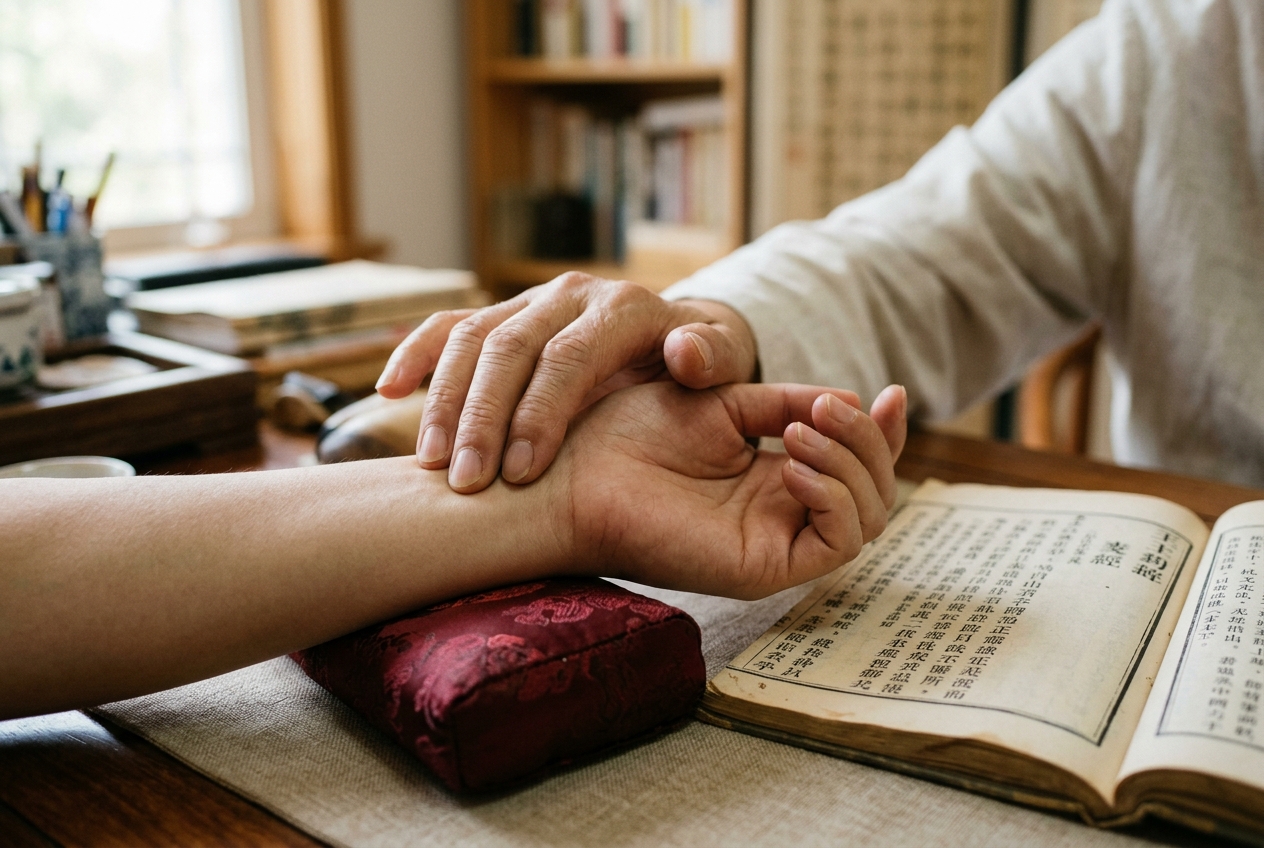
The decisive epistemological breakthrough occurred during the Western Jin Dynasty (265–316 CE) under the imperial physician Wang Shuhe, who compiled the Mai Jing (The Pulse Classic), the world's first dedicated treatise on sphygmology. Wang Shuhe established that the entire systemic physiology of the twelve primary meridians and their corresponding Zang-Fu (visceral and hollow) organ networks could be comprehensively mapped onto a single, accessible anatomical corridor: the Cun Kou (寸口, "Inch Opening"), situated along the radial artery at the styloid process of the radius.
       DISTAL (Hand) <==============================================> PROXIMAL (Elbow)

                     [ CUN / Inch ]        [ GUAN / Bar ]        [ CHI / Cubit ]
                    (Distal Radius)       (Styloid Process)     (Proximal Tendon)
                    -------------------------------------------------------------
      LEFT WRIST:     Heart / SI            Liver / GB            Kidney Yin / BL
      RIGHT WRIST:    Lung / LI             Spleen / ST           Kidney Yang / TB
                    -------------------------------------------------------------
      DEPTH LEVELS:   Superficial (Fu Organs) -> Middle (Blood/Qi) -> Deep (Zang Organs)
The physiological justification for this consolidation rests upon the functional architecture of the Lung Channel of Hand-Taiyin (LU Meridian). In classical physiology, the Lungs govern the Qi of the entire organism, regulate the water passages, and receive the ancestral or gathering vitality (Zong Qi) formed from inspired air and digested food essence. Crucially, the Lung channel terminates at the radial margin, and its Yuan-Source point, LU9 (Taiyuan), is recognized as the Mai Hui (脈會)—the convergence or meeting hub of all blood vessels throughout the human body. As blood cascades from the central vasculature into the peripheral microcirculation, the hemodynamics at the radial artery reflect the upstream vascular resistance, cardiac contractility, autonomic tone, and metabolic vitality of each internal organ.
Anatomical Topography: The Tripartite Matrix of Cun, Guan, and Chi
Wang Shuhe systematized the Cun Kou into three distinct spatial stations along the radial artery, calibrated relative to the radial styloid process:
- The Guan (關, "Bar" or Gate): Located directly adjacent to the prominent bony projection on the thumb side of the wrist—the radial styloid process. This middle station represents the metabolic and digestive pivot of the body.
- The Cun (寸, "Inch"): Located immediately distal to the Guan, in the shallow depression between the styloid process and the wrist flexion crease. This represents the Upper Burner (Shang Jiao), encompassing the thoracic organs and external channel manifestations.
- The Chi (尺, "Cubit"): Located immediately proximal to the Guan, extending toward the forearm along the tendon of the flexor carpi radialis muscle. This represents the Lower Burner (Xia Jiao), encompassing the pelvic, urogenital, and constitutional reserves.
These three positions are assessed bilaterally, yielding six distinct palpation zones, each corresponding to specific Zang-Fu organ pairings and their continuous meridian circuits:
| Wrist Position | Anatomical Station | Primary Zang (Yin Organ) | Primary Fu (Yang Organ) | Meridian Channel System |
|---|---|---|---|---|
| Left Cun | Distal radial head | Heart (Xin) | Small Intestine (Xiao Chang) | Hand-Shaoyin & Hand-Taiyang |
| Left Guan | Radial styloid | Liver (Gan) | Gallbladder (Dan) | Foot-Jueyin & Foot-Shaoyang |
| Left Chi | Proximal to styloid | Kidney Yin (Shen Yin) | Urinary Bladder (Pang Guang) | Foot-Shaoyin & Foot-Taiyang |
| Right Cun | Distal radial head | Lung (Fei) | Large Intestine (Da Chang) | Hand-Taiyin & Hand-Yangming |
| Right Guan | Radial styloid | Spleen (Pi) | Stomach (Wei) | Foot-Taiyin & Foot-Yangming |
| Right Chi | Proximal to styloid | Kidney Yang / Mingmen | Triple Burner (San Jiao) | Foot-Shaoyin & Hand-Shaoyang |
The Three Palpatory Depths (San Ceng)
Sphygmological assessment requires the calibrated application of fingertip pressure across three distinct vertical strata:
- Superficial Level (Fu Qu, 浮取): Palpated with feather-light contact, resting just above the vascular adventitia. This level reveals the state of the Wei Qi (defensive, immunogenic energy), the exterior bodily surface, and the Fu (hollow/Yang) organs.
- Middle Level (Zhong Qu, 中取): Palpated with moderate pressure compressing the vessel lumen halfway. This layer reflects the state of the Ying Qi (nutritive vitality), the digestive capacity of the Spleen and Stomach, and the dynamic flow of blood.
- Deep Level (Chen Qu, 沉取): Palpated with firm, downward force against the underlying periosteum of the radius bone. This stratum uncovers the state of the Zang (solid/Yin) organs, constitutional Jing (essence), and internal pathology.
       [ FINGERTIP PALPATION ]
                 |
                 v
   ~~~~~~~~~~~~~~~~~~~~~~~~~~~~~  <--- Superficial (Fu Qu): Wei Qi, Fu (Yang) Organs, Exterior
   =============================  <--- Middle (Zhong Qu): Ying Qi, Blood Flow, Spleen/Stomach
   #############################  <--- Deep (Chen Qu): Zang (Yin) Organs, Jing, Bone Matrix
   -----------------------------  <--- Radial Bone Floor
The Twenty-Four Canonical Pulses: Discriminating Vacuity (Xu) and Repletion (Shi)
The Mai Jing established twenty-four definitive pulse waveforms that capture the physical properties of the pulse wave—amplitude, velocity, rhythm, width, tension, and fluid viscosity. Modern research indexed in NCBI PubMed demonstrates that these classical categories correspond to quantifiable physiological parameters such as peripheral vascular resistance, stroke volume, arterial compliance, and autonomic nerve modulation.
Four primary pulse qualities serve as the archetypal foundations for distinguishing Channel Vacuity (Xu, 虛—deficiency of bio-energetic drive or fluid volume) from Channel Repletion (Shi, 實—excess, obstruction, or pathological hyperarousal):
+--------------------------------------------------------------------------------------------------+
|                            THE FOUR ARCHETYPAL PULSE WAVEFORMS                                   |
+--------------------------------------------------------------------------------------------------+
| 1. FLOATING (Fu Mai, 浮脈)                                                                        |
|    - Sensory Perception: Distinct immediately beneath light finger touch; fades under deep force.|
|    - Pathophysiology: Exterior pathogenic invasion; upward dispersion of Yang Qi.               |
|                                                                                                  |
| 2. SUNKEN (Chen Mai, 沉脈)                                                                        |
|    - Sensory Perception: Imperceptible at surface; requires deep pressure against bone to feel. |
|    - Pathophysiology: Interior Yin cold; deep-seated stagnation; visceral metabolic collapse.    |
|                                                                                                  |
| 3. WIRY / STRING-LIKE (Xian Mai, 弦脈)                                                           |
|    - Sensory Perception: Straight, taut, unyielding like a tuned instrument string.              |
|    - Pathophysiology: Liver Qi constraint; pain syndromes; hyperactive sympathetic tone.        |
|                                                                                                  |
| 4. SLIPPERY / ROLLING (Hua Mai, 滑脈)                                                            |
|    - Sensory Perception: Smooth, rounded, fluid; feels like pearls rolling smoothly in a basin.  |
|    - Pathophysiology: Damp-phlegm accumulation; food stagnation; blood volume repletion.         |
+--------------------------------------------------------------------------------------------------+
When a channel is in a state of Vacuity (Xu), the pulse wave lacks force, presenting as Fine (Xi Mai), Weak (Ruo Mai), or Empty (Xu Mai), signaling that the associated meridian requires tonification (Bu). Conversely, when a channel suffers from Repletion (Shi), the wave feels surging, rigid, or bounding (Shi Mai, Xian Mai, or Hua Mai), indicating stagnation or heat that demands draining and dispersing (Xie).
3. Two to Three Key Points You Can Press Right Now
To bridge the ancient sphygmology of Wang Shuhe with direct clinical application, we focus on four paramount acupoints: the Yuan-Source point of the Lungs (LU9), the Luo-Connecting/Confluent point of the Pericardium (PC6), the Lower He-Sea point of the Stomach (ST36), and the Three Yin Crossing point (SP6).
                                  HUMAN MERIDIAN LANDMARKS

      [PC6 Neiguan]                   [LU9 Taiyuan]                 [ST36 Zusanli]
      Inner Forearm                   Wrist Crease Base             Lateral Shin
      Between Tendons                 Thumb-side Depression         One Finger Lateral to Tibia
            |                               |                              |
            v                               v                              v
    (Autonomic Calming)            (Vascular Gathering)          (Systemic Tonification)
1. Taiyuan (LU9, 太淵) — "Great Abyss" (Yuan-Source and Vessel Convergence Point)
- Physical Landmark & Somatic Location: Rest your hand palm-up on a soft surface. Look at the transverse crease where your hand meets your wrist. On the thumb side, just below the fleshy base of the thumb pad and directly on the outer edge of the radial artery (the exact spot where you feel the pulse beat at the Cun position), lies a distinct, soft hollow.
- What You Will Feel (Deqi Sensation): Upon precise palpation, you will not feel sharp cutaneous pain, but rather an expansive, dull, gravitational ache that radiates slightly into the palm or up the forearm.
- Acupressure Protocol: Apply steady, perpendicular pressure with the tip of your opposite thumb. Press firmly enough to occlude the soft tissue without bruising the vessel wall (firm, rhythmic, non-painful pressure) for 2 to 3 minutes. Pair this with deep, diaphragmatic breathing.
- Everyday Therapeutic Indications: Rapidly relieves acute feelings of chest constriction, shallow stress-induced breathing, and mental grief; stabilizes erratic radial hemodynamics; improves peripheral oxygen delivery and warmth to the extremities.
2. Neiguan (PC6, 內關) — "Inner Pass" (Luo-Connecting and Master Point of the Chest)
- Physical Landmark & Somatic Location: Place your palm facing upward. Measure three finger-widths down from your main wrist crease along the midline of your forearm. In this exact zone, you will see and feel two prominent, cord-like tendons (the tendons of flexor carpi radialis and palmaris longus). The point sits precisely in the groove between these two tendons.
- What You Will Feel (Deqi Sensation): A pronounced, electric tingling sensation accompanied by a pleasant, heavy distension that travels along the center of the inner arm toward the chest.
- Acupressure Protocol: Use your thumb pad to press deeply into the groove between the tendons, applying sustained circular friction angled slightly toward the elbow for 1.5 to 3 minutes.
- Everyday Therapeutic Indications: Clinically validated via extensive NCBI clinical trials for the rapid mitigation of nausea, motion sickness, stress-induced palpitations, and epigastric tension; downregulates a rapid, wiry (Xian) pulse signature caused by acute psychological stress.
3. Zusanli (ST36, 足三里) — "Leg Three Miles" (He-Sea and Lower Earth Point)
- Physical Landmark & Somatic Location: Sit upright with your knees bent at a 90-degree angle. Locate the bottom edge of your kneecap (patella). Place four fingers horizontally directly beneath the kneecap. Find the sharp, vertical ridge of your shinbone (anterior crest of the tibia). Move your finger outward (laterally) by one thumb-width into the fleshy belly of the muscle (tibialis anterior).
- What You Will Feel (Deqi Sensation): A rich, deeply satisfying, sore tenderness that tends to travel downward along the lateral lower leg into the top of the foot.
- Acupressure Protocol: Using the knuckle of your index finger or a reinforced thumb, apply firm, deep, pulsating pressure in an upward and inward direction for 2 to 3 minutes per leg.
- Everyday Therapeutic Indications: The premier systemic vitality and digestive locus in Oriental medicine; resolves postprandial lethargy, chronic abdominal bloating, and physical fatigue; tonifies weak, empty (Xu) pulse qualities across both wrists.
+--------------------------------------------------------------------------------------------------+
|                            SOMATIC POINT IDENTIFICATION SUMMARY                                  |
+--------------------------------------------------------------------------------------------------+
| Point Name  | Anatomical Coordinates                     | Target Deqi Sensation                 |
| ----------- | ------------------------------------------ | ------------------------------------- |
| LU9 Taiyuan | Radial wrist crease, lateral to pulse      | Deep hollow ache, warm radial surge   |
| PC6 Neiguan | 3 finger-widths up forearm, between cords  | Heavy distension, electric tingling  |
| ST36 Zusanli| 4 fingers below knee, 1 thumb out from shin| Deep spreading ache down shin         |
| SP6 Sanyin. | 4 fingers above inner ankle, behind bone   | Dull soreness, ascending warmth       |
+--------------------------------------------------------------------------------------------------+
4. A Point Combination for One Common Issue
+==================================================================================================+
|                  CLINICAL PROTOCOL: THE EVENING NEURO-VISCERAL RESET                             |
|  Target Condition: Postprandial Stagnation, Sympathetic Hyperarousal, and Sleep-Onset Insomnia   |
+==================================================================================================+
|  STEP 1: Regulate Autonomic Tone and Clear Chest Oppression                                      |
|  - Point: Bilateral PC6 (Neiguan)                                                                |
|  - Duration: 2 Minutes per arm | Depth: Moderate-Deep | Direction: Angled toward elbow           |
|                                                                                                  |
|  STEP 2: Unbind the Diaphragm and Synchronize Gathering Qi                                       |
|  - Point: Bilateral LU9 (Taiyuan)                                                                |
|  - Duration: 90 Seconds per wrist | Depth: Firm, steady | Direction: Direct downward             |
|                                                                                                  |
|  STEP 3: Descend Turbid Stomach Qi and Dissipate Bloating                                        |
|  - Point: Bilateral ST36 (Zusanli)                                                               |
|  - Duration: 2 Minutes per leg | Depth: Deep pulsating knuckle | Direction: Upward-Inward        |
|                                                                                                  |
|  STEP 4: Anchor the Senses and Consolidate Lower Yin                                             |
|  - Point: Bilateral SP6 (Sanyinjiao) [Medial leg, 4 fingers above inner malleolus]               |
|  - Duration: 90 Seconds per leg | Depth: Sustained, gentle-firm | Direction: Perpendicular       |
+==================================================================================================+
The Scenario: Evening Burnout, Epigastric Fullness, and Restless Mind (Shen)
Consider a common modern presentation: you return home following an intense ten-hour workday, consume a dense dinner in a state of cognitive preoccupation, and subsequently find yourself sitting on the couch with a heavy, distended abdomen, an elevated resting heart rate, and an overactive mind that dreads another night of tossing and turning. Sphygmologically, this state manifests as a Wiry (Xian) pulse at the Left Guan (Liver Qi stagnation) and a Slippery-Full (Hua-Shi) pulse at the Right Guan (Stomach food accumulation), while the Chi positions feel depleted and faint.
The Complete "Do This Tonight" Sequence
- Positioning & Environment: Sit reclined in a quiet room with your feet flat on the floor or recline in bed with your knees slightly bent and supported by a pillow. Loosen restrictive clothing around the wrists, chest, and waist.
- Phase 1 (PC6 — 2 Minutes per arm): Begin on the left forearm. Apply firm thumb pressure to PC6. Inhale slowly through your nose for a count of 4, hold for 2, and exhale smoothly through your mouth for a count of 6. Feel the muscular tension around your diaphragm soften as cardiac parasympathetic tone is engaged. Repeat on the right arm.
- Phase 2 (LU9 — 90 Seconds per wrist): Shift your thumb to LU9 at the radial wrist crease. Maintain sustained, non-oscillating pressure. With each exhalation, visualize the blood vessel walls relaxing and warmth returning to your fingertips.
- Phase 3 (ST36 — 2 Minutes per leg): Transition to your lower extremities. Place your knuckles into ST36 on both legs simultaneously. Apply rhythmic, circular friction. You should feel an immediate rumbling or sensation of digestive movement as peristalsis is stimulated.
- Phase 4 (SP6 — 90 Seconds per leg): Conclude by locating Sanyinjiao (SP6), positioned four finger-widths directly above the high point of your inner ankle bone (medial malleolus), nestled just behind the posterior border of the shinbone. Press gently but deeply. This unites the three Yin channels of the leg (Spleen, Liver, Kidney), drawing hyperactive mental energy down into the lower abdomen and inducing systemic drowsiness.
5. Safety & Sense
While acupressure is an extraordinarily safe, non-invasive therapeutic modality, clinical prudence and somatic discernment are essential for optimal practice.
+--------------------------------------------------------------------------------------------------+
|                                    SAFETY AND CAUTION PROTOCOL                                   |
+--------------------------------------------------------------------------------------------------+
| [!] PREGNANCY CONTRAINDICATIONS:                                                                 |
|     - STRICTLY AVOID heavy stimulation of SP6 (Sanyinjiao), LI4 (Hegu), and BL60 (Kunlun).       |
|     - Mechanism: These points strongly descend Qi and can induce uterine contractions.          |
|                                                                                                  |
| [!] PRESSURE CALIBRATION:                                                                        |
|     - Target Sensation: Deep, spreading ache, dull soreness, or tingling (Deqi).                 |
|     - Warning Signals: Sharp, lancinating, or burning pain indicates nerve or vessel trauma.     |
|                                                                                                  |
| [!] CLINICAL TRIAGE RED FLAGS:                                                                   |
|     - Seek emergency medical care for: crushing substernal chest pain, radiating left arm pain,  |
|       sudden focal neurological deficits, acute unexplained abdomen, or unstable hemodynamics.   |
+--------------------------------------------------------------------------------------------------+
Calibrating Mechanical Force
The therapeutic mechanism of acupressure relies on stimulating mechanoreceptors, interstitial fascial planes, and peri-arterial neural plexuses to initiate systemic neurovascular reflexes. It does not require bruising force. "Good pressure" produces a recognizable sensation of dull, heavy, spreading soreness (Deqi), which feels profoundly relieving. If you experience sharp, superficial, lancinating, or burning pain, you are compressing a superficial cutaneous nerve branch or bruising the capillary bed. Immediately decrease the force and adjust your finger placement by several millimeters.
Absolute Contraindications During Pregnancy
Certain acupressure loci possess a powerful descending dynamic designed to break blood stasis and promote labor. Pregnant individuals must strictly avoid pressing SP6 (Sanyinjiao), as well as Hegu (LI4) on the web of the hand and Jianjing (GB21) on top of the shoulder, unless under the direct supervision of a licensed obstetric acupuncturist during active delivery.
When to Seek Clinical Care
Acupressure is an exceptional tool for functional self-regulation, stress reduction, and lifestyle optimization. However, it is not a substitute for emergent medical evaluation. If your pulse irregularities are accompanied by acute shortness of breath, crushing retrosternal chest tightness, severe sudden headache, unilateral motor weakness, or syncope, immediately access emergency medical services. For chronic, complex multi-system illness, consult a licensed acupuncturist or integrative physician certified through organizations adhering to World Health Organization Acupuncture Standards.
6. Today's Takeaway
+==================================================================================================+
|                                     YOUR TWO-MINUTE PRACTICE                                     |
+==================================================================================================+
|  THE TARGET: Pericardium 6 (Neiguan)                                                             |
|  THE PROBLEM: Midday cognitive overwhelm, shallow stress breathing, and tight throat            |
|                                                                                                  |
|  EXECUTION:                                                                                      |
|  1. Lay your left forearm flat, palm facing the ceiling.                                         |
|  2. Measure 3 finger-widths from your wrist crease along the arm's midline.                      |
|  3. Place your right thumb into the groove between the two central tendons.                      |
|  4. Press downward and slightly toward your elbow until you encounter a rich, heavy ache.        |
|  5. Close your eyes. Inhale for 4 seconds, exhale for 6 seconds.                                 |
|  6. Maintain steady pressure for exactly 120 seconds.                                            |
|                                                                                                  |
|  THE PHYSIOLOGIC SHIFT:                                                                          |
|  Vagal nerve activation -> Decreased vascular resistance -> Restored autonomic equilibrium.       |
+==================================================================================================+
Before closing this window or returning to your daily demands, take two minutes to engage directly with your body's self-regulatory circuitry. Place your left palm facing upward on your desk. Measure three finger-widths down from your wrist crease, anchor your thumb firmly between the two central cords of the forearm at PC6 (Neiguan), and close your eyes.
Hold this point with steady, firm intention while taking five slow, prolonged breaths—expanding your lower ribs on inhalation and fully releasing your abdominal wall on exhalation. Notice the subtle drop in your resting heart rate, the release of tension in your throat and temples, and the quiet return of clarity. In this brief moment of somatic mindfulness, you are participating in an unbroken lineage of vascular science and clinical healing that began with Wang Shuhe seventeen centuries ago.