Huangdi Neijing Ling Shu: Navigating the Spiritual Pivot Canon, Foundational Channel Architecture, and Precision Acupressure Protocols
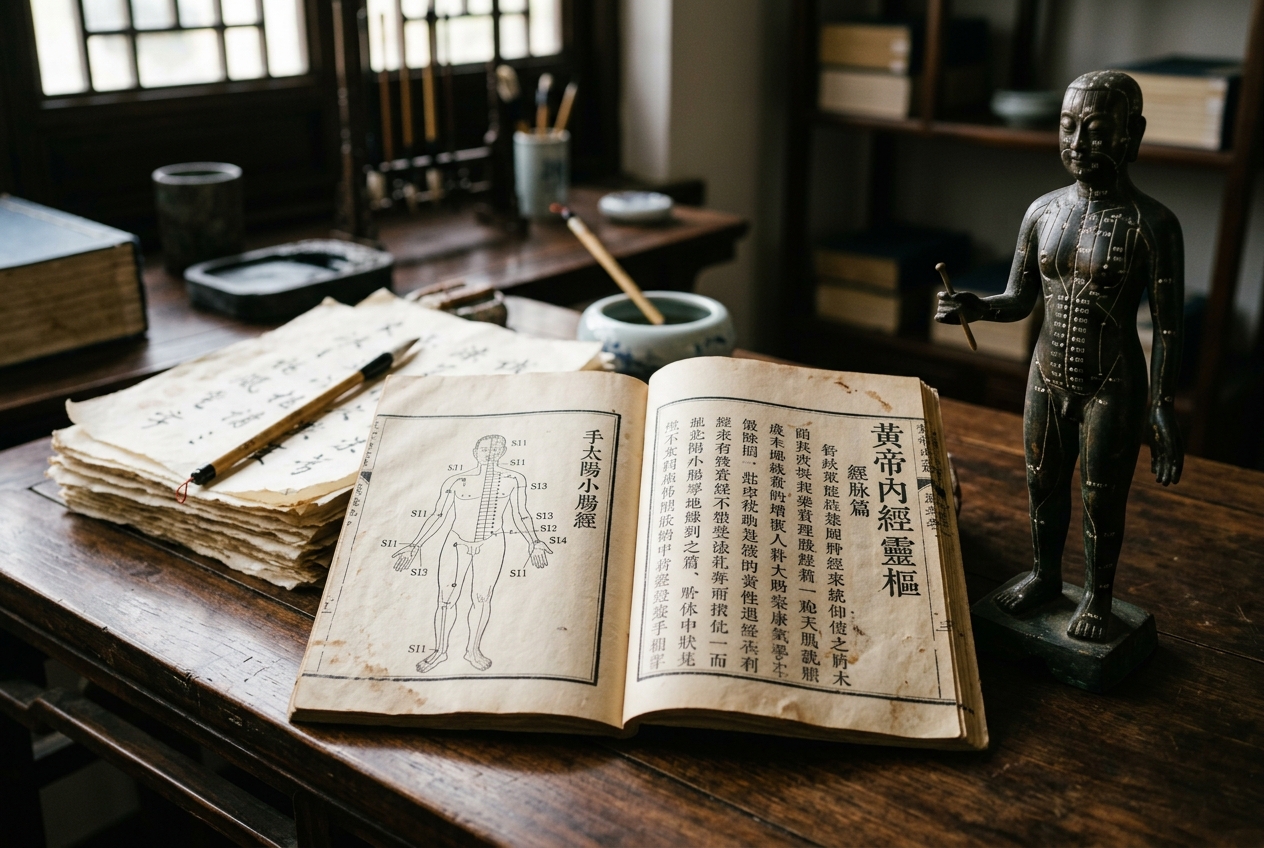
Consider a physiological pattern that has become the background noise of modern life: at approximately three in the afternoon, your shoulders tighten toward your ears, a dull pressure builds behind your eyes, and your digestion grinds to a sluggish, bloated halt. You have not suffered an acute mechanical injury, nor does a standard blood panel reveal an obvious biomarker of disease. Yet your body is registering a profound somatic complaint. In conventional clinical settings, such presentations are frequently filed under the broad, unsatisfactory heading of "idiopathic stress" or functional dysregulation.
Two millennia ago, Chinese medical scholars systematized this exact presentation not as a collection of disconnected symptoms, but as a predictable failure of systemic fluidic and bio-energetic transit. In the foundational canon of East Asian medicine—the Huangdi Neijing (The Yellow Emperor’s Inner Classic), and specifically its technical second volume, the Ling Shu (灵枢, The Spiritual Pivot, historically denominated the Zhen Jing or Needle Classic)—the human soma is mapped as a dynamic, continuous hydrological network. The canonical authors understood that persistent emotional strain, postural stagnation, and metabolic strain compress the living pathways of the body, choking off the continuous circulation of vitality.
The Ling Shu is not an esoteric treatise of mystical abstractions; it is a clinical manual of extraordinary anatomical precision, physiological reasoning, and manual therapeutics. By synthesizing the cartography of Ling Shu Chapter 10 (Jingmai) and the biophysical principles of Chapter 1 (Jiuzhen Shi'er Yuan), we can translate this classical wisdom into non-invasive, evidence-informed manual acupressure. When we understand how these ancient channels map onto modern connective tissue fascial planes and neurovascular pathways, we gain an accessible method for resetting our own nervous systems, alleviating chronic pain, and restoring systemic equilibrium.
1. The Living Conduit: Understanding the Ling Shu and the Meridian Matrix
To comprehend traditional channel mechanics, one must look to the Han Dynasty (206 BCE – 220 CE), an era of profound philosophical and scientific codification in imperial China. While the first book of the Inner Classic, the Su Wen (Basic Questions), establishes the cosmological, diagnostic, and philosophical architecture of health, the Ling Shu operates as the definitive textbook of applied therapeutics, needle craft, and meridian cartography.
The core doctrine of the Ling Shu asserts that human life is sustained through the perpetual, unbroken movement of Qi (functional metabolic energy) and Xue (nutrient-dense blood) through an intricate vascular and extra-vascular network termed the Jingmai (经脉). Chapter 10 (Jingmai) of the Ling Shu offers the earliest comprehensive codification of the twelve primary channels, describing them not as static lines painted on skin, but as deep, three-dimensional conduits that link internal viscera (Zang-Fu) directly with the peripheral musculoskeletal system.
In Chapter 10, the text delivers its timeless clinical maxim:
“The channels are that by which life and death are determined, all diseases are treated, and emptiness and fullness are regulated. They must not remain un-communicated.”
The Ling Shu describes health as a state of smooth, laminar hydrodynamic flow. Pathology arises when this flow becomes either Shi (实, full, stagnant, hyper-reactive) or Xu (虚, empty, depleted, lacking perfusion). Modern biomedical research increasingly identifies these ancient channels with the interstitial fluid highways running through the human fascial web. Pioneering anatomical studies led by researchers such as Dr. Helene Langevin, cataloged on the NCBI PubMed Database, reveal that acupuncture meridians coincide with subcutaneous cleavage planes rich in collagen, interstitial fluid, and unmyelinated nerve endings.
When mechanical pressure is applied to these sites, it initiates a cascade of cellular mechanotransduction: fibroblasts deform, sending electrical signals along collagen fibrils, modulating local vascular tone, and engaging the parasympathetic branch of the autonomic nervous system.
2. The Meridian Path: A Journey Through the Human Landscape
To navigate this terrain, one does not require fluent comprehension of classical anatomical terminology. The human body itself provides the natural landmarks—the bony headlands, muscle valleys, tendon ridges, and articular basins that the Han Dynasty physicians used to chart these channels.
Consider the great anterior pathway of the Stomach Meridian (Foot Yangming). The Ling Shu details its journey from the base of the skull down the throat, over the clavicle, through the chest and abdominal wall, descending along the front of the hip and thigh, crossing the knee joint, running straight down the muscular crest of the shinbone, over the arch of the foot, and terminating at the second toe.
In daily life, this is the functional superhighway of digestion, posture, and forward locomotion. When you spend eight hours seated in a chair, this channel is compressed at the hip flexors and abdominal core, leading directly to the mid-afternoon digestive heaviness and mental exhaustion documented in clinical textbooks.
Mirroring this Yang pathway on the inner surface of the limb is the Spleen Channel (Foot Taiyin), which originates at the inner corner of the big toe, travels up the soft, sensitive inner border of the foot, ascends immediately behind the inner edge of the shinbone, traverses the inner thigh, enters the pelvic cavity, and branches across the belly. This inner pathway governs fluid metabolism, tissue tone, and physical endurance.
Meanwhile, along the upper limb runs the Large Intestine Channel (Hand Yangming), traveling from the tip of the index finger, through the fleshy webbing of the hand, up the outer ridge of the forearm and elbow, over the crest of the shoulder, and up into the jaw. It works in partnership with the Pericardium Channel (Hand Jueyin), which flows down the midline of the inner forearm, nestled between two prominent flexor tendons, directly into the center of the palm.
The Ling Shu conceptualizes these pathways as an unbroken circuit. The energy does not vanish; it transforms and circulates across a diurnal rhythm (Zi Wu Liu Zhu, or the circadian organ clock). When one segment becomes obstructed through tension, repetitive strain, or mental stress, the downstream tissue starves while upstream regions suffer inflammatory congestion.
3. Somatic Cartography: Three Core Points for Clinical Modulation
In Chapter 1 (Jiuzhen Shi'er Yuan) of the Ling Shu, the Yellow Emperor asks his court physician Qibo how a practitioner can relieve suffering without complex apparatus. Qibo answers by defining the dynamics of the Yuan (Source) and key energetic confluence points—focal anatomical sites where the channel’s vitality is concentrated, accessible, and responsive to manual contact.
When locating and activating these points, you are not merely pressing skin; you are seeking what the Ling Shu defines as De Qi (得气)—the "arrival of vital energy." Mechanistically, as demonstrated in modern neuroimaging and clinical research published in PubMed Central on the Neurobiological Basis of Acupoint Deqi, De Qi corresponds to the mechanical grabbing of collagen fibers around the stimulating finger combined with the activation of deep A-delta and C-fiber mechanoreceptors.
Somatic sensation should manifest not as a sharp, bruising, or cutting pain, but as a deep, pleasant, spreading ache, a localized warmth, or a mild sensation of weight.
Below are three foundational points codified in the Ling Shu, mapped for practical self-application according to WHO Standard Acupuncture Nomenclature.
A. Zusanli (足三里, Stomach 36) — "Leg Three Miles"
- Anatomical Location: Sit comfortably with your knees bent at a ninety-degree angle. Place the palm of your hand directly over your kneecap. Lay your four fingers flat against the front of your shin. Just below the pinky finger, roughly one finger-width toward the outside of the sharp tibial shin ridge, you will locate a distinct muscular groove within the tibialis anterior muscle.
- The Somatic Benchmark (De Qi): When you engage this point with firm, direct thumb pressure, you will encounter a broad, deep, dull ache that frequently radiates down the shin toward the ankle or upward toward the knee. It feels dense, anchoring, and remarkably grounding.
- Clinical Application & Mechanics: Apply sustained, deep circular pressure using the reinforced tip of your thumb. Press with a bi-directional vector: inward toward the center of the bone and slightly upward toward the knee. Maintain this for two to three minutes while coordinating with slow, diaphragmatic breathing.
- Daily Indications: Physical exhaustion, postprandial lethargy, chronic bloating, nausea, and general immune deficiency. The Ling Shu notes that regular stimulation of this point "nourishes all deficiencies of the center."
B. Hegu (合谷, Large Intestine 4) — "Joining Valleys"
- Anatomical Location: Rest your hand flat on a table. Bring your thumb inward against the side of your index finger. You will notice a prominent mound of muscle rise in the webbing between the first and second metacarpal bones. Relax the hand; the point lies precisely at the highest midpoint of that muscular bulge, tucked closely against the bone of the index finger.
- The Somatic Benchmark (De Qi): Upon palpation, this point is exceptionally reactive. The sensation is an unmistakable sour, electric, or expanding ache that travels along the radial nerve pathway into the wrist or jaw.
- Clinical Application & Mechanics: Hook the pad of your opposite thumb into the webbing from the top of the hand, while your index finger supports the palm from underneath. Squeeze firmly, directing the pressure inward and obliquely toward the index finger bone. Hold with a steady, pulsing pressure for 90 to 120 seconds per side.
- Daily Indications: Tension headaches, eye strain, sinus congestion, neck stiffness, temporomandibular joint (TMJ) clenching, and acute mental stress.
C. Neiguan (内关, Pericardium 6) — "Inner Gate"
- Anatomical Location: Turn your hand palm-up. Lay the three middle fingers of your opposite hand across your wrist, with the ring finger aligned directly over the primary wrist crease. Your index finger now marks the vertical level of the point. Place your thumb precisely at this level, directly between the two prominent, cord-like tendons on the inner forearm (the palmaris longus and flexor carpi radialis tendons).
- The Somatic Benchmark (De Qi): Pressing into this fascial channel creates a distinct sensation of localized decompression, spreading as a mild tingling warmth into the palm or up the inside of the arm toward the chest.
- Clinical Application & Mechanics: Place your thumb between the tendons and apply deep, perpendicular pressure while gently flexing and extending your wrist through a small arc of motion. Maintain this continuous contact for two full minutes while lengthening your exhalations.
- Daily Indications: Situational anxiety, emotional constriction, palpitations caused by stress, motion sickness, acid reflux, and difficulty unwinding before sleep.
4. The Canonical Protocol: Evening Autonomic Reset
In modern life, chronic sympathetic hyper-arousal—often described as the "fight-or-flight" lock—disrupts autonomic regulation. The Ling Shu conceptualizes this as an inversion of the natural Biao-Ben (Branch-Root) polarity: metabolic heat, mental hyperactivity, and unanchored Yang rush upward into the head and chest, leaving the digestive center (Zhong Jiao) and lower extremities cold, stagnant, and depleted.
The following four-stage evening routine translates the root-and-branch balancing principles of the Ling Shu into a structured sequence designed to deactivate the sympathetic nervous system, promote visceral circulation, and prepare the mind for deep, restorative sleep.
The Protocol Execution
- Preparation & Posture: Sit comfortably on the floor or on a firm bed with your back supported. Dim the room's lighting. Remove tight socks or wristwatches that compress the superficial vasculature. Take three deep nasal breaths, allowing your belly to expand naturally on inhalation.
-
Stage 1: Clearing Upper Cranial Congestion via LI4 (Hegu) * Procedure: Begin with your right hand. Apply firm, steady, pinching pressure to LI4 using your left thumb and forefinger. * Duration: 2 minutes per side. * Mechanism: Sinks elevated cranial Yang, relaxes the suboccipital and masticatory muscles, and down-regulates trigeminal sensory irritation.
-
Stage 2: Calming the Thoracic Diaphragm via PC6 (Neiguan) * Procedure: Move to the inner forearm. Apply steady, perpendicular pressure directly between the flexor tendons of PC6. Synchronize your pressure with your breath: press deeper as you exhale; slightly ease off as you inhale. * Duration: 2 minutes per side. * Mechanism: Moderates the cardiac vagal brake, relieves epigastric tightness, and eases mental hyper-arousal.
-
Stage 3: Grounding Vitality into the Digestive Center via ST36 (Zusanli) * Procedure: Bend your knees and locate ST36 on both shins. Use both thumbs simultaneously to execute a rhythmic, downward-kneading motion along the outer edge of the shinbone. * Duration: 3 minutes continuous application. * Mechanism: Recruits the mesenteric vascular bed, stimulates gut motility via somatovisceral reflexes, and anchors somatic attention into the lower limbs.
-
Stage 4: Draining Residual Hepatic Fire via LV3 (Taichong) * Location & Procedure: On the top of the foot, locate the webbing between the big toe and the second toe. Slide your finger backward two finger-widths into the soft depression before the junction of the two metatarsal bones. Use the pad of your thumb to apply a sliding, downward-sweeping stroke toward the toes. * Duration: 2 minutes per side. * Mechanism: Completes the classical Si Guan (Four Gates) synergy when paired with LI4, promoting smooth, unobstructed vascular transit throughout the peripheral tissues.
5. Safety, Physiology, and Clinical Boundaries
While manual acupressure is an intrinsically safe, non-invasive therapeutic modality, its potency depends upon an accurate understanding of physiological contraindications, tissue mechanics, and diagnostic boundaries.
Canonical Contraindications in Pregnancy
The Ling Shu and subsequent classic texts explicitly forbid the vigorous stimulation of certain points during pregnancy. Chief among these are LI4 (Hegu), SP6 (Sanyinjiao), BL60 (Kunlun), and GB21 (Jianjing). In classical nomenclature, these points possess strong "descending and dispersing" properties.
Biomedically, strong manual stimulation at these sites can trigger reflexive uterine contractions and alter pelvic vascular dynamics. They should never be used on pregnant individuals except by licensed clinicians during active labor induction.
Understanding the Spectrum of Pressure
A widespread misconception is that therapeutic efficacy correlates directly with intense physical force. Bruising the skin or crushing peripheral nerves undermines the therapeutic mechanism.
True De Qi stimulation relies on sustained, elastic engagement with the fascial substrate. If you experience a sharp, burning, or lightning-like sensation, you are compressing a superficial sensory nerve branch; immediately adjust your angle of application.
Clinical Boundaries
Self-administered acupressure is a powerful modality for managing functional tension, mild digestive sluggishness, stress-related sleep disturbances, and postural fatigue. It is not, however, a substitute for emergency intervention or professional medical diagnosis.
If you experience crushing substernal chest pressure, sudden unilateral numbness, unexplained severe abdominal pain, persistent high fever, or rapid, unexplained weight loss, you must seek immediate evaluation from a licensed medical physician. For chronic, complex constitutional conditions, consult a board-certified licensed acupuncturist (L.Ac.) or Doctor of Acupuncture and Oriental Medicine (DAOM).
6. Today’s Takeaway: The Two-Minute Desk Reset
You do not need to wait for a formal evening routine to experience the practical utility of the Ling Shu’s meridian mechanics. If you are sitting at your desk right now, experiencing the classic combination of mental fatigue, neck tension, and shallow breathing, you can reset your physiological state in 120 seconds.
- The Point: Neiguan (PC6) on your non-dominant inner wrist.
- The Problem: Midday sensory overload, shallow apical breathing, and sympathetic stress lock.
- The Action: * Place three fingers across your inner wrist to identify the level of PC6 between the central tendons. * Rest your forearm on your desk. Press your thumb pad firmly into the point until you feel a distinct, warm, radiating dull ache. * Close your eyes. Inhale slowly through your nose for a count of four, feeling your lower ribs expand laterally. * Exhale gently through your nose for a count of six, increasing thumb pressure by just five percent on the exhalation. * Maintain this cycle for 60 seconds, then switch arms and repeat on the opposite side.
As you finish, release your grip, allow your hands to rest in your lap, and notice the change in your physiology. You will likely observe a spontaneous deepening of your breath, a subtle drop in your resting heart rate, and an easing of tension across your jaw and shoulders.
In this simple, reproducible sensory experience, the ancient wisdom of the Ling Shu demonstrates its enduring value: you have re-established communication across the pathways of your body, turning a 2,000-year-old medical philosophy into an immediate somatic reality.
Authoritative Scholarly References
- World Health Organization (WHO): Consult the standardized global meridian cartography in the WHO Standard Acupuncture Point Locations in the Western Pacific Region.
- National Center for Biotechnology Information (NCBI): Read comprehensive peer-reviewed clinical research on acupoint mechanics via the NCBI PubMed Database.
- Neurobiological Mechanisms: Explore the neurochemical and connective tissue dynamics of point stimulation via NCBI PMC - Neurobiological Basis of Acupoint Deqi.
- Classical Literature History: Review the historical and textual development of China's foundational medical canon on Wikipedia: Huangdi Neijing.
- Channel Biophysics: Understand the anatomical models of the channel network via Wikipedia: Meridian (Chinese Medicine).