Lei Jing Tu Yi: Navigating Zhang Jingyue's Classified Channel Cartography, Point Energetics, and Precision Acupressure Protocols
1. Opening — A Problem This Solves Today
If you regularly experience a hollow, postprandial heaviness after meals, a sudden wave of lethargy during the late morning, or a persistent, low-grade autonomic anxiety that tightens your chest and locks your jaw, you are living squarely within the somatic territory of systemic channel dysregulation. In contemporary life, these diffuse patterns of visceral distress—often dismissed as nonspecific stress or functional dyspepsia—rarely stem from isolated mechanical failures. Instead, they reflect an uncoupling of the body’s metabolic processing and neurovegetative regulation.
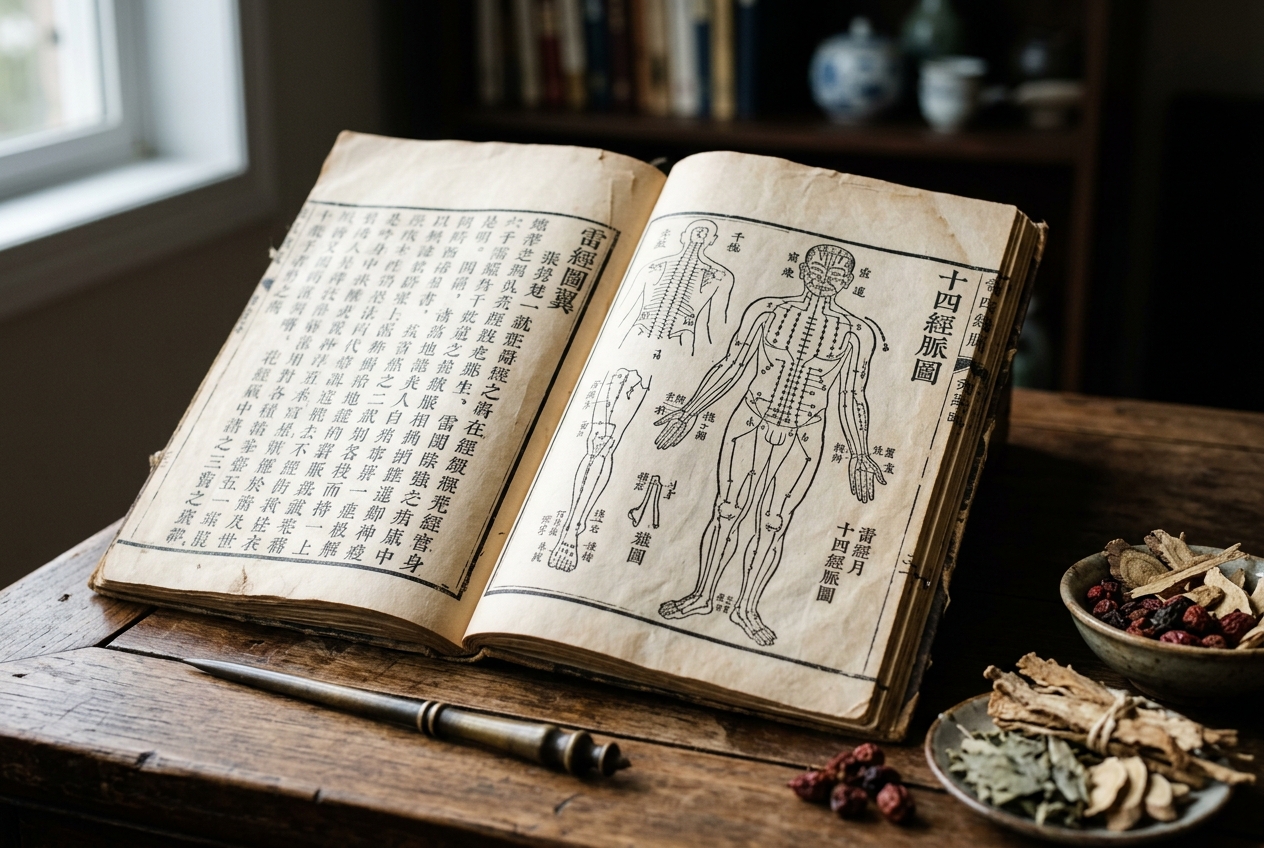
For centuries, Western clinical medicine struggled to categorize these multifaceted functional complaints because they exist at the intersection of connective tissue tension, autonomic tone, and visceral rhythm. Yet in 1624, during the twilight of the Ming dynasty, the polymath physician Zhang Jingyue (also known as Zhang Jiebin, 1563–1640) published a monumental treatise that provided an exquisitely detailed, systemic map for precisely these disruptions: the Lei Jing Tu Yi (類經圖翼, or Illustrated Wing to the Classified Classic).
Zhang recognized that the body does not operate as an assemblage of independent organs, but as a dynamic, continuous continuum of vascular, neural, and fascial pathways known as the meridian system (Jing-Luo). Where modern life creates chronic sympathetic hyperarousal—clamping microcirculation and inducing gastrointestinal stasis—classical meridian cartography offers a reproducible, non-invasive architecture for somatic reset. By translating Zhang’s classical cartography into targeted manual acupressure, we can access ancient anatomical levers that recalibrate autonomic tone, release deep fascial restrictions, and restore energetic homeostasis.
+-----------------------------------------------------------------------------+
|                     CLINICAL PRINCIPLE: LEI JING TU YI                      |
|                                                                             |
| "The channels and vessels are that by which life is determined, disease is  |
| diagnosed, and balance is restored. One must know the bone-proportional     |
| measurements and point matrices to govern the interior from the exterior."  |
|                                                                             |
| — Zhang Jingyue, Lei Jing Tu Yi (1624)                                      |
+-----------------------------------------------------------------------------+
2. Theoretical Architecture & Historical Significance: Zhang Jingyue’s Cartographic Revolution
To understand the practical efficacy of meridian stimulation, one must first grasp the monumental intellectual achievement of Zhang Jingyue. Throughout the imperial history of Traditional Chinese Medicine, the foundational canon remained the ancient Han dynasty compilation, the Huangdi Neijing (The Yellow Emperor’s Inner Classic). However, over centuries of scribal transcription, the Neijing’s anatomical tracts, clinical aphorisms, and physiological theories had become fragmented, cryptic, and difficult to operationalize at the bedside.
===============================================================================
               ZHANG JINGYUE'S EPISTEMOLOGICAL SYSTEMATIZATION
===============================================================================

[ Huangdi Neijing (Han Dynasty Canon) ]
                      |
                      v  (30 Years of Systematic Exegesis & Synthesis)
     [ Lei Jing (Classified Classic, 1624) ]
                      |
                      +---> Categorized into 12 Systematic Thematic Orders
                      |
     [ Lei Jing Tu Yi (Illustrated Wing, 1624) ]
                      |
       +--------------+--------------+--------------+
       |                             |              |
       v                             v              v
[ Anatomical Gu-Du ]        [ Five-Phase Shu ]   [ Extraordinary Vessels ]
Bone-Proportional System    Point Conduits       Core Reservoir Dynamics
===============================================================================
Zhang spent more than three decades reorganizing, categorizing, and annotating this ancient corpus into the Lei Jing (Classified Classic), supplementing it with the Lei Jing Tu Yi—a lavishly illustrated anatomical, cosmological, and point-location atlas. Zhang’s work represented an epistemological leap: he took the abstract metaphysical language of ancient Chinese medicine and anchored it within an exacting framework of human geometry and somatic topography.
The Bone-Proportional System (Gu-Du)
At the heart of Zhang’s cartographic precision was the formalization of the Gu-Du (骨度) or bone-proportional measurement framework. Classical physicians understood that human bodies vary widely in height, limb length, and muscular circumference. A rigid metric measurement (such as inches or centimeters) would inevitably miss critical neurovascular and fascial junctions.
Zhang systematized the proportional Cun (寸) system, defining body regions by invariant structural landmarks: * The distance from the sternocostal angle to the umbilicus is standardized as 8 proportional units. * The distance from the umbilicus to the superior border of the pubic symphysis is standardized as 5 units. * The distance between the inferior border of the patella and the prominence of the lateral malleolus is standardized as 16 units.
By anchoring point locations to relative skeletal proportions rather than fixed distances, Zhang created an anatomical coordinate system that preserved clinical reproducibility across every body habitus.
                   ZHANG JINGYUE'S SKELETAL PROPORTIONAL GRID
                               (ANTERIOR VIEW)

                 \   /          Infrasternal Angle
                  \_/           |
                   |            | (8 Proportional Cun)
                   |            v
                 ( * ) <------- Umbilicus
                   |            |
                   |            | (5 Proportional Cun)
                   |            v
                ======= <------ Superior Border of Pubic Symphysis
                |     |
                |  |  |
                |  |  |
                (  o  ) <------ Patella / Knee Joint Line
                |  |  |
                |  |  |         |
                |  |  |         | (16 Proportional Cun)
                |  |  |         v
                ---+--- <------ Prominence of Lateral Malleolus
                  / \
The Five-Phase Transporting Matrices (Wu Shu Xue)
Beyond linear measurement, Zhang deconstructed the dynamics of channel energetics through the Five-Phase (Wu Xing) matrices of the Wu Shu (Five Transporting) points: Jing-Well, Ying-Spring, Shu-Stream, Jing-River, and He-Sea.
Zhang conceptualized the flow of Qi and blood along the extremities by drawing an analogy to the hydrological cycle of water: 1. Jing-Well (Wellspring at the fingertips and toes): Where energy bubbles up with acute, dynamic volatility; 2. Ying-Spring (Trickling Brook): Where the flow accelerates and gathers velocity; 3. Shu-Stream (Flowing Stream): Where the current widens, transports deeper reserves, and becomes receptive to defensive mobilization; 4. Jing-River (Broad River): Where the energetic volume deepens and moves rapidly through major tendons; 5. He-Sea (Vast Delta/Sea): Where the current plunges inward to directly nourish and regulate the internal organ (Zang-Fu) systems.
-------------------------------------------------------------------------------
           THE HYDRODYNAMIC PROGRESSION OF FIVE-SHU POINT CONDUITS
-------------------------------------------------------------------------------
 Digits (Distal)                                                 Joints (Proximal)
   +-----------+     +-------------+     +------------+     +------------+     +----------+
   | Jing-Well | --> | Ying-Spring | --> | Shu-Stream | --> | Jing-River | --> |  He-Sea  |
   +-----------+     +-------------+     +------------+     +------------+     +----------+
     Bubbling            Rapid               Widened            Deep and           Plunging
     Emergence           Trickle             Transport          Resonant           Inward to
    (Acupoints)        (Clear Heat)        (Joint/Heaviness)    (Cough/Sinew)       Organs
-------------------------------------------------------------------------------
Extraordinary Vessel Reservoirs (Qi Jing Ba Mai)
Crucially, Zhang clarified the profound functional relationship between the twelve standard primary channels (Zheng Jing) and the Eight Extraordinary Vessels (Qi Jing Ba Mai). While the primary channels function like irrigation canals distributing vital energy throughout the musculoskeletal surface and interior viscera, the Extraordinary Vessels serve as deep, underlying energetic reservoirs and regulatory sea basins.
In the Lei Jing Tu Yi, Zhang illustrated how master points on the extremities act as hydraulic gates opening into these deep regulatory axes—most notably the Chong Mai (Penetrating Vessel, the sea of blood) and the Ren Mai (Conception Vessel, the sea of Yin).
3. The Meridian Path — A Journey Through the Body
To experience the brilliance of Zhang’s cartography, one does not need to memorize archaic nomenclature. Instead, one can trace these energetic highways through the intuitive, palpable landscape of their own body. Let us follow the journey of the body's primary digestive and autonomic conduits: the Stomach (Yangming) and Liver (Jueyin) meridian axes.
===============================================================================
                     THE DESCENT OF THE YANGMING STOMACH AXIS
===============================================================================

[ Infraorbital Ridge ] (Below the pupil)
                    |
                    v (Sweeps down the cheek, encircles the mouth)
           [ Angle of the Jaw ]
                    |
                    v (Descends anterior neck along the carotid pulse)
           [ Supraclavicular Fossa ] (Hollow above collarbone)
                    |
                    +====================+
                    | Internal Pathway:  | Plunges through diaphragm to
                    |                    | enter Stomach & Spleen viscera
                    +====================+
                    |
                    v (Descends superficial torso along the nipple line)
           [ Abdominal Meridian Strip ] (2 inches lateral to midline)
                    |
                    v (Traverses groin crease)
           [ Anterior Thigh & Quadriceps ]
                    |
                    v (Crosses lateral eye of knee)
           [ Anterior Tibial Ridge / Shinbone ]
                    |
                    v (Descends lateral to shin muscle into dorsal foot)
           [ Web Between 2nd and 3rd Toes ]
===============================================================================
The Yangming Descent: The Great Metabolic Highway
The Stomach channel represents the premier conduit of Yangming ("Abundant Yang") energy—the primary engine responsible for transforming food and fluid into bioavailable vitality.
- The Craniofacial Inception: The pathway begins just below the center of your eye socket, in the soft depression beneath the pupil. It sweeps downward across the cheek, wraps around the corner of the mouth, curves along the angle of the jaw, and ascends to the temple.
- The Cervical and Thoracic Plunge: From the jawline, it travels down the anterior aspect of the neck—just lateral to the carotid pulsation—and enters the hollow above the collarbone. Here, the pathway divides: an internal branch plunges deeply through the diaphragm to interface directly with the stomach and spleen viscera, while the external branch descends vertically down the chest along the mammillary line.
- The Abdominal Engine: The channel traverses the abdomen along a vertical corridor positioned roughly two inches lateral to the central midline. This is the muscular zone that tightens when you experience visceral dread or sudden digestive cramping.
- The Lower Extremity Highway: Passing through the groin crease, the conduit travels down the front of the thigh across the rectus femoris muscle, crosses the knee joint through the soft hollow just outside the kneecap tendon ("the lateral eye of the knee"), and continues down the front of your shinbone. It runs along the fleshy, muscular ridge of the tibialis anterior muscle—the exact structure that aches with burning fatigue after a long day of walking on hard pavement. Finally, it crosses the top arch of the foot, terminating at the lateral nail bed of the second toe.
===============================================================================
                      THE ASCENT OF THE JUEYIN LIVER AXIS
===============================================================================

[ Vertex of the Skull / Crown (Baihui GV20) ]
                    ^
                    | (Ascends through throat, eye system, and skull)
           [ Free End of the 11th Rib (Zhangmen LR13) ]
                    ^
                    | (Traverses costal arch and ribcage)
           [ Groin Crease & External Genitalia ]
                    ^
                    | (Ascends medial thigh along inner adductor line)
           [ Medial Aspect of the Knee Joint ]
                    ^
                    | (Ascends medial lower leg along posterior tibia)
           [ Anterior Ankle Fold / Dorsum of Foot ]
                    ^
                    |
           [ Web Between 1st and 2nd Metatarsals (Taichong LV3) ]
===============================================================================
The Jueyin Ascent: The Channel of Smooth Neurovascular Regulation
Running in functional, reciprocal polarity to the descent of the Stomach channel is the ascent of the Liver channel (Jueyin, the "Terminal Yin").
- The Foot and Ankle Gateway: The pathway originates at the lateral nail corner of the big toe, traverses the dorsal web between the first and second toes, and crosses the anterior fold of the inner ankle.
- The Medial Sinew Ascent: It tracks upward along the inner surface of the lower leg, running just behind the inner border of the tibia. It passes through the inner crease of the knee joint, ascends the medial adductor muscles of the inner thigh, and encircles the external genitalia and lower pelvic bowl.
- The Hypochondriac Expansion: Emerging into the lower abdomen, it sweeps upward across the flank to terminate at the base of the ribcage, right beneath the breast tissue. Deep internal extensions penetrate the liver and gallbladder, cross the diaphragm, ascend the throat and eye systems, and culminate at the very crown of the skull. When emotional stress, suppressed frustration, or cognitive overexertion causes tension in the neck, temple throbbing, or tight flank muscles, it is this Jueyin muscular and fascial chain that has constricted.
4. Master Point Matrices & The Biophysics of Mechanotransduction
How does manual, non-invasive mechanical compression applied to a focal cutaneous locus induce systemic visceral and neurochemical changes? For centuries, classical texts described this phenomenon as Deqi (得氣)—the "arrival of vital energy," characterized by a deep, radiating ache, numbness, distention, or subtle warmth. Today, cutting-edge cellular biology and biomechanics validate Zhang Jingyue's cartography through the framework of neurofascial mechanotransduction.
+-----------------------------------------------------------------------------+
|               NEUROFASCIAL MECHANOTRANSDUCTION CASCADE                      |
+-----------------------------------------------------------------------------+
|                                                                             |
|  1. MANUAL COMPRESSION / ROTATIONAL SHEAR                                   |
|     (Targeted mechanical pressure applied to an interstitial matrix)        |
|                            |                                                |
|                            v                                                |
|  2. EXTRACELLULAR MATRIX CYTOSKELETAL DEFORMATION                           |
|     (Collagen fibrils wind; mechanosensitive Piezo1/2 & TRPV channels open)  |
|                            |                                                |
|                            v                                                |
|  3. PURINERGIC & PARACRINE SIGNALING                                        |
|     (Hydrolysis of ATP into Adenosine -> Local microvascular vasodilation)  |
|                            |                                                |
|                            v                                                |
|  4. NEURAL TRANSDUCTION & CENTRAL MODULATION                                |
|     (A-delta & C afferents -> Dorsal horn gating -> Vagus nerve excitation) |
|                            |                                                |
|                            v                                                |
|  5. SYSTEMIC HOMEOSTATIC EQUILIBRIUM                                        |
|     (Suppression of systemic cortisol, upregulation of gastric motility)    |
|                                                                             |
+-----------------------------------------------------------------------------+
As demonstrated in landmark connective tissue research by Langevin et al. (2002), classical acupuncture points correspond with remarkable spatial fidelity to structural convergences in the subcutaneous interstitial connective tissue planes and intermuscular cleavage lines. When manual pressure or sustained rotational torque is applied to these loci, several distinct physiological events occur simultaneously:
- Fibroblast Remodeling and Mechanosensitive Ion Channels: Mechanical shear deforms the interstitial extracellular matrix, causing subcutaneous collagen fibers to wind physically around cellular boundaries. This mechanical strain activates mechanosensitive ion channels (including PIEZO1, PIEZO2, and TRPV channels) on the surfaces of interstitial fibroblasts and peripheral nerve terminals.
- Purinergic Signaling and Adenosine Release: Cellular distortion stimulates the rapid interstitial release of adenosine triphosphate (ATP), which is rapidly converted via local ectonucleotidases into adenosine. As established by Goldman et al. (2010), interstitial adenosine binds to localized $A_1$ adenosine receptors on nociceptive afferents, functioning as a potent local antinociceptive (pain-inhibiting) and vasodilatory agent that enhances microvascular perfusion.
- Somato-Autonomic Reflex Arcs and Vagal Modulation: The sustained sensory afferent barrage traveling via myelinated A-delta and unmyelinated C-fibers enters the spinal cord, modulating pain gating in the dorsal horn. Crucially, these signals ascend to the solitary tract nucleus (Nucleus Tractus Solitarii, NTS) and the dorsal motor nucleus of the vagus nerve in the brainstem, driving systemic parasympathetic upregulation, lowering resting heart rate variability, and stimulating acetylcholine release along the gut axis.
Guided by Zhang Jingyue’s Lei Jing Tu Yi, we can leverage these mechanotransductive pathways using five primary master loci:
Master Loci Deconstruction Table
| Acupoint Name & Code | Classical Classification | Anatomical Landmark Location | Palpatory Sensation (Deqi) | Primary Clinical Indication |
|---|---|---|---|---|
| Zusanli (ST36) | He-Sea Point (Earth); Command Point of Abdomen | Four finger-widths below the knee, one finger-width lateral to the tibia | Heavy, radiating dull ache descending into the foot | Postprandial bloating, chronic fatigue, gastric stasis |
| Taichong (LV3) | Shu-Stream & Yuan-Source Point | Web depression between the 1st and 2nd metatarsal bones on foot dorsum | Sharp, electric, or deep bruised tenderness | Autonomic tension, headaches, irritability, emotional stress |
| Hegu (LI4) | Yuan-Source Point; Command Point of Face/Head | Dorsal web space between 1st and 2nd metacarpals on the hand | Pronounced, spreading soreness throughout the palm | Tension headaches, neck stiffness, sinus congestion |
| Sanyinjiao (SP6) | Three Yin Intersection (Spleen, Liver, Kidney) | Four finger-widths above the medial malleolus behind the tibia | Deep, tender ache, slight systemic calming | Menstrual cramps, fluid retention, insomnia, pelvic stasis |
| Neiguan (PC6) | Luo-Connecting Point; Master of Yin Wei Mai | Three finger-widths above the wrist crease between two central tendons | Tingling, light warmth radiating toward chest and fingers | Anxiety palpitations, nausea, epigastric tightness |
1. Zusanli (足三里, ST36) — "Leg Three Miles"
- Anatomical Palpation: Sit with your knees bent at a ninety-degree angle. Place the four fingers of your opposite hand horizontally across your shin, directly beneath the bottom edge of your kneecap. Locate the sharp vertical ridge of your shinbone (the anterior border of the tibia). Move your finger outward (laterally) about one thumb-width into the soft, fleshy belly of the tibialis anterior muscle. You will find a natural, distinct structural hollow.
- Palpatory Quality: When compressed firmly against the underlying bone, you will encounter a characteristic deep, heavy ache that may radiate downward along the outer lower leg toward the middle toes.
- Biomechanical Execution: Apply firm, sustained perpendicular pressure with the pad of your thumb. Execute a slow, rhythmic, clockwise rotational compression at a tempo of roughly one revolution every two seconds. Maintain for 120 to 180 seconds bilaterally. In Zhang’s classical framework, clockwise rotational pressure serves a tonifying (Bu) function, augmenting metabolic fire and stimulating gastric peristalsis via vagal excitation.
                  ZUSANLI (ST36) PALPATORY IDENTIFICATION

                 [ Patella / Kneecap ]
                 +-------------------+
                 |                   |
                 +-------------------+
                   |               |
                   | Four Finger-  |
                   | Widths Down   |
                   v               v
    Shinbone Ridge [===========]   ( * ) <--- ZUSANLI (ST36)
       (Tibia)     |           |              (1 thumb-width lateral in
                   |           |               belly of tibialis anterior)
                   |           |
2. Taichong (太衝, LV3) — "Great Rushing"
- Anatomical Palpation: Place your index finger on the dorsal web between your big toe and second toe. Slide your finger backward along the groove between the two long metatarsal bones toward the ankle. Approximately one and a half to two finger-widths up, your finger will drop into a deep, tender triangular valley just before the two bones converge.
- Palpatory Quality: This point is exceptionally reactive in individuals experiencing autonomic strain; you will instantly feel an unmistakable, sharp, bruised sensitivity.
- Biomechanical Execution: Apply sustained, deep pressure angled slightly toward the bone of the big toe. Execute a counter-clockwise dispersing (Xie) rotation for 120 seconds while exhaling deeply. This down-regulates sympathetic vasoconstriction, moderating systemic cortisol surges and dissipating myofascial constriction in the cranial and cervical zones.
                  TAICHONG (LV3) PALPATORY IDENTIFICATION

                     Big Toe     2nd Toe
                       |           |
                       |           |
                      ( \         / )
                       \ \_______/ /  <--- Web Margin
                        \         /
                         \       /
                          \  *  / <------- TAICHONG (LV3)
                           \   /           (Deep triangular valley
                            | |             before bones converge)
                           [   ] Metatarsal Junction
3. Hegu (合谷, LI4) — "Joining Valleys"
- Anatomical Palpation: Bring your thumb and index finger together on one hand. Observe the fleshy muscular mound that bulges upward on the back of the hand between the first and second metacarpal bones. Place your opposite thumb on the peak of this mound, then relax your hand. Angle your thumb slightly inward toward the bone of the index finger.
- Palpatory Quality: A pronounced, dull, spreading ache that resonates deeply into the web space and palm.
- Biomechanical Execution: Press with firm, continuous perpendicular pressure, pinching the muscular tissue between your thumb on top and your index finger underneath. Hold firmly for 120 to 180 seconds per hand. This stimulation recruits endogenous opioid cascades (endorphins and enkephalins) within the periaqueductal gray matter, delivering potent analgesia for tension-type headaches, temporomandibular clenching, and sinus congestion.
                   HEGU (LI4) PALPATORY IDENTIFICATION

                          Index Finger
                             |
                             |
                            / \
                           /   \
                          /  *  \ <------- HEGU (LI4)
                         /       \         (On muscular mound,
                        /         \         angled toward 2nd metacarpal)
                  Thumb [_________]
4. Sanyinjiao (三陰交, SP6) — "Three Yin Intersection"
- Anatomical Palpation: Sit with your ankle resting across the opposite knee. Locate the high, prominent bony peak of your inner ankle (the medial malleolus). Lay the four fingers of your hand flat across the inside of your leg, starting just above that bony crest. Directly above the top finger, right along the back edge of your shinbone, press into the tender muscular border.
- Palpatory Quality: A deep, lingering, tender sensation that reflects the confluence of the Spleen, Liver, and Kidney conduits codified in Zhang's anatomical charts.
- Biomechanical Execution: Apply slow, gentle-to-moderate perpendicular compression for 120 seconds. Sanyinjiao regulates pelvic microcirculation, calms smooth muscle spasm, and promotes systemic Yin nourishment for restorative sleep.
                 SANYINJIAO (SP6) PALPATORY IDENTIFICATION

                   |           |
                   | Inner Leg |
                   |           |
                   |    ( * ) <------- SANYINJIAO (SP6)
                   |           |       (Just behind posterior border of tibia)
                   |           |
                   | 4 Fingers |
                   |  Height   |
                   v           v
                 +---------------+
                 |  Inner Ankle  | <--- Medial Malleolus Prominence
                 |  Bony Peak    |
                 +---------------+
5. Neiguan (內關, PC6) — "Inner Pass"
- Anatomical Palpation: Turn your palm upward. Place three finger-widths of your opposite hand across the inner wrist crease, starting directly at the base of the palm. In the center of your forearm, directly below the third finger, identify the two prominent, cord-like tendons (the flexor carpi radialis and palmaris longus). The point sits precisely in the groove between these two tendons.
- Palpatory Quality: A delicate, tingling, and spreading sensation that often travels outward into the palm or up the inside of the forearm.
- Biomechanical Execution: Press the tip of your thumb straight down into the inter-tendinous furrow. Maintain a steady, calm, non-rotational static compression for 120 seconds while practicing slow, diaphragmatic breathing. This point directly targets the median nerve sheath, inducing immediate reductions in nausea, esophageal spasm, and autonomic cardiac palpitations.
                  NEIGUAN (PC6) PALPATORY IDENTIFICATION

                   [ ====== Palm / Hand ====== ]
                   ----------------------------- <--- Wrist Crease
                     |                         |
                     |  Three Finger-Widths    |
                     v                         v
                   [Tendon]   ( * )   [Tendon] <--- NEIGUAN (PC6)
                   (Flexor)            (Palmaris)   (In the groove between
                                                     the two central cords)
5. A Point Combination for One Common Issue: The Evening Neuro-Visceral Reset
Modern desk-bound professionals routinely suffer from a classic somatic symptom cluster: a bloated, stagnant digestive tract paired with a hyper-aroused, hyper-vigilant mind and an aching, rigid neck.
In the Lei Jing Tu Yi, Zhang Jingyue described this condition as an uncoupling of Yin and Yang—where metabolic fire stagnates in the lower burner while turbulent energy surges upward into the sensory orifices. To resolve this complex pattern, we utilize one of the most celebrated point combinations in classical medicine: the synergistic pairing of the Four Gates (Si Guan, bilateral LV3 + LI4) combined with the digestive anchoring of Zusanli (ST36) and the psycho-emotional stabilization of Neiguan (PC6).
===============================================================================
               THE COMPLETE EVENING NEURO-VISCERAL RESET PROTOCOL
===============================================================================

STEP 1: Clear Cranial Tension & Open Peripheral Circulation
          [ LI4 (Hegu) ] Bilateral Compression — 120 Seconds Per Hand
                 |
                 v
  STEP 2: Disperse Visceral Resistance & Moderate Sympathetic Tone
          [ LV3 (Taichong) ] Bilateral Counter-Clockwise Dispersion — 120 Seconds
                 |
                 v
  STEP 3: Down-Regulate Central Arousal & Harmonize Cardiac Rhythm
          [ PC6 (Neiguan) ] Bilateral Static Compression — 120 Seconds
                 |
                 v
  STEP 4: Anchor Digestive Fire & Promote Parasympathetic Restoration
          [ ST36 (Zusanli) ] Bilateral Clockwise Tonification — 180 Seconds

POSITION: Semi-recumbent in a quiet space, knees supported by a bolster.
  BREATHWORK: 4-second nasal inhalation, 6-second unhurried exhalation.
===============================================================================
The "Do This Tonight" Step-by-Step Sequence
Preparation & Posture
Lie down in a warm, quiet, dimly lit room in a semi-recumbent posture (upper torso angled up at 30 degrees, head cradled by a supportive pillow, and knees gently elevated with a rolled blanket or bolster to relax the abdominal wall). Close your eyes. Spend two minutes establishing a coherent, parasympathetic breathing rhythm: inhale deeply through the nose for a count of 4, and exhale unhurriedly through slightly parted lips for a count of 6.
                               BODY POSITIONING

                   Head Supported
                     ( o )
                      \_/\
                          \__  <--- Torso at 30-Degree Angle
                             \
                              \======[ Rolled Bolster Under Knees ]
                                     / \
                                    /   \___ Flat Feet / Relaxed Heels
Step 1: Open the Upper Gate (Hegu, LI4)
- Action: Begin with your right hand. Locate LI4 in the muscular web between thumb and index finger. Apply firm, steady, pinching compression with your left thumb.
- Execution: Hold for 120 seconds, maintaining constant pressure while visualizing tension draining from your eyes, temples, and jaw. Switch hands and repeat on the left hand for 120 seconds.
- Target Result: A noticeable relaxation of the suboccipital muscles and jawline, accompanied by deeper nasal breathing.
Step 2: Open the Lower Gate (Taichong, LV3)
- Action: Move down to your feet. Locate LV3 in the dorsal groove between your first and second toes on the right foot.
- Execution: Press deeply into the valley with your right thumb. Perform slow, circular, counter-clockwise dispersing strokes for 120 seconds. Repeat immediately on the left foot for 120 seconds.
- Target Result: Dissipation of irritability, release of diaphragmatic bracing, and a warming sensation in the extremities.
Step 3: Calm the Central Core (Neiguan, PC6)
- Action: Return to your arms. Place your thumb three finger-widths down from the inner wrist crease, dead center between the two forearm tendons.
- Execution: Apply steady, gentle, perpendicular static pressure for 120 seconds on the left arm, then switch to the right arm for 120 seconds. Synchronize this hold with your 4-in, 6-out breathing pattern.
- Target Result: Slowing of resting heart rate, relief of chest tightness, and cessation of epigastric reflux.
Step 4: Anchor the Digestive Engine (Zusanli, ST36)
- Action: Conclude your protocol at the legs. Locate ST36 four finger-widths below the kneecap and one finger-width outside the shinbone.
- Execution: Using both thumbs simultaneously on both legs, apply firm, rhythmic, clockwise rotational compression for a full 180 seconds.
- Target Result: Audible or perceptible stomach gurgling (borborygmi), indicating the resumption of healthy digestive peristalsis and parasympathetic dominance.
6. Safety, Somatosensory Boundaries, and Clinical Sense
While precision manual acupressure is an extraordinarily safe, non-invasive somatic therapy, its physiological potency requires clinical prudence and clear somatosensory boundaries.
+-----------------------------------------------------------------------------+
|                              SAFETY GUIDELINES                              |
+-----------------------------------------------------------------------------+
|                                                                             |
|  [ ! ] PREGNANCY CONTRAINDICATION:                                          |
|        STRICTLY AVOID strong stimulation of LI4 (Hegu) and SP6 (Sanyinjiao) |
|        during pregnancy, as these loci strongly promote downward motor      |
|        energy and can stimulate uterine contractions.                       |
|                                                                             |
|  [ ! ] SOMATOSENSORY CALIBRATION:                                           |
|        Therapeutic pressure should register as a "satisfying, deep, dull    |
|        ache" (Deqi). It must NEVER produce sharp, searing neural pain,      |
|        electrical shocks, or superficial tissue bruising.                   |
|                                                                             |
|  [ ! ] RED-FLAG SYMPTOMS (SEEK IMMEDIATE MEDICAL EVALUATION):               |
|        Never use self-acupressure as a substitute for emergency care in     |
|        cases of acute unremitting abdominal pain ("board-like" rigidity),   |
|        crushing chest pressure radiating to the arm or jaw, sudden severe   |
|        neurological deficits, or unexplained high fever.                    |
|                                                                             |
+-----------------------------------------------------------------------------+
Critical Contraindications During Pregnancy
Certain acupoints possess marked descending, clearing, and oxytocic actions that stimulate pelvic and uterine contractility. Points such as Hegu (LI4), Sanyinjiao (SP6), and Jianjing (GB21) are strictly contraindicated for deep, sustained manual compression during pregnancy, except under the direct physical guidance of a licensed, board-certified obstetric acupuncturist during active labor.
Calibrating Pressure: The Deqi Spectrum
Therapeutic pressure is not a contest of brute force. The goal of mechanotransduction is to communicate with the fascial nervous system, not to induce protective muscular splinting. * The Sweet Spot: A rich, spreading, slightly heavy ache that feels relieving (often described as "good pain" or Deqi). * Too Much Pressure: Any sharp, searing, or electric shock-like sensation, which indicates direct nerve impingement or capillary trauma. If you wince, tense your shoulders, or hold your breath, reduce pressure immediately.
When to Seek a Licensed Professional
Self-acupressure is designed for functional harmonization and daily stress resilience. If you suffer from chronic, intractable inflammatory bowel disease, unresolved severe migraines, structural musculoskeletal tears, or systemic metabolic disorders, consult a licensed acupuncturist (L.Ac. or Dipl.Ac.) registered with national credentialing bodies such as the NCCAOM and working in coordination with your primary care physician.
7. Today’s Takeaway: The Two-Minute Reset
You do not need an entire clinical suite or hours of meditation to alter your neurovegetative state. Right now, before you navigate away from this page, you can run a two-minute empirical experiment in somatic regulation using Zhang Jingyue’s premier homeostatic anchor: Zusanli (ST36).
+=============================================================================+
|                      THE 2-MINUTE ZUSANLI GROUNDING DRILL                   |
+=============================================================================+
|                                                                             |
|  1. LOCATE (15 Seconds):                                                    |
|     Sit forward in your chair. Place four fingers horizontally below your   |
|     kneecap. Move one thumb-width lateral to the shinbone ridge into the    |
|     soft muscle hollow.                                                     |
|                                                                             |
|  2. ENGAGE (90 Seconds):                                                    |
|     Press both thumbs firmly down into the muscle beds on both legs.        |
|     Execute rhythmic, clockwise circular compression. Close your eyes.      |
|     Inhale for 4 seconds; exhale slowly for 6 seconds.                      |
|                                                                             |
|  3. RELEASE & INTEGRATE (15 Seconds):                                       |
|     Slowly ease off the pressure. Keep your eyes closed for three breaths.  |
|     Notice the subtle warmth flowing into your feet and the relaxation in   |
|     your belly.                                                             |
|                                                                             |
+=============================================================================+
Take a single moment to notice the shift. That gentle softening in your diaphragm, the subtle warmth descending into your feet, and the quiet clearing across your brow are not placebo effects. They are the living verification of an anatomical reality codified four hundred years ago in the Lei Jing Tu Yi—a timeless map of human physiology, waiting in your own hands.
Authoritative References & Further Reading
- World Health Organization (WHO) Standard Acupuncture Point Locations in the Western Pacific Region — The international standard for anatomical point location.
- Langevin HM, Churchill DL, Cipolla MJ. (2002). "Mechanical signaling through connective tissue: a mechanism for the therapeutic effect of acupuncture." FASEB Journal, 16(8):872-4. — Landmark paper on cytoskeletal remodeling and fascial mechanotransduction.
- Goldman N, et al. (2010). "Adenosine A1 receptors mediate local anti-nociceptive effects of acupuncture." Nature Neuroscience, 13(7):883-8. — Demonstrating purinergic signaling and adenosine release during point stimulation.
- Huangdi Neijing (The Yellow Emperor's Classic of Medicine) — The classical theoretical foundation organized and expanded in Zhang Jingyue's Lei Jing Tu Yi.
- Acupuncture Point Nomenclature & Anatomical Standards — Comprehensive structural definitions and classifications of classical acupoints.