Jing Luo Quan Shu: Navigating Shen Jinao's Comprehensive Meridian Canon, Systematic Collateral Topography, and Precision Acupressure Protocols
1. Opening — A Problem This Solves Today
If you spend your working hours anchored to an office chair, staring into the blue-lit glare of a screen, your body likely harbors a very specific constellation of complaints: a persistent, band-like tension constricting the temples; a sluggish, uncomfortable bloating in the mid-abdomen following lunch; a shallow, thoracic breathing pattern that keeps your shoulders hitched toward your ears; and a subtle, pervasive hum of sympathetic nervous exhaustion. In contemporary clinical neurology, this presentation is often categorized as autonomic dysregulation coupled with myofascial trigger-point pain syndrome. We treat the headache with non-steroidal anti-inflammatories, the digestive stagnation with antacids or prokinetics, and the muscular guarding with mechanical stretching.
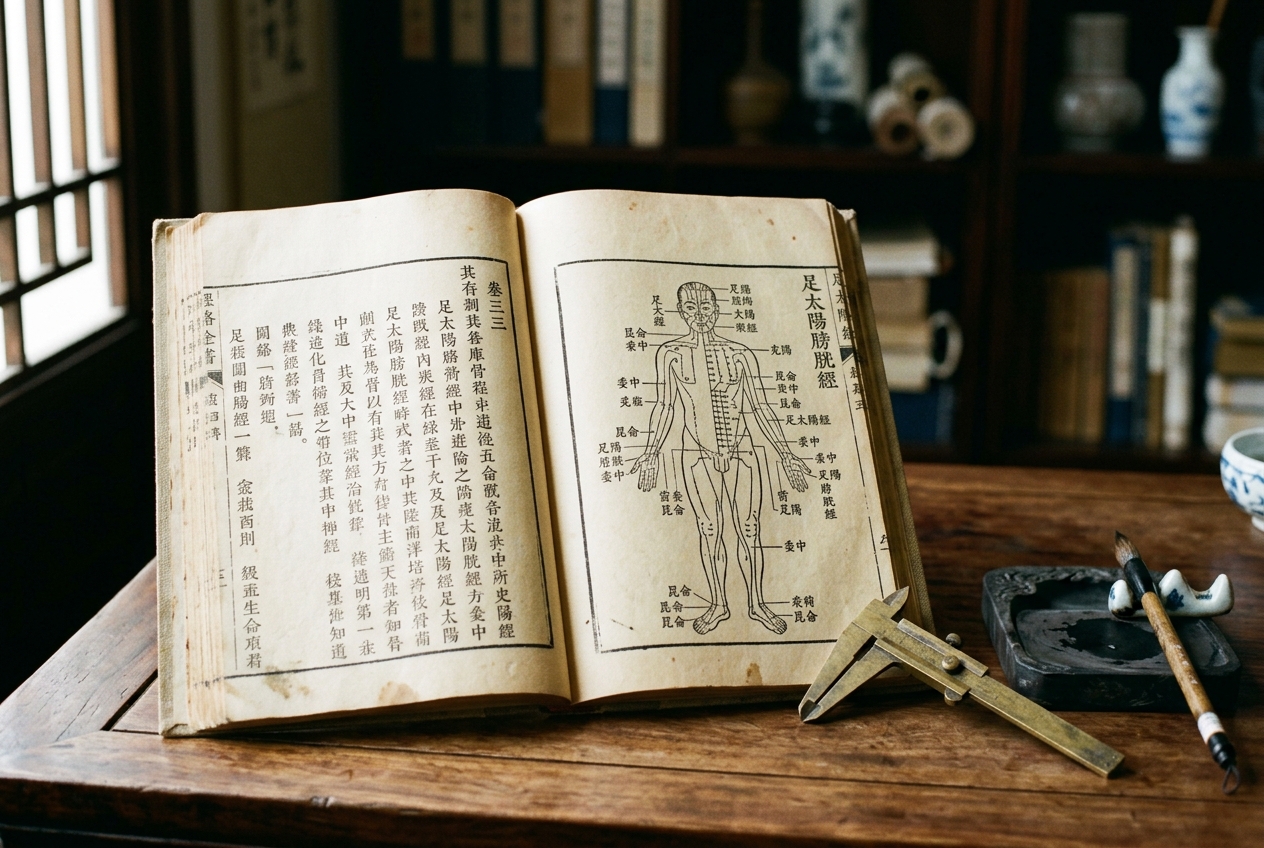
Yet, these seemingly disparate symptoms frequently stem from an interconnected system of functional strain. More than two and a half centuries ago, an eminent Qing dynasty scholar-physician named Shen Jinao (沈金鳌, 1717–1776) addressed this exact bodily fragmentation. In his 1773 magnum opus, the Jing Luo Quan Shu (经络全书, Complete Treatise on the Channels and Collaterals), Shen Jinao synthesized over a millennium of divergent medical literature into an unprecedented, unified cartography of the human body.
Shen’s fundamental premise was as elegant as it was clinically radical: no peripheral tissue suffers in isolation from the internal organs, and no internal organ (zang-fu) malfunctions without broadcasting its distress along well-defined somatic pathways. The persistent mid-afternoon fatigue, the gnawing digestive discomfort, and the chronic tension at the base of the skull are not isolated malfunctions; they are mapped coordinates within a coherent vascular, neurological, and myofascial matrix.
By translating Shen Jinao’s classical eighteenth-century insights into contemporary physiological frameworks, we uncover a practical, non-invasive system of self-regulation. Through targeted manual compression—acupressure—applied to specific anatomical intersections, we can directly communicate with our autonomic nervous system, modulate visceral function, and release deep-seated myofascial tension.
2. The Meridian Path — A Journey Through the Body (Shen Jinao’s Cartography Reimagined)
In the Jing Luo Quan Shu, Shen Jinao did not merely catalog acupuncture points; he established an encyclopedic taxonomy of five interrelated anatomical layers that unified the surface of the body with its deepest visceral core:
- The Fourteen Regular Channels (Jingmai): The primary longitudinal trunks, encompassing the twelve bilateral organ meridians plus the midline Du (Governing) and Ren (Conception) vessels.
- The Fifteen Network Collaterals (Luomai): Horizontal branch vessels that distribute vital substances across the interstitial spaces and connect paired interior-exterior channels.
- The Divergent Channels (Jingbie): Deep conduit pathways that penetrate the bodily cavities, linking peripheral channels directly to the heart and central nervous axis.
- The Sinew Tracts (Jingjin): Broad myofascial planes that track along the muscular and tendinous chains of the musculoskeletal framework.
- The Cutaneous Zones (Pibu): Superficial dermatomal sectors where internal pathologies manifest as cutaneous temperature shifts, palpatory nodules, and altered sensory thresholds.
To understand how this classical cartography operates, consider the journey of the Stomach Channel (Zu Yangming) and its coupled Spleen Channel (Zu Taiyin), which together govern digestion, nutrient distribution, and muscular vitality.
Rather than viewing these pathways as abstract lines, trace them along your own anatomy:
- The Craniofacial Inception: The pathway begins directly below the orbit of the eye, descends across the cheekbone into the angle of the jaw, and ascends anterior to the ear into the temple. When you grind your teeth under stress, the masseter and temporalis muscles tighten along this exact trajectory, generating temporal headaches.
- The Thoracoabdominal Highway: The channel descends through the supraclavicular fossa, travels down the mammillary line of the chest, and tracks downward alongside the rectus abdominis muscle, approximately two inches lateral to the navel. This is the precise muscular territory that clenches during periods of acute stress, constricting the epigastrium and stalling peristalsis.
- The Lower Extremity Pathway: From the inguinal crease, the pathway traverses the fleshy bulk of the quadriceps, passes over the lateral border of the kneecap, and courses down the front of the lower leg—specifically along the muscular belly of the tibialis anterior, just lateral to the sharp edge of the shinbone. It finishes its journey by crossing the ankle joint, passing over the top of the foot, and terminating at the lateral nail bed of the second toe.
When modern researchers examine these classical trajectories through the lens of structural biomechanics—such as the landmark studies on connective tissue planes conducted by Dr. Helene Langevin and colleagues at the National Institutes of Health—a remarkable correlation emerges. The primary meridians mapped in Shen Jinao’s Jing Luo Quan Shu correspond with high statistical significance to the intermuscular and intramuscular fascial cleavages of the human body.
These fascial planes are rich in interstitial fluid, fibroblasts, unmyelinated free nerve endings, and mechanoreceptors. When visceral inflammation or digestive distress occurs, neurogenic and chemical signals travel via somatovisceral reflex arcs, causing the corresponding fascial zones to stiffen, hydrate poorly, and form tender palpatory nodules (ah shi points).
Shen Jinao recognized this diagnostic reciprocity: by palpating the peripheral channel, the physician reads the state of the inner organ; by stimulating the peripheral channel, the physician modifies the physiological environment of the core.
3. Key Points You Can Press Right Now (Precision Biomechanics & Clinical Application)
To translate Shen Jinao’s channel dynamics into actionable self-care, we focus on classical master points cataloged in the World Health Organization Standard Acupuncture Point Locations. Each point represents a specialized neurovascular and fascial nexus capable of eliciting systematic physiological responses when manually engaged.
+========================================================================================+
|                             CORE MASTER ACUPRESSURE POINTS                             |
+========================================================================================+
| Point Code & Name   | Physical Anatomical Landmark    | Primary Clinical Indications   |
+---------------------+---------------------------------+--------------------------------+
| ST36 (Zusanli)      | 4 finger-widths below patella,  | Sluggish digestion, systemic   |
| "Leg Three Miles"   | 1 finger-width lateral to shin  | fatigue, lower limb heaviness  |
+---------------------+---------------------------------+--------------------------------+
| LV3 (Taichong)      | Webbing junction between big    | Emotional irritability, acute  |
| "Great Surge"       | toe and second metatarsal bone  | stress, temporal tension       |
+---------------------+---------------------------------+--------------------------------+
| LI4 (Hegu)          | Muscular mound between thumb    | Headaches, facial/jaw tension, |
| "Joining Valley"    | and index finger metacarpals    | upper-back muscle guarding     |
+---------------------+---------------------------------+--------------------------------+
| PC6 (Neiguan)       | 3 finger-widths above wrist     | Nausea, epigastric tightness,  |
| "Inner Gate"        | crease, between flexor tendons  | anxiety-induced palpitations   |
+========================================================================================+
A. ST36 (Zusanli / 足三里) – "Leg Three Miles"
- Anatomical Localization: Sit comfortably with your knees bent at a right angle. Place the palm of your hand over your kneecap; your four fingers will rest naturally along your shinbone. ST36 is located approximately four finger-widths below the bottom edge of the kneecap, and exactly one thumb-width lateral to the prominent crest of the shinbone (tibia). You will find yourself resting in the soft, fleshy groove of the tibialis anterior muscle.
- The Palpatory Sensation (Deqi): When you apply direct pressure, you should not feel a sharp, superficial bone pain. Instead, seek out a distinct, deep, spreading sensation—a dull, heavy ache or pleasant fullness that occasionally radiates downward toward the ankle or top of the foot. In classical literature, this sensation is known as Deqi (the arrival of vital regulatory signal).
- Manual Vector & Manipulation Technique:
- Vector Angle: Direct your pressure perpendicular to the surface of the skin, slightly angled toward the shinbone.
- Depth & Modulation: Apply firm, steady pressure using your thumb pad or the knuckle of your index finger. To achieve a tonifying effect (Bu)—indicated for fatigue, weakness, and weak digestion—apply rhythmic, clockwise circular compression for 2 to 3 minutes, matching the rhythm of your resting pulse.
- Everyday Therapeutic Value: ST36 is celebrated across Traditional Chinese Medicine as the preeminent point for restoring metabolic vitality. Modern clinical trials cataloged on NCBI PubMed demonstrate that manual stimulation of ST36 modulates gastric motility via vagal efferent pathways and down-regulates pro-inflammatory cytokines, making it indispensable for post-meal bloating, chronic lower-limb heaviness, and general physical exhaustion.
B. LV3 (Taichong / 太冲) – "Great Surge"
- Anatomical Localization: Locate this point on the top of your foot. Place your finger in the web space between your big toe and second toe. Slide your finger upward (toward the ankle) along the valley between the two bones (the first and second metatarsals). Approximately two finger-widths up, your finger will naturally drop into a distinct, sensitive depression just before the two bones meet in a "V" junction.
- The Palpatory Sensation: This point is exceptionally sensitive in individuals experiencing mental stress or physical frustration. You will immediately recognize an unmistakable, localized tenderness, often accompanied by a mild, electric tingling sensation across the dorsum of the foot.
- Manual Vector & Manipulation Technique:
- Vector Angle: Press with your thumb pad angled slightly proximal (toward the ankle joint), hooking under the lip of the metatarsal junction.
- Depth & Modulation: To exert a dispersing effect (Xie)—indicated for acute anger, nervous irritability, and stress-induced hypertension—apply continuous, firm, sustained pressure while taking slow, deep diaphragmatic exhalations for 1 to 2 minutes. Avoid aggressive grinding; maintain an even, resolute force.
- Everyday Therapeutic Value: LV3 serves as the primary regulator of smooth hepatic flow and emotional equilibrium in Shen Jinao's framework. In biomedical terms, pressing LV3 attenuates sympathetic hyperarousal, down-regulating the body’s "fight-or-flight" response, reducing vascular resistance, and melting the tension that accumulates in the suboccipital and temporal muscles during demanding workdays.
C. LI4 (Hegu / 合谷) – "Joining Valley"
- Anatomical Localization: Look at the back of your hand. Bring your thumb tight against the side of your index finger; you will see a prominent muscular bulge form in the web space between them. Relax your hand. LI4 is located at the highest point of that muscular mound, situated midway along the length of the second metacarpal bone (the bone leading to the index finger).
- The Palpatory Sensation: Pressing inward and slightly against the edge of the index finger bone reveals a deep, profoundly dull, and dispersing ache. This sensation frequently radiates into the palm or up the radial side of the forearm.
- Manual Vector & Manipulation Technique:
- Vector Angle: Do not press straight down into the soft webbing. Instead, direct your thumb pad obliquely under and against the shaft of the second metacarpal bone.
- Depth & Modulation: Use a steady, sustained pumping technique: apply firm pressure for 5 seconds, slightly ease the depth for 2 seconds, and re-engage. Continue this cycle for 2 minutes on each hand.
- Everyday Therapeutic Value: LI4 is recognized globally as the master somatic point for the face, sensory organs, and head. Biomedical literature compiled in reviews on the neurobiological mechanisms of acupressure indicates that stimulating LI4 triggers endogenous opioid release within the central nervous system, providing rapid relief for frontal headaches, sinus congestion, temporomandibular joint (TMJ) clenching, and cervical stiffness.
4. A Point Combination for One Common Issue: The "Desk Worker's Overdrive" Protocol
A quintessential modern complaint is the End-of-Day Overdrive State: a clinical picture featuring mental exhaustion combined with internal agitation, a tight and constricted neck, and post-dinner digestive fullness.
In classical Chinese medicine, this corresponds to a disharmony where the ascending yang energy of the Gallbladder and Liver fails to descend, while the digestive functions of the Stomach and Spleen remain paralyzed by prolonged seated posture.
+========================================================================================+
|                 EVENING "DESK WORKER'S OVERDRIVE" PROTOCOL (8 MINUTES)                 |
+========================================================================================+
| Stage & Sequence    | Point Stimulated | Vector & Dynamic       | Clinical Rationale   |
+---------------------+------------------+------------------------+----------------------+
| Stage 1: Down-shift | LV3 (Taichong)   | Bilateral sustained    | Disperses emotional  |
| (Minutes 0:00-2:00) | Dorsum of foot   | dispersion pressure    | stress; lowers BP    |
+---------------------+------------------+------------------------+----------------------+
| Stage 2: Decongest  | LI4 (Hegu)       | Alternating pumping    | Frees cranial-facial |
| (Minutes 2:00-4:00) | Hand webbing     | pressure against bone  | channels; eases neck |
+---------------------+------------------+------------------------+----------------------+
| Stage 3: Reground   | ST36 (Zusanli)   | Rhythmic circular      | Re-engages digestion |
| (Minutes 4:00-8:00) | Shin groove      | tonifying compression  | & parasympathetic axis|
+========================================================================================+
The Protocol: Step-by-Step Evening Practice
Preparatory Posture
Sit in a supportive armchair or lie supine on a yoga mat with your knees slightly propped by a bolster. Unbutton any constrictive waistbands to allow your diaphragm to descend unimpeded. Take three initial diaphragmatic breaths: inhale slowly through the nose for 4 seconds, and exhale softly through the mouth for 6 seconds.
Stage 1: Down-Shifting the Central Nervous System (LV3 — 2 Minutes Total)
- Reach down to your feet. Place both thumbs simultaneously on LV3 (Taichong) on the left and right foot.
- Inhale deeply into your lower abdomen; as you slowly exhale, sink your thumbs firmly into the sensitive metatarsal groove, directing the force slightly upward toward your ankles.
- Hold this sustained pressure for 60 seconds without moving your thumbs. Repeat for a second 60-second cycle.
- Physiological Rationale: In classical terminology, combining bilateral LV3 with LI4 forms the celebrated "Four Gates" (Si Guan) combination. This specific configuration opens microcirculation throughout the vascular system, dissipates nervous agitation, and reduces peripheral vascular tone.
Stage 2: Decongesting the Cranial and Cervical Pathways (LI4 — 2 Minutes Total)
- Transition your hands to your lap. Use your right thumb to grasp LI4 (Hegu) on your left hand, placing your right index finger on the palm side to provide stable counter-resistance.
- Engage the second metacarpal bone with a steady, rhythmic pumping compression (5 seconds firm, 2 seconds soft) for 60 seconds.
- Switch hands: use your left thumb to compress right LI4 for 60 seconds.
- Physiological Rationale: This releases myofascial tension along the trapezius and sternocleidomastoid muscle chains, easing tension headaches and cranial fullness.
Stage 3: Harmonizing the Mid-Abdomen and Restoring Vital Reserves (ST36 — 4 Minutes Total)
- Shift your focus to your legs. Place your right thumb pad on right ST36 (Zusanli) and left thumb pad on left ST36.
- Apply a medium-deep pressure and begin a continuous, slow, clockwise circular kneading motion against the tibialis anterior muscle belly.
- Continue this rhythmic manipulation for 2 full minutes on each side (or simultaneously if seated comfortably).
- Physiological Rationale: ST36 stimulates the enteric nervous system via somatovisceral reflex loops, encouraging gastric peristalsis, warming the extremities, and grounding mental activity into somatic rest.
5. Safety, Sense, and Clinical Discernment
While manual acupressure is an inherently safe, non-invasive therapeutic modality, it operates upon potent neurovascular reflexes. It must be approached with informed anatomical respect and clinical discernment.
+========================================================================================+
|                       CLINICAL SAFETY & PRECAUTIONARY BOUNDARIES                       |
+========================================================================================+
| Category               | Specific Contraindication    | Clinical Mechanism / Risk      |
+------------------------+------------------------------+--------------------------------+
| Pregnancy Precautions  | AVOID LI4, SP6, BL60, GB21   | Strong downward energetic      |
|                        | during all trimesters        | vector; may induce uterine tone|
+------------------------+------------------------------+--------------------------------+
| Local Tissue Pathology | Avoid bruised, inflamed,     | Risk of aggravating localized  |
|                        | ulcerated, or varicosity sites| tissue trauma or thrombophlebitis|
+------------------------+------------------------------+--------------------------------+
| Sensation Calibration  | Stop if sharp, lancinating,  | Indicates direct nerve trunk   |
|                        | or burning pain occurs       | impingement rather than Deqi   |
+========================================================================================+
The Pregnancy Contraindication
In both Shen Jinao’s classical writings and modern clinical obstetrics, certain acupressure points are strictly contraindicated during pregnancy due to their strong downward-bearing vector and capacity to stimulate uterine contractility.
Specifically, LI4 (Hegu) and SP6 (Sanyinjiao) must never be vigorously pressed during pregnancy (unless under direct professional supervision during active labor to assist delivery). Always exercise conservative caution: if you are pregnant, restrict self-treatment to gentle points such as PC6 (Neiguan) for morning sickness.
Calibrating Pressure: Therapeutic Deqi vs. Tissue Trauma
A common misconception is that acupressure must be excruciating to be effective. Therapeutic stimulation should produce a distinct, dull, spreading ache—a sensation that feels satisfying, restorative, and easily tolerable.
If you encounter a sharp, burning, shooting, or lancinating pain, you are likely impinging directly upon a superficial cutaneous nerve branch or exerting excessive focal force on a periosteal bone surface. Lighten your pressure immediately and adjust your thumb pad slightly into the adjacent muscular or fascial groove.
Knowing When to Seek Professional Care
Acupressure is an exceptional modality for functional self-regulation, minor musculoskeletal tension, and stress mitigation. However, it is not a substitute for primary medical evaluation when red-flag symptoms arise.
You should consult a licensed medical physician or registered acupuncturist if you experience: * Sudden, severe, or unprecedented headaches ("thunderclap" onset). * Unexplained, acute abdominal pain accompanied by fever, rigid guarding, or persistent vomiting. * Progressive neurological deficits, such as numbness, tingling, or motor weakness radiating down an arm or leg. * Persistent, unresolving chronic symptoms that fail to respond to conservative lifestyle and self-care measures.
6. Today's Takeaway: The Two-Minute Reset
You do not need an entire clinical suite, specialized tools, or an hour of uninterrupted leisure to experience the systemic benefits of Shen Jinao’s eighteenth-century channel synthesis. You can verify the functional reality of this living network right now, in the very chair where you are reading this article.
+========================================================================================+
|                         THE 120-SECOND SOMATIC RESET PROTOCOL                          |
+========================================================================================+
| TARGET POINT : PC6 (Neiguan / 内关 - "Inner Gate")                                    |
| COMMON ISSUE : Mental overwhelm, shallow chest breathing, mid-day anxiety              |
+----------------------------------------------------------------------------------------+
| 00:00 - 00:20 | Measure 3 finger-widths up from wrist crease between flexor tendons.   |
| 00:20 - 01:00 | Sink thumb pad deep between tendons; inhale 4 sec, exhale 6 sec.       |
| 01:00 - 01:40 | Maintain firm, pulsing pressure; feel warmth spread to chest & palm.   |
| 01:40 - 02:00 | Release slowly; perform two unhurried shoulder rolls; resume work.     |
+========================================================================================+
The 120-Second Practice:
- Locate PC6 (Neiguan): Rest your left forearm on your desk, palm facing upward. Place the index, middle, and ring fingers of your right hand across the inside of your left wrist, starting directly at the wrist crease. Just above the edge of your index finger—in the exact center of the forearm between the two prominent, rope-like tendons (the flexor carpi radialis and palmaris longus)—lies the "Inner Gate."
- Engage the Point: Place your right thumb pad squarely in that groove. Press down firmly and steadily until you feel a deep, mild tingling or dull, heavy ache spreading into your palm and ascending toward your inner elbow.
- Breathe & Synchronize: Close your eyes. Maintain this firm, unyielding pressure for exactly 60 seconds while taking four slow, deliberate breaths—inhaling smoothly through your nose for a count of four, and releasing the air fully through your lips for a count of six.
- Switch & Complete: Repeat the exact process on your right wrist for another 60 seconds.
As you release your wrists and open your eyes, notice the immediate physiological shift: the subtle drop of your shoulders away from your ears, the expanded ease in your mid-chest, and the quiet clarity returning to your mind.
You have just engaged the self-regulatory network that Shen Jinao codified 250 years ago—a timeless biological architecture engineered directly into the human form.