Zhen Jiu Jia Yi Jing: Navigating Huangfu Mi's Foundational Channel Cartography, Classical Point Topography, and Precision Acupressure Protocols
If you have ever spent the late hours of a Tuesday seated before a glowing monitor, conscious of a persistent, iron-hard band tightening across your occipital ridge and shoulders; if you have ever finished an evening meal only to feel a dense, stagnant swelling beneath your ribcage alongside an ambient hum of mental fatigue; or if you lie awake at 2:00 AM with a racing pulse despite physical exhaustion—you are directly experiencing dysregulation across the somatic and visceral corridors mapped out seventeen centuries ago.
In contemporary clinical terms, we describe these daily afflictions as chronic sympathetic nervous system overdrive, tension-type headaches, functional dyspepsia, and disruption of the circadian autonomic axis. Yet long before the advent of autonomic neuroscience or high-resolution myofascial imaging, classical scholars of Chinese medicine recognized that the interior organs and the exterior periphery of the human body communicate through an intricate, continuous topographical matrix.
+-----------------------------------------------------------------------------------------+
|                                    AT A GLANCE                                          |
|                                                                                         |
|  * The Text: Zhen Jiu Jia Yi Jing (282 CE) by scholar-physician Huangfu Mi.             |
|  * The Scope: 12 volumes, 128 chapters, systematically standardizing 349 acupoints.     |
|  * Modern Mechanism: Intermuscular fascial planes, neurovascular bundles, mechanotrans- |
|    duction, and purinergic signaling (adenosine release).                               |
|  * Application: Non-invasive, manual acupressure protocols to restore visceral balance. |
+-----------------------------------------------------------------------------------------+
Modern life frequently leaves us feeling disembodied—alienated from the subtle neurosomatic signals our bodies emit until they erupt into outright pathology. Traditional Chinese Medicine (TCM), anchored by its foundational literature, offers not a mystical abstraction, but a remarkably precise, somatic manual for self-regulation. By understanding the historical architecture of this meridian system and applying rhythmic, targeted pressure to specific anatomical sites, we can consciously stimulate neurochemical pathways that alleviate visceral tension, soften muscular rigidity, and restore systemic equilibrium.
1. HISTORICAL GENESIS & TEXTUAL ARCHITECTURE OF THE JIA YI JING
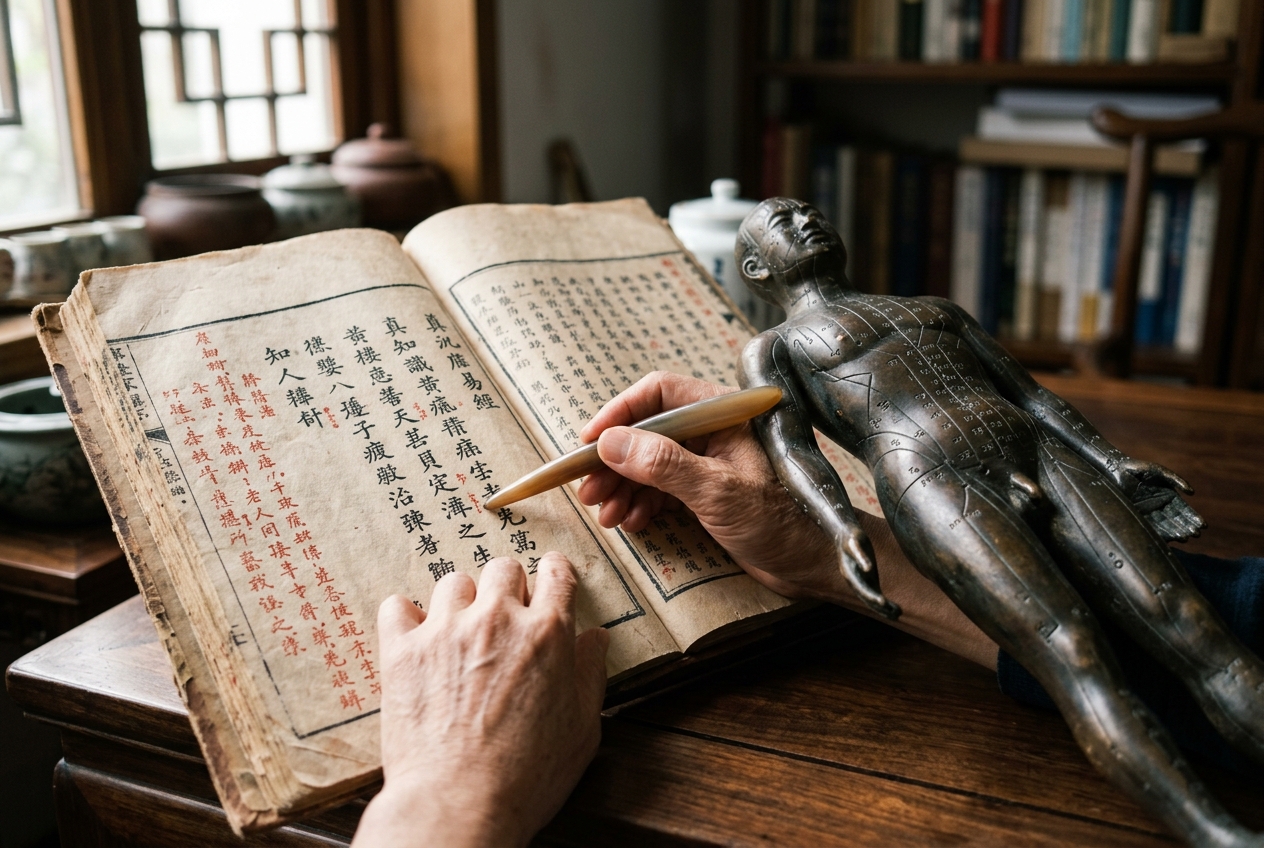
To comprehend the structural logic of meridian pathways and acupressure points, one must return to the late Han and Western Jin dynasties—a period of profound sociopolitical turbulence and intellectual consolidation. In the year 282 CE, the scholar-physician Huangfu Mi (215–282 CE), having himself suffered from debilitating hemiplegia and chronic arthritic illness, compiled the seminal text Zhen Jiu Jia Yi Jing (The Systematic Classic of Acupuncture and Moxibustion).
                            THE GENEALOGY OF JIA YI JING

    +-------------------------+            +--------------------------+
    |      HUANGDI NEIJING    |            |   MINGTANG KONGXUE       |
    |  * Suwen (Basic Theory) |            |   ZHENJIU ZHIYAO         |
    |  * Lingshu (Spiritual   |            |   (Lost Bright Hall      |
    |    Pivot: Point Loci)   |            |    Point Manual)         |
    +------------+------------+            +------------+-------------+
                 |                                      |
                 +------------------+-------------------+
                                    |
                                    v
                     +------------------------------+
                     |    ZHEN JIU JIA YI JING      |
                     |      (Huangfu Mi, 282 CE)    |
                     |  * 12 Volumes, 128 Chapters  |
                     |  * 349 Canonical Points      |
                     |  * Proportional Cun Metrics  |
                     |  * Tissue Stratification     |
                     +------------------------------+
Prior to Huangfu Mi’s monumental intervention, acupuncture theory was dispersed across disparate, sometimes contradictory manuscripts. Medical knowledge was primarily preserved within two distinct lineages: the philosophical, pathophysiological discourses of the Huangdi Neijing (comprising the Suwen or "Basic Questions" and the Lingshu or "Spiritual Pivot") and the purely topographical, point-location records found in the now-lost Mingtang Kongxue Zhenjiu Zhiyao ("Bright Hall Fundamentals of Acupoints and Moxibustion").
Huangfu Mi recognized that practitioners lacked an integrated, rigorously organized manual. In response, he crafted an architectural masterpiece structured into 12 volumes and 128 chapters, organizing what would become the canonical standard of 349 classical acupoint loci (comprising 300 bilateral paired points and 49 unilateral midline points) distributed along the twelve primary meridians (Jingmai) and the two extraordinary midline vessels: the Ren Mai (Conception Vessel) and Du Mai (Governing Vessel).
The organizational genius of the Jia Yi Jing rests on its dual epistemological matrix:
- Visceral-Pathological Classification (Volumes 1–6): Huangfu Mi mapped physiological functions, Zang-Fu (organ network) interactions, diagnostic pulses, and etiology.
- Regional Somatosensory Mapping (Volumes 7–12): Points were cataloged strictly by regional anatomy—progressing logically from the cranium, sensory orifices, thorax, and hypochondrium, down to the abdominal cavity, spine, and distal extremities.
Crucially, the Jia Yi Jing established the standardized method of proportional anatomical measurement (Cun) and codified the precise tissue depth stratification for every point. Huangfu Mi carefully noted whether a locus required superficial manipulation within the epidermal-dermal boundary or deep engagement through the dense muscular fascia, warning explicitly against the catastrophic puncture of deep neurovascular trunks or visceral cavities. This rigorous text served as the foundational curriculum for imperial medical education across China, Korea, and Japan for more than a millennium, and its geographic coordinate system forms the core of the World Health Organization Standard Acupuncture Point Locations.
2. THE MERIDIAN PATHWAYS: A JOURNEY THROUGH THE EMBODIED TERRAIN
To navigate this ancient map, we must demystify its terminology. In the classical Chinese worldview, a meridian (Jingluo) is not an isolated, impermeable tube like a plastic water pipe; rather, it is a dynamic, functional corridor of communication, fluid movement, and electrical coherence coursing through the continuous connective tissue matrix of the living body.
                                  MACRO-PATHWAYS OF QI

     [ LUNG / HEART / PERICARDIUM ]                 [ LARGE INTESTINE / TRIPLE ENERGIZER ]
         Anterior/Medial Arm                            Posterior/Lateral Arm
                  |                                               ^
                  | (Descending)                                  | (Ascending)
                  v                                               |
           [ CHEST / ABDOMEN ]                            [ SENSORY ORIFICES / HEAD ]
                  |                                               ^
                  | (Descending)                                  | (Ascending)
                  v                                               |
       [ STOMACH / BLADDER / GB ]                    [ SPLEEN / KIDNEY / LIVER ]
         Anterior/Lateral Leg                           Medial/Posterior Leg
Rather than visualizing these lines as abstract concepts, trace their journeys across the physical landmarks of your own anatomy:
The Anterior Descending Corridor: The Stomach Meridian (Foot Yangming)
Begin just beneath your eye, at the lower orbital ridge. The pathway drops through the muscles of mastication at the angle of the jaw, descends the muscular column of the throat, and runs vertically down the front of the ribcage and abdomen—approximately four finger-widths lateral to the midline. Continuing downward, it traverses the anterior hip crease, travels down the thick belly of the quadriceps, crosses the kneecap, and courses along the muscular ridge on the outer side of your shinbone—the exact fleshy expanse that aches after an uphill hike—before terminating at the lateral tip of the second toe. This is the master pathway of digestive assimilation, physical endurance, and systemic grounding.
The Medial Ascending Corridor: The Spleen Meridian (Foot Taiyin)
Originating at the inner corner of the big toenail, this pathway runs along the soft arch of the inner foot, passes directly behind the prominent inner ankle bone, and climbs the smooth inner surface of the calf behind the shinbone. It rises past the inner seam of the knee, sweeps up the inner thigh, enters the lower abdomen, and branches through the digestive viscera before terminating on the lateral chest wall beneath the axilla. It governs lymphatic transport, fluid metabolism, and structural integrity.
The Palmar Neurovascular Corridor: The Pericardium Meridian (Hand Jueyin)
Starting deep within the pericardial sac of the thorax, this pathway emerges at the lateral chest wall, sweeps over the anterior shoulder, and descends the dead center of the inner arm. It passes directly between the two prominent, cord-like tendons of the forearm (the flexor carpi radialis and palmaris longus), traverses the center of the palm, and concludes at the tip of the middle finger. This pathway is the primary regulator of emotional equilibrium, vascular tone, and cardiac autonomic balance.
3. MODERN BIOPHYSICAL & NEUROFASCIAL CORRELATIONS
For decades, modern biomedical science struggled to reconcile classical meridian topographies with gross human anatomy, searching in vain for discrete, microscopic "meridian walls." However, contemporary developments in fascial biology, biomechanics, and neurophysiology have revealed a striking convergence between classical descriptions and modern histological realities.
+-----------------------------------------------------------------------------------------+
|                              THE FASCIAL-NEURAL INTERFACE                               |
|                                                                                         |
|      Manual Pressure Applied to Cutaneous & Subcutaneous Layers                         |
|                                 |                                                       |
|                                 v                                                       |
|      Mechanical Deformation of Intermuscular Connective Tissue                          |
|      (Fascial Planes, Perivascular/Perineural Sheaths)                                  |
|                                 |                                                       |
|                                 v                                                       |
|      Mechanotransduction & Local Cellular Signaling:                                    |
|      * Interstitial Adenosine Release (Potent Anti-Nociception)                         |
|      * Nitric Oxide Synthesis (Microvascular Vasodilation)                              |
|                                 |                                                       |
|                                 v                                                       |
|      Sensory Afferent Activation (A-delta & C Fibers) -> Spinal Dorsal Horn             |
|                                 |                                                       |
|                                 v                                                       |
|      Central Nervous System Modulation: Somato-Visceral Autonomic Reflexes              |
|      * Downregulation of Sympathetic Tone                                               |
|      * Upregulation of Vagal/Parasympathetic Visceral Motility                          |
+-----------------------------------------------------------------------------------------+
Groundbreaking research pioneered by anatomist Dr. Helene Langevin and colleagues demonstrates that classical acupoint loci and meridian tracks exhibit an over 80% statistical correlation with intermuscular and intramuscular connective tissue cleavage planes. When an acupoint is stimulated—whether through a needle or focused manual compression—the mechanical force stretches the local subcutaneous collagen and extracellular matrix. This process, known as mechanotransduction, triggers a cascade of cellular events:
- Purinergic Signaling & Pain Attenuation: Mechanical deformation of interstitial fibroblasts stimulates the rapid, local secretion of adenosine, a potent endogenous neuromodulator that binds to local A1 adenosine receptors on sensory nerve terminals, suppressing pain signals to the brain.
- Microvascular Vasodilation via Nitric Oxide: Precise manual compression stimulates local endothelial cells to produce nitric oxide, creating sustained microvascular dilation, reducing localized ischemia, and accelerating metabolic clearance.
- Bioelectrical Conductance: Biophysical evaluations reveal that classical acupoints correspond to zones of significantly lowered electrical impedance and heightened electrical conductivity compared to surrounding non-point tissue, confirming that meridians act as low-resistance bioelectrical transmission highways.
- Somato-Visceral Reflex Arcs: Distal acupoints on the limbs (such as ST36 or PC6) are richly innervated by peripheral nerve branches sharing spinal segments with visceral organs. Stimulating these distal somatosensory fibers triggers spinal and vagal reflex loops, modulating gastric motility, cardiac rhythm, and inflammatory cytokines across distant internal organs.
4. FIVE CANONICAL POINTS: TOPOGRAPHY, ENERGETICS & APPLICATION
The Jia Yi Jing codifies hundreds of points, but five foundational loci stand out for their clinical versatility. These points are readily accessible and highly responsive to non-invasive manual pressure.
+----------------------------------------------------------------------------------------+
|                                THE FIVE CANONICAL POINTS                               |
|                                                                                        |
|   1. ST36 (Zusanli)      - Leg Three Miles      - Vitality, Digestion, Immunity        |
|   2. LI4 (Hegu)          - Joining Valleys      - Head, Neck, Analgesia, Decongestion  |
|   3. SP6 (Sanyinjiao)    - Three Yin Crossing   - Pelvic Health, Fluid Balance, Sleep  |
|   4. PC6 (Neiguan)       - Inner Gate           - Nausea, Anxiety, Cardiac Regulation  |
|   5. LV3 (Taichong)      - Great Rushing        - Stress Relief, Headaches, Liver Qi   |
+----------------------------------------------------------------------------------------+
1. Stomach 36 (Zusanli – "Leg Three Miles")
                 ST36 (Zusanli) - LATERAL LOWER LEG

                 [ Patella / Kneecap ]
                          |
                 (Four Finger-Widths Below)
                          |
             [ Tibial Ridge ] ---> [ ST36 ] (In the fleshy muscle groove)
- Classical Energetics: The supreme tonification point of the body; fortifies Spleen and Stomach Qi, nourishes Blood, calms the mind (Shen), and dispels fatigue.
- Embodied Location: Sit with your knee bent at a right angle. Place the four fingers of your hand horizontally across your shin, directly beneath the base of your kneecap. ST36 lies four finger-widths below the kneecap, precisely one finger-width outward (lateral) from the sharp, bony crest of your shinbone, in the soft dip of the tibialis anterior muscle.
- Somatosensory Marker: When properly engaged, you will experience a distinctive, dull, spreading ache, accompanied by a subtle downward sensation toward the foot. This deep, non-sharp sensation is the classical De Qi phenomenon.
- Application Protocol: Use your thumb or the knuckle of your index finger. Apply a firm, perpendicular downward vector. Maintain sustained, circular micro-kneading for 2 to 3 minutes. Employ a steady, rhythmic, nourishing pressure (Tonification / Bu).
- Clinical Indications: Acute and chronic indigestion, post-prandial bloating, profound systemic exhaustion, brain fog, and lower limb weakness.
2. Large Intestine 4 (Hegu – "Joining Valleys")
                 LI4 (Hegu) - DORSAL HAND

                 [ Index Finger Metacarpal ]
                            \
                             \  <--- [ LI4 ] (Peak of the muscle web)
                              \
                 [ Thumb Metacarpal ]
- Classical Energetics: Master point for all disorders of the head, face, sensory orifices, and neck; releases exterior wind, regulates defensive energy (Wei Qi), and provides powerful systemic analgesia.
- Embodied Location: Look at the back of your hand. Bring your thumb and index finger tight together; notice the small fleshy mound of muscle that bulges upward between their bones. Now relax your hand. LI4 is located at the absolute peak of that muscular webbing, nestled against the midpoint of the long index finger bone (the second metacarpal).
- Somatosensory Marker: Highly reactive; yields an immediate, intensely deep, radiating ache that may track slightly along the forearm.
- Application Protocol: Anchor your index finger on the palm side of the hand and press your thumb tip firmly into the back of the web, angling your pressure toward the bone of the index finger, not out into the soft tissue. Apply dynamic, pumping pressure with gentle circular dispersals for 1 to 2 minutes per hand (Sedation / Xie).
- Clinical Indications: Frontal and tension headaches, jaw clenching, sinusitis, acute cervical stiffness, ocular fatigue, and ambient stress.
- Crucial Safety Precaution: Contraindicated during pregnancy due to its potent descending energetic action.
3. Spleen 6 (Sanyinjiao – "Three Yin Intersection")
                 SP6 (Sanyinjiao) - MEDIAL LOWER LEG

                      [ Inner Calf Surface ]
                                |
                     (Four Finger-Widths Above)
                                |
                 [ Inner Ankle Bone (Malleolus) ]
                                |
                  [ SP6 ] (Just behind the bone edge)
- Classical Energetics: The grand anatomical junction where the Spleen, Kidney, and Liver channels intersect. Harmonizes the lower abdomen, enriches Yin, cools and invigorates Blood, regulates menses, and grounds racing thoughts.
- Embodied Location: Rest the inner side of your ankle flat. Place four fingers horizontally above the highest prominent peak of your inner ankle bone. SP6 is located four finger-widths directly above that bony tip, tucked right behind the posterior edge of the shinbone in a tender, shallow groove.
- Somatosensory Marker: A pronounced, tender soreness, often described as a bruised or tingling sensation upon initial contact.
- Application Protocol: Apply direct, slow, steadily intensifying perpendicular pressure with the pad of your thumb. Hold steadily for 2 to 3 minutes, breathing slowly into your lower abdomen.
- Clinical Indications: Insomnia, pelvic and menstrual cramping, restless legs, abdominal distension, emotional irritability, and fluid retention.
- Crucial Safety Precaution: Strictly contraindicated during pregnancy.
4. Pericardium 6 (Neiguan – "Inner Gate")
                 PC6 (Neiguan) - INNER FOREARM

                   [ Flexor Tendons ]
                   |      [PC6]     |
                   |        |       |
                 (Three Finger-Widths Up)
                            |
                   [ Wrist Flexure Crease ]
- Classical Energetics: Opens the chest, harmonizes the middle burner, unbinds epigastric fullness, calms the Shen (spirit), and arrests counterflow Qi (nausea/vomiting).
- Embodied Location: Turn your palm upward. Lay three fingers of your opposite hand across the inside of your wrist, starting directly from the main wrist crease. PC6 lies three finger-widths up the forearm, precisely centered between the two prominent, rope-like tendons that stand out when you make a fist and flex your wrist forward.
- Somatosensory Marker: A deep, electric, slightly numbing or tingly sensation that radiates into the palm and middle finger.
- Application Protocol: Press your thumb pad deeply between the two tendons at a 90-degree angle. Apply continuous, moderately firm, undulating pressure for 2 to 3 minutes, coordinating your pressure with slow, deep diaphragmatic exhalations.
- Clinical Indications: Motion sickness, post-operative or stress-induced nausea, gastroesophageal reflux, heart palpitations, panic sensations, and chest tightness.
5. Liver 3 (Taichong – "Great Rushing")
                 LV3 (Taichong) - DORSAL FOOT

                 [ Big Toe ]        [ 2nd Toe ]
                      \                  /
                       \                /
                        \   [ LV3 ]    /  <--- (In the valley before the bones join)
                         \            /
                          [ Joint Base ]
- Classical Energetics: The premier Shu-Stream and Yuan-Source point of the Liver meridian. Spreads Liver Qi, pacifies ascending Liver Yang, clears the eyes, subdues internal wind, and unblocks somatic stagnation.
- Embodied Location: On the top of your bare foot, place your finger in the webbed valley between the big toe and the second toe. Slide your finger backward along the groove toward your ankle for about two finger-widths, until your finger drops into a distinct, soft depression immediately before the junction where the two metatarsal bones meet.
- Somatosensory Marker: Exceptional sensitivity; produces a sharp, localized ache that quickly softens into an expansive, releasing sensation across the foot.
- Application Protocol: Use your thumb tip to press firmly into the bony depression, angling slightly toward the second toe. Employ an oscillating, dispersing circular motion for 2 minutes per side.
- Clinical Indications: Irritability, stress headaches radiating to the temples/vertex, muscular twitching, eye strain, hypertension, and emotional frustration.
5. THE EVENING AUTONOMIC RESET: A FIVE-STEP PROTOCOL
When the modern nervous system is chronically overwhelmed, traditional theory diagnoses an imbalance of Qi Stagnation turning to Internal Heat, paired with Spleen Qi Deficiency. The following evidence-informed routine integrates the classical principle of pairing distal source points with central regulatory points, systematically guiding the body out of sympathetic hyperarousal and into deep parasympathetic restoration.
+-----------------------------------------------------------------------------------------+
|                         EVENING SOMATO-VISCERAL RESET PROTOCOL                          |
|                                                                                         |
|   Step 1: Open the "Four Gates" (LI4 + LV3)             [ 4 Minutes Total ]             |
|           * Liberates stagnant circulation; dissolves mental tension.                   |
|                                                                                         |
|   Step 2: Balance the Middle Jiao (PC6 -> ST36)         [ 5 Minutes Total ]             |
|           * Settles digestive counterflow; downregulates cardiac excitability.          |
|                                                                                         |
|   Step 3: Ground the Yin Matrix (SP6)                   [ 3 Minutes Total ]             |
|           * Anchors ascending energy; prepares body for restorative sleep.              |
+-----------------------------------------------------------------------------------------+
The Step-by-Step Sequence
Step 1: Open the "Four Gates" (Si Guan – LI4 + LV3)
- Duration: 2 minutes per point pair (4 minutes total).
- Posture: Reclined or seated comfortably in a quiet room with uncrossed legs.
- Execution: Begin by stimulating LI4 on both hands to initiate systemic analgesia and clear craniofacial tension. Follow immediately with LV3 on both feet to draw hyperactive mental energy downward. This classical pairing acts as an autonomic circuit breaker, clearing neurovascular constriction and emotional tension.
Step 2: Unbind the Chest and Regulate Digestion (PC6 $\rightarrow$ ST36)
- Duration: 2 minutes on PC6, followed by 3 minutes on ST36.
- Posture: Seated or supported in a semi-reclined position.
- Execution: Press PC6 on your left forearm while taking five long, measured diaphragmatic breaths (inhale for 4 seconds, exhale for 6 seconds). Switch arms. Next, move down to ST36 on both legs. Apply firm, circular, clockwise thumb kneading. This specific sequence links the cardiac and enteric nervous systems, easing gastrointestinal bloating while softening baseline anxiety.
Step 3: Anchor the System and Induce Sedation (SP6)
- Duration: 1.5 minutes per leg (3 minutes total).
- Posture: Lying comfortably on your back, knees slightly elevated over a pillow.
- Execution: Locate SP6 on your inner calves. Apply smooth, sustained, warm thumb pressure without vigorous rubbing. Close your eyes and direct your attention toward the contact point. As you release the pressure, remain still for 60 seconds to allow the calming, parasympathetic rebound to settle through your nervous system.
6. SAFETY, CONTRAINDICATIONS & SENSORY CALIBRATION
Acupressure is fundamentally non-invasive, yet because it stimulates potent physiological reflexes, it requires mindful, informed practice.
+---------------------------------------------------------------------------------------+
|                                SAFETY CHECKLIST & RED LINES                           |
|                                                                                       |
|  * Pregnancy Warning: Strictly avoid LI4, SP6, and deep abdominal points.             |
|  * Calibrate Pressure: Seek De Qi (deep ache/warmth), never sharp, piercing pain.     |
|  * Anatomical Contraindications: Never press open wounds, bruises, or varicose veins. |
|  * Clinical Red Flags: Seek emergency care for chest pain, sudden thunderclap         |
|    headaches, unexplained neurological deficits, or acute severe abdominal rigidity.  |
+---------------------------------------------------------------------------------------+
Calibrating Your Pressure
Self-applied acupressure should never involve agonizing, sharp, or bruising force. The gold standard of manual stimulation is the elicitation of De Qi: a characteristic sensation described as a dull, heavy, spreading ache, deep warmth, or subtle localized distension.
Use the pad of your thumb, the flat surface of your knuckle, or the palm of your hand—never sharp fingernails. Begin with light contact, gradually increasing pressure over 10 to 15 seconds until you reach a depth of comfortable firmness (roughly a 5 or 6 on a 10-point intensity scale). Maintain that depth, and always release slowly.
Critical Contraindications
- Pregnancy: As codified in the Jia Yi Jing, strong downward-bearing points—specifically LI4 (Hegu), SP6 (Sanyinjiao), GB21 (Jianjing), and BL60 (Kunlun), alongside all deep lower-abdominal and sacral points—can stimulate uterine contractility and must be strictly avoided throughout pregnancy.
- Local Tissue Damage: Never apply pressure over open wounds, burns, localized rashes, active infections, skin lesions, bone fractures, or inflamed varicose veins.
- Thromboembolic Risk: Individuals with diagnosed deep vein thrombosis (DVT), severe peripheral vascular disease, or advanced atherosclerosis should avoid deep pressure on the lower extremities.
Knowing When to Seek Medical Attention
Self-applied acupressure is an empowering tool for functional maintenance and symptom relief, but it is not a substitute for emergency or specialized medical diagnosis. If you experience sudden "thunderclap" headaches, crushing substernal chest pain radiating to the jaw or arm, acute abdominal rigidity with high fever, unexplained numbness, or progressive motor weakness, bypass home protocols and seek immediate medical evaluation.
7. TODAY'S TWO-MINUTE TAKEAWAY
You do not need an hour of free time or specialized tools to begin using this system. You can reset your nervous system right now, at your desk, before closing this window.
                    YOUR TWO-MINUTE CRANIOFACIAL DE-STRESS

      [ Step 1: Rest Left Forearm Flat on Your Desk ]
                             |
      [ Step 2: Grasp Web of Left Hand with Right Thumb & Forefinger ]
                             |
      [ Step 3: Find LI4 Against the Midpoint of Index Finger Bone ]
                             |
      [ Step 4: Apply Deep, Circular Pressure for 60 Seconds ]
                             |
      [ Step 5: Switch Hands and Repeat for 60 Seconds ]
- The Issue: Midday mental fatigue, screen-induced eye strain, and clenching tension in the temples, jaw, and neck.
- The Locus: Large Intestine 4 (Hegu).
- The 120-Second Practice: * Rest your left forearm flat on your desk and relax your left hand. * Take your right thumb and place it on the top web of your left hand, curling your right index finger underneath to support the palm. * Slide your thumb tip snugly against the bone that runs from your wrist to your index finger. When you find that distinct, tender, aching sweet spot, apply firm, slow, circular pressure. * Inhale deeply through your nose for a count of four, drop your shoulders away from your ears, and exhale slowly through slightly parted lips for a count of six. * Maintain this rhythmic circular pressure for 60 seconds. * Switch hands and repeat the exact process on your right hand for 60 seconds.
Notice how the muscles around your temples, forehead, and jaw soften. What you have just performed is an ancient physiological reset: a small, deliberate act of embodied care standardized 1,700 years ago by Huangfu Mi, preserved across generations, and fully validated by modern human biology.
Authoritative References & Further Reading
- Huangfu Mi and the History of Chinese Medicine – Detailed biographical and textual history of the compiler of the Zhen Jiu Jia Yi Jing.
- World Health Organization (WHO): Standard Acupuncture Point Locations in the Western Pacific Region – The international anatomical standard for classical point topographies.
- National Center for Biotechnology Information (NCBI): Neurobiological Mechanisms of Acupuncture and Acupressure – Peer-reviewed review examining neurofascial pathways and central nervous system processing.
- Relationship of Acupuncture Points and Meridians to Connective Tissue Planes (Langevin et al., Anat Rec, 2002) – Landmark study establishing the anatomical correlation between meridians and intermuscular cleavage planes.
- Adenosine A1 Receptors Mediate Local Anti-Nociceptive Effects of Acupuncture (Goldman et al., Nature Neuroscience, 2010) – Mechanistic breakthrough demonstrating purinergic signaling and local pain modulation.
- Acupuncture Point Topography and Scientific Basis (Wikipedia) – Comprehensive structural and historical overview of the acupoint matrix.