Huangdi Mingtang Jing: Navigating Classical Hall of Light Cartography, Primary Point Topography, and Precision Acupressure Protocols
1. OPENING — A PROBLEM THIS SOLVES TODAY
If you have spent the latter half of this afternoon slumped before a glowing monitor, carrying a dull, vise-like band of tension across your temples, a persistent knot between your shoulder blades, and a sluggish, distended sensation in your upper abdomen, you are experiencing a thoroughly modern pathology with an ancient somatic geography. In contemporary ergonomics and neurology, we speak of postural fatigue, sustained sympathetic tone, and myofascial trigger irritation. Yet two thousand years ago, Chinese imperial physicians observed this exact constellation of somatic collapse and mapped it with architectural precision.
To live in a human body is to occupy a continuous, responsive matrix of tension and flow. When mental strain anchors itself in the trapezius muscles, digestion halts; when emotional irritability constricts the ribcage, the breath turns shallow and sleep fractures. Traditional Chinese Medicine (TCM) does not treat these as isolated complaints scattered across disparate medical specialties. Instead, it views them as predictable disturbances across dynamic anatomical corridors known as jingmai (meridian channels).
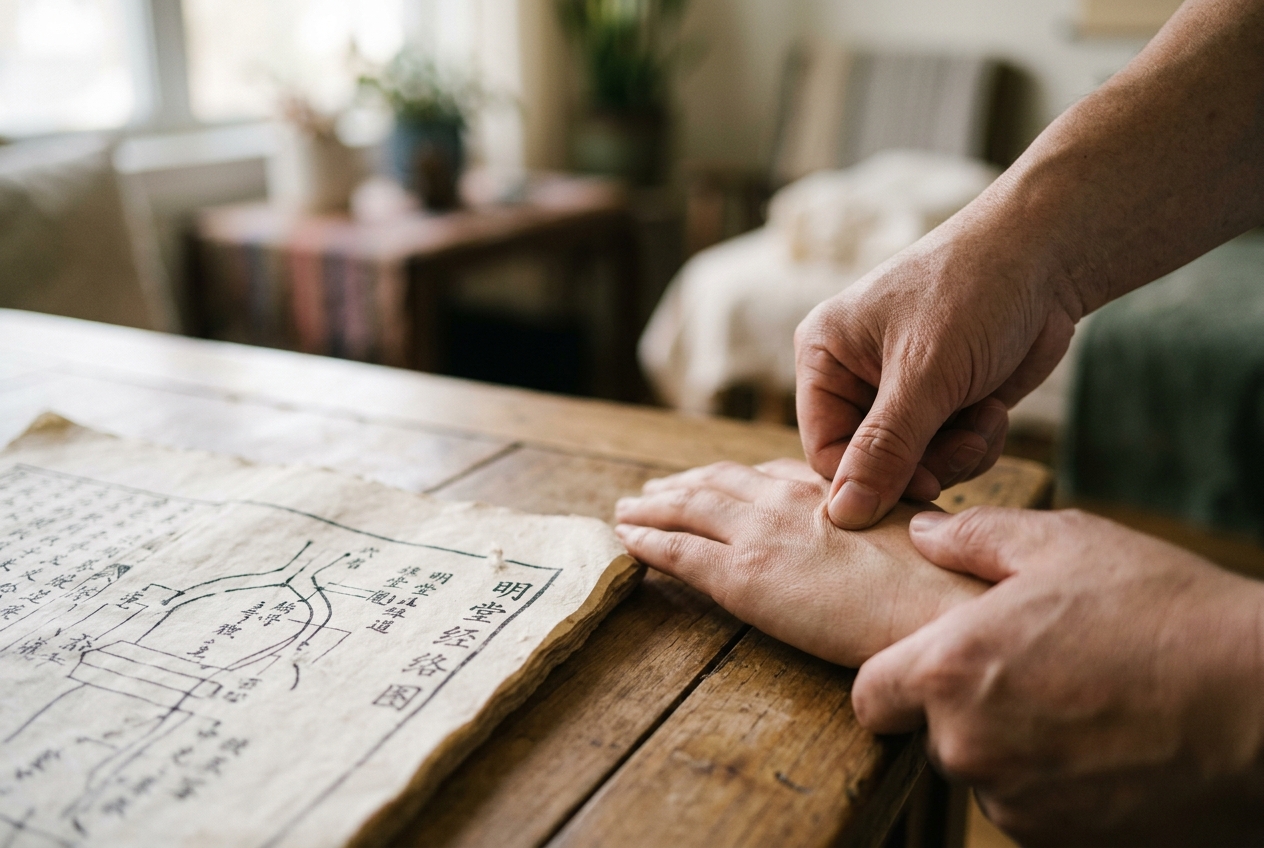
The foundational locus classicus for this spatial understanding is the Huangdi Mingtang Jing (黃帝明堂經, The Yellow Emperor’s Hall of Light Classic). Composed during the Western and Eastern Han dynasties, the Mingtang tradition represents China’s earliest systematic canon dedicated specifically to point localization, topographic landmarking, and regional clinical indications. While earlier texts like the Huangdi Neijing (Inner Canon) laid down philosophical and physiological doctrine, it was the Mingtang Jing that provided the tactile blueprint—translating abstract meridian theory into a tangible geography of bones, clefts, muscle margins, and skin creases.
Although the original Han manuscript was largely dispersed over the centuries, its precise anatomical formulas were preserved and crystallized in Huangfu Mi’s 282 CE masterpiece, the Zhen Jiu Jia Yi Jing (The Systematic Classic of Acupuncture and Moxibustion), and later cast into monumental bronze by Wang Weiyi in 1026 CE in his imperial compendium Tongren Shuxue Zhenjiu Tujing (Illustrated Manual of the Bronze Figure Acupoints). Today, this ancient cartography offers us an exquisitely practical, non-invasive method for resetting our overworked nervous systems: by applying sustained, biomechanically targeted pressure to key anatomical nodes, we can manually initiate homeostatic balance from the surface of our own skin.
2. THE MERIDIAN PATH — A JOURNEY THROUGH THE BODY
To understand how ancient physicians mapped the living body, one must set aside the modern misconception that meridians are mystical, invisible energy lines floating untethered in space. In the Huangdi Mingtang Jing, meridian pathways follow the palpable topography of the human form: the deep fascial sheaths, the intermuscular grooves, the courses of major neurovascular bundles, and the prominent contours of the skeletal frame.
Let us trace the primary pathways across three major somatic highways:
The Front Highway (The Yangming Corridor)
The front channel system begins at the outer flare of your nostril, sweeps up to the corner of the eye, and cascades down the front of the throat, chest, and abdomen. It passes across the fleshy belly of the rectus abdominis, plunges through the groin, and travels down the front-lateral aspect of the thigh along the rectus femoris. Crucially, it continues down the prominent muscular ridge on the outer side of your shinbone—the exact muscle that aches after walking uphill—crosses the crest of the ankle, and terminates at the tip of the second toe. This is the great conduit of physical vitality, nutrient assimilation, and motor strength.
The Inner River (The Taiyin & Jueyin Corridors)
Running along the softer, sheltered interior of the limbs is the yin network. On the lower extremity, this pathway begins at the base of the big toe, glides along the inner arch of the foot, wraps just behind the prominent inner ankle bone, and ascends tightly along the inner margin of the shinbone. It rises through the soft, sensitive inner thigh toward the lower abdomen, connecting directly with the gut and diaphragm. In the upper limb, this inner corridor runs down the soft, hairless underside of the forearm, coursing directly between the two prominent cord-like flexor tendons of the wrist before fanning into the palm and fingertips. This pathway governs autonomic calm, cardiac rhythm, and emotional processing.
The Posterior Chain (The Taiyang Highway)
Starting at the inner corner of the eye, this pathway arches over the crown of the head, descends into the deep hollows at the base of the skull, and branches into two parallel columns running down the thick muscular bands on either side of the spine. It cascades through the gluteal muscles, traces the exact center of the hamstrings down the back of the leg, dives through the calf muscle belly, wraps around the outside of the ankle bone, and ends at the little toe. It is the body's primary sensory and postural shield, absorbing the brunt of physical and environmental stress.
The Mingtang canon codified these paths not through abstract geometric coordinate systems, but through bone-proportional measurements (gudu / cun). A cun is not an absolute imperial inch; it is a personalized anatomical fraction based on the subject’s own skeletal landmarks—such as the distance between the tip of the inner ankle bone and the knee joint line, or the width of the interphalangeal joint of the thumb. By tying localization to living landmarks (tendon margins, bony depressions, and muscular crevices), the Mingtang ensured that every point could be identified regardless of body size or shape.
3. KEY MASTER POINTS YOU CAN PRESS RIGHT NOW
The Huangdi Mingtang Jing established that certain focal points—where neurovascular structures pierce deep fascial envelopes—exert profound systemic influence over distant organ systems. Modern palpatory research aligns with classical doctrine: when pressed correctly, these points produce a distinctive neuro-somatic sensation termed deqi (得氣), characterized by a dull ache, pleasant soreness, spreading warmth, or localized distension.
Below are five foundational master nodes codified in the Mingtang canon that you can locate and stimulate immediately.
1. Zusanli (ST36 — "Leg Three Miles")
The Master Node for Vitality, Digestion, and Postural Fatigue
- Topographic Location: Sit comfortably with your knees bent at a 90-degree angle. Locate the bottom edge of your kneecap. Place the palm of your four fingers directly below that bottom edge, resting against the shinbone. Zusanli is located four finger-widths below the kneecap, exactly one finger-width outward (lateral) from the sharp anterior ridge of your shinbone. You will feel your finger sink into the fleshy, firm belly of the tibialis anterior muscle.
- The Somatic Sensation (Deqi): A rich, deep, heavy ache that often radiates downward toward the ankle or upward into the knee joint, accompanied by an immediate reflexive gurgling in the digestive tract.
- Palpatory Vector & Technique: Apply firm, perpendicular pressure using the tip or knuckle of your thumb. Press directly backward toward the bone, maintaining a sustained, rhythmic circular compression for 2 to 3 minutes per leg.
- Clinical Indications: Eliminates postprandial bloating, counters midday mental brain fog, revitalizes exhausted leg muscles, and stimulates systemic metabolic stamina.
2. Hegu (LI4 — "Joining Valleys")
The Master Node for Headaches, Facial Tension, and Stress Modulation
- Topographic Location: Bring your thumb and index finger together flat against each other. A distinct muscular mound will rise on the back of your hand in the webbing between the two bones. Place your other thumb at the highest peak of this muscle. Now, relax the hand and angle your thumb slightly toward the bone of the index finger (the second metacarpal).
- The Somatic Sensation (Deqi): A poignant, spreading, dull tenderness that feels surprisingly profound for a small hand point, frequently sending a warming or releasing wave up the forearm to the neck.
- Palpatory Vector & Technique: Direct your thumb pressure not straight down into the soft web, but at an oblique 45-degree angle toward the index finger bone. Maintain sustained, steady compression while taking slow, deep diaphragmatic breaths for 1 to 2 minutes on each hand.
- Clinical Indications: Rapidly dissolves tension headaches, clears jaw clenching and sinus congestion, and down-regulates acute sympathetic hyperarousal.
3. Taichong (LV3 — "Great Surge")
The Master Node for Irritability, Eye Strain, and Muscular Constriction
- Topographic Location: On the top of your bare foot, place your index finger in the soft valley between the base of your big toe and second toe. Slide your finger backward along the groove toward your ankle for about two finger-widths until your finger naturally stops in the deep, triangular cleft just before the two metatarsal bones join.
- The Somatic Sensation (Deqi): An exquisite, sharp-dull ache that evokes an immediate instinct to exhale and drop the shoulders away from the ears.
- Palpatory Vector & Technique: Press with the pad of your thumb straight down into the skeletal notch, slightly angling the vector back toward your heel. Hold sustained, unyielding pressure for 2 minutes on each foot, visualizing your internal tension descending into the earth.
- Clinical Indications: Relieves irritability and emotional frustration, reduces eye fatigue caused by prolonged screen glare, and eases tight, spasming muscles.
4. Sanyinjiao (SP6 — "Three Yin Intersection")
The Master Node for Pelvic Circulation, Restless Sleep, and Fluid Retention
- Topographic Location: Locate the highest, most prominent point of your inner ankle bone (the medial malleolus). Lay four finger-widths flat across your inner calf starting directly above that ankle point. Sanyinjiao sits just at the top edge of your fourth finger, resting directly in the soft, tender depression right behind the posterior edge of the tibia (shinbone).
- The Somatic Sensation (Deqi): A distinct, warm, radiating soreness that travels upward along the inner calf or penetrates deeply into the pelvic basin.
- Palpatory Vector & Technique: Hook your thumb behind the shinbone and press firmly inward and slightly forward toward the bone surface. Maintain continuous, steady pressure for 2 to 3 minutes on both legs while sitting supported.
- Clinical Indications: Alleviates menstrual cramps and pelvic congestion, reduces heavy leg swelling, and promotes deep, restorative sleep by calming nocturnal mental chatter.
5. Neiguan (PC6 — "Inner Pass")
The Master Node for Nausea, Diaphragmatic Tightness, and Chest Anxiety
- Topographic Location: Turn your palm upward. Locate the main crease where your wrist meets your hand. Lay three finger-widths of your opposite hand across the wrist crease, pointing toward your elbow. Neiguan lies directly at the edge of the third finger, centered precisely between the two prominent, rope-like tendons (palmaris longus and flexor carpi radialis) that pop out when you make a tight fist.
- The Somatic Sensation (Deqi): A gentle, tingling, spreading release that travels across the palm and radiates up the anterior arm into the center of the chest.
- Palpatory Vector & Technique: Place your thumb between the two tendons and press straight down into the deep interosseous space. Maintain deep, rhythmic compression for 2 minutes while coordinating with smooth, 5-second exhalations.
- Clinical Indications: Neutralizes motion sickness and digestive nausea, relieves tightness in the chest caused by emotional distress, and moderates rapid heart palpitations.
4. A POINT COMBINATION FOR ONE COMMON ISSUE: THE EVENING DECOMPRESSION PROTOCOL
Consider the familiar experience of modern evening exhaustion: after ten hours of sitting at a workstation, processing high-cognitive loads and absorbing blue light, your body is physically rigid yet mentally restless. Your neck is stiff, your stomach feels dense and unmoving, and despite deep fatigue, your mind races as you attempt to fall asleep.
The Huangdi Mingtang Jing approached such presentations by pairing points along opposing yin-yang meridians to establish an open circuit throughout the body. The most celebrated of these classical formulas is the synergy of the Four Gates (Si Guan, 四關)—combining Hegu (LI4) on the hands with Taichong (LV3) on the feet—augmented by the visceral grounding of Zusanli (ST36) and the calming influence of Neiguan (PC6).
Follow this 10-minute bedtime protocol to transition your nervous system from sympathetic hyperarousal into deep parasympathetic restoration:
The "Do This Tonight" Routine (10 Minutes Total)
-
Phase 1: Opening the Chest and Diaphragm (Minutes 0–2) * Posture: Lie flat on your back in bed or on a yoga mat with a pillow beneath your knees. * Action: Locate Neiguan (PC6) on your left wrist. Using your right thumb, apply firm, perpendicular sustained pressure. Inhale slowly through your nose for 4 counts, hold gently for 2 counts, and exhale smoothly through your mouth for 6 counts. * Duration: 1 minute on the left wrist, followed by 1 minute on the right wrist. * Somatic Shift: You will notice an involuntary deep sigh as the diaphragm unlocks and your resting pulse slows.
-
Phase 2: Opening the "Four Gates" to Break Stagnation (Minutes 2–6) * Action 1 (Upper Gate): Move to Hegu (LI4) on your left hand. Apply deep, circular pressure angled toward the index finger bone for 1 minute. Repeat on the right hand for 1 minute. Feel the tension in your jaw, temples, and upper neck begin to dissipate. * Action 2 (Lower Gate): Slide down to your feet and locate Taichong (LV3) on your left foot. Press firmly into the bone juncture for 1 minute. Repeat on the right foot for 1 minute. * Somatic Shift: The pairing of upper and lower extremity nodes creates a bi-directional regulatory wave, dispersing tension pooled in the cranial-cervical region and distributing circulation downward.
-
Phase 3: Grounding the Gut and Anchoring the Mind (Minutes 6–10) * Action: Bend your knees and reach down to locate Zusanli (ST36) on both shins simultaneously using your thumbs or curved index knuckles. Lean your body weight slightly forward to apply strong, grounding, sustained pressure into the tibialis anterior muscle belly for 2 full minutes. * Closing: Complete the sequence by placing your warm palms flat over your lower abdomen (two inches below the navel), closing your eyes, and taking five quiet, natural abdominal breaths.
5. MODERN NEUROBIOLOGY, FASCIAL MECHANICS, AND THE MINGTANG MATRIX
For centuries, Western medicine regarded acupoints as anatomical artifacts of pre-scientific imagination. However, over the past two decades, rigorous advancements in histological imaging, connective tissue biomechanics, and functional neuroimaging have uncovered the cellular and neuroanatomical substrate underlying the Huangdi Mingtang Jing.
The Fascial Cleavage Continuum
Pioneering research led by Dr. Helene Langevin at Harvard Medical School demonstrated that over 80% of classical acupuncture points and 50% of meridian pathways correspond precisely with interfascial planes and connective tissue cleavage between muscular compartments. When an acupoint is palpated with sustained manual compression, the mechanical force deforms the extracellular matrix of loose connective tissue. This mechanotransduction cascade stimulates local fibroblasts, causing cellular remodeling, cytoskeletal reorganization, and the sustained release of extracellular adenosine.
Adenosine binds to local A1 receptors, functioning as a potent endogenous antinociceptive (pain-inhibiting) agent, as detailed in extensive studies on purinergic signaling and adenosine release. The Mingtang canon’s strict instructions to locate points within palpable depressions ("valleys," "clefts," and "gates") reflect an ancient empirical recognition of these high-compliance connective tissue pathways.
Neurovascular Bundles and Somatosensory Afferents
Modern microdissections confirm that classical acupoints exhibit a significantly higher density of free nerve endings, neurovascular bundles, and arteriole-venule anastomoses compared to non-point control tissue. Points such as Zusanli (ST36) and Hegu (LI4) are rich in myelinated Type II and III afferents (A-beta and A-delta fibers), as well as unmyelinated Type IV (C-fiber) mechanoreceptors.
When sustained manual pressure is applied to these sites, signals travel via the spinothalamic tracts to the dorsal horn of the spinal cord, modulating pain via the classic gate control mechanism. From the spinal cord, afferent signals ascend to the periaqueductal gray (PAG) and the hypothalamus, initiating a systemic cascade of endogenous opioids (endorphins, enkephalins) and serotonin, while dampening the hypothalamic-pituitary-adrenal (HPA) axis. Extensive research cataloged across neuroanatomical mechanisms of acupoint stimulation demonstrates that stimulating these distal points consistently modulates autonomic nervous system activity, down-regulating sympathetic vasomotor tone and up-regulating vagal parasympathetic output.
These insights have gained widespread international recognition. The World Health Organization Standard Acupuncture Point Locations has formalized the international cartography of 361 classical points, providing a standardized bridge between Han-era landmarking and contemporary anatomical science.
6. SAFETY, PRECAUTIONS & CLINICAL DISCERNMENT
Acupressure is an inherently gentle, non-invasive somatic modality. However, because it exerts genuine physiological and neurovascular effects, practitioners and self-care advocates must observe precise safety guidelines and contraindications.
Critical Contraindications During Pregnancy
Certain foundational acupressure points possess strong descending, uterine-contractile actions. In classical literature, these nodes were used to resolve delayed labor and expel the placenta. Pregnant women must strictly avoid heavy pressure on the following points until full term (under professional supervision): * Hegu (LI4): Downward kinetic vector strongly stimulates uterine smooth muscle tone. * Sanyinjiao (SP6): Direct innervation of pelvic splanchnic nerves can induce uterine contractions. * Jianjing (GB21) (top of the shoulder) and Zhiyin (BL67) (outer corner of the little toenail).
Calibrating Pressure: Therapeutic Sensation vs. Harmful Pain
- What to Seek: The target sensation is deqi—a deep, diffuse, dull ache, gentle tingling, or pleasant pressure that feels constructive and inviting.
- What to Avoid: Never apply sharp, pinching, electric, or lancinating pressure. If you feel a sudden, jarring shock like hitting your "funny bone," you are directly impinging an unshielded nerve trunk; shift your contact immediately a few millimeters into the adjacent muscular valley.
- Tissue Integrity: Never apply direct compression over varicose veins, inflamed cysts, open wounds, healing surgical scars, or active dermatological flare-ups.
When to Seek Professional Care
Self-applied acupressure is an exceptional maintenance protocol for stress, tension, and mild functional imbalances. However, it is not a replacement for emergency or primary medical diagnosis. Consult a qualified medical practitioner or licensed acupuncturist if you experience: * Sudden, severe, crushing chest pain or shortness of breath. * Unexplained, progressive neurological deficits (numbness, motor weakness, slurred speech). * Persistent, severe abdominal pain with fever or vomiting. * Chronic, unremitting symptoms that fail to respond to lifestyle modifications within two to three weeks.
7. TODAY'S TAKEAWAY: THE TWO-MINUTE DESK RESET
You do not need an hour of free time or specialized clinical equipment to benefit from the wisdom of the Huangdi Mingtang Jing. You can alter your autonomic state right now, before closing this browser window, in exactly two minutes.
+-------------------------------------------------------------------------------+
|                       THE 2-MINUTE AUTONOMIC DESK RESET                       |
|                                                                               |
|  Point:   Hegu (LI4) - The First Dorsal Interosseous Muscle                   |
|  Problem: Mid-afternoon screen fatigue, jaw clenching, and temple tension     |
|  Action:  45-degree angled thumb compression toward the index finger bone     |
|  Timing:  60 seconds per hand with smooth 4-in, 6-out diaphragmatic breaths   |
+-------------------------------------------------------------------------------+
The Protocol:
- Rest your left forearm on your desk.
- Locate Hegu (LI4) on your left hand by placing your right thumb into the fleshy web between your thumb and index finger.
- Angle your right thumb inward, pressing firmly against the edge of the index finger bone until you feel that unmistakable, satisfying, deep ache.
- Close your eyes, drop your shoulders down away from your ears, and take five slow, deliberate breaths: inhaling for 4 seconds through your nose, exhaling for 6 seconds through parted lips.
- Maintain the pressure for 60 seconds. Release slowly, swap hands, and repeat on the right side for another 60 seconds.
As you release the second hand, open your eyes. Notice the subtle drop in shoulder tension, the clearing of pressure behind your eyes, and the quiet return of mental clarity. You have just engaged the same cartography of touch that imperial scholars codified two millennia ago—a timeless map of human physiology written into the very architecture of the body.
REFERENCES & AUTHORITATIVE READING
- World Health Organization. (2008). WHO Standard Acupuncture Point Locations in the Western Pacific Region. World Health Organization Western Pacific Region.
- Langevin, H. M., & Yandow, J. A. (2002). Relationship of acupuncture points and meridians to connective tissue planes. The Anatomical Record, 269(6), 257-265. PubMed: 11805631
- Goldman, N., et al. (2010). Adenosine A1 receptors mediate local anti-nociceptive effects of acupuncture. Nature Neuroscience, 13(7), 883-888. PMC: 3617819
- Bai, L., et al. (2010). Modern neuroimaging studies on the neuroanatomical mechanisms of acupoint specificity. Evidence-Based Complementary and Alternative Medicine, PMC: 6447871
- Huangfu, M. (282 CE / modern trans. 1994). Zhen Jiu Jia Yi Jing (The Systematic Classic of Acupuncture and Moxibustion). Blue Poppy Press.
- World Health Organization. (2013). WHO Traditional Medicine Strategy: 2014-2023. World Health Organization.