Medicinal Paste Therapy (Gao Fang Fa) Dietary Dynamics: Governing Concentrated Decoction Reduction, Honey-Gelatin Matrix Preservation, Deep Essence-Blood Tonification, and Chronic Deficiency Homeostasis in Traditional Chinese Medicine
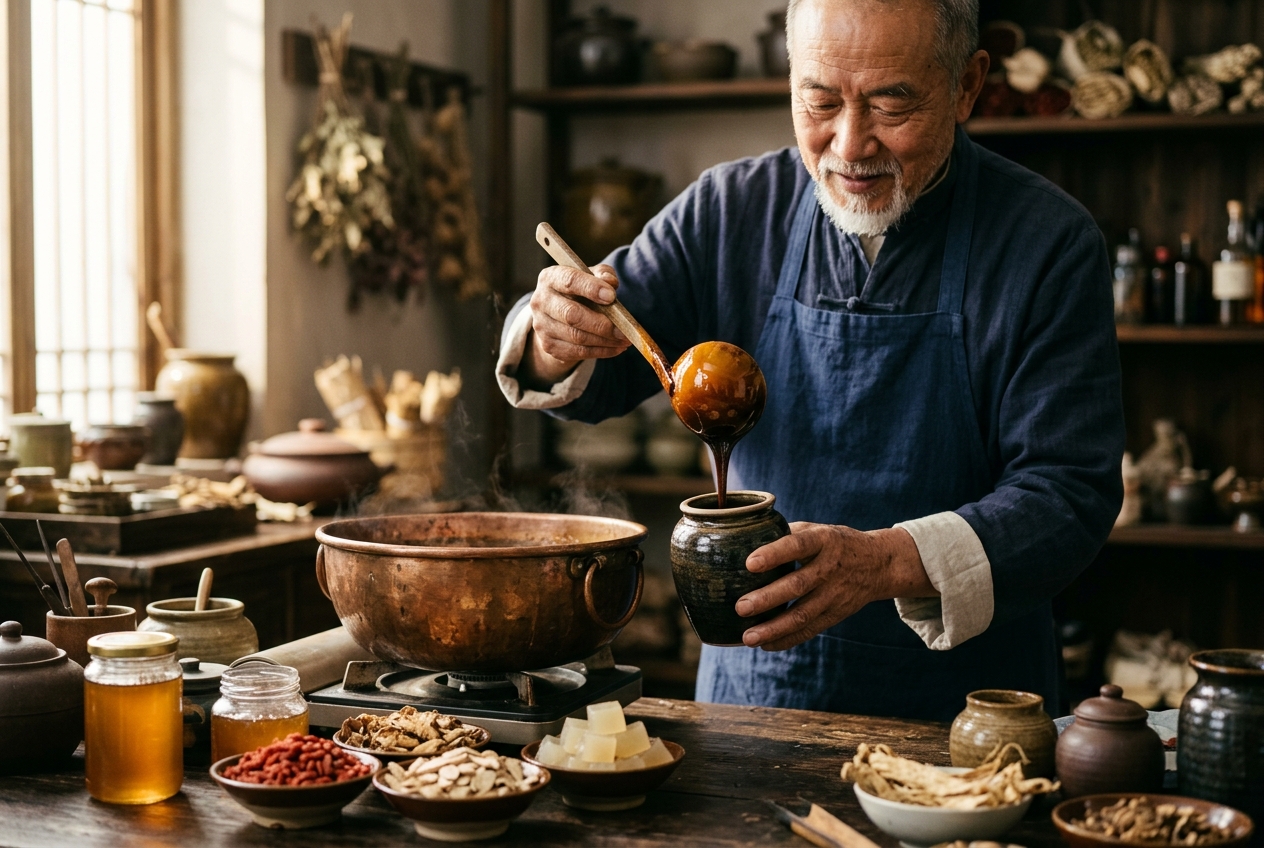
You wake up on a freezing midwinter morning, but the eight hours of sleep you just logged feel entirely illusory. Your limbs carry a dull, leaden weight; a persistent chill seems lodged deep inside your lower back; and your cognitive clarity is shrouded in a stubborn mental fog. You reach for a strong coffee or a standard herbal infusion, yet within an hour, the nervous buzz dissipates, leaving you even more depleted than before. When you eat lunch, your stomach feels immediately distended and heavy, as if your digestive fire lacks the spark required to convert food into usable vitality.
In the clinical framework of Traditional Chinese Medicine (TCM), this state is not mere temporary fatigue. It represents a systemic drawdown of your biological reserves—an exhaustion of both postnatal metabolic energy and deep, ancestral constitutional essence. When depletion reaches this structural depth, conventional light decoctions and transient stimulants prove insufficient: they simply flush through the system without anchoring into the visceral matrix. Resolving such profound constitutional deficit requires a specialized pharmaceutical discipline developed over two millennia: Gao Fang Fa (膏方法), or Medicinal Paste Therapy. By transforming dense herbal tonics into a slow-release, gelatinous, bioavailable matrix, this ancient therapy restores the primary engines of human vitality without overburdening the digestive tract.
2. What This Organ System Does: The Spleen-Stomach and Kidney Axis in Deep Essence Preservation
To understand why medicinal pastes exert such a profound restorative effect, one must examine the physiological interplay between two primary organ networks: the Spleen-Stomach (Pi-Wei, 脾胃) and the Kidneys (Shen, 肾). In East Asian medicine, these organ systems do not merely represent anatomical structures; they function as interdependent functional spheres governing the generation, distribution, and storage of life energy.
+-------------------------------------------------------------------------+
|                  THE DUAL ENGINES OF HUMAN VITALITY                     |
+-------------------------------------------------------------------------+
|                                                                         |
|   [ PRENATAL ESSENCE ]                           [ POSTNATAL ESSENCE ]  |
|       (Xian Tian)                                    (Hou Tian)         |
|            |                                              |             |
|    Housed in Kidneys (Shen)                       Generated by Spleen   |
|   Constitutional Reserve                           Digestive Furnace    |
|   Endocrine & Deep Jing                          Extraction of Gu Qi    |
|            \                                              /             |
|             \                                            /              |
|              +-------------------+----------------------+               |
|                                  |                                      |
|                                  v                                      |
|                   [ TOTAL VISCERAL VITALITY ]                           |
|                    Sustained by Gao Fang Matrix                         |
|                                                                         |
+-------------------------------------------------------------------------+
The Spleen-Stomach network is revered as the "Root of Postnatal Existence" (Hou Tian Zhi Ben, 后天之本). The Stomach acts as the sea of food and fluid, receiving ingested nutrients, while the Spleen governs transformation and transportation (Yun Hua, 运化). This metabolic engine extracts the refined energetic essence of food (Gu Qi, 谷气), which is subsequently distilled into Blood (Xue) and functional vitality (Qi). When Spleen Qi is vibrant, digestion is effortless, the mind is lucid, tissues are nourished, and muscle tone is firm.
Conversely, the Kidney network represents the "Root of Prenatal Existence" (Xian Tian Zhi Ben, 先天之本). The Kidneys store Jing (精), the foundational essence inherited from one's parents, which dictates constitutional resilience, reproductive capacity, cellular longevity, and endocrine equilibrium. While Prenatal Jing is finite, it is continuously replenished, buffered, and conserved by the surplus Postnatal Essence generated daily by the Spleen. If chronic stress, overwork, illness, or aging exhausts the Spleen's digestive capacity, the body is forced to draw directly upon its deep Kidney Jing reserves, precipitating premature senescence and chronic degenerative fatigue.
The historical lineage of Gao Fang arose specifically to bridge and restore this axis. First documented in the Han Dynasty medical classic Jingui Yaolüe (金匮要略, Essential Prescriptions from the Golden Cabinet) by Zhang Zhongjing, concentrated medicinal pastes were initially employed for external dermatological and surgical repair. By the Tang and Song Dynasties, imperial physicians refined these preparations into internal elixirs. During the Ming and Qing Dynasties—particularly within the elite Menghe medical tradition of the Jiangnan region—Gao Fang evolved into the pinnacle of individualized constitutional pharmacology.
Central to this clinical tradition is the chronobiological principle of "Winter Tonification" (Dong Ling Jin Bu, 冬令进补). According to the classical canon Huangdi Neijing (黄帝内经), winter is the season of absolute storage (Cang, 藏), wherein nature’s Yang Qi withdraws beneath the frozen earth. In the human organism, peripheral circulation consolidates inward, and metabolic reserves concentrate in the viscera. Administering dense, essence-supplementing pastes during this critical window anchors nourishment directly into the Kidney reservoir, securing vitality for the emerging spring.
3. How You Can Feel It — Signs of Balance and Imbalance
When the Spleen-Kidney axis operates in dynamic equilibrium, the subjective experience of health is marked by steady, unflagging endurance, robust thermoregulation, restorative sleep, keen mental focus, and seamless digestive transformation. However, when chronic exhaustion depletes this network, specific symptom clusters manifest across the somatic landscape.
+-------------------------------------------------------------------------------+
|                      CLINICAL PATTERNS OF VISCERAL DECLINE                     |
+-------------------------------------------------------------------------------+
| Pattern                  | Primary Subjective Signs    | Somatic Markers      |
+--------------------------+-----------------------------+----------------------+
| Kidney Essence           | Sore lumbar spine, weak     | Deep, thready pulse; |
| Depletion (Shen Jing)    | knees, tinnitus, chilliness | pale, indented tongue|
+--------------------------+-----------------------------+----------------------+
| Heart-Spleen Qi-Blood    | Post-prandial somnolence,   | Scalloped tongue;    |
| Deficiency (Xin Pi)      | insomnia, palpitations      | weak, floating pulse |
+--------------------------+-----------------------------+----------------------+
| Post-Febrile /           | Lingering dry cough, spontaneous | Thin tongue coat; |
| Convalescent Exhaustion  | sweats, cellular fatigue    | fine, rapid pulse    |
+--------------------------+-----------------------------+----------------------+
| Constitutional           | Multisystem decline, memory | Pale/peeled tongue;  |
| Senescence               | lapses, bone fragility      | frail, deep pulse    |
+--------------------------+-----------------------------+----------------------+
Diagnostic Patterns of Depletion
-
Kidney Essence Depletion (Shen Jing Kui Xu, 肾精亏虚): Patients experience a deep, aching weakness in the lumbar spine and knee joints, cold extremities, low-pitched tinnitus resembling the faint hum of cicadas, nocturnal urinary frequency, accelerated hair thinning or premature greying, and an enduring sensation of bone-deep fatigue that no amount of sedentary rest alleviates.
-
Heart-Spleen Qi and Blood Deficiency (Xin Pi Liang Xu, 心脾两虚): This state is characterized by profound post-prandial somnolence (the irresistible urge to sleep immediately following meals), chronic abdominal distension, loose stools, heart palpitations triggered by emotional or physical exertion, forgetfulness, and dream-disturbed sleep with frequent night-waking.
-
Post-Partum and Post-Febrile Convalescent Exhaustion (Chan Hou / Re Bing Hou Xu Sun, 产后/热病后虚损): Following severe acute illness, major surgery, or childbirth, the body's Yin fluids and foundational Qi are profoundly depleted. Symptoms include spontaneous daytime sweating, a dry throat, a low-grade late-afternoon feverish sensation, dull complexion, and impaired muscular recovery.
-
Age-Related Constitutional Decline (Sui Lao Ti Shuai, 岁老体衰): A systemic reduction in cellular regeneration, diminished sensory acuity, progressive osteopenia, cognitive slowing, and an inability to tolerate environmental fluctuations in temperature.
Self-Assessment Checklist: Are Your Deep Reserves Depleted?
Take a moment to evaluate your current physiological baseline: - [ ] Do you experience an energy crash between 3:00 PM and 7:00 PM (the peak chronobiological hours of the Bladder and Kidney meridians)? - [ ] Does your lower back feel chronically cold or structurally unsupported, particularly in cold weather? - [ ] Look at your tongue in a mirror: Is the body of the tongue pale and swollen, with visible tooth marks (scalloping) along the lateral edges, indicating Spleen Qi deficiency and fluid stagnation? - [ ] Do your joints feel dry or creaky, accompanied by dry eyes and brittle nails, suggesting Blood and Yin exhaustion? - [ ] Do you feel overwhelmed by routine mental tasks, accompanied by poor memory retention and restless sleep?
If you identify with three or more of these indicators, your physiological architecture is signaling that standard superficial nutrition is failing to replenish your deep visceral reservoir.
4. Qigong & Movement Practice: Anchoring the Breath at the Gate of Origin
To optimize the visceral absorption of concentrated nutritional pastes, somatic movement must be employed to harmonize the ascending motion of Spleen Qi with the descending, anchoring function of Kidney Qi. The following classical exercise—Cultivating the Cauldron and Returning Essence to the Source (Bao Ding Gui Yuan Gong, 抱鼎归元功)—draws upon foundational postures from Qigong traditions to stimulate digestive peristalsis and consolidate the lower energetic field (Dan Tian, 丹田).
                 [ QIGONG PRACTICE ALIGNMENT ]

                       (Crown Point: Baihui)
                                 |
                                 v
                             +-------+
                             |   O   |  Head suspended as if by a silk thread
                             +---+---+
                                 |
                        (Chest relaxed/open)
                                 |
                  /\         +---+---+         /\
                 /  \=======<|   *   |>=======/  \  Palms holding the cauldron
                /             +--+--+             \ at navel level (Dan Tian)
                                 |
                      (Lower Back/Mingmen flat)
                                 |
                              +--+--+
                              |     |
                             /       \
                            /         \
                           /           \
                          /             \
                      [Foot]           [Foot]
                   (Yongquan grounded into earth)
Step-by-Step Exercise Protocol
-
Starting Position and Setup: Stand barefoot or in flat shoes on a firm surface. Place your feet precisely shoulder-width apart, parallel to each other. Soften your knees with a micro-bend, ensuring they do not collapse inward. Relax your sacrum downward, gently flattening the lumbar curve to open the "Gate of Life" (Mingmen, 命门, GV-4). Suspend the crown of your head (Baihui, 百会, GV-20) upward as if suspended by a celestial silk thread, allowing your chin to tuck slightly. Rest your tongue gently against the upper palate behind your front teeth.
-
Movement and Breath Sequencing: 1. Phase 1 (Inhalation & Expansion): Inhale slowly through your nose over a 4-second count. Direct the breath down into the lower abdomen, expanding the belly 360 degrees into both the navel and the lower back. As you inhale, float both hands upward from your sides to the level of your navel, palms facing upward with fingers curved gently toward each other, as though cradling a heavy bronze vessel. 2. Phase 2 (Retention & Gathering): Pause your breath for 2 seconds. Rotate your palms inward so they face the lower abdomen (Dan Tian), approximately two inches away from the physical skin. Feel the latent warmth radiating from the center of your palms (Laogong, PC-8) penetrating into the deep abdominal cavity. 3. Phase 3 (Exhalation & Anchoring): Exhale smoothly through your nose over a 6-second count. Simultaneously, gently contract the lower abdominal wall inward toward the spine while executing a subtle, upward contraction of the pelvic floor (Huiyin, CV-1). Press your palms downward toward the earth, ending with fingers pointing forward at thigh level. 4. Phase 4 (Ascending Transition): Inhale again, sweeping the hands out in a wide lateral arc, drawing fresh atmospheric vitality into the lungs, and bring the hands back to the navel level.
-
Duration and Repetitions: Perform this sequence for a total of 18 continuous cycles (approximately 6–8 minutes). Practice every morning upon waking, ideally prior to consuming your prescribed paste or morning meal.
-
Somatic Sensations and Clinical Meaning: Within 6 to 9 repetitions, you should observe an accumulation of sweet, clear saliva in your mouth—termed the "Jade Fluid" (Yu Ye, 玉液) in classical medical literature. This signifies activation of the parasympathetic nervous system and the simultaneous engagement of Kidney Water and Spleen Fluids. Swallow this saliva mindfully in three increments, mentally guiding it down to the lower abdomen. You will also experience a distinct spreading warmth across your lumbar region, confirming the revival of Mingmen Yang fire.
5. Acupressure Points You Can Try Today
Targeted acupressure enhances the therapeutic efficacy of Gao Fang therapy by opening specific energetic pathways, stimulating digestive enzyme secretion, and directing dense nutrients into constitutional reservoirs.
       [ ACUPRESSURE TOPOGRAPHY: SP-6, ST-36 & CV-4 ]

         (Leg Anatomy)                       (Abdominal Midline)

         Patella (Knee)                          Umbilicus (Navel)
             |                                          |
             | [3 inches down, 1 inch lateral]          |
             v                                          | [3 inches down]
        (O) ST-36 (Zu San Li)                           v
             |                                     (O) CV-4 (Guan Yuan)
             |                                          |
             |                                          v
             |                                     Pubic Symphysis
             | [3 inches up from ankle]
             v
        (O) SP-6 (San Yin Jiao)
             |
       Medial Malleolus (Inner Ankle)
1. Zu San Li (足三里, ST-36) — "Leg Three Miles"
- Anatomical Location: Situated on the anterior lateral aspect of the lower leg. Place your hand across your knee joint with your fingers pointing downward; the point is located four finger-widths (3 inches) below the lower border of the patella, exactly one finger-breadth lateral to the anterior crest of the tibia bone.
- Application Technique: Apply deep, perpendicular pressure using the tip of your thumb or a rounded knuckle. Execute a slow, circular friction-kneading motion for 2 to 3 minutes on each leg. Maintain firm pressure that elicits a distinct De Qi (得气) sensation—a dull, spreading ache accompanied by slight muscular heaviness.
- Clinical Utility: As the He-Sea and Earth point of the Stomach Channel, ST-36 is the most potent point on the human body for fortifying Spleen-Stomach Qi. Scientific research indexed on NCBI PubMed confirms that stimulating ST-36 enhances gastric motility, modulates gut mucosal immunity, and relieves post-prandial bloating, nausea, and chronic fatigue.
2. San Yin Jiao (三阴交, SP-6) — "Three Yin Intersection"
- Anatomical Location: On the medial aspect of the lower leg, exactly three finger-widths (2 inches) superior to the prominence of the medial malleolus (the inner ankle bone), positioned immediately along the posterior border of the tibia.
- Application Technique: Place your thumb flat against the posterior tibial margin. Press inwardly and slightly upward toward the bone with steady, moderate firmness. Hold sustained static pressure for 90 seconds, followed by 1 minute of gentle circular massage.
- Clinical Utility: SP-6 represents the anatomical crossroads where the Spleen, Liver, and Kidney meridians intersect. It is the premier point for nourishing Yin and Blood, resolving fluid stagnation, calming an agitated nervous system, and supporting endocrine harmony. (Precaution: Contraindicated during pregnancy due to its downward-draining action).
3. Guan Yuan (关元, CV-4) — "Gate of Origin"
- Anatomical Location: On the anterior abdominal midline, precisely four finger-widths (3 inches) directly below the center of the umbilicus (navel).
- Application Technique: Place the pads of your index, middle, and ring fingers over the point. Apply gentle, progressive downward pressure on each exhalation, sinking into the soft tissue without creating sharp discomfort. Maintain steady rhythmic pressure for 3 to 5 minutes, or apply clockwise circular palm friction until deep heat radiates into the pelvic bowl.
- Clinical Utility: CV-4 is the Front-Mu point of the Small Intestine and the primary gathering point of Primordial Qi (Yuan Qi). Stimulating Guan Yuan directly fortifies Kidney Yang, consolidates reproductive Jing, and eliminates chronic lower abdominal coldness.
6. Food & Lifestyle — Small Changes for Today: The Pharmaceutical Thermodynamics, Matrix Biochemistry, and Dietary Dynamics of Gao Fang Fa
To fully appreciate the profound therapeutic scope of Medicinal Paste Therapy, one must grasp its sophisticated pharmaceutical engineering and the physiological dynamics governing its sustained-release action.
+-------------------------------------------------------------------------------+
|             PHARMACEUTICAL EXTRACTION & CONSOLIDATION CASCADE                 |
+-------------------------------------------------------------------------------+
|                                                                               |
|   1. AQUEOUS MACERATION & PROLONGED MULTI-STAGE DECOCTION                     |
|      (Cold soak 12h -> High boil [Wu Huo] -> Gentle simmer [Wen Huo] 6h x 3)  |
|                                     |                                         |
|                                     v                                         |
|   2. MULTI-STAGE FILTRATION & SEDIMENTATION                                   |
|      (Removal of insoluble cellulose -> Isolation of active phytocompounds)   |
|                                     |                                         |
|                                     v                                         |
|   3. THERMAL EVAPORATION & VACUUM CONCENTRATION (Nong Suo)                    |
|      (Slow reduction to viscous crude syrup: "Hanging Flag" [Gua Qi] test)    |
|                                     |                                         |
|                                     v                                         |
|   4. MATRIX CONSOLIDATION & GELATINOUS BINDING (Shou Gao)                     |
|      (Incorporation of Ejiao, Guiban Jiao, Mel [Feng Mi], Maltose [Yi Tang])  |
|                                     |                                         |
|                                     v                                         |
|   5. STABILIZED BIOAVAILABLE GAOFANG COLLOIDAL MATRIX                         |
|      (Sustained-release mucosal absorption without digestive burden)          |
|                                                                               |
+-------------------------------------------------------------------------------+
The Four Extraction and Compounding Thermodynamics of Gao Fang
The manufacture of an authentic medicinal paste is a rigorous pharmaceutical operation designed to extract, concentrate, and preserve both thermolabile and heavy structural phytocompounds:
-
Aqueous Maceration and Prolonged Decoction (Jian Zhu, 煎煮): The herbal formulation—often comprising 20 to 40 distinct botanical, mineral, and animal substances—undergoes initial cold-water maceration for 12 to 24 hours to soften cell walls. It is then subjected to three successive decoction cycles using varying thermodynamic profiles. The first decoction uses high heat (Wu Huo, 武火) to break down dense roots and barks, followed by prolonged gentle simmering (Wen Huo, 文火) for 4 to 6 hours. Subsequent extractions ensure that high-molecular-weight polysaccharides, glycosides, and saponins are completely liberated from the plant matrix into aqueous suspension.
-
Refined Multi-Tier Filtration (Guo Lu, 过滤): The combined liquid extracts undergo fine-mesh screening and prolonged gravity sedimentation. This critical step eliminates insoluble plant fibers, resins, and cellular debris while preserving dissolved bioactive fractions. Removing harsh fibrous particulate protects the gastrointestinal mucosa from physical irritation.
-
Slow Evaporation Concentration (Nong Suo, 浓缩): The filtered aqueous extract is transferred to a double-bottomed copper or stainless-steel concentration vessel. Over 8 to 12 hours of continuous low-temperature simmering, excess water is steadily evaporated until the liquid achieves a specific density (typically 1.30–1.35 g/cm³). The master herbalist confirms optimal concentration using the classical "Dripping Bead" (Di Shui Cheng Zhu, 滴水成珠) test—where a drop of syrup dropped into cold water remains cohesive without dispersing—and the "Hanging Flag" (Gua Qi, 挂旗) phenomenon, wherein a wooden spatula lifted from the boiling concentrate displays a continuous, translucent, honey-like curtain.
-
Gelatinous Matrix Binding and Consolidation (Shou Gao, 收膏): In the final phase, specialized binding excipients are incorporated to forge a stable colloidal matrix. These include unheated apicultural honey (Mel, Feng Mi, 蜂蜜) or maltose (Yi Tang, 饴糖), which function as natural preservatives and digestive harmonizers. Crucially, medicinal gelatinous animal collagens (Jiao Lei, 胶类) are melted directly into the hot concentrate: * Ejiao (Asini Corii Colla, 阿胶): A purified donkey-hide gelatin rich in collagen-derived amino acids (glycine, proline, alanine) that powerfully enriches Blood, arrests bleeding, and moistens lung-kidney dryness. * Guiban Jiao (Testudinis Carapacis et Plastri Colla, 龟板胶): Tortoise plastron gelatin, revered for nourishing deep Yin, anchoring ascending Liver Yang, and reinforcing bone matrix. * Lujiao Jiao (Cornu Cervi Colla, 鹿角胶): Deer antler gelatin, which supplements pure Kidney Yang, invigorates the Du Mai (Governing Vessel), and stimulates hematopoietic marrow production.
Pharmacokinetics of the Paste Matrix: Sustained Release Without Cloying Stagnation
A major clinical dilemma in chronic depletion is that the very patients who urgently require rich, heavy tonics—such as Shu Di Huang (Prepared Rehmannia) and Huang Qi (Astragalus)—possess the weakest digestive faculties. In standard raw decoctions, these dense, saccharide-rich herbs frequently cause a phenomenon known as "Cloying Stagnation" (Ni Zhi, 腻滞), leading to epigastric fullness, nausea, and diarrhea.
+-------------------------------------------------------------------------------+
|                  PHARMACOKINETIC DRUG-DELIVERY COMPARISON                     |
+-------------------------------------------------------------------------------+
| Feature                  | Raw Aqueous Decoction       | Gao Fang Paste Matrix|
+--------------------------+-----------------------------+----------------------+
| Gastric Emptying Rate    | Rapid (15-30 minutes)       | Modulated, gradual   |
| Plasma Concentration     | Sharp spike; rapid clearance| Sustained therapeutic|
|                          |                             | baseline plateau     |
| Enteric Mucosal Contact  | Transient                   | Prolonged, protected |
| Spleen Digestive Burden  | High (risk of Ni Zhi)       | Low (pre-digested    |
|                          |                             | matrix integration)  |
+--------------------------+-----------------------------+----------------------+
As recognized in integrative pharmacology frameworks supported by the World Health Organization Traditional Medicine Strategy, the gelatinous colloidal matrix of Gao Fang functions as an advanced natural sustained-release delivery vehicle. The micro-encapsulation of active phytocompounds within collagen-amino acid and polysaccharide lattices protects sensitive saponins and flavonoids from premature enzymatic degradation in the acidic gastric environment.
Gastric emptying is smoothly modulated rather than abrupt. Upon entering the small intestine, the pre-digested, water-soluble matrix is systematically absorbed across the enteric villi without requiring massive expenditures of digestive acid and enzymes from the Spleen-Stomach. This delivers a continuous, steady plasma concentration of therapeutic compounds throughout the day, providing sustained cellular nourishment. Research documented via NCBI PMC highlights how these polysaccharide-collagen complexes significantly enhance mucosal barrier integrity and systemic immunomodulation.
Formula Balancing Architecture: The "Tonic with Harmonizer" Principle
To guarantee that heavy tonics do not stagnate, classical formula construction mandates a strict architectural balance:
$$\text{Therapeutic Base} = \sum (\text{Heavy Tonifying Agents}) + \sum (\text{Aromatic Carminatives}) + \sum (\text{Gelatinous Binders})$$
+-------------------------------------------------------------------------------+
|                   FORMULATION ARCHITECTURE & BALANCE                          |
+-------------------------------------------------------------------------------+
| HEAVY TONIC PILLARS (Nourishing)      | AROMATIC HARMONIZERS (Motility)       |
+---------------------------------------+---------------------------------------+
| Shu Di Huang (Rehmannia) - Yin/Blood  | Chen Pi (Tangerine Peel) - Moves Qi   |
| Huang Qi (Astragalus) - Primordial Qi | Sha Ren (Amomi Fructus) - Wakes Spleen|
| Dang Gui (Angelica) - Hematopoiesis   | Fu Ling (Poria) - Leaches Dampness    |
| Ba Ji Tian (Morinda) - Kidney Yang    | Mu Xiang (Aucklandia) - Relieves Stasis|
+---------------------------------------+---------------------------------------+
| Result: Deep essence restoration without gastrointestinal distension or heat  |
+-------------------------------------------------------------------------------+
By systematically pairing heavy nutritive tonics with aromatic, Qi-moving carminatives like Chen Pi (Aged Tangerine Peel) and Sha Ren (Cardamom fruit), the formulation keeps the digestive transport mechanism agile and unhindered.
Practical Clinical Protocols, Seasonal Chronobiology, and Dietary Taboos
-
Dosage and Administration: The standard adult dosage is 15 to 20 grams (approximately one heaping tablespoon) taken twice daily. Dissolve the paste in a small cup of hot boiled water, stirring until fully emulsified, or consume it directly followed by warm water. For optimal absorption, take the first dose in the morning on an empty stomach (30 minutes prior to breakfast) to harness the peak metabolic energy of the Stomach channel (7:00 AM – 9:00 AM), and the second dose one hour before sleep to nourish Kidney Yin during the nocturnal regenerative phase.
-
Seasonal Chronobiology: Gao Fang therapy traditionally commences at the Winter Solstice (Dong Zhi, 冬至)—the astronomical inflection point where Yin reaches its apex and the first spark of Yang returns—and continues across the subsequent "Nine Nines" period (approx. 81 days) through early spring.
-
Absolute Clinical Contraindications: 1. Acute Exterior Invasions (Biao Zheng, 表证): If you contract an acute upper respiratory infection, common cold, influenza, or acute fever, immediately suspend Gao Fang therapy. Dense tonics taken during acute pathogenic invasion will "trap the thief inside the house" (Guan Men Liu Ze, 关门留贼), driving the pathogen deeper into the interior. 2. Acute Damp-Heat Accumulation (Shi Re, 湿热): Contraindicated during acute gastroenteritis, dysentery, active jaundice, or when presenting with a thick, greasy yellow tongue coating.
-
Strict Dietary Taboos (Ji Kou, 忌口) During Therapy:
- Prohibit Raw and Cold Foods: Iced beverages, raw salads, and refrigerated items paralyze the Spleen's enzymatic warmth, causing the gelatinous paste to congeal indigestibly in the stomach.
- Avoid Radish and Radish Seed (Lai Fu Zi): Radishes strongly descend and disperse Qi, directly neutralizing the ascending and tonifying actions of precious tonics like Ginseng and Astragalus.
- Avoid Strong Tea and Coffee: Highly concentrated tannins in green and black teas chemically bind to the gelatinous animal proteins (Ejiao, Guiban Jiao), precipitating insoluble complexes that impair intestinal absorption. Consume warm ginger water or plain boiled water instead.
7. Today's Takeaway
The single most effective action you can take right now to protect your Spleen-Kidney axis requires no specialized ingredients and takes under five minutes: Drink a cup of hot water infused with two slices of fresh ginger, then perform three minutes of rhythmic abdominal breathing while applying warm palm friction over your Guan Yuan point (three inches below your navel). This immediate micro-practice rekindles your Spleen digestive furnace, draws dispersed nervous energy down into your Kidney essence reservoir, and creates the internal biological warmth necessary to anchor lasting constitutional resilience.