Fuliu Cavity Returning Current: Medial Crural Fascial Decompression, Renal Fluid Transformation Dynamics, and Calcaneal Kinetic Transmission in Classical Neigong
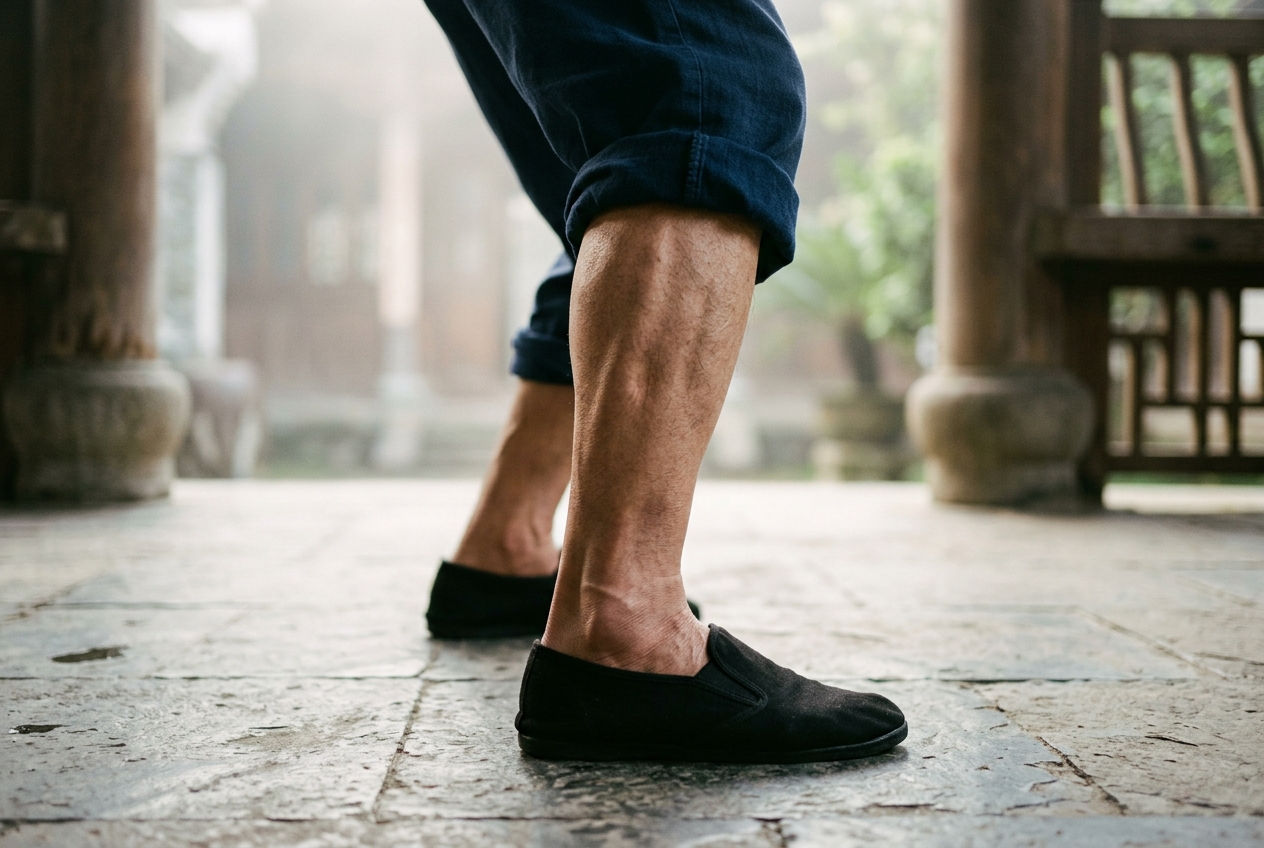
In traditional Chinese medicine, Fuliu is recognized as the "Mother" point and the "Jing-River" point of the Kidney meridian—a primary energy conduit associated with water metabolism, hormonal vigor, bone marrow health, and constitutional vitality. When we combine gentle postural alignment with diaphragmatic breathing—breathing deep into the lower abdomen, two inches below the navel (the Dantian)—we physically decompress the nerve pathways, blood vessels, and dense connective tissues running behind the ankle. This allows physical force to rebound smoothly into the pelvis while simultaneously initiating an invigorating upward flow of internal warmth and energy through the spinal column.
Step-by-Step Practice Guide
This foundational Neigong and Daoyin sequence mobilizes the Fuliu cavity, integrates the deep crural fascia with diaphragmatic respiration, and establishes a clear kinetic line from the earth to the lumbar spine. Practice barefoot on a level, unyielding surface.
+-------------------------------------------------------------------------+
|                       KEY PRACTICE MILESTONES                           |
+-------------------------------------------------------------------------+
| 1. Calcaneal Centering: Weight drops cleanly through the heel bone.     |
| 2. Fuliu Decompression: 2 cun above inner ankle releases anteriorly.   |
| 3. Dantian Coupling: Lower belly expands as the crural sleeve relaxes.  |
| 4. Mingmen Opening: Lumbar curve flattens naturally, receiving force.   |
+-------------------------------------------------------------------------+
1. Establishing the Root: The Standing Stake (Zhan Zhuang) Setup
- Foot Placement: Place your feet parallel, outer edges aligned with the outer tips of your shoulders. Ensure the toes point directly forward rather than flared outward.
- Weight Distribution: Distribute your body weight evenly across three points on each foot: the base of the big toe, the base of the little toe, and the center of the heel bone (the calcaneus). The center of the sole—the Yongquan cavity (KI1, "Bubbling Spring")—should remain slightly domed and suctioned off the floor, like the palm of a relaxed hand.
- Joint Micro-Bending: Micro-bend your knees without letting them collapse inward. Ensure your kneecaps track directly over the second toe. Release your tailbone downward as if sitting on the edge of a tall barstool, allowing the natural curve of your lower back (the Mingmen or "Gate of Life" region) to gently widen and decompress.
- Upper Body Suspension: Rest your tongue against the upper palate behind your front teeth. Suspend the crown of your head (Baihui) toward the sky as if pulled upward by a single silk thread, allowing your chin to tuck slightly and the back of your neck to lengthen.
2. Palpation and Somatic Awakening of Fuliu
- Locating the Gate: Before assuming the static posture, reach down to your inner lower leg. Locate the high point of your medial malleolus (the inner ankle bone) and the prominent band of your Achilles tendon. The depression directly between them is Taixi (KI3). Measure two anatomical inches—the combined width of your index and middle fingers (two cun)—straight upward from Taixi, along the anterior (front) edge of the Achilles tendon. Here lies Fuliu (KI7).
- Releasing the Tissue: Place your thumb lightly on Fuliu and your index finger on the opposite, outer edge of the tendon (Kunlun, BL60). Apply gentle, rolling circular pressure for 30 seconds. Do not dig painfully; invite the deep sheath of connective tissue (the deep crural fascia) to soften beneath your touch. Repeat on the opposite leg.
3. Breath Coordination and Fascial Decompression
- The Inhalation Phase (Expansion and Descending): Return to your upright standing posture. Rest your hands gently over your lower abdomen. Inhale smoothly through your nose over a count of four to five seconds. Direct the breath down into the pelvic basin. As your lower belly, flanks, and lower back gently expand like a sphere, mentally track a downward current from your hips, through the deep inner calf, into the Fuliu cavity. Consciously release any gripping in the soleus and calf muscles, letting the Fuliu gateway "widen" and open.
- The Exhalation Phase (Ascending Vector and Recoil): Exhale slowly through your nose over five to six seconds. As your lower belly gently draws back toward your spine, feel the ground beneath your heels. Do not push with muscular effort; instead, allow the elastic recoil of the decompressed Achilles tendon and deep crural fascia to draw a warm, subtle, upward current from Fuliu, ascending along the inner line of the tibia, through the adductors of the inner thighs, into the pelvic floor (Huiyin), and directly up into the lumbar spine (Mingmen).
- Repetition: Maintain this rhythmic, cyclical wave for 36 complete breath cycles (approximately 8 to 10 minutes).
===========================================================================
                      SOMATIC FAULT & CORRECTION MATRIX
===========================================================================
FAULT                          MECHANICAL CAUSE            PRECISE CORRECTION
---------------------------------------------------------------------------
1. Hyper-Dorsiflexion /        Shifting center of mass     Shift weight back into
   Weight on Toes              too far forward; gripping   the calcaneal tripod;
                               with toe flexors.           relax toes like leaves.
---------------------------------------------------------------------------
2. Medial Arch Collapse        Weakness in posterior       Engage the outer arch;
   (Pronation)                 tibial tendon; inner knee   spiral knees outward
                               collapsing medially.        microscopically.
---------------------------------------------------------------------------
3. Clamped Calcaneal Sleeve    Overactive soleus/gas-      Imagine the space behind
   (Gripping Achilles)         trocnemius; fear of falling the inner ankle filled
                               backward.                   with warm, melting oil.
---------------------------------------------------------------------------
4. Lumbar Lordosis             Tight hip flexors; pelvis   Drop the sacrum plumb;
   (Hollow Back)               tilted anteriorly.          breathe directly into
                                                           the Mingmen hinge.
===========================================================================
What Sensations to Look For—and What They Mean
- Warmth at the Inner Ankle: A distinct spreading warmth around Fuliu signifies vasodilation of the posterior tibial artery and the opening of microvascular perfusion through the deep crural sleeve.
- Effervescent Tingling ("Ants Crawling") along the Inner Calf: This is the subjective sensory hallmark of neurofascial decompression along the tibial nerve pathway and unobstructed Shaoyin meridian conduction.
- Spontaneous Flotation of the Sacrum: A feeling of weightlessness or expansive decompression in the lumbar spine confirms that the Ground Reaction Force is no longer being choked at the ankle, but is transmitting cleanly through the tensegral network into the Mingmen.
- Heavy, Spongy Grounding: The sensation that your feet have melted several inches into the earth indicates the transition from superficial muscular holding to deep fascial rooting.
Why It Works: The Body Science
To understand the transformative power of Fuliu, one must examine the intersection between classical Eastern meridian dynamics and Western myofascial biomechanics, neuroanatomy, and fluid physiology.
1. Fascial Tensegrity and the Deep Kinetic Chain
The human body operates not as a stack of compression-bearing bricks, but as a continuous, self-stabilizing tensegrity structure, as detailed in modern biomechanical research on Fascia as a Proprioceptive and Tensegrity Organ. In the structural model of Anatomy Trains, the Foot Shaoyin Kidney meridian corresponds directly to the lower segment of the Deep Front Line and its interface with the Superficial Back Line.
Fuliu sits at a critical myofascial intersection where the investing layer of the deep crural fascia forms a retinacular sleeve around the soleus, the flexor hallucis longus, the flexor digitorum longus, and the tendon of the tibialis posterior. When an individual stands with unconscious postural tension, these fascial layers adhere, creating dense cross-links that lock the Achilles Tendon Biomechanics in a state of chronic shear stress.
By consciously releasing this crural envelope through somatic attention and breath, you restore fluid shear mobility between the sliding fascial planes. This allows the Achilles tendon to function as an optimal biological spring. During dynamic movement and martial stepping, the stretch-shortening cycle of the tendon stores elastic strain energy on ground contact and recoils effortlessly, propelling the body forward without taxing the cardiovascular system or overworking superficial muscles.
2. Neurovascular Decompression of the Posterior Tibial Bundle
Directly adjacent to the Fuliu point, nestled beneath the deep crural fascia and behind the medial malleolus, lies the posterior tibial neurovascular bundle, containing: * The tibial nerve (supplying motor control to the plantar flexors and intrinsic foot muscles, and sensory feedback from the sole of the foot). * The posterior tibial artery and veins (the primary vascular supply to the deep posterior compartment of the leg and plantar surface of the foot).
Chronic hypertonicity in the soleus and flexor muscles compresses this neurovascular bundle against the calcaneus and tibia, impairing local microcirculation and sending continuous low-grade nociceptive and sympathetic distress signals to the central nervous system. Somatic decompression of Fuliu acts as an endogenous mechanical release for the tarsal tunnel and medial crural compartment.
This release immediately triggers localized nitric oxide synthesis, restoring vascular flow, while calming the tibial nerve's sympathetic efferent tone. The downstream effect is a measurable increase in Heart Rate Variability (HRV) and a global shift toward parasympathetic nervous system dominance, validated in clinical research indexed in NCBI PubMed on Acupoint KI7 and Autonomic Regulation.
3. Interstitial Hydrodynamics and the Peripheral Heart
Western physiology recognizes the deep calf musculature—specifically the soleus and gastrocnemius complex—as the body's "secondary pump" or peripheral heart. Because venous blood and interstitial lymph in the lower extremities must overcome gravity to return to the heart and kidneys, efficient drainage relies upon the rhythmic contraction and full elastic relaxation of the calf pump.
When the crural fascia around Fuliu is chronically constricted, venous stasis and lymphatic congestion occur, leading to heavy legs, ankle edema, and systemic sluggishness. Synchronizing the diaphragmatic descent of lower belly breathing with the micro-elastic expansion of the Fuliu sleeve creates a powerful thoraco-abdominal suction pump. Intra-abdominal pressure drops during the initiation of exhalation, drawing stagnant interstitial fluid from the lower limbs up through the femoral and iliac vessels straight into the renal filtration system.
Classical Lineage & Context
The systematic cultivation of Fuliu is deeply rooted in the foundational texts of classical Chinese medicine and the secretive internal martial arts lineages of Daoist Daoyin.
+-------------------------------------------------------------------------+
|                  CLASSICAL CORRESPONDENCES OF FULIU                     |
+-------------------------------------------------------------------------+
| Meridian: Foot Shaoyin Kidney (足少阴肾经)                               |
| Element: Metal (金) generating Water (水)                               |
| Categorization: Jing-River Point (经穴 - Where Qi flows like a river)   |
| Classical Action: Regulates Water, tonifies Kidney Yin/Yang, clears damp |
| Martial Function: Grounds root, unlocks spring of the calcaneal sleeve  |
+-------------------------------------------------------------------------+
The Yellow Emperor and the Five Phase Dynamic
The earliest theoretical systematization of Fuliu appears in the seminal Han Dynasty medical text, the Huangdi Neijing (Yellow Emperor’s Inner Canon), specifically within the Lingshu (Spiritual Pivot). In the classic taxonomy of the Five Transporting (Shu) points, Fuliu is classified as the Jing-River (Jing Xue, 经穴) of the Foot Shaoyin Kidney channel. The classical text states: “Where the meridian flow courses rapidly like a surging current, it is the Jing-River.”
Furthermore, under the Five Phase (Wu Xing) system detailed in the Nan Jing (Classic of Difficulties, 64th and 68th Difficulties), Fuliu is designated as the Metal point of the Kidney Water channel. In Five Phase cosmology and physiology, Metal is the "Mother" of Water (Jin Sheng Shui, 金生水). Metal represents the qualities of clarity, condensation, descending structure, and pure breath (associated with the Lungs). When the bodily Water (the Kidneys, governing fluids, hormonal essence, and constitutional vitality) is depleted, stagnant, or overheated, classical medicine does not attempt to force the Water directly. Instead, the physician or Neigong adept tonifies the Mother—Metal—at Fuliu.
By stimulating or somatically opening Fuliu, the dense, organizing, descending power of Metal condenses atmospheric Qi into bio-usable fluid essence, replenishing Kidney Yin and stoking the catalytic fire of Kidney Yang (Mingmen Huo). For further reading on this ancient energetic framework, consult the comprehensive documentation provided by the World Health Organization: WHO Traditional Medicine Strategy and the canonical archives on Traditional Chinese Medicine Meridian Theory.
The Daoist Internal Alchemy (Neidan) Perspective
In the internal alchemical treatises of the Tang and Song dynasties, Fuliu was revered not merely as a therapeutic acupuncture cavity, but as an energetic valve controlling the circulation of Jing (Essence) and Yuan Qi (Original Qi). The Daoist masters observed that under normal, degenerative conditions, human vitality leaks constantly downward and outward through unconscious physical tension, emotional turbulence, and gravitational collapse.
By decompressing the medial crural sleeve in standing meditation (Zhan Zhuang), the adept reverses this entropic descent. Fuliu—the "Returning Current"—literally causes the fluid essence to turn around and flow upstream (Ni Liu). The Pre-Heaven vitality that typically lies dormant in the calcaneus and pelvic floor is vaporized by the heat of lower belly breathing and guided up the internal channel of the spine, passing through the three energetic gates (San Guan): the tailbone (Weilü), the mid-back (Jiaji), and the base of the skull (Yuzhen), ultimately nourishing the brain and upper spiritual centers (Niwan).
Lineage Applications in the Internal Martial Arts
In the internal martial systems (Neijiaquan)—namely Taijiquan, Xingyiquan, and Baguazhang—the Fuliu cavity is a guarded structural secret: * In Xingyiquan (specifically the Hebei and Shanxi traditions), the explosive forward burst of the "Dragon Body" (Long Shen) relies upon an instantaneous, unhindered release of the rear Achilles tendon. If Fuliu is tense, the kinetic force generated from the ground is choked at the ankle, causing the practitioner to lurch with their shoulders and lose structural integrity (Zheng Ti Jin). * In Baguazhang, during the signature "Mud-Wading Step" (Tang Ni Bu), the foot skims flat across the earth. The adept maintains continuous opening through Fuliu, which keeps the medial longitudinal arch alive and springy, preventing the foot from slapping or jarring the nervous system as they circle constantly. * In Taijiquan, the classic treatise dictate that “The root is in the feet, issued through the legs, governed by the waist, and expressed through the fingers.” Unlocking Fuliu provides the physiological conduit that allows this unbroken transmission of Ground Reaction Force to manifest as effortless, whole-body internal power (Fa Jin). Practitioners seeking authentic instructional lineages and educational standards can reference resources curated by the National Qigong Association.
Movement Diagnostic Markers for Tensegrity Verification
How does an advanced practitioner or teacher objectively verify that the Fuliu gateway is fully patent and that the Shaoyin meridian is conducting kinetic force without obstruction? Use these four movement markers:
===========================================================================
              OBJECTIVE SOMATIC VERIFICATION CHECKLIST
===========================================================================
[ ] 1. The Achilles Pinch Test:
       Light bilateral pinching of the calcaneal tendon 2 cun superior to
       the ankle produces zero sharp tenderness, demonstrating absence of
       fascial adhesions and micro-inflammatory congestion.

[ ] 2. The Single-Leg Squat Rooting Vector:
       During a slow single-leg pistol or deep knee flexion, the medial arch
       remains stable without pronation or supination, proving active
       suspension from the deep crural sleeve.

[ ] 3. The Lumbar Resonance Check:
       A gentle, rhythmic tap on the bottom of the heel bone while standing
       transmits an immediate, painless, un-damped vibration directly into
       the L3-L4 Mingmen space.

[ ] 4. Post-Standing Microvascular Refill:
       Upon completing 10 minutes of Zhan Zhuang, the skin of the inner
       ankle and sole displays a rosy, warm, microvascular flush, and the
       dorsalis pedis / posterior tibial pulse feels full, slow, and deep.
===========================================================================
Today's Practice Commitment
Transforming theoretical understanding into cellular architecture requires consistent, micro-dosed daily application. Commit to the following 10-minute protocol starting today:
The 10-Minute Morning Awakening Protocol: 1. Immediate Action: Tomorrow morning, before checking your phone, sitting at your desk, or taking your first sip of tea or coffee, step out of bed onto the bare floor. 2. Physical Setup (1 Minute): Spend 60 seconds gently massaging both Fuliu cavities with your thumbs, feeling the deep tissues soften and warm beneath your touch. 3. Static Cultivation (8 Minutes): Assume the parallel Zhan Zhuang stance described in Section 3. Close your eyes, sink your weight into the calcaneal tripod, and perform 36 slow, continuous, diaphragmatic breath cycles. With every inhalation, expand the lower belly and let the Fuliu crural sleeve widen; with every exhalation, feel the elastic recoil travel up your inner legs into your lower back. 4. Integration Walk (1 Minute): Conclude by walking slowly across the room for one minute. Pay deliberate attention to the light, buoyant, spring-like quality in your heels and the sense of open, grounded vitality rising through your spine.
Notice how your energy, mental clarity, and lower back comfort evolve over the course of the day. By tending daily to this ancient "Returning Current," you reclaim the natural spring of the human body and establish an enduring foundation for physical longevity and internal power.