Fengshi Cavity Wind Market: Iliotibial Tract Fascial Decompression, Lateral Femoral Kinetic Tensegrity, and Shaoyang Channel Conduction in Classical Neigong
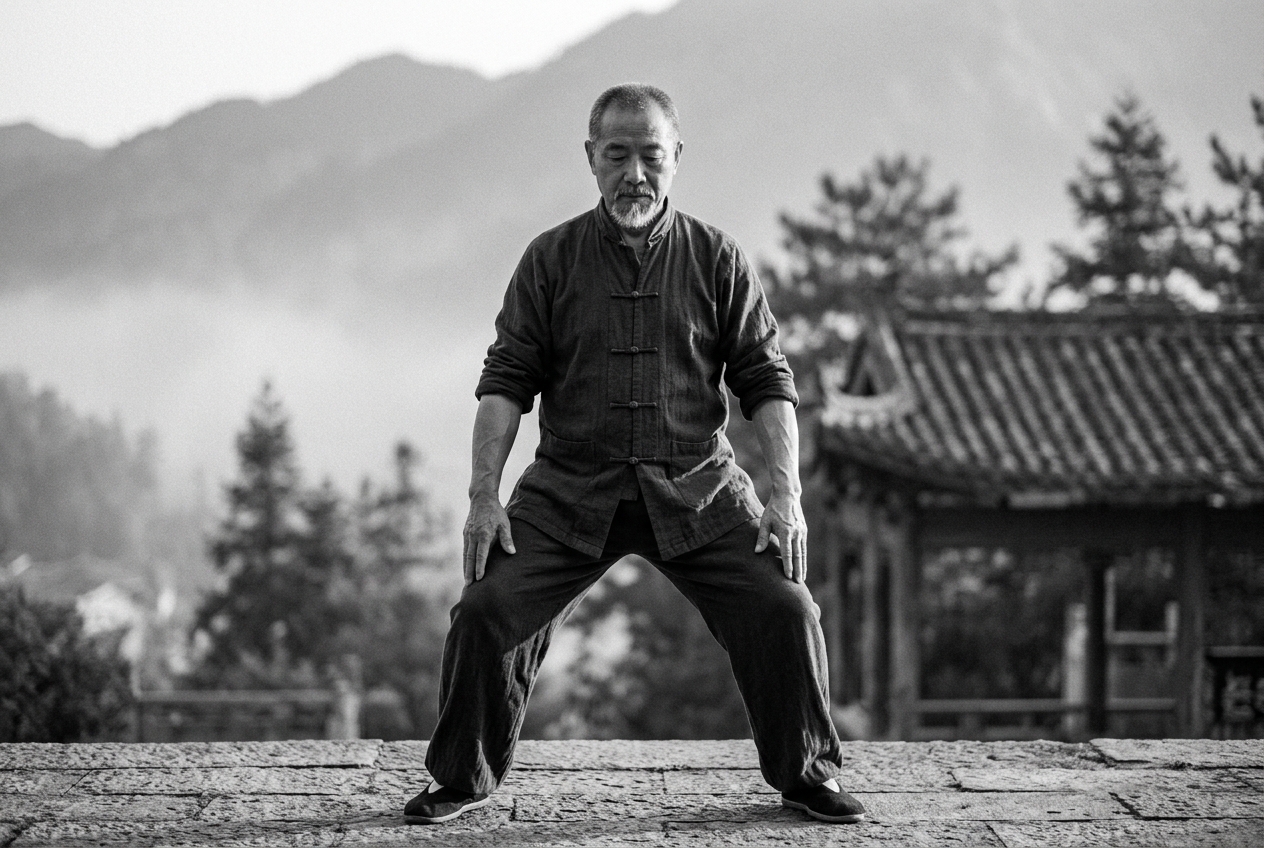
In traditional Chinese medicine and classical movement arts, this outer leg pathway is mapped as the Foot Shaoyang (Gallbladder Meridian), a kinetic and bioelectric channel responsible for lateral stability, pivoting movements, and the smooth circulation of vital vitality throughout the body's connective tissues. The acupoint located at the epicenter of this lateral tension band is Fengshi (GB31), translating literally to the "Wind Market"—a metaphor for a biological crossroads where pathogenic tension, metabolic waste, and neuromuscular stress ("wind-dampness") tend to pool and stagnate.
To open this point, internal martial artists and practitioners of classical Daoyin (therapeutic somatic movement) utilize two fundamental structural adjustments: Song Kua (releasing and sinking the inguinal creases of the hips) and Yuan Dang (shaping the pelvic floor and inner thighs into a rounded, supportive suspension arch). By combining these postural shapes with relaxed, mindful intention (Yi Dao), practitioners decompress the dense lateral femoral sheath without muscular force, allowing trapped neural and bioelectric flow to move freely from the pelvis down to the feet.
Step-by-Step Practice Guide: Decompressing the Lateral Sheath
This progressive protocol guides you through the anatomical localization, structural decompression, and somatic release of the Fengshi cavity. It can be practiced as a standalone standing meditation or integrated into broader movement routines.
1. Structural Stance Setup (The Wuji Architecture)
- Base Placement: Position your feet parallel, precisely hip-to-shoulder-width apart, with your second toes pointing straight ahead. Distribute your body weight evenly across the "foot tripod": the base of the big toe, the base of the little toe, and the center of the calcaneus (heel).
- Knee Alignment: Soften your knee joints by releasing the popliteal fossa at the back of the knee. Ensure your patellae track directly over the center of your feet, preventing any inward rolling (valgus collapse).
- Pelvic Neutralization (Song Kua): Allow your tailbone to sink vertically toward the floor as if weighted by a plumb line. Gently fold the inguinal crease (the groin line where the thigh meets the pelvis), creating an internal hollow in the front hips while opening the lumbar spine (Mingmen).
- Arching the Perineum (Yuan Dang): Subtly expand the inner thigh adductors outward while keeping the soles of the feet rooted. This creates an open, dome-like suspension bridge between the legs, redistributing downward gravitational weight from the lateral legs toward the skeletal core.
2. Palpatory Localization and Diagnostic Verification
- Stand upright with your arms hanging naturally at your sides in anatomical neutral.
- Observe where the tip of your middle finger rests against the lateral thigh.
- Anatomically, Fengshi resides on the lateral aspect of the thigh, approximately 7 cun (the width of about two hand spans) superior to the popliteal crease, nestled directly in the intermuscular sulcus between the posterior border of the vastus lateralis and the anterior border of the biceps femoris, penetrating the dense fibers of the iliotibial tract.
- Diagnostic Touch Protocol: Use your thumb or middle knuckle to apply firm, perpendicular pressure into this groove. A healthy, open tissue bed exhibits supple, springy rebound elasticity. A congested or pathological state presents as a hard, fibrous, "rope-like" band accompanied by a sharp, radiating ache, local numbness, or a cold sensation running down toward the lateral malleolus of the ankle.
3. Breath-Synchronized Decompression with Somatic Intent (Yi Dao)
- Inhalation Phase (Cellular Expansion): Inhale smoothly through your nose for four seconds. Direct the breath down through the respiratory diaphragm into the lower abdomen (Dantian), allowing the lower belly, flanks, and lower back to expand circumferentially in 360 degrees. Maintain passive structural awareness at GB31 without contracting the surrounding muscle fibers.
- Exhalation Phase (Fascial Dissolution): Exhale slowly through your nose for six seconds. As the breath empties, guide your somatic awareness (Yi) directly into the lateral intermuscular sulcus at GB31. Cultivate the visceral feeling of warm water or melting wax trickling down through the lateral femoral fascial sheath.
- The Micro-Spiraling Cue: As you exhale, imagine the femur bones gently spiraling outward within the acetabulum (hip socket) while your feet remain magnetically anchored to the earth. This creates a subtle, microscopic transverse shear that uncouples adhered fascial layers along the iliotibial band.
4. Clearing Pathogenic Stagnation through Resonant Micro-Vibration
- Settle into a stable standing stake stance (Zhan Zhuang), holding your arms rounded in front of your chest as if embracing a broad tree trunk.
- Initiate a minute, rhythmic pulsation from the soles of your feet (the Yongquan or Kidney 1 point), creating a micro-vibration through the skeletal frame at roughly 2 to 3 cycles per second.
- Direct this internal oscillation through the lateral femoral columns. As the subtle rhythmic shockwaves pass through the Fengshi gateway, visualize dense, stagnant energetic residue ("turbid wind-dampness") vibrating loose from the collagen matrix and draining downward deep into the earth.
- Continue this breath-synchronized resonance for 5 to 10 minutes.
5. Dynamic Weight Transference: Gong Bu and Xie Bu Integration
- Bow Stance (Gong Bu): Step forward into a forward stance, shifting 70% of your weight to the front leg. Maintain Song Kua by actively relaxing the front hip crease. Verify that the lateral thigh of the rear leg does not hyper-brace; the iliotibial band must remain an elastic spring storing kinetic energy rather than a rigid strut.
- Cross Stance (Xie Bu): Transition smoothly by crossing one leg behind the other and descending into a low crouching twist. As the hips descend, the lateral femoral sheath across GB31 experiences maximum rotational stretch. Ensure the pelvis remains level and the sacrum suspended; release all defensive muscular clenching at GB31, relying entirely on the viscoelastic recoil of the fascial web to rise back to standing.
Common Practitioner Errors and Biomechanical Corrections
- Error 1: Compensatory Knee Valgus (Inward Collapse)
- Symptom: The practitioner attempts to round the crotch (Yuan Dang) by simply forcing the feet apart, causing the knees to buckle inward and placing extreme tensile stress on the medial collateral ligament while compressing the lateral fascial line at GB31.
- Correction: Anchor the outer borders of the feet firmly into the floor. Think of widening the knees from the deep rotator muscles of the hip rather than from the ankles.
- Error 2: Anterior Pelvic Tilt and Lumbar Hyperextension
- Symptom: Sticking the buttocks backward collapses the inguinal crease, locking the Kua in a pinched, rigid state that jams the lateral hip stabilizers.
- Correction: Consciously release the gluteal muscles. Allow the sacrum to drop straight downward, leveling the pelvic bowl like an upright urn filled with water.
- Error 3: Mental and Muscular Forcing (Zhuo Li)
- Symptom: Trying to "force" energy into the point by tensing the quadriceps or aggressively pinching the skin.
- Correction: Adhere strictly to the classical precept: "Where the mind goes, the Qi follows; where the Qi goes, the blood flows" (Yi Dao, Qi Dao, Xue Dao). Release all voluntary muscular contraction in the thigh and employ receptive somatic listening (Ting Jin).
Somatic Sensations: What You Will Experience
+-------------------------------------------------------------------------+
|                  SOMATIC SENSATION INTERPRETATION TABLE                 |
+----------------------+--------------------+-----------------------------+
| Physical Phenomenon  | Neurological Basis | Classical Energetic Meaning |
+----------------------+--------------------+-----------------------------+
| Spreading Warmth     | Microvascular      | Restoration of Shaoyang Qi  |
| / Thermal Glow       | Vasodilation       | & Nutrient Blood Flow       |
+----------------------+--------------------+-----------------------------+
| Fine Tingling /      | Sensory Nerve      | Bioelectric Meridian        |
| Electric Current     | Decompression      | Unblocking (De-Qi)          |
+----------------------+--------------------+-----------------------------+
| Heavy Leadenness     | Viscoelastic Creep | Expulsion of Latent         |
| Melting to Lightness | & Myofascial Release| Pathogenic Wind-Dampness   |
+----------------------+--------------------+-----------------------------+
Why It Works — The Body Science
Modern clinical anatomy, orthopedic biomechanics, and fascial research provide compelling validation for the empirical discoveries of classical Neigong masters.
1. Neuroanatomy of the Lateral Femoral Fascial Sheath
The Fengshi cavity is not an isolated geometric point, but a high-density biological intersection within the human fascia and biotensegrity system. At this exact locus, the thick collagenous sheet of the iliotibial tract sends deep fibrous slips—the lateral intermuscular septum—directly to attach onto the linea aspera of the femur bone. This septum acts as a structural firewall dividing the anterior compartment of the thigh (quadriceps) from the posterior compartment (hamstrings).
Embedded within and immediately adjacent to this septum are branches of the lateral femoral cutaneous nerve and muscular branches of the femoral and sciatic nerves. When the vastus lateralis and biceps femoris maintain chronic hypertonicity, this intermuscular boundary adheres. The resulting fascial cross-linking compresses adjacent unmyelinated free nerve endings, triggering localized ischemia, myofascial trigger points, and referred aching down the lateral chain.
2. Biotensegrity and Kinetic Load Redistribution
According to biotensegrity principles established in contemporary movement science, the human body maintains structural integrity not through continuous compression stacking like a brick wall, but via continuous tension networks surrounding discontinuous compression struts (bones). When an athlete or practitioner maintains chronic pelvic misalignment, the lateral myofascial line absorbs disproportionate ground reaction forces.
By executing Song Kua (relaxing the hip hinge) and Yuan Dang (rounding the perineal arch), the mechanical loading vector shifts from an external shearing force along the lateral IT band to an axial compression distributed cleanly through the femoral head, acetabulum, and pelvic ring. This relieves excessive tension at Fengshi, optimizing patellar tracking across the femoral trochlea and protecting the cruciate ligaments during complex rotational transitions. Clinical overviews indexed on NCBI PubMed emphasize how balancing myofascial tension across the hip abductors and iliotibial complex prevents common lower-extremity kinetic chain dysfunction.
3. Mechanotransduction, Piezoelectricity, and Fluid Dynamics
Fascia is fundamentally a fluid-rich, liquid-crystalline matrix composed of parallel collagen fibers embedded in a ground substance of glycosaminoglycans and hyaluronic acid. Scientific investigations into mechanotransduction on NCBI demonstrate that mechanical deformation of connective tissue—such as the micro-spiraling and tensile release utilized in Zhan Zhuang—stimulates cellular fibroblasts to regulate matrix remodeling and reduce interstitial inflammation.
Furthermore, collagen displays distinct piezoelectric properties: when subjected to rhythmic, non-injurious shear stress and oscillatory micro-vibrations, the collagen fibers generate minute electric potentials. In classical terminology, this phenomenon corresponds to the stimulation and unhindered conduction of De-Qi (bioelectric meridian flow) along the Shaoyang pathway. When the lateral sheath is uncoupled and rehydrated through conscious decompression, interstitial fluid dynamics improve, accelerating the clearance of inflammatory metabolites—the exact biological correlate of "dispelling pathogenic wind and dampness."
4. Autonomic Regulation via Diaphragmatic Descent
The somatic focus (Yi Dao) combined with prolonged exhalations directly stimulates the ventral vagal complex of the parasympathetic nervous system. Lowering systemic sympathetic tone down-regulates muscle spindle sensitivity throughout the postural stabilizers, including the tensor fasciae latae and gluteus medius. This systemic down-regulation breaks the reflexive gamma-motor loop that sustains chronic guarding at GB31, transforming rigid physical bracing into resilient, elastic suspension. Organizations such as the World Health Organization Traditional Medicine continue to examine how traditional mind-body modalities integrate autonomic regulation with musculoskeletal rehabilitation to optimize health outcomes.
Classical Lineage & Historical Context
The systematic cultivation of the Fengshi cavity is rooted in the oldest surviving traditions of Chinese medicine and internal martial arts. The earliest detailed anatomical and functional analysis of the Foot Shaoyang Gallbladder meridian appears in the foundational Han Dynasty canon, the Huangdi Neijing (The Yellow Emperor’s Inner Classic, c. 1st–2nd Century BCE), particularly within the Lingshu (Spiritual Pivot).
In the classical cosmological and physiological framework of the Neijing, the Shaoyang (Lesser Yang) represents the dynamic "pivot" (Hao Yang) of the human body. While Taiyang (Greater Yang) governs the exterior posterior surface and Yangming (Bright Yang) governs the anterior surface, Shaoyang stands at the lateral transition zone, acting as the operational hinge that permits lateral turning, rotational power generation, and agile adaptation. The classical texts warn that when wind and dampness (Feng-Shi) invade the body, they naturally lodge in the lateral joints and intermuscular valleys, causing hemiplegia, gait instability, and joint stiffness.
+-------------------------------------------------------------------------+
|                  HISTORICAL LINEAGE OF SHAOYANG CULTIVATION             |
+---------------------+-------------------+-------------------------------+
| Epoch / Dynasty     | Source Text / Art | Primary Technical Focus       |
+---------------------+-------------------+-------------------------------+
| Western Han         | Mawangdui         | Animal Daoyin Postures for    |
| (c. 168 BCE)        | Daoyin Tu         | Dispersing Lateral Stagnation |
+---------------------+-------------------+-------------------------------+
| Han Dynasty         | Huangdi Neijing   | Mapping Shaoyang Pivot &      |
| (c. 1st Cent. BCE)  | (Lingshu)         | Treating Pathogenic Wind-Damp |
+---------------------+-------------------+-------------------------------+
| Tang/Song Dynasties | Baduanjin         | "Clenching Fists & Glaring"   |
| (c. 960–1279 CE)    | & Yijinjing       | for Fascial Sheath Extension  |
+---------------------+-------------------+-------------------------------+
| Ming/Qing Dynasties | Taijiquan &       | Song Kua, Yuan Dang, and      |
| (c. 1644–1912 CE)   | Baguazhang        | Coiling Lateral Elastic Force |
+---------------------+-------------------+-------------------------------+
During the Western Han dynasty, archaeological evidence recovered from the Mawangdui tombs revealed the Daoyin Tu ("Gymnastics Chart," dated to 168 BCE), depicting dynamic standing stretches and somatic forms specifically engineered to clear obstruction from the lateral flanks and lower limbs. Later, during the Tang and Song dynasties, these techniques were formalized within the Yijinjing (Muscle-Tendon Changing Classic) and the Baduanjin (Eight Pieces of Brocade), emphasizing that true physical vitality requires transforming stiff, brittle muscle into pliable, sinewy fascia (Jin).
In the internal martial lineages developed during the late Ming and Qing dynasties—most notably Chen and Yang family Taijiquan, Dong Haichuan’s Baguazhang, and Xingyiquan—the mastery of Song Kua and Yuan Dang became the paramount structural requirement. Masters observed that any practitioner who braced or tensed the Fengshi cavity suffered from "double-weighting" (Shuang Zhong), an inability to transfer weight swiftly, leaving their balance vulnerable to an opponent's redirection.
Conversely, by dissolving resistance at GB31, internal practitioners achieved the legendary quality of Zheng Ti Jin (unified whole-body structural power), allowing ground reaction force to travel from the feet through the lateral kinetic chain without dissipation or structural collapse. Contemporary resources documented by the National Qigong Association continue to preserve these lineage teachings, demonstrating their profound relevance for contemporary somatic education.
Diagnostic Touch Protocol for Instructors and Advanced Practitioners
To verify tissue elasticity and unobstructed bioelectric conduction at GB31, apply this three-tier palpation protocol before and after practice:
Today's Practice Commitment
To transform theoretical comprehension into tangible neuromuscular adaptation, dedicate seven minutes tomorrow morning, prior to your first meal or beverage, to this focused routine:
- Minutes 0:00–1:30: Establish the Wuji stance. Align your foot tripod, gently sink the sacral root to achieve Song Kua, and open the adductor dome for Yuan Dang. Locate GB31 with light manual touch to establish somatic proprioception.
- Minutes 1:30–4:30: Enter Zhan Zhuang (holding the tree). Engage 360-degree lower belly breathing. On every four-second inhalation, maintain expansive awareness; on every six-second exhalation, direct Yi Dao to melt the lateral femoral sheath at Fengshi, feeling the warm fluid sensation cascade toward your feet.
- Minutes 4:30–6:00: Initiate subtle resonant micro-vibrations from the soles of your feet. Mentally vibrate any stagnant wind-damp tension out through the lateral thighs into the earth.
- Minutes 6:00–7:00: Step smoothly through five slow, alternating repetitions of Bow Stance (Gong Bu) and Cross Stance (Xie Bu). Verify that the outer thighs remain soft, supple, and elastic during every phase of weight transference.
Observe how your gait, pelvic ease, and mental clarity feel throughout the remainder of your day. With consistent daily practice, the "Wind Market" ceases to be an epicenter of stored tension and transforms into an open conduit of structural freedom, effortless balance, and vitality.