Fenglong Cavity Abundant Bulge: Anterolateral Crural Fascial Decompression, Phlegm-Turbid Transformation Dynamics, and Lower-Limb Kinetic Vectoring in Classical Neigong
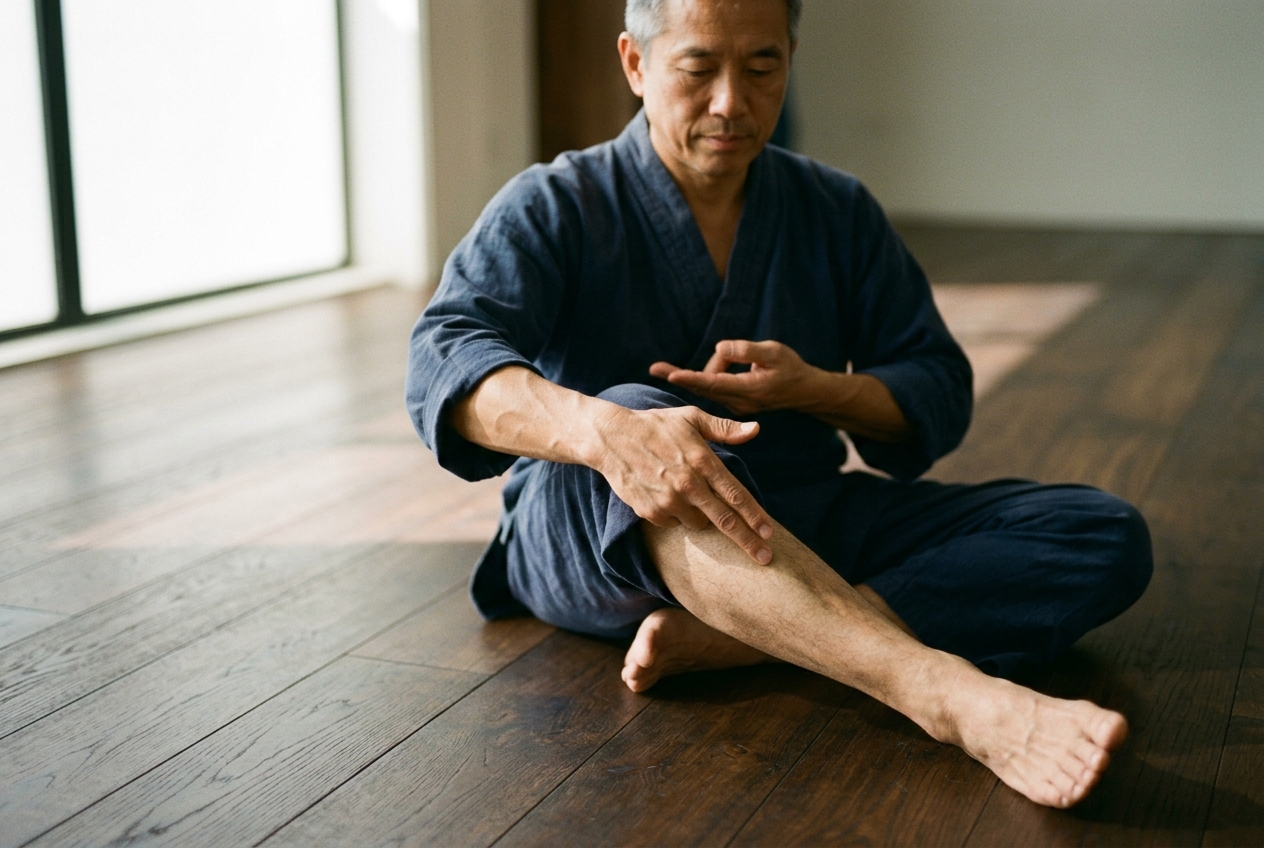
To resolve this stagnation, classical internal martial arts (Neigong / 内功) and traditional Chinese medicine target a master regulatory point on the lower leg known as Fenglong (Stomach 40, 丰隆), translated poetically as the "Abundant Bulge." Located midway up the outer shin within the deep muscular groove between the shin-lifting muscles and the outer ankle stabilizers, Fenglong functions as an anatomical and energetic sluice gate. By integrating mindful standing postures (Zhan Zhuang / 站桩), intention-driven diaphragmatic breathing (Yi Dao Qi Dao / 意到气到, meaning "where the intention goes, vital energy follows"), and micro-torsional weight shifts, we release chronic structural adhesions in the deep crural fascia. This restores fluid circulation, optimizes ground-reaction force up into the lower abdominal center (Xia Dantian / 下丹田), and clears physical and constitutional congestion from the entire body.
       ANTEROLATERAL CRURAL TOPOGRAPHY (RIGHT LEG, ANTERIOR-LATERAL VIEW)

              [ Patella / Knee Joint ]
                         |
      Tibial Tuberosity  |  Head of Fibula
              o          |      o
              |          |      |
  Tibialis    |          |      |  Peroneus Longus Muscle
  Anterior    |          |      |
  Muscle      |          |      |
              |   8 CUN  |      |  Extensor Digitorum Longus
              |  MIDWAY  |      |
              |          +------* <--- ST40 (FENGLONG)
              |                 |     (2 finger-breadths / 1.5 cun lateral
              |                 |      to anterior tibial crest, in groove
              |                 |      anterior to Peroneus Brevis)
              |                 |
  Tibia Bone  |                 |  Fibula Bone / Deep Crural Fascia
  Shaft       |                 |
              |                 |
              o-----------------o
       [ Medial           [ Lateral
       Malleolus ]        Malleolus ]
Step-by-Step Practice Guide: Decompressing the Fenglong Locus
Executing this practice requires no specialized equipment, only a flat surface, bare feet or thin flat-soled shoes, and mindful awareness. The protocol comprises four interconnected phases: anatomical location, static postural alignment, intention-breath vectoring, and dynamic Daoyin mobilization.
Phase 1: Precise Anatomical Palpation and Location of Fenglong (ST40)
- Find the Reference Landmarks: Sit on a chair with your knee bent at a 90-degree angle. Locate the prominence of your lateral malleolus (the outer ankle bone) and the lateral joint line of your knee (the depression just below your kneecap on the outer edge, corresponding to the lateral eye of the knee or ST35).
- Establish the Proportional Measurement: According to standard Chinese medical measurements, the distance between the lateral malleolus and the popliteal crease/lateral knee joint line is measured as 16 cun (proportional anatomical units). Fenglong sits exactly halfway up this distance—precisely 8 cun superior to the apex of the lateral malleolus.
- Locate the Intermuscular Groove: Place your index and middle fingers against the sharp anterior border of your shinbone (the tibia) at this midpoint. Slide your fingers laterally (outward) across the belly of the tibialis anterior muscle by approximately two finger-breadths (1.5 cun). Your fingertips will drop into a distinct anatomical valley or intermuscular cleft situated between the extensor digitorum longus muscle and the peroneus brevis muscle.
- Confirm the Locus: Apply firm, perpendicular pressure into this lateral intermuscular septum. You will typically evoke a distinct dull, distending, or mildly aching sensation—known clinically as De Qi (得气, the arrival of vital sensation). Maintain gentle circular pressure here with your thumb for thirty seconds per leg to awaken sensory-motor feedback before standing.
Phase 2: The Foundation — Zhan Zhuang (Standing Tree Alignment)
- Foot Placement: Stand with your feet parallel, outer edges aligned with the width of your shoulders. Ensure your weight is distributed across the classical "three tripod points" of each foot: the base of the big toe, the base of the little toe, and the center of the heel.
- Lower-Limb Tensegrity: Soften the knees without allowing them to collapse inward. Gently draw the knees outward over the line of the second and third toes to create an open, arch-like structure across the groin (Kua / 胯). This external spiral creates pre-tension across the lateral compartment of the lower leg, gently elongating the peroneus longus and brevis muscles surrounding Fenglong.
- Pelvic Neutrality: Tuck the sacrum down and forward slightly, lengthening the lumbar spine and releasing pressure from the lower back. Relax the abdominal wall completely.
- Upper Body Suspension: Imagine the crown of your head (Baihui / 百会, GV20) being suspended by an invisible silk thread from above, gently tucking the chin to lengthen the cervical vertebrae. Rest your palms over your lower abdomen, right over left for men, left over right for women, thumbs aligned with the navel.
Phase 3: Intention-Guided Breath Vectoring (Yi Dao Qi Dao)
- Diaphragmatic Inhalation: Inhale slowly and silently through the nose for a count of four. Feel your lower abdomen, flanks, and lower back expand in a 360-degree cylindrical fashion. Keep your shoulders, neck, and upper chest completely still.
- The Descent Vector: As the breath reaches its apex, do not hold it with a closed throat. Instead, initiate a smooth, unforced exhalation through the nose for six counts.
- Somatic Visualization: As you exhale, direct your cognitive intention (Yi / 意) downward from the lower abdominal reservoir (Xia Dantian), dividing through the hips, traveling down the anterolateral aspect of both thighs, and pouring straight through the bilateral Fenglong (ST40) cavities in your outer shins into the earth.
- Hydraulic Flushing: Imagine each exhalation flushing out murky, sluggish fluid accumulated in the lateral crural compartments, replacing it with light, clear, structural buoyancy. Repeat this conscious breathing cycle for 12 complete breaths.
Phase 4: Dynamic Daoyin Weight-Shifting and Torsional Ankle Mobilization
- Unilateral Loading: From your stable stance, slowly shift 70% of your body weight onto your left leg while keeping the pelvis level and the torso vertical.
- Torsional Shearing of the Crural Compartment: As the left leg receives weight, gently rotate your pelvis and torso 15 degrees to the left. Allow the left ankle to undergo a micro-eversion (a subtle flattening of the inner arch while keeping the outer heel grounded) followed by a spring-like rebound back into neutral. This creates a gentle myofascial wringing action along the intermuscular septum of the left ST40 locus.
- Dynamic Stepping (Daoyin Step): Peel the right heel off the floor, lift the right knee to hip height without tilting the pelvis, and extend the right foot forward, touching down with the heel first. As the weight transfers forward from heel to midfoot to ball, consciously engage the extensor muscles along the lateral shin.
- Percussive Resonance: To finish the movement, pause in a relaxed stance. Form loose, hollow fists with both hands. Bend forward slightly at the hips and rhythmically tap the outer shins along the ST40 region using gentle, hollow strikes for 30 to 45 seconds. The gentle vibration promotes interstitial fluid drainage and dispels local micro-spasms.
Common Beginner Mistakes and Precise Corrections
- Mistake 1: Genu Valgum (Knee Collapse)
The Error: Allowing the knees to buckle inward toward each other during standing or weight-shifting. This compresses the medial joint line and overstretches the lateral crural fascia without mobilizing it.
The Correction: Maintain a continuous outward opening through the Kua (creases of the hips), ensuring the kneecap tracks strictly over the second and third toes. - Mistake 2: Clenching the Toes (Gripping the Earth)
The Error: Curling the toes downward into the floor, which causes acute hypertonicity in the flexor digitorum longus and prevents the anterior/lateral compartment from releasing.
The Correction: Lift all ten toes off the floor, spread them as wide as possible, and lay them softly back down without tension. - Mistake 3: Upper-Chest Paradoxical Respiration
The Error: Raising the shoulders and expanding the ribcage upward on inhalation, which traps energy in the upper torso and prevents descending kinetic propagation.
The Correction: Place your hands firmly against the sides of your lower ribs and lower abdomen; ensure that all movement occurs beneath your navel while the sternum remains relaxed.
Proprioceptive Sensations: What to Look For
- Warmth or Gentle Heat: Indicates local microvascular dilation and increased peripheral perfusion following the release of fascial restriction.
- Fine Tingling or "Pebble-Dropping" Sensations: A sign of peripheral neural desensitization and sensory awakening within the superficial peroneal nerve branches.
- Heaviness Followed by Lightness: The initial sensation of thick, heavy sinking in the lower legs is the subjective experience of dampness draining; it is naturally succeeded by an airy, spring-loaded sensation during walking.
- Spontaneous Swallowing or Salivation: A classical hallmark of switching into a parasympathetic-dominant autonomic state as gastrointestinal motility and descending Stomach Qi are restored.
Why It Works: The Body Science
Modern clinical physiology and biomechanical sciences provide robust corroboration for the profound systemic effects experienced through the mobilization of the Fenglong cavity.
1. Fascial Compartments, Mechanotransduction, and Kinetic Chains
The human lower leg is divided into four distinct anatomical compartments enclosed by the unyielding fascia cruris: the anterior, lateral, superficial posterior, and deep posterior compartments. Fenglong (ST40) sits directly over the anterior intermuscular septum, which separates the anterior compartment (containing the tibialis anterior and extensor digitorum longus) from the lateral compartment (housing the peroneus longus and peroneus brevis).
          CROSS-SECTION OF MID-CALF (TRANSVERSE VIEW, RIGHT LEG)

                            ANTERIOR
                        [ Anterior Crest ]
                             (Tibia)
                    /-----------------------\
                   /   Tibialis     Extensor \
                  |    Anterior    Digitorum  |
                  |                  Longus   |
   MEDIAL         |                           |  <-- Anterior Intermuscular
 (Tibial Shaft)   | [TIBIA]                   |      Septum & ST40 LOCUS
                  |       \    [FIBULA]       |
                  |  Deep  \  /   Peroneus    |         LATERAL
                  | Posterior \    Longus     |      (Fibula / Peroneal
                  | Compartment \  & Brevis   |       Compartment)
                   \             \           /
                    \   Gastrocnemius &     /
                     \     Soleus          /
                      \-------------------/
                            POSTERIOR
In sedentary individuals or athletes with repetitive strain, micro-adhesions and densification of hyaluronic acid form within this intermuscular septum. This fascial restriction tethers the extensor digitorum longus to the peroneus brevis, creating chronic stiffness that disrupts the entire Spiral Line and Lateral Line kinetic chains described in modern tensegrity models. When Zhan Zhuang standing and dynamic Daoyin torsion are applied, shear stresses deform fibroblasts within this septum. Through mechanotransduction—a cellular process extensively documented in research published by the National Center for Biotechnology Information (NCBI)—these mechanical forces stimulate the release of matrix metalloproteinases, breaking down pathological cross-links, rehydrating the ground substance, and restoring frictionless sliding between adjacent muscle bellies.
2. Hydraulic Pumping, Venous Return, and Interstitial Fluid Clearance
The classical concept of "clearing turbid dampness" maps directly onto modern lymphatic drainage and venous return mechanics. The lower extremity relies heavily on the peripheral muscular pump of the calf to propel deoxygenated blood and lymphatic fluid back toward the central thoracic cavity against gravity. Because the deep crural fascia is rigid, muscular contractions and relaxations create significant fluctuating intramuscular pressure gradients. Stagnant interstitial fluid—rich in inflammatory cytokines, cellular debris, and metabolic byproducts—is squeezed through open micro-lymphatic valves into the deep collector vessels.
When tension at ST40 is released, microvascular resistance drops dramatically, reducing peripheral edema and systemic fluid sluggishness. As recognized in global clinical guidelines from the World Health Organization Traditional Medicine framework, activating distal lower-extremity points produces measurable systemic hemodynamic and homeostatic modulations.
3. Autonomic Regulation, Diaphragmatic Descent, and Vagal Tone
The somatic breath vectoring (Yi Dao Qi Dao) employed in this practice activates slow-adapting pulmonary stretch receptors during deep diaphragmatic excursions. When the diaphragm descends fully, it increases intra-abdominal pressure, gently massaging the abdominal viscera and stimulating the celiac and mesenteric neural plexuses.
Studies available through National Library of Medicine PubMed demonstrate that paced respiration at approximately 5.5 to 6 breaths per minute induces cardiac-vagal resonance, significantly boosting heart rate variability (HRV) and triggering robust parasympathetic nervous system dominance. The vagal efferent outflow enhances gastrointestinal peristalsis, bile secretion, and digestive enzyme production—the exact physiological equivalent of the traditional Chinese medical assertion that ST40 fortifies the Spleen's digestive capacity to transform metabolic dampness at its root.
4. Ground-Reaction Force Transmission to the Pelvic Core
From a structural biomechanics standpoint, releasing the lateral crural compartment restores freedom of motion to the subtalar and talocrural ankle joints. When the foot interacts with the ground, ground-reaction forces are smoothly transmitted upward through the tibia and fibula, passing through an unlocked knee directly into the femoral head and the acetabulum of the pelvis.
This efficient mechanical vector prevents energy leakage at the ankle or knee, allowing physical kinetic energy to integrate directly with the muscular sling of the pelvic floor and transversus abdominis—the anatomical anchor of the lower abdominal core (Xia Dantian).
Classical Lineage & Context: The Heritage of Fenglong
The lineage of Fenglong as a primary therapeutic gateway extends across two millennia of clinical scholarship and esoteric Daoist cultivation. To understand its stature, one must examine its place in canonical texts and the continuous evolution of somatic lineage traditions.
The Foundation: Huangdi Neijing (The Yellow Emperor's Classic of Internal Medicine)
The earliest comprehensive textual exposition of Fenglong appears in the Lingshu (灵枢 - The Miraculous Pivot), compiled around the 1st century BCE, specifically within Chapter 10 (Jingmai / 经脉 - The Meridians). Here, Fenglong is formally designated as the Luo-Connecting Point (Luo Xue / 络穴) of the Foot Yangming Stomach Meridian.
In classical channel theory, while the primary meridian travels down the leg toward the second toe, the Luo-connecting collateral branches off at ST40, crosses the intermuscular boundary, and merges directly into the interiorly-exteriorly paired Foot Taiyin Spleen meridian. The Lingshu states:
"The Luo-connecting vessel of the Foot Yangming is named Fenglong. It originates eight cun above the external malleolus and joins the Taiyin. When rebellious, it causes swelling and pain in the throat, sudden loss of voice, and madness; when deficient, it causes flaccidity and weakness of the lower legs and feet."
This dual connection is clinically profound. In traditional Chinese medical physiology, the Spleen is tasked with the transformation and transportation of fluids (Yun Hua / 运化), yet it is inherently vulnerable to damp congestion. The Stomach is responsible for ripening food and driving descending kinetic dynamics (Jiang Ni / 降逆). By acting as the bridge between Spleen and Stomach, Fenglong possesses the unique functional capacity to recruit the strong, downward-clearing force of Yangming Stomach Qi to drain dampness and fluid congestion accumulated within the Taiyin Spleen system.
The Lyric Masterpiece: The Ode of the Jade Dragon (Yu Long Ge)
By the Song and Yuan dynasties, clinical experience had elevated Fenglong to the status of an absolute sovereign point for transforming phlegm. In the 13th-century masterpiece Yu Long Ge (玉龙歌 - The Ode of the Jade Dragon), composed by the celebrated master Dou Hanqing, Fenglong was canonized in poetic verse designed for oral transmission among lineage disciples:
“Phlegm and dampness cause countless obscure diseases,
Dazing the mind and congesting the chest with stagnation;
Search out Fenglong and apply the needle with skill,
The turbid descends, the clear ascends, and health is instantly restored.”
In the classical understanding, phlegm (Tan) was not restricted merely to visible bronchial mucus. It was categorized into "Substantial Phlegm" (viscous secretions in the lungs and throat) and "Formless Phlegm" (microscopic accumulations that obstruct the heart orifices, dull the sensory faculties, cause joint immobility, and create mental fog, dizziness, and emotional lethargy). Master Gao Wu’s later Ming Dynasty work, the Zhen Jiu Ju Ying (针灸聚英 - Collection of Gems in Acupuncture), re-emphasized that regardless of where phlegm resides—in the head, the channels, the lungs, or the joints—Fenglong remains the master regulator capable of dissolving and eliminating it through the downward pathway of the gastrointestinal and urinary tracts.
Daoist Daoyin and Internal Martial Arts (Neigong) Integration
Parallel to the clinical acupuncture lineage, Daoist mountain hermits and martial adepts recognized the biomechanical and energetic necessity of decompressing ST40. In traditions preserved by organizations such as the National Qigong Association, moving through physical forms like the Baduanjin (Eight Pieces of Brocade) or the stationary root-cultivation of Zhan Zhuang relied on unobstructed channels along the lower legs.
Lineages of Xingyiquan and Taijiquan noted that if the lateral crural compartment remained stiff or adhered, the practitioner could never achieve true "Rooting" (Chen Gen / 沉根). A locked Fenglong compartment prevented the practitioner's internal Qi and weight from sinking into the bubbling spring point on the sole of the foot (Yongquan, Kidney 1), causing the upper body to become top-heavy, the breath to rise into the chest, and the mind to become irritable. Thus, specific Daoyin stepping patterns and percussive tapping protocols along the anterolateral shin were systematically embedded into the preparatory stages of Neigong training to ensure the lower extremity remained a fluid, supple conductor of kinetic power and earth energy.
Today's Practice Commitment: The 7-Minute Morning Reset
To experience the transformative somatic and physiological benefits of decompressing the Fenglong cavity, commit to this streamlined, 7-minute morning routine every day for the next seven days, ideally practiced barefoot immediately after waking and before your morning beverage.
- Minute 0:00 – 1:00 (Palpation & Awakening): Sit down. Locate ST40 on both legs (8 cun above the outer ankle, two finger-breadths lateral to the shin crest). Apply deep, circular thumb pressure for 30 seconds per leg until a warm, aching De Qi sensation is established.
- Minute 1:00 – 4:00 (Zhan Zhuang Standing & Breath Vectoring): Stand up in parallel alignment, knees soft, hips relaxed. Take 18 slow, rhythmic diaphragmatic breaths (4 seconds in, 6 seconds out). On every exhalation, guide your awareness from your lower belly down through both ST40 points into the floor.
- Minute 4:00 – 6:00 (Dynamic Weight Shifts & Torsion): Perform 12 slow weight shifts side-to-side, gently spiraling the pelvis and allowing the loaded ankle to experience a subtle, micro-wringing sensation through the outer crural compartment.
- Minute 6:00 – 7:00 (Percussive Resonance & Integration): Form soft, hollow fists and tap lightly along the ST40 region on both shins for 45 seconds. Stand completely still for the final 15 seconds, eyes closed, feeling the rush of warmth, lightness, and grounded stability rising through your entire body.
Observe over the course of your week how this simple somatic gateway eliminates morning sluggishness, clarifies your mental focus, and restores effortless, fluid poise to your daily movement.