Daoyin Techniques (Dao Yin Fa) Meridian Dynamics: Governing Postural Alignment, Respiratory-Kinetic Synchronization, Fascial Meridian Traction, and Visceral Qi Mobilization in Traditional Chinese Medicine
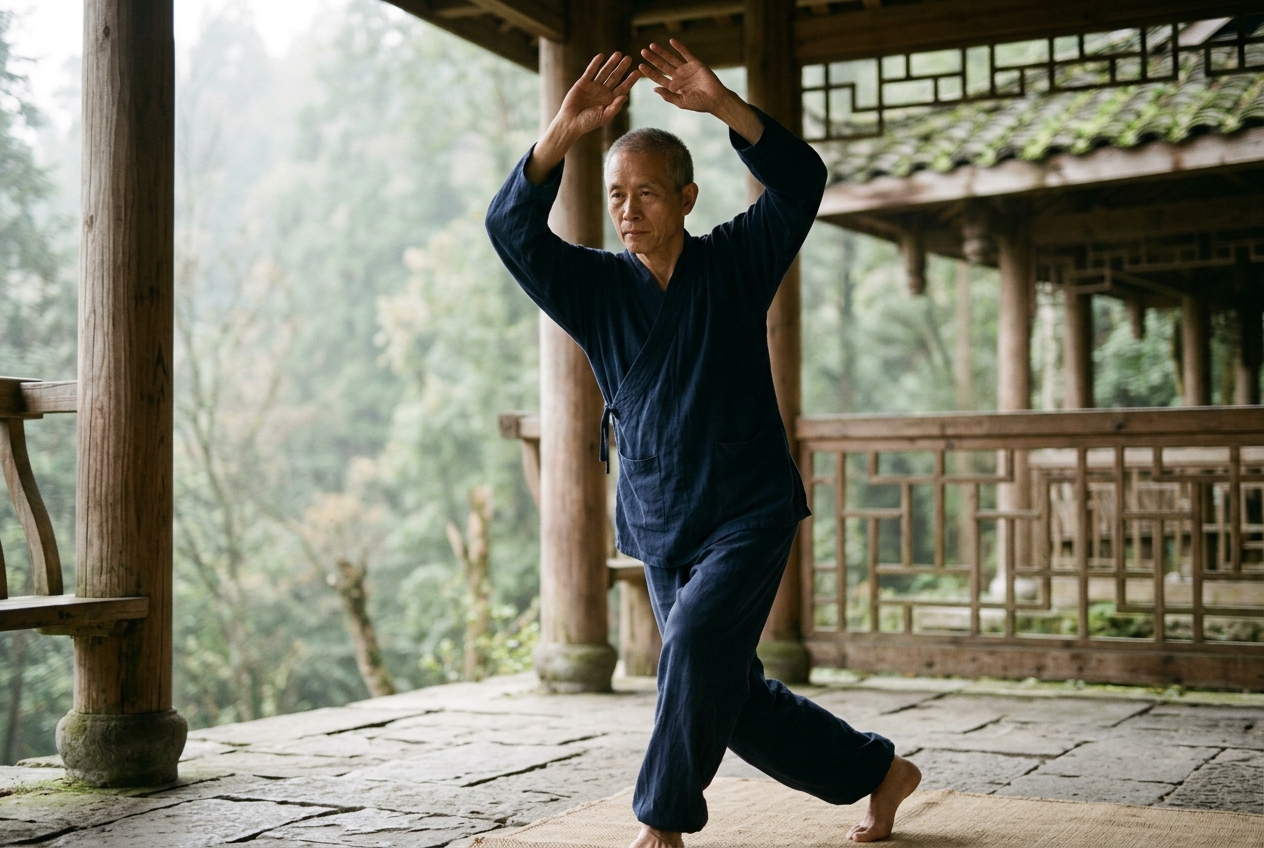
By synthesizing ancient Han dynasty kinetic practices with contemporary connective tissue biology and autonomic neuroscience, modern medicine is rediscovering how the deliberate alignment of posture, respiration, and conscious intention systematically unloads the nervous system and restores visceral homeostasis.
1. Opening Scene — A Moment You'll Recognise
Consider the somatic signature of a late afternoon spent pinned to an office chair. Your shoulders have imperceptibly crept toward your ears; the posterior cervical spine feels compacted under the gravitational weight of a forward-tilted skull; your breathing has contracted into a shallow, rapid flutter confined strictly to the apical lobes of the lungs; and an overarching cognitive fog envelops your prefrontal cortex. When you finally stand, an instinctual urge takes over: you interlace your fingers, invert your palms toward the ceiling, arch your spine backward in an expansive yawn, and release a long, shuddering exhalation.
In that single, unchoreographed movement, you have performed the rudimentary mechanics of Daoyin (導引). What modern Western ergonomics categorizes as simple postural resetting is understood in Traditional Chinese Medicine (TCM) as the urgent clearance of Qi (vital functional energy) and Xue (blood) stasis. For over two millennia, Chinese medical scholars have recognized that sedentary confinement and emotional distress physically constrict the body’s sinew channels, freeze the diaphragmatic pump, and deprive internal organs of requisite neurovascular perfusion. Daoyin was engineered not merely as calisthenics, but as a sophisticated, patient-directed medical technology designed to reverse this systemic stagnation from the inside out.
2. What This System Does: Classical Taxonomy and the Tripartite Regulatory Framework
At its core, Daoyin represents the dynamic kinetic branch of classical Chinese therapeutics. The term itself is an etymological composite of two distinct clinical actions: Dao (導), meaning to guide, direct, or conduct the circulation of Qi and fluids through intentional somatic focus and specific movement vectors; and Yin (引), meaning to stretch, lengthen, and articulate the sinews, myofascial planes, and joint capsules to maintain mechanical patency throughout the channel network.
The historical trajectory of Daoyin is intimately woven into the foundational canons of Chinese intellectual history. The philosophical masterwork Zhuangzi (c. 4th century BCE) offers one of the earliest literary references to these methods, observing that ancient practitioners would "pant, exhale, inhale, blow out the old breath and draw in the new, practicing bear-hangings and bird-stretchings" to achieve systemic longevity.
Medical codification arrived in the seminal Huangdi Neijing Suwen (The Yellow Emperor’s Inner Classic: Basic Questions). In Chapter 12, Yi Fa Fang Yi Lun (Treatise on the Different Methods of Treatment Suited to Different Conditions), the text establishes a geographic and physiological taxonomy of healing arts. It notes that the inhabitants of the central geographical plains—living in a temperate, damp environment and consuming a diverse diet without excessive physical toil—frequently suffered from cold syndromes, muscular weakness, and vascular stagnation. For these pathologies, the imperial physicians prescribed Daoyin alongside Anmo (therapeutic massage), cementing active movement as a primary clinical intervention rather than an adjunct philosophy.
Archaeological confirmation of these ancient regimens was uncovered in 1973 with the excavation of the Han tomb at Mawangdui in Changsha, Hunan province. The tomb yielded the famous Mawangdui Daoyin Tu (c. 168 BCE), a polychrome silk manuscript illustrating 44 distinct figures engaged in therapeutic exercises. These illustrations capture an extraordinarily mature clinical taxonomy, categorizing specific bodily postures, animal mimetics (such as the crane, monkey, and dragon), and breathing techniques aimed at alleviating specific somatic ailments, including knee pain, gastrointestinal distension, and febrile disorders.
To execute Daoyin with clinical precision, the practitioner must integrate the Tripartite Regulatory Framework (San Tiao 三調):
1. Body Regulation (Tiao Shen 調身)
Body regulation demands a total departure from rigid muscular contraction, prioritizing structural integrity rooted in skeletal alignment. The practitioner establishes a dynamic equilibrium through the Wuji (neutral) stance: the feet are grounded firmly into the earth (anchoring through the kidney meridian point Yongquan, KI-1), the knees remain micro-flexed to prevent articular jamming, the pelvis is neutrally tucked to flatten excessive lumbar lordosis, and the sacrum sinks as if weighted. This structural disposition roots the center of mass in the lower Dantian (the lower abdominal energetic center). Simultaneously, the crown of the head (Baihui, GV-20) gently suspends upward, initiating axial spinal decompression and releasing tension across intervertebral discs.
2. Breath Regulation (Tiao Xi 調息)
Daoyin utilizes diaphragmatic, abdominal, and reverse-abdominal breathing (Ni Fushi Huxi) to drive physiological change. Rather than allowing respiration to remain an unconscious autonomic reflex, the practitioner synchronizes tidal respiratory phases directly with spatial movement vectors. Inward and upward kinetic movements (expansion, spinal extension, limb elevation) are synchronized with inhalation, charging the thoracic cavity and promoting outward arterial perfusion. Downward, inward, and twisting movements (condensation, joint closure, flexion) correspond to exhalation, facilitating systemic neuromuscular release and the downward descent of Turbid Qi (Zhuo Qi).
3. Mind Regulation (Tiao Xin 調心)
The mental component hinges upon Yi (意)—focused conscious intention. Classical theory dictates: Yi Dao Qi Dao (意到氣到)—"Where the intention goes, the Qi follows." In contemporary neurological terms, this involves the deliberate deployment of top-down somatosensory attention. By focusing interoceptive awareness along specific meridian trajectories or anatomical regions during movement, the practitioner enhances cortical representation, increases local nitric oxide release, and amplifies localized microvascular perfusion.
3. How You Can Feel It: Signs of Balance and Imbalance
The human body provides immediate, tangible feedback regarding the patency or obstruction of its channel network. When Daoyin dynamics are absent from daily life, the somatic landscape degrades along predictable diagnostic lines:
| Diagnostic Pattern | Subjective Signs & Symptoms | Objective Somatic & Fascial Markers |
|---|---|---|
| Channel & Sinew Stagnation (Bi Syndrome) | Localized achiness, stiffness upon waking, joint crepitus, feeling "locked" in the mornings | Myofascial trigger points, reduced articular range of motion, collagen cross-linking along Jing Jin pathways |
| Liver Qi Constraint (Gan Qi Yu Jie) | Emotional irritability, chronic sighing, hypochondriac tension, globus hystericus (throat lump) | Hypertonicity of the respiratory diaphragm, restricted intercostal expansion, elevated resting sympathetic tone |
| Middle Burner Stasis (Pi Wei Bu He) | Postprandial somnolence, abdominal bloating, sluggish metabolism, brain fog | Hypoactive gastrointestinal motility, splanchnic venous pooling, diminished abdominal core temperature |
| Systemic Yang Deficiency (Yang Xu) | Aversion to cold, icy extremities, chronic low back fatigue, lack of physical drive | Reduced peripheral microvascular capillary flow, sluggish baroreflex response, postural collapse |
                       SELF-ASSESSMENT CHECKPOINT

  Check yourself right now:
  [ ] Clench your jaw: Is there baseline tenderness in the masseter muscle?
  [ ] Take a deep breath: Does your chest lift while your belly remains still?
  [ ] Rotate your neck: Is there gritty resistance or restricted rotation?
  [ ] Observe your hands: Are your fingers cold or pale compared to your arms?

  Presence of two or more indicators confirms interstitial stasis and
  myofascial restriction, warranting kinetic Daoyin intervention.
Fascial Mechanotransduction and Jing Jin (Sinew Channel) Dynamics
To understand why Daoyin resolves these symptoms, we must examine the interface between the classical Jing Jin (Sinew Channels) and modern fascial anatomy. The Jing Jin represent continuous planes of connective tissue, tendons, and muscular pathways that wrap, brace, and articulate the musculoskeletal framework, mirroring the longitudinal anatomical meridians described by modern fascial researchers.
When a Daoyin exercise executes a slow, torsional joint rotation combined with eccentric loading, it subjects the extracellular matrix (ECM) to continuous shear stress. Research into fascial mechanotransduction illustrates that mechanical deformation of fibroblasts stimulates cytoskeletal remodeling, triggers collagen realignment, and releases bound water molecules within the interstitial fluid (a transition from a rigid "gel" state to a fluid "sol" state).
Furthermore, collagenous tissue possesses crystalline, piezoelectric properties: mechanical deformation generates minute electrical potentials that propagate along continuous fascial sheets. In the framework of TCM, this biophysical signal transduction is the physical correlate of stimulating channel Qi, breaking down chronic adhesions (Bi syndrome), and restoring laminar flow through the microvasculature.
Neuro-Autonomic and Somatovisceral Modulation
Simultaneously, Daoyin acts as a potent regulator of the central and autonomic nervous systems. Slow, deep, diaphragmatic breathing coupled with structural axial elongation stimulates the afferent pathways of the vagus nerve (Cranial Nerve X). As demonstrated in clinical studies on vagal nerve activation and mind-body therapies, this mechanical descent of the diaphragm compresses and decompresses the abdominal viscera, physically massaging the Spleen, Stomach, and mesenteric vasculature.
This rhythmic visceral mobilization enhances gastrointestinal peristalsis, assisting the Spleen in its classical role of "transformation and transportation" (Yun Hua). Centrally, the afferent vagal barrage terminates in the nucleus tractus solitarius (NTS) within the brainstem, driving a rapid upregulation of parasympathetic vagal tone, optimizing baroreflex sensitivity, and suppressing the hypothalamic-pituitary-adrenal (HPA) axis. The result is a precipitous drop in serum cortisol, systemic vasodilation, and the alleviation of somatic hyperarousal.
4. Qigong & Movement Practice: The Dual Regimen of Heavenly Support and Archer's Draw
The following two-part protocol synthesizes two of the most potent classical Daoyin exercises from the Ba Duan Jin (Eight Brocades) tradition, specifically engineered to open the Triple Burner (San Jiao) and soothe Liver Qi constraint.
Movement 1: Two Hands Hold Up the Heavens (Shuang Shou Tuo Tian)
Target Meridians: The Triple Burner (San Jiao), Conception Vessel (Ren Mai), and the Anterior Fascial Line.
1. Starting Position and Setup
Stand with feet parallel, shoulder-width apart. Micro-flex the knees. Release the tailbone vertically toward the floor. Rest the tongue lightly against the hard palate behind the upper incisors (completing the energetic circuit between the Ren and Du channels). Allow the arms to hang naturally at your sides, with empty space in the axillae as if holding a small bird's egg beneath each armpit.
2. Execution & Breath Timing
- Phase A (Gathering / Inhalation): Bring the hands in front of the lower abdomen, palms facing upward, fingers loosely interlacing. Begin a slow, deep diaphragmatic inhalation through the nose. Smoothly draw the interlaced hands up the midline of the body past the chest (Tanzhong, CV-17).
- Phase B (Inversion & Extension): As the hands reach the throat, rotate the palms outward and push upward toward the ceiling. Straighten the arms without hyperextending the elbows. Simultaneously, press down through the heels into the earth, feeling the entire anterior fascial chain and spine elongate axially. Gaze softly upward at the backs of your hands. Hold this suspended elongation at the peak of your inhalation for 2 seconds.
- Phase C (Descent / Exhalation): Unlock the fingers, turn the palms outward, and exhale smoothly through the nose. Allow the arms to trace wide, sweeping arcs down to your sides, visualizing stagnant heat and turbid energy descending through the soles of your feet into the earth. Return the hands to the lower abdomen.
3. Dosage & Duration
Execute 8 complete repetitions. Maintain a steady, unbroken rhythm (approximately 6 seconds for the ascending inhalation, 2-second apical suspension, 6 seconds for the descending exhalation).
4. Sensations & Clinical Signifiers
Look for a spreading, radiating warmth through the epigastrium and palms, accompanied by a distinct release of tension along the ribcage. A spontaneous deep sigh or gentle gastrointestinal gurgling (borborygmi) indicates the activation of the parasympathetic state and the clearance of stagnant Middle Burner Qi.
Movement 2: Drawing the Bow to Shoot the Hawk (Zuo You Kai Gong Si She Diao)
Target Meridians: The Lung (Shou Taiyin), Large Intestine (Shou Yangming), and Liver (Zue Jueyin) Sinew Channels.
1. Starting Position and Setup
Step out into a wide horse stance (Ma Bu), approximately one-and-a-half times shoulder width. Sink the pelvis down, keeping the torso strictly erect and the knees tracking over the second toes.
2. Execution & Breath Timing
- Phase A (Crossing / Inhalation): Cross the wrists in front of the chest at the level of the heart, right wrist on the outside. Inhale deeply, expanding the posterior ribcage and lateral costal margins.
- Phase B (Drawing the Bow / Dynamic Tension): Form a dynamic "sword-finger" mudra or an open L-shape with the left hand (extending the thumb and index finger along the Large Intestine meridian). Extend the left arm horizontally to the left, gazing intensely past the index finger. Simultaneously, pull the right hand back toward the right shoulder as if drawing a heavy composite bowstring, retracting the right scapula and opening the chest fully. Hold the dynamic torsional tension across the pectoralis and upper back for 2 seconds.
- Phase C (Release & Re-centering / Exhalation): Exhale slowly, opening both hands, softening the posture, and sweeping the arms back across the midline to cross the wrists with the left wrist outside.
- Phase D (Alternate): Repeat the movement drawing the bow to the right side.
3. Dosage & Duration
Execute 6 alternating repetitions (3 per side).
4. Sensations & Clinical Signifiers
Feel the intense fascial stretch traversing from the chest down the inner seam of the outstretched arm into the thumb and index finger. This clears constriction in the chest, optimizes Lung capacity, and mobilizes constrained Liver Qi across the hypochondrium.
5. Acupressure Points You Can Try Today
To amplify the physiological benefits of kinetic Daoyin, targeted stimulation of specific acupoints helps clear local myofascial nodes and anchor the redirected Qi.
1. Zusanli (足三里, ST-36) — "Leg Three Miles"
- Anatomical Location: Sit with your knees bent at 90 degrees. Locate the depression below the lateral edge of the patella (the lateral "eye" of the knee). Measure four finger-widths directly downward from this point, then move one thumb-width lateral to the anterior crest of the tibia. You will locate a subtle muscular depression within the tibialis anterior muscle.
- Application Technique: Apply firm, deep perpendicular pressure using the tip of your thumb or a rounded knuckle. Execute small, slow, clockwise circular friction for 2 to 3 minutes per leg. The sensation should be a pronounced dull, spreading ache (Deqi) that may travel down the anterior lateral compartment of the lower leg.
- Clinical Indications: Widely referenced across clinical acupuncture trials for stimulating gastrointestinal motility, boosting cellular energy output, alleviating postprandial lethargy, and combating systemic fatigue.
2. Neiguan (內關, PC-6) — "Inner Gate"
- Anatomical Location: Turn your palm facing upward. Place three fingers of your opposite hand across the transverse wrist crease. The point lies directly beneath the index finger, centered precisely between the two prominent, palpable tendons of the forearm: the flexor carpi radialis and the palmaris longus.
- Application Technique: Press deeply into the inter-tendinous groove using the fleshy pad of your thumb. Angle the pressure slightly proximally (toward the elbow). Maintain continuous, firm pressure while taking slow, 6-second diaphragmatic breaths for 2 minutes on each wrist.
- Clinical Indications: PC-6 is the premier point for regulating the autonomous nervous system, soothing cardiac palpitations, mitigating situational anxiety, opening diaphragmatic constriction, and settling nausea.
3. Taichong (太衝, LR-3) — "Great Surge"
- Anatomical Location: On the dorsum of the foot, locate the webbing between the big toe and the second toe. Slide your finger proximally along the groove between the first and second metatarsal bones until your finger drops into the V-shaped depression just before the junction of the bones.
- Application Technique: Apply firm, angled pressure toward the heel using your thumb. Because this point frequently accumulates stagnant stress tension, the sensation can be quite sharp. Apply pressure for 90 seconds to 2 minutes per foot, pairing the stimulation with deep, releasing exhalations.
- Clinical Indications: The primary distal point for resolving Liver Qi stagnation, mitigating tension headaches, reducing muscular irritability, and releasing the clamped somatic patterns associated with chronic psychological stress.
6. Food & Lifestyle: Small Changes for Today
Supporting the elasticity of the sinews (Jin) and maintaining channel conductivity requires nourishing the blood and preventing cold-induced stagnation within the extracellular matrix.
1. Dietary Therapeutics: Hydrating the Matrix
- Add Collagen-Rich and Moistening Foods: The classical sinews depend on adequate Liver Blood and Kidney Yin for their supple glide. Introduce gelatinous bone broths, slow-cooked connective tissues, and soaked black sesame seeds into your weekly diet. These provide the precise amino acid profiles (glycine, proline, hydroxyproline) necessary for continuous fascial regeneration.
- Introduce Warming Carminatives: Drink freshly steeped ginger and dried tangerine peel (Chen Pi) tea throughout the day. This warms the Middle Burner, facilitates the enzymatic breakdown of nutrients, and prevents the internal accumulation of "Cold-Damp" which causes the ground substance of connective tissue to thicken and stiffen.
- Reduce Cold, Raw, and Inflammatory Inputs: Eliminate iced beverages, particularly during meals. Ingesting freezing liquids abruptly shocks the gastric vasculature, inhibiting digestive enzymes and inducing a systemic vasoconstrictive reflex that immediately tightens the deep pelvic and abdominal fascia.
2. Ergonomics and Kinetic Rhythmicity
- The 45-Minute Spinal Reset: Never remain in static seated compression for more than 45 minutes. Set an unobtrusive recurring timer. When it sounds, stand, perform three cycles of Two Hands Hold Up the Heavens, and rotate the sacrum in wide circles. This simple protocol prevents collagen cross-linking and restores the hydraulic fluid pressure of the intervertebral discs before chronic dehydration sets in.
3. Active Daoyin vs. Passive Interventions: The Clinical Synthesis
A common clinical error is viewing Daoyin as mutually exclusive from external clinical therapies such as acupuncture, Tuina (medical massage), and cupping. In the classical paradigm, these modalities occupy complementary positions along the healing continuum.
Passive modalities are unmatched for the acute resolution of severe stasis: acupuncture unblocks localized electrical resistance in the meridian, Tuina manually breaks down dense structural adhesions, and cupping extracts deep myofascial micro-stasis to the superficial capillary beds.
However, passive interventions cannot retrain the central nervous system's motor cortex, nor can they establish active diaphragmatic excursion or self-directed interoception. Daoyin provides the active, neuroplastic reinforcement. While passive clinical modalities open the obstructed channels, patient-driven Daoyin practice continually circulates Qi, re-educates the neuromuscular apparatus, and secures lasting visceral health.
7. Today's Takeaway
If you do only one thing for your body today, step away from your screens, stand in a neutral posture with your knees soft, and perform two minutes of conscious, intention-guided spinal elongation: inhale deeply as you raise your hands overhead to decompress the intervertebral spaces, hold for two quiet seconds while feeling the connective tissue stretch from your soles to your palms, and exhale smoothly as you lower your arms, deliberately releasing the accumulated tension in your jaw, diaphragm, and lower back into the earth.