Cuanzhu Cavity Gathering Bamboo: Supraorbital Fascial Decompression, Ophthalmic Neurovascular Modulation, and Bladder Channel Cranial Conduction in Classical Neigong
In the terminology of Traditional Chinese Medicine and classical internal alchemy (Neigong), this precise anatomical point is known as Cuanzhu (translated as "Gathering Bamboo," categorized as Bladder 2 or BL 2). Classical master practitioners identified Cuanzhu as the primary structural and energetic gateway for ascending Yang Qi—the active, bio-electric, and warming functional energy of the body. Situated as the second point along the Foot Taiyang Bladder Channel (Zutaiyang Pangguangjing), Cuanzhu receives the ascending energetic stream originating from the inner canthus at Jingming (BL 1), conducts it upward over the cranial vault to the vertex, and channels it over the occiput into Tianzhu ("Heavenly Pillar," BL 10) before descending the entire posterior kinetic chain of the body. When Cuanzhu becomes mechanically compressed or energetically congested, stagnant heat accumulates in the eyes and frontal lobes, clouding the Upper Dantian (Shang Dantian)—the energetic chamber located behind the midpoint of the eyebrows associated with cognitive clarity and the illumination of Shen (spirit and refined awareness).
STEP-BY-STEP PRACTICE GUIDE
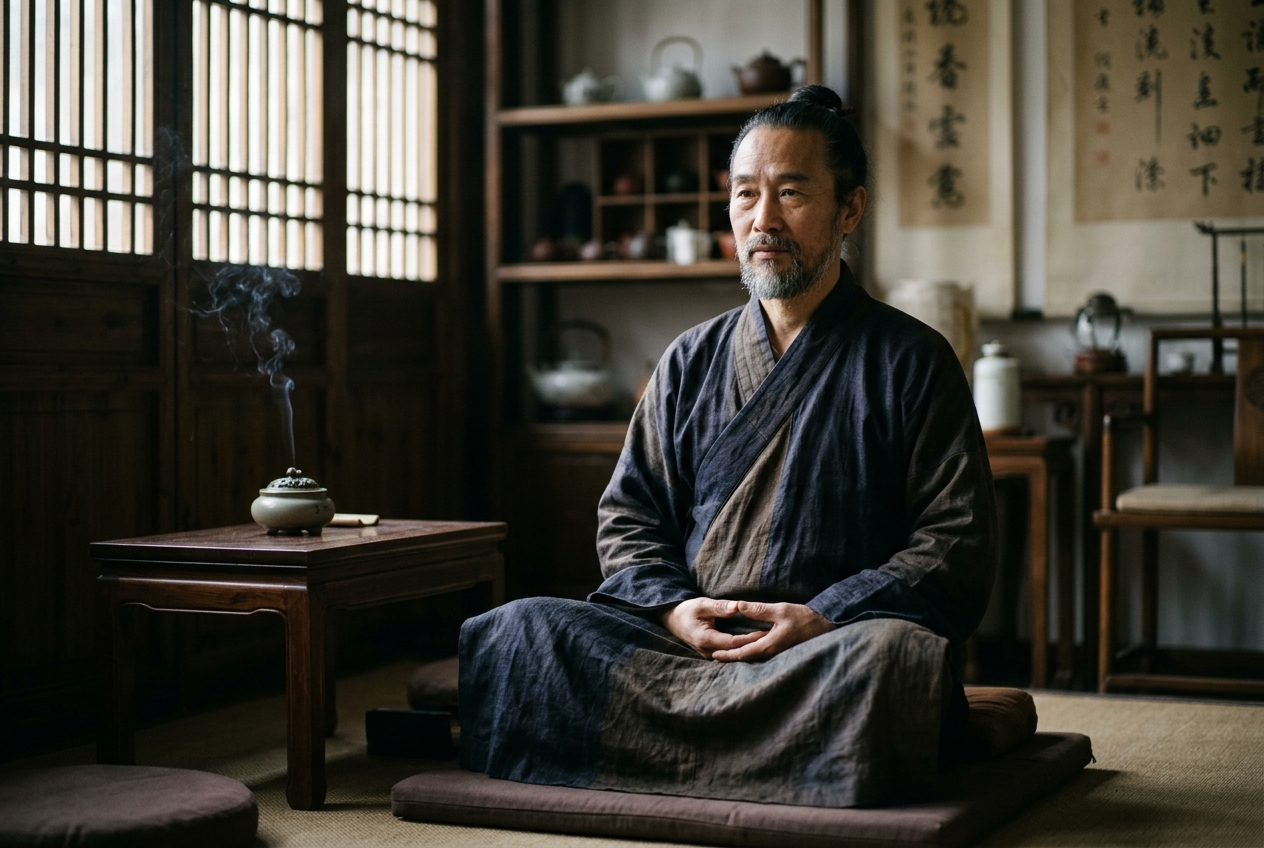
This sequence can be executed either seated in an upright, stable chair or in a classical crossed-legged meditation posture (Lianhuazuo). Practice in a quiet environment free of glaring blue light.
1. Basal Alignment and Lower Center Anchoring
Begin by establishing a stable somatic base. Ground your sitz bones firmly into your seat, tuck your sacrum slightly to open the lumbar curve (Mingmen), and allow your chin to subtly retract so that the crown of your head (Baihui, GV 20) feels suspended from above by an invisible silk cord. Rest your tongue against the upper palate behind the incisors to bridge the Conception (Ren) and Governing (Du) vessels. Breathe naturally into your lower abdomen—the Lower Dantian, located approximately two inches below your navel—allowing your belly to expand three-dimensionally on the inhalation and gently recede on the exhalation. Spend three minutes establishing this calm, parasympathetic rhythm.
2. Tactile Localization of the Supraorbital Notch
Raise both arms with relaxed, heavy elbows, keeping your shoulders dropped away from your ears. Bring the radial aspect or the fleshy pads of your index or middle fingers to the medial borders of the orbital rims. Palpate gently along the superior orbital margin until you detect the bilateral groove or small bony notch (incisura supraorbitalis) situated in the frontal bone directly above the inner corner of each eye. * The Touch: Do not press, dig, or knead. The contact pressure must not exceed five to ten grams—equivalent to the weight of a single coin. Your fingers act merely as stationary fulcrums of mindful awareness rather than mechanical tools of deep-tissue manipulation.
3. Spiral Micro-Intention (Yi Dao Qi Dao)
In classical Daoist somatic training, the principle of Yi Dao Qi Dao ("Where the intention goes, the Qi follows") dictates that physical tissue follows microscopic, non-muscular neuromuscular intentional vectors. * With your fingers resting lightly on Cuanzhu, cultivate a subtle, inward-and-upward spiral intention within the notch. Visualize the fibers of the brow gently unfurling outward like soft bamboo shoots uncoiling in spring rain. * Direct your inner gaze (Neishi) into the hollow of each notch, perceiving the space between the frontal bone and the eyebrow tissues expanding on a microscopic scale.
4. Synchronized Respiration and Cranial Conduction
Synchronize your breath with the following directional pathways: * On the Inhalation (4 to 5 seconds): Draw smooth, quiet air through the nasal passages down to the Lower Dantian. Simultaneously, sense a clear, cool current of bio-electric vitality ascending from the soles of your feet, climbing up the posterior kinetic chain, and arriving at Cuanzhu. As the breath fills the lower abdomen, visualize the supraorbital notches subtly opening and lifting away from the eyeball. * On the Exhalation (6 to 8 seconds): Let the breath exit slowly through the nose. Channel the energetic stream from Cuanzhu upward over the curvature of the forehead (Frontalis), gliding across the coronal suture, over the vertex of the head (Baihui), and cascading smoothly down the occipital muscles at the base of the skull (Tianzhu, BL 10) into the erector spinae muscles of the back. * Allow every exhalation to drain residual ocular pressure, mental agitation, and heat downward through the spine and into the ground.
5. Upper Field Harmonization and Sealing
Perform 18 to 36 cycles of this synchronized breath. Conclude the protocol by slowly removing your fingertips while maintaining the internal spatial openness within the supraorbital notches. Rest your hands palm-up over your knees in the Dhyana mudra. Direct your attention into the center of the brain—the crystal chamber of the Shang Dantian (Upper Elixir Field / Niwan Palace). Observe the quality of internal light and stillness that fills the cranial vault for two minutes before opening your eyes.
Critical Troubleshooting: Common Pitfalls and Precision Corrections
| Beginner Deviation | Somatic Consequence | Precision Correction |
|---|---|---|
| Excessive Mechanical Force | Triggers reflexive periosteal guarding and spasms the corrugator muscle. | Reduce pressure immediately; utilize the "feather resting on silk" principle where contact is purely observational. |
| Thoracic / Collarbone Breathing | Drives sympathetic tone and elevates intracranial vascular pressure. | Anchor the respiratory cycle in the lower pelvic bowl; ensure the upper chest remains completely quiet during inhalation. |
| Retinotopic Clenching (Internal Squinting) | Strains the deep intrinsic and extrinsic ocular muscles, trapping heat in the orbit. | Consciously "widen the horizon" behind closed eyelids; imagine looking across a vast, distant ocean to soften the optic nerve. |
| Cervical Hyperextension (Chin Tilted Up) | Compresses the suboccipital triangle and pinches Tianzhu (BL 10), choking cranial outflow. | Draw the chin subtly inward toward the throat, elongating the posterior neck to create an open hydraulic channel over the skull. |
Somatic Markers and Sensations: What to Expect
As the myofascial and neurovascular structures unwind, you should look for several distinct somatic markers: * Thermal Bloom: A gradual warming or subtle tingling sensation radiating from the inner brow across the forehead, indicating restored micro-capillary flow. * Vitreous Release: The subjective feeling that the eyeballs are dropping deeper and softer into their bony sockets, accompanied by spontaneous lacrimal lubrication (gentle, clear tearing). * Cranial Fluidity: A distinct sensation of cranial decompression, as if a tight band around the forehead has been loosened, accompanied by involuntary deeper inhalations and swallowing reflexes. * Luminous Stillness: A clearing of internal visual noise (phosphenes) replaced by a serene, cool, indigo or golden translucency behind the closed eyes, confirming the harmonized illumination of Shang Dantian.
WHY IT WORKS — THE BODY SCIENCE
The profound physiological transformations induced by this seemingly simple internal practice are fully grounded in contemporary neuroanatomy, myofascial kinematics, and neurovascular dynamics.
1. The Fronto-Ocular Myofascial Interface
The anatomical region surrounding Cuanzhu represents a high-density kinetic intersection where three primary expressive muscles interlock: the corrugator supercilii, the orbital segment of the orbicularis oculi, and the medial fibers of the frontalis belly. These muscle bellies are structurally continuous with the Epicranial Aponeurosis (Galea Aponeurotica)—the dense, fibrous sheet of connective tissue covering the upper cranial vault.
When a person concentrates intensely, experiences psycho-emotional stress, or strains against high-luminance digital monitors, the corrugator supercilii contracts chronically, drawing the eyebrows downward and medially. Because the epicranial aponeurosis operates under a continuous tensegrity matrix, this localized fronto-orbital contracture transmits tensile pull across the entire cranial envelope, translating tension directly down into the occipital belly (occipitalis) and the suboccipital musculature at the base of the skull. By initiating spiral micro-release at the supraorbital notch, the practitioner dissolves the primary focal anchor of this whole-head tension loop.
2. Neurovascular Decompression of the Supraorbital Bundle
Perforating the frontal bone through the supraorbital notch is the supraorbital neurovascular bundle, comprising the supraorbital nerve—a major terminal branch of the ophthalmic division of the trigeminal nerve ($V_1$)—and the supraorbital artery and vein, which branch directly from the internal carotid system via the ophthalmic artery.
Chronic hypertonicity of the corrugator and frontalis muscles subjects the supraorbital nerve to mechanical entrapment and ischemic micro-trauma, a recognized etiology in tension-type headaches, supraorbital neuralgia, and cognitive fog. Light-touch tactile engagement paired with somatic micro-intention reduces intramuscular shear stress, liberating the nerve from local fascial tethering. Concurrently, relieving mechanical compression upon the supraorbital artery restores normal pulsatile microcirculation to the frontal pericranium and enhances retrograde venous drainage through the superior ophthalmic veins into the cavernous sinus, thereby regulating localized tissue hydrostatic pressure.
+-------------------------------------------------------------------------+
|                  CLINICAL PROOF: NEUROVASCULAR DYNAMICS                 |
+-------------------------------------------------------------------------+
| Mechanoreceptor stimulation of the ophthalmic branch of the trigeminal  |
| nerve (V1) at the supraorbital margin directly modulates autonomic      |
| outflow via central brainstem projections. Peer-reviewed research       |
| indexed across the National Library of Medicine demonstrates that       |
| somatic modulation of craniofacial acupoints induces immediate          |
| parasympathetic shift, lowering systemic vascular resistance and        |
| stabilizing heart rate variability (HRV).                               |
+-------------------------------------------------------------------------+
3. Cranial Dural Tensegrity and Intracranial Pressure (ICP) Modulation
The pericranium and the epicranial aponeurosis do not exist in isolation from the interior of the skull. As documented in anatomical literature across the National Library of Medicine PubMed Central, the outer periosteum is continuous with the intracranial dura mater via Sharpey's fibers traversing the cranial sutures, and through emissary venous channels that bridge the superficial scalp to the superior sagittal sinus.
Sustained myofascial strain along the supraorbital ridge distorts the baseline mechanical balance of the dural membrane system—specifically the falx cerebri and tentorium cerebelli. By releasing myofascial strain vectors at Cuanzhu, the practitioner restores isotropic tension to the intracranial dural architecture. This somatic normalization supports healthy craniosacral fluid dynamics, optimizes venous outflow from the cranial cavity, and reduces the micro-elevation of intracranial pressure associated with mental exhaustion.
4. Trigeminovagal Integration and Autonomic Equilibrium
The trigeminal sensory complex shares profound, monosynaptic connections with the autonomic control centers of the brainstem, particularly the nucleus tractus solitarii (NTS) and the dorsal motor nucleus of the vagus nerve. Stimulation of the ophthalmic division ($V_1$) at Cuanzhu engages the trigemino-vagal reflex arc, an innate physiological pathway evaluated in NCBI studies on Trigeminal and Autonomic Modulation. When engaged through gentle, non-threatening somatic mindfulness rather than painful pressure, this pathway stimulates parasympathetic efferent outflow, slows the cardiac pacing cycle, enhances high-frequency Heart Rate Variability (HRV), and attenuates sympathetic hyper-arousal.
5. Kinetic Chain Continuity: The Superficial Back Line
From a whole-body biomechanical perspective, the trajectory of the Bladder Channel perfectly mirrors the Superficial Back Line (SBL) identified in modern myofascial anatomy. As described in scientific overviews of Fascial Anatomy and Kinetic Chains, the SBL forms an uninterrupted, continuous sheet of dense connective tissue running from the plantar fascia of the feet, up through the Achilles tendon, gastrocnemius, hamstrings, sacrotuberous ligament, erector spinae, and epicranial aponeurosis, terminating precisely at the supraorbital ridges of the frontal bone.
Consequently, tension within the medial brow at Cuanzhu is both an instigator and an ultimate reflector of tension held within the lumbar spine, hamstrings, and plantar vaults. Decompressing the terminal terminus of this vast posterior myofascial kinetic highway at Cuanzhu releases reciprocal strain along the entire length of the spine.
CLASSICAL LINEAGE & CONTEXT
The esoteric and clinical significance of Cuanzhu extends back millennia through the foundational canons of Chinese medicine and Daoist internal cultivation.
Canonical Origins in the Huangdi Neijing
The earliest recorded documentation of this cavity appears in the foundational medical text Huangdi Neijing (The Yellow Emperor’s Inner Classic), composed between the Warring States period and the Han Dynasty. In the Lingshu (Spiritual Pivot), Chapter 10 ("Meridian Vessels"), the Foot Taiyang Bladder Channel is described as the longest and most exterior-protecting meridian in the human body, acting as the primary bio-magnetic shield against pathogenic factors. The text establishes that the meridian emerges from the inner eye corner at Jingming, ascends directly through the eyebrow at the point later standardized as Cuanzhu, climbs the forehead to intersect the Governing Vessel at the vertex, and bifurcates down the back.
Later, during the Western Jin Dynasty, physician Huangfu Mi codified the exact therapeutic locations and properties of the point in his monumental classic Zhenjiu Jiayi Jing (The Systematic Classic of Acupuncture and Moxibustion, 282 CE), designating Cuanzhu as an indispensable cavity for expelling cranial wind, clearing ocular heat, and soothing neurological tension. The global standardization of this classical location is recognized today by the World Health Organization Standard Acupuncture Point Locations.
The Metaphor of "Gathering Bamboo" (Cuanzhu)
The naming of this cavity within classical traditions is deeply symbolic and instructional. The character Cuan (攢) translates as "to gather, collect, assemble, or cluster," while Zhu (竹) translates as "bamboo." Classical commentaries explain this poetic taxonomy through two distinct didactic layers: 1. Morphological Resemblance: The fine, vertical myofascial strands of the corrugator supercilii and frontalis muscles, when gathered together above the bridge of the nose, visually and palpatively resemble a dense grove of slender bamboo stalks emerging from the earth. 2. Energetic Properties of Bamboo: In Chinese cultural philosophy and martial strategy, bamboo represents the ultimate embodiment of flexible resilience—hollow on the inside to allow unrestricted passage of wind and water, segmented by strong energetic nodes, and capable of bending in extreme storms without snapping. To "gather bamboo" at the brow means to restore hollow, unobstructed conductivity and elastic resilience to a region that has become rigid, brittle, and clogged by intellectual over-exertion.
Daoist Daoyin and the Shangqing Alchemical Lineage
Within the esoteric lineages of Daoist Daoyin (guiding and stretching the breath-energy) and internal alchemy (Neidan), particularly within the Shangqing (Supreme Clarity) tradition that flourished during the Jin and Tang dynasties, Cuanzhu was recognized as an essential energetic lock (Guan) guarding the entrance to the Upper Dantian.
Shangqing practitioners engaged in intricate visualization practices known as Cunsi, wherein celestial light was gathered through the eyes and guided through the supraorbital gateway into the Niwan Palace (the Mud Pill Palace, corresponding anatomically to the pineal and pituitary centers in the third ventricle of the brain). Master practitioners taught that if Cuanzhu remains locked by worldly worries and sensory over-stimulation, the divine light (Shen Guang) cannot enter the central chamber, causing the spirit to become restless, volatile, and exhausted. By cultivating quiet spatial release at Cuanzhu, the adept calms the restless mind, clears the ocular windows, and allows the inner light to illuminate the crystalline space of the Upper Elixir Field. These living lineages are continually preserved and taught through educational bodies such as the National Qigong Association.
TODAY'S PRACTICE COMMITMENT
To integrate these physiological and energetic benefits into your daily life, commit to the following structured, seven-minute protocol starting today:
- When: Perform this practice either immediately upon waking before looking at any digital screens, or at the exact midpoint of your workday when mental fatigue and eye strain reach their peak.
- The 7-Minute Sequence:
- Minute 1: Grounding: Sit quietly, ground your feet, lengthen your spine, and establish deep diaphragmatic breathing into the Lower Dantian.
- Minutes 2–5: Tactile & Micro-Intentional Cultivation: Place the pads of your middle fingers lightly in the supraorbital notches (Cuanzhu). Perform 24 cycles of synchronized breathing: inhale upward to the open notches; exhale over the cranial vault, down the neck (Tianzhu), and through the spine.
- Minutes 6–7: Internal Absorption: Release your hands, close your eyes, and remain entirely motionless in seated awareness, resting in the cool, clear stillness of the Upper Dantian.
Notice the immediate shift in your ocular lubrication, visual field clarity, and mental focus over the subsequent two hours. By turning this ancient practice into a consistent daily habit, you systematically rewire your nervous system, transform your biomechanics, and reclaim the serene, unclouded luminosity of your mind.