Chengshan Cavity Supporting Mountain: Gastrocnemius Fascial Decompression, Posterior Kinetic Chain Unweighting, and Calcaneal Ground Force Rooting in Classical Neigong
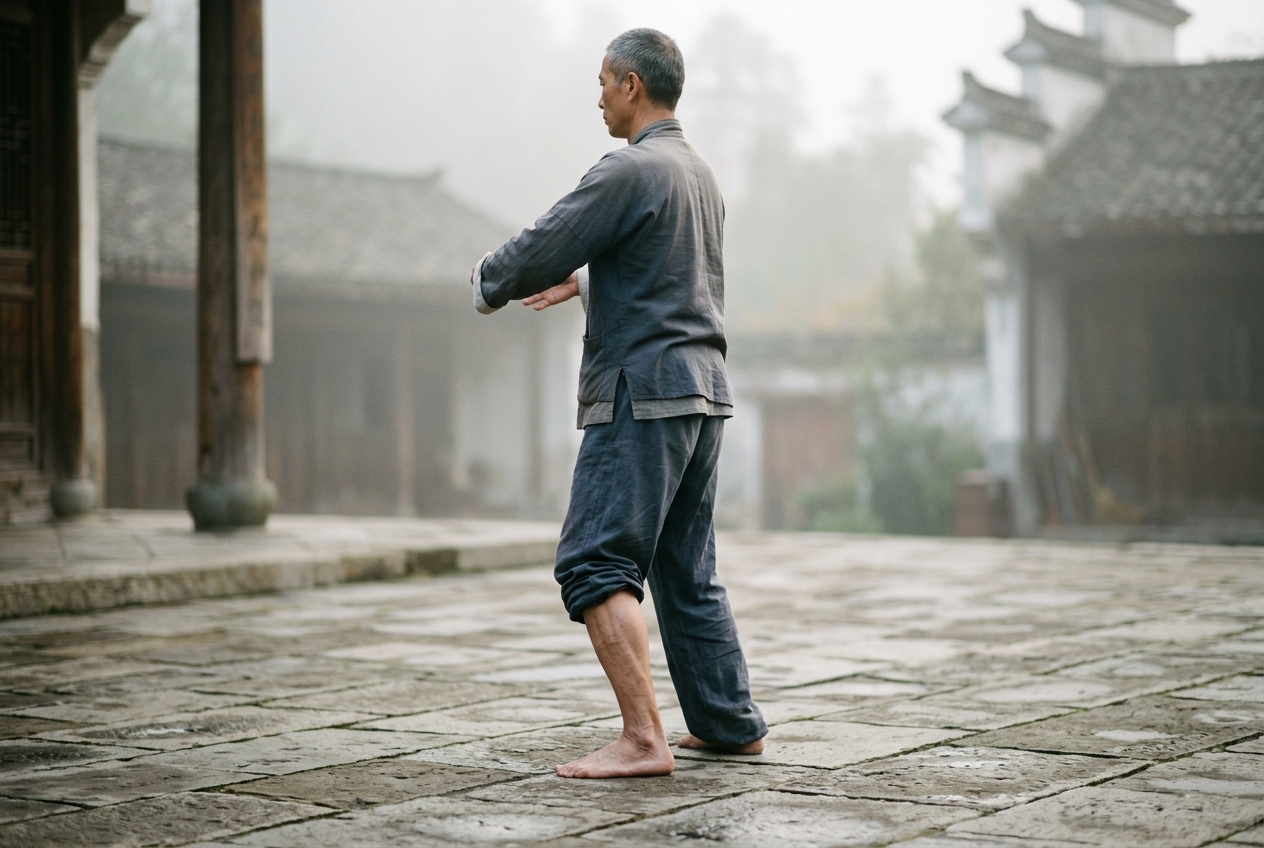
        [ Structural Vector: The Unweighted Calcaneal Line ]

( Vertex / Baihui GV 20 )
                         |
                 [ Cervical Neutral ]
                         |
                  [ Song Yao / Lumbar Plumb ]
                         |
                  [ Song Kua / Inguinal Fold ]
                         |
           ( Micro-flexed Knee: Patella over Yongquan )
                         |
                         v
     Apex of Triceps Surae  ===>  [ CHENGSHAN (BL 57) DECOMPRESSED ]
     (Gastrocnemius "V")          (Tension dissolves laterally & downward)
                         |
                         +-----------------+
                         |                 |
                         v                 v
                 [ Calcaneus Base ]    [ Plantar Fascia Unfurled ]
                 (70% Bone Load)       (30% Dynamic Spring)
Only after you physically experience this unburdening can we appreciate the classical terminology of Traditional Chinese Medicine. Chengshan is the 57th point along the Foot Taiyang Bladder Meridian, the longest energy pathway in the human body, which cascades from the inner corners of the eyes, over the crown, down both sides of the spine, and along the posterior legs to the pinky toes. When Chengshan is physically constricted by chronic muscle spasm, Turbid Yang (metabolic heat, emotional agitation, and stagnant blood) becomes trapped in the upper body and lower back. By learning to release this anatomical "mountain," we enable physical tension to drain effortlessly down into the floor, while facilitating the smooth, upward conduction of ground reaction forces throughout the spine.
Step-by-Step Practice Guide: Decompressing the Supporting Mountain
The following protocol guides you through the neuromuscular release of the triceps surae and the experiential opening of the Chengshan cavity during stationary standing (Wuji Zhan Zhuang). Practice this protocol in bare feet on a level, non-slip surface.
       +-------------------------------------------------------------+
       |                  QUICK-REFERENCE BENCHMARK                  |
       +-------------------------------------------------------------+
       | Sensation   : Melting warmth, water trickling down Achilles |
       | Fault-Check : Toes gripping the floor = Chengshan braced    |
       | Remedy      : Lift toes slightly, settle weight into heels  |
       +-------------------------------------------------------------+
1. Establishing the Base: Calcaneal Anchoring (Chen Zhou)
Stand with your feet parallel, outer edges aligned with the lateral borders of your shoulders, toes pointing dead ahead. Gently lift all ten toes off the floor for two seconds to awaken the arch of the foot, then lay them down softly without allowing them to grip or claw the ground. Shift your center of mass slightly posterior until roughly 65–70% of your body weight rests solidly through the calcaneus (the heel bone), while the remaining 30–35% distributes evenly across the first and fifth metatarsal heads. Your feet should feel like broad, suctioning pads rather than rigid blocks.
2. Articular Micro-Flexion: Unlocking the Patellofemoral Hinge
Never hyperextend or lock your knees. Allow a micro-flexion of approximately 3 to 5 degrees—an adjustment so subtle that an external observer cannot see it, but you instantly feel your knee joints "float." Align the kneecaps directly over the Yongquan cavity (Kidney 1, located in the depression formed when the foot is plantarflexed, roughly one-third of the distance from the base of the toes to the heel). This micro-bend immediately disengages the mechanical bony lock of the femorotibial joint, transferring structural loading into the myofascial web.
3. Sinking the Kua and Waisting the Lumbar (Song Kua, Song Yao)
Release your inguinal creases (Kua) by allowing the pelvic basin to settle downward, as if gently resting onto a tall barstool. Concurrently, practice Song Yao (relaxing the lower back): let the sacrum drop vertically under the influence of gravity. This action gently lengthens the lumbar lordosis without forcibly tucking the pelvis. As the sacrum descends, imagine a plumb line dropping directly from the perineum (Huiyin, CV 1) through the space between your heels.
4. Reciprocal Inhibition: Anterior Tibialis Micro-Engagement
To systematically extinguish the involuntary spasm of the gastrocnemius and soleus, gently introduce a 5% intention of dorsiflexion. Without visibly moving your feet, imagine drawing the top of your foot toward the front of your shin. This subtle intent activates the tibialis anterior muscle on the front of the lower leg, triggering a neurological reflex known as reciprocal inhibition: the motor neurons governing the posterior calf muscles are forced to down-regulate their firing rate, dissolving baseline tension across the Chengshan cavity.
5. Breath Entrainment and Fascial Release
Inhale slowly through your nose for a count of four, directing the breath into the lower abdomen (Dantian), allowing the lower belly, flanks, and lower back to expand circumferentially like a balloon. As you exhale through your nose for a count of six, visualize the breath cascading down the back of your thighs, washing through the popliteal fossa behind the knees, and flowing down the calf bellies. Feel the "V-notch" of the calf split open and surrender its mass downward into the heel bone. Maintain this standing alignment for 10 to 20 minutes daily.
Common Practitioner Faults and Biomechanical Corrections
Even experienced practitioners frequently stumble into compensatory patterns that re-tighten the lower leg. The diagnostic matrix below identifies the four primary postural distortions, their physiological impacts, and their exact somatic corrections:
| Postural Distortion | Musculoskeletal Consequence | Meridian / Kinetic Impact | Corrective Somatic Cue |
|---|---|---|---|
| Anterior Pelvic Shift (Weight driven onto forefoot) | Hyper-tonicity of gastrocnemius; patellofemoral shear stress | Compresses BL 57; traps Turbid Yang in head and cervical spine | "Draw the hip joints back 1 cm; settle 70% of mass directly into heel marrow." |
| Knee Hyperextension (Genu Recurvatum) | Capsular jamming; triceps surae locked in active passive tension | Blocs kidney-bladder water conduit; severs kinetic ground spring | "Soften the back of the knee capsules; imagine holding a ripe plum behind each knee." |
| Toes Clawing the Floor (Digit Flexor Hyperactivity) | Plantar fascial contracture; reciprocal jamming of tibialis | Prevents venous return through deep soleus plexus; causes calf cramps | "Fan the toes wide; let them rest on the floor like silk ribbons on water." |
| Forced Pelvic Tucking (Posterior Tilt Obliteration) | Flattened lumbar lordosis; hamstring over-recruitment | Stifles diaphragmatic excursion; prevents true Song Yao | "Release the tailbone straight down toward the earth rather than curling it forward." |
Somatic Sensations: Decoding Internal Signposts
As the Chengshan cavity releases its ischemic hold, you will experience distinct physiological sensations. Understanding these signposts prevents confusion and confirms correct internal alignment:
- Warm, Trickling Sensation (Microvascular Reperfusion): As intramuscular compartment pressure drops, capillary beds reopen. Practitioners frequently report a warm sensation resembling warm water running down the back of the calves into the heels.
- Effervescent Tingling (Neuromuscular Reset): A light, fizzy vibration along the calf bellies indicates the resetting of over-sensitized muscle spindles and the down-regulation of alpha motor neurons.
- Heavy, Magnetic Grounding (Fascial Settling): The sensation of the lower legs becoming dense, heavy, and rooted into the earth signifies that the myofascial sleeve has relaxed around the tibia and fibula, transferring support directly to the skeletal framework.
- Deep Myofascial Unwinding (Twitching or Tremor): Involuntary, localized micro-tremors in the calf bellies are normal signs of deep postural re-patterning. Allow them to pass naturally without tensing against them.
Why It Works: The Anatomy and Body Science of Chengshan
To understand why decompressing a single cavity in the mid-calf has such transformative effects throughout the entire musculoskeletal structure, we must examine the intersection of myofascial anatomy, neurophysiology, and hemodynamic circulation.
       +-------------------------------------------------------------+
       |                  ANATOMICAL ARCHITECTURE                    |
       +-------------------------------------------------------------+
       | Site: Gastrocnemius bellies converging into Achilles tendon |
       | Chain: Superficial Back Line (Plantar Fascia to Epicranium) |
       | Vascular Action: Deep Soleus Venous Plexus Pump Reset       |
       +-------------------------------------------------------------+
Topographical Anatomy of BL 57
Anatomically, Chengshan is positioned on the posterior midline of the lower leg, precisely at the inferior apex of the "V" formed by the convergence of the medial and lateral bellies of the gastrocnemius muscle as they fuse into the calcaneal tendon (Achilles tendon aponeurosis), directly overlying the deeper soleus muscle. This region represents a major mechanical transition zone where high-force tensile tendon merges with highly vascularized contractile tissue.
                  [ Gastrocnemius Medial Belly ]   [ Gastrocnemius Lateral Belly ]
                                \                 /
                                 \               /
                                  \             /
                                   \   (BL 57) /  <--- CHENGSHAN CAVITY
                                    \  APEX   /       (Aponeurotic V-Notch)
                                     |       |
                                     |       |
                                  [ Calcaneal / Achilles ]
                                  [ Tendon Aponeurosis  ]
                                     |       |
                                     |       |
                                     v       v
                                 [ Calcaneal Tuberosity ]
The Superficial Back Line and Lumbar Lordosis
In fascial anatomy, as popularized by modern structural integration research on myofascial meridians documented on PubMed, Chengshan is a crucial hub of the Superficial Back Line (SBL). The SBL is a continuous sheet of connective tissue running from the plantar fascia of the feet, around the calcaneus, up the triceps surae, across the popliteal space into the hamstrings, through the sacrotuberous ligament, up the erector spinae of the back, and over the epicranial aponeurosis to the brow ridge.
When Chengshan is held in chronic ischemic contracture, tensile shortening transmits upward across the knee joint into the hamstrings and pelvis. To prevent the torso from pitching forward under this tension, the body compensates by over-contracting the erector spinae and iliopsoas, locking the lumbar spine into excessive anterior pelvic tilt and pathological lordosis. By opening and lengthening the gastrocnemius-calcaneal junction at Chengshan, the entire posterior myofascial kinetic chain decompresses, instantly freeing the lumbar vertebrae (Yao) to lengthen and decompress.
Interstitial Hydrodynamics and the Peripheral Calf Pump
The calf musculature is clinically recognized as the human body's "second heart." The deep soleus and gastrocnemius muscles house an extensive network of low-pressure venous sinuses known as the soleus venous plexus.
   [ Muscle Contraction/Release Cycle ] ---> Compresses/Opens Venous Sinus
                 |
                 v
   [ Hydrodynamic Pumping Action ]     ---> Propels Deoxygenated Blood Cranially
                 |
                 v
   [ Interstitial Matrix Hydration ]   ---> Restores Hyaluronic Acid Viscoelasticity
Under habitual stress and faulty standing mechanics, constant tonic bracing produces elevated intramuscular compartment pressure. This static squeeze chokes local microvascular capillary beds, resulting in tissue hypoxia, metabolic acid buildup, and densification of the interstitial ground substance. When ground substance densifies, hyaluronic acid between the sliding fascial sheaths loses its lubricating water content, creating "adhesions" that prevent smooth tissue glide. Dynamic unweighting of Chengshan restores the natural, rhythmic expansion and contraction of the venous pump, lowering compartment pressure and allowing fresh, oxygenated arterial blood and interstitial fluids to restore tissue suppleness.
Classical Lineage, Daoist Neigong, and Meridian Energetics
The deliberate somatic cultivation of Chengshan possesses a rich lineage stretching back through centuries of Daoist self-cultivation, classical acupuncture, and Chinese martial traditions.
       +-------------------------------------------------------------+
       |                     HISTORICAL TIMELINE                     |
       +-------------------------------------------------------------+
       | 168 BCE : Mawangdui Daoyin Tu (Illustrations of Daoyin)     |
       | 100 BCE : Huangdi Neijing (Internal Canon of Medicine)      |
       | 282 CE  : Zhenjiu Jiayi Jing (Systematic Classic of Acu)    |
       | 1920s   : Yiquan Zhan Zhuang Modern Synthesis (Wang)        |
       +-------------------------------------------------------------+
The Mawangdui Daoyin Lineage
The earliest graphic records of therapeutic standing and stretching exercises, discovered in the Mawangdui Silk Texts dating back to 168 BCE in China's Hunan province, depict figures practicing foundational postures that lengthen the posterior myofascial chain. These historical illustrations demonstrate that ancient Daoist physicians understood that diseases of stagnation—including digestive disorders, hemorrhoids, sciatica, and lower back pain—could be remediated by grounding the feet, dropping the hips, and stretching the calf-heel junction.
   [ Heaven / Yang ] ===> (Baihui GV 20)
                               |
                        [ Central Axis ]
                               |
   [ Earth / Yin ]   ===> (Chengshan BL 57 Open) ===> (Calcaneus Ground Root)
The Huangdi Neijing and the Foot Taiyang Meridian
In the seminal medical treatise Huangdi Neijing (The Yellow Emperor's Classic of Internal Medicine), compiled around the 1st century BCE, the Taiyang (Great Yang) meridian system is characterized as the outermost protective energetic shield of the body. Because it covers the entire dorsal surface, it is the primary conduit through which environmental cold and wind pathogens penetrate, and conversely, through which excess heat and emotional tension must be discharged.
The Zhenjiu Jiayi Jing (The Systematic Classic of Acupuncture and Moxibustion), compiled by Huangfu Mi in 282 CE during the Jin Dynasty, explicitly designates Chengshan as the premier point for "spasms of the calf, heaviness of the lumbar region, difficulty in defecation, and inability to stand for long durations." Classical masters observed that when an individual undergoes severe psychological stress, the fight-or-flight response instinctively primes the calf muscles to sprint, locking Chengshan into chronic hyper-tonicity. Daoist internal martial artists transformed this observation into an internal training method: by intentionally relaxing Chengshan during quiet standing meditation, the mind directly soothes the nervous system, settling the heart rate and restoring emotional equilibrium.
Elastic Rebound: From Calves of Iron to Tendons of Silk
In the modern synthesis of internal martial arts formulated by master Wang Xiangzhai (1885–1963), the founder of Yiquan and Dachengquan Neigong, heavy muscular contraction in the calves was identified as a fatal structural flaw known as Zhuo Li (clumsy, stagnant force). Wang taught that if a practitioner clutches the ground with the calf muscles, the body becomes an isolated, rigid pole that transmits mechanical shocks directly into the knee joints and spine.
Conversely, when Chengshan is "hollowed and suspended" through calcaneal grounding and sacral sinking, the calf muscles soften while the deep connective tissues and Achilles tendon stretch elastically like a drawn bowstring. This fascial tensioning creates Peng Jin (expansive, spring-like structural power). Instead of burning metabolic fuel through continuous muscular tension, the practitioner harnesses the effortless kinetic rebound of ground reaction forces, allowing physical power to surge from the earth through the heels, legs, spine, and hands without encountering any internal structural resistance.
Somatic Verification Benchmarks: Assessing Chengshan Openness
To verify whether your practice is successfully decompressing the Chengshan cavity, use these four diagnostic self-assessments:
+----------------------------------------------------------------------------------------------------+
|                                DIAGNOSTIC VERIFICATION BENCHMARKS                                  |
+------------------------------------+---------------------------------------------------------------+
| Test Protocol                      | Positive Indicator of Decompression                           |
+------------------------------------+---------------------------------------------------------------+
| 1. The Manual Palpation Check      | Calf feels supple and yielding like soft dough, not a hard cord|
| 2. The Vertical Plumb Line Test    | Weight vector drops cleanly into calcaneus; toes remain loose |
| 3. The Dorsiflexion Range Test     | Ankle reaches 15–20° dorsiflexion without calf cramping       |
| 4. The Microvascular Rebound Test  | Rapid skin refill time (<2 sec) with uniform warm glow in heel|
+------------------------------------+---------------------------------------------------------------+
- The Manual Palpation Check: While seated with your leg fully extended and relaxed on a footstool, reach down and palpate the Chengshan cavity at the bottom of the calf muscle "V." If the tissue feels like a hard, fibrous cable or elicits sharp, focal pain upon moderate pressure, the cavity remains in chronic ischemic contracture. When properly conditioned through Song, the point will feel supple, hydrated, and yielding like soft bread dough, resting over a resilient tendon.
- The Vertical Plumb Line Test: Stand in your natural Zhan Zhuang posture and have a partner observe your lateral profile. A vertical line dropped from the ear canal should pass cleanly through the tip of the shoulder, the greater trochanter of the hip, slightly behind the patella, and land squarely through the anterior aspect of the heel bone (calcaneus). If your tibia slants forward and your toes grip the floor, Chengshan is still bearing excessive body weight.
- The Active Ankle Dorsiflexion Test: While standing with an unweighted calf, gently flex your toes and the front of your foot upward. An open, unweighted posterior chain allows the ankle joint to flex 15 to 20 degrees past perpendicular smoothly, without producing sharp pulling, binding, or cramping sensations in the mid-calf.
- The Thermal/Reperfusion Test: After ten minutes of proper standing, step out of the posture and examine the temperature of your feet. If your heels and soles feel cold, blood flow remains impeded by muscular constriction in the lower leg. If your feet feel uniformly warm, rosy, and buzzing with circulation, your deep soleus pump is fully open and functional.
Today's Practice Commitment
Tomorrow morning, immediately upon getting out of bed and before checking your phone or drinking your first cup of tea or coffee, step onto a bare floor and dedicate precisely seven minutes to decompressing your Chengshan cavities.
Set a gentle timer. For the first two minutes, establish your calcaneal rooting: micro-bend your knees, soften your toes, drop your tailbone, and subtly engage the front of your shins to turn off your calves. For the remaining five minutes, close your eyes and coordinate your breathing—expanding the lower abdomen on inhalation, and visualizing all tension melting down the posterior chain and out through the heels on exhalation.
Throughout the remainder of your day, notice how this brief morning alignment alters your somatic baseline: whether your lower back feels looser while walking, whether your standing posture feels more grounded, and whether your mind feels centered and clear.
Authoritative Scientific and Classical Resources
To deepen your study of fascial anatomy, clinical meridian research, and internal arts cultivation, consult the following authoritative repositories:
- NCBI PubMed Database on Acupuncture and Biomechanics — Scientific clinical trials on acupoint stimulation, gastrocnemius biomechanics, and microvascular hemodynamics.
- World Health Organization Traditional Medicine Strategy — Global health standards, safety frameworks, and nomenclature for acupuncture and traditional somatic therapies.
- National Qigong Association (NQA) Educational Resources — Professional standards, historical lineages, and research on Zhan Zhuang and medical Daoyin cultivation.
- Wikipedia: Detailed Anatomy of the Bladder Meridian — Comprehensive trajectory, classical point indications, and anatomical cross-references for the Foot Taiyang channel.
- Wikipedia: Overview of Human Fascial Anatomy and Myers' Chains — Contemporary structural models of myofascial continuity and tensegrity systems.