Chengjiang Cavity Container of Fluids: Mentolabial Fascial Decompression, Sublingual Salivary Secretion, and Ren Mai Terminal Confluence in Classical Neigong
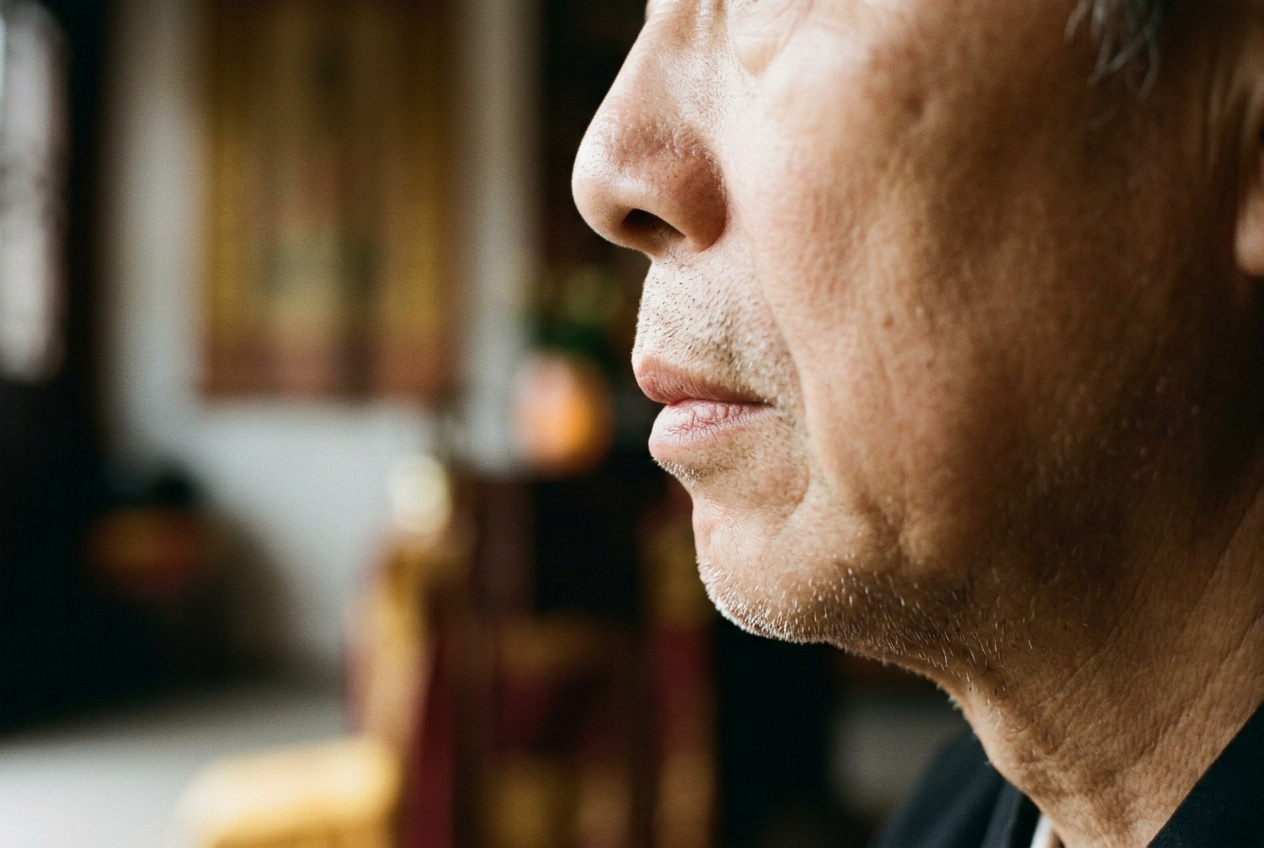
By realigning the jaw, softening the mentolabial groove between the lip and chin, and resting the tongue gently against the roof of the mouth, you create what classical texts call the anterior "Magpie Bridge" (Qian Que Qiao). This subtle posture bridges the nervous system and fascial pathways, stimulating the salivary glands to produce a thin, sweet saliva that is swallowed slowly into the lower abdomen (the Lower Dantian, located roughly two inches below the navel). What begins as a microscopic adjustment of the chin unfolds into a whole-body parasympathetic reset, regulating breathing, steadying heart rate variability, and calming the central nervous system.
                       =======================================
                         THE ANTERIOR MAGPIE BRIDGE (QUE QIAO)
                       =======================================

[ Hard Palate ]
                                        ^
                                        | (Lingual-Palatal Seal)
                     [ Tip of Tongue ] -+
                            |
   [ Du Mai (GV28) ]        |                   [ Ren Mai (CV24) ]
   Upper Gum / Incisors <---+---> [ Mentolabial Sulcus / Chengjiang ]
                                                |
                                                v
                                    [ Mentalis Relaxation ]
                                                |
                                                v
                                [ Platysma / Hyoid Decompression ]
                                                |
                                                v
                              [ Sublingual Glandular Activation ]
                                        ("Jade Nectar")
                                                |
                                                v
                                [ Peristaltic Descent to Dantian ]
Anatomical Topography and Classical Channel Confluence
To understand why this minute locus exerts such widespread systemic influence, one must first examine its exact anatomical topography. Located along the anterior facial midline in the mentolabial sulcus—the horizontal groove separating the lower vermilion border from the mental prominence—Chengjiang (CV24) occupies a dense neuromuscular crossroads.
                  +-----------------------------------------+
                  |         ORBICULARIS ORIS (Inferior)     |
                  +--------------------+--------------------+
                                       |
                         +-------------+-------------+
                         |    CHENGJIANG (CV24)      |
                         |  (Mentolabial Depression) |
                         +-------------+-------------+
                                       |
                  +--------------------+--------------------+
                  |           MENTALIS MUSCLE               |
                  |     & DEPRESSOR LABII INFERIORIS        |
                  +--------------------+--------------------+
                                       |
                                       v
                  +-----------------------------------------+
                  |       MENTAL NERVE (CN V3 Sensory)      |
                  |    & MARGINAL MANDIBULAR (CN VII Motor) |
                  +-----------------------------------------+
Superficially, the point sits at the interstice where the inferior fibres of the orbicularis oris blend with the paired mentalis muscles and the medial borders of the depressor labii inferioris. The mentalis muscle originates from the incisive fossa of the mandible and inserts downward into the skin of the chin; when hypertonic, it elevates and protrudes the lower lip while wrinkling the mental skin into an uneven texture often called a "pebble chin."
Sensory innervation of this territory is governed by the bilateral mental nerve, the terminal sensory branch of the inferior alveolar nerve derived from the mandibular division of the Trigeminal Nerve (CN V3). Motor control of the surrounding musculature is provided by the marginal mandibular and buccal branches of the Facial Nerve (CN VII). Vascular supply is delivered via the mental artery (a terminal branch of the maxillary arterial system) and the inferior labial branches of the facial artery, anastomosing with the submental vascular tree.
       =================================================================
       CLASSICAL CHANNEL CONFLUENCE AT CHENGJIANG (CV24 / 承漿)
       =================================================================

MERIDIAN SYSTEM              PATHWAY / PHYSIOLOGICAL FUNCTION
       -----------------------------------------------------------------
       Ren Mai (Conception Vessel)  Terminal point (CV24); receives the
                                    ascending Yin essence from the pelvic
                                    floor (CV1) and abdominal core.

Hand Yangming Large          Ascends across the cheek, crosses
       Intestine (LI)               the philtrum, and converges at
                                    Chengjiang to ground digestive Yang.

Foot Yangming Stomach (ST)   Originates near the infraorbital rim,
                                    descends along the mouth to intersect
                                    Chengjiang before circling the jaw.

Yin Qiao Mai (Yin Motility)  Ascends the medial leg, torso, and
                                    throat, terminating its anterior motor
                                    regulation near the perioral nexus.
       -----------------------------------------------------------------
In classical acupuncture theory, as documented by the World Health Organization Traditional Medicine standard point nomenclature, CV24 is the 24th and final point of the Conception Vessel (Ren Mai). The Ren Mai is the primary regulator of all Yin meridians in the human body, directing the upward flow of nutritive essence (Yin Qi) from the perineum (Huiyin, CV1) through the pubic symphysis, navel, solar plexus, and throat, culminating at Chengjiang.
Crucially, CV24 is designated as an intersection point (Jiao Hui Xue) where the Ren Mai converges with three other vital energetic conduits: 1. The Foot Yangming Stomach Channel, which governs the breakdown and assimilation of nutritive fluids. 2. The Hand Yangming Large Intestine Channel, which regulates the downward discharge of turbid waste and clear fluid reclamation. 3. The Yin Qiao Mai (Yin Heel / Yin Motility Vessel), an extraordinary vessel that controls bilateral muscular tone along the medial axis of the body, internal somatic balance, and the smooth motor coordination of the jaw and throat.
Because Chengjiang serves as the terminal reservoir where ascending Yin meets descending Yangming vitality, any physical clamping of the mentolabial sulcus acts as a hydraulic bottleneck, damming the circulation of the Microcosmic Orbit (Xiao Zhoutian) and stranding stagnant heat in the head and facial structures.
Biomechanical Decompression and the Deep Fascial Continuum
The impact of Chengjiang extends far beyond the face due to the continuous architecture of human connective tissue. The perioral musculature around CV24 does not exist in isolation; it forms the anterior extremity of the Superficial Muscular Aponeurotic System (SMAS), which wraps around the facial expression muscles and blends seamlessly into the platysma muscle of the neck and the superficial cervical fascia.
             +-----------------------------------------------+
             |         CHENGJIANG / PERIORAL SMAS            |
             |       (Mentalis & Depressor Muscles)          |
             +-----------------------+-----------------------+
                                     |
                                     v  [Superficial Cervical Fascia]
             +-----------------------------------------------+
             |               PLATYSMA TENSION                |
             +-----------------------+-----------------------+
                                     |
                                     v  [Mechanical Traction]
             +-----------------------------------------------+
             |           HYOID SUSPENSION APPARATUS          |
             |   (Mylohyoid, Geniohyoid, Digastric Pull)     |
             +-----------------------+-----------------------+
                                     |
                                     v  [Deep Fascial Continuity]
             +-----------------------------------------------+
             |             DEEP FRONT LINE (DFL)             |
             |  (Pretracheal Fascia, Pericardium, Diaphragm, |
             |   Psoas Major, Pelvic Floor / Huiyin)         |
             +-----------------------------------------------+
When an individual experiences emotional anxiety, cognitive overload, or postural collapse (such as forward-head posture from screen use), the mentalis and depressor labii muscles chronically contract. This hypertonus transmits mechanical tension downward through the platysma, exerting continuous superior traction on the hyoid suspension apparatus. The hyoid bone acts as a free-floating mechanical anchor for the tongue, pharynx, and larynx, suspended by the suprahyoid muscles (digastric, stylohyoid, mylohyoid, geniohyoid) from above and balanced by the infrahyoid muscles (sternohyoid, omohyoid, sternothyroid, thyrohyoid) from below.
When chronic mentalis tension pulls the hyoid complex anterosuperiorly: * The pharynx narrows, compromising the airway and encouraging shallow, upper-chest breathing. * The anterior scalenes and sternocleidomastoid muscles brace defensively, compressing the cervical neurovascular bundle. * The pretracheal and endothoracic fasciae are pulled upward, transmitting compressive force into the pericardial ligaments, the respiratory diaphragm, and the psoas complexes along the anatomical Deep Front Line (DFL).
By consciously releasing the mentalis muscle and "opening" the Chengjiang hollow, this entire anterior mechanical kinetic chain undergoes reciprocal lengthening. The hyoid bone settles into its neutral resting suspension, freeing the laryngeal cartilage, widening the retroglossal airway, and allowing the respiratory diaphragm to descend fully on inhalation without encountering upper-body fascial resistance.
Neuro-Glandular Dynamics: The Parasympathetic Cascade and "Jade Nectar"
The most celebrated physiological consequence of opening Chengjiang in classical internal alchemy (Neidan) is the stimulation of the salivary reflex, producing what Daoist texts venerate as the Jade Nectar (Yu Ye, 玉液), Golden Fluid (Jin Ye, 金液), or Sweet Dew (Ganlu, 甘露).
Salivary secretion in humans is dual-innervated by the autonomic nervous system: * Sympathetic stimulation (fight-or-flight) produces a sparse, thick, highly viscous, mucin-laden secretion that leaves the mouth feeling dry, tacky, and sour. * Parasympathetic stimulation (rest-and-digest) induces copious, watery, enzyme-rich serous saliva characterized by high concentrations of alpha-amylase, lysozyme, secretory immunoglobulin A (sIgA), bicarbonate ions, and epidermal growth factor (EGF), as detailed in peer-reviewed physiological research on autonomic salivary gland regulation in PubMed Central.
                 ===========================================
                     NEURO-GLANDULAR SALIVARY REFLEX ARC
                 ===========================================

Conscious Mentalis & Jaw Decompression
                                       |
                                       v
                     Trigeminal Sensory Calming (CN V3)
                                       |
                                       v
                     Superior & Inferior Salivatory Nuclei
                                (Brainstem / Medulla)
                                       |
                    +------------------+------------------+
                    |                                     |
                    v                                     v
          Chorda Tympani (CN VII)             Glossopharyngeal (CN IX)
          via Lingual Nerve                   via Otic Ganglion
                    |                                     |
                    v                                     v
          [ Submandibular &                    [ Parotid Gland ]
            Sublingual Glands ]                           |
                    |                                     |
                    +------------------+------------------+
                                       |
                                       v
                    Copious Serous Secretion: "Jade Nectar"
                      (Rich in Amylase, sIgA, Bicarbonate)
The bioenergetic link occurs through the establishment of the Anterior Magpie Bridge (Qian Que Qiao). In somatic meditation, the practitioner places the relaxed tip of the tongue against the hard palate directly behind the upper incisors, near the rugae palatinae. This lingual-palatal contact forms an unbroken bioelectric and mechanical circuit between the ascending Du Mai (Governor Vessel, terminating at GV28 inside the upper lip frenulum) and the descending Ren Mai (initiating its downward return from CV24).
From a neuroanatomical perspective, resting the tongue against the palate while relaxing the mentalis muscle relieves pressure on the mandibular nerve branches, sending afferent signals to the superior and inferior salivatory nuclei in the brainstem. Parasympathetic efferent impulses travel along: 1. The Chorda Tympani (a branch of the Facial Nerve, CN VII), which joins the lingual nerve to synapse at the submandibular ganglion, innervating the submandibular and sublingual glands. 2. The Glossopharyngeal Nerve (CN IX), which projects via the lesser petrosal nerve and otic ganglion to stimulate the parotid glands.
As the parasympathetic tone rises, clear, fluid saliva wells up from the sublingual caruncles beneath the tongue (known in Daoyin as the Xuan Ying or "Mysterious Spring"). When swallowed according to classical protocols—in small, pressurized sips accompanied by focused somatic intention—this fluid coats the esophageal mucous membrane, stimulates the vagus nerve (CN X) via esophageal stretch receptors, and activates enteric nervous system peristalsis, anchoring biological awareness and metabolic warmth deep into the lower abdomen.
Step-by-Step Internal Cultivation Guide
Follow this detailed somatic protocol to decompress the Chengjiang cavity, establish the Magpie Bridge, and circulate the Microcosmic Orbit.
       +-------------------------------------------------------------+
       |             SOMATIC ALIGNMENT AT A GLANCE                   |
       |                                                             |
       |  1. Baihui (GV20): Suspended upward from the crown.         |
       |  2. Mandible: Suspended lightly, back teeth parted 2-3 mm.  |
       |  3. Chengjiang (CV24): Softened inward, mentalis smooth.    |
       |  4. Tongue Tip: Resting on hard palate (Magpie Bridge).     |
       |  5. Throat / Hyoid: Widened, soft, sinking downward.        |
       |  6. Lower Dantian: Warm, expanded, receptive basin.         |
       +-------------------------------------------------------------+
Step 1: Structural Posture and Cranial Suspension
- Sit upright on a firm meditation cushion or chair, with feet planted flat on the floor shoulder-width apart. Alternatively, assume the classical standing Zhan Zhuang ("Standing Posture") as taught by the National Qigong Association (NQA).
- Imagine a silk cord gently elevating the crown of your head at the point Baihui (Du 20).
- Allow the chin to tuck back slightly (roughly half an inch), lengthening the suboccipital muscles at the base of the skull without creating strain in the throat.
Step 2: Mandibular Uncoupling and Perioral Softening
- Consciously release the temporalis and masseter muscles on the sides of your face.
- Allow the lower jaw to drop by 2 to 3 millimetres so the upper and lower molars do not make contact.
- Bring your mental focus (Yi) to the mentolabial sulcus (CV24). Imagine that the flesh between your lower lip and the chin bone is melting like warm wax.
- Soften the corners of your mouth into a faint, neutral "mona lisa" smile (Weixiao), which naturally inhibits the contraction of the depressor anguli oris and smooths the mentalis.
Step 3: Engaging the Anterior Magpie Bridge
- Rest the tip of your tongue against the roof of your mouth, approximately half an inch behind the back of the upper central incisors.
- Do not press hard; the tongue should adhere with the gentle, passive suction of a soft leaf clinging to a damp stone.
- Keep the root of the tongue relaxed down the throat, maintaining space in the oropharynx.
Step 4: Inducing and Accumulating the "Jade Nectar"
- Breathe deeply into the lower abdomen using natural diaphragmatic respiration (inhalation gently expands the lower belly, exhalation lets it settle).
- Maintain your intention softly resting on CV24 and the space beneath the tongue. Within 2 to 5 minutes of quiet stillness, a thin, sweet, watery saliva will begin to accumulate in the floor of the mouth.
- Allow the saliva to pool naturally. Do not swallow immediately; allow a comfortable mouthful to collect.
Step 5: The Descending Swallow (Yin Ye Gui Gen)
- When a sufficient volume of saliva has gathered, gently gather it with the tongue into the back of the throat.
- Tuck the chin slightly, widen the throat, and swallow with a single, deliberate, fluid contraction.
- Maintain your internal awareness (Yi) directly tracking the descending bolus as it glides down the esophagus, passes through the cardiac sphincter into the solar plexus, and lands softly in the Lower Dantian (two inches below the navel, three inches deep into the pelvic bowl).
- As the fluid reaches the Dantian, feel a distinct wave of warmth and downward settling throughout the entire abdominal cavity, locking the breath into the lower belly.
Troubleshooting Common Somatic Pitfalls
| Pitfall / Error Pattern | Underlying Biomechanical Cause | Diagnostic Signs | Actionable Somatic Correction |
|---|---|---|---|
| Forced Lip Compression | Hyperactive orbicularis oris attempting to close the mouth forcefully. | Lower lip turns pale; skin at chin shows dimpling or "pebble" puckering. | Part the lips slightly; visualize warm water trickling across CV24 to soften the perioral muscles. |
| TMJ Clenching | Mental stress or defensive bracing in the masseters and pterygoids. | Soreness in the jaw joints; tension radiating to the temples; clicking on movement. | Place the tips of your index fingers on the jaw joints in front of your ears; inhale and consciously imagine the mandible floating on air. |
| Lingual Strain (Hard Pressing) | Pushing the tongue forcefully against the hard palate. | Tongue fatigue; cramping in the floor of the mouth; tight suprahyoid muscles. | Reduce tongue contact pressure to zero weight; use light capillary adhesion rather than muscular pushing. |
| Noisy, Gulping Swallow | Swallowing against a constricted pharynx without relaxing the hyoid bone. | Audible "gulp" sound; air ingestion into the stomach; tension in the anterior neck. | Slightly drop the chin, relax the back of the neck, and let the saliva slide down effortlessly like water flowing down a silk ribbon. |
Diagnostic Sensations: Indicators of Proper Opening
When the Chengjiang cavity is correctly decompressed and integrated into the Microcosmic Orbit, the practitioner will reliably experience several distinct somatic markers:
- Thermal and Textural Shifts at the Sulcus: A distinct sensation of coolness or spaciousness replaces the habitual warmth and tension of the mentolabial groove, followed by gentle, rhythmic micro-pulsations in the mental artery beneath CV24.
- Salivary Quality Changes: The mouth transitions from feeling dry or coated with thick mucus to filling effortlessly with thin, highly lubricative, almost sweet-tasting saliva.
- Spontaneous Diaphragmatic Deepening: The moment the mentalis and hyoid complexes relax, the breath reflexively drops out of the chest and deepens into the lower belly without any conscious effort to breathe deeply.
- Fascial Unwinding Down the Midline: A palpable sensation of release or gentle tingling travels straight down the midline of the chest (along the sternum through the Ren Mai points Shanzhong/CV17 and Zhongwan/CV12), grounding into the lower abdomen.
Classical Lineage and Daoist Alchemical Context
The therapeutic and meditative cultivation of Chengjiang has an illustrious history spanning more than two millennia of East Asian somatic medicine. In the foundational clinical canon of traditional Chinese medicine, the Huangdi Neijing (The Yellow Emperor’s Classic of Internal Medicine, compiled circa 2nd century BCE; see academic texts indexed via the National Center for Biotechnology Information (NCBI)), Chengjiang is classified as the crucial exit-entry nexus for the Ren Mai, responsible for regulating facial harmony and moistening dryness in the upper body.
Later, in the Jin Dynasty (282 CE), the grandmaster acupuncturist Huangfu Mi authored the Zhenjiu Jiayi Jing (The Systematic Classic of Acupuncture and Moxibustion), which expanded on Chengjiang’s clinical capacity to treat facial paralysis, toothache, lockjaw, wasting and thirsting disorders (Xiao Ke, akin to modern diabetes), and emotional disorders manifesting as speech impediments or manic tension.
+-------------------------------------------------------------------------+
|                  HISTORICAL EVOLUTION OF CV24 CULTIVATION               |
|                                                                         |
|  * Huangdi Neijing (ca. 200 BCE): Initial identification of CV24 as the |
|    lubricating terminus of the Ren Mai and regulator of fluids.         |
|                                                                         |
|  * Zhenjiu Jiayi Jing (282 CE): Formalization of clinical parameters    |
|    for resolving lockjaw, facial paralysis, and systemic dryness.      |
|                                                                         |
|  * Shangqing Daoist Neidan (ca. 4th–10th Century CE): Transformation   |
|    into an internal alchemical technology: collecting "Jade Nectar" to  |
|    nourish the internal organs and cultivate Shen (spirit).             |
|                                                                         |
|  * Ming/Qing Taiji & Daoyin Lineages: Integration into martial and     |
|    postural alignment, using the relaxed chin to unlock the spine.      |
+-------------------------------------------------------------------------+
Simultaneously, within the esoteric Daoist lineages of Mount Maoshan and Mount Wudang (notably the Shangqing and Quanzhen traditions), Chengjiang became central to the alchemical technology of Neidan (Internal Alchemy). Alchemists recognized that modern humans perpetually dissipate their vital essence (Jing) through cognitive overexertion, speech, and chronic stress, causing the body's internal fluids to burn dry.
By closing the circuit of the Microcosmic Orbit—uniting the fire-like ascending energy of the back meridian (Du Mai) with the cooling, water-like descending energy of the front meridian (Ren Mai) through the Magpie Bridge at CV24—practitioners transformed basic biological saliva into "Jade Nectar." This fluid was understood not merely as digestive juice, but as the physical vessel carrying refined vital energy (Yuan Qi) back to its physiological root in the kidneys and Lower Dantian.
Today’s Practice Commitment
To experience the restorative power of this practice firsthand, dedicate five minutes tomorrow morning before consuming your first cup of tea or coffee to decompressing Chengjiang:
- Sit comfortably with your spine upright and your hands resting over your lower belly.
- Touch your index finger to the hollow below your lower lip (CV24), then release your hand, keeping your focus resting in that soft depression.
- Drop your jaw by two millimetres, soften your chin completely, and place the tip of your tongue gently on the hard palate behind your upper front teeth.
- Breathe naturally into your lower abdomen for four minutes, allowing the sweet "Jade Nectar" saliva to gather naturally.
- In the fifth minute, swallow the gathered saliva in two smooth, conscious sips, tracking the fluid as it sinks into your lower belly.
- Notice the immediate clarity in your mind, the release of tension across your neck and shoulders, and the centered calm that anchors you for the remainder of the day.