Changqiang Cavity Long Strong: Sacrococcygeal Fascial Decompression, Du Mai Luo-Connecting Dynamics, and Pelvic Kinetic Rooting in Classical Neigong
While Western medicine often views the tailbone as an evolutionary vestige, classical Daoist Neigong (internal skill cultivation) regards Changqiang as an active hydraulic pump and bio-electric switchboard. Working in dynamic polarity with Huiyin (Conception Vessel 1 or CV1, located at the central perineal body in front of the anus), Changqiang forms the posterior half of the body's pelvic energetic diaphragm. When correctly aligned and activated through somatic training, breathwork, and postural decompression, this single acupoint unlocks the coccygeal gate (Weilu Guan), allowing physiological vitality, cerebrospinal fluid, and neural impulses to ascend the spine without mechanical impedance.
Step-by-Step Practice Guide: Awakening the Weilu Gate
To safely and effectively engage Changqiang without inducing muscular strain or pelvic congestion, one must combine structural alignment with Taoist reverse abdominal breathing (Ni Fu Shi Hu Xi) and subtle myofascial micro-contractions. This exercise can be performed either in a seated posture or within the foundational standing pole meditation known as Zhan Zhuang.
+--------------------------------------------------------------------------------+
|                        THE DUAL PELVIC PUMP MECHANISM                          |
+--------------------------------------------------------------------------------+
|  INHALATION (Reverse Breath)          |  EXHALATION (Release & Ascend)         |
|  • Lower abdomen gently draws in      |  • Lower abdomen expands softly        |
|  • Pelvic diaphragm lifts (GV1/CV1)   |  • Pelvic floor relaxes to neutral     |
|  • Filum terminale tensions subtly    |  • CSF & Yang Qi surge up spinal axis  |
|  • Compressive joint shear removed    |  • Ground force links to Mingmen (L2)  |
+--------------------------------------------------------------------------------+
1. Establishing the Structural Vessel
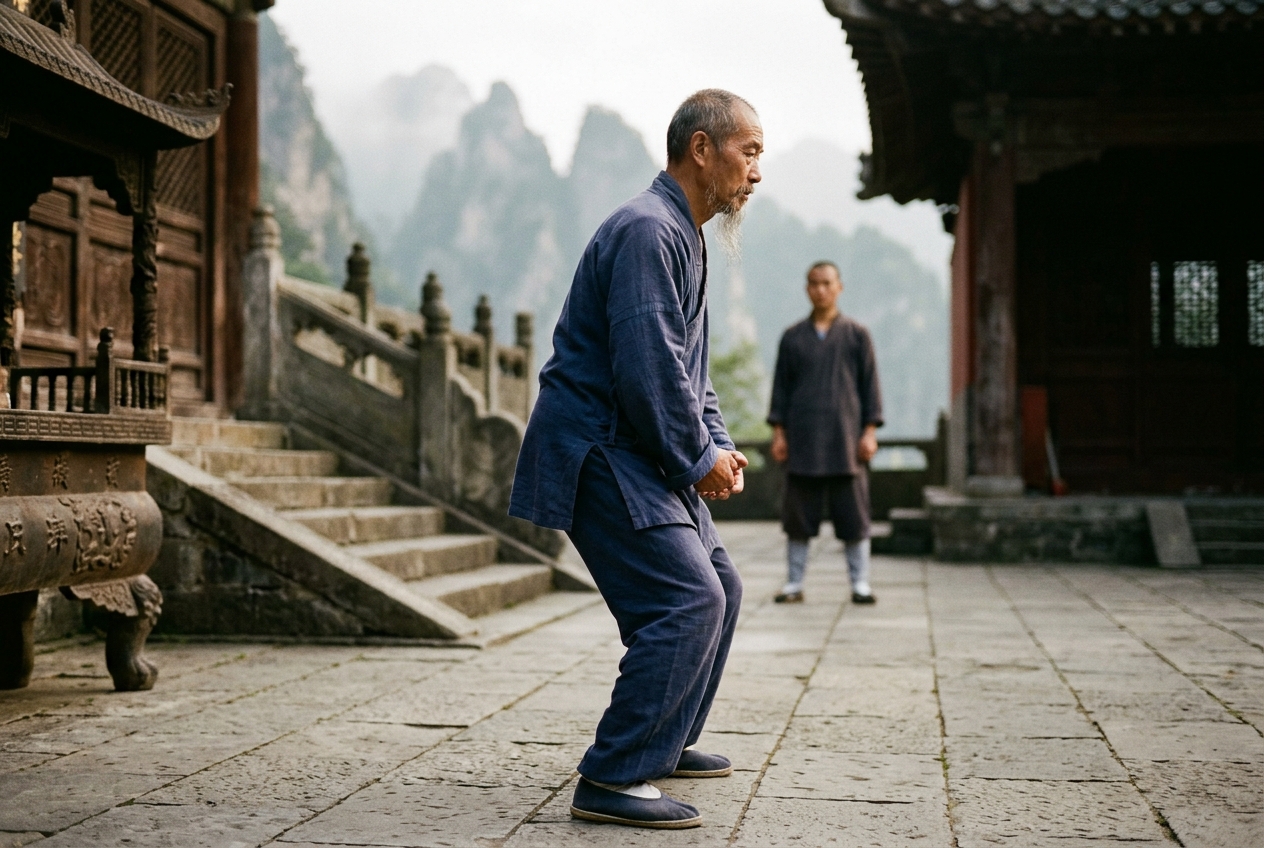
Begin by standing with your feet parallel, set shoulder-width apart, knees softly unlocked with three to five degrees of flexion. Implement the foundational requirement of Song Yao (relaxing the waist): allow your lumbar spine to gently lengthen downward, smoothing out excessive anterior lordotic sway without tucking the pelvis so aggressively that you flatten the spine into a rigid curve. Next, apply Yuan Dang (rounding the crotch): imagine holding an elastic sphere between your inner thighs, gently spiralling the knees outward over the toes to open the inguinal creases (Kua) and widen the ischial tuberosities. This structural configuration suspends the coccyx like a plumb line hanging into the earth, immediately relieving compressive shear forces across the sacrococcygeal articulation.
2. Synchronising the Reverse Breath and Perineal Micro-Lift
Shift your breathing entirely to nasal respiration with the tip of your tongue resting against the upper palate behind the front teeth, connecting the governing and conception vessels. Unlike standard diaphragmatic breathing where the belly expands on the inhale, Taoist reverse abdominal breathing coordinates reciprocal pressures: * The Inhalation Phase: Inhale smoothly through the nose over a count of four. As the thoracic diaphragm contracts downward, consciously draw your lower abdomen (the lower Dantian, two inches below the navel) gently inward toward the lumbar spine (Mingmen). Simultaneously, initiate an extremely subtle, five-to-ten percent micro-contraction of the levator ani muscle complex, drawing the Changqiang cavity upward and forward along the inner curve of the sacrum. Do not clench the gluteal muscles or external anal sphincter; the movement should feel like an internal suction or an upward levitation of the pelvic floor. * The Suspended Pause: At the top of the inhalation, pause for one to two seconds in absolute stillness. Maintain the gentle upward lift of Changqiang, feeling an accumulation of pressure and warmth concentrated in the sacrococcygeal hollow. * The Exhalation Phase: Exhale slowly through the nose over a count of six. Slowly release the inward pull of the abdomen, allowing the lower belly to expand naturally and softly back to its neutral resting state. Simultaneously relax the upward lift at Changqiang, visualizing the accumulated bio-electric warmth and hydraulic pressure releasing upward past the Weilu gate, cascading directly into the central spinal canal toward the mid-back (Jiaji) and base of the skull (Yuzhen).
3. Common Beginner Pitfalls and Precise Adjustments
- Gross Gluteal Clenching: The most widespread error is clenching the large gluteus maximus muscles to force the tailbone under. This locks the sacrum, pinches the sciatic and pudendal nerves, and arrests fluid dynamics. Correction: Keep your outer buttocks completely soft; place your fingers on your glutes to ensure they remain relaxed while the lift originates strictly from the deep, inner pelvic floor.
- Excessive Pelvic Posterior Tilt: Forcibly tucking the tailbone under rounds the lower back excessively, reversing the natural spine architecture and creating anterior disc compression. Correction: Maintain the plumb-line suspension; imagine the tailbone is weighted with a small stone that drops straight down into the floor between your heels rather than curling forward between your legs.
- Valsalva Straining: Holding the breath with high intra-thoracic pressure causes vascular strain and cranial congestion. Correction: Ensure the breath remains silky, continuous, and unforced. The micro-lift is a neurological intention rather than an athletic squeeze.
4. Somatosensory Milestones and Interpretations
As somatic proprioception deepens over consecutive weeks of practice, specific physiological sensations will emerge: * Thermal Waves (Warmth / Re): A distinct, spreading sensation of warmth radiating from the coccyx into the sacrum indicates local vasodilation, release of arterial tone, and recruitment of pelvic microcirculation. * Vibratory Tingling (Ma): Micro-paresthesia along the dorsal surface of the sacrum indicates decompression and activation of the sacral plexus and the pudendal nerve pathways. * Hydraulic Pulsing: A rhythmic, buoyant pulse synchronous with respiration indicates the restoration of the primary respiratory mechanism and optimal cerebrospinal fluid flow through the dural canal. * Profound Kinetic Heaviness (Chen): The sensation of the lower body sinking firmly into the earth like tree roots reflects the integration of fascial tensegrity, allowing ground reaction forces to transmit directly through the pelvic ring without muscular fatigue.
Why It Works: The Neurofascial and Hydraulic Science
Modern anatomical and neurophysiological research validates the profound biomechanical claims made by classical Neigong masters regarding Changqiang. When we dissect the somatic substrate of GV1, we uncover a dense intersection of fibrous ligaments, fascial continuities, neural networks, and fluid dynamics that directly influence the central nervous system.
Fascial Tensegrity and the Filum Terminale
At the anatomical level, Changqiang lies immediately adjacent to the anococcygeal ligament and the insertion of the pubococcygeus and iliococcygeus muscles. Crucially, the tailbone serves as the distal anchorage site for the filum terminale—a slender, fibrous filament of connective tissue extending from the apex of the conus medullaris of the spinal cord down to the dorsal surface of the coccyx. The spinal cord and brain are enveloped within a tough, non-elastic dural tube (dura mater), which attaches superiorly to the inner table of the cranium and the margin of the foramen magnum, and inferiorly via the filum terminale to the coccyx.
When an individual suffers from chronic postural collapse, sedentary pelvic compression, or hyperlordosis, excessive shear strain is transmitted directly across the sacrococcygeal joint. This mechanical torque creates abnormal longitudinal tension along the filum terminale, tethering the spinal dural sheath and inhibiting natural spinal movement.
By applying Song Yao (lumbar relaxation) and the gentle interoceptive lift of Changqiang, the practitioner neutralises this sacrococcygeal shear, releasing fascial tethering along the entire cranio-sacral axis. As documented across biomechanical studies listed on the National Center for Biotechnology Information, proper pelvic floor recruitment and spinal alignment reduce dural stress and facilitate optimal neuromechanical transmission.
The Pelvic-Cranial Hydraulic Pump
The human central nervous system is bathed in cerebrospinal fluid (CSF), which circulates within the subarachnoid space, providing metabolic clearance, mechanical cushioning, and neuro-endocrine transport. CSF movement is governed not only by arterial pulsation but also by the reciprocal motion of the thoracic respiratory diaphragm and the pelvic diaphragm.
During Taoist reverse abdominal breathing, the simultaneous descent of the thoracic diaphragm and voluntary elevation of the pelvic diaphragm (levator ani complex) generates a controlled increase in intra-abdominal pressure (IAP). This pressure acts as a visceral hydraulic piston against the anterior surface of the sacrum and the pelvic venous plexus.
Upon exhalation, when this compression is rhythmically released, the hydrostatic pressure gradient propels blood and CSF rostrally (upward) through the spinal canal, past the narrow anatomical bottleneck of the Weilu gateway. This mechanism directly mirrors clinical insights into pelvic-ocular and pelvic-cerebral fluid mechanics.
Neuromodulation and Autonomic Regulation
The region surrounding Changqiang is densely innervated by the pudendal nerve (originating from sacral spinal nerve roots S2, S3, and S4) and the coccygeal nerve plexus. S2 through S4 also represent the primary outflow of the sacral parasympathetic division of the autonomic nervous system via the pelvic splanchnic nerves.
Chronic stress and sedentary lifestyles lock the pelvic floor in a state of either hypertonic spasm or flaccid disengagement, feeding a continuous loop of sympathetic nervous system hyperarousal. Gentle, mindful contraction and somatic release of the Changqiang zone stimulates the mechanoreceptors and parasympathetic afferents of the sacral plexus. This sends inhibitory signals up the vagal and spinal pathways to downregulate the hypothalamic-pituitary-adrenal (HPA) axis, lowering resting heart rate, increasing heart rate variability (HRV), and promoting systemic restorative recovery.
Kinetic Rooting and Ground Force Transmission
In internal martial arts (Taijiquan, Baguazhang, and Xingyiquan), martial power (Fajin) is never generated through isolated upper-body muscular exertion; it is absorbed from the earth through the feet (specifically Kidney 1, Yongquan), channelled through the legs, directed by the waist (Yao), and expressed through the hands.
If the coccyx is flared backward (anterior pelvic tilt), ground reaction forces crash into the lumbar vertebrae, creating energy leakage and structural vulnerability. Conversely, when Changqiang is drawn gently inward and downward via Yuan Dang, the pelvic basin forms an elastic architectural arch. The pelvis transforms into a biomechanical kinetic transducer, transmitting ground forces directly into the deep fascial core of the spine for structural absorption and martial power delivery.
Classical Lineage and Historical Context
The esoteric and clinical significance of Changqiang is rooted in classical Chinese medical and alchemical treatises. The earliest comprehensive discussion of the Governing Vessel appears in the foundational canon of Chinese medicine, the Huangdi Neijing (The Yellow Emperor’s Classic of Internal Medicine, c. 2nd century BCE).
In the Ling Shu (the spiritual and technical acupuncture volume of the canon), Chapter 10 systematically outlines the pathways of the meridians, establishing Changqiang as the point where the Du Mai emerges from the pelvic floor to ascend along the spinal column to the vertex of the head (Baihui, GV20) before descending to the upper gum.
The 81st Chapter of the Nan Jing (Classic of Difficult Issues, c. 1st–2nd century CE) expands on this taxonomy, defining Changqiang as the Luo-Connecting (network) point of the Governing Vessel. From this point, the meridian issues a secondary collateral vessel that bifurcates across the sacral region, intertwining with the Bladder meridian and weaving directly into the spine, while also linking to the Conception Vessel (Ren Mai) at the perineum. This anatomical and energetic mapping positions Changqiang as the primary functional bridge between the front Yin matrix and the back Yang reservoir of the human organism.
In the medieval Daoist internal alchemical traditions (Neidan), particularly during the Tang (618–907 CE) and Song (960–1279 CE) Dynasties, the physical body was mapped as an alchemical laboratory. Texts preserved within the massive Daozang (Daoist Canon), such as the writings attributed to the semi-legendary patriarch Lü Dongbin and the Zhong-Lü Chuan Dao Ji (Anthology of the Transmission of the Dao from Zhongli Quan to Lü Dongbin), articulate the doctrine of the San Guan (The Three Passes or Gates): 1. The Weilu Gate (Weilu Guan): Located at the coccyx/sacrum (Changqiang). 2. The Jiaji Gate (Jiaji Guan): Located between the shoulder blades at the thoracic spine. 3. The Yuzhen Gate (Yuzhen Guan): Located at the occiput / "Jade Pillow" at the base of the skull.
The classical alchemists observed that raw biological energy (Jing) naturally flows downward and dissipates into mundane physiological drives and environmental friction. To reverse this degenerative depletion, the practitioner initiates the process of Lian Jing Hua Qi ("Refining Essence into Vital Energy") by closing the lower sensory and pelvic doors and opening the Weilu gate.
Through focused interoceptive intention (Yi) and internal reverse respiration, the practitioner sparks an internal Yang fire at Changqiang, melting the physical tension of the lower pelvis and drawing the refined energetic vapor up through the spinal canal in the circulatory pathway known as the Microcosmic Orbit (Xiao Zhou Tian), as preserved by contemporary organisations like the National Qigong Association.
Comparative Analysis: Huiyin (CV1) vs. Changqiang (GV1)
To fully comprehend the structural and bioenergetic mechanics of the pelvic floor in internal cultivation, one must understand how Changqiang operates in functional polarity with its anterior counterpart, Huiyin (Conception Vessel 1 / CV1).
| Feature / Dimension | Huiyin (CV1 / Conception Vessel 1) | Changqiang (GV1 / Governing Vessel 1) |
|---|---|---|
| Anatomical Location | Central Perineal Body (between anus and genitalia) | Midpoint between the coccyx tip and the anus |
| Primary Meridian Channel | Ren Mai (Conception Vessel / Sea of Yin) | Du Mai (Governing Vessel / Sea of Yang) |
| Fascial Anchor | Central tendon of the perineum, superficial transverse perineal muscle | Anococcygeal ligament, levator ani plate, filum terminale |
| Hydraulic Function | Fluid containment, pelvic floor descent regulation, Yin condensation | Upward hydraulic propulsion, spinal fluid acceleration, Yang expansion |
| Alchemical Role | Ocean of Water/Essence (Jing), gathering ground for earth energy | Fire Gate (Weilu Guan), dynamic spark ignition for spinal ascent |
| Somatic Sensation | Deep stillness, buoyant magnetic suction, cool fullness | Expanding radiant warmth, electrical micro-tingling, vertical lightness |
Pelvic Floor Restoration and Clinical Implications
Beyond its esoteric applications in martial cultivation and Daoist meditation, the somatic activation of Changqiang offers practical clinical interventions for contemporary movement therapy, physical rehabilitation, and pelvic floor restoration.
Modern physical therapy frequently addresses pelvic floor disorders—such as stress urinary incontinence, pelvic organ prolapse, and chronic pelvic pain syndrome (CPPS)—through repetitive, high-load voluntary contractions known as Kegel exercises. However, for a significant percentage of patients, particularly those presenting with hypertonic pelvic floor dysfunction, generic Kegel regimens exacerbate muscular hyper-tonicity, spasm, and nerve entrapment.
The Changqiang somatic protocol resolves this clinical limitation through three distinct therapeutic mechanisms: * Neurological Recalibration over Brute Force: Rather than demanding isolated, maximal clenching of the external sphincters, the Changqiang practice emphasizes micro-contractions (5–10% maximal voluntary contraction) coupled with full, somatic exhalation-phase releases. This retrains the muscle spindle sensitivity and resets baseline resting tone, teaching a hypertonic pelvic floor how to decompress and dynamicise. * Decompression of the Pudendal Canal: Alcock's canal, which carries the pudendal nerve and internal pudendal vessels, passes adjacent to the ischial spines and sacrotuberous ligament. Chronic sacral counter-nutation and gluteal gripping compress this neurovascular bundle. The combined alignment of Song Yao and Yuan Dang widens the ischial bases and decompresses the pudendal nerve, relieving neuralgia, numbness, and pelvic congestive symptoms. * Integration with Core Diaphragmatic Synergy: Classical Neigong refuses to treat the pelvic floor as an isolated muscular hammock. By binding pelvic micro-lifts to respiratory diaphragmatic excursions and abdominal wall mechanics, the Changqiang protocol restores the natural poly-diaphragmatic synergy required for healthy intra-abdominal pressure management and functional spinal stability.
Today’s Practice Commitment
To translate these theoretical, anatomical, and historical principles into physiological transformation, commit to the following five-minute routine tomorrow morning before consuming breakfast or caffeine:
+--------------------------------------------------------------------------------+
|                     FIVE-MINUTE MORNING ACTIVATION PROTOCOL                    |
+--------------------------------------------------------------------------------+
|  0:00 - 1:00  |  Postural Setup: Front edge of chair, sit-bones wide,          |
|               |  lumbar relaxed (Song Yao), coccyx suspended like a plumb line. |
|  1:00 - 4:00  |  12 Cycles of Reverse Respiration:                              |
|               |  • Inhale 4s: Lower belly draws in; subtle 5% GV1 upward lift. |
|               |  • Pause 2s: Hold focus in sacrococcygeal hollow; sense warmth.|
|               |  • Exhale 6s: Soften belly; release lift; feel warmth ascend.  |
|  4:00 - 5:00  |  Passive Integration: Rest in natural breathing; observe       |
|               |  spontaneous spinal elongation and mental clarity.             |
+--------------------------------------------------------------------------------+
- Setup (1 Minute): Sit on the front edge of a firm wooden chair or meditation cushion. Place your feet flat on the floor, relax your lumbar spine (Song Yao), and widen your sitting bones. Place your hands on your lower abdomen.
- Execution (3 Minutes): Complete twelve slow, continuous cycles of Taoist reverse abdominal breathing. Inhale for four seconds while drawing the lower belly inward and subtly lifting Changqiang upward into the sacral hollow. Pause for two seconds, then exhale smoothly for six seconds, releasing the muscular lift and visualizing a stream of warm, hydraulic energy ascending effortlessly through the center of your vertebrae.
- Observation (1 Minute): Return to completely natural, effortless breathing. Keep your eyes closed and remain motionless for sixty seconds, observing the sensations at the base of your spine, the natural decompression of your lower back, and the calm, focused alertness emerging across your central nervous system.
By returning daily to this ancestral somatic gateway, you move beyond intellectual comprehension, cultivating the living, embodied bridge between classical Daoist energetic cultivation and modern somatic science.